蜜雪集团

Search documents
餐饮业持续回暖:2025年收入近5.8万亿,茶饮上市与“餐饮+”成亮点
第一财经· 2026-01-24 06:54
Core Viewpoint - The restaurant industry in China showed signs of recovery in 2025, with a total revenue of 57,982 billion yuan, reflecting a year-on-year growth of 3.2% and accounting for 11.6% of total retail sales of consumer goods, an increase of 0.2 percentage points from the previous year [3]. Group 1: Industry Performance - In 2022, the restaurant revenue was 43,941 billion yuan, experiencing a decline of 6.3%. The revenue rebounded to 52,890 billion yuan in 2023, marking a significant year-on-year growth of 20.4%. In 2024, the revenue reached 55,718 billion yuan, with a growth rate of 5.3% [3]. - The overall growth of the restaurant market in 2025 exhibited a pattern of "stable growth, structural optimization, and emerging highlights," with a noticeable trend of stabilization in the latter half of the year [3][4]. Group 2: Market Trends and Innovations - The year 2025 saw active performance in new business formats and categories, with a clear trend towards health and seasonality. Beverage sectors like tea and coffee accelerated innovation and capital investment, expanding towards health and integration [4]. - Restaurant companies launched seasonal products themed around "summer coolness" and "autumn and winter warmth," with hot pot and barbecue categories continuing to gain popularity amid consumer upgrades [4]. Group 3: Capital Market Activity - 2025 marked a concentrated period for restaurant industry listings, primarily on the Hong Kong stock market. Notable new tea brands such as Gu Ming and Mi Xue Group went public, followed by several other brands like Ba Wang Cha Ji and Green Tea Group [5]. - The China Cuisine Association noted that companies actively sought innovation and diversification through "restaurant+" models, enhancing product development, holiday marketing, and cultural integration [5]. Group 4: Future Outlook - The World Federation of Chinese Catering recently predicted trends in the restaurant industry, emphasizing the survival of small, specialized, and aesthetically pleasing establishments. Key characteristics of new consumption include fresh, traceable ingredients with fewer processing steps [5]. - There is an increasing demand for standardization, professionalism, technical skills, and innovation in the restaurant industry, alongside a diversification of consumption structures and greater use of automated kitchen equipment [5].


餐饮业持续回暖:2025年收入近5.8万亿 茶饮上市与“餐饮+”成亮点
Di Yi Cai Jing· 2026-01-24 05:36
Core Insights - The Chinese catering industry showed signs of recovery in 2025, with total revenue reaching 57,982 billion yuan, a year-on-year increase of 3.2% [1] - The industry experienced a significant rebound from a decline in 2022, where revenue was 43,941 billion yuan, down 6.3% [1] - The growth trend in 2025 reflects a stabilization in the market, with new business models and product categories emerging, particularly in health-oriented and seasonal offerings [1][2] Group 1: Industry Performance - In 2023, the catering revenue was 52,890 billion yuan, marking a 20.4% increase, followed by 55,718 billion yuan in 2024, which was a 5.3% growth [1] - The overall growth rate in 2025 showed a pattern of high growth followed by stabilization, with pressures on larger enterprises due to competitive factors [1] - The catering market is characterized by dynamic adjustments and optimization of internal structures, with some months showing growth rates below the industry average [1] Group 2: Market Trends and Innovations - The year 2025 saw a surge in listings within the catering sector, with many companies opting for Hong Kong stock exchange listings, including brands like Gu Ming and Mi Xue [2] - Companies are actively innovating and expanding into "catering+" scenarios, integrating with cultural tourism, digitalization, and local live streaming to enhance consumer experiences [2] - Future trends in the catering industry include a focus on small, specialized, and aesthetically pleasing establishments, with an emphasis on fresh, traceable ingredients and increased automation in kitchens [2]
餐饮业持续回暖:2025年收入近5.8万亿,茶饮上市与“餐饮+”成亮点
Di Yi Cai Jing· 2026-01-24 05:25
Core Insights - The Chinese catering market in 2025 is characterized by "stable growth, structural optimization, and frequent highlights" amidst fluctuations [1][2] Group 1: Market Performance - In 2025, the national catering revenue reached 57,982 billion yuan, a year-on-year increase of 3.2%, accounting for 11.6% of total retail sales of consumer goods, up 0.2 percentage points from the previous year [2] - The catering revenue in 2022 was 43,941 billion yuan, showing a decline of 6.3%. In 2023, the revenue rebounded to 52,890 billion yuan, marking a 20.4% increase. In 2024, it further increased to 55,718 billion yuan, with a growth rate of 5.3% [2] - The overall growth rate of the catering market in 2025 showed a trend of high growth followed by stabilization, with the growth rate gradually leveling off in the second half of the year [2] Group 2: Industry Trends - New business formats and product categories are actively emerging in 2025, with clear trends towards health and seasonality. Beverage sectors like tea and coffee are accelerating innovation and capital investment, expanding towards health and integration [2] - Catering enterprises are launching seasonal themed products such as "summer cool" and "autumn and winter warm food," with hot pot and barbecue categories continuing to gain popularity, reflecting a keen grasp of market trends [2] - The year 2025 marks a concentrated period for listings in the Chinese catering industry, with many companies opting for listings on the Hong Kong stock exchange [3] - Companies are proactively innovating and expanding "catering+" multi-scenario approaches, enhancing product development, holiday marketing, and cultural integration [3] - Future trends in the catering industry include the survival of small, specialized, and aesthetically pleasing shops, with an emphasis on fresh, traceable ingredients and fewer processing steps [3]
港股IPO排队企业超350家,2026年能否再创融资新高?
Sou Hu Cai Jing· 2026-01-24 01:07
Core Insights - The Hong Kong IPO market continues its strong momentum from the previous year, with over 350 companies currently waiting to list as of early 2026 [1][3] - In the first three weeks of the new year, Hong Kong has completed 11 IPOs, raising approximately $4 billion [1] Group 1: IPO Market Dynamics - As of early 2026, the number of companies waiting to list has increased from 316 at the end of 2025 to over 350 within a few weeks [3] - The surge in IPO applications is ongoing, with 16 companies submitting applications to the Hong Kong Stock Exchange in the first seven working days of January 2026 [3] - The IPO pipeline includes leading companies from various sectors, including technology and traditional industries, with notable names such as Ruipai Pet Medical and Anker Innovations [5] Group 2: Geographic and Sectoral Trends - Companies from both first-tier and lower-tier cities in China are actively pursuing listings in Hong Kong, with three companies from Henan province advancing their IPO plans within a week [5] - The IPO market is characterized by a concentration of leading firms across emerging and traditional sectors, with over 70% of listed companies in 2025 coming from information technology, biomedicine, new energy, and high-end manufacturing [12] Group 3: Historical Performance and Future Projections - In 2025, Hong Kong regained its position as the top global IPO market, with 119 IPOs and a total fundraising amount of 2858 billion HKD, marking a 68% increase from 2024 [14] - Predictions for 2026 suggest that the IPO fundraising scale could exceed 300 billion HKD, with estimates ranging from 320 billion to 350 billion HKD and around 150 to 180 companies expected to successfully list [14][12] Group 4: Quality and Market Sentiment - The Hong Kong Stock Exchange emphasizes the importance of IPO quality, acknowledging that the recent surge in applications has led to some lower-quality submissions [16] - There is a growing trend of differentiation in the market, where larger projects and industry leaders are more likely to attract long-term funding, while smaller projects may face challenges based on market conditions and performance [16]
最高300万年薪招CFO,70后河南女老板创立的酸菜鱼要上市,9年狂开2600店
3 6 Ke· 2026-01-23 11:08
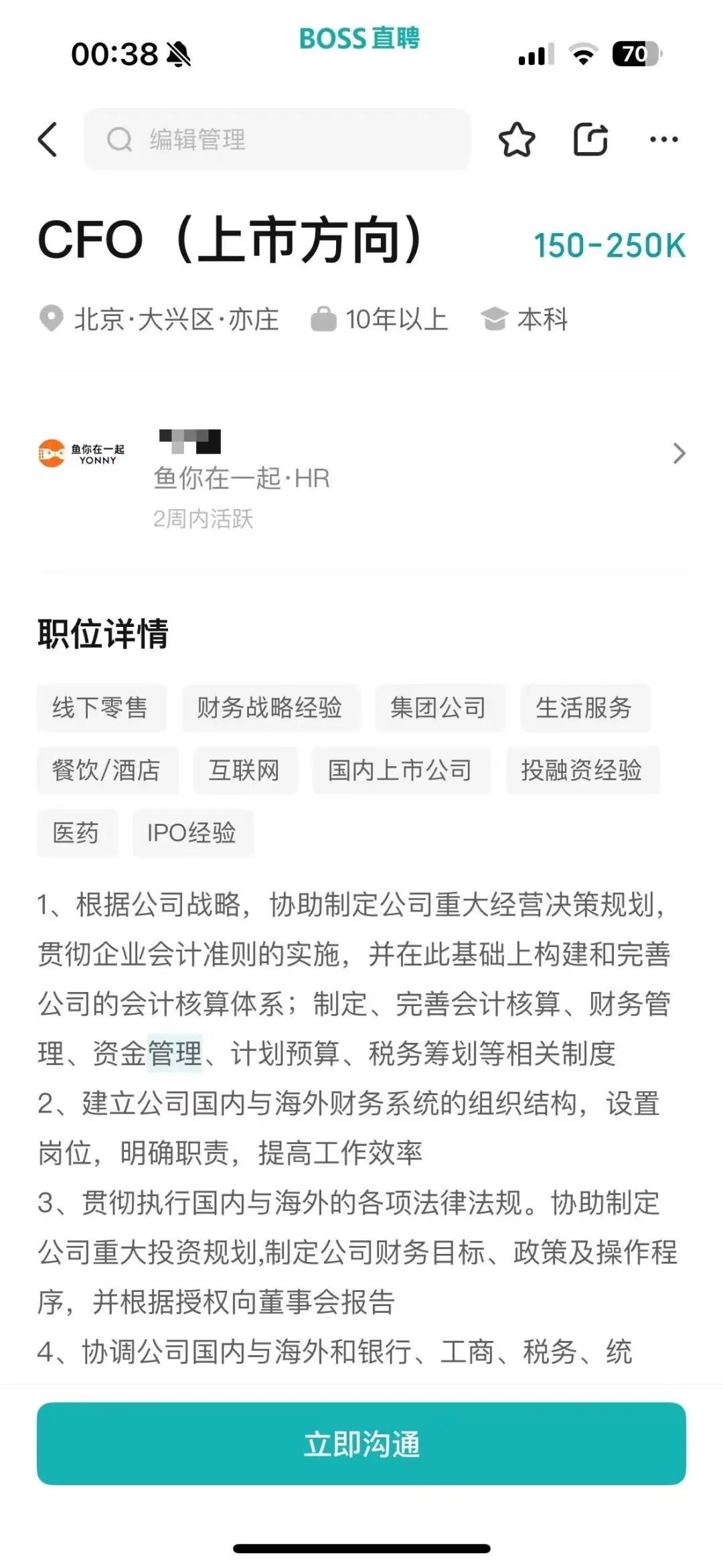
当袁记食品、金星啤酒等消费品牌接连递交上市申请时,中式快餐赛道的资本竞速也悄然升温。 时代周报记者注意到,酸菜鱼快餐品牌"鱼你在一起"正公开招聘CFO(上市方向),月薪为15万~25万元,以此计算,年薪在180万~300万元之间。 与部分港股上市的内地中式餐饮企业相比,这一价码并不低。以2024年计算,太二酸菜鱼母公司九毛九(09922.HK)、绿茶集团(06831.HK)和遇见小 面(02408.HK)的首席财务官/财务总监薪酬(不计算持股市值)在百万元上下,而海底捞(06862.HK)财务总监李朋同期年薪(不计算持股市值)高达 478.2万元。 同时,汪洪栋表示,快餐是刚需赛道,市场空间比较大,适配外卖需求,加盟投入低,开店模式灵活等,这是鱼你在一起快速扩张的主要原因。 有信息显示,鱼你在一起的加盟费用(不计转让费)50万元左右,汪洪栋预估,加盟太二或需百万元左右的投入。 2019年,鱼你在一起门店规模超1000家,顺利被明星餐饮赛道投资机构注意到了。 △图源:"鱼你在一起"公众号 "很明显公司要冲上市去了。"有业内人士向记者表示。但在港股餐饮企业整体估值承压、上市节奏放缓的背景下,300万元年薪背后,一 ...
国证国际港股晨报-20260121
国投证券国际· 2026-01-21 07:08
港股晨报 2026 年 1 月 21 日 国投证券(香港)有限公司 • 研究部 1. 国投证券国际视点:特朗普关税威胁升级,美欧关系进 入敏感期,黄金白银价格创新高 昨日,港股三大指数持续下探。截至收盘,恒生指数跌 0.29%,国企指数跌 0.43%, 恒生科技指数跌 1.16%。大市成交金额 2,377.66 亿元,主板总卖空金额 329.52 亿元,占可卖空股票总成交额比率为 15.68%。南向资金北水方面,港股通交易 净流入 36.63 亿港元。港股通 10 大成交活跃股中,北水净买入最多的是腾讯 700.HK、美团 3690.HK、小米集团 1810.HK;净卖出最多的是中芯国际 981.HK、 中国移动 941.HK、中海油 883.HK。 板块方面,大消费板块飘红。其中,沪上阿姨 2589.HK 涨 9.87%,中烟香港 6055.HK 涨 6.04%,中国波顿 3318.HK 涨 4.71%,蜜雪集团 2097.HK 涨 3.64%, 中国南方航空 1055.HK 涨 4.57%,中国国航 753.HK 涨 3.91%,中国东方航空 670.HK 涨 3.68%,华润啤酒 291.HK 涨 3. ...
未知机构:20260120仍持续看好万辰集团鸣鸣很忙上市有催化折扣零售-20260121
未知机构· 2026-01-21 02:15
Summary of Conference Call Notes Industry Overview - The retail sector in China is currently in the early stages of transformation, highlighting significant investment opportunities in discount retail [1] - The discount retail segment is emphasized as a key area for investment, with Wanchen Group identified as a leading player in this space [1] Company Insights - Wanchen Group is recognized as the purest representative of discount retail, suggesting strong potential for growth and investment [1] - The anticipated IPO of Mingming Henbang is expected to validate and enhance the valuation of the discount retail sector, potentially initiating a new trend of opportunities [1] Competitive Landscape - The milk tea market is characterized by strong cost-performance dynamics, with competitive advantages likely to expand [1] - For instance, Mixue Ice City is leveraging a rural-to-urban channel strategy, which has allowed it to penetrate markets despite initial supply chain disadvantages [1] - Currently, Mixue Ice City operates over 50,000 stores, which provides a robust supply chain advantage that is facilitating its increasing market penetration in first-tier cities [1] Investment Recommendations - The supply chain competitive advantages associated with cost-effective business models are expected to continue to proliferate [1] - It is recommended to focus on investment opportunities in companies like Mixue Group, which are well-positioned in the evolving market landscape [1]
A股调整,三大原因
Zhong Guo Zheng Quan Bao· 2026-01-20 05:05
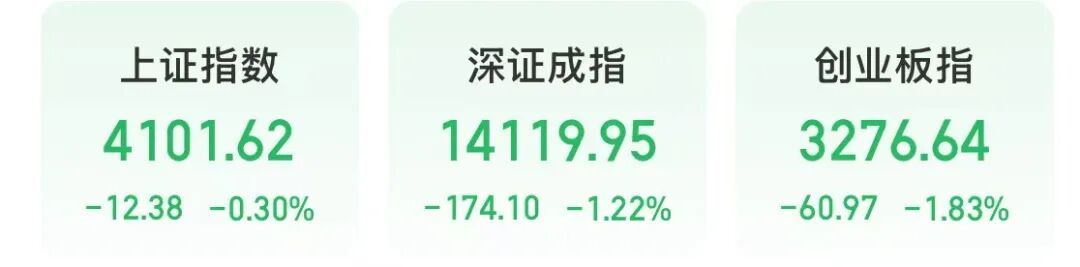
Market Overview - The Shanghai Composite Index experienced significant volatility, dropping below 4100 points and reaching a maximum decline of over 0.8% before recovering slightly [1] - The technology sector faced a pullback, particularly in the computing industry chain, while consumer sectors, high-dividend assets, and chemicals saw gains [1] Market Influences - The U.S. stock market was closed on Martin Luther King Jr. Day, leading to concerns about its performance upon reopening, which negatively impacted the Asia-Pacific markets [1] - A report indicated that U.S. President Trump announced a 10% tariff on imports from Denmark, Norway, Sweden, France, Germany, the UK, the Netherlands, and Finland starting February 1 [1] - Market liquidity has changed, with a rapid decline in trading volume since January 15 and a decrease in margin financing balance, which reported 2.7059 trillion yuan as of January 19, down 8.5 billion yuan from the previous day [1] Consumer Sector Activity - The consumer sector showed strong performance, with significant gains in beauty care, food processing, and liquor sectors. Notably, stocks of "new consumption" companies like Pop Mart, Mixue Group, and Laopu Gold rose collectively [4] - Analysts attribute the strength in the consumer sector to several factors, including Pop Mart's announcement of a share buyback worth approximately 251 million Hong Kong dollars, which positively influenced market sentiment [6] Policy Support - Recent government policies aimed at boosting consumption were highlighted, including a meeting on January 16 that discussed measures to enhance service consumption and domestic demand [7] - The National Development and Reform Commission emphasized the need to strengthen domestic demand and adapt to the evolving demand structure, with plans to develop a strategy for expanding domestic demand from 2026 to 2030 [7] AI Sector Developments - The AI for Science concept saw active performance, with leading stocks like Zhite New Materials rising over 17%. Other AI application stocks also experienced significant gains [8] - Analysts noted that advancements in model capabilities and cost reductions are accelerating the commercialization of AI applications, suggesting a growing competitive landscape among major AI model providers [8]
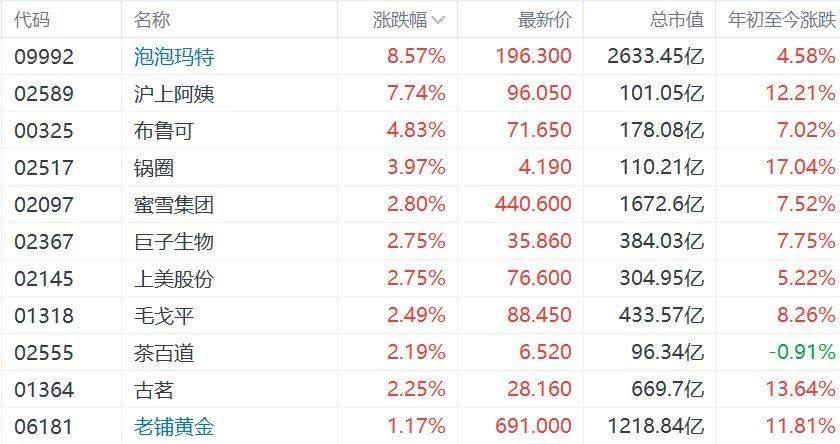
港股新消费概念集体走强,泡泡玛特涨超8%,沪上阿姨涨超7%,布鲁可涨超4%,锅圈涨近4%,蜜雪集团、古茗涨2%
Ge Long Hui· 2026-01-20 03:11
Core Viewpoint - Pop Mart has conducted its first share buyback in nearly two years, leading to a significant increase in its stock price and positively impacting the Hong Kong market for new consumer stocks [1] Group 1: Company Performance - Pop Mart's stock price rose over 8%, leading the market, while other companies like Hu Shang Ayi and Blok also saw increases of over 7% and 4% respectively [1] - The company repurchased 1.4 million shares at prices ranging from HKD 177.7 to HKD 181.2, totaling over HKD 250 million, marking its first buyback in nearly two years [2] - Morgan Stanley noted that the buyback is expected to attract more investors, particularly those looking for stock price catalysts, and highlighted Pop Mart's strong growth and clear driving factors [3] Group 2: Financial Outlook - Morgan Stanley projects that Pop Mart's net profit will reach RMB 12.6 billion by 2025, supported by a net cash position of RMB 20 billion at the end of last year, indicating ample financial resources for shareholder returns [3] - The collaboration with Honor to launch the "trendy toy phone" and the release of the Honor 500 Pro Molly 20th Anniversary Limited Edition at a price of RMB 4,499, with a promotional price of RMB 3,999, is expected to further enhance brand visibility and sales [2]

泡泡玛特,大涨超8%
Shang Hai Zheng Quan Bao· 2026-01-20 02:58
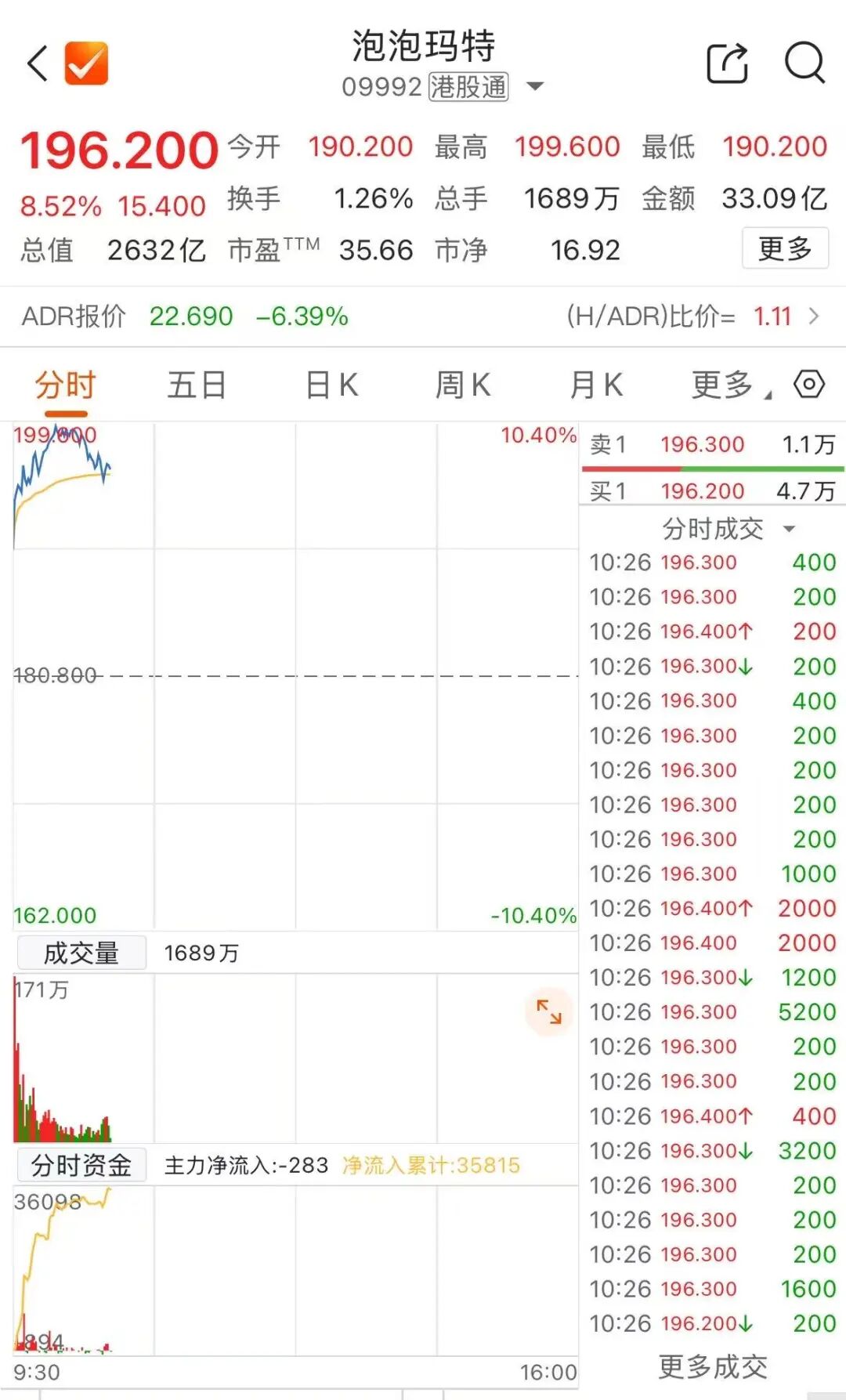
Group 1 - The Hong Kong stock market saw a strong performance in new consumer stocks on January 20, with notable gains for several companies [1] - Pop Mart experienced a significant increase, rising over 8% during the trading session [1] - Other companies such as China Duty Free Group (H shares) and Blukoo also saw gains of nearly 5% and over 5% respectively [1] Group 2 - Pop Mart's stock opened at 196.200, reaching a high of 199.600 and a low of 190.200, with a total trading volume of 16.89 million shares [2] - The market capitalization of Pop Mart is reported at 263.2 billion, with a price-to-earnings ratio of 35.66 and a price-to-book ratio of 16.92 [2] - The stock's performance indicates a net inflow of capital, with a cumulative net inflow of 35,815 [2]