银行

Search documents
美联储报告:政策不确定性成头号金融稳定风险,央行独立性首次被点名,关注金融杠杆
Sou Hu Cai Jing· 2025-11-07 23:01
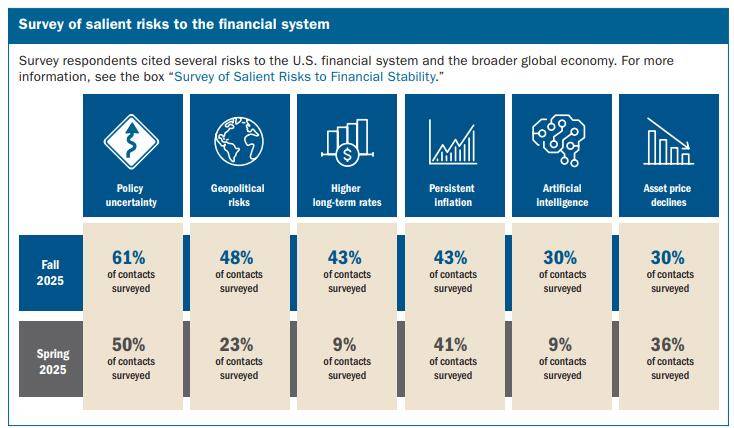
Core Viewpoint - The Federal Reserve's Financial Stability Report highlights policy uncertainty as the primary risk facing the U.S. financial system, with concerns shifting from specific trade policies to broader uncertainties, including central bank independence and the availability of economic data [1][2][3] Group 1: Policy Uncertainty - Over 61% of surveyed market participants identified policy uncertainty as the top financial stability risk, up from 50% in the spring survey [3] - The report marks the first time central bank independence has been explicitly mentioned as a risk factor, reflecting recent political pressures on the Fed [1][3] - Geopolitical risks have also gained attention, with 48% of respondents highlighting this concern, a significant increase from 23% in the previous survey [3] Group 2: Interest Rate Concerns - Concerns about rising long-term interest rates have increased, with 43% of respondents mentioning this risk, compared to just 9% in the spring survey [4] - Higher long-term rates could lead to unrealized losses for banks and impact fixed-income investors [4] Group 3: AI-Related Risks - The perception of AI-related asset valuation risks has risen sharply, with 30% of respondents viewing it as a potential shock in the next 12 to 18 months, up from 9% previously [4] Group 4: Leverage in Financial Institutions - The report emphasizes high leverage levels in non-bank financial institutions, particularly hedge funds, which have reached their highest levels since tracking began over a decade ago [7] - Hedge funds' leverage has steadily increased across various strategies, raising concerns about systemic risk [7] - Life insurance companies also exhibit high leverage, although their use of non-traditional liabilities remains limited [7] Group 5: Asset Valuation - Asset valuations are noted to be high, with stock price-to-earnings ratios nearing historical highs and corporate bond yield spreads at low levels compared to long-term averages [9] - The real estate market shows signs of vulnerability, particularly with upcoming refinancing needs in commercial real estate [9] Group 6: Debt Levels - Corporate and household debt vulnerabilities are assessed as moderate, with total debt as a percentage of GDP declining to a two-decade low [11] - While overall debt levels are manageable, certain consumer groups face repayment pressures, particularly in credit card and auto loans [11] Group 7: Financing Risks - Financing risks remain moderate, with government money market funds driving asset growth [12] - The commercial real estate market is showing signs of stabilization, but significant debt maturities in the coming year could increase volatility [12]

应对金价波动 强化风险防控——多家银行上调积存金门槛
Jing Ji Ri Bao· 2025-11-07 22:20
Core Viewpoint - Several banks have raised the minimum investment threshold for gold accumulation business, increasing it to a range of 950 to 1200 yuan, which is an increase of 300 to 550 yuan compared to the beginning of this year [1][2]. Group 1: Market Dynamics - The gold accumulation business allows financial institutions to open gold accounts for clients, recording the weight of gold deposited over a certain period, functioning similarly to "installment buying of gold" [1]. - The core reason for banks adjusting the gold accumulation business threshold is the significant increase in gold price volatility and investment risk, with international gold prices rising nearly 60% this year and reaching historical highs [1][2]. - On October 28, international gold prices dropped below 3900 USD per ounce after approaching 4400 USD per ounce, indicating recent fluctuations and high-level oscillations [1]. Group 2: Regulatory and Operational Considerations - The adjustment aligns with regulatory requirements, as the "Interim Measures for the Management of Gold Accumulation Business" mandates that financial institutions protect investor rights and adequately inform them of risks [2]. - Internal operational considerations and risk prevention are also driving the dynamic adjustments, aimed at reducing operational risks associated with severe price fluctuations [2]. - Increasing the threshold helps filter investors with stronger risk tolerance, thereby mitigating liquidity pressure caused by irrational redemptions during market volatility [2].
大约20家银行排队,为新墨西哥州与甲骨文相关的数据中心提供180亿美元贷款
Hua Er Jie Jian Wen· 2025-11-07 19:09
Core Insights - Approximately 20 banks are lined up to provide $18 billion in loans for data centers related to Oracle in New Mexico [1] Group 1 - The financing involves a significant amount of $18 billion, indicating strong interest and confidence from the banking sector in the data center project [1] - The involvement of around 20 banks suggests a collaborative effort and shared risk among financial institutions [1]

十月以来不良资产转让超百亿,银行加速风险出清,关注板块投资机会
Mei Ri Jing Ji Xin Wen· 2025-11-06 07:04
Core Insights - Nearly 90 banks have announced non-performing loan (NPL) transfers since October, involving amounts exceeding 100 billion yuan [1] - Banks are transferring non-performing assets to reduce NPL balances and free up capital tied to inefficient assets, creating a "risk clearance-capital circulation" mechanism [1] - The concentrated efforts of domestic banks in NPL transfers are expected to enhance bank stock valuations further this year, with investment opportunities available through index investment tools like bank ETFs (515020) [1] Summary by Categories - **NPL Transfers** - Approximately 90 banks, including state-owned, joint-stock, and city commercial banks, have issued announcements regarding NPL transfers since October [1] - The total amount involved in these transfers exceeds 100 billion yuan [1] - **Capital Management** - The transfer of non-performing assets allows banks to lower their NPL balances and release capital that has been tied up in low-efficiency assets [1] - This strategy not only clears low liquidity assets but also creates space for new credit issuance in the coming year [1] - **Market Outlook** - The ongoing NPL transfer initiatives by domestic banks are likely to lead to an increase in bank stock valuations for the year [1] - Investors looking to enter the banking sector may consider using index investment tools such as bank ETFs (515020) [1]
“存款活化”大潮开启,银行负债端迎来松绑,布局正当时
Mei Ri Jing Ji Xin Wen· 2025-11-06 02:52
Core Viewpoint - The upcoming third quarter of 2025 marks a significant window for the maturity of high-interest deposits, leading many clients to shift their matured funds into higher-yielding wealth management products, which will increase the total market scale of wealth management to 32.13 trillion yuan, a year-on-year increase of 9.42% [1] Group 1: Market Dynamics - The maturity repricing of deposits will positively impact banks' cost structures, directly lowering liability costs and alleviating the pressure from narrowing net interest margins [1] - With the recovery of the capital market, there is an increased willingness among residents to invest their demand deposits into stocks and funds [1] Group 2: Future Projections - According to CITIC Securities, from 2025 to 2026, the repricing of high-interest deposits combined with "deposit activation" is expected to accelerate the decline in existing deposit rates [1] - CITIC Securities estimates that just considering the repricing of time deposits, banks could see a downward adjustment of approximately 30 basis points in liability costs each year [1] Group 3: Investment Opportunities - As banks relieve their liability burdens, their profitability is expected to improve further, suggesting potential investment opportunities in bank ETF funds (515020) and other index investment tools [1] - Market analysts indicate that the current market conditions present an optimal time for strategic investments during dips [1]
持股市值6510亿元!超3000亿元全是这个方向!
Mei Ri Jing Ji Xin Wen· 2025-11-04 06:02
Group 1 - The core viewpoint of the article highlights the significant presence of insurance capital in the A-share market, particularly in the banking sector, as of the end of Q3 2025 [1] - As of the end of Q3 2025, insurance capital appeared in the top ten circulating shareholders of 633 A-shares, with a total holding of 688 billion shares valued at 651 billion yuan [1] - The banking sector leads in insurance capital allocation, with a total investment of 316.52 billion yuan, followed by public utilities and transportation sectors with 41.43 billion yuan and 38.16 billion yuan respectively [1] Group 2 - In a low-interest-rate environment, insurance capital has increased its allocation to bank stocks, indicating a long-term preference for high-dividend and undervalued assets [1] - The bank ETF fund (515020) tracks the CSI Bank Index, which includes 42 constituent stocks, comprising major state-owned banks as well as joint-stock and rural commercial banks [1] - As of November 3, the index has a dividend yield of 3.94% over the past 12 months, making it an essential tool for investing in the banking sector [1]
金融法治协同持续增强
Jing Ji Ri Bao· 2025-11-03 22:35
Core Viewpoint - The 2025 Financial Street Forum emphasizes the importance of advancing financial development through legal frameworks, highlighting the need for a robust financial legal system to support the construction of a financial powerhouse [1]. Group 1: Financial Legal System Development - The National People's Congress (NPC) is prioritizing financial legislation, including the formulation of a Financial Stability Law and amendments to the Banking Supervision Law [1]. - There is a call for enhanced research on foreign-related legal issues in finance to safeguard national financial security and promote high-level opening-up [1]. Group 2: Securities Dispute Resolution - The Beijing Financial Court has accepted 10,942 securities commercial cases from March 2021 to August 2025, with securities disputes accounting for 44.47% of its civil and commercial case filings [2]. - The court has handled 1,080 foreign-related cases involving 38 countries and regions, with securities misrepresentation and financial contract disputes being the most common types [2]. Group 3: Investor Protection and Fund Management - The rapid evolution of the private equity fund industry has led to challenges in governance and liquidation, prompting the China Securities Investment Fund Industry Association and the Beijing Financial Court to issue guidelines to protect investor rights [2]. - The court has introduced a dual-track dispute resolution mechanism to lower investor protection costs, including representative litigation and demonstration judgment mechanisms [3]. Group 4: Judicial Support for Capital Markets - Recent court rulings have clarified the legitimacy of investor representation in litigation when fund managers are unresponsive, addressing the "no one to perform duties" dilemma [3]. - The Beijing Financial Court has implemented innovative methods for loss calculation and has released guidelines to combat securities violations, clarifying responsibilities and regulating trading behaviors [3].
银行投资的周期及边际变化
雪球· 2025-11-03 08:26
Core Viewpoint - The article discusses the relationship between banking metrics such as asset yield, liability cost, growth rate, asset quality, and valuation changes with the economic development cycle, predicting an L-shaped economic growth trend in the future [2]. Banking Metrics - The overall loan interest rates are stabilizing, with potential for slight decreases, but retail and competitive corporate loan demand remains weak, leading to significant competitive pressure [2]. - The current high reserve requirement ratio allows for substantial room for reduction, which could improve deposit supply-demand relationships and lower banks' funding costs [2]. Interest Rate Dynamics - Deposit rates have considerable room to decline compared to loan rates, with the repricing of loans occurring within a year while deposits take about two years [3]. - Banks with a higher proportion of demand deposits previously enjoyed a significant advantage, but this advantage is now priced in, and banks with more time deposits may have a marginal optimization advantage in future rate cuts [3]. Loan Demand and Quality - Retail loans and competitive corporate loans are under pressure in terms of volume, price, and asset quality, while government-backed projects remain relatively stable [3]. - Regional banks with monopolistic advantages have maintained high loan growth rates during previous rate cuts, but this growth has been offset by reduced interest margins [3]. Economic Cycles and Bank Risks - In periods of economic overheating, competition among businesses can lead to instability, increasing the risk of non-performing loans for banks [4]. - Conversely, during economic downturns, competition stabilizes, making bank loans relatively safer even if businesses incur losses [4]. Investment Risks - Traditional industries may not pose significant risks to banks due to shareholder equity acting as a buffer, while technology companies present a mismatch between risk and return for banks [5]. - The average return on capital is decreasing due to limited profits relative to growing capital, leading to higher asset valuations without a corresponding increase in profitability [6]. Bond Investments - Banks' profits and assets are significantly influenced by bond market fluctuations, especially during a rate-cutting cycle where loan yields and net interest margins decline [7]. - The appreciation of bonds during a rate-cutting cycle has historically provided substantial returns, but as this appreciation diminishes, banks may face reduced profits and growth rates [8]. Future Outlook - Banks with high bond investment ratios may face comparative disadvantages as the benefits of holding long-duration bonds diminish [9]. - The recognition of bond investment gains in current profits versus future interest income can vary significantly among banks, affecting their operational strategies [10].

金价攀升引热议:金店高价背后的逻辑与消费者之问
Sou Hu Cai Jing· 2025-11-03 05:11
Core Insights - The recent surge in gold prices has led to significant discrepancies in pricing across different sales channels, with online gold prices reaching 919.7 yuan per gram, while a well-known jewelry store quotes as high as 1198 yuan per gram, and a bank offers a more competitive price of 934 yuan per gram [1][2] Pricing Discrepancies - The jewelry store justifies its higher prices by citing factors such as a time lag in price adjustments relative to market demand, processing costs associated with crafting fine jewelry, and the impact of inventory holding costs on pricing [1] - Despite these explanations, consumers express skepticism regarding the fairness and transparency of such pricing strategies, questioning whether they should accept inflated prices based on these reasons [1] Consumer Rights and Market Dynamics - Consumers, as key market players, have the right to question high pricing strategies and to choose alternatives, highlighting the importance of a fair and transparent market environment [2] - The reluctance of the jewelry store to lower prices raises questions about underlying business logic and market considerations, suggesting a need for greater alignment with consumer interests [2] - The expectation for a competitive market where consumers receive value for their money emphasizes the necessity for businesses to adopt pricing strategies that prioritize consumer trust and satisfaction [2]

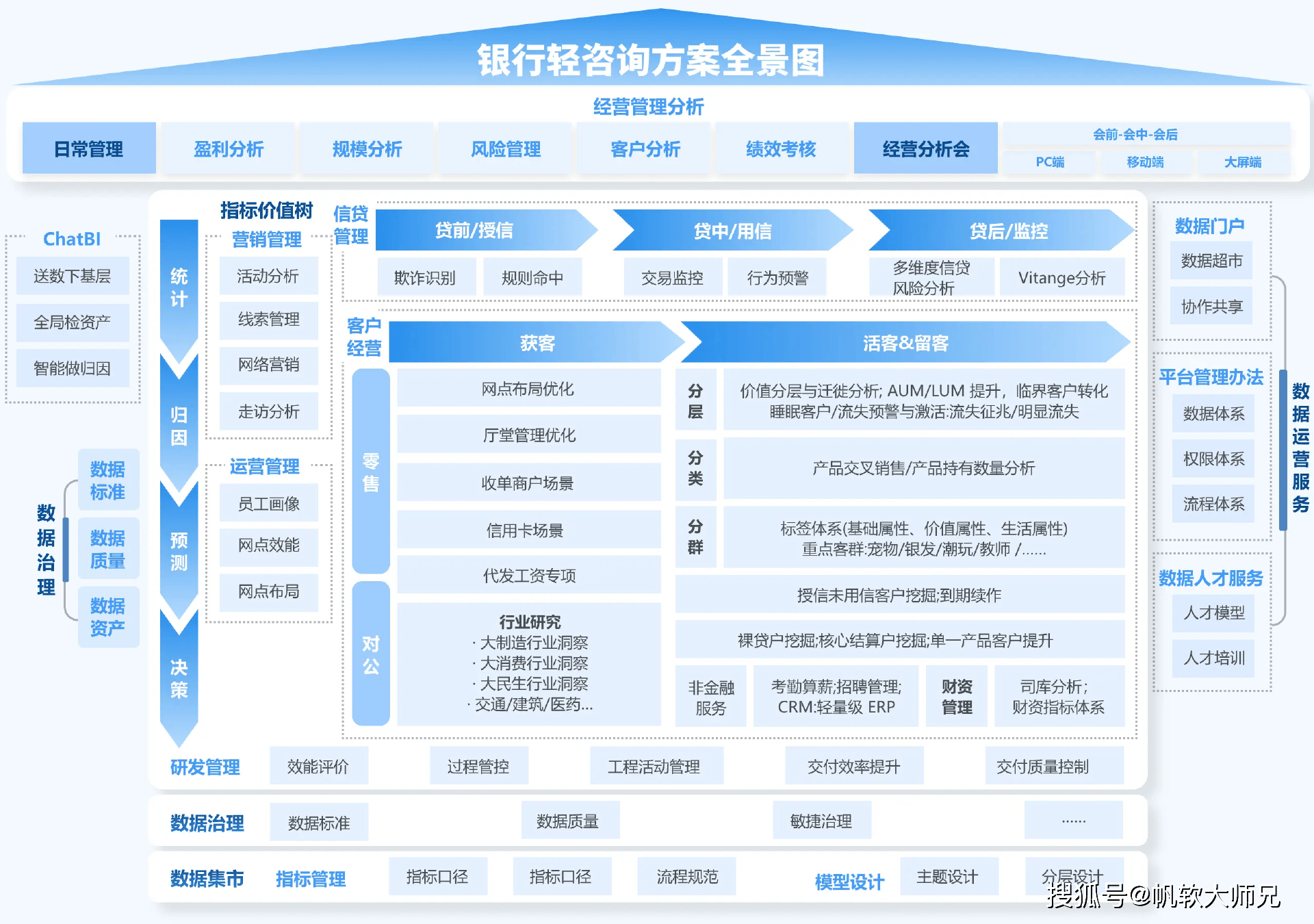
经营分析,就是要把这5大模块做好
Sou Hu Cai Jing· 2025-11-03 02:52
Core Insights - The article emphasizes the importance of integrating financial, business, and organizational data to enhance operational analysis in banks, transforming it from passive reporting to proactive insights [1][4][32] Financial Performance - The bank's operating income reached 1.753 billion, reflecting a year-on-year growth of 16.79%, indicating stable profitability quality [4] - The total liabilities amount to 30.22 billion, showcasing the bank's liability stability [7] Asset and Liability Analysis - The analysis dashboard provides insights into loan structures, including corporate and personal loans, with an average corporate loan balance of 21.956 million [7][10] - The bank's deposit scale is 30.22 billion, with a focus on the stability of liabilities and market financing dependencies [7] Customer Insights - The analysis identifies high-contribution customers and optimizes resource allocation, enhancing the bank's overall operational efficiency [13] - The economic value added (EVA) of customers is assessed, revealing potential for profit contribution and areas for optimization [11] Risk Management - The article discusses the importance of tracking overdue loans and identifying periods of increased risk, which aids in dynamic risk provisioning [16][17] - Customer demographic analysis helps in recognizing core value segments and potential high-risk groups, facilitating targeted risk management strategies [21] Operational Efficiency - The bank's internal operations are analyzed to optimize branch resource allocation and improve service quality [22][27] - Time-based analysis reveals seasonal trends and peak business hours, allowing for better staffing and resource management [28] Strategic Decision-Making - The integration of customer structure and operational data enables precise service delivery and marketing strategies tailored to different demographic groups [31] - A data-driven operational analysis system is essential for strategic decision-making and refined management practices in the banking sector [32]