华润啤酒

Search documents
儋州工业园:打造对接大湾区的“科创门户”
Hai Nan Ri Bao· 2025-08-08 01:16
Core Points - The Danzhou Industrial Park has successfully launched the first domestically produced computer equipped with Huawei's Kunpeng processor, marking a significant milestone in the collaboration between Shenzhen and Danzhou [1] - The production line has an annual capacity of 80,000 units, including domestic terminal computers and servers, showcasing a strong partnership between Donghua Software Co., Ltd. and Huawei Technologies Co., Ltd. [1] - The Danzhou Industrial Park is evolving into a model for integrating technological innovation and industrial development, driven by the collaboration with Shenzhen [1][2] Group 1 - The Danzhou Industrial Park was previously underdeveloped, with only 27 companies, 18 of which were inactive before 2020, highlighting the transformation since the establishment of a joint venture with Shenzhen Port Group [2] - Since 2020, major Shenzhen enterprises have established operations in Danzhou, including the Donghua Pengxiao Industrial Park project, which focuses on high-tech industries [2][3] - The Danzhou government and Shenzhen enterprises have created a comprehensive cooperation system involving government agencies, industry associations, state-owned platforms, think tanks, and businesses [2] Group 2 - The second Hainan (Danzhou) Agricultural Products Supply and Marketing Conference facilitated a signing amount of 2.36 billion yuan, enhancing the export channels for Danzhou's agricultural products [3] - The Danzhou Industrial Park has attracted new investments, such as a 500 million yuan international food industry park project by Guoquan Group, which aims to leverage the region's port advantages and favorable policies [4][5] - The Danzhou Industrial Park is implementing a one-stop service model to streamline business operations, significantly reducing the barriers for new enterprises [5] Group 3 - The Danzhou Science and Technology Innovation Center project is under construction, utilizing advanced technologies like 3D modeling and BIM to enhance project management [6] - This center aims to integrate Shenzhen's innovative resources and focus on sectors such as digital economy, food processing, biotechnology, and new materials [6][7] - The center will serve as a hub for technology exchange between Danzhou and Shenzhen, providing differentiated services for startups at various development stages [7]

啤酒竞争格局演变及推演
2025-08-07 15:03
Summary of Key Points from the Conference Call Industry Overview - The conference call focuses on the Chinese beer industry, highlighting the competitive landscape and key players such as Yanjing Beer and Budweiser APAC [1][5][10]. Core Insights and Arguments - **Yanjing Beer**: - Yanjing Beer is recommended due to its nationwide expansion and the significant growth potential of its flagship product U8, with a profit margin that could improve by at least 3-4 percentage points compared to the industry average [1][3][4]. - The company is currently in a catch-up phase regarding supply-side reforms, which began in 2016, and its net profit margin is around 10%, indicating room for improvement [3][9]. - **Budweiser APAC**: - Budweiser APAC faces challenges in the Chinese market, including a decline in market share that has persisted since the second half of last year, with a sales drop of approximately 8% in the first half of this year [5][6]. - The tightening of expense policies post-pandemic has weakened its brand and channel barriers, leading to a significant impact on its sales performance [5]. - **Market Dynamics**: - The decline in Budweiser's market share has benefited domestic brands, particularly in regions like Guangdong (where Zhujiang Beer has gained), Fujian (where China Resources' Heineken has benefited), and Zhejiang [6]. - The overall industry has experienced pressure on ton prices, which are expected to decline throughout the year due to economic conditions and a shift towards lower-end products by breweries [7][8]. Additional Important Insights - **Ton Price Trends**: - The ton price in the Chinese beer industry has not yet peaked, with expectations for continued high-end product development and potential price increases once deflation ends [8][9]. - The current ton price is projected to improve from a base of 3,300 RMB, showing resilience even during economic downturns [8]. - **Supply-Side Reform Impact**: - Supply-side reforms initiated in 2016 have led to varying net profit margins across brands, with most brands achieving margins above 13%, while Yanjing's slower reform process has kept it at around 10% [9]. - **Future Outlook**: - The next one to two years will focus on market share dynamics, with Yanjing Beer, Qingdao Beer, and Chongqing Beer being key players to watch for potential organizational innovations [3][10]. - The restaurant sector has seen limited impact from recent policy adjustments, with non-dining channels maintaining positive growth [11]. - **Investment Timing**: - The best time for investment is suggested to be after August, following the release of mid-year reports, as traditional consumer sectors are expected to undergo revaluation and performance outlook improvements [12].

华润啤酒(00291) - 董事会会议召开日期
2025-08-07 09:11
香港交易及結算所有限公司及香港聯合交易所有限公司對本公告的內容概不負責,對其 準確性或完整性亦不發表任何聲明,並明確表示,概不對因本公告全部或任何部分內容 而產生或因倚賴該等內容而引致的任何損失承擔任何責任。 梁偉強 (於香港註冊成立的有限公司) (股份代號:291(港幣櫃台)及80291(人民幣櫃台)) 董事會會議召開日期 茲通告華潤啤酒(控股)有限公司(「本公司」)將於二零二五年八月十九日(星期二)於香 港灣仔港灣道二十六號華潤大廈23樓2301&2310室舉行董事會會議,以(其中包括)考慮 及通過(如適用)本公司及其附屬公司截至二零二五年六月三十日止六個月之中期業績及 其發佈,以及考慮及通過(如適用)宣派中期股息。 華潤啤酒(控股)有限公司 公司秘書 謹啟 香港,二零二五年八月七日 於本公告日期,本公司執行董事為趙春武先生(總裁)及趙偉先生(首席財務官)。本公司 非執行董事為 Daniel Robinson 先生、郭巍女士及王成偉先生。本公司獨立非執行董事則 為黃大寧先生、李家祥博士、賴顯榮先生及陳智思先生。 ...
悦己消费、性价比消费或延续增长趋势,聚焦港股消费ETF(513230)布局机会
Mei Ri Jing Ji Xin Wen· 2025-08-07 06:46
8月7日周四,港股三大指数上午探底回升,恒生指数午间收涨0.52%,重回25000点上方,国企指数、 恒生科技指数分别上涨0.36%及0.54%。今日,港股多数飘红,港股消费ETF(513230)现小幅微涨。持 仓股中,金沙中国有限公司领涨超5%,名创优品、周大福、银河娱乐、华润啤酒、老铺黄金等均涨超 3%。 国泰海通证券认为,6月中旬以来港股新消费震荡休整,处在热度消化的阶段。这背后原因主要是上半 年港股新消费板块大幅上涨,6月下旬时从交易和估值等维度看热度较高,部分投资者对新消费板块行 情持续性的担忧逐渐显现,此后逐渐步入消化热度的休整阶段。尽管当前港股新消费部分领域短期略显 过热,但居民消费更加注重个性化和理性化的宏观趋势并未改变,预计悦己和性价比相关消费或延续增 长趋势,如潮玩、美护、宠物等。 港股消费ETF(513230)跟踪中证港股通消费主题指数,一键打包互联网电商龙头+新消费,成分股近 乎囊括港股消费的各个领域,既包括泡泡玛特、老铺黄金、蜜雪集团等新消费龙头,又包含小米、阿里 巴巴、腾讯、美团等互联网电商龙头,科技+消费属性突出。 ...


百威亚太中国“寒意”弥漫:上半年净利锐降24.4%
Jing Ji Guan Cha Bao· 2025-08-07 05:12
Group 1 - The core viewpoint of the news is that Budweiser APAC is facing significant challenges in the Chinese market, with a notable decline in sales and revenue, indicating a deeper crisis in its operations in China [1][2] - In the first half of 2025, Budweiser APAC reported a total sales volume decrease of 6.1% to 4.363 billion liters and a revenue decline of 5.6% to $3.136 billion, with net profit plummeting by 24.4% to $409 million [1] - The company’s performance in China is particularly concerning, with sales down 8.2% and revenue down 9.5%, highlighting the struggles of this foreign beer giant in the Chinese market [1] Group 2 - The recent leadership change, with Cheng Yanjun becoming the first Chinese CEO, has not yet yielded positive results, as the second quarter of 2025 still showed a 7.4% decline in sales and a 6.4% drop in revenue in the China region [1] - The financial report identifies key issues such as "imbalanced regional layout" and "weakness in on-premise channels," with traditional strong markets like Guangdong and Fujian facing significant contraction in high-end consumption scenarios [1] - The company is also challenged by domestic brands like China Resources Beer and Tsingtao Brewery, which are rapidly advancing in the high-end market, directly impacting Budweiser APAC's market share [2] Group 3 - The Chinese beer industry is undergoing a dual transformation towards premiumization and a shift in consumption scenarios, which poses a critical challenge for Budweiser APAC [2] - The future growth of Budweiser APAC will depend on its ability to optimize channels, innovate products, and effectively manage its leadership changes to regain market dominance [2]

平安证券(香港)港股晨报-20250807
Ping An Securities Hongkong· 2025-08-07 02:29
Core Insights - The report highlights the current advantages of the Hong Kong stock market, including low valuations and increasing trading activity under the "profit-making effect," maintaining a relatively optimistic medium to long-term outlook [4] - In July, both A-shares and Hong Kong stocks recorded different gains ranging from 2% to 5%, with the healthcare sector performing the best, as evidenced by the 23% increase in the Wind Hang Seng Medical Health Index [4] - The report suggests continued focus on sectors such as artificial intelligence, robotics, semiconductors, and industrial software, as well as new consumption sectors supported by policy initiatives [4] Market Review - The Hang Seng Index closed at 23,831 points, down 145 points or 0.61%, while the Hang Seng Tech Index rose by 0.2% [2] - The market turnover decreased to 82.799 billion, with net inflows recorded in the Hong Kong Stock Connect totaling 484 million, indicating continued interest from mainland investors [2] - New consumption stocks showed a collective rebound, with notable increases in companies like Pop Mart (9992HK) and Lao Pu Gold (6181HK) [2] Company Performance - The report mentions that the company ZTE Corporation (0763HK) is a leading global telecommunications manufacturer, with a projected revenue of 121.299 billion in 2024, a slight decrease of 2.38% year-on-year [10] - Despite a small decline in revenue and net profit, ZTE maintains a high overall gross margin of 37.91% [10] - The company has shown significant growth in its government enterprise and consumer business segments, particularly in the computing power sector [10] Industry Insights - The report emphasizes the ongoing innovation and positive developments in the pharmaceutical sector, suggesting a focus on leading companies like Fosun Pharma (2196HK) and Shanghai Pharma (1093HK) [9] - The report also notes the impact of recent regulatory measures aimed at promoting the high-quality development of commercial health insurance, which could benefit the biopharmaceutical industry [9]
啤酒:渠道变革,精酿崛起
2025-08-06 14:45
Summary of Key Points from the Conference Call on the Beer Industry Industry Overview - The Chinese beer market has entered a mature phase, with a gradual decline in per capita penetration rates and a decrease in the primary drinking population, posing challenges for total growth [1][5] - The high-end beer segment's growth has slowed due to economic cycles and policy impacts, but long-term economic recovery may drive structural upgrades in high-end consumption [1][5] Core Trends and Insights - The rise of craft beer and new retail channels are identified as key development trends starting from 2024, providing growth opportunities for both large and regional breweries [2][3] - New retail channels have accelerated channel equality, allowing mid-tier brands to utilize OEM to manage production capacity, while major brands like Heineken, Budweiser, and Tsingtao still dominate sales in these channels [2][4] - The new generation of consumers (post-90s and post-00s) emphasizes value for money and emotional value, driving demand for product innovation rather than solely focusing on high-end branding [3][6] Craft Beer Market Dynamics - The craft beer market in China is growing rapidly, with a penetration rate still lower than that of mature markets, indicating significant future growth potential [1][9] - As of 2024, craft beer sales in China are projected to increase from 40,000 tons in 2021 to 390,000 tons, with a penetration rate of approximately 1% [9] - Major players in the craft beer market include large industrial breweries, regional breweries, imported brands, and private label brands [9] Challenges Facing the Beer Industry - The industry faces challenges such as declining sales volume, a shrinking primary drinking population, and a slowdown in the high-end segment due to economic conditions and regulatory impacts [5][6] - The current market environment requires innovation in product categories and channels to find new growth opportunities [6][7] Future Directions - The focus on product innovation and the shift in drinking culture from social enjoyment to personal satisfaction will shape future strategies for breweries [6][7] - The craft beer segment is expected to thrive, with large brands leveraging their scale and brand strength to capture growth opportunities [3][12] Impact of New Retail Channels - New retail channels are reshaping the competitive landscape by increasing the share of non-traditional sales channels, but they primarily optimize existing sales methods rather than creating new consumer segments [13][14] - The sales performance of major brands in new retail channels indicates that consumer preferences still lean towards established high-end brands [14][15] Conclusion - The beer industry in China is at a crossroads, with significant opportunities in craft beer and new retail channels, but also facing challenges from market saturation and changing consumer preferences. The ability of both large and small breweries to adapt to these changes will be crucial for future success [1][12][17]
「雪糕刺客」走了,2元「汽水鼻祖」杀回市场,被年轻人买爆了
36氪· 2025-08-06 09:50
Core Viewpoint - The article discusses the challenges and opportunities faced by the traditional "salt soda" beverage industry in China, highlighting the need for innovation and market expansion to attract younger consumers and compete with larger beverage brands [2][7][22]. Group 1: Historical Context and Market Position - Salt soda originated in the 1950s as an electrolyte drink for laborers in hot environments, quickly becoming popular among the general public in the Shanghai region [4][5]. - The main brands in the salt soda category include "Yanzhong," "Zhengguanghe," and "Xuefeili," with Yanzhong being the market leader, selling 150 million bottles in Shanghai in 2021 [6][13]. - The sales of salt soda are highly seasonal, peaking during the summer months, and are primarily concentrated in the Yangtze River Delta region [15][19]. Group 2: Challenges Faced by the Industry - Salt soda brands face significant challenges in expanding beyond their traditional markets due to a lack of consumer awareness in other regions [17][18]. - The industry is heavily reliant on offline sales channels, with online sales accounting for less than 20% of total sales for leading brands like Yanzhong [19]. - The competition from major beverage brands and the evolving consumer preferences pose a threat to the traditional salt soda market, which is struggling to adapt [22][25]. Group 3: Opportunities for Growth - There is potential for salt soda brands to expand their market presence by leveraging regional brands that have already established a foothold in other heavy industrial cities [24]. - The low price point of around 2 yuan per bottle and the low-calorie content make salt soda appealing to cost-conscious consumers [25]. - Innovations such as new flavors and smaller packaging sizes are being introduced to attract younger consumers and adapt to current market trends [22][25].

华润啤酒又抛厂,“刀刃向内”是否撬开了高端大门?
Xin Lang Cai Jing· 2025-08-06 07:26
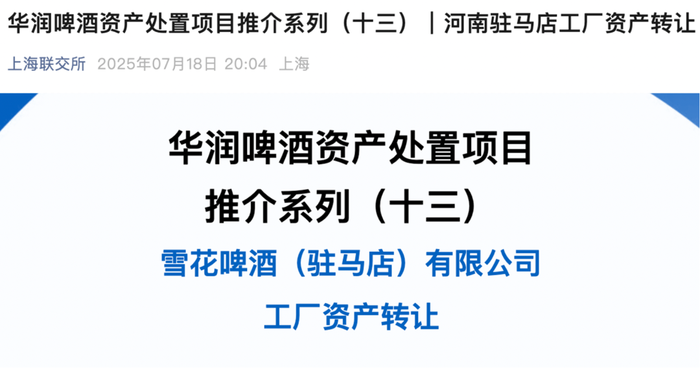
Core Viewpoint - China Resources Beer is actively promoting the disposal of underperforming factories as part of its long-term strategy to optimize production capacity and transition towards high-end products, marking the culmination of its "3+3+3" strategy after nine years of reform [1][10][24]. Group 1: Factory Closures and Capacity Optimization - China Resources Beer has initiated the transfer of assets from three factories, including those in Zhumadian, Shantou, and Dazhou, as part of its ongoing factory closure initiative [1]. - Since 2017, the company has closed 36 breweries, with a goal to reduce the number of operational breweries to around 60 by 2024, stabilizing the count at this level [6][8]. - The company’s production capacity has slightly decreased from 1,910 million liters in 2023 to approximately 1,900 million liters in 2024, reflecting a 0.5% decline [8]. Group 2: Financial Performance and Strategic Goals - From 2016 to 2024, China Resources Beer’s revenue increased from 28.69 billion yuan to 38.64 billion yuan, while net profit surged from 629 million yuan to 4.739 billion yuan, indicating an almost eightfold increase in profit [17]. - The company’s gross margin improved from 33.71% to 42.64% during the same period, showcasing effective cost management and operational efficiency [17]. - Despite the positive long-term outlook, the company reported a decline in both revenue and net profit for the first time since 2017, highlighting the challenges faced during the transition [24]. Group 3: High-End Product Development - In 2024, sales of high-end and above beers grew by 9%, with sales volume exceeding 2.5 million kiloliters, a significant increase from 1.46 million kiloliters in 2020 [19]. - The company’s premium products, such as "Heineken" and "Snow Beer," have shown substantial growth, with "Heineken" maintaining nearly 20% growth in 2023 [19]. - However, the overall sales volume of mid-to-high-end products did not show significant improvement compared to 2023, indicating a potential plateau in this segment [21]. Group 4: Industry Context and Future Outlook - The beer industry in China has been undergoing a transformation, with many companies, including China Resources Beer, closing factories to adapt to changing market demands and focus on high-quality production [13][16]. - The shift from quantity to quality in production reflects a broader trend in the industry, where efficiency and product quality are becoming more critical than sheer production volume [16]. - As the "3+3+3" strategy concludes, the company is expected to continue exploring new consumption scenarios and partnerships to enhance its market presence and adapt to evolving consumer preferences [24].
茅台累计回购股票超53亿;郎酒签约“粤超”;6酒企获MSCI评级
Sou Hu Cai Jing· 2025-08-05 12:11
Group 1 - Kweichow Moutai has repurchased shares totaling 5.301 billion yuan, acquiring 3.4517 million shares, which is 0.2748% of its total share capital, with a maximum purchase price of 1,639.99 yuan per share and a minimum of 1,408.29 yuan per share [2] - Kweichow Moutai is recruiting general distributors for six health liquor products, with annual sales targets set at 30 million yuan for Moutai Chuan and 20 million yuan for other brands [2] - Luzhou Laojiao's annual sales in Zhejiang province have exceeded 2.5 billion yuan, ranking among the top three in the local white liquor market [2] Group 2 - Langjiu has signed a partnership as the official designated liquor for the Guangdong Super League, engaging with 22 teams across 13 cities in Guangdong [3] - The "Soft Elegant Type Liquor" group standard has been approved and will be implemented starting August 24, 2025, aiming to enhance industry competitiveness and consumer protection [4] - The Hubei Economic and Information Technology Department has conducted research on Shennongjia Liquor, focusing on technology, resource integration, and brand development [4] Group 3 - Six liquor companies, including Chongqing Beer and Luzhou Laojiao, have been recognized in the MSCI ESG rating list, with Chongqing Beer listed as a leader [4] - The first Ecological Year Value Summit Forum will be held, focusing on ecological and quality aspects of liquor [4] - The establishment of a postdoctoral research station at Xige Winery aims to enhance talent cultivation and research innovation in the Ningxia wine industry [8] Group 4 - The Longnan Economic Development Zone has announced a health liquor production project with an investment of 180 million yuan, aiming to produce around 6,000 tons of health liquor annually [8] - The project will include a fully automated production line and is expected to generate approximately 720 million yuan in revenue [8] - Shanxi Pangquan Winery is expanding its market presence, emphasizing quality and regional validation in the clear aroma liquor sector [5]