中科曙光

Search documents
中石科技20251207
2025-12-08 00:41
Summary of Zhongshi Technology Conference Call Company Overview - **Company**: Zhongshi Technology - **Acquisition**: Acquired 51% of Dongguan Xunlong to enhance liquid cooling market presence [2][4][5] Industry Focus - **Industry**: Liquid Cooling Solutions - **Market**: Targeting domestic and international data center and server markets [2][4][7] Key Points Acquisition Details - **Dongguan Xunlong**: Specializes in liquid cooling module design and manufacturing with 15 years of experience [2][4] - **Revenue Projections**: Expected revenue of Dongguan Xunlong is approximately 100 million RMB in 2024, increasing to 130-150 million RMB in 2025, with 20-30 million RMB from server liquid cooling [2][5][6] Product Offerings - **Liquid Cooling Modules**: Products include cooling plates or modules for CPUs, GPUs, switches, and power supplies [2][6] - **Customization**: Multiple customized products developed, with ongoing order fulfillment [6] Market Strategy - **Domestic Market**: Focus on major clients like Inspur, Sugon, and Supermicro, with potential expansion based on large orders [8][10] - **International Market**: Existing relationships with Google, Meta, Microsoft, and Nokia to be leveraged for growth [7][8] Financial Performance - **Performance Targets**: Dongguan Xunlong has performance targets of 8 million RMB in 2024, over 10 million RMB in 2025, and 11 million RMB in 2026 [10] - **Revenue Contribution**: Liquid cooling expected to contribute over 30% of total revenue, with a goal of reaching 5 billion RMB in 3-5 years [4][31] Competitive Landscape - **Collaboration**: Partnerships with domestic second-tier manufacturers like Sorsy, New Speed Link, and Hisense for 400G and 800G solutions [3][11] - **Market Positioning**: Aiming to be a comprehensive supplier rather than just a processing factory, with plans to accept indirect orders [4][20][25] Future Outlook - **Growth Projections**: Anticipated rapid growth in the light module sector, particularly with US telecom companies [11][17] - **Technological Development**: Focus on high-performance materials and solutions for next-generation high-power demands [18][22] - **Acquisition Strategy**: Plans for further acquisitions to enhance capabilities and market presence, particularly in liquid cooling [24][30] Challenges and Considerations - **Technical Challenges**: Ongoing technical issues in production processes, particularly for new products [12][22] - **Market Dynamics**: Potential shifts in market share as major players like NVIDIA and Meta reassess their supply chains [29][30] Conclusion - **Strategic Vision**: Zhongshi Technology aims to solidify its position in the high-growth liquid cooling market through strategic acquisitions, product innovation, and leveraging existing client relationships [32]

中原证券晨会聚焦-20251208
Zhongyuan Securities· 2025-12-07 23:31
Core Insights - The report emphasizes the gradual recovery of the industry, with investment opportunities emerging from both supply and demand sides [6][19][20] - The AI application is accelerating, reshaping the global landscape, and presenting new investment avenues [22][24] - The report highlights the importance of maintaining a balanced investment strategy, focusing on high dividend defensive assets and technology growth [12][14] Domestic Market Performance - The Shanghai Composite Index closed at 3,902.81, with a slight increase of 0.70%, while the Shenzhen Component Index rose by 1.08% to 13,147.68 [3] - The average P/E ratios for the Shanghai Composite and ChiNext are 15.93 and 47.79, respectively, indicating a suitable environment for medium to long-term investments [8][10] International Market Performance - The Dow Jones Industrial Average closed at 30,772.79, down by 0.67%, while the S&P 500 and Nasdaq also experienced declines of 0.45% and 0.15% respectively [4] Industry Analysis - The charging and swapping service industry, along with information transmission, software, and IT services, are experiencing rapid growth in electricity consumption [15][16] - The chemical industry is gradually entering a prosperous phase, with profit declines slowing down and demand recovering [19][20] - The food and beverage sector is facing a slowdown in revenue growth, with inventory turnover rates declining, indicating weak consumer demand [25][26] Investment Recommendations - The report suggests maintaining a "stronger than the market" rating for the electricity and public utilities sector, focusing on stable and high dividend-paying companies [18] - In the chemical industry, it recommends attention to integrated leaders like Wanhua Chemical and Baofeng Energy, as well as sectors benefiting from demand recovery [21] - For the AI and technology sectors, the report highlights the importance of domestic alternatives and the growth of computing power, recommending companies like Huada Jiutian and Keda Technology [22][23]

液冷迎来千亿拐点:AI算力驱动热管理升级,国产链迎历史性入局机遇
材料汇· 2025-12-07 15:30
Core Viewpoint - The article emphasizes the rapid growth of global computing power demand driven by advancements in artificial intelligence, cloud computing, and high-performance computing, leading to unprecedented cooling challenges for data centers. Liquid cooling technology is evolving from an optional solution to a necessary one due to its energy efficiency, low power consumption, and noise reduction advantages, especially in light of tightening national PUE (Power Usage Effectiveness) requirements. The article outlines the evolution of liquid cooling technology, market landscape, and future trends, predicting that the global liquid cooling market will exceed 100 billion yuan by 2026, marking the beginning of a liquid cooling revolution driven by technology, policy, and industry collaboration [2]. Group 1: Liquid Cooling Technology - Liquid cooling technology is essential for addressing the cooling pressures of data centers. It utilizes liquid to dissipate heat from components, leveraging the high thermal conductivity and heat capacity of liquids compared to air, resulting in lower energy consumption, higher cooling efficiency, and reduced noise [6][13]. - The core advantages of liquid cooling include low energy consumption, high cooling capacity (4-9 times that of air cooling), low noise levels, and lower total cost of ownership (TCO), with PUE values potentially dropping below 1.2 [13][26]. - The rapid increase in chip power density necessitates the adoption of liquid cooling solutions, as traditional air cooling struggles to meet the demands of next-generation architectures like NVIDIA's Rubin, which anticipates power densities reaching up to 600 kW [14][18]. Group 2: Market Trends and Future Outlook - The liquid cooling market is expected to surpass 100 billion yuan by 2026, driven by technological advancements, policy support, and collaboration across the supply chain [2]. - The evolution of liquid cooling technology is characterized by the emergence of microchannel cold plates and phase change cooling plates, which enhance efficiency and customization [2][14]. - The article highlights the increasing importance of liquid cooling in meeting national PUE requirements, with policies pushing for lower PUE values, thereby promoting the adoption of energy-efficient technologies [22][25]. Group 3: Industry Applications and Solutions - Liquid cooling solutions are categorized into direct contact and indirect contact types, with single-phase immersion cooling being the primary development direction due to its high efficiency and energy savings [30][47]. - Single-phase cold plate cooling is expected to remain the mainstream solution for a considerable time due to its compatibility with existing infrastructure and lower retrofit costs [37]. - Immersion cooling offers high energy efficiency (PUE < 1.13) and supports high-density deployments, although it presents challenges in product design and maintenance [48][49].



国产芯片的2025:从“能用”到“好用”的临界点
经济观察报· 2025-12-07 04:31
Core Viewpoint - The domestic chip industry in China is undergoing significant transformation, moving from a perception of being "stuck" or "ineffective" to showcasing advancements and capabilities by 2025 [1][3]. Group 1: Consumer Electronics and Automotive - The gaming performance of domestic processors is improving, with the Haiguang C86 processor achieving frame rates of nearly 200 and 300 for major games, indicating readiness for high-performance gaming [2][3]. - The Haiguang C86 processor, featured in the "Black Warrior·Hunting Blade Pro" gaming PC, has a base frequency of 2.8GHz and supports PCIe 5.0, demonstrating its capability to handle high-load tasks [5][6]. - The GAC Aopao GT "Climbing Edition" achieved 100% domestic chip design, utilizing the RK3588M chip for its intelligent cockpit, showcasing the reliability and performance of domestic chips in high-end vehicles [12][13]. Group 2: Storage and Memory Chips - Changxin Storage launched DDR5 products with speeds up to 8000Mbps, marking a significant advancement for domestic manufacturers in the high-end memory market [9][10]. - The introduction of DDR5 technology represents a leap from DDR4, with performance improvements and the ability to address high-frequency signal interference [10][11]. - Longjiang Storage's TiPlus7100s SSD achieved read speeds of 7400MB/s and write speeds of 6900MB/s, indicating competitive performance against international brands [11]. Group 3: AI and Computing Power - The exit of international giants from the AI chip market has created opportunities for domestic companies, with Cambrian Technologies reporting a 1332.52% year-on-year revenue increase in Q3 2025 [15][16]. - Domestic firms are adopting "super node" technology to enhance computing power by integrating multiple AI acceleration cards into a single cabinet, addressing performance bottlenecks in large model training [17][18]. - The demand for storage has shifted from being a cost component to a strategic asset, with significant implications for the supply chain and market dynamics [18][19]. Group 4: Semiconductor Manufacturing and Equipment - Domestic companies are making strides in semiconductor manufacturing equipment, with the shipment of a 350nm lithography machine that supports the production of power devices and RF chips [23][24]. - The development of high-speed oscilloscopes and EDA tools is filling critical gaps in the chip design and testing process, enhancing the capabilities of domestic semiconductor firms [25][26]. - The Chinese semiconductor industry is transitioning from "point breakthroughs" to "chain collaboration," indicating a shift towards more integrated and cooperative development efforts [20][27].



国产芯片新气象
Jing Ji Guan Cha Wang· 2025-12-06 13:57
Core Insights - The article highlights significant advancements in the domestic chip industry, showcasing breakthroughs in gaming, automotive, and AI sectors, indicating a shift from reliance on foreign technology to a more self-sufficient and competitive domestic market [2][3][4]. Group 1: Gaming and Consumer Electronics - The domestic chip, Haiguang C86, demonstrated impressive performance in gaming, achieving frame rates of nearly 200 and 300 for major titles, indicating its capability to meet high-performance gaming demands [2]. - Thunderobot's new gaming PC, featuring the Haiguang C86 processor, marks a significant entry into the consumer gaming market, showcasing the processor's specifications that support high-performance tasks [5][6]. - The shift in perception of domestic chips from being seen as inferior to now being recognized for their performance and compatibility with mainstream software and games is emphasized [6]. Group 2: Automotive Sector - The GAC Aopao GT "Climbing Edition" achieved 100% domestic chip design, utilizing the RK3588M chip from Rockchip, which supports advanced features like multi-screen interaction and 3D rendering [11][12]. - The introduction of domestic chips in high-end vehicles signifies their ability to meet stringent performance and reliability standards required in the automotive industry [12]. Group 3: AI and Computing - The domestic AI chip market is experiencing a surge, with companies like Cambricon reporting significant revenue growth, indicating a shift in market dynamics following the exit of international competitors [15][16]. - The adoption of "super node" technology by domestic firms aims to enhance computing power by integrating multiple AI acceleration cards, addressing the challenges of performance and efficiency in AI training [16]. - The need for cost-effective solutions in AI computing is highlighted, with innovations that significantly reduce hardware costs for training large models [17]. Group 4: Storage and Memory - Changxin Storage's launch of DDR5 products marks a significant advancement in domestic memory technology, achieving speeds of up to 8000 Mbps, thus entering the high-end market previously dominated by international brands [9][10]. - The demand for high-performance storage solutions is increasing, with domestic manufacturers stepping up to fill the gap left by international suppliers [18][19]. Group 5: Semiconductor Manufacturing and Materials - The development of domestic semiconductor manufacturing equipment, such as the AST6200 lithography machine, represents a crucial step towards self-sufficiency in chip production [23]. - The emergence of domestic materials for semiconductor manufacturing, like those produced by Hengkun New Materials, indicates progress in reducing reliance on foreign suppliers [24]. - Innovations in testing equipment and EDA tools are also being made, with companies like Wanliyan Technology and Huada Jiutian leading efforts to enhance domestic capabilities in chip design and testing [25][26]. Group 6: Industry Challenges and Future Directions - Despite advancements, the domestic chip industry faces challenges in high-end manufacturing and the need for substantial R&D investment to keep pace with global competitors [27][28]. - The article concludes that while the domestic chip industry has made significant strides, ongoing investment and innovation are essential to overcome existing gaps and achieve long-term competitiveness [28].
国产大规模智算超集群真机或将亮相HAIC2025
Huan Qiu Wang· 2025-12-05 12:11
Core Insights - The leading domestic large-scale intelligent computing supercluster system is set to debut at the HAIC2025 from December 17 to 19, 2025, in Kunshan, which will provide comprehensive support for breaking through the domestic AI computing power bottleneck and further improve the AI computing power industry chain layout [1][2] Group 1: Technology and Design - The supercluster system is designed with an open collaboration core concept and will feature domestically developed high-speed interconnect network technology, which is expected to break industry records for computing power density and achieve both "scale expansion" and "performance enhancement" [1] - The system is based on the Shuguang scaleX640 super node technology, potentially reaching a computing power scale of tens of thousands of cards, placing it at the forefront of domestic intelligent computing devices [2] Group 2: Performance and Compatibility - The scaleX640 super node is the world's first single cabinet-level 640-card super node, with a "one-to-two" high-density architecture that can form a thousand-card computing unit, doubling performance and increasing density by 20 times compared to similar products [2] - In scenarios involving MoE trillion-parameter large models, performance is expected to improve by 30% to 40%, and the system is compatible with multiple brands of domestic accelerator cards, showcasing significant adaptability and cost-performance advantages [2] Group 3: Industry Impact - The potential release of the tens of thousands of card supercluster represents a milestone for domestic intelligent computing, transitioning from "single-point breakthroughs" to "clustered implementation" [2]
12月5日国企改革(399974)指数涨0.91%,成份股金风科技(002202)领涨
Sou Hu Cai Jing· 2025-12-05 10:52
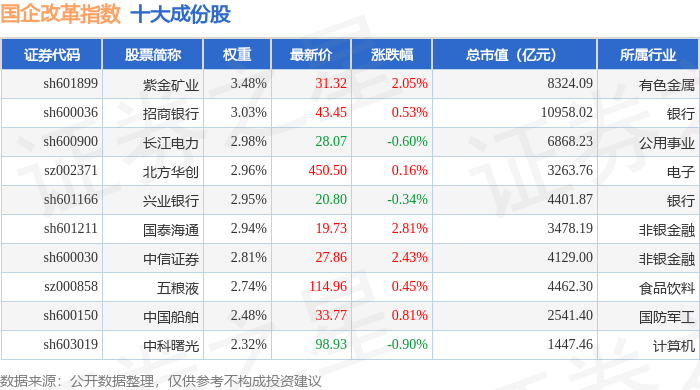
Core Viewpoint - The State-Owned Enterprise Reform Index (399974) closed at 1869.16 points on December 5, with a gain of 0.91% and a trading volume of 115.45 billion yuan, indicating positive market sentiment towards state-owned enterprises [1]. Group 1: Index Performance - The index saw 71 stocks rise, with Goldwind Technology leading at a 5.46% increase, while 28 stocks fell, with Shenzhen South Circuit leading the decline at 2.74% [1]. - The top ten constituent stocks of the index include Zijin Mining, China Merchants Bank, and Changjiang Electric Power, with respective weights of 3.48%, 3.03%, and 2.98% [1]. Group 2: Market Capitalization and Sector Breakdown - The total market capitalization of the top ten stocks includes Zijin Mining at 832.41 billion yuan and China Merchants Bank at 1,095.80 billion yuan, reflecting significant investment in the metals and banking sectors [1]. - The sectors represented in the top ten include non-ferrous metals, banking, public utilities, and food and beverage, indicating a diverse investment landscape [1]. Group 3: Capital Flow Analysis - The net inflow of main funds into the index constituents totaled 2.22 billion yuan, while retail investors experienced a net outflow of 816 million yuan, suggesting institutional confidence contrasted with retail caution [3]. - Notable stocks with significant capital flow include BOE Technology Group with a net outflow of 900 million yuan from main funds and Zijin Mining with a net inflow of 731 million yuan [3]. Group 4: Index Adjustments - Recent adjustments to the index included the addition of Guorui Technology and Zhongcai Technology, while Haifeng Control and Xujie Electric were removed, reflecting ongoing changes in the index composition [4].



千亿液冷元年已至,看好国产供应链加速入局 | 投研报告
Zhong Guo Neng Yuan Wang· 2025-12-05 10:13
Group 1 - Liquid cooling technology is essential for addressing the heat dissipation pressure in data centers, offering advantages such as low energy consumption, high heat dissipation, low noise, and low total cost of ownership (TCO) [1][2] - The value of liquid cooling systems is expected to grow significantly alongside chip upgrades, with a projected increase of over 20% for rack liquid cooling modules in GB300-GB200 servers [1][2] - The market for ASIC liquid cooling systems is estimated to reach 35.3 billion yuan by 2026, while the market for NVIDIA liquid cooling systems is projected to reach 69.7 billion yuan [1][2] Group 2 - The domestic supply chain is accelerating its entry into the liquid cooling market, with NVIDIA opening its supplier list to allow more flexibility in supply chain composition [2] - The Rubin architecture requires new liquid cooling solutions due to its high thermal design power (TDP) of 2300W, necessitating alternatives to single-phase cooling plates [2] - Two viable solutions for the Rubin architecture include phase change cooling plates and microchannel plates, with the latter likely becoming the preferred option as power requirements increase [2] Group 3 - The demand for AI server computing power is rapidly increasing, driving the penetration rate of liquid cooling solutions, and leading to an explosive demand for efficient and energy-saving heat exchange solutions in data centers [3] - Companies to watch in this sector include Yingweike, Shenling Environment, Gaolan Co., Hongsheng Co., Zhongke Shuguang, and Jieban Technology [3]
东吴证券:算力需求增长带动液冷渗透率提升 看好国产供应链加速入局
智通财经网· 2025-12-05 06:31
Core Viewpoint - The current mainstream solution for liquid cooling is the cold plate system, while immersion cooling is expected to become a future development direction. The maturity of domestic liquid cooling systems is increasing, and domestic supply chains are likely to enter the NVIDIA ecosystem directly as demand for AI server computing power surges, driving the penetration rate of liquid cooling solutions [1][2]. Group 1: Liquid Cooling Technology - Liquid cooling technology is essential for addressing the heat dissipation pressure in data centers, offering advantages such as low energy consumption, high heat dissipation, low noise, and low total cost of ownership (TCO). It can also reduce the Power Usage Effectiveness (PUE) of data centers, meeting national requirements [1]. - As chip iterations increase power density, the heat dissipation requirements for corresponding chips are growing, making traditional air cooling insufficient and necessitating the introduction of liquid cooling solutions. Currently, cold plate systems dominate the market, while immersion cooling is anticipated to be a future trend [1]. - The liquid cooling system consists of an outdoor side (primary side) and a data center side (secondary side), with the primary side accounting for approximately 30% of the value, including chillers and circulation pipelines, while the secondary side accounts for about 70%, with core components such as CDU, manifold, quick connectors, and water pumps [1]. Group 2: Liquid Cooling Industry - The value of liquid cooling is expected to increase alongside chip upgrades. For example, the value of rack liquid cooling modules is projected to grow by over 20% with the transition to GB300-GB200 servers. By 2026, the market for ASIC liquid cooling systems is estimated to reach 35.3 billion yuan, while the market for NVIDIA liquid cooling systems is expected to reach 69.7 billion yuan [2]. - Domestic supply chains are accelerating their entry into the liquid cooling market. NVIDIA has opened its supplier list, allowing manufacturers to choose their supply chain components independently. This shift from a single certified CDU supplier to multiple suppliers enables domestic chains to indirectly enter the market. As domestic liquid cooling systems mature and end-user CSPs focus more on cost-performance ratios, domestic suppliers are likely to enter NVIDIA's ecosystem directly [2]. Group 3: Rubin Architecture Outlook - Single-phase cold plates are unsuitable for the Rubin architecture due to its thermal design power (TDP) of 2300W and a total cabinet power of approximately 200KW, exceeding the design limit of single-phase cold plates at 150KW per cabinet. Therefore, new liquid cooling solutions must be introduced [3]. - One feasible solution is the phase change cold plate, which utilizes the phase change of a liquid working fluid to absorb heat efficiently, suitable for scenarios exceeding 300KW per cabinet. Another option is the microchannel cold plate (MLCP), which features densely packed micro-scale cooling liquid channels, potentially becoming the preferred choice for the Rubin architecture as future iterations may require even higher power capacities [3].

工信部强调人工智能重要性,人工智能AIETF(515070)持仓股协创数据涨超3%
Mei Ri Jing Ji Xin Wen· 2025-12-05 06:13
Group 1 - The A-share technology sector continues to rise, with strong performance in computing hardware, CPO, and humanoid robot sectors, and the AI ETF (515070) shows a slight increase of 0.11% during trading [1] - The Ministry of Industry and Information Technology emphasizes accelerating the mutual development of industrial internet with AI, 5G, big data, and cloud computing, highlighting the importance of systematic advantages and the need for deep integration of various technologies [1] - The AI industry is still in a high prosperity cycle, with a positive outlook for the domestic industrial chain, focusing on two main investment directions: computing infrastructure and the commercialization of AI technology in vertical industries [2] Group 2 - The AI ETF (515070) tracks the CS AI theme index (930713), selecting component stocks that provide technology, basic resources, and applications for AI, focusing on the midstream and upstream of the AI industry chain [2] - The top ten weighted stocks in the AI ETF include leading domestic technology companies such as Zhongji Xuchuang, Xinyi Sheng, and Hanwha Technology, indicating a concentration of key players in the AI sector [2]