大成基金

Search documents
7只纳斯达克100指数ETF成交放量,成交额环比均增加超亿元
Zheng Quan Shi Bao Wang· 2025-06-13 09:44
Core Insights - The total trading volume of Nasdaq 100 index ETFs reached 4.618 billion yuan today, an increase of 2.084 billion yuan from the previous trading day, representing a growth rate of 82.27% [1] Trading Volume Summary - The GTAA Nasdaq 100 (QDII-ETF) (513100) had a trading volume of 999.7 million yuan, up 477 million yuan from the previous day, with a growth rate of 91.62% [1] - The GF Nasdaq 100 ETF (159941) recorded a trading volume of 1.260 billion yuan, an increase of 401 million yuan, with a growth rate of 46.64% [1] - The Huaxia Nasdaq 100 ETF (QDII) (513300) saw a trading volume of 581 million yuan, up 278 million yuan, with a growth rate of 91.96% [1] - The E Fund Nasdaq 100 ETF (QDII) (159696) and the Nasdaq 100 (513110) had significant increases in trading volume, with growth rates of 288.91% and 209.97% respectively [1] Market Performance Summary - As of market close, the average decline for Nasdaq 100 index ETFs was 1.09%, with the largest declines seen in the Huaan Nasdaq 100 ETF (QDII) (159632) and the E Fund Nasdaq 100 ETF (QDII) (159696), which fell by 1.18% and 1.17% respectively [1]
量化基金最新收益排名揭晓!诺安基金以超90%收益夺得第1
Sou Hu Cai Jing· 2025-06-13 09:33
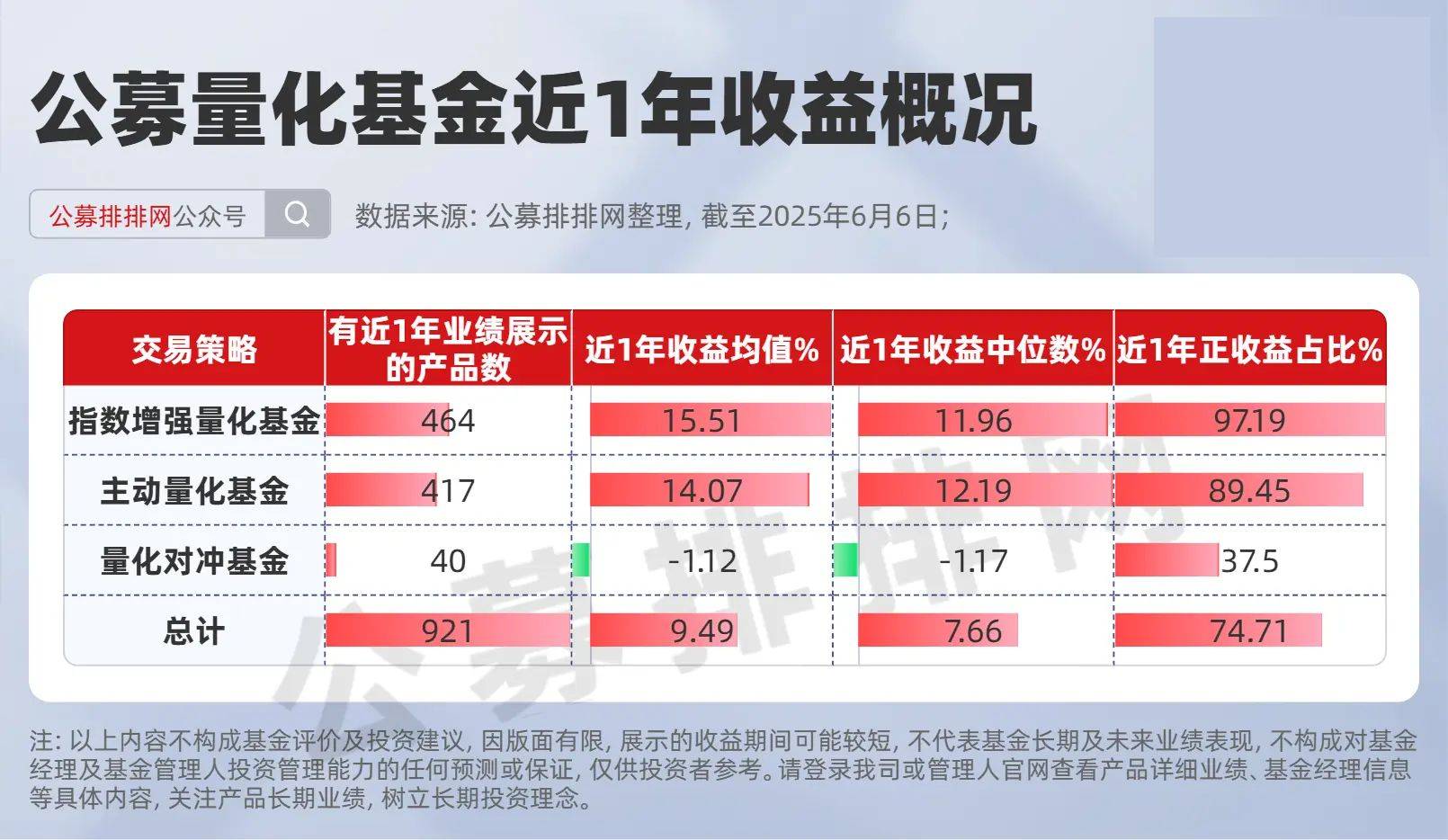
Core Insights - The advantages of quantitative investment have become increasingly prominent in the market, particularly with the rise of public quantitative funds attracting a broader range of retail investors due to their lower entry barriers [1] - Major public fund companies, such as Fuguo Fund and Penghua Fund, are exploring deep applications of AI to enhance their quantitative fund products following the launch of the DeepSeek-R1 model by the private fund giant Huanfang [1] Group 1: Performance of Quantitative Funds - As of June 6, 2025, there are 921 public quantitative fund products with a mean return of 9.49% over the past year [1] - Among these, index-enhanced quantitative funds, active quantitative funds, and quantitative hedge funds have 464, 417, and 40 products respectively, with average returns of 15.51%, 14.07%, and -1.12% [1] - The proportion of positive returns for these funds is 97.19% for index-enhanced, 89.45% for active, and 37.5% for quantitative hedge funds, indicating that index-enhanced funds performed the best [1] Group 2: Top Performing Funds - The top 10 index-enhanced quantitative funds have a minimum return threshold of 37.61%, with the top three being managed by Chuangjin Hexin Fund, Huatai-PB Fund, and Dacheng Fund [3] - The "Chuangjin Hexin North 50 Component Index Enhanced A" fund has a one-year net value growth rate of 90.46%, outperforming its benchmark by 8.44% [5] - The "Huatai-PB CSI 2000 Index Enhanced A" fund achieved a one-year net value growth rate of 56.8%, also exceeding its benchmark by 23.27% [6] Group 3: Active Quantitative Funds - The top 10 active quantitative funds have a minimum return threshold of 42.43%, with the leading fund being "Noan Multi-Strategy A" which recorded a one-year net value growth rate of 90.2% [9][11] - This fund's performance significantly surpassed its benchmark, which only grew by 7.68% [11] - The top three active quantitative funds are managed by Noan Fund, CITIC Prudential Fund, and GF Fund [9] Group 4: Quantitative Hedge Funds - Among the 40 quantitative hedge funds, 8 achieved positive returns, with the top three managed by Fuguo Fund, ICBC Credit Suisse Fund, and Haifutong Fund [13] - The focus of quantitative hedge funds is to construct stock portfolios while using tools like index futures for risk hedging, aiming for absolute returns [13]

穿越牛熊的中坚力量,优秀中生代基金经理大盘点
Sou Hu Cai Jing· 2025-06-13 08:00
Group 1 - The article highlights the emergence of mid-generation fund managers in the public fund industry, who are becoming key players between established veterans and new rising stars [2] - Notable mid-generation fund managers include Yuan Weide from China Europe Fund, Liu Xu and Han Chuang from Great Wall Fund, and Zhang Jintao from Harvest Fund, among others [2] - These managers face the challenge of balancing scale growth with performance stability, aiming to convert short-term success into long-term sustainable returns [2] Group 2 - Yuan Weide has 8.46 years of investment experience and manages four products with a total scale of 10.267 billion yuan [3] - Initially focused on TMT and electronics, Yuan has expanded his expertise to banking, new energy, and consumer sectors, categorizing assets into three types based on risk-return characteristics [4] - As of Q1 2025, Yuan's portfolio includes high-end manufacturing, consumer goods, and gold stocks, adhering to a value investment philosophy that prioritizes safety and growth [4][5] Group 3 - Liu Xu, with 9.88 years of experience, manages seven products totaling 25.734 billion yuan, focusing on deep value investment through a five-dimensional stock selection model [8] - His investment strategy emphasizes long-term value and competitive advantages, particularly in the manufacturing sector [9] - Liu's flagship product, Great Wall Gaoxin, has achieved a total return of 382.52% since his appointment in July 2015, outperforming the benchmark [13] Group 4 - Han Chuang, with 6.42 years of experience, manages seven products totaling 14.642 billion yuan, known for a cyclical growth strategy focusing on industry trends [10] - His performance has been closely tied to macroeconomic conditions, and he aims to diversify beyond cyclical sectors to enhance returns [17] - Han's flagship product, Great Wall New Industry, has delivered a total return of 299.27% since his appointment in January 2019, although recent performance has lagged [16] Group 5 - Zhang Jintao from Harvest Fund has 9.05 years of experience and manages seven products with a total scale of 15.428 billion yuan, focusing on value investment principles [20] - His representative product, Harvest Hong Kong and Shanghai Select, has achieved a total return of 152.37% since May 2016, with a year-to-date return of 10.68% [22][23] - Wang Guizhong, another notable manager from Harvest Fund, has 6.10 years of experience and focuses on technology investments, achieving a total return of 170.06% since May 2019 [25][27]

盐湖股份(000792) - 000792盐湖股份投资者关系管理信息20250613
2025-06-13 07:53
Production Capacity and Structure - The company has established a potassium fertilizer production capacity of 500,000 tons per year, with the potassium fertilizer subsidiary responsible for approximately 400,000 tons, accounting for 80% of total capacity [2] - The remaining 100,000 tons are produced by subsidiaries with unique processes, enabling differentiated production and supply of various potassium fertilizer products [2] Market Outlook - In 2024, China's total potassium chloride imports are projected to reach 12.63 million tons, a 9% year-on-year increase, with an import dependency of 67% [2] - The demand for potassium fertilizer is expected to remain stable and increase due to national strategies aimed at ensuring food security and enhancing agricultural productivity [2] - Geopolitical factors have led to significant price fluctuations in potassium fertilizer, with international prices rising due to supply constraints from major producers [3] Strategic Initiatives - The company is actively expanding its potassium salt resource reserves through geological exploration and resource acquisitions to ensure long-term supply stability [3] - A project cooperation agreement has been signed for the control of potassium mining projects in Canada and Spain, focusing on resource evaluation and economic feasibility [4] Technological Advancements - The company has developed five core processing technologies for potassium extraction, establishing itself as a leader in the industry [5] - The new lithium salt integrated project is expected to enhance lithium recovery rates by approximately 25% and significantly reduce energy consumption [7] Cost Management - The company emphasizes meticulous cost control across all operational aspects, aiming to reduce production costs through standardized management and efficiency improvements [10] - Strategies include optimizing sales and logistics costs, as well as labor costs, to enhance overall profitability [10] Shareholder Returns - The company is exploring diversified shareholder return methods and is committed to maintaining a stable profit distribution policy [9] - The integration into the China Minmetals Corporation framework is expected to enhance operational efficiency and competitive advantage [12] Future Development Strategy - The company aims to build a world-class salt lake industry base, focusing on sustainable development and resource optimization [12] - It plans to leverage the advantages of the China Minmetals Corporation to enhance its role in national strategic resource security and green development [13]

ETF融资榜 | 港股通金融ETF(513190)杠杆资金加速流入,港股相关ETF受杠杆资金关注-20250612
Sou Hu Cai Jing· 2025-06-13 04:06
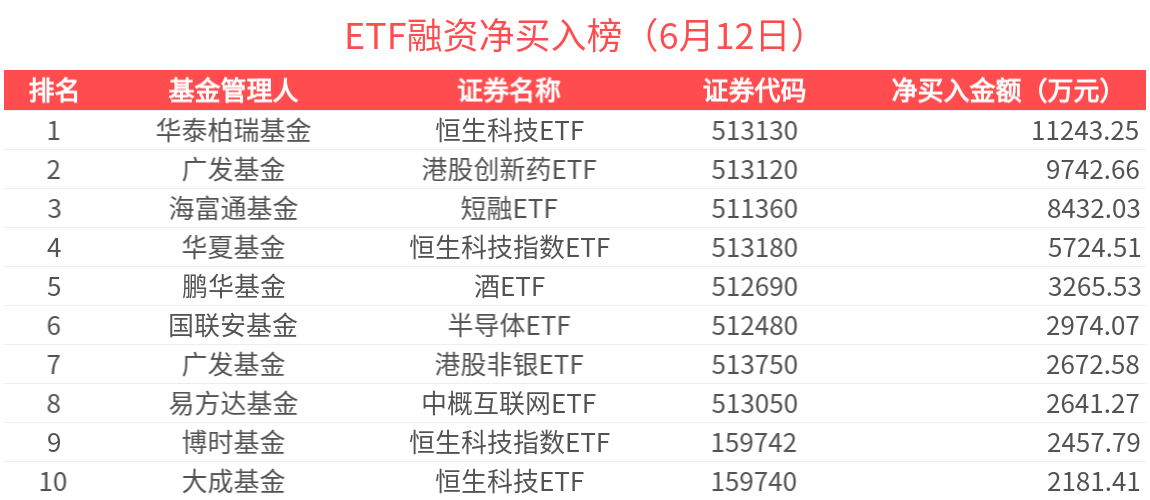
Summary of Key Points Core Viewpoint - On June 12, 2025, a total of 184 ETF funds experienced net buying through financing, while 38 ETF funds saw net selling through securities lending. The total net buying amount exceeded 5 million yuan for 34 funds, indicating significant inflows into specific ETFs such as the Hang Seng Technology ETF and the Hong Kong Innovative Drug ETF [1][3]. Financing Net Buying - The top five ETFs with the highest net buying amounts were: 1. Hang Seng Technology ETF (513130.SH) with a net inflow of 112.43 million yuan 2. Hong Kong Innovative Drug ETF (513120.SH) with a net inflow of 97.42 million yuan 3. Short-term Bond ETF (511360.SH) with a net inflow of 84.32 million yuan 4. Hang Seng Technology Index ETF (513180.SH) with a net inflow of 57.24 million yuan 5. Wine ETF (512690.SH) with a net inflow of 32.65 million yuan [3][5]. Securities Lending Net Selling - The two ETFs with the highest net selling amounts through securities lending were: 1. CSI 500 ETF (510500.SH) with a net outflow of 22.06 million yuan 2. CSI 1000 ETF Index (560010.SH) with a net outflow of 14.39 million yuan [5][10]. Continuous Financing Net Buying - A total of 81 ETFs have seen continuous net buying through financing, with the leading funds being: - Hong Kong Stock Connect Financial ETF with a net inflow of 13.09 million yuan over 11 days - Rare Earth ETF with a net inflow of 16.49 million yuan over 5 days [6][8]. Continuous Securities Lending Net Selling - Seventeen ETFs experienced continuous net selling through securities lending, with the top funds being: - CSI 300 ETF with a net outflow of 31.62 million yuan over 5 days - Power ETF with a net outflow of 0.66 million yuan over 4 days [6][10]. Long-term Trends - Over the past 5 days, the ETFs with net buying exceeding 5 million yuan included: - Hong Kong Innovative Drug ETF with a net inflow of 576 million yuan - Sci-Tech 50 ETF with a net inflow of 296 million yuan [8][10]. - Conversely, the ETFs with net selling exceeding 5 million yuan included: - CSI 500 ETF with a net outflow of 102 million yuan - CSI 300 ETF with a net outflow of 31.62 million yuan [6][10].
提前结募+火速成立 新基金抢抓建仓机会
Shang Hai Zheng Quan Bao· 2025-06-12 18:27
Group 1 - The market is witnessing a rapid increase in new fund issuance, with several funds ending their fundraising periods early to seize investment opportunities [1][2] - On June 12, multiple equity funds announced early closure of their fundraising, indicating strong demand and optimism among fund companies [1] - The first batch of new floating management fee funds has already exceeded 8 billion yuan in issuance scale, reflecting a shift in fund management strategies [1] Group 2 - New funds are being established quickly, with some having fundraising periods as short as 2 days, highlighting a focus on swift market entry [2] - Fund managers are actively purchasing their own funds, demonstrating confidence in the market's long-term stability and growth potential [2] - Economic resilience and potential in China are expected to support market valuation recovery, with sectors like AI, high-end manufacturing, and biomedicine showing promising developments [3]
4只,跻身百亿阵营!
Zhong Guo Ji Jin Bao· 2025-06-12 05:37
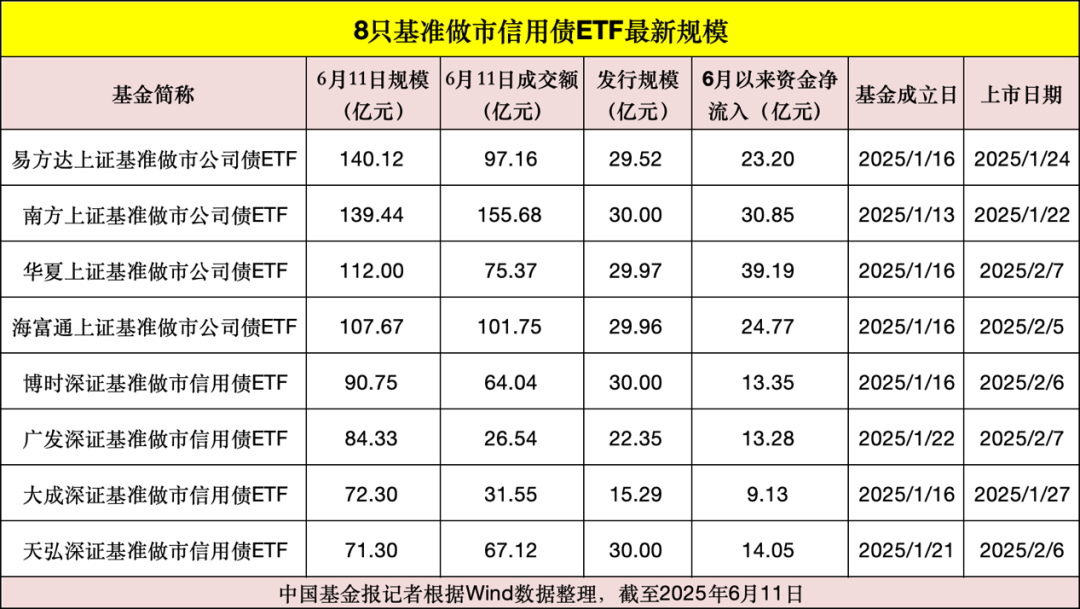
Core Viewpoint - The recent surge in the scale of benchmark market-making credit bond ETFs in China, with four ETFs surpassing 10 billion yuan, indicates strong market demand and effective liquidity management tools for investors [1][4]. Group 1: ETF Scale and Performance - Four benchmark market-making credit bond ETFs have surpassed 10 billion yuan in scale, including E Fund, Southern, Huaxia, and Haifutong ETFs, with respective scales of 140.12 billion yuan, 139.44 billion yuan, 112 billion yuan, and 107.67 billion yuan [4]. - The total scale of eight benchmark market-making credit bond ETFs has reached 817.91 billion yuan, reflecting a significant increase of nearly 277% in just four months [1][4]. - On June 11, the trading volume for benchmark market-making credit bond ETFs reached 619.22 billion yuan, with notable daily trading amounts for Southern and Haifutong ETFs at 155.68 billion yuan and 101.75 billion yuan, respectively [2]. Group 2: Market Dynamics and Investor Behavior - The inclusion of credit bond ETFs in the general repurchase pledge library has enhanced liquidity management for investors, promoting the healthy development of the credit bond market [1][5]. - The recent influx of 167.82 billion yuan in net buying for these ETFs in June indicates strong market interest and confidence among investors [4]. - The current low-interest-rate environment, coupled with the central bank's recent policy adjustments, has increased the attractiveness of medium-term high-rated credit bond yields, further driving demand for credit bond ETFs [5].
新型浮动费率基金“抢滩”,24只产品募超80亿
Huan Qiu Wang· 2025-06-12 04:19
Group 1 - The core viewpoint of the article highlights the surge in the issuance of new floating-rate funds, with a total fundraising scale exceeding 8 billion yuan, indicating a competitive market environment among fund companies [1] - As of June 11, 2023, 24 new floating-rate funds have collectively raised over 8 billion yuan, with nearly 20 funds surpassing the 200 million yuan threshold for establishment [1] - Several fund companies are employing differentiated marketing strategies, with notable early success from Dongfanghong Asset Management, which announced its fund reached the fundraising cap of 1.991 billion yuan and ended its fundraising early [1][2] Group 2 - Fund companies are deploying experienced managers for these new funds, with notable figures such as Zhu Hongyu from China Merchants Fund and Wang Mingxu from GF Fund taking leading roles [2] - Many fund management firms are actively investing their own capital into these new floating-rate funds, with a total self-investment amount reaching 110 million yuan as of June 11, 2023 [2] - The new floating-rate funds are designed to strengthen the alignment of interests between investors and fund managers, promoting long-term holding and rational investment practices [3][4]
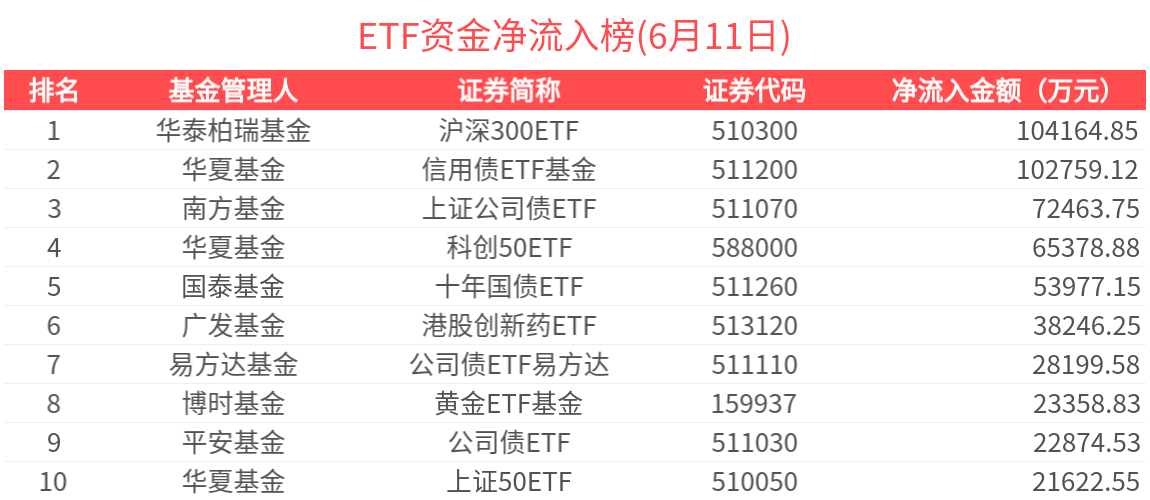
ETF资金榜 | 港股通红利ETF(513530)资金加速流入,沪深300ETF(510300)单日“吸金”逾10亿元-20250611
Sou Hu Cai Jing· 2025-06-12 03:21
Summary of ETF Fund Flows Core Insights - On June 11, 2025, a total of 179 ETFs experienced net inflows, while 446 ETFs saw net outflows. Notably, 25 ETFs had net inflows exceeding 100 million yuan, with significant inflows into the CSI 300 ETF, Credit Bond ETF, and others [1][3]. Inflows - The top five ETFs with the highest net inflows included: - CSI 300 ETF (510300.SH): 1.04164 billion yuan - Credit Bond ETF (511200.SH): 1.02759 billion yuan - Shanghai Corporate Bond ETF (511070.SH): 724.6 million yuan - Sci-Tech Innovation 50 ETF (588000.SH): 653.78 million yuan - Ten-Year Treasury ETF (511260.SH): 539.7 million yuan [3][5]. - A total of 95 ETFs have seen consecutive net inflows, with the leading ones being: - Hong Kong Stock Connect Dividend ETF: 510 million yuan over 31 days - Soybean Meal ETF: 66.41 million yuan over 29 days - Credit Bond ETF (Dacheng): 3.547 billion yuan over 25 days [7]. Outflows - The top five ETFs with the highest net outflows included: - ChiNext ETF (159915.SZ): 544.2 million yuan - CSI 300 ETF (159919.SZ): 360 million yuan - Credit Innovation ETF (159538.SZ): 334.3 million yuan - Short-Term Bond ETF (511360.SH): 327.18 million yuan - Credit Innovation ETF (562570.SZ): 296.2 million yuan [5]. - A total of 254 ETFs have experienced consecutive net outflows, with the leading ones being: - Biopharmaceutical ETF: 617 million yuan over 34 days - Innovative Drug ETF: 3.620 billion yuan over 29 days [7]. Recent Trends - Over the past five days, 63 ETFs have seen cumulative net inflows exceeding 100 million yuan, with the top inflows being: - Ten-Year Treasury ETF: 4.540 billion yuan - Credit Bond ETF: 4.067 billion yuan [8]. - Conversely, 96 ETFs have experienced cumulative net outflows exceeding 100 million yuan, with the top outflows being: - ChiNext ETF: 1.830 billion yuan - Hong Kong Internet ETF: 1.372 billion yuan [8].
今年以来,这类ETF爆发
申万宏源证券上海北京西路营业部· 2025-06-12 02:24
Core Viewpoint - The article highlights the strong performance of Hong Kong ETFs in 2025, driven by optimistic market sentiment and significant capital inflows, particularly in technology sectors such as robotics and artificial intelligence [2][7]. Group 1: Hong Kong Market Performance - The Hang Seng Index and Hang Seng Tech Index have shown notable increases of 16.1008% and 15.7185% respectively as of May 30, 2025, indicating a robust start to the year [2]. - The overall positive sentiment in the Hong Kong market is attributed to a favorable global monetary policy environment and China's economic resilience, which enhances the attractiveness of Hong Kong stocks compared to A-shares [7]. Group 2: Understanding Hong Kong ETFs - Hong Kong ETFs are funds that track Hong Kong-listed stocks, allowing investors to gain exposure to the market through a single investment, similar to a "one-click package" of quality stocks [3]. - These ETFs are primarily listed on mainland exchanges, enabling domestic investors to trade them in RMB without needing a Hong Kong stock account, thus lowering entry barriers for investors [3][4]. Group 3: Advantages of Hong Kong ETFs - The cross-border nature of Hong Kong ETFs allows for easier access to the Hong Kong market without the need for additional accounts or foreign exchange quotas, making them suitable for first-time investors [4]. - Unlike the T+1 settlement of most A-shares, some Hong Kong ETFs offer T+0 trading, providing greater flexibility for short-term trading strategies [5]. - The trading costs associated with Hong Kong ETFs are generally lower than direct investments in Hong Kong stocks, as they are exempt from certain fees like stamp duty, enhancing their long-term investment value [6]. Group 4: Current ETF Offerings - A list of current Hong Kong ETFs available for margin trading includes various funds such as Huazhang Hang Seng Internet Technology ETF, GF Hang Seng Consumer ETF, and others, providing diverse investment options for investors [9].