
平安银行

Search documents
银行零售经营逻辑重塑:资产投放缩量,中高低净值客群增速分化
Zheng Quan Shi Bao Wang· 2025-11-16 13:41
Core Insights - The retail credit market is experiencing a slowdown, with many banks facing challenges in maintaining retail performance metrics amid weak consumer demand and credit needs [1][2][3] Group 1: Retail Credit Trends - Retail loan growth has decelerated, with several banks reporting a decrease in retail loan balances compared to the end of last year [2] - As of the end of September, several banks, including Industrial Bank and Minsheng Bank, reported declines in personal loan balances, with decreases of 2.49% and 3.17% respectively [2] - The overall retail loan demand is insufficient, particularly in mortgage and credit card segments, leading to a downward trend in loan balances [3] Group 2: Customer Segmentation - There is a noticeable divergence in growth rates between high-net-worth and basic retail customer segments, with high-net-worth customers growing at a faster pace [4][5] - As of September, the number of high-net-worth customers at several banks, such as China Merchants Bank and Ping An Bank, has increased significantly, with growth rates of 10.42% and 6.7% respectively [5][6] - The trend indicates a shift towards deeper competition in the retail banking sector, focusing on maximizing value from existing customer bases rather than acquiring new customers [7]

深度|银行零售经营逻辑重塑:资产投放缩量,中高低净值客群增速分化
券商中国· 2025-11-16 12:37
Core Viewpoint - The retail banking sector is facing challenges with slowing loan growth, reduced retail performance contributions, and a shift in customer demographics, necessitating a focus on existing high-net-worth clients while managing declining retail loan demand [1][2]. Group 1: Retail Loan Trends - Retail loan growth has slowed, with several banks reporting a decrease in retail loan balances compared to the end of the previous year. For instance, Industrial Bank's personal loan balance was 1.94 trillion yuan, down 2.49% from the end of last year [3]. - As of the end of September, Minsheng Bank's personal loan total was 1.71 trillion yuan, a decrease of 3.17% from the end of last year [3]. - Other banks, such as China Construction Bank and Bank of China, also reported slight declines in personal loan balances compared to mid-year figures, indicating a broader trend of reduced retail lending [4]. Group 2: Customer Segmentation - There is a noticeable divergence in growth rates between high-net-worth clients and basic retail clients. High-net-worth client segments are growing faster than the basic retail customer base [6]. - For example, as of September, China Merchants Bank reported a 4.76% increase in retail customers, with high-net-worth clients growing by 10.42% [6]. - Similarly, Ping An Bank's wealth clients increased by 2.4%, while private banking clients grew by 6.7% [7]. Group 3: Strategic Focus - Banks are shifting their strategies to focus on existing customers, particularly in enhancing the value of lower-tier clients to transition them into higher-value segments. This includes leveraging digital channels for customer engagement [8]. - The emphasis is on "collective operation of retail long-tail customers," aiming to optimize customer interactions through various digital platforms and increase the conversion of basic clients to high-net-worth clients [8].







国际金价反复震荡,银行积存金投资门槛升至千元以上
Di Yi Cai Jing· 2025-11-16 12:11
花旗更倾向于认为金价在2026年面临回调压力,或回落至3650美元/盎司。 11月14日,国际金价跳水,截至当天收盘,现货黄金报4082.159美元/盎司;沪金跟随下跌,当天收盘报 934.86元/克。 在国际金价高位震荡的大背景下,银行端正迎来新一轮黄金积存业务的集体调整。10月以来,多家大型 银行相继上调积存金起购门槛或调整相关交易规则,以应对价格快速波动带来的风险压力。 与此同时,国际金价近日在连续大涨后出现明显回调,市场对后续走势的判断出现分化,在机构普遍认 可黄金中长期逻辑的同时,2026年前后的短期路径仍存在较大不确定性。 银行再度抬高积存金门槛 随着金价持续攀升并伴随剧烈波动,银行端的黄金积存业务正在经历快速调整。中信银行、建设银行最 新公告显示,自11月15日起,两家银行均将积存金业务的月度起存金额明显上调,门槛普遍进入"千元 时代"。 建设银行公告称,为保护投资者权益、优化交易结构,该行修订了黄金积存业务规则,新增涉及报价机 制、巨额赎回等内容。其中,月积存金额起点由此前的较低水平提升至1200元,并按10元整数倍递增; 新规将自11月15日起正式执行。 值得注意的是,建行此次调整的核心,是 ...


下周,多家银行派发“现金红包”
Zhong Guo Zheng Quan Bao· 2025-11-16 09:15
南京银行将于11月20日进行2025年中期现金红利发放。该次利润分配以方案实施前的该行总股本123.64 亿股为基数,每股派发现金红利0.3062元(含税),共计派发现金红利37.86亿元。 中信银行将于11月21日进行2025年中期现金红利发放。该次利润分配以截至股权登记日的该行普通股总 股本556.45亿股为基数,向全体股东每股派发现金红利0.188元(含税),共计派发现金红利104.61亿 元。其中A股股本为407.63亿股,派发A股现金红利76.63亿元。 自9月以来,多家银行2025年中期分红已陆续落地。截至11月15日,已有上海银行(601229)、平安银 行(000001)、张家港行(002839)、沪农商行(601825)、长沙银行(601577)、苏农银行 (603323)、民生银行(600016)、常熟银行(601128)8家银行已派发2025年中期现金红利。 下周,四家A股上市银行将实施2025年中期分红。苏州银行(002966)、杭州银行(600926)、南京银 行(601009)、中信银行(601998)将分别于11月17日、18日、20日、21日进行2025年中期分红,分红 金额合 ...


大湾区上市公司治理评价报告出炉,整体治理水平略高于京津冀
Nan Fang Du Shi Bao· 2025-11-16 07:42
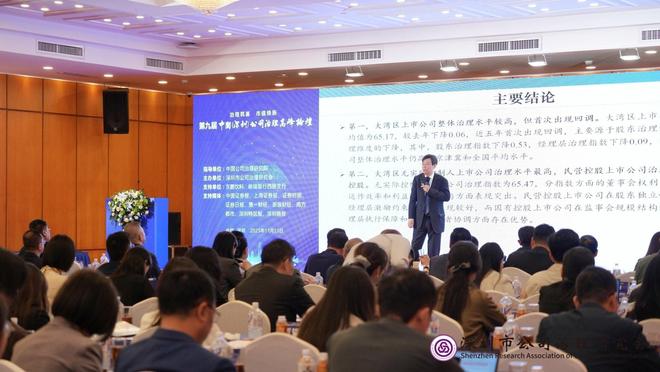
大湾区800多家上市公司治理总体处于什么水平?还有哪些短板?11月13日上午,在中国公司治理研究 院指导下,由深圳市公司治理研究会主办的第九届中国(深圳)公司治理高峰论坛在深圳市举行,"治 理筑基,市值焕新"成为主议题。 《2025大湾区上市公司治理评价报告》发布现场 深圳上市公司总体治理水平略高于北京低于上海 当天,南开大学讲席教授、中国公司治理研究院院长李维安发布《2025大湾区上市公司治理评价报 告》。报告显示,大湾区803家上市公司治理水平总体上较高,治理指数平均值为65.17,比全国平均水 平(64.94)高出0.23。 大湾区不同地区上市公司数量由多到少依次为深圳市(421家)、广州市(154家)、东莞市(62家)、 佛山市(54家)、珠海市(40家)、中山市(27家)、惠州市(20家)、江门市(15家)以及肇庆市 (10家)。 截至2024年12月31的数据统计显示,803家大湾区上市公司的资产总额为507743.38亿元,约占A股上市 公司的11.30%;营业收入总额为85266.62亿元,约占A股上市公司的11.82%;利润总额为8732.83亿元, 约占A股上市公司的12.72%。 从六大 ...
今日黄金多少钱一克?11月13日黄金价格又跌价
Sou Hu Cai Jing· 2025-11-15 14:17
Core Insights - On November 13, 2025, global financial markets focused on precious metals, with international spot gold prices experiencing notable fluctuations, reaching $4,129.2 per ounce [1] - The domestic gold market also showed complex dynamics, with real-time prices providing investors with immediate market references [2] Domestic Precious Metals Market - The domestic gold price was reported at 946.3 RMB per gram, while silver, platinum, and palladium prices were 11.6 RMB, 365.7 RMB, and 332.6 RMB per gram respectively [2] - Various jewelry brands offered different retail prices for gold, with notable examples including Chow Tai Fook at 1,313 RMB per gram for gold jewelry and 642 RMB for platinum [5] Gold Price Trends - The Shanghai Gold Exchange reported a gold price of 942.19 RMB per gram, down 4.31 RMB from the previous trading day, reflecting a decline of 0.455% [6] - The price fluctuated during the day, reaching a high of 949.22 RMB and a low of 938.16 RMB [6] Financial Institutions' Gold Bar Pricing - Different financial institutions offered varying prices for their gold bars, with prices ranging from 936.1 RMB to 976 RMB per gram [7] - For instance, the Agricultural Bank's gold bar was priced at 945.2 RMB per gram, while the higher-priced option from Qianjiaxin was 1,072 RMB per gram [7] Investment Logic Behind Gold Price Movements - Recent adjustments in international gold prices followed a significant prior increase, with London spot gold prices dipping below $4,000 per ounce [8] - Factors influencing this trend included a strengthening dollar, high interest rates, and a shift in global investor risk appetite [8][9] Dollar and Interest Rate Impact - A strong dollar typically pressures gold prices, while a weak dollar supports them; recent Federal Reserve actions have contributed to a stronger dollar [9] - High yields on 10-year U.S. Treasury bonds, currently above 4.1%, have led investors to reassess the opportunity cost of holding gold [9] Evolving Investor Sentiment - The allure of gold as a safe-haven asset has diminished as geopolitical and financial risks have eased, prompting a shift of funds towards equities, bonds, and cryptocurrencies [10] - The adjustment in gold prices reflects a rebalancing of market investment logic rather than panic selling or a decline in gold's intrinsic value [10]

金融监管总局发布最新数据!股份行净息差环比回升1个基点
证券时报· 2025-11-15 02:49
Core Viewpoint - The banking and insurance sectors in China have shown signs of stability and growth, with improvements in net interest margins and asset quality, indicating a potential recovery phase for the industry [2][4][5]. Banking Sector Overview - As of the end of Q3 this year, the total assets of China's banking institutions reached 474.3 trillion yuan, a year-on-year increase of 7.9%. Large commercial banks accounted for 208.1 trillion yuan, growing by 10% [2]. - The net profit of commercial banks for the first three quarters was 1.9 trillion yuan, remaining stable compared to the same period last year. The net interest margin stood at 1.42%, stable compared to Q2 but down by 11 basis points year-on-year [4][5]. - The net interest margin for joint-stock commercial banks increased by 1 basis point compared to the end of Q2, indicating a trend towards stabilization [3][5]. Asset Quality and Loan Growth - By the end of Q3, the non-performing loan balance for commercial banks was 3.5 trillion yuan, with a non-performing loan ratio of 1.52%, reflecting a slight increase from the previous quarter [9]. - The balance of inclusive small and micro enterprise loans reached 36.5 trillion yuan, growing by 12.1% year-on-year, while inclusive agricultural loans increased to 14.1 trillion yuan [11]. Liquidity Indicators - The liquidity coverage ratio for commercial banks was 149.73%, up by 0.48 percentage points from the previous quarter, indicating stable liquidity conditions [13]. - Other liquidity metrics, such as the net stable funding ratio and loan-to-deposit ratio, also showed slight improvements, reflecting a healthy liquidity position across the banking sector [13]. Market Position of Large Commercial Banks - The asset share of large commercial banks has risen to 43.88%, marking a new high in recent years, underscoring their dominant role in serving the real economy [10][11].

东莞市华立实业股份有限公司关于公司及控股子公司提供担保的公告
Shang Hai Zheng Quan Bao· 2025-11-14 18:47
Summary of Key Points Core Viewpoint - The company has announced new guarantees provided to its subsidiaries, aimed at supporting their financing needs and ensuring stable operations, which aligns with the company's overall development strategy [10][11]. Group 1: Guarantee Details - The company has signed a comprehensive credit limit contract with Ping An Bank for a new credit exposure limit of RMB 20 million, valid for 12 months, to support its wholly-owned subsidiary, Dongguan Huafuli Decoration Materials Co., Ltd. [1] - The company has also signed a maximum guarantee contract with CITIC Bank for a maximum guarantee of RMB 20 million for its subsidiary, Suzhou Shangyuan Intelligent Technology Co., Ltd., covering debts incurred from November 14, 2025, to November 14, 2026 [1][2]. - Additionally, Shangyuan Intelligent has signed a maximum guarantee contract with CITIC Bank for a maximum guarantee of RMB 10 million for its subsidiary, Jiangsu Nuolai Smart Water Equipment Co., Ltd., covering debts incurred during the same period [2]. Group 2: Internal Decision-Making Process - On May 15, 2025, the company held its annual shareholders' meeting, approving a proposal to provide guarantees for its subsidiaries, with a total maximum guarantee limit of RMB 1.87 billion, including RMB 1 billion for subsidiaries and RMB 870 million for inter-subsidiary guarantees [2]. Group 3: Necessity and Reasonableness of Guarantees - The guarantees are within the authorized limits set by the shareholders' meeting and are intended to support the operational and business development needs of the subsidiaries, reflecting the company's strategic goals [10]. - The company maintains effective control over the daily operations and decisions of the subsidiaries, ensuring that the risks associated with the guarantees are manageable and do not harm the interests of the company or minority shareholders [10][11]. Group 4: Cumulative Guarantee Situation - As of now, the total amount of external guarantees provided by the company and its subsidiaries, including the new guarantees, amounts to RMB 1.16 billion, which represents 83.26% of the company's most recent audited net assets [11]. - The company has not provided guarantees to its controlling shareholders or related parties, and there are no overdue external guarantees [11].

11月14日区块链50(399286)指数跌1.49%,成份股汉得信息(300170)领跌
Sou Hu Cai Jing· 2025-11-14 16:42
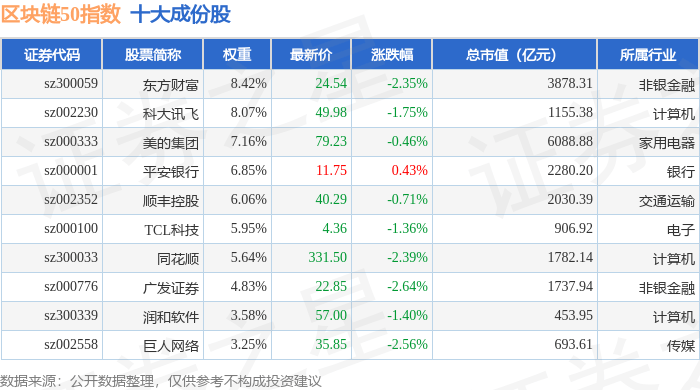
Market Performance - The Blockchain 50 Index (399286) closed at 3982.08 points, down 1.49%, with a trading volume of 35.197 billion yuan and a turnover rate of 1.74% [1] - Among the index constituents, 4 stocks rose while 45 stocks fell, with Yihualu leading the gainers at 3.15% and Handexin leading the decliners at 3.57% [1] Key Constituents - The top ten constituents of the Blockchain 50 Index include: - Dongfang Caifu (8.42% weight) at 24.54 yuan, down 2.35% [1] - Keda Xunfei (8.07% weight) at 49.98 yuan, down 1.75% [1] - Midea Group (7.16% weight) at 79.23 yuan, down 0.46% [1] - Ping An Bank (6.85% weight) at 11.75 yuan, up 0.43% [1] - SF Holding (6.06% weight) at 40.29 yuan, down 0.71% [1] - TCL Technology (5.95% weight) at 4.36 yuan, down 1.36% [1] - Tonghuashun (5.64% weight) at 331.50 yuan, down 2.39% [1] - Guangfa Securities (4.83% weight) at 22.85 yuan, down 2.64% [1] - Runhe Software (3.58% weight) at 57.00 yuan, down 1.40% [1] - Giant Network (3.25% weight) at 35.85 yuan, down 2.56% [1] Capital Flow - The net outflow of main funds from the Blockchain 50 Index constituents totaled 2.988 billion yuan, while retail investors saw a net inflow of 2.268 billion yuan [3] - Notable capital flows include: - Ping An Bank with a main fund net inflow of 12.8 million yuan [3] - Yihualu with a main fund net inflow of 41.29 million yuan [3] - Midea Group with a main fund net inflow of 10.00 million yuan [3]





银行加速出清信用卡不良资产 转让折扣不足一成
Jing Ji Guan Cha Wang· 2025-11-14 13:22
Core Viewpoint - The recent announcements by Bank of Communications regarding the transfer of non-performing loans indicate a significant acceleration in risk clearance within the banking sector, particularly focusing on credit card debts [1][2]. Summary by Sections Non-Performing Loan Transfers - Bank of Communications has announced the transfer of multiple non-performing loans, including credit card overdrafts totaling approximately 17.9 billion yuan and 607 million yuan, alongside personal consumption and business loans from its Sichuan and Hebei branches, amounting to around 38 million yuan and 15.07 million yuan respectively [1][2]. - The bank's strategy reflects a broader trend among various banks, including China Construction Bank and Minsheng Bank, to actively offload non-performing assets, although market valuations for such assets remain under pressure [1][2]. Market Dynamics and Valuation - The market for non-performing credit card assets is currently characterized by low valuation and limited buyer interest, as evidenced by Ping An Bank's recent transfer of a 1.033 billion yuan asset package that sold for only 93 million yuan, representing a discount of less than 10% [1][7]. - The overall trend indicates that while banks are eager to clear these assets, the secondary market's willingness to absorb them at reasonable valuations is lacking [1][7]. Characteristics of Non-Performing Assets - The non-performing loans being transferred by Bank of Communications include a significant number of overdue accounts, with average overdue days exceeding 2000 days and borrowers averaging around 41 years old [2][3]. - Other banks, such as Minsheng Bank, are also focusing on large-scale transfers of non-performing credit card debts, with their sixth project involving 148,351 loans totaling 5.142 billion yuan, all classified as loss category with no collateral [3][4]. Regulatory Environment and Market Efficiency - Recent regulatory changes have facilitated the inclusion of non-performing asset disposal into regular banking operations, enhancing efficiency and asset quality stability [8][9]. - The role of the Credit Asset Registration and Transfer Center has been pivotal in accelerating the turnover of non-performing assets, with banks increasingly opting for rapid clearance at significant discounts to optimize their balance sheets [9]. Risk Trends in Retail Loans - The overall non-performing loan ratio for various retail loan types, including credit cards, is on the rise, indicating an emerging risk landscape within the retail banking sector [9].
