成本收入比

Search documents
大华银行(U11):2025年四季度业绩:初步观点-20260224
citic securities· 2026-02-24 12:22
Investment Rating - The report provides a positive investment rating for United Overseas Bank (UOB), indicating a favorable outlook based on its recent performance and strategic initiatives [3]. Core Insights - UOB's net profit after tax (NPAT) for Q4 2025 exceeded market expectations by 3%, driven by effective cost management and a higher net interest margin (NIM) [3]. - The bank's non-interest income fell short of expectations primarily due to declines in trading and investment income, although net fee income slightly surpassed forecasts [3]. - Asset quality showed improvement with a decrease in non-performing assets (NPA) and a decline in the non-performing loan (NPL) ratio by 10 basis points [3]. - The bank's common equity tier 1 (CET1) capital ratio improved by 40 basis points to 14.9%, indicating a strong capital position [3]. Financial Performance Summary - Q4 2025 net profit reached SGD 1.41 billion, reflecting a quarter-on-quarter increase of 218% and a year-on-year decrease of 7% due to lower provisions [3]. - Net interest income increased by 4% quarter-on-quarter but decreased by 4% year-on-year, with NIM rising by 2 basis points to 1.84% [3]. - Loan growth was 0.3% quarter-on-quarter, below expectations and weaker than the system growth, while deposits increased by 1.5% [3]. - Non-interest income decreased by 17% quarter-on-quarter and 7% year-on-year, with net fee income up by 1.5% quarter-on-quarter [3]. - The cost-to-income ratio rose to 46.5%, aligning with expectations [3]. Asset Quality and Capital Position - New non-performing assets decreased by 29% quarter-on-quarter, although they remained higher than levels seen in the first two quarters of 2025 [3]. - The NPL ratio fell to 1.5%, and specific provisions dropped to 26 basis points [3]. - Total credit costs significantly decreased to 19 basis points, with a non-performing asset coverage ratio of 97% [8]. - Liquidity ratios remained strong, with a liquidity coverage ratio (LCR) of 147% and a net stable funding ratio (NSFR) of 116% [8]. Strategic Developments - UOB is experiencing accelerated growth in its SME asset portfolio and has successfully integrated Citigroup's retail assets in four ASEAN countries, contributing positively to net profit [4]. - The bank's exposure to commercial real estate in Western markets is low, which may provide additional confidence to investors [4]. Market Position and Shareholder Information - UOB is the second-largest bank in Singapore by domestic asset size and has a significant presence in Malaysia, Thailand, Indonesia, and Greater China [6]. - As of February 23, 2026, UOB's market capitalization is USD 50.38 billion, with a share price of SGD 38.8 [11].
Barclays Q4 Earnings Increase Y/Y, Credit Impairment Charges Decline
ZACKS· 2026-02-10 18:35
Core Insights - Barclays reported a fourth-quarter 2025 net income of £1.19 billion ($1.63 billion), reflecting a 23.8% increase year-over-year, supported by revenue growth and a strong balance sheet [1][7] Financial Performance - Total income for the quarter was £7.08 billion ($9.65 billion), up 1.6% year-over-year [2] - Operating expenses (excluding litigation and conduct costs) rose to £4.61 billion ($6.28 billion), an increase of 3.1% year-over-year [2] - The cost-to-income ratio remained stable at 66% compared to the previous year [2] - Credit impairment charges decreased to £535 million ($729.7 million), down 24.7% year-over-year [2][7] - Pre-tax income was reported at £1.86 billion ($2.53 billion), an 11.9% increase from the prior-year quarter [2] Balance Sheet Strength - Total assets as of December 31, 2025, were £1,544.2 billion ($2,106.3 billion), a 1.7% increase from December 31, 2024 [3] - Total risk-weighted assets slightly decreased to £356.8 billion ($486.7 billion) as of December 31, 2025 [3] - The Common Equity Tier 1 (CET1) ratio improved to 14.3% from 13.6% a year earlier [3][7] Share Buyback and Capital Returns - Barclays announced a new share buyback plan of up to £1 billion concurrent with the earnings release [4] - The company plans to return at least £10 billion between 2024 and 2026 through dividends and share buybacks, with a preference for buybacks [9] - A multi-year capital return plan is subject to supervisory and board approvals [9] Future Guidance - For 2026, Barclays projects total income of £31 billion, up from a previous estimate of around £30 billion [5] - Net interest income (NII) is expected to exceed £13.5 billion, with Barclays U.K. projected to generate NII between £8.1 billion and £8.3 billion [5] - The cost-to-income ratio is anticipated to be in the high 50s percentage range [5] - The CET1 ratio is expected to remain between 13-14%, with a return on tangible equity (RoTE) estimated to exceed 12% [6] Long-term Outlook - Barclays expects total income to grow at a compound annual growth rate (CAGR) of more than 5% from 2025 to 2028 [10] - The cost-to-income ratio is projected to be in the low 50s, including gross efficiency savings of approximately £2 billion during 2026-2028 [10] - The loan loss rate is expected to remain stable at 50-60 basis points through the cycle [10]



中金:料今年香港上市银行资本回报率维持10%至17%水平
Zhi Tong Cai Jing· 2026-01-05 08:58
Core Viewpoint - Hong Kong bank stocks have performed well over the past year, primarily due to an unexpected increase in return on tangible equity (ROTE) [1] Group 1: Capital Return and Dividends - CICC forecasts that the capital return rate for listed Hong Kong banks will maintain a high level of 10% to 17% until 2026, with a dividend and buyback return rate of around 7%, indicating investment value [1] Group 2: Interest Rate Outlook - The market is expected to remain in a rate-cutting cycle this year, with the Federal Reserve's dot plot indicating potential rate cuts of 1 to 2 times in 2026 and 0 to 1 time in 2027, eventually reaching a level of 3% [1] - Based on this backdrop, Hong Kong banks' net interest margin is expected to continue narrowing, but the anticipated rate cuts, combined with slight asset growth, will keep the decline in net interest income to a low single-digit percentage [1] Group 3: Wealth Management Growth - CICC estimates that Hong Kong banks' wealth management business will continue to grow this year, driven by expectations of domestic and international investment returns and global economic factors [1] - Regions such as Singapore, India, and the Middle East are experiencing rapid growth in wealth management, and the presence of Hong Kong banks in these areas will further boost revenue [1] Group 4: Credit Costs and Risk Management - It is anticipated that credit costs for Hong Kong banks may see a slight increase this year but will remain manageable within the range of 30 to 50 basis points [1] - Key areas of focus include the evolution of the real estate market in mainland China and Hong Kong, risks associated with high overseas interest rates, and potential risks arising from financial market volatility [1] - However, it is expected that the cost-to-income ratio for Hong Kong banks will continue to decline [1]
渣打集团(02888.HK):盈利回升路径清晰 股东回报继续领军
Ge Long Hui· 2026-01-01 04:03
Core Viewpoint - Standard Chartered Group is focusing on expanding its presence in ASEAN and the Middle East while maintaining a strong foundation in Asia, benefiting from a stable recovery in profitability and high overall return rates, with a significant stock price increase of over 250% in 2023 [1] Group 1: Financial Performance - As of Q3 2025, Standard Chartered's total assets reached nearly $914 billion, a year-on-year growth of 5% [1] - The current Return on Tangible Equity (ROTE) has improved to 16.5%, exceeding the official guidance of 13% for the year, driven by high non-interest income contributions and low credit costs [2] - The projected net profit growth rates for Standard Chartered from 2025 to 2027 are 25.1%, 16.9%, and 16.2% respectively, with a target valuation of 1.40 times the 2026 price-to-book ratio, indicating a potential upside of 23% [4] Group 2: Revenue Drivers - Non-interest income is expected to remain stable at around 50%, supported by transaction banking, financial markets, and wealth management, with a compound annual growth rate (CAGR) of 17.5% in wealth management revenue from 2022 to 2024 [2] - The bank's structural hedging tools, including interest rate swaps and long-term bonds, amount to $75 billion, with an average interest rate of 3.6%, limiting the impact of potential interest rate cuts on net interest income [3] Group 3: Risk Management - Standard Chartered has limited exposure to commercial real estate in China, with real estate loans accounting for only 0.6% of total loans, and a high non-performing loan coverage ratio of 89% [3] - The bank's non-performing loan ratio stands at 1.93%, a decrease of nearly 300 basis points since 2015, with a provision coverage ratio of 80%, significantly higher than peers [3]
德银(DB.US)公布未来三年战略规划!承诺提高股东回报及派息 拟削减20亿欧元成本
Zhi Tong Cai Jing· 2025-11-17 13:56
Group 1 - The core strategy of Deutsche Bank aims to achieve a return on tangible equity (RoTE) of over 13% by 2028, up from the current target of "over 10%" for this year [1] - The bank plans to increase its profit distribution to shareholders to 60% starting next year, up from the current 50%, with excess cash allocated for growth or increased dividends [1] - Under CEO Christian Sewing's leadership since 2018, Deutsche Bank has recovered from losses and legal challenges, achieving record profits and a stock price increase of over six times from its low five years ago [1] Group 2 - Deutsche Bank will invest €1.5 billion over the next three years, with €600 million allocated for technology development, focusing on asset management, payments and services, and consulting [2] - The bank has shifted its focus from equity trading to its traditional strengths in fixed income, while also integrating Postbank's retail banking and strengthening its corporate banking division [2] - Deutsche Bank expects to meet its operational targets for the year, including €32 billion in revenue, a RoTE exceeding 10%, and a cost-to-income ratio below 65% [2]

金融监管总局发布最新数据!股份行净息差环比回升1个基点
证券时报· 2025-11-15 02:49
Core Viewpoint - The banking and insurance sectors in China have shown signs of stability and growth, with improvements in net interest margins and asset quality, indicating a potential recovery phase for the industry [2][4][5]. Banking Sector Overview - As of the end of Q3 this year, the total assets of China's banking institutions reached 474.3 trillion yuan, a year-on-year increase of 7.9%. Large commercial banks accounted for 208.1 trillion yuan, growing by 10% [2]. - The net profit of commercial banks for the first three quarters was 1.9 trillion yuan, remaining stable compared to the same period last year. The net interest margin stood at 1.42%, stable compared to Q2 but down by 11 basis points year-on-year [4][5]. - The net interest margin for joint-stock commercial banks increased by 1 basis point compared to the end of Q2, indicating a trend towards stabilization [3][5]. Asset Quality and Loan Growth - By the end of Q3, the non-performing loan balance for commercial banks was 3.5 trillion yuan, with a non-performing loan ratio of 1.52%, reflecting a slight increase from the previous quarter [9]. - The balance of inclusive small and micro enterprise loans reached 36.5 trillion yuan, growing by 12.1% year-on-year, while inclusive agricultural loans increased to 14.1 trillion yuan [11]. Liquidity Indicators - The liquidity coverage ratio for commercial banks was 149.73%, up by 0.48 percentage points from the previous quarter, indicating stable liquidity conditions [13]. - Other liquidity metrics, such as the net stable funding ratio and loan-to-deposit ratio, also showed slight improvements, reflecting a healthy liquidity position across the banking sector [13]. Market Position of Large Commercial Banks - The asset share of large commercial banks has risen to 43.88%, marking a new high in recent years, underscoring their dominant role in serving the real economy [10][11].



长沙银行(601577):规模扩张强度不减 业绩表现稳中有增
Xin Lang Cai Jing· 2025-09-01 02:35
Core Viewpoint - Changsha Bank reported a slight increase in revenue and a faster growth in net profit for the first half of 2025, indicating a stable financial performance despite some challenges in net interest margin and asset quality [1][2]. Financial Performance - The bank achieved an operating income of 13.2 billion, a year-on-year increase of 1.6%, and a net profit attributable to shareholders of 4.3 billion, up 5.1% year-on-year [1]. - The annualized weighted average return on equity was 12.6%, a decrease of 0.6 percentage points year-on-year [1]. - Revenue growth rates for operating income, pre-provision profit, and net profit were 1.6%, 1.9%, and 5.1% respectively, with changes from the previous quarter of -2.2, -5.4, and +1.2 percentage points [2]. Loan and Asset Growth - As of the end of Q2 2025, the bank's interest-earning assets and loans grew by 10.9% and 13% year-on-year, maintaining strong expansion [3]. - New loans totaled 57.6 billion, an increase of 12.4 billion year-on-year, with the loan-to-interest-earning assets ratio rising to 56.5% [3]. - The bank focused its lending on sectors such as leasing services, water and environmental management, and manufacturing, with significant growth in green and inclusive agricultural loans [3]. Deposit and Funding Trends - By the end of Q2 2025, interest-bearing liabilities and deposits grew by 12.6% and 11.2% year-on-year, reflecting a steady increase [4]. - The bank added 36.2 billion in deposits, a year-on-year increase of 12.5 billion, with time deposits making up 61.3% of total deposits [5]. Interest Margin and Non-Interest Income - The net interest margin (NIM) for the first half of the year was 1.87%, down 24 basis points from 2024, but the decline was less severe compared to previous quarters [5]. - Non-interest income reached 3.6 billion, growing by 11.8% year-on-year and contributing 27% to total revenue [6]. Asset Quality and Risk Management - The non-performing loan (NPL) ratio was 1.17%, showing a slight decrease, while the provision coverage ratio remained strong at 310% [7]. - The bank's capital adequacy ratios were stable, with the core tier 1 capital ratio at 9.73% [7]. Future Outlook - The bank is expected to maintain a high credit growth rate and expand its asset base, with a focus on enhancing pricing resilience in the regional market [8]. - The bank's earnings per share (EPS) forecasts for 2025-2027 are 2.02, 2.10, and 2.15, with corresponding price-to-book (PB) and price-to-earnings (PE) ratios indicating a "buy" rating [8].
江阴银行(002807):资产质量稳定 投资表现亮眼
Xin Lang Cai Jing· 2025-08-20 06:43
Core Viewpoint - Jiangyin Bank released its 2025 semi-annual report, showing revenue, PPOP, and net profit attributable to shareholders growth rates of 10.5%, 14.7%, and 16.6% year-on-year, with respective changes from Q1 of +4.45pct, +6.27pct, and +14.40pct [1] Highlights - Steady growth in scale and optimized loan structure: As of Q2 2025, interest-earning assets and loans grew by 10.6% and 7.0% year-on-year, with changes from Q1 of 7bp and -19bp respectively. The proportion of corporate loans increased while the share of bill discounting decreased. Personal loans saw a 21bp decline in proportion, with the largest drop in housing mortgage loans at 1.13pct [2] - Stable asset quality and strengthened risk compensation ability: The non-performing loan ratio remained at 0.86% as of Q2 2025, consistent with Q1, maintaining a steady decline trend since 2024. The new non-performing loan generation rate for H1 2025 was 1.30%, down 48bp from the previous quarter, with a provision coverage ratio of 381.22%, up 31.22bp [2] - Improvement in net interest margin: The net interest margin for H1 2025 was 1.54%, up 3bp quarter-on-quarter. In Q2 2025, the yield on interest-earning assets was 3.14%, stable quarter-on-quarter, while the cost of interest-bearing liabilities decreased by 5bp to 1.53%, indicating potential for further improvement as high-cost liabilities mature [2] - Decrease in cost-to-income ratio: The cost-to-income ratio for H1 2025 was 23.74%, down 1.57pct quarter-on-quarter [2] - Continued high growth in investment income: Other non-interest income grew by 37.6% year-on-year in H1 2025, with a quarter-on-quarter increase of 11.95pct, driven by reduced market volatility and proactive cashing of financial investment gains, leading to an 81.44% increase in investment income [2] Concerns - Fee income remains under pressure: Net fee income decreased by 35.2% year-on-year in H1 2025, continuing the decline from Q1's -19.1% [3] - Volatility in quality forward indicators: The attention rate as of Q2 2025 was 1.10%, up 7bp from Q1. The proportion of loans in wholesale retail and construction sectors increased by 3.83% and 2.34% respectively, while the manufacturing sector's loan proportion decreased by 1.19%, necessitating further monitoring of potential non-performing loans in small and micro enterprises and real estate [3] Profit Forecast and Investment Recommendation - The company is expected to achieve net profit growth rates of 5.68% and 6.97% for 2025 and 2026 respectively, with EPS of 0.87 and 0.94 yuan per share. The current stock price corresponds to PE ratios of 5.29X and 4.95X for 2025 and 2026, and PB ratios of 0.56X and 0.52X. Considering the historical PB valuation center and fundamental conditions, a PB of 0.7 times the latest net asset value per share is suggested, corresponding to a fair value of 5.39 yuan per share, maintaining a "buy" rating [3]

交易收入大涨、诉讼成本下降,德银Q2利润创2007年以来最高
Hua Er Jie Jian Wen· 2025-07-24 08:06
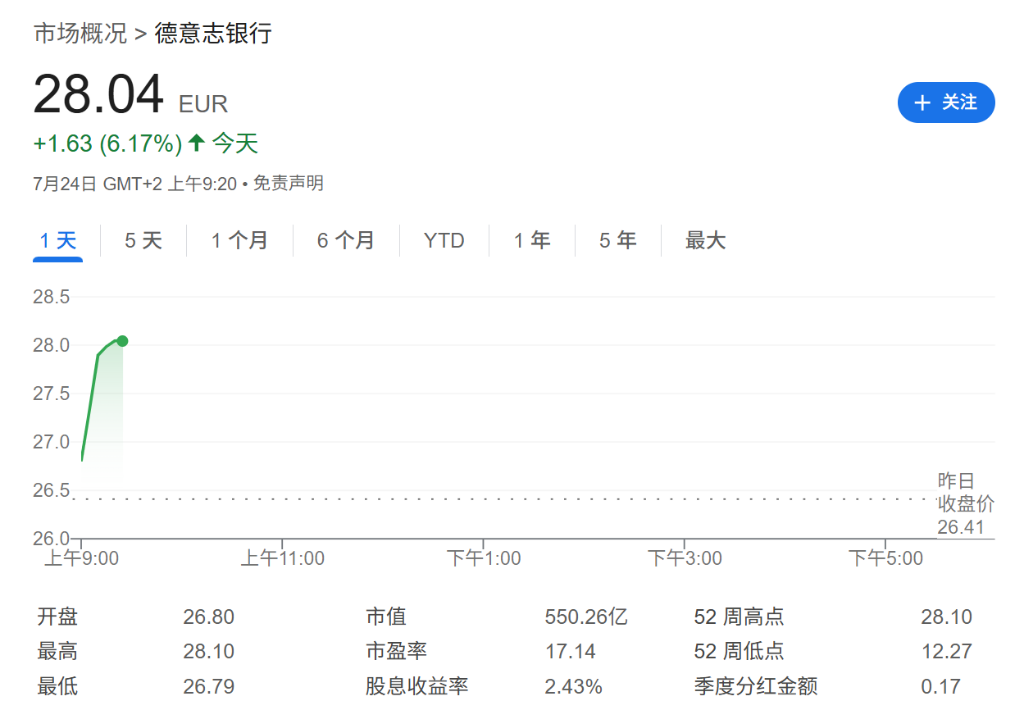
Core Viewpoint - Deutsche Bank reported its strongest second-quarter performance since 2007, with a significant increase in pre-tax profit driven by a sharp decline in litigation-related costs [1][4]. Group 1: Financial Performance - In Q2, Deutsche Bank's pre-tax profit surged to €2.4 billion, up from €0.4 billion in the same period last year, primarily due to a reduction in legal provisions [1]. - The bank released €85 million in legal provisions this quarter, compared to €1.3 billion in the same quarter last year related to the Postbank acquisition [1]. - The cost-to-income ratio improved significantly from 78.1% last year to 62.3% this year, moving towards the target of below 65% for the year [4]. Group 2: Investment Banking Division - The investment banking division contributed approximately one-third of the bank's revenue, showing mixed results [3]. - Fixed Income and Foreign Exchange (FICC) trading revenue increased by 11% year-on-year to €2.28 billion, exceeding analyst expectations [3]. - However, revenue from mergers and acquisitions advisory services declined by 29%, reflecting a slowdown in global trading activity [3]. Group 3: Future Outlook and Shareholder Commitment - The management expressed optimism about achieving all targets set for 2025 and plans to increase capital distribution to shareholders thereafter [6]. - Deutsche Bank confirmed it has submitted a stock buyback application to the European Central Bank, although specific amounts were not disclosed [6]. - The implementation of new capital regulations, known as CRR3, will not affect the bank's dividend strategy [6].
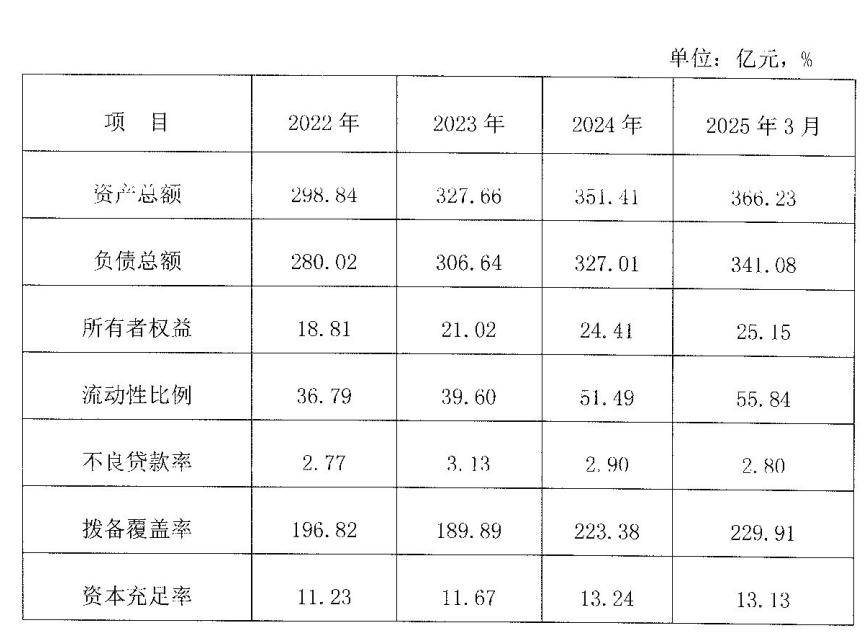
广西贵港农商银行2025年拟发行1亿元同业存单,3月末不良率为2.8%
Sou Hu Cai Jing· 2025-07-11 09:25
Group 1 - Guangxi Guigang Rural Commercial Bank plans to issue interbank certificates of deposit worth 100 million yuan for 2025 [1] - The bank's total assets reached 34.998 billion yuan in 2024, with a growth rate of 7.28%, and loan balance was 23.859 billion yuan, growing at 5.6% [1] - The bank achieved an operating profit of 716 million yuan in 2024, a year-on-year increase of 3.77%, and as of March 2025, total assets reached 36.623 billion yuan [1] Group 2 - The bank's net interest margin has been declining, from 3.25% in 2022 to 2.72% in 2024, although it slightly rebounded to 2.83% in Q1 2025 [2] - The cost-to-income ratio increased from 30.06% in 2023 to 34.59% in Q1 2025, indicating challenges in cost control [2] - The non-performing loan ratio was 3.13% in 2023, decreasing to 2.90% in 2024 and 2.80% in Q1 2025, but still remains at a relatively high level [2] Group 3 - The bank was established in March 2007, evolving from the Guigang City Rural Credit Cooperative, and was renamed several times, with the latest being Guangxi Guigang Rural Commercial Bank in June 2021 [2] - The bank is under the Guangxi Guigang Steel Group, with a registered capital of 503 million yuan [2] - The top four shareholders hold more than 5% of the shares, with Guangxi Guigang Steel Group holding 9.69% [3]