
平安银行

Search documents
银行股逆势走强成避风港
第一财经· 2025-11-13 01:07
Core Viewpoint - The banking sector has emerged as a "safe haven" amid market downturns, with significant gains driven by rising risk aversion, institutional fund inflows, and expectations of loose monetary policy [3][8]. Group 1: Banking Sector Performance - On November 12, the banking index rose by 0.46%, outperforming the Shanghai Composite Index, which fell by 0.07%, and the Shenzhen Component Index, which declined by 0.36% [3]. - Agricultural Bank of China led the sector with a 3.49% increase, reaching a market capitalization of over 3 trillion yuan, while other major state-owned banks also saw gains [5]. - The banking sector has accumulated an 8.73% increase in the fourth quarter up to November 12 [3]. Group 2: Fund Flows and Market Dynamics - The banking sector experienced a net inflow of 1.076 billion yuan, with Agricultural Bank, Ping An Bank, and Construction Bank attracting the most capital [6]. - The E Fund Bank ETF has seen a capital inflow of 567 million yuan over the past 22 trading days, indicating strong investor interest [6]. Group 3: Factors Driving Bank Stock Performance - Analysts attribute the banking sector's resilience to a combination of heightened risk aversion, long-term capital allocation, and expectations of monetary policy easing [8]. - The average dividend yield for the banking sector is approximately 6.5%, significantly higher than the 1.80% yield on 10-year government bonds, making it an attractive option for low-risk investors [8]. Group 4: Future Outlook for the Banking Sector - Institutions are optimistic about the banking sector's investment prospects, with expectations that high dividend strategies will continue to dominate the market [12]. - Analysts predict that the banking sector will remain a "ballast" in the market due to its stable dividends and low valuation characteristics, especially as economic conditions evolve [12]. - The ongoing structural adjustments in banking services towards technology, green finance, and pension finance are expected to enhance long-term growth potential and support valuation recovery [12].


多家银行上调积存金起点
2 1 Shi Ji Jing Ji Bao Dao· 2025-11-13 00:24
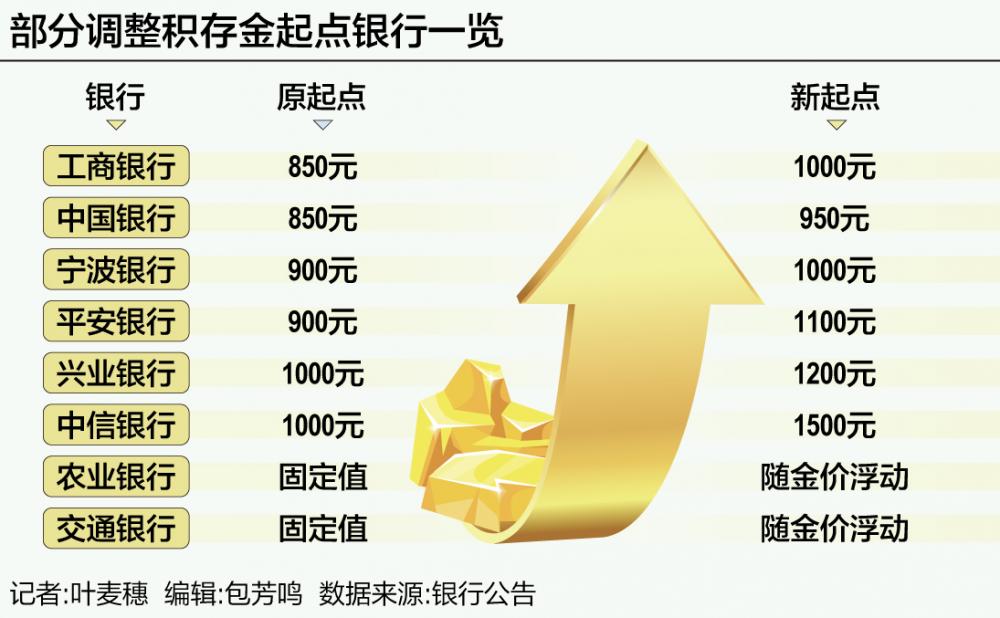
Core Viewpoint - The international gold price has returned to $4100 per ounce, prompting banks to raise the minimum investment threshold for gold accumulation, with some banks adjusting the starting point to a historical high of 1500 yuan [1][3]. Summary by Sections Bank Adjustments - Several banks have raised their gold accumulation thresholds, with notable changes including: - ICBC from 850 yuan to 1000 yuan - Bank of China from 850 yuan to 950 yuan - Ningbo Bank from 900 yuan to 1000 yuan - Ping An Bank from 900 yuan to 1100 yuan - Industrial Bank from 1000 yuan to 1200 yuan - CITIC Bank from 1000 yuan to 1500 yuan - Agricultural Bank and Bank of Communications have switched to a "floating with gold price" mechanism [2][3]. Investment Mechanism Changes - Some banks, like Agricultural Bank and Bank of Communications, have implemented a "floating with gold price" mechanism to avoid frequent adjustments, allowing the minimum investment amount to vary with market prices [4][5]. - This approach aims to provide flexibility for investors and better align with market dynamics [4]. Market Analysis - The gold price has seen significant volatility, with a rise of over 60% this year, peaking above $4300 per ounce before experiencing a sharp decline [6][7]. - Analysts have differing views on future gold prices, with predictions ranging from $3650 to $5000 per ounce by the end of 2026, influenced by various economic factors [7][8]. - The outlook remains optimistic for gold due to factors such as a weakening dollar and inflation risks, which could sustain investment demand [7][8]. Risk Awareness - In response to the volatile gold market, banks and regulatory bodies have increased risk awareness efforts, advising investors to recognize the inherent risks in precious metal investments [5].



银行再度上调积存金起投门槛
Zheng Quan Ri Bao Zhi Sheng· 2025-11-12 16:43
Core Insights - International gold prices have significantly rebounded, surpassing the $4100 per ounce mark, prompting banks to adjust their gold accumulation business rules and increase minimum investment thresholds [1][2][3] Group 1: Changes in Investment Thresholds - Multiple banks have raised the minimum investment amount for gold accumulation plans, with some banks increasing the threshold to 1500 RMB, up from 1000 RMB [2][3] - The adjustments in minimum investment amounts have been frequent throughout the year, particularly accelerating in the third quarter, with banks like China Construction Bank and others raising the threshold from 600 RMB to 1000 RMB or more [3][4] Group 2: Regulatory Compliance and Risk Management - The increase in minimum investment thresholds is primarily driven by the need to mitigate potential risks associated with gold market volatility and to ensure compliance with regulatory requirements [1][4] - According to industry experts, the adjustments serve as a risk warning to investors, encouraging them to be cautious and avoid irrational investment behaviors [4][5] Group 3: Investment Strategies and Recommendations - Investors are advised to adopt a rational approach to gold asset allocation, focusing on long-term value preservation rather than short-term speculation [5][6] - It is recommended that investors utilize a periodic investment strategy to mitigate the impact of market volatility, while also considering their financial situation and risk tolerance when determining the proportion of gold in their overall asset allocation [6]

年内券商发债规模同比增长超62%
Zheng Quan Ri Bao Zhi Sheng· 2025-11-12 16:38
Core Insights - The bond issuance by securities firms has significantly increased this year, with a total of 1.6 trillion yuan raised, marking a year-on-year growth of 62.34% [1][2] Group 1: Bond Issuance Trends - Securities firms are actively issuing bonds to enhance capital strength and market competitiveness, with 73 firms having issued bonds totaling 1.6 trillion yuan as of November 12 [1] - Major firms leading in bond issuance include China Galaxy with 126.9 billion yuan, Huatai Securities with 121.9 billion yuan, and others like Guotai Junan, GF Securities, and CITIC Securities [2] Group 2: Factors Driving Bond Issuance - The increase in bond issuance is driven by multiple factors, including abundant market liquidity, low interest rates, and the need for firms to strengthen capital to support business growth [2] - The launch of the "Technology Board" in the bond market has also contributed to the growth in bond issuance by securities firms [2] Group 3: Use of Raised Funds - The funds raised through bond issuance are primarily used for repaying maturing debts and supplementing operational liquidity, which is crucial for the stable operation and business expansion of securities firms [3] Group 4: Technology Bonds - Since the introduction of the "Technology Board" in May, 45 securities firms have issued 58 technology bonds, raising a total of 78.97 billion yuan, with high investor interest reflected in an average oversubscription rate of 3.8 times [4] - Leading firms in technology bond issuance include China Merchants Securities with 15 billion yuan and Guotai Junan with 13.9 billion yuan [4] Group 5: Market Development and Services - Securities firms are enhancing their roles in the technology bond market by providing liquidity and underwriting services, with 76 firms participating in underwriting, totaling 823.688 billion yuan [4][6] - The complexity of technology bond services is pushing firms to upgrade their core service capabilities, creating competitive advantages in the market [6]



万亿港元南向资金爆买港股,重点板块、个股曝光
2 1 Shi Ji Jing Ji Bao Dao· 2025-11-12 15:06
Core Viewpoint - The Hong Kong stock market has reached a milestone with cumulative net purchases from southbound funds exceeding 5 trillion HKD, reflecting unprecedented enthusiasm from mainland investors [1][4][5]. Group 1: Southbound Fund Inflows - As of November 11, southbound funds have recorded a net inflow of 1.31 trillion HKD in 2023, marking a historical high for the year [4][5]. - The inflow of southbound funds has accelerated, with 16 consecutive trading days of net purchases, and only 3 out of 23 trading days in October showing net outflows [5][9]. - The Hong Kong stock market has demonstrated significant profitability, with major indices like the Hang Seng Index and Hang Seng Tech Index rising over 30% this year [3]. Group 2: Investment Strategy Shift - There has been a notable shift in investment strategy among southbound funds, moving from a growth-oriented "offensive" approach to a focus on high-dividend "defensive" stocks [9][10]. - Financials have become the core asset for southbound funds, accounting for 39% of net purchases since 2025, with the top three sectors being financials, information technology, and consumer discretionary [9][10]. - The recent trend shows a significant reduction in holdings of high-growth, high-valuation sectors like pharmaceuticals and technology, while increasing investments in traditional sectors such as banking and oil, which offer low valuations and high dividend yields [10][11]. Group 3: Market Dynamics and Future Outlook - Analysts attribute the continued inflow of southbound funds to the low valuations and high dividend yields in the Hong Kong market, making it an attractive investment destination [6][7]. - The market is witnessing a rotation towards high-dividend sectors, with stocks like China National Offshore Oil Corporation gaining favor due to their strong dividend attributes [10]. - Despite the current defensive posture, there is potential for growth in undervalued quality stocks, suggesting future opportunities for a shift back to an offensive strategy [11].


银行股逆势走强成避风港,农行A股大涨3.5%创新高
Di Yi Cai Jing· 2025-11-12 12:56
Core Viewpoint - The banking sector has emerged as a "safe haven" amid market downturns, with significant gains in stock prices, particularly among state-owned banks, driven by rising risk aversion, institutional fund inflows, and expectations of loose monetary policy [1][2][3]. Group 1: Market Performance - On November 12, the banking index rose by 0.46%, outperforming the Shanghai Composite Index, which fell by 0.07%, and the Shenzhen Component Index, which declined by 0.36% [1]. - The banking sector has accumulated an increase of 8.73% as of the close on November 12 [1]. - Agricultural Bank of China led the sector with a 3.49% increase, reaching a market capitalization of over 3 trillion yuan [2]. Group 2: Fund Flows and Investment Trends - The banking sector saw a net inflow of 1.076 billion yuan in principal funds, with Agricultural Bank, Ping An Bank, and Construction Bank being the top beneficiaries [2]. - The E Fund Bank ETF attracted 567 million yuan over nearly 22 trading days, indicating strong interest in banking stocks [2]. Group 3: Factors Driving Performance - Analysts attribute the banking sector's resilience to a combination of heightened risk aversion, sustained long-term fund allocation, and reinforced expectations of monetary policy easing [3]. - The average dividend yield for the banking sector is approximately 6.5%, significantly higher than the 1.80% yield on 10-year government bonds, making it attractive for low-risk investors [3]. Group 4: Future Outlook - Analysts expect the high dividend strategy to remain a key theme, with long-term funds likely to continue increasing their allocations to banking stocks [4][6]. - The banking sector is anticipated to benefit from a stable net interest margin and improved profitability due to supportive monetary policies and financial regulations [5][6]. - Structural adjustments in banking services towards technology, green finance, and pension finance are expected to enhance long-term growth prospects and valuation recovery [6].
银行直售房,没那么吓人
Ge Long Hui· 2025-11-12 10:55
Core Insights - The recent surge in banks selling properties has raised concerns about the accumulation of non-performing assets within the banking sector [1][2][4] - Data indicates that the number of properties listed for sale by various rural credit systems is substantial, with Guangdong, Sichuan, and other provinces showing significant figures [1][2][6] - Despite the high number of properties being sold, they represent a small fraction of the overall housing inventory in major cities like Guangzhou, Shenzhen, and Chengdu [6][11][9] Summary by Sections Property Sales Data - Since August 2024, the Guangdong rural credit system has listed 12,386 properties for sale, while the Sichuan rural credit system has listed 24,821 properties since November 2024 [1] - Other provinces such as Liaoning, Guizhou, Jilin, and Fujian have also contributed to the total number of properties being sold [1] Market Reaction - The market has reacted with surprise, speculating that banks may be facing a significant amount of non-performing assets [2][4] - The perception is that the properties being sold are just the tip of the iceberg, indicating a larger issue with banks needing to liquidate assets [2] Non-Performing Loans and Asset Management - The sale of properties is often linked to borrowers' inability to repay loans, leading banks to reclaim and sell these assets [3] - The current data suggests that the number of properties being sold is relatively small compared to the total inventory of second-hand homes available in the market [6][11] Trends in Non-Performing Loan Rates - The overall non-performing loan rates for listed banks have been declining since 2020, indicating that banks have been effectively managing and disposing of non-performing assets [12][13] - As of November 2025, the non-performing loan rates for various banks show a downward trend compared to previous years, with many banks reporting lower rates than in 2020 [12][13] Industry Restructuring - The banking sector has undergone significant reforms and consolidations, with over 300 rural banks being merged or restructured in 2025 alone [15] - Major banks have also participated in these consolidations, indicating a strategic move to strengthen their positions and manage non-performing assets more effectively [15] Asset Disposal Efforts - Banks have been actively disposing of non-performing assets, with significant amounts being processed each year [18][20] - In 2025, banks disposed of 1.5 trillion yuan in non-performing assets, reflecting a proactive approach to managing risk [20] - The rural commercial banks have seen the highest non-performing loan rates but have also experienced the most significant reductions in these rates over the years [21][22]

行业点评报告:抵债房产加速处置下,银行涉房风险再观察
KAIYUAN SECURITIES· 2025-11-12 10:13
Investment Rating - The industry investment rating is "Positive" (maintained) [1] Core Insights - Banks are accelerating the disposal of debt properties due to multiple considerations including capital, profitability, and market risks. This includes selling properties obtained from non-performing loans on platforms like JD and Alibaba, which helps avoid legal disputes [3][4] - The current economic environment pressures banks to dispose of these assets quickly to reduce capital consumption, supplement profits, and mitigate risks associated with fluctuating real estate prices [3][4] - The scale and impairment provisions of debt assets among listed banks show significant differentiation, with some banks having higher levels of non-performing assets and varying impairment ratios [4][5] Summary by Sections Section on Debt Property Disposal - Banks are expediting the sale of debt properties to alleviate capital pressure, as regulations require disposal within two years to avoid punitive risk weights [3] - The new capital management guidelines propose extending the disposal period to five years and reducing risk weights for non-self-use properties beyond the disposal period [3][8] Section on Asset Characteristics - The characteristics of debt assets among listed banks vary significantly, with some banks like ICBC and Minsheng Bank having higher levels of debt assets and differing asset structures [4][9] - The impairment provision ratios for debt assets also differ, with some banks fully provisioning while others have lower ratios, indicating potential under-provisioning issues [4][5] Section on Risk Parameters - The risk exposure and default parameters for housing collateral loans indicate that the majority of banks have low default probabilities, particularly in first and second-tier cities [5][15] - The analysis shows that higher collateral values correlate with lower default probabilities, suggesting that banks with significant exposure in major cities may face manageable risks [5][15]
积极投身科技金融,多家中小银行上半年科技贷款增速超20%
2 1 Shi Ji Jing Ji Bao Dao· 2025-11-12 10:12
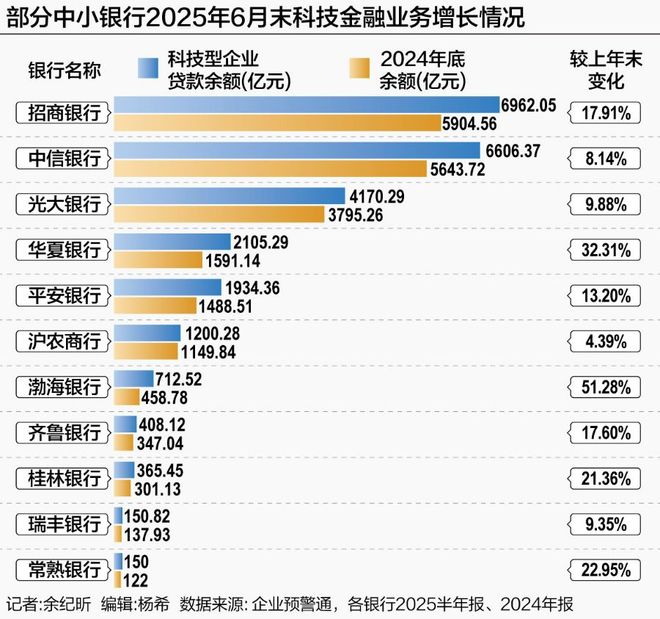
Core Insights - The report highlights the upgraded strategic positioning of technological innovation in China's financial sector, emphasizing the need for high-level self-reliance and strength in the context of the "14th Five-Year Plan" and the upcoming "15th Five-Year Plan" [1] - The rapid growth of technology finance in small and medium-sized banks is noted, with several banks reporting loan growth rates exceeding 20% in the first half of 2025 [1][6] Policy Developments - Central government initiatives in 2025 have focused on enhancing support for technology finance, particularly for small and medium-sized enterprises (SMEs) [2] - Key policies include the issuance of guidelines to strengthen financial support for major technological tasks and the promotion of credit loans for technology enterprises [2][3] - Local governments have also implemented action plans to support technological innovation, with specific targets for loan disbursement [3] Market Performance - As of June 2025, several small and medium-sized banks have shown significant growth in technology loans, with some banks like Huaxia Bank and Bohai Bank achieving over 20% growth [6][10] - The total balance of loans to technology SMEs reached 3.4 trillion yuan, reflecting a year-on-year growth of 22% [5] Financial Instruments - The introduction of the "Technology Board" in the bond market is a significant development, aimed at supporting technological innovation through diversified financing options [12] - By October 2025, banks had issued a total of 57 technology bonds, amounting to 277.6 billion yuan, indicating a strong market response [15] Participation of Financial Institutions - Major banks have taken a leading role in underwriting technology bonds, with a notable number of new issues and a significant total amount raised [16] - The participation of local small and medium-sized banks in the technology bond market is increasing, reflecting a broader engagement in supporting technological enterprises [17]
部分金饰价突破1310元/克 有银行提高定投门槛至1500元
2 1 Shi Ji Jing Ji Bao Dao· 2025-11-12 09:41
Group 1 - The domestic gold jewelry prices have significantly increased, with most brands surpassing 1300 RMB per gram, and some top brands exceeding 1310 RMB per gram, reaching new highs [2] - As of November 12, 2023, the international gold market continues to rise, with London gold priced at 4116.931 USD per ounce, reflecting a year-to-date increase of 56.89%, while COMEX gold is at 4119.6 USD per ounce, also up 56.09% for the year [2] - The domestic gold price in Shanghai is reported at 945.76 RMB per gram, with a year-to-date increase of 51.13%, indicating a clear upward trend in both domestic and international gold prices [2] Group 2 - Several banks have raised the minimum investment thresholds for gold accumulation products, with Citic Bank increasing its minimum from 1000 RMB to 1500 RMB effective November 15, 2025 [3] - China Construction Bank announced a revision to its gold accumulation business, raising the minimum investment amount from 1000 RMB to 1200 RMB, effective November 15, 2023 [3] - Other banks, including Ningbo Bank, Industrial and Commercial Bank of China, and Bank of China, have also adjusted their minimum investment amounts for gold accumulation products in recent weeks, reflecting a broader trend in the banking sector [4]

