
华润电力

Search documents
电价预期逐步明朗,如何看待火电行情表现?
Changjiang Securities· 2025-12-28 15:40
Investment Rating - The investment rating for the industry is "Positive" and maintained [7] Core Insights - The annual electricity price expectations are gradually becoming clearer, with multiple factors constraining electricity price levels. The average transaction price for Guangdong's annual electricity trading in 2026 has reached the lower limit of the medium to long-term trading price, indicating a downward price expectation [2][6] - Despite the clear downward expectation for electricity prices, the thermal power sector has shown relative stability, outperforming the hydroelectric sector, which is less impacted by price fluctuations [2][6] - The recent decline in coal prices and the expected increase in capacity prices for 2026 are expected to provide a buffer against the downward trend in long-term contract prices, supporting market expectations for thermal power company profitability [2][6] Summary by Sections Electricity Price Expectations - The electricity supply and demand situation is at risk of deterioration, and there are non-seasonal risks associated with coal prices. The market's expectation for the 2026 annual electricity price has been negatively impacted by weak monthly and spot electricity prices in some provinces [2][7] - The average monthly prices for Guangdong and Jiangsu this year were 373 and 377 cents/kWh, respectively, down by 47 and 52 cents/kWh year-on-year. The announcement of the annual trading results has confirmed the market's previous pessimistic expectations [2][6] Thermal Power Sector Performance - The thermal power sector has shown resilience despite the downward price expectations, driven by two main factors: a significant "inverted V" trend in coal prices since October and the expected stepwise increase in capacity prices for 2026 [2][6] - The price of Qinhuangdao Q5500 thermal coal peaked at 834 yuan/ton in late November but has since dropped to 672 yuan/ton by December 26, a decrease of 162 yuan/ton [2][6] - The expected increase in capacity prices by approximately 65 yuan/year·kW across provinces is anticipated to enhance the profitability stability of thermal power companies [2][6] Investment Recommendations - Recommended companies include Huaneng International, Datang Power, Guodian Power, Huadian International, China Power, China Resources Power, and Funiu Co., as well as Inner Mongolia Huadian, which represents "coal-electricity integration" thermal power [2][12][13] - For the hydroelectric sector, recommended companies include Yangtze Power, Guotou Power, Chuan Investment Energy, and Huaneng Hydropower [2][12][14] - In the renewable energy sector, companies such as Longyuan Power H, Xintian Green Energy H, China Nuclear Power, and Zhongmin Energy are recommended due to their potential for growth [2][12][15]




“无醇葡萄酒”市场乱象调查:披“无醇”外衣 葡萄汁变身葡萄酒
Xin Lang Cai Jing· 2025-12-25 17:23
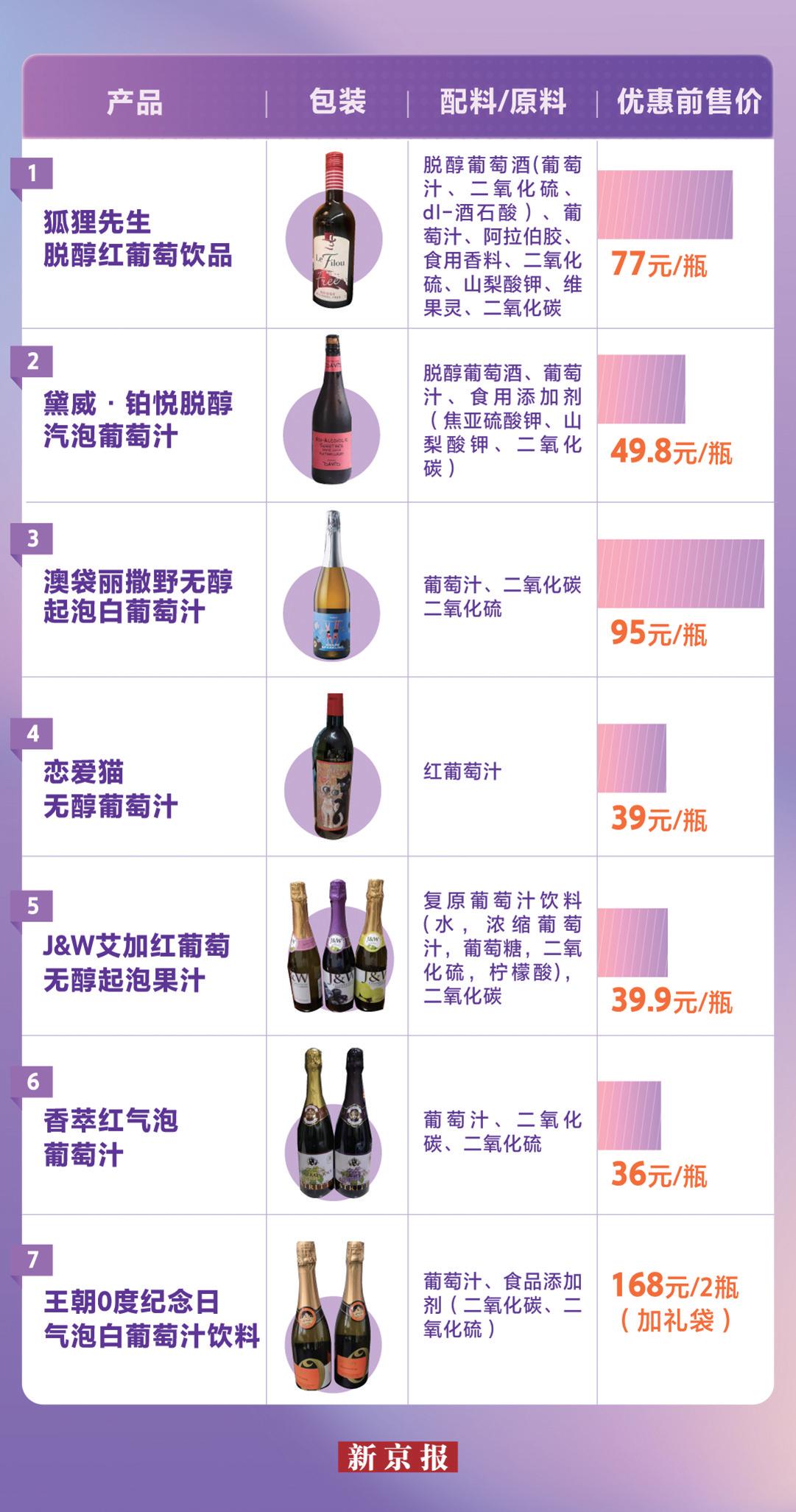
Core Viewpoint - The non-alcoholic wine market is experiencing a trend towards youthfulness and lower alcohol content, with non-alcoholic wines emerging as a popular alternative that retains the flavor and social attributes of traditional wines while eliminating health risks associated with alcohol consumption [1][5][21]. Group 1: Market Overview - A recent investigation revealed that out of 11 sampled products, only 4 were clearly labeled as "wine," while others were misrepresented as non-alcoholic wines but were actually unfermented grape juice [1][5]. - The non-alcoholic wine market in China is expected to enter a developmental "first year" by 2025, with major brands like Zhangyu and Great Wall entering the sector [5][21]. - The lack of clear standards for non-alcoholic wines in China has led to confusion among consumers regarding the distinction between non-alcoholic wines and grape juice products [2][21]. Group 2: Product Analysis - Among the 11 products analyzed, only 4 were labeled as "non-alcoholic wine," while the remaining 7 were labeled as "grape juice" or "grape beverage," making it difficult for consumers to discern their true nature [5][6]. - The ingredients of the products labeled as "non-alcoholic wine" often included grape juice and additives, which can mislead consumers regarding their actual content [6][17]. - Some products marketed as "0% alcohol" were found to contain alcohol levels of 0.5% vol, raising concerns about misleading labeling practices [18][19]. Group 3: Regulatory Environment - Current regulations in China do not provide a clear definition for "non-alcoholic wine," leading to inconsistencies in labeling and marketing practices [2][21]. - The introduction of new standards in 2024 is expected to clarify the definition of non-alcoholic wine, distinguishing it from grape juice products and ensuring proper labeling [22][23]. - The absence of a separate customs code for imported non-alcoholic wines complicates the classification and labeling of these products, often leading to misrepresentation [22][23].

广东公示年度长协电价,持续关注价格结算情况
Changjiang Securities· 2025-12-25 14:12
Investment Rating - The investment rating for the industry is "Positive" and is maintained [9]. Core Insights - The average transaction price for Guangdong Province in 2026 is projected to be 372.14 RMB/MWh, reaching the lower limit of the medium to long-term trading price, which represents a year-on-year decrease of 19.72 RMB/MWh. If the impact of the coal power capacity price increase in 2026 is considered, the comprehensive average electricity price will remain roughly the same as in 2025 [2][13]. - The total transaction volume for Guangdong Province in 2026 is expected to reach 359.437 billion kWh, reflecting a year-on-year growth of 5.38% [6][13]. - The Southern Energy Regulatory Bureau has emphasized the prohibition of signing "yin-yang contracts" and will strictly investigate violations in medium to long-term electricity trading. This indicates a focus on maintaining market order and rational trading [2][13]. - The report suggests that if electricity prices experience irrational declines, a new round of mechanism reforms may be initiated. The publication of the long-term electricity price in Guangdong marks the beginning of a new phase in the national electricity price negotiations [13]. Summary by Sections Section: Price Trends - The long-term electricity price has reached its lower limit, indicating potential volatility in prices if not constrained. The regulatory body has issued guidelines to ensure compliance and market stability [2][13]. - The coal power capacity price is set to increase from 100 RMB/year·kW to 165 RMB/year·kW in 2026, which, combined with a decrease in coal power utilization hours, will affect the average price for coal power units, keeping it stable compared to 2025 [2][13]. Section: Market Dynamics - The report highlights that the supply-demand relationship is becoming more relaxed, with an increase in new coal power installations, which may exert downward pressure on electricity prices. The dual-track pricing system of medium to long-term and spot markets is also contributing to this dynamic [13]. - The report recommends focusing on quality coal power operators such as Huaneng International, Datang Power, and others, as well as hydropower companies like Yangtze Power and Guotou Power, and new energy firms like Longyuan Power and China Nuclear Power [13].


华润电力(00836) - 续订持续关连交易 - 有关提供财务资助的2026年框架协议
2025-12-24 13:20
香港交易及結算所有限公司及香港聯合交易所有限公司對本公告的內容概不負責,對其準確性 或完整性亦不發表任何聲明,並明確表示,概不對因本公告全部或任何部份內容而產生或因倚 賴該等內容而引致的任何損失承擔任何責任。 (根據公司條例在香港註冊成立的有限責任公司) (股份代號:836) 續訂持續關連交易 有關提供財務資助的2026年框架協議 2026年框架協議 茲提述本公司日期為2023年12月11日之公告,內容乃關於本公司之全資附屬公 司新能源控股與新能源(涼山)於2023年12月11日就提供財務資助訂立2023年框 架協議,有效期由2023年12月11日起至2025年12月31日止。鑒於2023年框架協 議將於2025年12月31日屆滿,新能源控股與新能源(涼山)已於2025年12月24 日訂立2026年框架協議,據此,新能源控股集團將於2026年框架協議有效期內 (即由2026年1月1日起至2028年12月31日止)繼續不時向新能源(涼山)集團提 供總金額不超過適用年度上限的財務資助。新能源控股集團與新能源(涼山)集 團會就2026年框架協議項下擬進行的個別交易訂立單獨協議。 上市規則的涵義 於本公告日期,華潤三 ...

港股速报|恒指高开低走 今日新股表现两极分化
Mei Ri Jing Ji Xin Wen· 2025-12-23 12:26
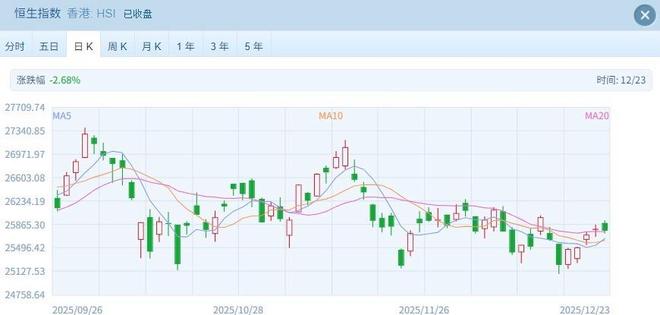
Market Performance - The Hong Kong stock market opened high but experienced a downward trend, closing slightly lower with the Hang Seng Index at 25,774.14 points, down 27.63 points or 0.11% [1] - The Hang Seng Tech Index also showed weakness, closing at 5,488.89 points, down 37.94 points or 0.69% [3] Sector Performance - There was a notable divergence in sector performance, with gold and wind power stocks leading gains, while technology stocks generally weakened [1] - Gold stocks continued to rise, driven by record high international gold prices, with Shandong Gold up nearly 5% [5] - The wind power sector saw significant gains, with Dongfang Electric rising over 8% [5] - Lithium battery stocks were positively impacted by optimistic lithium price expectations, with Ganfeng Lithium up over 4% and Tianqi Lithium rising over 2% [5] New Stock Performance - The new stock market showed significant divergence, with AI-related stocks like Nobi Kan (HK02635) performing exceptionally well, opening with a 299.75% increase from the issue price of 80 HKD and closing up over 363% [6] - Another new stock, Easy Health (HK02661), also performed strongly, opening with a rise of over 120% from the issue price of 22.68 HKD and closing up over 158.8% [6] - Conversely, the new stock Hansai Aitai-B (HK03378) struggled, closing down over 46% from its issue price of 32 HKD, ending at 17.2 HKD [9] Capital Flow - Southbound funds continued to flow into the Hong Kong stock market, with a net buy of 611 million HKD through the Stock Connect on December 23 [8] Future Outlook - According to a report by CITIC Securities, the Hong Kong stock market is expected to benefit from internal and external economic stimuli, potentially leading to a second round of valuation recovery and performance revival by 2026, with a focus on technology, healthcare, resource products, consumer staples, paper, and aviation sectors [11]
港股收盘 | 恒指收跌0.11% 科技股多数承压 黄金、锂电股表现活跃
Zhi Tong Cai Jing· 2025-12-23 09:58
Market Overview - The Hong Kong stock market opened slightly higher but weakened throughout the day, with all three major indices turning negative by the close. The Hang Seng Index fell by 0.11% to 25,774.14 points, with a total turnover of HKD 157.13 billion [1] - The Hang Seng China Enterprises Index decreased by 0.29% to 8,913.83 points, while the Hang Seng Tech Index dropped by 0.69% to 5,488.89 points [1] Blue Chip Performance - CSPC Pharmaceutical Group (01093) led the blue-chip stocks, rising by 7.64% to HKD 8.88, contributing 8.08 points to the Hang Seng Index. The stock had a turnover of HKD 2.76 billion [2] - Other notable blue-chip movements included Tingyi (00322) up by 2.07% to HKD 12.35, and China Resources Power (00836) up by 1.25% to HKD 17.8. Tencent Holdings (00700) and China Unicom (00762) both fell by 2.03%, dragging the index down by 42.3 points and 1.68 points respectively [2] Sector Highlights - Large tech stocks showed mixed performance, with Alibaba rising by 0.55% while Tencent fell by 2.03% [3] - Gold stocks initially surged but later retreated, with Shandong Gold (01787) closing up by 4.64% at HKD 37.86. The international gold price reached a historic high, with COMEX gold futures surpassing USD 4,500 per ounce [4][3] - Lithium battery stocks were active, with Ganfeng Lithium (01772) rising by 4.08% to HKD 56.15, and CATL's lithium production news causing market fluctuations [4][5] Upcoming Market Events - A wave of stock unlocks is expected in the Hong Kong market, with over ten companies, including Sanhua Intelligent Control and Yujing, having significant shareholder unlocks from December 16 to 31 [6] - Yujing's shares will be unlocked for 36 shareholders, totaling approximately 193 million shares, while Sanhua Intelligent Control will see 17 shareholders unlock around 196 million shares [6] Notable Stock Movements - New stocks had varied performances on their debut, with Nobikang (02635) soaring by 363.75% to HKD 371, while Hantang Aitai (03378) plummeted by 46.25% to HKD 17.2 [7] - Dongfang Electric (01072) showed strong performance, rising by 8.17% to HKD 25.94, benefiting from its position in the high-end energy equipment sector [8] - Cathay Pacific (00293) reported expected net profits exceeding HKD 9.88 billion (USD 1.3 billion) for 2025, marking a potential for consecutive annual profit growth for the first time in a decade [9] - Tmall's stock faced pressure, declining by 4.49% to HKD 2.98, with a reported year-on-year decline in retail and wholesale sales [10]
华源晨会精粹20251222-20251222
Hua Yuan Zheng Quan· 2025-12-22 12:41
证券研究报告 晨会 hyzqdatemark 2025 年 12 月 22 日 投资要点: 资料来源:聚源,华源证券研究所,截至2025年12月22日 华源晨会精粹 20251222 固定收益 短期制约因素突出,当前经济或仍承压——利率周报:11 月经济数据与财 政收支数据相继披露,当前经济或仍持续承压。我们认为经济运行核心矛盾仍聚焦 于"旧动能调整拖累与新动能成长并存",消费与投资的短期压力与财政收支的低 增长态势相互呼应。从经济运行基本面看,需求端或仍承压。消费与投资双引擎若 持续乏力,可能直接影响四季度经济增速预期,预计同比增速将较三季度有所放缓。 短期制约因素尤为突出:房地产市场仍在筑底阶段,居民消费短期仍可能保持谨慎 态度。2025 年 1-11 月财政收支情况显示,财政运行呈现"收入低增、支出中央地 方分化"的特征。当前经济与财政的运行态势,与 2025 年中央经济工作会议的政策 部署形成精准呼应。会议强化内需主导作用、突出企业创新主体地位,并新增"加 大逆周期和跨周期调节力度"的表述,为后续政策发力指明了方向。明年经济或呈 现弱修复态势,财政收支平衡压力或将持续。2026 年债市行情可能好于预期 ...
为什么越来越多品牌开始故意做小众?
3 6 Ke· 2025-12-22 10:47
Core Insights - The article discusses the shift in consumer behavior and market dynamics, highlighting how niche brands are thriving in a saturated market by addressing specific consumer needs and preferences [5][25]. Group 1: Market Dynamics - The traditional approach of targeting mass markets is becoming less effective as competition intensifies and profit margins shrink in a saturated environment [6][7]. - Brands are increasingly focusing on niche markets that larger companies overlook, allowing them to establish stronger customer loyalty and pricing power [8][19]. Group 2: Consumer Behavior - Modern consumers, especially younger generations, prioritize self-expression and individuality over mere functionality in their purchasing decisions [12][14]. - Consumers are willing to pay a premium for niche products that reflect their values and identity, contrasting with the past when purchases were primarily driven by functional needs [12][14]. Group 3: Brand Strategy - Successful niche brands, such as Yeti and Lululemon, focus on creating high-quality products tailored to specific consumer needs, allowing them to command higher prices and maintain profitability [19][20]. - The marketing approach has shifted from trying to persuade everyone to recognizing and attracting the right audience, which enhances customer loyalty and reduces marketing costs [21][23]. Group 4: Industry Implications - The article suggests that the future of branding lies in defining differences rather than seeking commonalities, as the concept of a mass market is fragmenting into various interest-based communities [25][26]. - Brands that fail to adapt to this new reality risk becoming irrelevant and losing their competitive edge in an increasingly niche-focused market [25][26].

申万公用环保周报(25/12/15~25/12/19):11月发电增速环比放缓进口LNG现货价格继续下跌-20251222
Shenwan Hongyuan Securities· 2025-12-22 07:46
Investment Rating - The report does not explicitly state an overall investment rating for the industry, but it provides specific recommendations for various sectors within the energy industry, indicating a positive outlook for certain companies and sectors [2][3]. Core Insights - The report highlights a slowdown in electricity generation growth in November 2025, with total generation at 779.2 billion kWh, a year-on-year increase of 2.7%. The growth was primarily driven by hydropower and wind power, while thermal power saw a decline [5][6]. - Natural gas prices in the U.S. and Europe have shown slight fluctuations, with U.S. Henry Hub spot prices at $3.58/mmBtu, reflecting a 12.1% weekly decline. Northeast Asia's LNG prices have also decreased, reaching $9.50/mmBtu, marking a 5% drop [18][19]. - The report emphasizes the increasing contribution of renewable energy sources, particularly wind and solar, to the overall electricity generation mix, with significant year-on-year growth rates [6][12]. Summary by Sections 1. Electricity Generation - November 2025 saw total electricity generation of 779.2 billion kWh, up 2.7% year-on-year. Thermal power generation decreased by 4.2% to 497.0 billion kWh, while hydropower increased by 17.1% to 96.7 billion kWh. Wind power grew by 22.0% to 104.6 billion kWh, and solar power rose by 23.4% to 41.2 billion kWh [5][7]. - From January to November 2025, total electricity generation reached 88,567 billion kWh, a 2.4% increase year-on-year, with significant contributions from hydropower, nuclear, wind, and solar energy [12][13]. 2. Natural Gas Market - As of December 19, 2025, U.S. Henry Hub spot prices were $3.58/mmBtu, down 12.1% from the previous week. European gas prices showed slight increases, with the Dutch TTF price at €28.10/MWh, up 2.0% [18][19]. - The report notes that the supply of natural gas remains high, with U.S. production at historical levels, contributing to the downward pressure on prices [18][19]. 3. Investment Recommendations - For thermal power, companies like Guodian Power and Inner Mongolia Huadian are recommended due to their integrated coal and power operations. For hydropower, companies such as Yangtze Power and State Power Investment Corporation are highlighted for their potential in the upcoming winter and spring [16][38]. - In the nuclear sector, China National Nuclear Power and China General Nuclear Power are suggested as key players due to their stable cost structures and growth potential [16][38]. - Renewable energy operators like Xinneng Green Energy and Longyuan Power are recommended as the market for green certificates and environmental values continues to grow [16][38].


申万公用环保周报:11月发电增速环比放缓,进口LNG现货价格继续下跌-20251222
Shenwan Hongyuan Securities· 2025-12-22 05:41
Investment Rating - The report maintains a positive outlook on the power and environmental sectors, indicating a favorable investment environment [1]. Core Insights - The report highlights a slowdown in electricity generation growth in November, with a total generation of 779.2 billion kWh, a year-on-year increase of 2.7%. The contribution from hydropower and wind power is significant, while thermal power shows a decline [7][9]. - Natural gas prices in the US and Europe have shown slight fluctuations, with Northeast Asia's LNG prices continuing to decline, reaching $9.50/mmBtu, the lowest since May 2024 [21][34]. - The report suggests various investment opportunities across different sectors, including thermal power, hydropower, nuclear power, green energy, and gas companies, emphasizing the importance of diversified revenue streams [19][41]. Summary by Sections 1. Electricity: November Generation Growth Slows, Hydropower and Wind Power Contribute Incrementally - November electricity generation totaled 779.2 billion kWh, with thermal power decreasing by 4.2% year-on-year, while hydropower increased by 17.1%, nuclear power by 4.7%, wind power by 22.0%, and solar power by 23.4% [7][9]. - The overall growth rate of electricity generation has slowed compared to the previous month, with hydropower and wind power contributing significantly to the incremental generation [8][9]. 2. Natural Gas: Global Gas Prices Show Minor Fluctuations, Asian and US Prices Continue to Decline - As of December 19, the Henry Hub spot price in the US was $3.58/mmBtu, down 12.10% week-on-week, while the TTF spot price in Europe was €28.10/MWh, up 2.00% [21][22]. - The report notes that the LNG ex-factory price in China was 4030 yuan/ton, a decrease of 3.70% week-on-week, indicating a trend of declining costs in the natural gas sector [39]. 3. Weekly Market Review - The public utility and electricity sectors underperformed compared to the CSI 300 index, while the gas and environmental sectors outperformed [44]. 4. Company and Industry Dynamics - The report discusses various company announcements and industry developments, including stable coal production and increased oil production rates, as well as significant investments in energy projects [46][48].
