蜜雪集团

Search documents
泡泡玛特,大涨超8%
Shang Hai Zheng Quan Bao· 2026-01-20 02:58
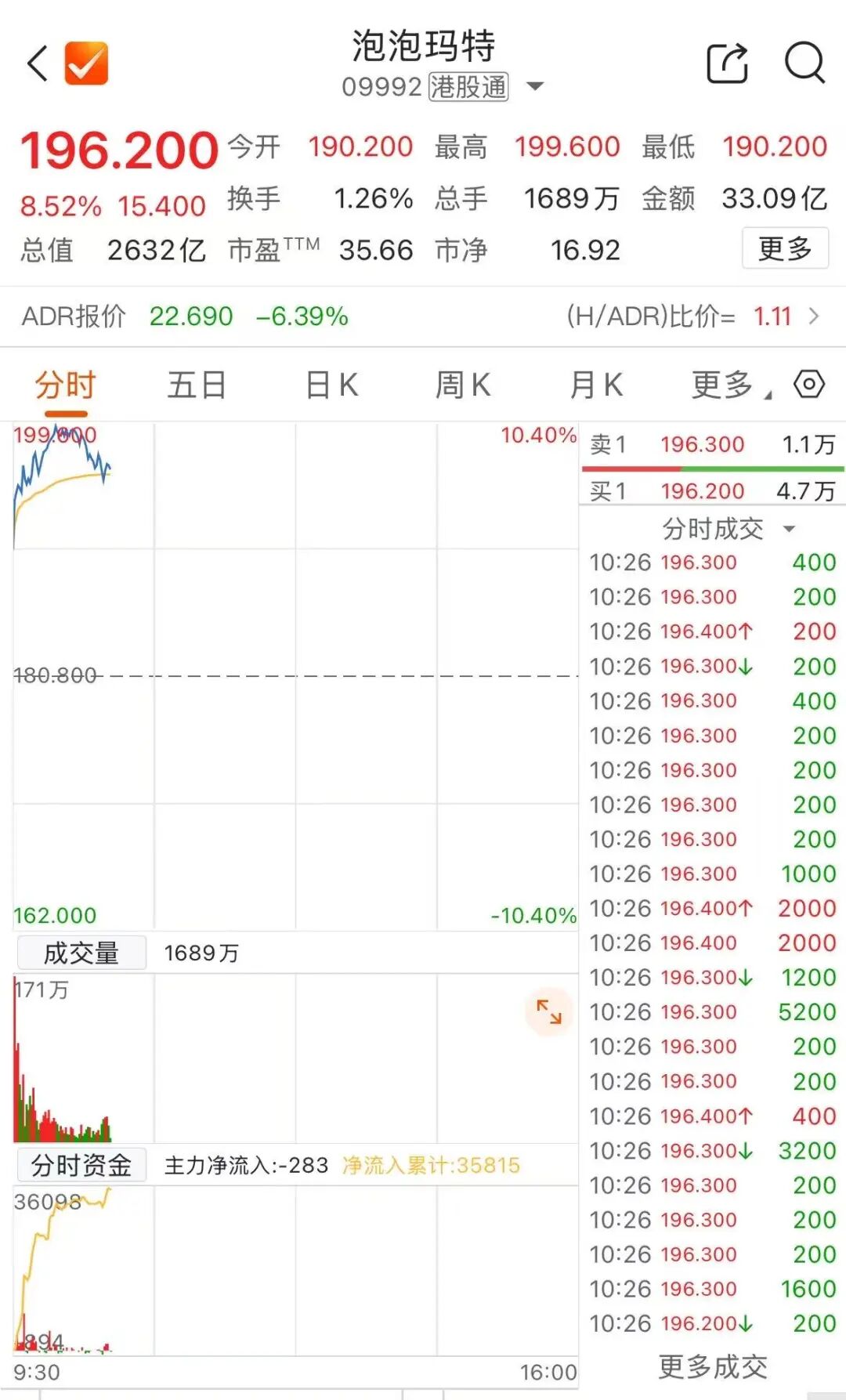
Group 1 - The Hong Kong stock market saw a strong performance in new consumer stocks on January 20, with notable gains for several companies [1] - Pop Mart experienced a significant increase, rising over 8% during the trading session [1] - Other companies such as China Duty Free Group (H shares) and Blukoo also saw gains of nearly 5% and over 5% respectively [1] Group 2 - Pop Mart's stock opened at 196.200, reaching a high of 199.600 and a low of 190.200, with a total trading volume of 16.89 million shares [2] - The market capitalization of Pop Mart is reported at 263.2 billion, with a price-to-earnings ratio of 35.66 and a price-to-book ratio of 16.92 [2] - The stock's performance indicates a net inflow of capital, with a cumulative net inflow of 35,815 [2]

港股新消费概念集体走强,泡泡玛特涨超8%,布鲁可涨超4%
Jin Rong Jie· 2026-01-20 02:50
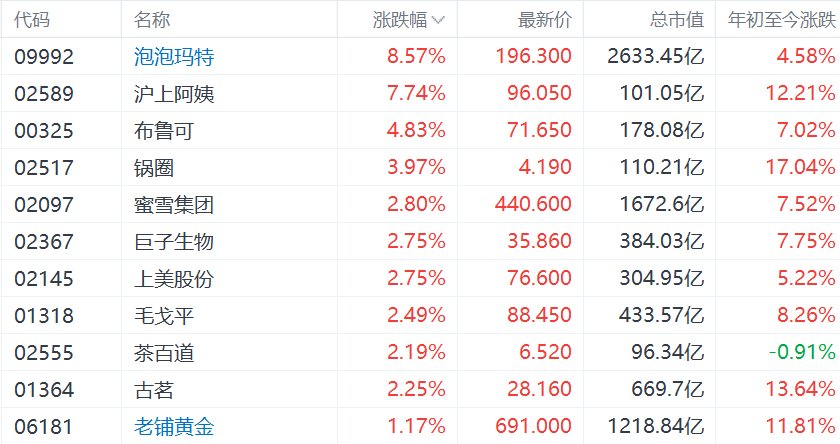
Group 1 - The core viewpoint of the article highlights that Pop Mart has initiated its first share buyback in two years, which has led to a significant increase in its stock price, boosting the performance of new consumer stocks in the Hong Kong market [1] Group 2 - As of now, Pop Mart's stock has surged over 8%, leading the market [1] - Other companies in the new consumer sector have also seen gains, with Hu Shang A Yi up over 7%, Blokus up over 4%, Guoquan up nearly 4%, and several others including Mixue Group, Shangmei Shares, Maolongping, Cha Baidao, and Guming all rising over 2% [1]
新消费概念集体走强,泡泡玛特涨超8%,布鲁可涨超4%
Ge Long Hui· 2026-01-20 02:44
Group 1 - The core viewpoint of the article highlights that Pop Mart has conducted its first share buyback in nearly two years, leading to a significant increase in its stock price and positively impacting the Hong Kong stock market for new consumer stocks [1] - Pop Mart repurchased 1.4 million shares at a price range of HKD 177.7 to HKD 181.2, totaling over HKD 250 million, marking the company's first buyback in two years [1] - The collaboration between Pop Mart and Honor resulted in the launch of the "潮玩手机" (Trendy Toy Phone), specifically the Honor 500 Pro Molly 20th Anniversary Limited Edition, priced at RMB 4,499, with a net price of RMB 3,999 after subsidies [1] Group 2 - Morgan Stanley noted that Pop Mart's share buyback is expected to attract more investor attention, particularly from those looking for stock price catalysts, and emphasized the company's strong growth and clear driving factors [1] - The firm projects that Pop Mart's net profit will reach RMB 12.6 billion by 2025, and the company had RMB 20 billion in net cash at the end of last year, indicating ample financial resources to provide returns to shareholders [1] - As of the latest data, Pop Mart's stock price increased by 8.57%, leading the market, with a total market capitalization of HKD 2,633.45 million and a year-to-date increase of 4.58% [2]
港股异动丨新消费概念集体走强,泡泡玛特涨超8%,布鲁可涨超4%
Ge Long Hui· 2026-01-20 02:37
Group 1 - The core viewpoint of the news is that Pop Mart has conducted its first share buyback in nearly two years, leading to a significant increase in its stock price and positively impacting the Hong Kong market for new consumer stocks [1] - Pop Mart repurchased 1.4 million shares at a price range of HKD 177.7 to HKD 181.2, totaling over HKD 250 million, marking the company's first buyback in two years [1] - The collaboration between Pop Mart and Honor to launch the "Trendy Toy Phone" has been announced, with the limited edition Honor 500 Pro Molly priced at RMB 4,499, and a promotional price of RMB 3,999 [1] Group 2 - Morgan Stanley noted that Pop Mart's share buyback is expected to attract more investor attention, particularly from those looking for stock price catalysts [1] - The firm highlighted that Pop Mart is experiencing strong growth with clear driving factors and a solid long-term outlook, projecting a net profit of RMB 12.6 billion by 2025 [1] - As of the end of last year, Pop Mart had RMB 20 billion in net cash, indicating ample financial resources to provide returns to shareholders [1]
港股新消费概念股回暖,沪上阿姨(02589.HK)盘中一度涨超10%,泡泡玛特(09992.HK)涨10.2%,布鲁可(00325.HK)涨超7%,古茗...




Jin Rong Jie· 2026-01-20 02:16
Group 1 - The new consumption concept stocks in the Hong Kong market are experiencing a rebound, with significant price increases observed in several companies [1] - "沪上阿姨" (02589.HK) saw its stock price rise by over 10% during trading [1] - "泡泡玛特" (09992.HK) increased by 10.2%, while "布鲁可" (00325.HK) rose by more than 7% [1] Group 2 - Other companies such as "古茗" (01364.HK) and "锅圈" (02517.HK) experienced nearly 5% increases in their stock prices [1] - "蜜雪集团" (02097.HK) also saw its stock price rise by over 4% [1]
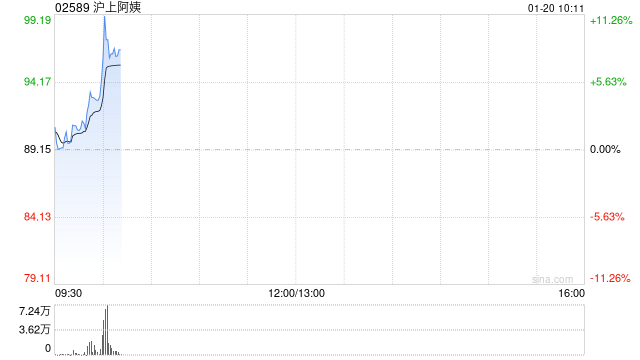
港股茶饮股盘中拉升,沪上阿姨一度大涨超10%,公司日前发盈喜
Xin Lang Cai Jing· 2026-01-20 02:11
Core Viewpoint - The Hong Kong tea beverage stocks experienced a significant rise, with notable increases in share prices for several companies, particularly "沪上阿姨" which saw a surge of over 10% during trading [1][4]. Group 1: Stock Performance - "沪上阿姨" shares rose by 8.47%, reaching a price of 96.700, with an increase of 7.550 [2][5]. - "古茗" shares increased by over 4% [1][4]. - "蜜雪集团" shares rose by 3.64%, priced at 444.200, with an increase of 15.600 [2][5]. - "茶百道" shares saw a rise of 2.98%, priced at 6.570, with an increase of 0.190 [2][5]. - "奈雪的茶" shares increased by 0.88%, priced at 1.150, with a slight increase of 0.010 [2][5]. Group 2: Company Earnings Forecast - "沪上阿姨" announced an earnings forecast, expecting a net profit of 495 million to 525 million yuan for the year 2025, representing a year-on-year growth of 50% to 60% [2][5]. - The adjusted net profit, which excludes stock payment and listing expenses, is projected to be between 560 million to 590 million yuan, indicating a year-on-year increase of 34% to 41% [2][5].
食品饮料行业周报:春节备货启动,肉奶周期共振
Donghai Securities· 2026-01-19 12:24
Investment Rating - The industry investment rating is "Overweight" indicating a positive outlook for the sector in the next six months [1]. Core Insights - The food and beverage industry is expected to benefit from the extended Chinese New Year stocking period, which may lead to improved performance in Q1 2026 [5]. - The raw milk price has been stabilizing at a low level, with the average price at 3.02 CNY/kg as of January 8, 2026, indicating a potential turning point in supply and demand dynamics [5]. - The secondary market performance showed a decline of 2.10% in the food and beverage sector, underperforming the CSI 300 index by 1.53 percentage points [10]. Summary by Sections 1. Secondary Market Performance - The food and beverage sector ranked 25th among 31 sectors, with all sub-sectors under pressure, particularly health products which saw a smaller decline of 0.72% [10]. - The top five performing stocks included CITIC Nia, Good Idea, and others, with gains ranging from 5.05% to 8.85% [10]. 2. Major Consumer Goods and Raw Material Prices - As of January 9, 2026, the retail price of fresh milk was 12.18 CNY/liter, and yogurt was 15.88 CNY/kg, showing slight weekly increases [26]. - The price of live pigs was 12.78 CNY/kg, with a weekly increase of 1.19% but a year-on-year decrease of 18.91% [26]. 3. Industry Dynamics - Yuanji Food Group and Jinxing Beer have submitted applications for listing on the Hong Kong Stock Exchange, with projected revenues of 2.026 billion CNY and 3.56 billion CNY respectively for 2023 [53]. - The dairy farming sector in Shandong is experiencing a recovery in raw milk prices, with a reported average cost of 3.34 CNY/kg for dairy farming [54].
现饮市场争夺加速:“价格之战”变“资本之战”
Zhong Guo Jing Ying Bao· 2026-01-19 06:03
Group 1 - The year 2025 is significant for China's ready-to-drink tea industry, with many new tea brands planning to go public and the coffee sector experiencing mergers and acquisitions [1][2] - The coffee market is characterized by four core features: market expansion, price stratification, rapid store openings, and the rise of local brands, with international brands like Starbucks seeking local partnerships [1][2] - New tea brands are shifting from rapid expansion to focusing on quality and customer loyalty, especially in overseas markets like North America [1][2] Group 2 - Several new tea brands, including Gu Ming and Mi Xue Group, are preparing for IPOs in 2025, contributing to a wave of capital influx in the industry [2] - In the coffee sector, Starbucks China is collaborating with Boyu Capital to expand its store count to 20,000, marking a significant strategic shift [2][3] - Luckin Coffee has become a dominant player with 29,214 stores globally, surpassing Starbucks in terms of store count and revenue [4][5] Group 3 - The competition in the coffee market is intensifying, with brands like Luckin Coffee and Manner Coffee adopting aggressive expansion strategies [5][6] - The focus is shifting towards high-traffic locations in first and second-tier cities, while brands are also investing in premium coffee segments [6] - The entry of Boyu Capital is expected to enhance Starbucks' market presence, particularly in smaller cities and emerging regions [6] Group 4 - The new tea drink sector is facing challenges, including a wave of store closures, with a reported net decrease of 16,000 tea shops in the past year [8] - Brands are competing aggressively in the low-price segment, with many products priced below 10 yuan [8][9] - New tea brands are also exploring international markets, particularly in North America and Latin America, to find new growth opportunities [9][10]
行业周报:赤子城科技Dramabite成短剧黑马,关注AKK菌布局企业-20260118
KAIYUAN SECURITIES· 2026-01-18 14:44
Investment Rating - Investment rating: Positive (maintained) [1] Core Insights - The luxury goods retail revenue in China is showing signs of recovery, with high-end brands like LVMH, Hermès, and Prada experiencing positive growth since Q2 2025 [15][16] - The global network literature market is witnessing rapid growth, particularly in Latin America, with WebNovel reaching nearly 400 million cumulative users by October 2025 [34][35] - The micro-drama and comic-drama market in China is projected to exceed 100 billion yuan in 2025, significantly surpassing the film box office revenue [37][38] - The probiotic market is expanding, with a focus on next-generation probiotics (NGPs) like AKK bacteria, which show significant potential in health applications [55][63] Summary by Sections 1. Duty-Free Shopping - Post-New Year duty-free shopping in Hainan shows strong growth, with sales reaching 3.89 billion yuan and a 49.6% year-on-year increase in shopping amount [31][33] - The high net worth individuals are expected to drive luxury consumption, with a notable increase in spending on preservation-type luxury goods [15][16] 2. Network Literature - The Chinese network literature market reached 49.55 billion yuan in 2024, with a 29.37% year-on-year growth, while the overseas market grew by 10.68% [34] - WebNovel has cultivated nearly 530,000 authors and over 820,000 original works, with a significant increase in user engagement [34][35] 3. Micro-Drama - The micro-drama and comic-drama market in China is expected to reach 100 billion yuan in 2025, with a 98% year-on-year growth [37][38] - The user base for micro-dramas is approaching 700 million, with a strong preference among female viewers [40][42] 4. Probiotics - The global probiotic market is projected to grow at a CAGR of 8.7%, reaching 93.49 billion USD by 2028, with China's market expected to reach 134.89 billion yuan by 2024 [55][63] - Next-generation probiotics like AKK bacteria are gaining traction, with significant potential in health management and consumer interest [55][63]




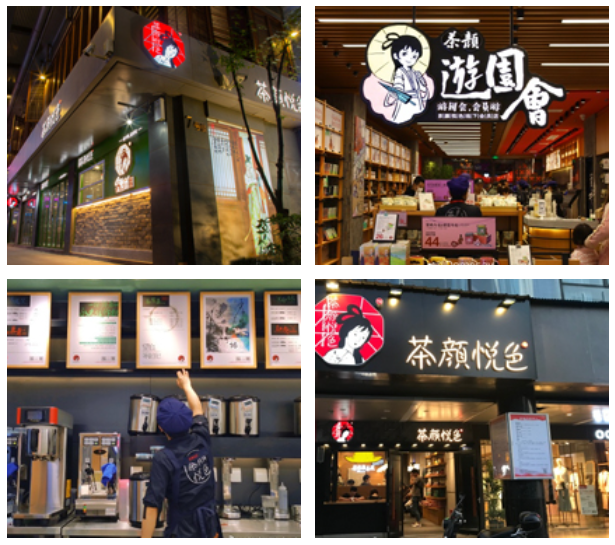
月薪2万-7万,茶颜悦色在北上深密集招人,公司回应“外拓”传闻:常规人员储备
Xin Lang Cai Jing· 2026-01-18 14:14
Core Viewpoint - The recent recruitment activities by the parent company of Cha Yan Yue Se in Beijing, Shenzhen, and Shanghai have sparked speculation about potential market expansion into North China, South China, and East China, although the company claims this is part of routine personnel reserves [1][14][16]. Group 1: Recruitment and Market Expansion - Cha Yan Yue Se is hiring for various positions in Beijing, Shenzhen, and Shanghai, with salaries ranging from 15,000 to 75,000 yuan, indicating a focus on brand, content, market, and technical roles [3][6][18]. - The company has stated that any new store opening plans will be communicated through its official channels, emphasizing that current hiring is for routine personnel reserves [1][14][20]. - There is speculation about a new creative studio being established in Shanghai, aimed at attracting professional talent and gathering creative inspiration, rather than immediate store openings [20][22]. Group 2: Company Growth and Competition - Established in 2013, Cha Yan Yue Se has only expanded to four provinces with approximately 758 stores, while competitors like Bawang Tea and Mixue Ice City have rapidly expanded to over 7,000 and 10,000 stores respectively [8][21][24]. - The company has been cautious in its expansion strategy, with a history of slow growth due to its direct sales model and concerns over product quality and supply chain management [9][21][22]. - Recent reports indicate that several investment firms have exited their stakes in Cha Yan Yue Se, returning control to the founding team, which may impact future growth and expansion plans [10][22][24]. Group 3: Industry Landscape - The new tea beverage market has undergone significant changes, with many competitors adopting franchise models for rapid expansion, while Cha Yan Yue Se has maintained a direct sales approach [12][24]. - Major competitors have successfully gone public and leveraged capital for global expansion, contrasting with Cha Yan Yue Se's more cautious approach to growth and potential IPO plans [12][22][24]. - The company is exploring new growth avenues, including retail and product diversification, but these efforts are currently limited to the Changsha area [11][23].