中国铝业

Search documents
90后、00后成为省委书记“座上宾”,传递什么信号?
Mei Ri Jing Ji Xin Wen· 2025-12-19 14:18
每经记者|淡忠奎 每经编辑|刘艳美 "我们欢迎宇树科技在黑龙江省布局人工智能产业,围绕大模型、绿色算力、人机交互、具身智能等领域,深化技术创新、市场应用和产业培育合作……"近 日,黑龙江省委书记许勤会见宇树科技董事长兼首席执行官、首席技术官王兴兴,让外界对这个东北省份的新兴产业布局有了更多期待。 地方领导干部的"座上宾",向来是观察其发展动向与工作重心的窗口。一个明显趋势是,年轻企业家正成为备受关注的群体。 今年以来,从星竞威武集团"90后"董事长何猷君,到武汉模态跃迁科技"00后"首席运营官常元和,再到宇树科技"90后"创始人王兴兴,多地党委"一把手"的 座上宾中,年轻面孔越发常见。 "新质生产力强调的是创新,而创新技术迭代非常快,很多都是年轻人掌握的。"复旦大学政党建设与国家发展研究中心主任、教授郑长忠对城市进化论表 示,从中央到地方的"十五五"规划建议,都非常强调因地制宜发展新质生产力,这也使新兴产业、创新企业以及高校的前沿研究,越来越受到各地主要领导 的重视。 梳理一年间主要省份党委书记的"座上宾"名单,一幅新的区域经济发展版图,越发清晰可见。 年轻面孔 "以往地方招商引资、产业对接多聚焦于成熟企业与 ...


国内唯一、亚洲最大,山东海底发现巨型金矿!紫金矿业翻红,有色50ETF(159652)涨近2%!机构:通胀缓解+宽松预期,有色金属行情可期
Sou Hu Cai Jing· 2025-12-19 10:24
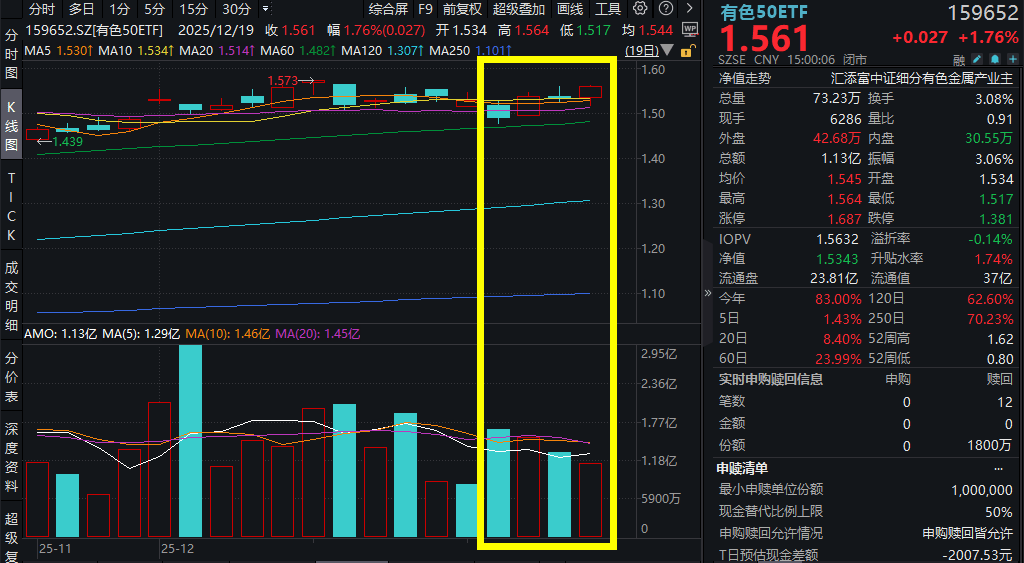
Core Viewpoint - The A-share market has shown significant recovery, with over 4,400 stocks rising, particularly in the non-ferrous metals sector, where the Non-Ferrous 50 ETF (159652) increased by 1.76% [1] Non-Ferrous Metals Sector Performance - The majority of the Non-Ferrous 50 ETF constituent stocks experienced gains, with notable increases such as Yun Aluminum Co. (000807) rising by 6.48%, and other companies like Northern Rare Earth, Huayou Cobalt, and China Aluminum seeing increases of over 3% [3] - The top ten constituent stocks of the Non-Ferrous 50 ETF include companies like Sanfour New Materials, Jialong Aluminum, and Northern Rare Earth, with varying performance metrics [4] Domestic and International News Impact - A significant domestic discovery of a giant underwater gold mine in Laizhou City, with proven gold reserves exceeding 3,900 tons, accounting for approximately 26% of the national total [5] - Internationally, U.S. inflation data showed a lower-than-expected increase in the core Consumer Price Index (CPI), leading to heightened expectations for Federal Reserve interest rate cuts, which positively influenced global commodity markets [6] Characteristics and Importance of Non-Ferrous Metals - Non-ferrous metals encompass all metals excluding ferrous metals, including precious metals (gold), industrial metals (copper, aluminum), energy metals (lithium), and rare earths, playing a crucial role in the economy [8] - Copper is highlighted as a key industrial metal, often referred to as the "doctor of the economy," and is increasingly recognized as essential in the AI era [9] Investment Outlook for Precious Metals - The outlook for gold remains positive due to factors such as declining real interest rates, ongoing central bank purchases, and the potential for a global debt crisis reshaping economic order [12][14] - Predictions indicate that gold prices could exceed $4,500 per ounce in the first quarter of next year, with long-term forecasts suggesting prices could reach $5,000 to $6,000 by 2026 [15] Copper Market Dynamics - The copper market is characterized by both supply rigidity and vulnerability, with increasing demand driven by traditional and emerging sectors, including AI and renewable energy [16] - Forecasts indicate a growing global copper supply-demand gap, with prices expected to rise significantly, potentially reaching $12,000 per ton by the end of the year [19] Non-Ferrous 50 ETF Advantages - The Non-Ferrous 50 ETF (159652) offers comprehensive exposure to various metal sectors, with a high concentration of copper (31%) and gold (14%), making it a leading choice for investors [21] - The ETF has demonstrated superior performance with a cumulative return leading its peers, driven by earnings rather than valuation expansion, indicating a strong investment experience [22][23]

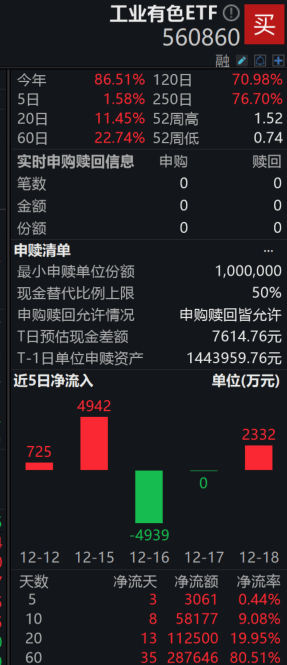
11月CPI或增美联储鸽派声音,国际铜、铝期价上涨,工业有色ETF(560860)放量涨超2%,场内溢价频现,近10日“吸金”超5.8亿
Sou Hu Cai Jing· 2025-12-19 06:44
Group 1 - The market experienced a slight increase on December 19, with the non-ferrous metals sector leading the gains, including copper, aluminum, and rare earths, with Yun Aluminum rising over 60% [1] - The Industrial Non-Ferrous ETF (560860) saw a trading volume exceeding 3.1 billion, surpassing the total from the previous day, indicating active trading with frequent premiums in the market [1] - The Industrial Non-Ferrous ETF has attracted significant capital, with over 5.8 billion raised in the last 10 days, over 11 billion in the last 20 days, and over 28 billion in the last 60 days, bringing its latest scale to 69.88 billion [1] Group 2 - Internationally, U.S. inflation showed unexpected easing, with the November core CPI rising by 2.6%, the lowest since 2021, providing the Federal Reserve with substantial room to consider interest rate cuts [3] - LME metal futures generally rose, with LME copper increasing by 41 USD to 11,778 USD/ton and LME aluminum rising by 10 USD to 2,916 USD/ton [3] - In the rare earth sector, Chinese authorities have communicated policies to exporters, with some exporters meeting the basic requirements for applying for general licenses, indicating a potential increase in exports [3] Group 3 - According to Guotai Junan Securities, copper is expected to see dual positive catalysts from its financial and commodity attributes, with increased demand and inventory pressures due to insufficient supply [3] - Aluminum is anticipated to break out of its three-year price range due to strong demand and low inventory, entering a phase of significant upward movement driven by demand catalysts [4] - The Industrial Non-Ferrous ETF closely tracks the CSI Industrial Non-Ferrous Metals Theme Index, covering leading strategic resources such as copper, aluminum, and rare earths, providing opportunities for investors to capitalize on cyclical and policy-driven benefits [4]



流动性宽松预期提振市场行情,有色ETF基金(159880)午后涨超1%
Sou Hu Cai Jing· 2025-12-19 05:25
截至2025年12月19日 13:04,国证有色金属行业指数(399395)强势上涨1.35%,成分股铂科新材(300811) 上涨6.29%,云铝股份(000807)上涨4.99%,神火股份(000933)上涨3.70%,天山铝业(002532),金力永磁 (300748)等个股跟涨。有色ETF基金(159880)上涨1.45%,最新价报1.82元。 据美国劳工统计局最新发布的报告,美国CPI数据超预期放缓。受此影响,美国联邦基金利率期货显 示,美联储1月份降息的可能性从26.6%上升至28.8%。交易员押注明年美联储将降息62个基点。 有色ETF基金(159880),场外联接(A:021296;C:021297;I:022886)。 以上内容与数据,与有连云立场无关,不构成投资建议。据此操作,风险自担。 展望后市,机构普遍认为,尽管板块短期波动幅度可能加大,但中长期景气逻辑依然坚实。主要金属的 供需紧平衡格局有望延续,部分品种的短缺问题或持续存在。同时,板块整体估值并未全面泡沫化,在 产能周期驱动和宏观环境支撑下,其上行趋势仍有望持续。 有色ETF基金紧密跟踪国证有色金属行业指数,国证有色金属行业指数参照 ...
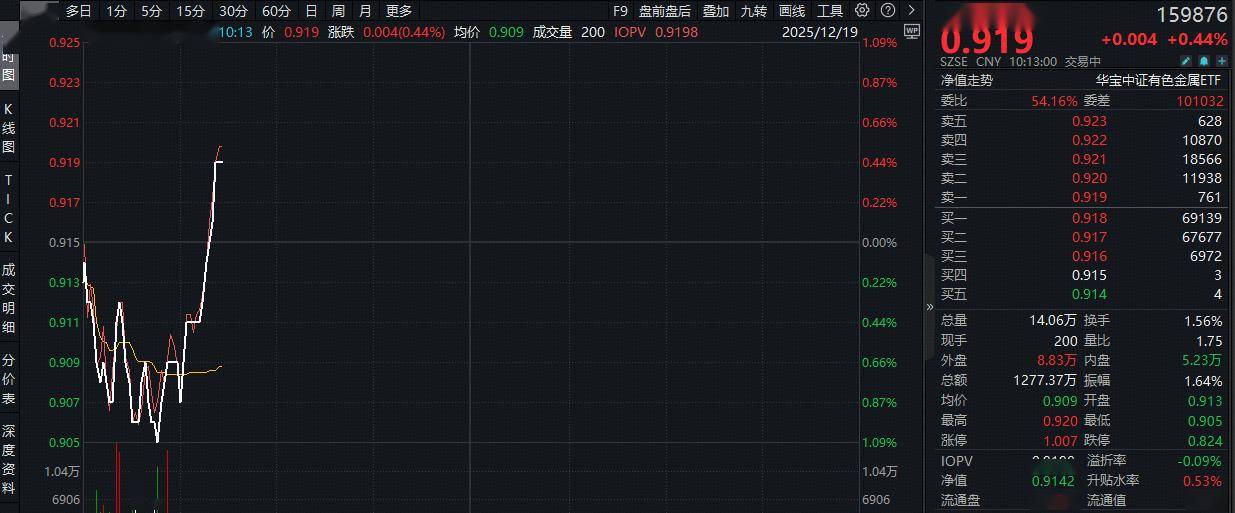
ETF盘中资讯|商务部表态!稀土出口破冰!北方稀土涨超1%,有色ETF华宝(159876)早盘拉升翻红!
Sou Hu Cai Jing· 2025-12-19 03:01
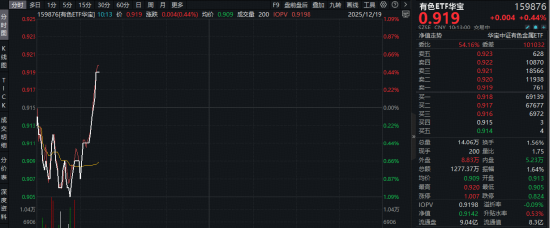
今日(12月19日)早盘,有色金属板块从水面下强势拉升翻红,同标的指数规模最大的有色ETF华宝(159876)场内价格现涨0.44%,当前站在所有均线上 方。 成份股方面,西部超导涨超3%,立中集团、楚江新材涨逾2%,天山铝业、盛和资源、中国稀土等个股跟涨。权重股方面,中国铝业、北方稀土涨超1%, 紫金矿业、洛阳钼业飘红。 | 15分 30分 60分 日 周 月 更多 | 多日 1分 5分 | F9 盘前盘后 叠加 九转 画线 工具 ♡ ② | 17 | 10:13 价 0.919 涨跌 0.004(0.44%) 均价 0.909 成交量 200 IOPV 0.9198 | 2025/12/19 | WE | | | --- | --- | --- | --- | --- | --- | --- | --- | | .09% | 0.925 | 四号 | 10:13:00 交易中 | SZSE CNY | | | | | 降值走势 | 0.923 | 0.87% | 54.16% 중 | 整次 | 又找图 | | | | 英 | 0.92 | 0.921 | 0.66% | 題 死 年 是 是 死 | 0.9 ...

中国铝业涨2.09%,成交额7.04亿元,主力资金净流出1731.53万元
Xin Lang Cai Jing· 2025-12-19 02:53
12月19日,中国铝业盘中上涨2.09%,截至10:32,报10.75元/股,成交7.04亿元,换手率0.51%,总市值 1844.23亿元。 资料显示,中国铝业股份有限公司位于北京市海淀区西直门北大街62号,成立日期2001年9月10日,上 市日期2007年4月30日,公司主营业务涉及铝土矿、煤炭等资源的勘探开采,氧化铝、原铝和铝合金产品 生产、销售、技术研发,国际贸易,物流产业,火力及新能源发电等。主营业务收入构成为:销售商品 97.41%,其他业务收入1.56%,提供服务1.03%。 中国铝业所属申万行业为:有色金属-工业金属-铝。所属概念板块包括:债转股、中特估、H股、有色 铝、证金汇金等。 截至9月30日,中国铝业股东户数35.63万,较上期减少2.91%;人均流通股0股,较上期增加0.00%。 2025年1月-9月,中国铝业实现营业收入1765.16亿元,同比增长1.58%;归母净利润108.72亿元,同比增 长20.58%。 分红方面,中国铝业A股上市后累计派现133.58亿元。近三年,累计派现78.23亿元。 资金流向方面,主力资金净流出1731.53万元,特大单买入9172.91万元,占比1 ...
商务部表态!稀土出口破冰!北方稀土涨超1%,有色ETF华宝(159876)早盘拉升翻红!
Xin Lang Cai Jing· 2025-12-19 02:28
今日(12月19日)早盘,有色金属板块从水面下强势拉升翻红,同标的指数规模最大的有色ETF华宝 (159876)场内价格现涨0.44%,当前站在所有均线上方。 成份股方面,西部超导涨超3%,立中集团、楚江新材涨逾2%,天山铝业、盛和资源、中国稀土等个股 跟涨。权重股方面,中国铝业、北方稀土涨超1%,紫金矿业、洛阳钼业飘红。 消息面上,商务部新闻发言人表态,目前已收到并批准了部分中国出口商提交的通用许可申请。对于民 用、合规的稀土出口申请,将得到中国政府的及时批准,全球供应链的紧张情绪有望得到缓解。 业内人士指出,商务部关于稀土出口管制的表态,对稀土板块形成四重核心利好: 1、审批效率提升:从"逐笔审批"到"通用许可",出口流程大幅简化,订单执行效率提升; 2、行业集中度提升:通用许可优先向合规龙头倾斜,头部效应强化,加速淘汰不合规中小企业; 3、价格中枢上移:管制政策强化供给刚性,同时通用许可保障合规需求释放,供需格局优化推动价格 稳步上涨; 4、战略价值重估:军民两用属性凸显,出口管制提升资源话语权,全球产业链地位巩固。 展望有色金属板块后市,中信建投证券认为,在四季度全球宏观经济波动加剧与地缘局势冲突升级 ...
2025年全球及中国汽车线缆行业分类、产业链、市场规模、重点企业及发展趋势研判:汽车产业发展态势良好,驱动汽车线缆规模突破200亿元[图]
Chan Ye Xin Xi Wang· 2025-12-19 01:49
Core Insights - The automotive cable industry is crucial for electric energy transmission, signal transmission, and control in vehicles, with increasing importance due to the rise of electric vehicles and automotive intelligence [1][7] - The market size of China's automotive cable industry is projected to grow from 149 billion yuan in 2021 to 193.2 billion yuan in 2024, with a compound annual growth rate (CAGR) of 9.05% [1][7] - The global automotive cable market is expected to expand from $58.21 billion in 2020 to $71.74 billion in 2024, with a CAGR of 5.36% [6] Industry Overview - Automotive cables are specifically designed for vehicles, categorized by purpose (signal and power cables), material (copper and aluminum), voltage (high and low), and temperature tolerance (high and low) [3] - The automotive cable industry supply chain includes raw materials (copper, aluminum, rubber, plastic), manufacturing, and downstream automotive manufacturers [3] Market Trends - The automotive cable market is expected to benefit from the increasing demand for electric vehicles and the advancement of smart connectivity in cars, leading to higher cable usage and value per vehicle [1][4] - The market size is anticipated to exceed 200 billion yuan by 2025, driven by economic growth and rising consumer demand [1][7] Competitive Landscape - The Chinese automotive cable industry is characterized by a mix of foreign dominance and local competition, with companies like Yazaki and Sumitomo leading the high-end market, while domestic firms like Carby and Xinhongye are gaining market share [8] - Carby and Xinhongye are focusing on technology introduction and cost advantages to enhance their market presence, especially in the growing electric vehicle segment [8] Challenges - The industry faces challenges such as outdated raw material performance, which affects the development of new automotive cables and increases operational costs [11] - The supply chain is often closed, with established international brands preferring to source from stable partners, making it difficult for local manufacturers to penetrate these networks [12] Future Development Trends - Lightweight cables are becoming a focus due to the push for energy efficiency and electric vehicle transition, utilizing aluminum alloys and innovative insulation materials [13][14] - High-voltage systems are being integrated into electric vehicles, necessitating advancements in insulation materials and safety features [15] - The demand for high-speed data transmission is increasing, leading to the development of high-frequency and high-speed cable systems [16] - Smart manufacturing technologies are reshaping production processes, enhancing flexibility and customization in cable manufacturing [17]



碳酸锂期货续涨超2%!华友钴业涨超4%,获8万吨“超级订单”!有色50ETF(159652)冲击两连阳,盘中强势吸金超2000万!金、铜后市怎么看?
Sou Hu Cai Jing· 2025-12-18 03:52
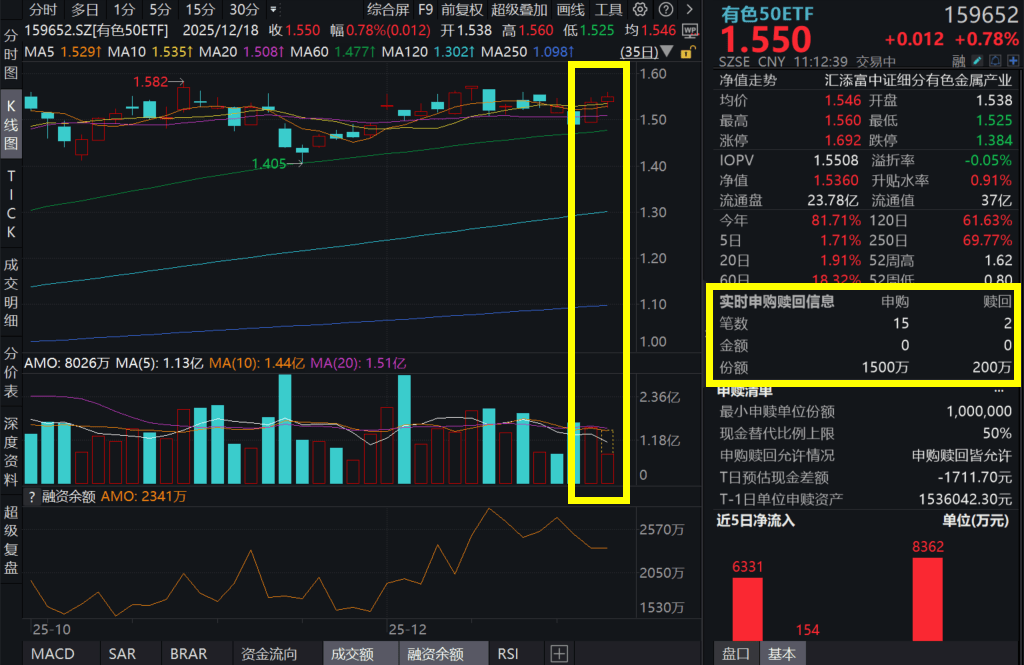
Core Viewpoint - The A-share market is experiencing an upward trend, particularly in the non-ferrous metals sector, driven by significant capital inflows and positive price dynamics in the sector [1][3]. Group 1: Market Performance - The non-ferrous 50 ETF (159652) saw a slight increase of 0.78%, aiming for a second consecutive day of gains, with over 20 million yuan in capital inflow during the trading session [1]. - Over the past five days, the non-ferrous 50 ETF attracted more than 120 million yuan in investments, indicating strong market interest [1]. Group 2: Key Stocks and Announcements - Major stocks within the non-ferrous 50 ETF index experienced gains, with Huayou Cobalt rising over 4% and Shandong Gold increasing by over 2%, influenced by an 80,000-ton "super order" [3][5]. - Huayou Cobalt announced a binding memorandum with a well-known international client to supply a total of 79,600 tons of ternary precursor products [5]. - Luoyang Molybdenum announced plans to acquire 100% equity in EQX's LatAm and Luna Gold Corp. for approximately 10.15 billion USD, equivalent to over 7.1 billion yuan [5]. Group 3: Industry Trends - Lithium carbonate futures surged again, following a previous increase of 7%, reflecting ongoing bullish sentiment in the market [6]. - The Jiangxi Yichun Natural Resources Bureau plans to revoke 27 mining rights, which could tighten lithium supply and support domestic lithium carbonate prices [8]. - The non-ferrous metals sector is seen as crucial for economic recovery and technological advancements, with copper being highlighted as a key indicator of economic health [9]. Group 4: Investment Opportunities - The non-ferrous 50 ETF (159652) is positioned to benefit from a super cycle in non-ferrous metals, covering a wide range of metals including gold, copper, aluminum, lithium, and rare earths [24][26]. - The ETF has a leading concentration of "gold and copper content," with copper accounting for 31% and gold for 14% of its index [26]. - The index has shown a cumulative return of 86.28% since 2022, driven by earnings rather than valuation expansion, indicating a favorable investment environment [28].




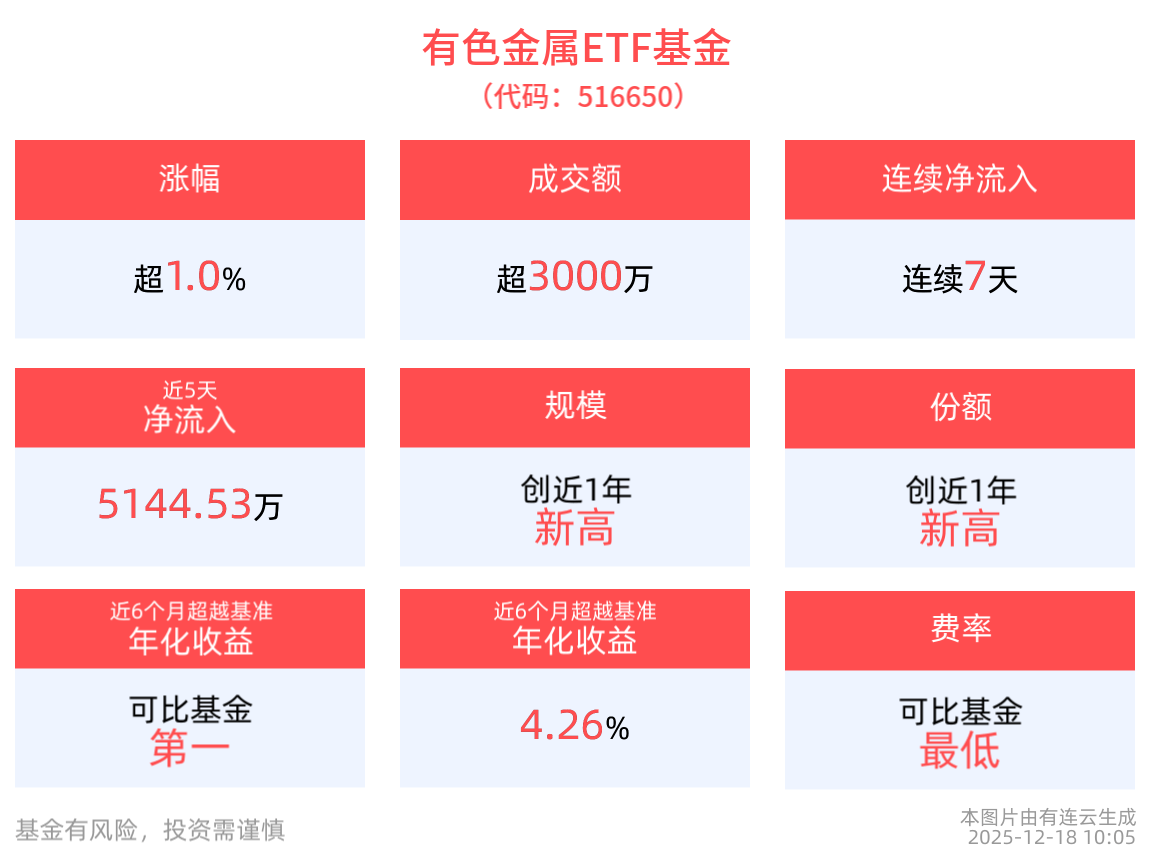
份额规模均创新高,有色金属ETF基金(516650)连续7天吸金1.44亿
Sou Hu Cai Jing· 2025-12-18 02:35
Core Insights - The recent rise in precious metals, including gold, silver, and copper, has positively impacted various ETFs, particularly the gold and non-ferrous metal ETFs [2] - The non-ferrous metal ETF (516650) has seen a continuous inflow of funds over the past week, totaling 144 million yuan, reaching a record high in both share count and total assets [2] - The ETF closely tracks the CSI sub-index for the non-ferrous metal industry, with the top ten weighted stocks accounting for 52.65% of the index [2] ETF Performance - The gold ETF (518850) increased by 0.13%, while the gold stock ETF (159562) rose by 0.46% [2] - The non-ferrous metal ETF (516650) experienced a 1.09% increase, with notable stock performances including Huaxi Nonferrous (7.01% increase) and Chihong Zinc & Germanium (5.04% increase) [2] - The latest share count for the non-ferrous metal ETF reached 1.391 billion, with a total asset size of 2.417 billion yuan [2] Top Holdings - The top ten weighted stocks in the non-ferrous metal ETF include Zijin Mining, Luoyang Molybdenum, Northern Rare Earth, Huayou Cobalt, and China Aluminum, among others [2] - These stocks are significant contributors to the ETF's performance, reflecting the overall strength of the non-ferrous metal sector [2]