
通胀放缓

Search documents
日本消费行业1月跟踪报告:入境消费走弱,内需强劲托底
Haitong Securities International· 2026-03-04 09:30
Investment Rating - The report suggests a focus on key Japanese consumer companies, highlighting their resilience and growth potential in the current economic environment [7]. Core Insights - The Japanese consumer sector is characterized by strong domestic demand, offsetting weak inbound consumption. Essential consumption remains resilient, with notable growth in local sales despite a decline in inbound tourism [3][15]. - The consumer confidence index in Japan rose to 37.9 in January, the highest since April 2024, indicating a recovery in consumer sentiment [2][9]. - Inflation is easing, with the core CPI rising by 2.0% year-on-year in January, down from 2.4% in December, reflecting a decrease in energy and food price increases [2][11]. Summary by Sections Macro - The consumer confidence index increased to 37.9 in January from 37.2 in December, marking a recovery trend [2][9]. - Real wages contracted by 0.1% year-on-year in December, a significant improvement from a 2.8% decline in November, although it remains in negative territory for 12 consecutive months [2][9]. - The core CPI rose by 2.0% year-on-year in January, down from 2.4% in December, indicating a slowdown in inflation driven by energy price declines and reduced food price increases [2][11]. Industry - Essential consumption shows resilience, with strong growth in food, daily necessities, and pharmaceuticals, while soft drinks and alcohol sales have slightly declined due to previous price increases [3][15]. - Inbound consumption is weak, with a 19.1% year-on-year decline in duty-free sales, but local consumption is robust, driving department store sales up by 2.3% year-on-year [3][15]. - Seasonal weather and holiday effects have positively impacted retail performance, although rising costs and price increases continue to challenge the industry [3][15]. Essential Companies - In January, PPIH, Aeon, and 7-Eleven reported same-store sales growth of 7.4%, 3.6%, and 1.6% respectively [4][19]. - Matsukiyo Cocokara reported a 0.4% increase in same-store sales, while Tsuruha Holdings saw a 2.3% increase in same-store sales [4][20]. - The beverage sector faced challenges, with Asahi's sales declining by 16% in January, while Kirin's domestic revenue increased by 8% [4][22]. Discretionary Companies - In January, restaurant chains like Salia, Food & Life, and McDonald's reported same-store sales growth of 14.8%, 12.4%, and 11.7% respectively [5][28]. - The clothing sector saw same-store sales growth for ABC-MART, Workman, and Uniqlo at 14.0%, 10.8%, and 2.2% respectively [5][32]. - Department stores reported a total sales figure of 491.5 billion yen in January, up 2.3% year-on-year, driven by strong local consumption [5][34]. Stock Market - In February, the consumer sector saw most stocks rise, with textiles and clothing up by 13.1% and food and beverage by 10.6% [6]. - Essential consumption stocks led the gains, while soft drinks lagged behind with a 4.0% decline [6]. Investment Recommendations - Key companies to watch include Kobe Bussan, which is benefiting from a shift in consumer sentiment amid prolonged inflation, and Mercari, which is focusing on quality growth and cost efficiency [7]. - Kirin Holdings is expected to see robust growth in its health science and beverage segments, supported by price increases and cost optimization [7].
每日投资策略:港股反复回升,恒指收涨175点-20260226
Guodu Securities Hongkong· 2026-02-26 02:24
Group 1: Market Overview - The Hang Seng Index closed at 26,765.72, up 175 points or 0.66%, after fluctuating throughout the day, with a high of 26,870 and a low of 26,632 [2][3] - The total market turnover was 236.765 billion, with a net outflow of 4.057 billion from northbound trading [2] Group 2: Economic Indicators - Hong Kong's inflation rate slowed to 1.1% in January, down from 1.4% in December, with the basic inflation rate at 1% [6] - The year-on-year price increases in January were noted in categories such as electricity, gas, and water (3%), miscellaneous services (2.9%), and transportation (1.3%) [6] Group 3: Company News - Hong Kong Sheng Li Beer reported a profit of 76.119 million, with a revenue increase of 3.68% to 737 million [11] - Crown Property Trust's CEO indicated a narrowing decline in office rental income, with a stable occupancy rate of 81.6% and a positive outlook for retail due to increased consumer spending [12] - Neway Group reported a 9.72% increase in shareholder profit to 531 million, attributed to lower borrowing costs and growth in data center revenue [13] - Sinopharm's expected profit for the year is projected to be between 1.3 billion to 1.4 billion, reflecting a growth of approximately 80.1% to 93.9% [14]
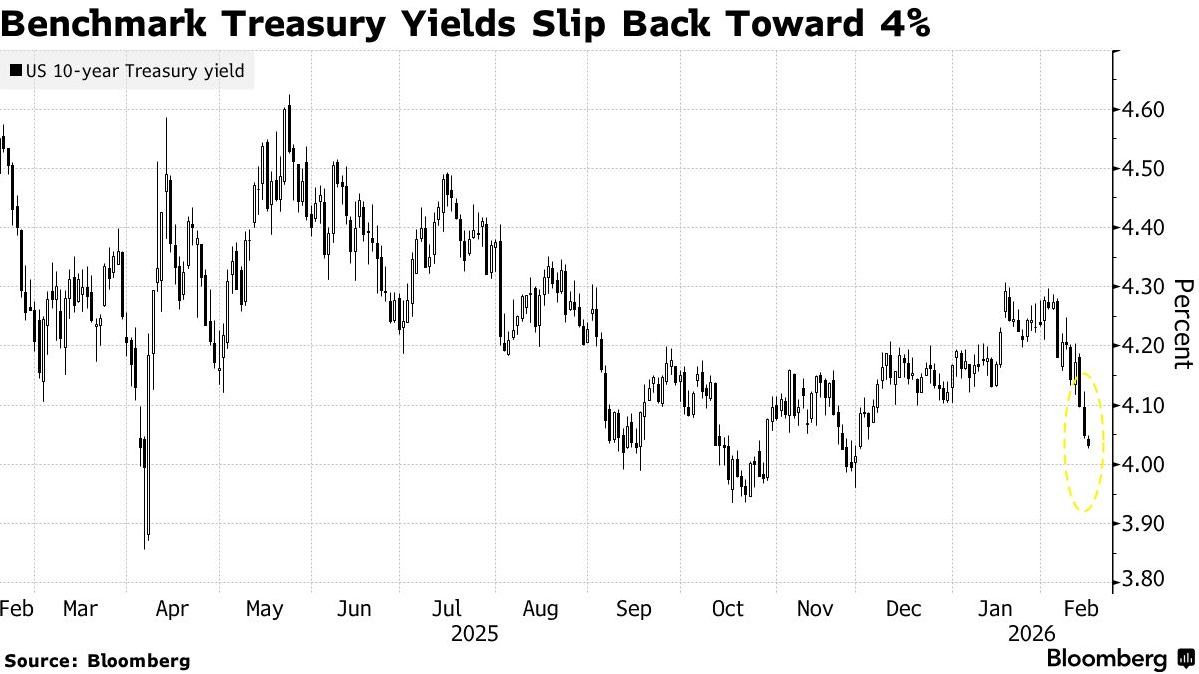
CPI余波未了!美债收益率直逼4%关口,市场屏息以待就业数据验证降息路径
智通财经网· 2026-02-17 07:09
Group 1 - The core viewpoint of the articles indicates that the recent rally in U.S. Treasury bonds is driven by expectations of slowing inflation, which may lead the Federal Reserve to cut interest rates at least twice this year [1][3] - The benchmark 10-year Treasury yield fell by 2 basis points to 4.03%, while the two-year yield approached its lowest level since 2022 during light trading in Asia [1] - The weak U.S. CPI data from last week and ongoing deleveraging by quantitative funds in the stock market are contributing to increased demand for bonds [3] Group 2 - The 4% level for the 10-year Treasury yield is seen as a critical support level; if breached, a significant decline in yields is expected [3] - Bond yields in the region, including Australia and New Zealand, also saw slight declines, indicating a broader trend of falling yields [3] - Traders are closely monitoring upcoming U.S. employment data and the minutes from the Federal Reserve's January meeting for clues on potential interest rate adjustments [3]

报告:美国国债收益率或受即将公布的数据影响进一步下跌
Sou Hu Cai Jing· 2026-02-17 06:42
Core Viewpoint - The Revacy Fund's report indicates that if new data strengthens expectations for further interest rate cuts by the Federal Reserve, U.S. Treasury yields may decline further [1] Group 1: Market Reactions - Last week's decline in U.S. Treasury yields reflects an increasing market belief that monetary policy may become less restrictive [1] - During the Asian trading session, U.S. Treasury yields fell by 2-3 basis points across various maturities [1] Group 2: Upcoming Economic Indicators - The next potential drivers for U.S. Treasuries and the dollar are the latest Federal Open Market Committee meeting minutes and fourth-quarter GDP data [1] - The market is also anticipating the personal consumption expenditures price index data to confirm that price pressures are continuing to ease [1] - If these indicators confirm a broader slowdown in inflation, downward pressure on yields and the dollar may continue in the coming trading days [1]
2月14日国际油价小幅攀升 通胀放缓与OPEC+增产预期相互制衡
Xin Lang Cai Jing· 2026-02-13 20:10
Group 1 - International oil prices experienced a slight increase due to a slowdown in U.S. inflation, recovering from early losses caused by OPEC+'s inclination to resume production increases [1][3] - Brent crude oil futures for March delivery rose by $0.23, a 0.34% increase, closing at $67.75 per barrel, while WTI crude oil futures increased by $0.05, nearly 0.1%, closing at $62.89 per barrel [4][3] - The U.S. January consumer price increase was below expectations, primarily due to falling gasoline prices and a slowdown in rental inflation, which could lead to lower interest rates, positively impacting the economy [4][5] Group 2 - Early declines in oil prices were attributed to media reports suggesting that rising tensions between the U.S. and Iran could push oil prices higher, alongside OPEC's potential decision to increase production starting in April [4][5] - Negotiations with Iran and Russia are expected to be short-term market drivers, with current global oil supply remaining ample, and futures prices reflecting a geopolitical premium of $5-7 per barrel [5] - The U.S. has eased sanctions on Venezuela's energy sector, allowing energy companies to operate oil and gas projects in OPEC member countries, with expected revenues from Venezuelan oil sales exceeding $10 billion to potentially add another $5 billion in the coming months [5]
非农就业数据或低于预期 沪银继续高位震荡
Jin Tou Wang· 2026-02-10 06:57
Group 1 - Silver futures are currently trading above 20424, with a reported price of 20507 per kilogram, reflecting a 3.09% increase, and a daily high of 20963 and a low of 20103 [1] - The upcoming U.S. non-farm payroll data is expected to show an increase of 69,000 jobs for January, with the unemployment rate projected to remain at 4.4%, slightly below the four-year high of 4.5% reached in November [1] - The January employment report will also include significant revisions, indicating a potential downward adjustment of 911,000 jobs, which would mark a record low in hiring speed [1] Group 2 - The expectation of two additional interest rate cuts by the U.S. central bank this year has led to a decline in the dollar, providing support for non-yielding silver and limiting its losses [2] - Traders are focusing on important U.S. macroeconomic data releases this week for further insights into the Federal Reserve's interest rate path [2] Group 3 - The Shanghai silver market showed no significant pullback on Monday, with support expected around 18500, and a potential upward target set at 25000 [3] - The Shanghai silver premium has narrowed to 1280 per gram, indicating a rapid cooling of domestic sentiment [3] - The trading range for Shanghai silver is noted to be between 19630 and 21400, with a broader range of 18470 to 22088 [3]
机构:受AI与减税推动,预计美国经济将稳健增长
Sou Hu Cai Jing· 2026-02-06 14:04
Core Viewpoint - The Oxford Economics Institute forecasts that the U.S. economy will maintain robust growth from 2026 to 2027, driven by investments in artificial intelligence, tax incentives, and spending by high-income groups [1] Economic Growth Projections - The projected GDP growth rate for the U.S. is 2.8% in 2026 and 2.3% in 2027, following a 4.4% annualized growth rate in Q3 2025 [1] - Rising investments in AI and non-tech sectors are contributing to productivity improvements [1] Consumer Spending and Market Conditions - Stock market gains and tax cuts are supporting consumer spending [1] - Inflation is expected to slow to 2.4%, creating conditions for the Federal Reserve to implement two rate cuts next year [1] Inflation and Housing Market - A decline in immigration and weakening housing demand may further alleviate inflationary pressures [1] - Overall, the fundamental outlook for the U.S. economy remains strong, although there is a high sensitivity to stock market performance [1]
高盛:预计美联储今年晚些时候重启降息措施
Sou Hu Cai Jing· 2026-01-28 19:25
Core Viewpoint - Goldman Sachs analyst Kay Hahi indicates that due to strong economic data and signs of stability in the labor market, the Federal Reserve is likely to keep its policy unchanged for the time being. However, a rate cut is expected to be reinitiated later this year as the slowdown in inflation allows the Fed to implement two more "normalization" rate cuts, bringing rates back to what the Federal Open Market Committee members consider neutral levels [1] Economic Data - Strong economic data is influencing the Federal Reserve's current policy stance [1] - Signs of stability in the labor market are contributing to the Fed's decision-making process [1] Future Expectations - A rate cut is anticipated to be reintroduced later this year [1] - The slowdown in inflation is a key factor enabling the Fed to consider further rate cuts [1] - The expectation is for two additional "normalization" rate cuts [1] - The goal is to return interest rates to neutral levels as defined by the Federal Open Market Committee members [1]
阿尔及利亚通胀继续放缓 2025年11月同比降至1.5%
Shang Wu Bu Wang Zhan· 2026-01-22 14:42
Core Viewpoint - Algeria's annual inflation rate is projected to decrease to 1.5% by the end of November 2025, down from 1.7% in October, indicating a clear trend of slowing inflation [1] Inflation Trends - The report from Algeria's National Statistics Office reflects changes in the Consumer Price Index (CPI) from December 2024 to November 2025, with a slight year-on-year increase of 0.9% in the CPI compared to November 2024 [1] - Month-on-month, the CPI rose by 1.5% in November compared to October, which is higher than a decrease of 0.6% observed in the same month of the previous year [1] Price Movements - The monthly price increase is primarily driven by a significant rise in manufactured goods prices, which increased by 4.3%, with jewelry and watch prices surging by 24.7% [1] - Conversely, food prices overall decreased by 0.7%, with fresh agricultural products dropping by 1.3%. Notably, prices for fruits, chicken, vegetables, and eggs fell, while prices for potatoes and red meat increased [1] - Service prices experienced a slight increase of 0.2% [1] - After seasonal adjustments, the month-on-month CPI rose by 2.1% in November [1]
广州期货:美国12月CPI持平前值 沪金或偏强运行
Jin Tou Wang· 2026-01-14 09:28
Macro News - The U.S. December CPI met expectations, with a core CPI year-on-year increase of 2.6%, the lowest level since March 2021, and lower than the expected 2.7% [1] - Month-on-month CPI increased by 0.2%, below the expected 0.3%, confirming a continued slowdown in inflation [1] - U.S. President Trump announced the cancellation of all talks with Iranian officials, and the State Department has requested U.S. citizens to leave Iran immediately [1] - U.S. Defense Department officials revealed that President Trump has been briefed on a wide range of military and covert options to address the situation in Iran, which exceed traditional airstrikes, although the White House stated that diplomacy is the preferred approach [1] Institutional Perspectives - The main contract performance showed that Shanghai gold rose by 0.14% to 1031, while Shanghai silver increased by 4.14% to 21943; platinum fell by 3.32% to 605.05, and palladium dropped by 5.22% to 483.25 [1] - The U.S. CPI for December 2025 remained unchanged year-on-year at 2.7%, with the core CPI also stable at 2.6% [1] - Trump stated that any country engaging in business with Iran will face a 25% tariff on any commercial activities with the U.S. [1] - Concerns over geopolitical tensions and the independence of the Federal Reserve have heightened risk aversion, leading to a potentially strong performance in precious metals prices [1]