平安银行

Search documents
中金:银行已进入高质量发展阶段 高股息投资成为主要范式
智通财经网· 2025-11-05 00:09
Group 1 - The core viewpoint is that stability is likely to characterize the banking industry's performance in 2026, with expected steady year-on-year growth in revenue and profit for listed banks, primarily due to a further narrowing of net interest margin pressure [1][2] - Credit growth may slow down further, driven by weak credit demand and insufficient risk compensation, while social financing growth will depend on fiscal policy [1][2] - After several years of fee reductions and the digestion of high base pressure, the growth rate of fee income is expected to stabilize and rebound [2] Group 2 - Small and micro enterprises, along with retail customer exposures, remain the main sources of non-performing loans, but corporate business exposures are expected to maintain stability or even show an improving trend in net non-performing loan generation rates [2] - The industry is likely to see accelerated supply-side reforms, evidenced by a rapid decrease in the number of bank licenses, leading to improved competition and operational landscape [2] - The banking sector has entered a high-quality development phase, with only a few listed banks achieving double-digit growth, and high-dividend investment becoming the main paradigm [3]

11/4财经夜宵:得知基金净值排名及选基策略,赶紧告知大家
Sou Hu Cai Jing· 2025-11-04 16:10
Core Insights - The article provides a ranking of mutual funds based on their net asset value updates, highlighting the top-performing and bottom-performing funds in the market [2][3][4]. Fund Performance Summary - The top 10 funds with the highest net value growth as of November 4, 2025, include: 1. Tianhong Zhongzheng Bank ETF: Unit Net Value 1.5043, Cumulative Net Value 1.5043, with a growth of 0.03 2. Zhongzheng Bank ETF: Unit Net Value 1.4720, Cumulative Net Value 1.6680, with a growth of 0.02 3. Huaxia Zhongzheng Bank ETF: Unit Net Value 1.7798, Cumulative Net Value 1.7798, with a growth of 0.03 4. Fuguo Zhongzheng 800 Bank ETF: Unit Net Value 1.3649, Cumulative Net Value 1.3649, with a growth of 0.02 5. Huabao Zhongzheng Bank ETF: Unit Net Value 0.8391, Cumulative Net Value 1.6782, with a growth of 0.01 6. Nanfang Zhongzheng Bank ETF: Unit Net Value 1.6954, Cumulative Net Value 1.8624, with a growth of 0.03 7. Hu'an Zhongzheng Bank ETF: Unit Net Value 1.4270, Cumulative Net Value 1.4270, with a growth of 0.02 8. Penghua Zhongzheng Bank ETF: Unit Net Value 1.7185, Cumulative Net Value 1.7185, with a growth of 0.03 9. Yifangda Zhongzheng Bank ETF: Unit Net Value 1.3836, Cumulative Net Value 1.3836, with a growth of 0.02 10. Dongcai Zhongzheng Bank Index C: Unit Net Value 1.3390, Cumulative Net Value 1.3390, with a growth of 0.02 [2][4]. - The bottom 10 funds with the lowest net value growth include: 1. Debang High-end Equipment Mixed Initiation C: Unit Net Value 1.0852, with a decline of -0.06 2. Debang High-end Equipment Mixed Initiation A: Unit Net Value 1.0869, with a decline of -0.06 3. Furong Fuxin Mixed C: Unit Net Value 2.2756, with a decline of -0.12 4. Furong Fuxin Mixed A: Unit Net Value 2.3155, with a decline of -0.13 5. Great Wall Emerging Industry Mixed A: Unit Net Value 2.4973, with a decline of -0.12 6. Great Wall Emerging Industry Mixed C: Unit Net Value 2.4651, with a decline of -0.12 7. AVIC Trend Navigation Mixed Initiation A: Unit Net Value 2.3952, with a decline of -0.11 8. AVIC Trend Navigation Mixed Initiation C: Unit Net Value 2.3750, with a decline of -0.11 9. Minsheng Jianyin Frontier Technology Mixed: Unit Net Value 1.0935, with a decline of -0.05 10. Qianhai Kaiyuan Jiaxin Mixed C: Unit Net Value 2.1170, with a decline of -0.09 [4][6]. Market Analysis - The Shanghai Composite Index experienced a pullback after a rise, closing slightly lower, while the ChiNext Index showed a similar trend. The total trading volume reached 1.93 trillion, with a market breadth of 1,630 gainers to 3,650 losers. The banking sector led the market with a rise of over 2%, while the non-ferrous metals and pharmaceutical sectors saw declines of over 2% [6]. Fund Holdings - The Tianhong Zhongzheng Bank ETF has a concentrated holding of 64.57% in its top ten stocks, with significant daily gains from major banks such as: - China Merchants Bank: 2.92% increase - Industrial Bank: 2.82% increase - Agricultural Bank: 1.75% increase - Shanghai Bank: 3.20% increase - The fund's total assets amount to 5.844 billion [7]. - Conversely, the Debang High-end Equipment Mixed Initiation C fund has a holding concentration of 60.76%, with significant declines in its top holdings, including: - Yinlun Co.: -6.07% decrease - Zhejiang Songtai: -6.34% decrease - Hanwei Technology: -6.70% decrease - This fund's total assets are 1.169 billion [7].


商业银行纷纷调整积存金业务并提示风险
Zheng Quan Ri Bao· 2025-11-04 15:40
Core Insights - Several commercial banks have recently adjusted their gold accumulation businesses, with major banks like Industrial and Commercial Bank of China and China Construction Bank announcing suspensions and subsequent resumption of certain services [1][2] Group 1: Business Adjustments - On November 3, Industrial and Commercial Bank of China and China Construction Bank announced the suspension of certain gold accumulation services, including "Ruyi Gold Accumulation" and "Easy Gold" [1] - Later that same day, Industrial and Commercial Bank of China announced the resumption of its "Ruyi Gold Accumulation" services, including account openings and physical gold withdrawals [1] - Other banks, such as Bank of China, Ping An Bank, and Industrial Bank, have also raised the minimum investment thresholds for their gold accumulation products since October [1] Group 2: Reasons for Adjustments - The adjustments in gold accumulation services are influenced by macroeconomic policies, market risk management, and compliance requirements [2] - Global uncertainties, including fluctuations in the US dollar, shifts in monetary policy, and geopolitical risks, have led to price volatility in precious metals, prompting banks to adopt a more cautious approach to asset safety and liquidity management [2] - The rapid growth in customer numbers for gold accumulation services has raised operational, liquidity, and compliance risks, leading banks to pause new business and physical withdrawals as a preventive measure [2] Group 3: Future Outlook - If market volatility increases or regulatory scrutiny tightens, other banks may implement similar measures, although these adjustments typically target new or high-risk businesses, ensuring that existing customer rights are protected [3] - Recent communications from multiple banks have highlighted the need to mitigate risks associated with fluctuations in precious metal prices [3] - Investors are advised to maintain a balanced approach to gold investments, considering the asset's volatility and the influence of international economic data, monetary policy, and geopolitical factors [3]


银行业2025年三季报综述:业绩稳健性凸显,引领银行价值回归
Shenwan Hongyuan Securities· 2025-11-04 14:41
Investment Rating - The report maintains a positive outlook on the banking sector, indicating a potential return to a valuation of 1 times net asset value [4][7]. Core Insights - The banking sector has demonstrated steady performance, with a year-to-date revenue growth of 0.8% and a net profit growth of 1.5% for the first nine months of 2025, reflecting a stable regulatory environment supporting bank profitability [10][14]. - The report highlights a shift in focus from scale to balance in credit growth, with banks increasingly pursuing a "quantity-price balance" strategy [4][7]. - The cost of liabilities has improved more significantly than the decline in asset pricing, leading to a stabilization of net interest margins, which is expected to continue into the next year [4][7]. - Asset quality remains stable but shows signs of divergence, particularly with rising risks in small and micro businesses [4][7]. - The report suggests that the current dividend yield of the banking sector has returned to an attractive range, indicating a significant disconnect between stable earnings and stock holdings, which could lead to a value recovery [4][7]. Summary by Sections Performance Overview - The banking sector's performance has been characterized by a steady increase in revenue and profit, with state-owned banks showing better-than-expected stability and regional banks leading in performance [11][12][15]. - The report notes that the revenue growth of state-owned banks has turned positive, with non-interest income contributing significantly to this growth [12][15]. Credit Growth and Strategy - The report indicates a gradual abandonment of scale-driven growth, with banks focusing on achieving a balance between volume and pricing in their lending practices [4][7]. - The credit growth rate for listed banks decreased by 0.3 percentage points to 7.7% in Q3 2025, with state-owned banks maintaining a growth rate of approximately 8.5% [4][7]. Profitability and Asset Quality - The net interest margin for listed banks remained stable at 1.5%, with a slight quarter-on-quarter increase of 3 basis points in Q3 2025 [4][7]. - The overall non-performing loan ratio remained stable at 1.22%, indicating manageable risk levels across the sector [4][7]. Investment Recommendations - The report recommends focusing on leading banks and undervalued regional banks as key investment opportunities, suggesting that the recovery in valuations is supported by stable earnings and attractive dividend yields [4][7].


股份行前三季度盈利承压 4家营收净利双降
Di Yi Cai Jing· 2025-11-04 12:24
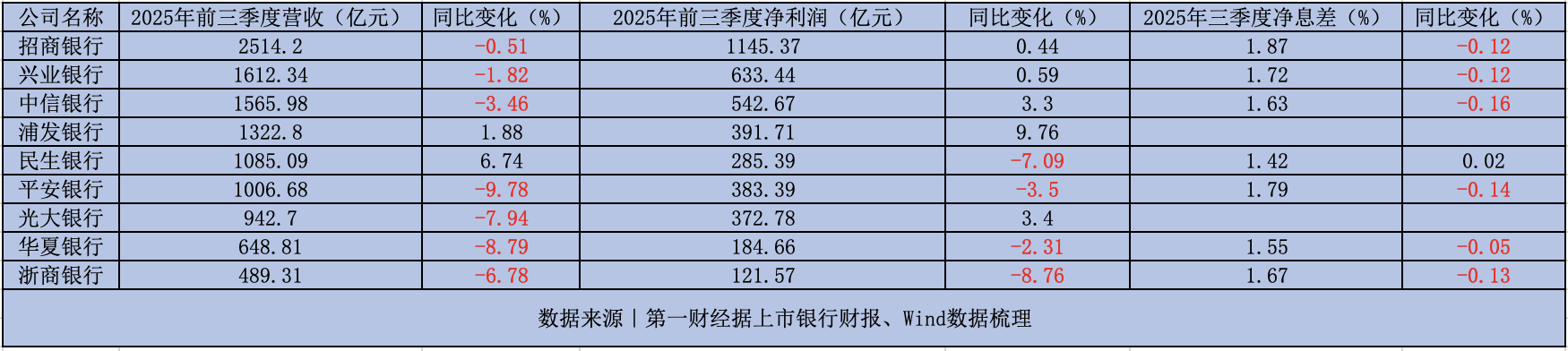
Core Insights - The overall profitability of A-share listed joint-stock banks faces significant pressure, with both revenue and net profit showing a year-on-year decline [1][2] - Among the nine listed banks, total revenue reached approximately 1.12 trillion yuan, down 2.56% year-on-year, while net profit was 406.1 billion yuan, with a nearly 1% decrease [1][2] Revenue and Profit Performance - The top-performing bank, China Merchants Bank, reported revenue of 251.42 billion yuan, a slight decline of 0.51%, and net profit of 114.54 billion yuan [3][5] - Shanghai Pudong Development Bank was the only bank to achieve "double growth," with revenue increasing by 1.88% to 132.28 billion yuan and net profit rising by 9.76% to 39.17 billion yuan [5] - Four banks, including Ping An Bank and Huaxia Bank, experienced a decline in both revenue and net profit [5][6] Net Interest Margin and Asset Quality - The net interest margin (NIM) remains under pressure but shows signs of stabilization, with most banks reporting a year-on-year decline [7][8] - The average non-performing loan (NPL) ratio for the nine banks was 1.24%, with China Merchants Bank having the lowest at 0.94% [10][11] - The overall asset quality remains stable, with five banks reporting a decrease in NPL ratios compared to the end of the previous year [1][11] Non-Interest Income and Market Trends - Non-interest income growth is uneven, with China Merchants Bank leading in wealth management, achieving a nearly 20% increase in fee and commission income [9] - The capital market's increased activity has positively impacted some banks' agency and custody businesses, although overall non-interest income growth remains weaker than that of state-owned banks [9] Risk Management and Future Outlook - The provisioning coverage ratio is under pressure, with seven out of nine banks showing a decline [12][13] - Analysts suggest that the asset quality of small and micro loans remains a concern, but overall risks are manageable due to ongoing policy support [13]




股份行前三季度盈利承压,4家营收净利双降
Di Yi Cai Jing Zi Xun· 2025-11-04 11:40
Core Insights - The overall profitability of A-share listed joint-stock banks faces significant pressure, with both revenue and net profit showing a year-on-year decline [1][2] - Among the nine listed banks, total revenue reached approximately 1.12 trillion yuan, down 2.56% year-on-year, while net profit was 406.1 billion yuan, with a nearly 1% decrease [2][3] - Leading banks like China Merchants Bank and Shanghai Pudong Development Bank performed relatively well, with the latter being the only bank to achieve "double growth" in both revenue and net profit [4] Revenue and Profit Performance - China Merchants Bank led with a revenue of 251.42 billion yuan, a slight decline of 0.51%, and a net profit of 114.54 billion yuan, an increase of 0.44% [3][4] - Shanghai Pudong Development Bank reported a revenue increase of 1.88% to 132.28 billion yuan and a net profit growth of 9.76% to 39.17 billion yuan [4] - Other banks like Ping An Bank, Everbright Bank, Huaxia Bank, and Zheshang Bank experienced declines in both revenue and net profit [4] Net Interest Margin and Asset Quality - The net interest margin (NIM) remains low but shows signs of stabilization, with five banks reporting a decrease in non-performing loan (NPL) ratios compared to the end of the previous year [1][6] - The average NPL ratio for the nine banks was 1.24%, with China Merchants Bank having the lowest at 0.94% and Huaxia Bank the highest at 1.58% [9][10] - The NIM for major banks like China Merchants Bank, Ping An Bank, and Industrial Bank showed a year-on-year decline, while Minsheng Bank saw a slight increase [6][7] Non-Interest Income and Market Trends - Non-interest income growth varied, with China Merchants Bank leading in wealth management, achieving a nearly 20% increase in fee and commission income [8] - The capital market's increased activity has positively impacted some banks' agency and custody businesses, although overall non-interest income growth remains weaker than that of state-owned banks [8] - Analysts suggest that wealth management, investment banking, and custody services are becoming new differentiators among joint-stock banks [8] Asset Quality and Risk Management - The overall asset quality of joint-stock banks remains stable, with a slight decline in NPL ratios and sufficient risk coverage [9][11] - Seven out of nine banks experienced a decline in their provision coverage ratios, with Ping An Bank showing the largest drop [11] - The risk management focus includes monitoring the asset quality of small and micro enterprises and unsecured retail loans, with expectations for stable asset quality in the coming year [12]
1万元借一天利息0.83元,双11金融机构发力“低息贷+免息分期”
Sou Hu Cai Jing· 2025-11-04 11:15
"为了方便双11购物,我专程去办了一张信用卡。11月3日在线上申请,4号就去银行确认激活,想在11 月11日之前购物完毕。"家住北京市东城区的90后消费者小孙对《华夏时报》记者表示,办卡前咨询了 好几家银行客户经理,自己的目标很明确就是需要支付满减,以及送电商平台会员。 今年,多家银行将信用卡、消费贷作为核心发力点,密集推出满减、返现抽奖、低息分期等专属营销活 动。 本报(chinatimes.net.cn)记者付乐 北京报道 今年"双11"金融机构成为不可或缺的"推力"。记者梳理了今年双11消费金融市场发现,从银行到消费金 融公司,各机构不再是单纯的支付通道,而是通过24期免息、满减返现、财政贴息等举措,激发消费意 愿。 例如中山农商银行推出"双11消费备用金"计划,其"街坊快贷"最高30万元额度,年利率最低3%,相当 于1万元借一天利息0.83元,为消费者减轻支付压力。此外,针对双11电商创业者的备货资金需求,新 网银行推出电商专享贷,缓解创业者资金周转压力。 11月4日,邮储银行研究员娄飞鹏对《华夏时报》记者表示,金融机构通过支付立减、积分返现、国补 叠加红包等短期优惠吸引用户,但要实现从一次性交易到长 ...

9家股份行三季报透视:5家不良率降,零售AUM增长成亮点
Nan Fang Du Shi Bao· 2025-11-04 09:59
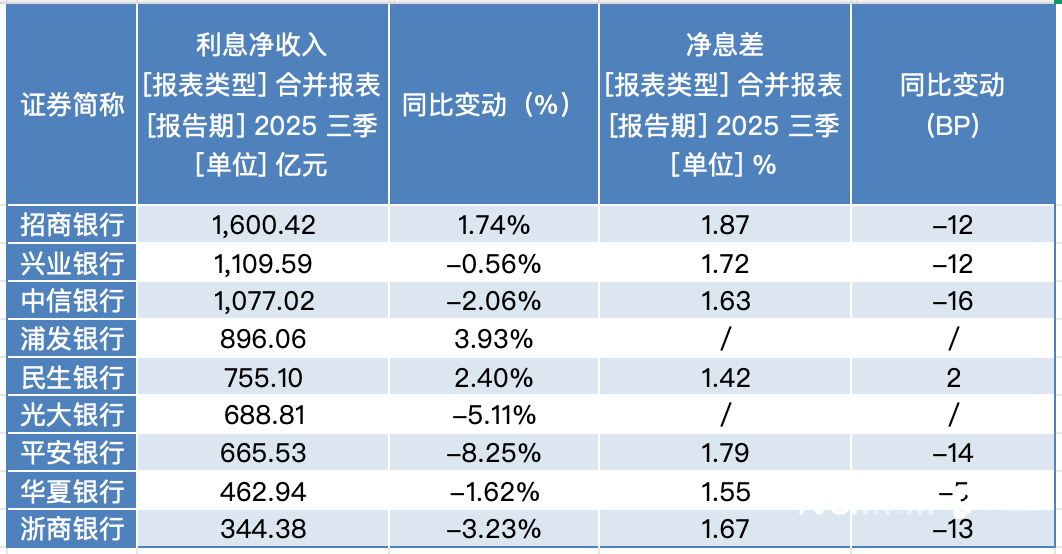
Core Viewpoint - The performance of nine A-share listed joint-stock banks in the third quarter of 2025 shows a mixed picture, with seven banks experiencing a year-on-year decline in operating income and five banks seeing a drop in net profit. Only Shanghai Pudong Development Bank achieved growth in both metrics [1][2]. Financial Performance - Among the nine banks, only Shanghai Pudong Development Bank and Minsheng Bank reported year-on-year growth in operating income, while four banks, including China Merchants Bank and Industrial Bank, saw an increase in net profit [2][3]. - China Merchants Bank led in operating income with CNY 251.42 billion, followed by Industrial Bank and CITIC Bank with CNY 161.23 billion and CNY 156.60 billion, respectively. Zhejiang Commercial Bank ranked last with CNY 48.93 billion [2]. - Minsheng Bank recorded the highest operating income growth rate at 6.74%, while Ping An Bank experienced the most significant decline at -9.78% [2]. Net Profit Analysis - China Merchants Bank maintained the highest net profit at CNY 113.77 billion, with a slight increase of 0.52%. Shanghai Pudong Development Bank saw a notable increase of 10.21% in net profit [3]. - The only bank to achieve growth in both operating income and net profit was Shanghai Pudong Development Bank, which reported a 1.88% increase in operating income [3]. Interest Income and Net Interest Margin - Six banks reported a year-on-year decline in net interest income, with the overall industry facing pressure on net interest margins, although the rate of decline has narrowed [4][6]. - China Merchants Bank led in net interest income with CNY 160.04 billion, showing a 1.74% increase, while Ping An Bank faced the largest decline at -8.25% [5][6]. Asset Quality - The asset quality of the banks showed mixed results, with five banks reporting a decline in non-performing loan (NPL) ratios, while three banks saw an increase [7][9]. - China Merchants Bank maintained the best asset quality with an NPL ratio of 0.94%, while Ping An Bank's NPL ratio was 1.05% [8][9]. Retail and Corporate Loan Trends - The third quarter of 2025 revealed a shift in loan structure, with corporate loans expanding while retail loans showed weakness. Three banks reported negative growth in retail loans [10][12]. - Among the banks, only Shanghai Pudong Development Bank, China Merchants Bank, and CITIC Bank saw growth in personal loans, while others experienced declines [11][12]. Retail Asset Under Management (AUM) - Several banks reported strong growth in retail AUM, with China Merchants Bank managing CNY 16.60 trillion in retail customer assets, an increase of 11.19% [12][14]. - Shanghai Pudong Development Bank's retail AUM reached CNY 4.62 trillion, reflecting a growth of 19.07% [13].


新进270家上市公司十大流通股名单,险资前三季度加大权益投资
Hua Xia Shi Bao· 2025-11-04 09:58
Core Viewpoint - The A-share market has shown a strong upward trend in Q3 2023, driven by favorable policies and capital inflows, with insurance funds playing a crucial role in market dynamics [2] Group 1: Insurance Fund Investment Strategies - Insurance funds have maintained a strong preference for traditional "anchor" bank stocks, demonstrating a commitment to stable returns and high dividend assets [2][4] - There has been a significant increase in the allocation towards technology growth sectors such as electronics and computers, indicating a strategic shift towards economic transformation and industrial upgrading [2][8] - The "cash flow and growth" strategy reflects the asset allocation wisdom of insurance funds in the current market environment, potentially revealing future capital flows and market style preferences [2] Group 2: Performance and Holdings of Insurance Companies - Major insurance companies like China Life, China Ping An, and China Pacific have reported an increase in total investment returns, ranging from 5.2% to 8.6% year-on-year [4] - By the end of Q3, insurance funds were among the top ten shareholders in 633 A-share listed companies, with a total holding value exceeding 650 billion yuan, marking a growth of over 6% from mid-2023 [4][5] - The overall number of shares held by insurance funds in bank stocks increased significantly by 8.36 billion shares, with a market value growth of over 6.4 billion yuan despite a decline in the bank sector index [5][6] Group 3: Specific Stock Movements - Postal Savings Bank emerged as a standout stock for insurance funds in Q3, with a notable increase of 2.189 billion shares held by Ping An Life, making it one of the top ten shareholders [5][6] - Other banks like Industrial and Commercial Bank of China and Nanjing Bank also saw increased holdings from insurance funds, reflecting a trend of deepening investment in the banking sector [5][6] - Insurance funds are not only increasing their stakes but also seeking deeper involvement in governance, as seen with Hongkang Life's nomination of a director candidate at Su Nong Bank [6] Group 4: Focus on Technology Growth Stocks - The electronics sector saw the largest increase in holdings by insurance funds, with a rise of nearly 11.8 billion yuan and an increase of 15.6 million shares [8] - The number of computer industry companies in which insurance funds are among the top ten shareholders rose from 17 to 23, with a market value increase of over 1.2 billion yuan [9] - The investment in technology stocks is seen as a response to the macroeconomic environment and a strategic move to capture future growth potential, particularly in the context of the AI wave [9][10] Group 5: Adjustments in Other Sectors - Insurance funds have significantly reduced their holdings in sectors such as public utilities, construction materials, and transportation, indicating a reassessment of traditional cyclical industries [10] - This reduction reflects insurance funds' judgment on the economic outlook and policy impacts on certain sectors, showcasing their role as long-term investors and value discoverers in the capital market [10]





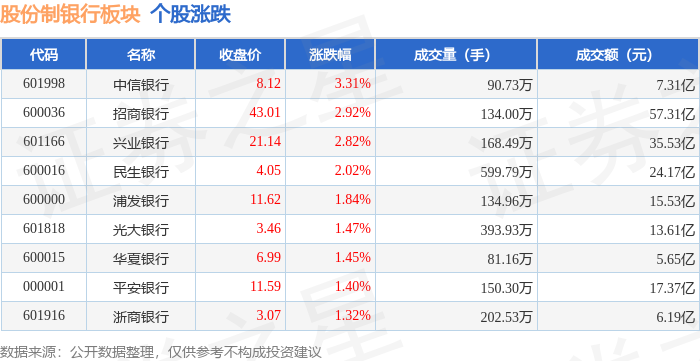
股份制银行板块11月4日涨2.44%,中信银行领涨,主力资金净流入17.63亿元
Zheng Xing Xing Ye Ri Bao· 2025-11-04 08:48
Core Viewpoint - The banking sector, particularly the joint-stock banks, experienced a notable increase of 2.44% on November 4, with CITIC Bank leading the gains, despite the overall decline in major stock indices [1] Group 1: Market Performance - The Shanghai Composite Index closed at 3960.19, down 0.41%, while the Shenzhen Component Index closed at 13175.22, down 1.71% [1] - CITIC Bank's stock price rose by 3.31% to 8.12, with a trading volume of 907,300 shares and a transaction value of 731 million [1] - Other notable performers included China Merchants Bank, which increased by 2.92% to 43.01, and Industrial Bank, which rose by 2.82% to 21.14 [1] Group 2: Capital Flow - The joint-stock banking sector saw a net inflow of 1.763 billion in main funds, while retail investors experienced a net outflow of 664 million [1] - Specific banks like Shanghai Pudong Development Bank had a main fund net inflow of 413 million, while retail investors saw a net outflow of 251 million [2] - Ping An Bank recorded a main fund net inflow of 294 million, with retail investors also experiencing a net outflow of 165 million [2]