
宇树科技

Search documents
中国AI装进了麻省理工教授的电脑
阿尔法工场研究院· 2026-01-21 00:07
Group 1 - The 2026 World Economic Forum will take place in Davos, Switzerland, from January 19-23, with heightened security measures due to the attendance of global leaders, including U.S. President Trump and other G7 leaders [3][5][10] - The main topics of concern among attendees include Trump and geopolitical issues, reflecting a complex geopolitical backdrop that is unprecedented for the forum [9][10] - The Global Risks Report 2026 highlights that the most pressing risks for the next two years are "geoeconomic confrontation" and the potential for full-scale wars between nations [13] Group 2 - There is a growing acceptance of "division as the new normal," with technology emerging as a universal language, particularly in the context of AI and robotics, which are gaining attention at the forum [15][16] - Attendees from different regions exhibit varying concerns, with Europeans focused on trade deficits with China, while Americans show a pragmatic curiosity about China's advancements in technology, especially in electric vehicles and AI [19][20] - The presence of Chinese entrepreneurs in the U.S. innovation ecosystem is increasing, particularly in AI, showcasing a competitive advantage and a collective emergence in the field [20]


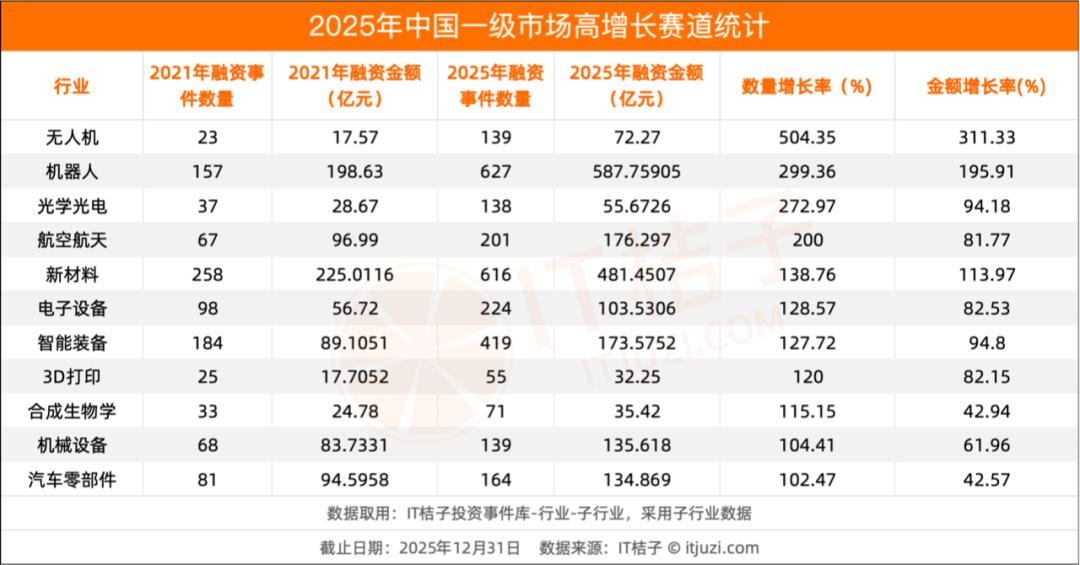
资本大迁徙:五年前后,2025年中国创投11大高增长赛道深度解析
3 6 Ke· 2026-01-20 11:01
Core Insights - The Chinese venture capital market is experiencing a significant shift from consumer-driven sectors to hard technology sectors, with funding for hard tech such as drones, robotics, and new materials increasing dramatically while consumer sectors like second-hand e-commerce and local logistics see funding drop by over 95% [1][15] Funding Growth by Sector - Drones: Funding events increased from 23 in 2021 to 139 in 2025, with total funding rising from 1.757 billion to 7.227 billion yuan, marking a growth rate of 504.35% in event numbers and 311.33% in funding amount [2][3] - Robotics: Funding events surged from 157 to 627, with total funding jumping from 19.863 billion to 58.776 billion yuan, reflecting a growth rate of 299.36% in event numbers and 195.91% in funding amount [2][3] - New Materials: Increased from 258 events and 22.50116 billion yuan in 2021 to 616 events and 48.14507 billion yuan in 2025, showing a growth rate of 138.76% in event numbers and 113.97% in funding amount [2][4] High-Growth Sectors - Aerospace: Funding events grew from 67 to 201, with total funding increasing from 9.699 billion to 17.6297 billion yuan, achieving a growth rate of 200% in event numbers and 81.77% in funding amount [2][4] - Optical and Photonic: Events increased from 37 to 138, with funding rising from 2.867 billion to 5.56726 billion yuan, reflecting a growth rate of 272.97% in event numbers and 94.18% in funding amount [2][4] Key Drivers of Growth - The rise of drones is driven by the transition from consumer to industrial applications, supported by national policies promoting low-altitude economy [7] - Robotics growth is fueled by advancements in AI and the emergence of "embodied intelligence," leading to increased investment in humanoid robots and automation [8] - The push for domestic alternatives and self-sufficiency in sectors like new materials and aerospace is a significant driver of investment, particularly in response to external technology restrictions [9][10] Strategic Insights - The shift towards hard technology represents a fundamental change in investment paradigms, moving from short-term gains to long-term value creation [15] - The demand for automation in manufacturing due to rising labor costs and the need for efficiency is driving investments in robotics and smart equipment [11] - Continuous policy support, including tax incentives and funding for high-tech industries, is crucial for sustaining growth in hard technology sectors [12]
杰克科技(603337.SH):目前与宇树科技暂无技术上的合作
Ge Long Hui· 2026-01-20 10:26
Group 1 - The core point of the article is that Jack Technology (603337.SH) has stated there is currently no technical cooperation with Yushu Technology on the investor interaction platform [1]

重构具身智能感知范式,宸境科技推出视觉「空间智能」新品
3 6 Ke· 2026-01-20 10:20
Core Insights - The year 2026 is anticipated to be a watershed moment for embodied intelligence, with humanoid robots gaining attention but facing challenges in real-world applications [1] - The bottleneck in the industry is not the robots' ability to perform tasks but their reliability in unpredictable environments [1][2] - The focus is shifting from traditional methods to a vision-based approach for embodied intelligence, aiming to create a more robust and adaptable system [2][5] Industry Challenges - The current industry anxiety stems from the inability of robots to transition from demonstration to practical use in factories and homes [1] - The long-tail reliability in real-world scenarios poses significant challenges, as environmental factors can disrupt robotic operations [1][3] Technological Innovations - Chenjing Technology is pioneering a vision-based approach, moving away from expensive lidar systems to create a more cost-effective and scalable solution [2][5] - The concept of "spatial intelligence" is introduced, emphasizing the need for robots to have a precise understanding of their physical environment [3][4] - The upcoming product from Chenjing Technology aims to enable robots to build internal world models that are computable, predictable, and executable [4] Product Development - The new product lineup includes the Insight autonomous spatial camera, which utilizes advanced neural network computing and a high-performance VSLAM engine for enhanced perception [8] - The TinyNav high-performance navigation algorithm library is designed to provide robust positioning and mapping capabilities even in low-cost embedded systems [8] - The RoboSpatial toolchain allows developers to easily manipulate 3D spatial intelligence capabilities, streamlining the deployment of embodied intelligence applications [9] Strategic Partnerships - Chenjing Technology has partnered with industry leader Yushu Technology to enhance the robustness of its visual perception solutions in complex environments [7]
国投证券:PEEK深化赋能具身智能 国产化程度持续深化
智通财经网· 2026-01-20 08:16
Core Viewpoint - The PEEK (Polyether Ether Ketone) industry chain is expected to enter a high-growth phase, driven by increasing downstream demand and the ability of domestic companies to respond quickly and reduce costs, enhancing their market share in the domestic substitution process [1][2]. Group 1: PEEK Characteristics and Market Potential - PEEK is a high-performance engineering plastic with superior rigidity and toughness compared to general engineering plastics, significantly surpassing metal materials in specific strength, and offers advantages such as high temperature resistance, wear resistance, chemical corrosion resistance, and flame retardancy [1]. - The current market price for PEEK is estimated at 350,000 yuan per ton, corresponding to a market space of approximately 2.3 billion yuan. If PEEK's penetration in robotic components increases, the actual demand scale will further expand [1][4]. Group 2: Supply Side Dynamics - The global PEEK production capacity is dominated by international companies such as Victrex, Solvay, and Evonik, which have established high barriers in intellectual property and industrial-scale production. Domestic companies are actively expanding production and leveraging advantages in raw materials to accelerate substitution [2]. - China's PEEK production has significantly increased from approximately 200 tons in 2017 to an estimated 3,808 tons in 2024, indicating a deepening level of domestic production [2]. Group 3: Demand Side Trends - China, Europe, and the Americas are the main consumption regions for PEEK. China's demand for PEEK has grown from 80 tons in 2012 to 1,980 tons in 2021, with a CAGR of 42.84%, significantly outpacing the global average [3]. - The application of PEEK is expanding in high-end fields, with increasing commercialization and maturity in processing methods. It is gaining traction in sectors such as high-pressure charging, automotive lightweighting, medical devices, and humanoid robots [3]. Group 4: PEEK's Role in Humanoid Robotics - Breakthroughs in humanoid robotics and embodied intelligence are creating strong new growth opportunities for PEEK. The global number of humanoid robots in use is expected to exceed 100 million units by 2045, corresponding to a market size of approximately 10 trillion yuan [4]. - In the cost structure of robots, the motion layer (including components like planetary roller screws and harmonic reducers) accounts for about 55% of the total value. PEEK's advantages in lightweight and durability make it an ideal choice for enhancing the performance of these components [4].
最神秘的机器人公司,浮出水面
3 6 Ke· 2026-01-20 07:56
Core Insights - Sharpa is emerging as a significant player in the embodied intelligence investment circle, particularly noted for its dexterous robotic hand capable of performing intricate tasks with human-like precision [1][2] - The company has garnered attention for its innovative products, including the Sharpa North robot, which features advanced decision-making capabilities and has been positively reviewed by notable investors [3] - Sharpa's founders are also key figures in Hesai Technology, a leading global provider of lidar technology, indicating a strong connection between the two companies [5][6] Company Overview - Sharpa's dexterous hand, priced at approximately $50,000, has generated interest among industry professionals, but purchasing the product has proven challenging due to limited availability [2] - The company recently showcased its robot at CES 2026, highlighting its capabilities in performing complex tasks and engaging in interactive activities [3] - Hesai Technology, which has a dominant market share in the lidar sector, is closely associated with Sharpa, as its founders are also the co-founders of Sharpa [5][6] Market Context - The lidar market is experiencing significant growth, with Hesai reporting a 1311.9% year-over-year increase in lidar deliveries for the robotics sector, indicating a robust demand for such technologies [7] - The crossover of expertise from autonomous driving to embodied intelligence is becoming a trend, with several companies gaining attention in the investment community [9] - Sharpa's establishment in Singapore, along with its operational presence in Shanghai, reflects a strategic approach to leverage both local supply chains and international business opportunities [10]

2026,物理AI的六大趋势:新物种大爆发,淘汰赛开启
Tai Mei Ti A P P· 2026-01-20 07:36
Core Viewpoint - The next wave of artificial intelligence (AI) will transition from virtual content generation to Physical AI, enabling autonomous completion of complex tasks in the real world by 2026 [1] Group 1: Trends in Physical AI - Trend 1: Robotaxi will move from regional trials to large-scale operations, driven by reduced costs of core hardware and supportive regulations in major markets [3][4] - Trend 2: The shipment volume of humanoid robots is expected to double, leading to a competitive landscape where companies lacking closed-loop evolution capabilities may face challenges [5][7] - Trend 3: AI Agents will evolve from simple Q&A bots to personal intelligent partners, increasing interaction with the real world and intensifying competition between terminal and application manufacturers [8][10] Group 2: Developments in Wearable and Cleaning Devices - Trend 4: A surge of innovative wearable devices will emerge, focusing on specific functions and seamless AI integration for health and interaction [11][13] - Trend 5: AI toys will enhance emotional companionship capabilities, moving away from mere conversation to empathetic interactions [14][15] - Trend 6: The cleaning appliance sector will see accelerated embodiment, with products gaining advanced capabilities to perceive and adapt to their environments [16][17]



宇树科技2025年人形机器人出货量超过5500台;小米玄戒O2或继续用台积电3nm丨智能制造日报
创业邦· 2026-01-20 03:29
Group 1 - Musk stated that the AI5 chip is crucial for Tesla, emphasizing the need for two teams to focus on its development, with personal involvement for several months [2] - The AI5 chip is described as a "very powerful" chip, with design progress reported to be on track, and Tesla plans to restart the development of Dojo3 [2] - Yushutech is projected to exceed 5,500 units in humanoid robot shipments by 2025, with over 6,000 units expected to roll off the production line [2] Group 2 - Xiaomi's second-generation self-developed SoC, the Xuanjie O2, is likely to use TSMC's N3P process instead of the latest 2nm process, with plans to expand its application beyond smartphones to tablets, cars, and computers [2] - The launch of 19 low-orbit satellites for satellite internet was successfully completed by China using the Long March 12 rocket, marking a significant achievement in commercial space endeavors [2]



机器人行业周报:1XTechnologies发布世界模型,SkildAI获14亿美元融资
GUOTAI HAITONG SECURITIES· 2026-01-20 03:15
Investment Rating - The report assigns an "Overweight" rating to the robotics industry, indicating a projected performance that exceeds the Shanghai and Shenzhen 300 Index by more than 15% [5][26]. Core Insights - The robotics industry is experiencing significant advancements with the release of the "World Model" by 1X Technologies, which enables the NEO robot to achieve autonomous learning, marking a pivotal step towards embodied intelligence [5][7]. - There is a robust demand in the investment and financing market, with notable funding rounds such as Skild AI securing $1.4 billion to develop a general-purpose robot "brain" [5][13]. - The domestic market is witnessing a surge in new products and applications, with companies like Matrix Super Intelligence and Kepler Robotics making strides in humanoid robot capabilities [5][8][10]. Summary by Sections Industry News and Company Developments - 1X Technologies launched the "World Model" for its NEO humanoid robot, allowing it to autonomously learn and execute tasks based on real-world physics [7]. - Humanoid and Schaeffler announced a strategic partnership to integrate humanoid robots into manufacturing, enhancing industrial automation [7]. - The CES 2026 showcased significant participation from Chinese humanoid robot companies, highlighting advancements in technology and applications [12]. Investment and Financing Dynamics - Skild AI raised $1.4 billion from major investors including SoftBank and NVIDIA, emphasizing a shift in focus from hardware to the cognitive capabilities of robots [13]. - The domestic company Self-Variable Robotics completed a 1 billion yuan A++ financing round led by ByteDance, indicating strong investor interest in the sector [13]. - The first robot leasing platform, "Qingtian Rent," successfully completed seed financing, demonstrating a growing business model in the robotics market [13]. Investment Recommendations - The report recommends focusing on both complete robot manufacturers and core component suppliers, including actuators, motors, reducers, and sensors, with specific companies highlighted for investment [5][18]. - Key recommended companies include Zhaowei Electromechanical, Mingzhi Electric, and Jiechang Drive for actuators and motors, and others for reducers and precision components [18].


未知机构:人形机器人市场新信息汇总260119注以下信息为市场传-20260120
未知机构· 2026-01-20 02:30
Summary of Key Points from the Conference Call Industry Overview - The humanoid robot market is experiencing significant developments, with various companies making strides in technology and partnerships. [5] Key Companies and Developments 1. 日盈电子 (Riying Electronics) - The company has established a competitive advantage in the market by addressing the demand for robotic hand coverings. They are currently in the R&D phase for bionic covering components. [1] - The company has a long-standing reserve in tactile sensor technology, with both resistive and photoelectric solutions available. They plan to send samples of their tactile sensors to the U.S. soon. [1] 2. 宏润建设 (Hongrun Construction) - The company has launched the Matrix-3 and has officially acquired a 3.33% stake in Matrix Super Intelligence, indicating a stable partnership. [2] 3. 岱美股份 (Daimai Co., Ltd.) - The company generates 60% of its revenue from the U.S. and has deep ties with major North American automotive manufacturers, including T. Revenue from T is expected to approach 1 billion yuan in 2024. [3] - The company is making progress in applications related to skin, structural components, and industrial scenarios, having secured several contracts. [3] 4. 宁波华翔 (Ningbo Huaxiang) - The company is focusing on PEEK structural components for joints, being the only company with access to PEEK raw materials, which is expected to reduce costs. [3] 5. 福达股份 (Fuda Co., Ltd.) - The company plans to visit North American clients in February, focusing on promoting rotary joints, particularly those that have passed through overseas Tier 1 suppliers. [3] 6. 恒辉安防 (Henghui Security) - The company is developing skin-like garments for robots, aligning with the trend of bionic structural components. [3] 7. 拓普集团 (Top Group) - As a core supplier for T, the company has increased the number of V3 rotary joints and is making progress with garments and dexterous hands, with a single machine value exceeding 70,000 yuan. [3] - The company is preparing its factory in Thailand to meet Tesla's production capacity requirements of one million units. [3] 8. 科森科技 (Kosen Technology) - The company is expected to visit North America next week to meet with major players, including T and M. [3] 9. 新泉股份 (Xinquan Co., Ltd.) - The company has received blueprints and held an important meeting with T over the weekend, in collaboration with Kadi. [3] Additional Industry Information - 宇树科技 (Yushu Technology) reported that it has shipped over 5,500 humanoid robots and has produced more than 6,000 units since 2025, focusing solely on humanoid models. [5] - 优必选 (UBTECH) has signed a service agreement with Airbus, which has purchased the latest industrial version of the humanoid robot Walker S2 for its manufacturing facility. [6] - 固高伺创 (Gogos) has launched a series of integrated control solutions, enhancing the efficiency of motion control cards and servo drivers. [6] - 太原重型机械集团 (Taiyuan Heavy Machinery Group) has developed the world's first high-altitude box bundling robot, which has passed inspection and is now in production. [7] Conclusion - The humanoid robot industry is rapidly evolving, with multiple companies making significant advancements in technology and forming strategic partnerships. The focus on R&D, particularly in tactile sensors and structural components, is expected to drive future growth and innovation in the sector.