
中国移动

Search documents
南向资金今日净买入73.06亿港元,快手-W净买入22.45亿港元
Zheng Quan Shi Bao Wang· 2026-01-12 15:13
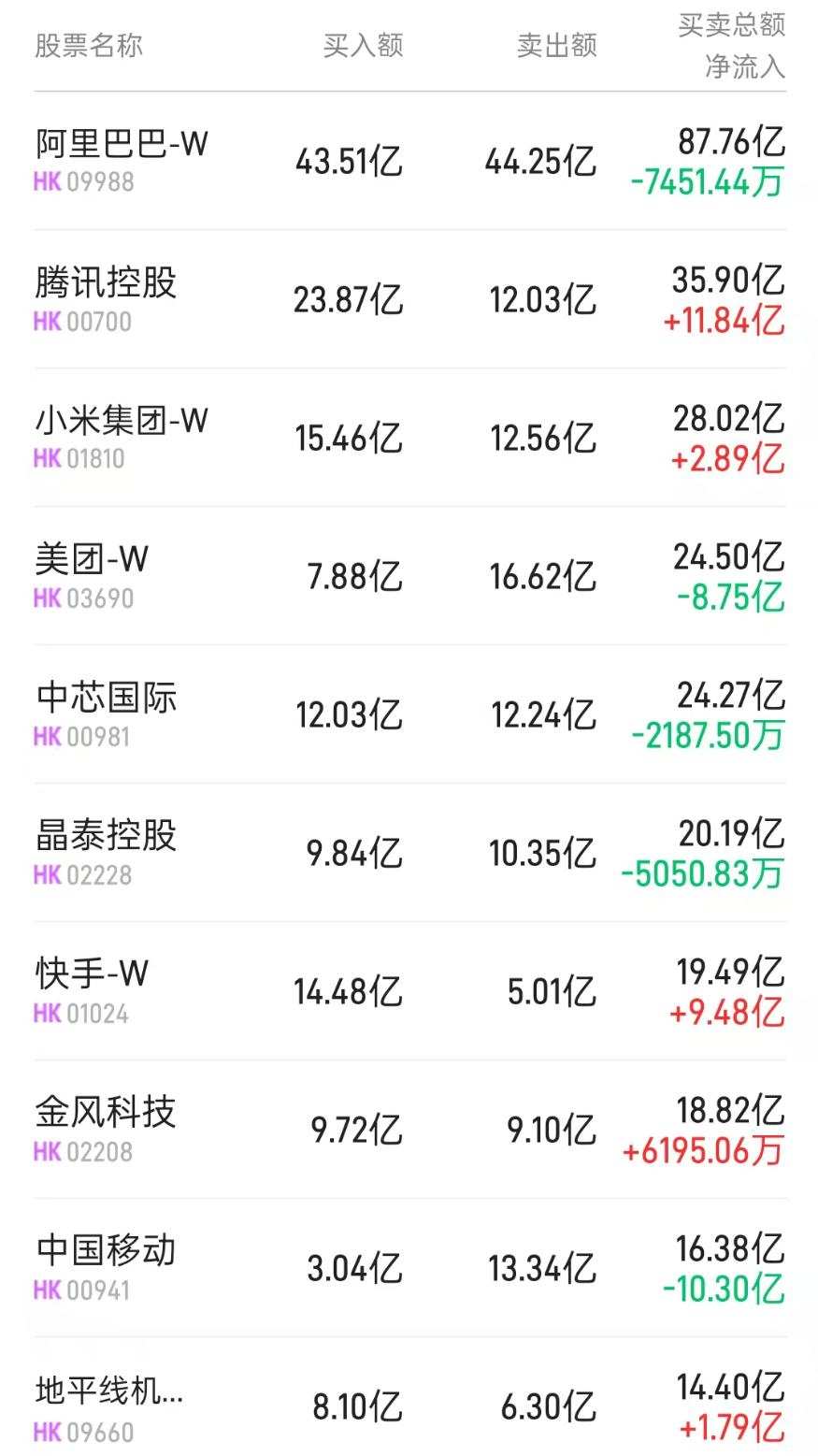
Market Overview - On January 12, the Hang Seng Index rose by 1.44%, with total southbound trading amounting to HKD 1,474.94 billion, including buy transactions of HKD 774.00 billion and sell transactions of HKD 700.94 billion, resulting in a net buy of HKD 73.06 billion [2][3]. Southbound Trading Details - The southbound trading through Stock Connect (Shenzhen) had a total transaction amount of HKD 610.81 billion, with buy transactions of HKD 334.20 billion and sell transactions of HKD 276.61 billion, leading to a net buy of HKD 57.60 billion [2]. - The southbound trading through Stock Connect (Shanghai) had a total transaction amount of HKD 864.13 billion, with buy transactions of HKD 439.80 billion and sell transactions of HKD 424.33 billion, resulting in a net buy of HKD 15.46 billion [2]. Active Stocks - The most actively traded stock by southbound funds was Alibaba-W, with a total transaction amount of HKD 156.07 billion, followed by Tencent Holdings and Xiaomi Group-W, with transaction amounts of HKD 70.06 billion and HKD 46.71 billion, respectively [2][3]. - Among the net buying stocks, Kuaishou-W had the highest net buy amount of HKD 22.45 billion, with a closing price increase of 7.43%. Tencent Holdings followed with a net buy of HKD 20.12 billion, and Southern Hang Seng Technology had a net buy of HKD 8.58 billion [2][3]. Continuous Net Buying and Selling - Three stocks experienced continuous net buying for more than three days, with Xiaomi Group-W leading at 8 days, followed by Tencent Holdings at 4 days and SMIC at 3 days. The total net buy amounts were HKD 63.26 billion for Xiaomi Group-W, HKD 62.43 billion for Tencent Holdings, and HKD 12.79 billion for SMIC [3]. - Two stocks faced continuous net selling, with China Mobile and Meituan-W having the highest net sell amounts of HKD 44.80 billion and HKD 10.76 billion, respectively [3].



算力巨头闯关IPO,估值超600亿
Xin Lang Cai Jing· 2026-01-12 13:15
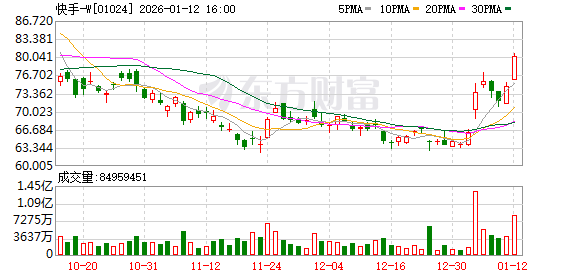
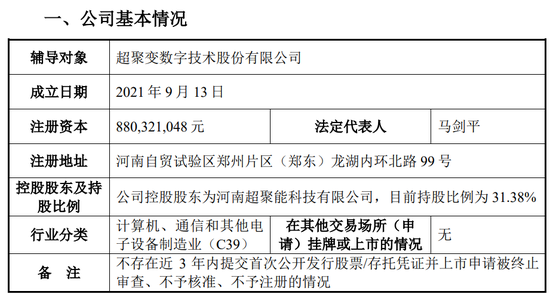
记者丨雷晨 编辑丨巫燕玲 2026年开局,中国算力产业迎来一则重磅消息。 1月6日,中国证监会官网更新的一则备案信息,揭开了一场酝酿已久的资本大戏——成立仅四年、年营 收已突破400亿元的超聚变数字技术有限公司(下称"超聚变"),正式启动A股上市辅导,中信证券出 任辅导机构。 图片来源:超聚变辅导备案报告 这家从华为母体"断裂"而生的企业,在经历了"独立生存质疑—国资果断接手—技术路线押注—市场逆 势跃升"的完整周期后,不仅活了下来,更以四年狂飙的速度,长成了中国算力版图中一个不容忽视 的"新巨头"。 此刻,站在IPO的起跑线上,超聚变的发展故事既是中国算力产业链自主可控的生动切片,也是地方政 府以资本与政策培育战略性新兴产业的一次关键实验,更是AI浪潮席卷之下,国产算力企业密集资本 化的又一标志性事件。 从生存到领先 超聚变的诞生,始于一场科技界的战略调整。 2021年,在复杂的国际环境下,华为对其x86服务器业务做出了剥离决策。同年9月,脱胎于此的超聚变 数字技术有限公司正式成立,并落户河南郑州。 剥离之初,业内曾有声音:离开了华为的品牌与生态体系,这家新公司如何独立生存?没过多久,河南 国资的果断出手, ...
超20万颗!中国新增多个星座计划申请 商业航天再掀涨停潮
2 1 Shi Ji Jing Ji Bao Dao· 2026-01-12 12:19
Core Viewpoint - The recent submission of 203,000 satellites by China to the International Telecommunication Union (ITU) marks the largest frequency and orbit resource application in the country's history, significantly boosting the commercial space sector and leading to increased activity in A-share commercial aerospace stocks [1][2]. Group 1: Satellite Submission Details - China submitted an application for 203,000 satellites, covering 14 satellite constellations, including low and medium Earth orbit satellites, with major contributors being China Star Network and Yuanxin Satellite [1][2]. - The application includes significant participation from commercial space enterprises and telecom operators, with the Radio Spectrum Development and Utilization and Technology Innovation Research Institute applying for two constellations (CTC-1 and CTC-2) that account for 95% of the total application [1][2]. - This submission is a routine procedure under ITU regulations, which requires countries to register satellite network data to gain international recognition and protect frequency resources from interference [2]. Group 2: Market Reactions and Implications - Following the announcement, A-share commercial aerospace stocks saw significant activity, with companies like Tongyu Communication and Jushi Holding experiencing multiple-day stock price increases [6]. - Experts caution that the transition from application to actual satellite launch will take time, and the market should maintain a rational perspective on the developments [6]. - The large-scale application is expected to activate the entire satellite manufacturing, launching, and operational industry chain, potentially leading to significant advancements in China's aerospace capabilities [7]. Group 3: Strategic Insights - The submission reflects a long-term national strategic layout and space resource planning, differing fundamentally from SpaceX's commercial expansion based on an established business model [7][8]. - The involvement of major telecom companies like China Mobile and China Telecom indicates that satellite internet is evolving into a crucial component of national infrastructure, enhancing resource mobilization and market reach [8]. - The increase in application scale signifies a shift in industry perception regarding low Earth orbit capacity, moving from smaller constellations to larger-scale projects, indicating a strategic evolution [8]. Group 4: Challenges and Future Directions - Key challenges for the industry include improving satellite manufacturing efficiency to automotive levels, significantly reducing launch costs, and creating a closed-loop system for aerial data and ground applications to realize commercial value [8][9]. - The resolution of these challenges will directly impact the successful realization of the proposed satellite network and its associated benefits [9].

资金动向 | 北水扫货港股73亿港元,爆买快手超22亿港元
Ge Long Hui A P P· 2026-01-12 11:12
Group 1 - Southbound funds net bought Hong Kong stocks worth 7.306 billion HKD on January 12, with notable purchases including Kuaishou-W (2.245 billion HKD), Tencent Holdings (2.012 billion HKD), and Xiaomi Group-W (0.773 billion HKD) [1] - Continuous net buying trends were observed, with Xiaomi receiving a total of 6.327 billion HKD over the last eight days and Tencent accumulating 6.243 billion HKD over the last four days [4] - China Mobile experienced a continuous net sell-off for six days, totaling 4.480 billion HKD, while Meituan faced net selling for three days, amounting to 1.075 billion HKD [4] Group 2 - Tencent Holdings repurchased 1 million shares for 635.7 million HKD on January 12 [5] - Xiaomi Group-W announced significant upgrades to its new generation SU7 model, indicating an increase in overall weight compared to the first generation [5] - Meituan expressed support for a government investigation into the competitive landscape of the food delivery service industry, advocating for rational competition and collaboration among platforms [6]
智通港股通活跃成交|1月12日
智通财经网· 2026-01-12 11:01
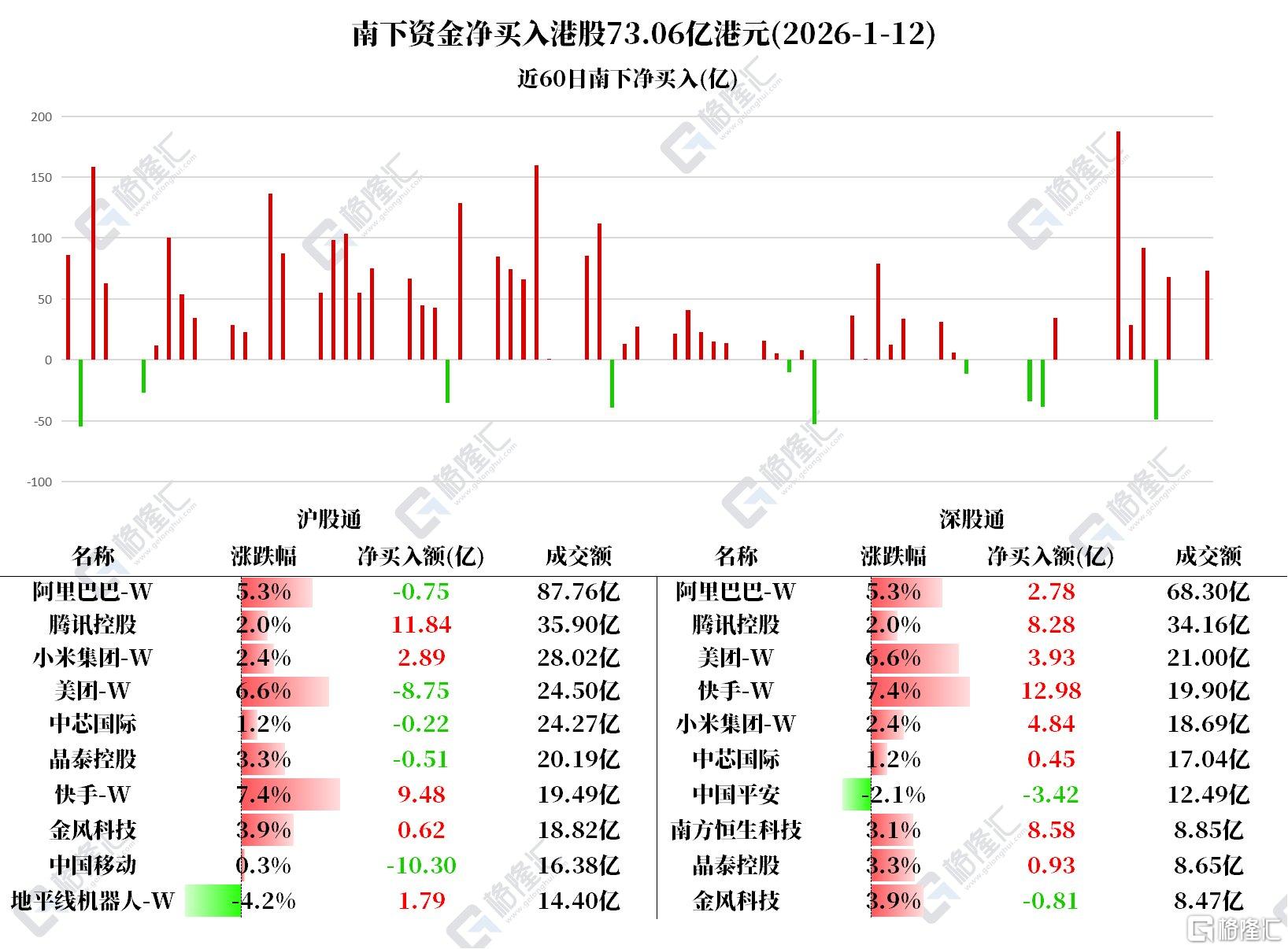
Core Insights - On January 12, 2026, Alibaba-W (09988), Tencent Holdings (00700), and Xiaomi Group-W (01810) were the top three companies by trading volume in the Southbound Stock Connect, with trading amounts of 8.776 billion, 3.590 billion, and 2.802 billion respectively [1] - In the Shenzhen-Hong Kong Stock Connect, Alibaba-W (09988), Tencent Holdings (00700), and Meituan-W (03690) also led the trading volume, with amounts of 6.830 billion, 3.416 billion, and 2.100 billion respectively [1] Southbound Stock Connect Trading Activity - **Top Active Companies in Southbound Stock Connect:** - Alibaba-W (09988): Trading amount of 8.776 billion, net buy of -74.5144 million [2] - Tencent Holdings (00700): Trading amount of 3.590 billion, net buy of 1.184 billion [2] - Xiaomi Group-W (01810): Trading amount of 2.802 billion, net buy of 289 million [2] - Meituan-W (03690): Trading amount of 2.450 billion, net buy of -875 million [2] - SMIC (00981): Trading amount of 2.427 billion, net buy of -21.875 million [2] - Other notable companies include Kuaishou-W (01024) with a trading amount of 1.949 billion and a net buy of 948 million [2] Shenzhen-Hong Kong Stock Connect Trading Activity - **Top Active Companies in Shenzhen-Hong Kong Stock Connect:** - Alibaba-W (09988): Trading amount of 6.830 billion, net buy of 278 million [2] - Tencent Holdings (00700): Trading amount of 3.416 billion, net buy of 828 million [2] - Meituan-W (03690): Trading amount of 2.100 billion, net buy of 393 million [2] - Kuaishou-W (01024): Trading amount of 1.990 billion, net buy of 1.298 billion [2] - Xiaomi Group-W (01810): Trading amount of 1.869 billion, net buy of 484 million [2]

我国新增超20万颗卫星申请
第一财经· 2026-01-12 10:29
2026.01. 12 本文字数:1390,阅读时长大约4分钟 作者 | 第一财经 钱童心 在中国商业航天多重利好影响下,2026年开年,卫星产业链表现持续强劲。1月12日,卫星ETF (563230)、卫星ETF易方达(563530)、卫星产业ETF(159218)、卫星ETF(159206)、 卫星ETF鹏华(563790)均触及涨停。 另据Wind数据,截至1月9日,中证卫星产业指数近一个月涨幅接近65%,国证商用卫星通信产业指 数近一个月涨幅也超过50%。多只卫星ETF近一个月的业绩涨幅也都超过60%,卫星产业相关ETF 及联接产品总规模达237.6亿元,较2025年末的121.1亿元接近翻倍。永赢国证商用卫星通信产业 ETF最新规模更是达到117.69亿元,成为市场上诞生的首个单只规模破百亿元的卫星ETF。 市场普遍认为,2026年将成为中国商业航天产业加速发展的元年,具备高进入壁垒、强政策支持和 明确订单可见性的产业中游,火箭发射、卫星制造等领域更具景气确定性。 有基金经理表示,近期商业航天板块利好消息密集释放,政策支持落地、行业标杆企业IPO推进等多 重利好因素等提振下,2026年中国商业航天板 ...


李彦宏要IPO敲钟了
盐财经· 2026-01-12 10:22
Core Viewpoint - Baidu's Kunlun Chip is preparing for an IPO in Hong Kong, marking a significant move in the Chinese semiconductor industry as it aims to capitalize on the rising demand for computing power [4][9][10]. Group 1: Company Background and Development - Kunlun Chip, originally part of Baidu's AI chip division, was spun off in 2021 with an initial valuation of 13 billion RMB [4][12]. - The chip development began in 2011, with significant milestones including the launch of the first Kunlun chip in 2018, which achieved a computing power of 260 Tops [7][8]. - By 2024, the third generation of Kunlun chips is expected to be mass-produced, targeting various industries such as finance, energy, and education [8]. Group 2: Financial Performance and Market Position - Kunlun Chip has attracted a diverse range of investors, including major firms like BYD and various state-owned enterprises, indicating strong market confidence [12][13]. - Projections suggest that Kunlun Chip's sales could reach 3.5 billion RMB in 2025 and 6.5 billion RMB in 2026, highlighting its growth potential [13]. - Baidu anticipates that the IPO will enhance Kunlun Chip's market image and allow for independent capital market access, optimizing financial resource allocation [13]. Group 3: Competitive Landscape and Strategic Importance - The IPO comes at a time when other Chinese semiconductor companies, such as Wallen Technology and Moore Threads, have recently achieved significant market valuations, creating a competitive environment [16][17]. - Baidu's Kunlun Chip is positioned to replicate the success of its competitors, with a current shipment volume of 69,000 units, placing it among the top domestic chip manufacturers [17]. - Analysts suggest that if Kunlun Chip receives a valuation similar to that of Cambricon, Baidu's stake could be valued at 22 billion USD, representing 45% of its total market capitalization [17].

南向资金 | 快手-W获净买入22.45亿港元



Di Yi Cai Jing· 2026-01-12 10:12
Group 1 - Southbound funds recorded a net purchase of 7.306 billion HKD today [1] - Kuaishou-W, Tencent Holdings, and Southern Hang Seng Technology were the top three net purchases, with net buys of 2.245 billion HKD, 2.012 billion HKD, and 858 million HKD respectively [1] - On the sell side, China Mobile, Meituan-W, and Ping An of China experienced net sales of 1.03 billion HKD, 482 million HKD, and 342 million HKD respectively [1]
北水动向|北水成交净买入73.06亿 AI概念股受追捧 快手获北水加仓超22亿港元
Zhi Tong Cai Jing· 2026-01-12 10:09
Core Viewpoint - The Hong Kong stock market experienced significant net inflows from northbound trading, totaling HKD 73.06 billion on January 12, with notable net purchases in specific stocks such as Kuaishou-W, Tencent, and Southern Hang Seng Technology [1][2]. Group 1: Northbound Trading Activity - Northbound trading saw a net purchase of HKD 73.06 billion, with HKD 15.46 billion from the Shanghai Stock Connect and HKD 57.6 billion from the Shenzhen Stock Connect [1]. - The most purchased stocks included Kuaishou-W (01024), Tencent (00700), and Southern Hang Seng Technology (03033) [1]. - The most sold stocks were China Mobile (00941) and Goldwind Technology (02208) [1]. Group 2: Individual Stock Performance - Kuaishou-W received a net inflow of HKD 22.45 billion, driven by its AI capabilities gaining popularity globally, with a reported 102% increase in daily revenue from December 2025 to January 2026 [4]. - Tencent saw a net inflow of HKD 20.11 billion, with a positive outlook from Zhongtai Securities, highlighting its potential in the AI sector [5]. - Xiaomi Group-W had a net inflow of HKD 7.73 billion, with plans for a significant increase in R&D investment over the next five years [5]. - Alibaba-W experienced a net inflow of HKD 2.03 billion amid ongoing regulatory scrutiny in the food delivery sector [5]. - Horizon Robotics-W received a net inflow of HKD 1.79 billion, with optimistic growth expectations due to advancements in smart driving technology [6]. - JingTai Holdings (02228) had a net inflow of HKD 42.04 million, with a focus on its AI and robotics business model [7].
中国移动入选“2025中国企业ESG百强”榜单
Xin Lang Cai Jing· 2026-01-12 10:07
Core Insights - The article emphasizes the growing importance of ESG (Environmental, Social, and Governance) as a key metric for high-quality corporate development and a vital link between corporate value and social value [1][12] - The "2025 China ESG Top 100" list was released by Sina Finance, evaluating over 5,000 A-share listed companies and mainland companies listed in Hong Kong using 18 industry-specific ESG evaluation models and over 150 ESG indicators [1][12] - The list serves as a benchmark for industry development and provides valuable decision-making references for investors [1][12] Industry Overview - The ESG ecosystem in China is rapidly improving, with tightening regulatory policies and increasing market focus on ESG performance, making sustainable development capabilities a core competitive advantage for companies [1][12] - ESG is no longer seen as an optional enhancement but as an essential requirement for companies facing global challenges and demands for high-quality development [2][13] Company Highlights - China Mobile ranked 2nd in the "2025 China ESG Top 100" list, recognized for its substantial work and innovative practices in the ESG domain [2][13] - The recognition of companies in the ESG Top 100 is a significant endorsement of their sustainable development practices and aims to inspire other companies to integrate ESG principles into their strategic planning and operations [2][13]
