
OPPO

Search documents
Omdia数据快闪:2025年第四季度,全球智能手机重点市场厂商排名
Canalys· 2026-02-12 01:03
Core Insights - The global smartphone market experienced a year-on-year growth of 4% in Q4 2025, driven by seasonal demand recovery and improved inventory management, despite some manufacturers facing rising component costs [2] - Apple led the global smartphone market with a 25% market share, attributed to strong demand for the iPhone 17 series, achieving record quarterly shipments and maintaining its position as the largest smartphone manufacturer for three consecutive years, slightly ahead of Samsung [2] - Samsung ranked second with an 18% market share, boosted by strong sales of models priced below $300, particularly the Galaxy A17 4G and 5G series [2] - Xiaomi maintained its position as the third-largest manufacturer, although its market share declined to 11% due to shipment challenges in key markets [2] - Vivo achieved an 8% market share, benefiting from its leading position in the Indian market, while OPPO returned to growth, re-entering the global top five [2] Regional Summaries Global Key Regions - In Q4 2025, Apple held a 25% market share globally with a 9% annual growth, while Samsung had an 18% share with a 16% growth. Xiaomi's share fell to 11% with an 11% decline, Vivo and OPPO both held 8% shares with growth rates of 4% and 9% respectively [2] Europe - In Europe, Apple captured a 30% market share with a 6% growth, while Samsung followed closely with 28% and a 10% growth. Xiaomi's share was 17%, down by 3%, and Lenovo achieved a 6% share with a 13% growth [3] APAC (Excluding Greater China) - In the APAC region, Samsung led with a 19% market share and an 18% growth, followed by Apple at 18% with a 4% growth. Vivo and OPPO held 15% and 11% shares with growth rates of 11% and 6% respectively, while Xiaomi's share dropped to 10% with a 23% decline [3] Mainland China - In Mainland China, Apple ranked first with a 22% market share and a significant 26% growth. Vivo and OPPO followed with 16% and 15% shares, experiencing declines of 8% and growth of 9% respectively [7] India - In India, Vivo led with a 25% market share and a 16% growth, followed by OPPO at 16% with a 4% growth. Samsung's share was 14%, down by 11%, while Xiaomi's share fell to 12% with a 26% decline [7] United States - In the United States, Apple dominated with a 69% market share and an 8% growth, while Samsung held 14% with a 3% decline. Lenovo captured 9% with a 13% growth [9] Brazil - In Brazil, Samsung led with a 39% market share, experiencing a slight decline of 1%. Lenovo and Xiaomi both held 23% and 15% shares with 12% growth, while Apple had an 11% share with a 10% growth [10]




罗永浩炮轰段永平:“他懂个屁手机”
3 6 Ke· 2026-02-11 13:21
Core Viewpoint - The debate between entrepreneurs Luo Yonghao and Duan Yongping highlights contrasting business philosophies: idealism versus pragmatism, with Luo focusing on product design and marketing, while Duan emphasizes comprehensive business strategy and long-term investment [6][17]. Group 1: The Trigger of the Debate - The argument was sparked by a comparison made by a netizen between Duan Yongping and Luo Yonghao, suggesting that Duan's understanding of the mobile industry is superior due to his strategic investment approach, while Luo's approach is seen as less informed [4][6]. - Luo's response criticized Duan's knowledge of mobile technology, claiming that both he and Duan lack the understanding of the industry, with a reference to the late Steve Jobs as the only one who truly understood [4][6]. Group 2: Luo Yonghao's Journey - Luo Yonghao founded Smartisan Technology in May 2012, transitioning from an English teacher to the mobile industry, but faced numerous challenges, including product failures and financial difficulties [7][8]. - After exiting the mobile market, Luo engaged in various ventures, including live streaming sales, which helped him repay significant debts, ultimately clearing 820 million yuan by 2025 [9][10]. Group 3: Duan Yongping's Business Landscape - Duan Yongping, with a background in technology and business, built a substantial commercial empire, including the creation of brands like OPPO and vivo, and made significant investments, notably in Apple, yielding extraordinary returns [12][14]. - His investment philosophy focuses on long-term value creation and understanding business models, which has influenced many entrepreneurs in the tech sector [12][14]. Group 4: Underlying Themes of the Debate - The discussion reflects differing interpretations of what it means to "understand mobile technology," with Luo emphasizing user experience and marketing, while Duan's perspective includes technical development and supply chain management [17][18]. - The tension between idealism and realism in business is evident, with Luo's aspirations contrasting with Duan's practical investment strategies [18][19]. Group 5: Future Implications - The mobile industry is undergoing significant transformation, particularly with the integration of AI technology, which both entrepreneurs are exploring in their respective ventures [19][22]. - The outcomes of this debate may influence the future landscape of the Chinese business environment, as both figures represent different strategic approaches to technology and investment [23].

【行情】全球每4部手机就有1部iPhone?最新用户设备情况出炉
Xin Lang Cai Jing· 2026-02-11 10:32
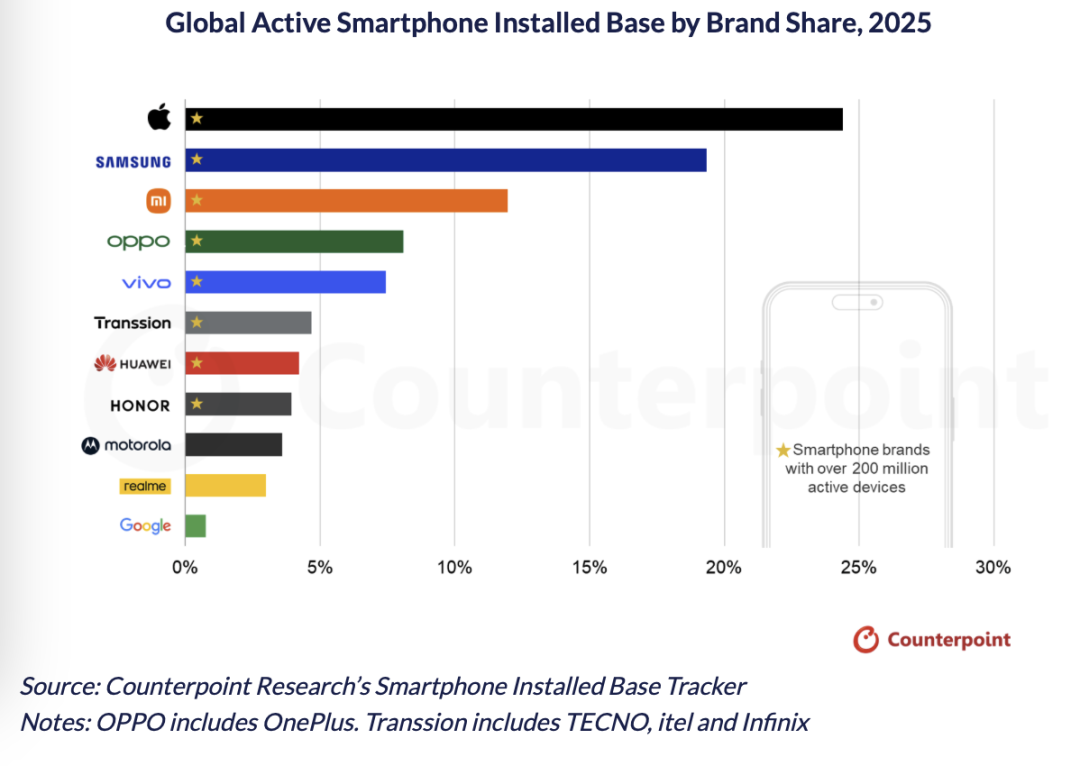
如上图所见,报告显示2025年全球智能手机设备活跃量来说,TOP10依次是:苹果、三星、小米、OPPO、vivo、传音、华为、荣耀、摩托罗拉、realme、 谷歌。 报告还提到TOP8品牌人均有2亿台以上设备,苹果和三星超10亿台,也就是近四分之一的手机是iPhone,近五分之一是三星手机。报告还提到2025年苹果 新增的手机设备比后面7家品牌加起来还多,问问大家,你现在用的哪家手机? 研究机构Counterpoint近日发布了一份2025年全球智能手机设备活跃情况。 研究机构Counterpoint近日发布了一份2025年全球智能手机设备活跃情况。 如上图所见,报告显示2025年全球智能手机设备活跃量来说,TOP10依次是:苹果、三星、小米、OPPO、vivo、传音、华为、荣耀、摩托罗拉、realme、 谷歌。 报告还提到TOP8品牌人均有2亿台以上设备,苹果和三星超10亿台,也就是近四分之一的手机是iPhone,近五分之一是三星手机。报告还提到2025年苹果 新增的手机设备比后面7家品牌加起来还多,问问大家,你现在用的哪家手机? ...
全球在使用的苹果三星手机均超过10亿部 7家国内品牌进入前10
Xin Lang Cai Jing· 2026-02-11 10:16
在活跃量进入前10的厂商中,除了摩托罗拉和真我,其余8家的活跃量是都在2亿部之上。(海蓝) 【TechWeb】2月11日消息,据外媒报道,有市场研究机 构发布了全球智能手机活跃量报告,从品牌来看苹果是 高居第1,三星电子紧随其后,两家双双超过了10亿部, 小米、OPPO、vivo等国内厂商,也都进入了前10,6家 的活跃量超过了2亿部。 市场研究机构在报告中表示,全球活跃的智能手机在 2025年同比增长2%。 具体到厂商方面,在全球目前活跃的智能手机中,苹果 所占的比例接近25%,三星电子则是接近20%,他们也 是仅有的两家活跃量超过10亿部的厂商。 活跃量进入前10的另外8家,分别是小米、OPPO、 vivo、传音、华为、荣耀、摩托罗拉、真我,其中的小米的份额是超过了10%,OPPO和vivo在5%到 10%之间。 【TechWeb】2月11日消息,据外媒报道,有市场研究机构发布了全球智能手机活跃量报告,从品牌来 看苹果是高居第1,三星电子紧随其后,两家双双超过了10亿部,小米、OPPO、vivo等国内厂商,也都 进入了前10,6家的活跃量超过了2亿部。 市场研究机构在报告中表示,全球活跃的智能手机在202 ...
存储芯片暴涨暗藏危机!中芯国际:当心猛涨后一地鸡毛
Sou Hu Cai Jing· 2026-02-11 07:30
Core Viewpoint - The storage chip market is experiencing significant price increases driven by AI demand, but there are warnings from companies like SMIC about potential overestimation of demand and supply chain disruptions in traditional sectors [1][3][9] Group 1: Market Dynamics - DDR5 memory prices surged nearly 70% in a month, with SSD prices in Shenzhen doubling, leading to unusual trading practices like "buying memory with motherboards" [1] - Major semiconductor companies, including Samsung and SK Hynix, are projected to achieve record revenues in their storage businesses by 2025, while domestic module manufacturer Jiangbolong reported a 1994% increase in net profit [3] - SMIC's capacity utilization reached 95.8%, forcing delays in mobile phone orders to prioritize AI chip deliveries [3] Group 2: Supply Chain Issues - The price surge is attributed to unexpected capacity cuts by manufacturers like Micron in the consumer storage segment and structural shortages in HBM memory due to AI demand [3][5] - There is a panic-driven cycle of stockpiling within the industry, with DRAM modules being allocated through a "distribution system," marking a first in the industry [3][5] - Smartphone manufacturers like Xiaomi and OPPO are facing DRAM inventory shortages of less than three weeks, leading to price increases of 100-400 yuan for new models [3][5] Group 3: Future Outlook - The current situation is expected to lead to a reduction in orders for PMICs and display drivers, which are key products for SMIC, as smartphone manufacturers struggle with storage shortages [5] - TrendForce has revised down its 2026 smartphone shipment forecasts, indicating that the high prices are negatively impacting the end market [5] - SMIC predicts that the current high-price environment will not last, warning of potential overcapacity as demand from end-users is suppressed [7][9]


通信行业周报(2月2日-2月8日)
Guoxin Securities Co., Ltd· 2026-02-11 04:20
Investment Rating - The communication industry is rated as "Cautiously Optimistic" with a focus on operators with sustained profit growth and enhanced network value, as well as companies benefiting from traffic growth and continuous technological innovation [6][41]. Core Insights - The communication sector experienced a decline of 6.73% from February 2 to February 6, 2026, underperforming the CSI 300 index by 5.39 percentage points [3][13]. - The sector's cumulative decline for 2026 is 1.63%, ranking it 27th among 30 sectors [3][14]. - The TTM PE ratio for the communication industry is 26.41, placing it in the 36.08 percentile [3][14]. - The smartphone market in China saw a total shipment of 307 million units in 2025, a year-on-year decrease of 2.4%, with 5G phones accounting for 86.9% of shipments [4][36]. - Global smartphone shipments grew by 2% in 2025, reaching 1.25 billion units, marking the highest level since 2021 [4][38]. Summary by Sections Communication Industry Market Review - The communication sector's performance was notably poor, with a significant drop in stock prices and a low ranking among other sectors [3][13]. - A total of 119 companies are listed in the communication sector, with 30 companies seeing stock price increases and 88 experiencing declines during the review period [3][14]. Industry News - As of December 2025, China has built 4.838 million 5G base stations, with internet penetration exceeding 80% [17]. - The number of internet users reached 1.125 billion, with a significant increase in generative AI users [17][20]. - The production of optical cables in China decreased by 5.3% in 2025, although the decline rate has slowed compared to previous years [20]. Weekly Focus: Consumer Electronics Data - The smartphone market in China is experiencing structural adjustments, with a notable decline in December 2025 shipments [5][40]. - Despite the overall decline, the proportion of 5G phones continues to rise, indicating a maturation of 5G technology [5][36]. Investment Recommendations - The report suggests a cautious optimism for the communication industry, emphasizing the importance of profit growth and technological innovation for future investments [6][41].
罗永浩懂个屁手机,他只是懂流量!
Sou Hu Cai Jing· 2026-02-11 03:29
Core Viewpoint - The comparison between Luo Yonghao and Duan Yongping highlights the importance of both product value creation and market value realization in achieving business success [1][21]. Group 1: Understanding of Mobile Phones - Luo Yonghao believes he understands mobile phones, citing micro-innovations in the Smartisan phone's operating system as evidence [2][3]. - However, the article argues that these innovations do not encompass the entirety of understanding mobile phones, as they focus too much on superficial features rather than the broader product strategy [5][11]. - The article emphasizes that in a mature manufacturing industry like smartphones, localized innovations hold little value compared to comprehensive technological advancements [7][8]. Group 2: Business Acumen - Luo Yonghao admits to not fully understanding business, operating instead within a framework of internet celebrity and traffic monetization rather than sustainable business growth [17][18]. - The core of successful business is establishing a positive feedback loop where good products lead to consumer satisfaction, repeat purchases, and reinvestment in product development [19]. - Luo's business model is described as event-driven, relying on generating buzz and controversy to mask product weaknesses, which is unsustainable in the long run [19][20]. Group 3: Comparison with Duan Yongping - Duan Yongping's understanding of business is characterized by ecological insight, allowing him to identify effective teams and strategies in the smartphone ecosystem [21][23]. - His investments in OPPO and VIVO reflect a focus on companies that can meet specific consumer needs, demonstrating a deeper understanding of resource organization and consumer demand [23]. - The article concludes that Luo Yonghao's approach is superficial and lacks the sustainable value creation that defines successful business practices, contrasting sharply with Duan Yongping's investment philosophy [24][25].

当“华米OV 耀”都不再满足于造手机
3 6 Ke· 2026-02-11 02:28
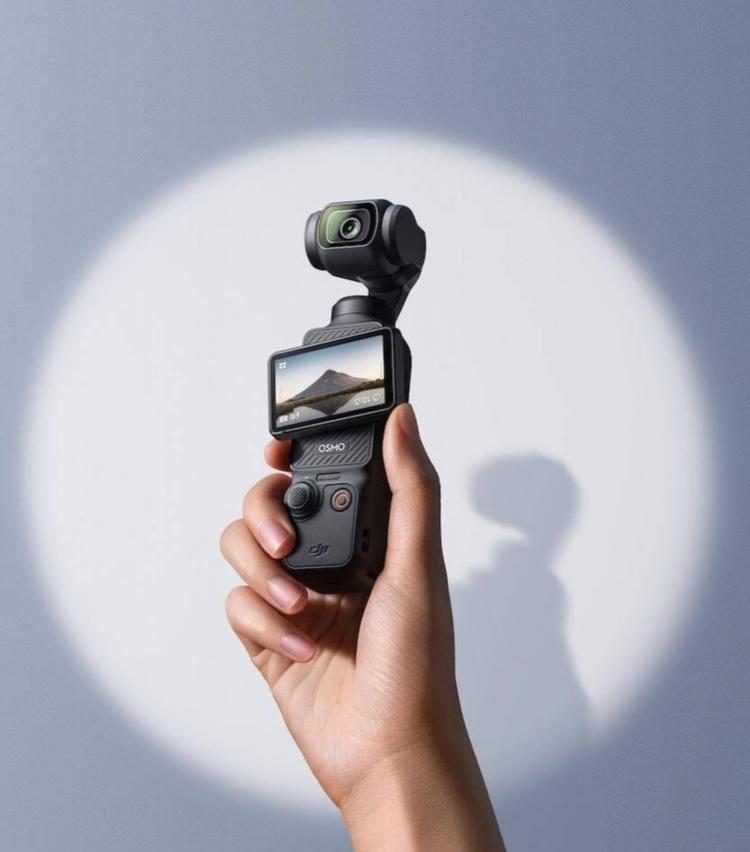
Core Viewpoint - The mobile phone manufacturers are shifting their focus towards the professional camera and handheld imaging device market, which was previously considered untouchable, indicating a significant transformation in the industry landscape [1]. Group 1: Market Dynamics - OPPO and vivo are the first to target the market dominated by DJI's Pocket series, which has become a standard for content creators and tourists seeking better image quality and stabilization than smartphones [2][4]. - vivo is developing a standalone Vlog camera aimed at competing directly with DJI's Pocket series, featuring a lightweight design and integration with its OriginOS for seamless editing and sharing [4][6]. - OPPO is also working on a new imaging product that may be part of its Find series, focusing on high-quality material collection while leveraging mobile processing power for editing and social sharing [8]. Group 2: Product Innovations - Xiaomi is pursuing a modular approach with a magnetic lens system that allows its smartphones to transform into high-quality cameras, potentially launching with the MIX 5 or 16 Ultra in 2026 [9][12]. - The magnetic lens module will enable users to attach a large optical module to their phones, enhancing photography capabilities while maintaining a lightweight design [13][15]. - Honor is taking a more radical approach by integrating a mechanical gimbal into its upcoming "Robot Phone," allowing for advanced stabilization and 360-degree tracking [17][19]. Group 3: Strategic Collaborations - Huawei is not developing a standalone Vlog camera but is collaborating with DJI for deeper integration of camera controls within its HarmonyOS, indicating a strategic focus on software rather than hardware [21][26]. - Huawei is also testing a square sensor for front cameras, aimed at optimizing social media content creation by allowing for maximum image capture regardless of phone orientation [23][24]. Group 4: Industry Trends - The year 2026 is seen as a pivotal moment for the smartphone industry, as manufacturers face diminishing returns on hardware improvements and are compelled to innovate through external devices or standalone products [27]. - The shift towards integrating advanced computational photography into traditional camera forms represents a significant challenge to established camera manufacturers, who have struggled to meet the demands of modern content creators [28][29].
技术硬件与设备行业2025年信用回顾与2026年展望
新世纪评级· 2026-02-11 01:17
Investment Rating - The technology hardware and equipment industry is rated as stable for 2025 and 2026 [1] Core Insights - The technology hardware and equipment industry is experiencing a slow recovery driven by inventory replenishment cycles and AI technology, despite overall pressure from weak global economic growth since 2025. There is significant differentiation among sub-industries, with strong demand for data center equipment driven by computing power, while traditional telecom equipment shows sluggish growth [2][3] - The Chinese government has established a policy framework to support the industry, focusing on short-term growth stabilization, medium-term supply chain strengthening, and long-term innovation promotion, primarily through domestic substitution to overcome high-end equipment and material bottlenecks [2] - The industry is expected to benefit from the deepening of digital China initiatives and the industrialization of cutting-edge technologies like AI, entering a structurally growth-driven cycle. However, geopolitical disturbances and rapid technological iterations may lead to uneven recovery across the industry [5] Summary by Sections Industry Overview - The electronic information manufacturing industry is closely tied to global economic conditions, showing signs of recovery since 2024 due to inventory replenishment and AI-driven demand. It is a core industry in China's economic structure transformation and upgrade [7][8] - In 2024, the added value of China's electronic information manufacturing industry grew by 11.8%, outperforming overall industrial and high-tech manufacturing growth rates [8] Financial Performance - Sample companies in the technology hardware and equipment industry reported positive revenue growth year-on-year in 2025, aligning with industry recovery trends. However, high R&D investments and asset impairment losses have pressured net profits, while EBITDA showed year-on-year growth, indicating profit resilience [3] - The debt scale and liability ratios of sample companies have increased, with a decline in the EBITDA coverage ratio for rigid debt, although interest coverage has improved due to lower financing costs [3] Sub-Industry Insights Communication Equipment - The communication equipment sector is experiencing growth opportunities driven by AI and industrial interconnectivity, with significant demand for data center equipment but slow growth in traditional telecom network equipment. The market is highly competitive and concentrated [24][27] - The deployment of high-speed optical modules and data center switches is expected to grow significantly, while traditional telecom equipment investments are declining as operators shift focus to computing power networks [28] Computers and Peripheral Devices - The global PC and server markets are stable, with Chinese manufacturers gaining market share due to domestic substitution. The AI PC segment is becoming a core growth driver, with AI PC shipments expected to increase significantly [37][38] - The global server market is experiencing robust growth driven by AI computing demand, with significant revenue increases expected in the coming years [42] Electronic Devices, Instruments, and Components - The electronic devices, instruments, and components sector is seeing overall recovery driven by AI innovation and domestic supply chain localization. Key areas of growth include computing power chips and advanced packaging [48][49] - The semiconductor industry is entering an upward trend, with significant sales growth expected in both global and Chinese markets [56]



半导体行业月报:海外云厂商26年资本支出再加速,半导体产业链迎来全面涨价潮
Zhongyuan Securities· 2026-02-11 00:20
Investment Rating - The semiconductor industry is rated as "Outperform" compared to the market [1] Core Insights - The semiconductor industry is experiencing a comprehensive price increase driven by the accelerated capital expenditures of overseas cloud vendors in 2026, with significant demand from AI servers leading to a shortage in testing capacity and subsequent price hikes across the supply chain [4][8] - In January 2026, the domestic semiconductor industry saw an increase of 18.63%, significantly outperforming the Shanghai and Shenzhen 300 index, which rose by 1.65% [7][13] - Global semiconductor sales continued to grow year-on-year, with a 37.1% increase in December 2025, marking 26 consecutive months of growth [28] Summary by Sections 1. Semiconductor Industry Performance - In January 2026, the semiconductor sector (CITIC) rose by 18.63%, with integrated circuits up by 18.52%, discrete devices by 18.91%, semiconductor materials by 19.04%, and semiconductor equipment by 18.88% [7][13] - The Philadelphia Semiconductor Index increased by 12.92% in January 2026, outperforming the Nasdaq 100, which rose by 1.20% [19][20] 2. Global Semiconductor Sales Growth - December 2025 global semiconductor sales reached approximately $78.9 billion, with a year-on-year growth of 37.1% and a month-on-month increase of 2.7% [28] - The sales of logic products grew by 39.9% year-on-year, reaching $301.9 billion, while memory products saw a 34.8% increase, totaling $223.1 billion [28] 3. Capital Expenditure Trends - The capital expenditures of the four major North American cloud vendors (Google, Microsoft, Meta, Amazon) increased by 67% year-on-year in Q4 2025, with expectations for continued acceleration in 2026 [7][8] - Google is projected to spend between $175 billion and $185 billion in 2026, a year-on-year increase of 91-102% [7] 4. Price Trends in Semiconductor Products - In January 2026, DRAM and NAND Flash spot prices continued to rise, with DRAM prices increasing by approximately 39% and NAND prices by about 35% month-on-month [7] - TrendForce has raised its price forecast for Q1 2026, expecting a 90-95% increase in general DRAM contract prices and a 55-60% increase in NAND Flash contract prices [7] 5. Investment Opportunities - The report suggests focusing on investment opportunities in AI PCB, optical chips, wafer foundries, testing, power devices, server CPUs, and memory sectors due to the ongoing price increases and strong demand driven by AI [8]