奇瑞汽车

Search documents
兴业科技落子安徽巢湖 加速开拓新能源与高端车市场
Zheng Quan Ri Bao Zhi Sheng· 2025-10-13 13:11
Group 1 - The core point of the article is that Xingye Leather Technology Co., Ltd. plans to invest 50 million yuan to establish a subsidiary in Chao Lake, Anhui, focusing on the localized deep processing of automotive interior leather [1] - The investment plan involves Xingye Technology contributing 45 million yuan for a 90% stake, in collaboration with partner Xu Jiakuan, to enhance competitiveness in the automotive interior leather sector [1] - The strategic layout leverages the automotive industry cluster advantages in the Hefei region, which includes major automotive manufacturers like BYD, NIO, Jianghuai, and Volkswagen [1] Group 2 - Xingye Technology's subsidiary, Hongxing Automotive Leather, is already a supplier for several automotive manufacturers, including Ideal Auto, NIO, Jianghuai, and Chery [1] - Establishing the subsidiary in Chao Lake will allow the company to better integrate into the local industrial ecosystem, improving supply chain responsiveness and building competitive advantages for expanding the automotive interior leather market [1] - The automotive interior leather business is becoming a growth engine for Xingye Technology, with revenue in the first half of 2025 increasing by 26.95% year-on-year and net profit reaching 76.5654 million yuan, up 30.91% [1] Group 3 - Through this strategic investment, Xingye Technology aims to leverage Hefei as an industrial hub to further penetrate the Yangtze River Delta automotive market [2] - The company seeks to strengthen existing customer relationships while also exploring broader high-value market opportunities, accelerating its entry into the new energy and high-end vehicle markets [2]

18个月以来首度同比下滑,比亚迪丢失月度销量冠军之位
Xin Lang Cai Jing· 2025-10-13 13:02
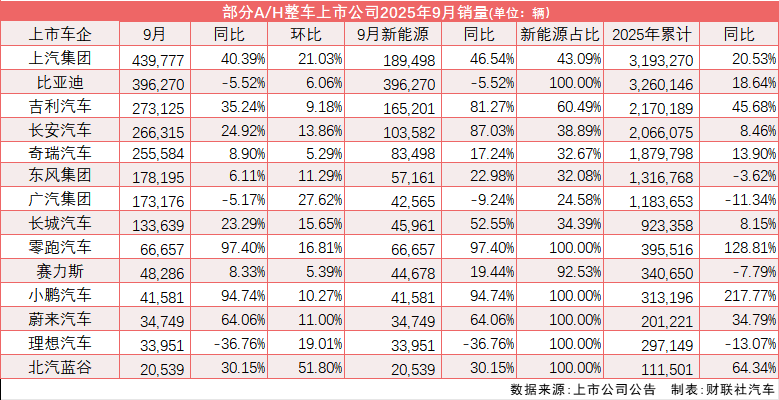
Core Insights - In September, the national retail sales of passenger cars reached 2.241 million units, a year-on-year increase of 6.3% and a month-on-month increase of 11.0% [1] - Cumulatively, retail sales for the year reached 17.005 million units, marking a year-on-year growth of 9.2%, setting a new historical high [1] Company Performance - BYD's September sales were 396,200 units, a year-on-year decline of 5.52%, marking the first monthly decline since March 2024, ending an 18-month streak of growth [1] - In September, BYD's pure electric vehicle sales were 205,000 units, a year-on-year increase of 24.31%, while plug-in hybrid sales were 188,000 units, a year-on-year decline of 25.58% [1] - BYD lost its position as the monthly sales champion among listed Chinese automakers, falling to second place [1] - For the first eight months of the year, BYD's cumulative sales of new energy vehicles reached 2.864 million units, a year-on-year increase of 23% [1] Competitor Performance - SAIC Motor's September sales reached 439,800 units, a year-on-year increase of 40.39%, reclaiming the monthly sales champion position after five months [2] - Cumulatively, SAIC's sales for January to September reached 3.193 million units, a year-on-year increase of 20.53% [2] - Geely's September sales were 273,100 units, a year-on-year increase of 35.24%, with new energy vehicle sales reaching 165,200 units, a year-on-year increase of 81.27% [2] - Chery's September sales were 255,600 units, a year-on-year increase of 8.90%, with new energy vehicle sales of 83,500 units, a year-on-year increase of 17.24% [2] Financial Performance - BYD's mid-year financial report for 2025 showed operating revenue of 371.28 billion yuan, a year-on-year increase of 23.30%, and a net profit attributable to shareholders of 15.51 billion yuan, a year-on-year increase of 13.79% [2] - BYD's net profit excluding non-recurring gains and losses was 13.60 billion yuan, a year-on-year increase of 10.43% [2] - In the first half of 2025, BYD's new energy vehicle sales reached 2.146 million units, a year-on-year increase of 33.04% [2] - BYD's pure electric vehicle sales in the first half of 2025 were 1.0234 million units, a year-on-year increase of 40.93% [2] Stock Performance - As of October 13, BYD's stock price closed down 1.95% at 105.69 yuan per share, with a total market capitalization of approximately 963.6 billion yuan [3]

时隔5个月,上汽重夺“销冠”
财联社· 2025-10-13 09:44
Core Viewpoint - The Chinese passenger car market experienced significant growth in September, with retail sales reaching 2.241 million units, a year-on-year increase of 6.3% and a month-on-month increase of 11.0%. Cumulatively, retail sales for the year reached 17.005 million units, marking a 9.2% year-on-year growth and setting a new historical peak [1]. Group 1: Market Performance - In September, 11 out of 14 listed car companies reported year-on-year sales growth, accounting for 78.6% of the sample. New energy vehicles (NEVs) were the primary driver of this growth, with total sales exceeding 1.32 million units among the 14 major companies [1]. - The penetration rate of NEVs in the overall passenger car retail market reached 57.8% in September, an increase of 5 percentage points compared to the same period last year. Among domestic brands, the penetration rate for NEVs reached 78.1% [1]. Group 2: Company-Specific Sales Data - SAIC Motor Corporation achieved sales of 439,777 units in September, a year-on-year increase of 40.39%, reclaiming the title of monthly sales champion among Chinese listed car companies after five months. Cumulative sales for the first nine months reached 3.193 million units, up 20.53% year-on-year [2]. - BYD's sales in September were 396,270 units, marking a year-on-year decline of 5.52%, ending an 18-month growth streak. The sales of pure electric models were 205,000 units, up 24.31%, while plug-in hybrid models saw a significant drop of 25.58% [3]. - Geely Automobile reported sales of 273,125 units in September, a year-on-year increase of 35.24%. NEV sales reached 165,201 units, up 81.27%, with a market penetration rate of 60.49% [3]. - Chery Automobile's sales reached 255,584 units in September, a year-on-year increase of 8.90%, with NEV sales at 83,498 units, up 17.24% [4]. - New force in the automotive sector, Leap Motor, achieved a record monthly delivery of 66,657 units in September, a year-on-year increase of 97.4% [4]. Group 3: Market Trends and Future Outlook - The automotive market in September saw the launch of over 70 new models, driven by government subsidies and local purchase incentives, which boosted consumer purchasing enthusiasm [5]. - The Secretary-General of the China Passenger Car Association, Cui Dongshu, indicated that the rapid release of new models, particularly from domestic brands, is enhancing competitiveness in the NEV market. The fourth quarter is expected to maintain stable growth due to policy guidance and a strong growth foundation [5].




2030年汽车市场格局,玩家还有多少?
数说新能源· 2025-10-13 08:12
Core Viewpoint - The article discusses the future landscape of the Chinese automotive market by 2030, emphasizing the potential consolidation of players and the critical role of electric vehicles (EVs) in shaping the market dynamics [1][12]. Group 1: Central Enterprises - The three central enterprises are accelerating their transition to new energy, but only Changan is showing significant change, with a likelihood of mergers or further integration among them, potentially leaving only one major player [1]. - The assessment of the fuel vehicle business dependency for the three central enterprises indicates high risks, particularly for FAW and Dongfeng, due to their reliance on joint ventures and slow transition to EVs [2]. - Changan is noted for its faster transition and lower dependency on fuel vehicles compared to its peers, positioning it better for the future [2]. Group 2: Local State-Owned Enterprises - Local state-owned enterprises like BAIC may become less relevant due to the rise of new players like Xiaomi and Li Auto, while SAIC remains a significant player but faces profitability challenges [2]. - The article suggests that without strong governmental push for restructuring, only one local state-owned enterprise may survive in the competitive landscape [2]. Group 3: Private Enterprises - BYD is identified as the dominant player among private enterprises, with Geely also expected to remain competitive, while Great Wall and Chery have a chance to stay relevant [3]. - The emergence of new forces like Huawei and Xiaomi is highlighted as a significant factor that could reshape the competitive landscape [3]. Group 4: Market Dynamics and Sales Projections - The "survival line" for mainstream automakers in the EV market is projected at an annual sales volume of 1 million units, with 2 million units needed to maintain pricing power and invest in next-generation technologies [4]. - The penetration rate of new energy vehicles in China is expected to exceed 50% by 2024, with projections suggesting it could reach between 70% and 85% by 2030 [5]. - The total retail sales of passenger vehicles in China are projected to grow slightly from 23 million in 2024 to 25 million by 2030, with a significant portion of this market transitioning to EVs [5]. Group 5: Replacement Market Analysis - The article outlines a replacement market for fuel vehicles, estimating that 8 to 10 million buyers will switch to EVs by 2030, creating a substantial market opportunity for new energy vehicles [6]. - The analysis of various price segments indicates that the economic segment (under 80,000 RMB) will predominantly be occupied by EVs, while the mainstream market (80,000-150,000 RMB) is largely controlled by BYD and Geely [7][8]. Group 6: Competitive Landscape and Future Outlook - The competitive landscape in the mid-to-high-end market (150,000-250,000 RMB) is expected to be challenging, with brands like NIO and Li Auto facing stiff competition from Huawei and Tesla [9][10]. - The high-end market (above 400,000 RMB) is anticipated to be dominated by Huawei, with significant challenges for other brands to maintain market share [10]. - Factors such as export markets, demographic changes, and pricing strategies will play crucial roles in shaping the future of the automotive industry in China [11][12].

9月全国乘用车零售销量达224.1万辆 乘联分会:车市将现“银九金十”
Mei Ri Jing Ji Xin Wen· 2025-10-13 07:51
Core Insights - In September, China's passenger car retail sales reached a record high of 2.241 million units, marking a year-on-year increase of 6.3% and surpassing the previous record of 2.19 million units set in September 2017 by 50,000 units [1][3] Retail Sales Performance - Cumulative retail sales of passenger cars from January to September totaled 17.005 million units, reflecting a year-on-year growth of 9.2% [3] - The retail sales growth rate showed a trend of "front low, middle high, and back flat," with growth rates fluctuating from 1.2% in the first two months to 11% in the first half of the year, and stabilizing around 6% in the third quarter [3] Brand Performance - Domestic brands maintained strong growth in September, with retail sales reaching 1.5 million units, a year-on-year increase of 13% and a month-on-month increase of 12.9% [4][6] - The market share of domestic brands in September was 66.9%, up 3.6 percentage points year-on-year, while the cumulative market share for the first nine months was 64.8%, an increase of 5.9 percentage points compared to the same period last year [4] Export and Wholesale Trends - In September, China's passenger car exports reached 528,000 units, a year-on-year increase of 20.7% [7] - The wholesale sales of new energy vehicles (NEVs) in September amounted to 1.5 million units, representing a year-on-year growth of 22.4% [9][11] Market Dynamics - The market is shifting towards "reduced price cuts and stable promotions," with 23 models experiencing price reductions in September, compared to 36 in the same month last year [8][9] - The penetration rate of new energy vehicles in retail sales reached 57.8% in September, an increase of 5 percentage points year-on-year [9][11] Future Outlook - The market is expected to show a "Silver September, Golden October" trend, with October's performance anticipated to surpass that of September [3][12] - The upcoming adjustment of the new energy vehicle purchase tax policy in 2026 is expected to stimulate consumer purchases towards the end of the year, contributing to a slight positive growth in the fourth quarter [12]
创历史新高!9月全国乘用车零售销量达224.1万辆 乘联分会:车市将现“银九金十”
Mei Ri Jing Ji Xin Wen· 2025-10-13 07:33
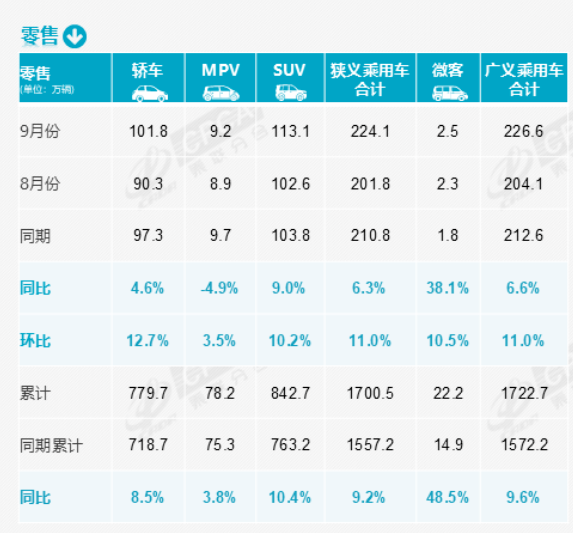
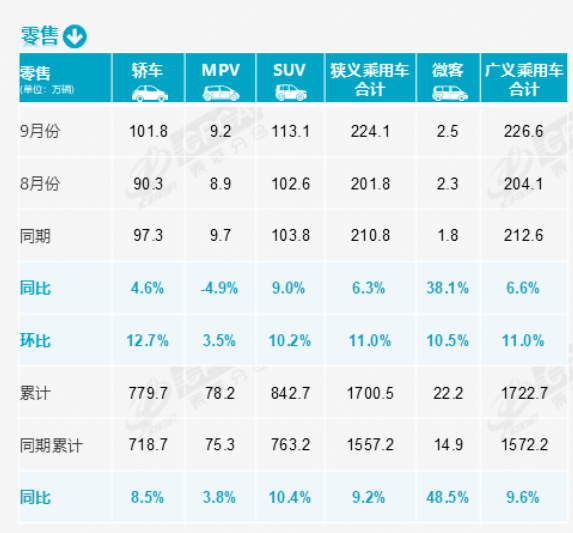
Core Insights - In September, China's passenger car retail sales reached a record high of 2.241 million units, marking a 6.3% year-on-year increase and surpassing the previous record of 2.19 million units set in September 2017 by 50,000 units, indicating strong growth before the end of year policy withdrawal [1][4] Retail Sales Performance - The retail sales of passenger cars in September included 1.018 million sedans, 1.131 million SUVs, and 224.1 million narrow passenger vehicles, with a total of 2.266 million broad passenger vehicles sold [2] - Cumulative retail sales from January to September reached 17.005 million units, reflecting a 9.2% year-on-year growth [4] Brand Performance - Domestic brands continued to show high growth, with retail sales of 1.5 million units in September, a 13% year-on-year increase and a 12.9% month-on-month increase, capturing a market share of 66.9% [5][6] - In the top five manufacturers by retail sales in September, four were domestic brands, with BYD leading at 347,000 units, followed by Geely, Changan, and Chery [5] Export and Wholesale Trends - In September, China's passenger car exports reached 528,000 units, a 20.7% year-on-year increase, with domestic brands accounting for 463,000 units of this total [6] - The wholesale volume of new energy vehicles (NEVs) in September was 1.5 million units, a 22.4% year-on-year increase, with pure electric vehicles (BEVs) making up 63% of the total [12] Market Dynamics - The market is shifting towards reduced price cuts and stable promotions, with 23 models seeing price reductions in September compared to 36 in the previous year [7][8] - The penetration rate of new energy vehicles reached 57.8% in September, up 5 percentage points year-on-year, indicating a stable growth driven by policies and market dynamics [8] Future Outlook - The market is expected to maintain a "Silver September, Golden October" trend, with October's performance anticipated to surpass that of September [4][13] - The upcoming adjustments to the new energy vehicle purchase tax policy in 2026 are expected to stimulate consumer purchases towards the end of the year, contributing to a slight positive growth in the fourth quarter [13]


奇瑞的“中国新燃油”革命
Jing Ji Guan Cha Wang· 2025-10-13 07:21
Core Viewpoint - Chery Automobile is launching the "China New Fuel" strategy, emphasizing the importance of fuel vehicles alongside electric vehicles, aiming to enhance the user experience and value perception of fuel cars through technological upgrades [1][2][9]. Market Context - In 2024, global passenger car sales are projected to reach 80.25 million, with fuel vehicles accounting for 62.75 million, representing 78.2% of the market. In China, over half of consumers still prefer fuel vehicles despite the rise of new energy vehicles [1][9]. - Chery's strategy targets the significant market of fuel vehicles, which remains largely unmet, seeking to provide intelligent features comparable to electric vehicles [1][2]. Technological Advancements - Chery's "China New Fuel" strategy focuses on four new standards: new technology, new intelligence, new safety, and new patterns [2]. - The company has developed the Kunpeng engine series, with over 3.1 million units installed globally, and the second-generation Kunpeng 8AT transmission, showcasing its self-research capabilities in key automotive components [2][7]. - The Falcon Assisted Driving system will be standard across all fuel and new energy models starting in 2025, promoting technological equality between fuel and electric vehicles [3][6]. Safety and Manufacturing - Chery has invested over 100 billion yuan in creating a robust safety structure and a comprehensive safety protection system for its vehicles [3]. - The company has entered the Fortune Global 500 list, demonstrating its rapid growth and competitive advantage in the automotive market [3][4]. Global Expansion - Chery is a leading exporter of Chinese automobiles, with a strong presence in overseas markets, particularly in developing countries where electric vehicle infrastructure is lacking [4]. - The "China New Fuel" strategy is seen as a complementary approach to electric vehicles, recognizing the coexistence of different energy sources in the automotive market [4]. Sales Performance - According to a Frost & Sullivan report, Chery is among the top 20 global passenger car companies expected to achieve over 25% growth in both new energy and fuel vehicle sales in 2024 [5]. - In the first nine months of 2025, Chery sold 2.0077 million vehicles, a 14.5% increase year-on-year, with new energy vehicles accounting for approximately 587,500 units, reflecting a 77.1% growth [5]. Product Offerings - The new models, including the Tiggo 9X, Tiggo 9, and Tiggo 9 high-performance version, are priced competitively, aiming to provide high-value options for consumers who prefer fuel vehicles [10][11]. - The Tiggo 9 features advanced comfort and noise reduction technologies, while the Tiggo 9X offers high-level intelligent driving capabilities at a mid-range price [11].
9月乘用车零售再破历史峰值:上汽时隔五月重夺“销冠” 比亚迪同比首现负增长
Xin Lang Cai Jing· 2025-10-13 05:44
Core Insights - The overall retail sales of passenger cars in China reached 2.241 million units in September, marking a year-on-year increase of 6.3% and a month-on-month increase of 11.0% [1] - Cumulative retail sales for the year have reached 17.005 million units, representing a year-on-year growth of 9.2%, setting a new historical peak [1] - New energy vehicles (NEVs) have been the primary driver of sales growth, with 14 major car manufacturers collectively selling over 1.32 million NEVs in September [1] Industry Performance - The penetration rate of NEVs in the domestic passenger car market reached 57.8% in September, an increase of 5 percentage points compared to the same period last year [1] - Domestic brands achieved a NEV penetration rate of 78.1% [1] Company Performance - SAIC Motor Corporation achieved sales of 439,777 units in September, a year-on-year increase of 40.39%, reclaiming the title of monthly sales champion among Chinese listed car companies [2] - BYD's sales in September were 396,270 units, a decline of 5.52%, marking the first month of year-on-year decline since March 2024 [3] - Geely Automobile reported sales of 273,125 units in September, a year-on-year increase of 35.24%, with NEV sales reaching 165,201 units, up 81.27% [3] - Chery Automobile's sales reached 255,584 units in September, a year-on-year increase of 8.90%, with NEV sales of 83,498 units, up 17.24% [4] - Leap Motor achieved a remarkable sales increase of 97.4% in September, with 66,657 units delivered, setting a new record for new car manufacturers [5] Market Trends - The automotive market in September saw over 70 new car models launched, contributing to increased consumer purchasing enthusiasm [5] - The fourth quarter is expected to maintain stable growth, driven by policy guidance and high growth foundations, with an anticipated increase in consumer purchases before the adjustment of NEV tax policies in 2026 [6]
乘联分会:9月全国乘用车市场零售224.1万辆,同比增长6.3%
Ge Long Hui· 2025-10-13 02:21
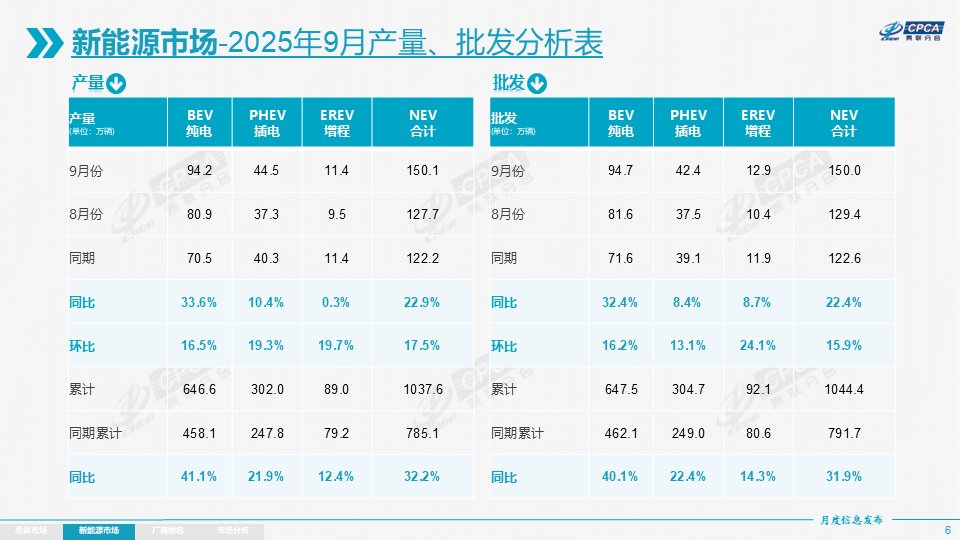
Retail Performance - In September, the national retail sales of passenger cars reached 2.241 million units, a year-on-year increase of 6.3% and a month-on-month increase of 11.0%, with cumulative retail sales for the year at 17.005 million units, up 9.2% year-on-year [1][3] - The retail sales in September set a new record, surpassing the previous high of 2.19 million units in September 2017 by 50,000 units, indicating strong growth before the end of year policy adjustments [1][3] - The market is shifting towards stability with fewer price cuts and promotions, as evidenced by 23 models reducing prices in September compared to 36 last year and 11 in 2023 [1][3] Market Characteristics - In September, the retail, export, wholesale, and production of passenger cars all reached historical highs for the month, with new energy vehicle exports also hitting a record [3] - The cumulative domestic retail growth rate for passenger cars from January to September fell to 9.2%, showing a "front low, middle high, back flat" trend [3] - The penetration rate of new energy vehicles in domestic retail reached 57.8% in September, supported by policies such as tax exemptions for new energy vehicles [3][11] Brand Performance - In September, retail sales of domestic brands reached 1.5 million units, a year-on-year increase of 13%, capturing 66.9% of the domestic market share [4] - The top five state-owned groups saw a combined year-on-year growth of 25% in September, with brands like SAIC, Dongfeng, and Changan performing strongly [3][4] - The retail share of luxury brands decreased slightly to 10.8% in September, indicating increased pressure in the traditional luxury car market [4] Export and Production - In September, passenger car exports reached 528,000 units, a year-on-year increase of 20.7%, with new energy vehicles accounting for 40.1% of total exports [5] - Production of passenger cars in September was 2.838 million units, up 17.2% year-on-year, with cumulative production from January to September at 20.78 million units, a 13.9% increase [5][6] - The wholesale of passenger cars in September reached 2.803 million units, marking a historical high for the month, with a year-on-year increase of 12.4% [6] Inventory and Market Dynamics - The overall industry inventory increased by 70,000 units in September, contrasting with a decrease of 120,000 units in the same month last year, indicating a proactive inventory strategy by manufacturers [7] - The market is experiencing a gradual shift towards stability, with manufacturers maintaining a balance between production and sales [7][18] New Energy Vehicles - In September, production of new energy passenger cars reached 1.501 million units, a year-on-year increase of 22.9%, with cumulative production for the year at 10.376 million units, up 32.2% [8] - The wholesale volume of new energy vehicles in September was 1.5 million units, reflecting a year-on-year increase of 22.4% [8] - The penetration rate of new energy vehicles among domestic brands reached 68.3%, while mainstream joint venture brands lagged significantly at 6.6% [8][11] Future Outlook - The outlook for October suggests a slight decrease in market activity due to fewer working days compared to the previous year, with expectations of a more moderate growth rate [17] - The ongoing push for new energy vehicles and consumer incentives is expected to sustain market momentum, despite potential challenges from policy changes [17][20]

乘联分会:9月乘用车厂商零售、出口、批发和生产均创当月历史新高
智通财经网· 2025-10-13 02:21
Core Insights - The passenger car market in China showed strong performance in September 2025, with record highs in retail, export, wholesale, and production, particularly in the new energy vehicle (NEV) sector [1][2][5] Retail Performance - In September, the retail sales of passenger cars reached 2.241 million units, a year-on-year increase of 6.3% and a month-on-month increase of 11.0% [2][4] - Cumulative retail sales from January to September reached 17.005 million units, reflecting a 9.2% year-on-year growth [2][4] - The retail penetration rate of NEVs in September was 57.8%, with a notable increase in the share of domestic brands [12][14] Export Trends - In September, the total export of passenger cars was 528,000 units, marking a year-on-year increase of 20.7% [5][15] - NEVs accounted for 40.1% of total exports, with a significant year-on-year increase of 15 percentage points [5][15] - The export of domestic brands reached 463,000 units, a year-on-year growth of 27% [5][15] Production Insights - Passenger car production in September was 2.838 million units, a year-on-year increase of 17.2% [5][6] - Cumulative production from January to September reached 20.78 million units, reflecting a 13.9% year-on-year growth [5][6] Wholesale Data - In September, wholesale sales of passenger cars reached 2.803 million units, a year-on-year increase of 12.4% [6][12] - The wholesale penetration rate of NEVs was 53.5%, with domestic brands leading at 68.3% [12][15] New Energy Vehicle (NEV) Performance - NEV production in September reached 1.501 million units, a year-on-year increase of 22.9% [8][9] - NEV wholesale sales were 1.500 million units, reflecting a year-on-year growth of 22.4% [9][12] - The cumulative retail of NEVs from January to September was 8.866 million units, a growth of 24.4% [9][12] Brand Performance - In September, domestic brands achieved retail sales of 1.5 million units, a year-on-year increase of 13% [4][17] - The market share of domestic brands in the retail sector reached 66.9%, up 3.6 percentage points year-on-year [4][17] - New energy brands like BYD, Geely, and Chery showed strong performance in both retail and wholesale segments [16][17] Market Dynamics - The market is transitioning towards a more stable environment with reduced price wars and moderate promotional activities [3][4] - The competitive landscape is evolving, with emerging brands gaining market share and traditional brands adapting to new trends [16][17]