李宁

Search documents
彪马待价而沽,阿迪达斯、中资企业、国际私募或上演“三国杀”
Mei Ri Jing Ji Xin Wen· 2025-09-18 11:28
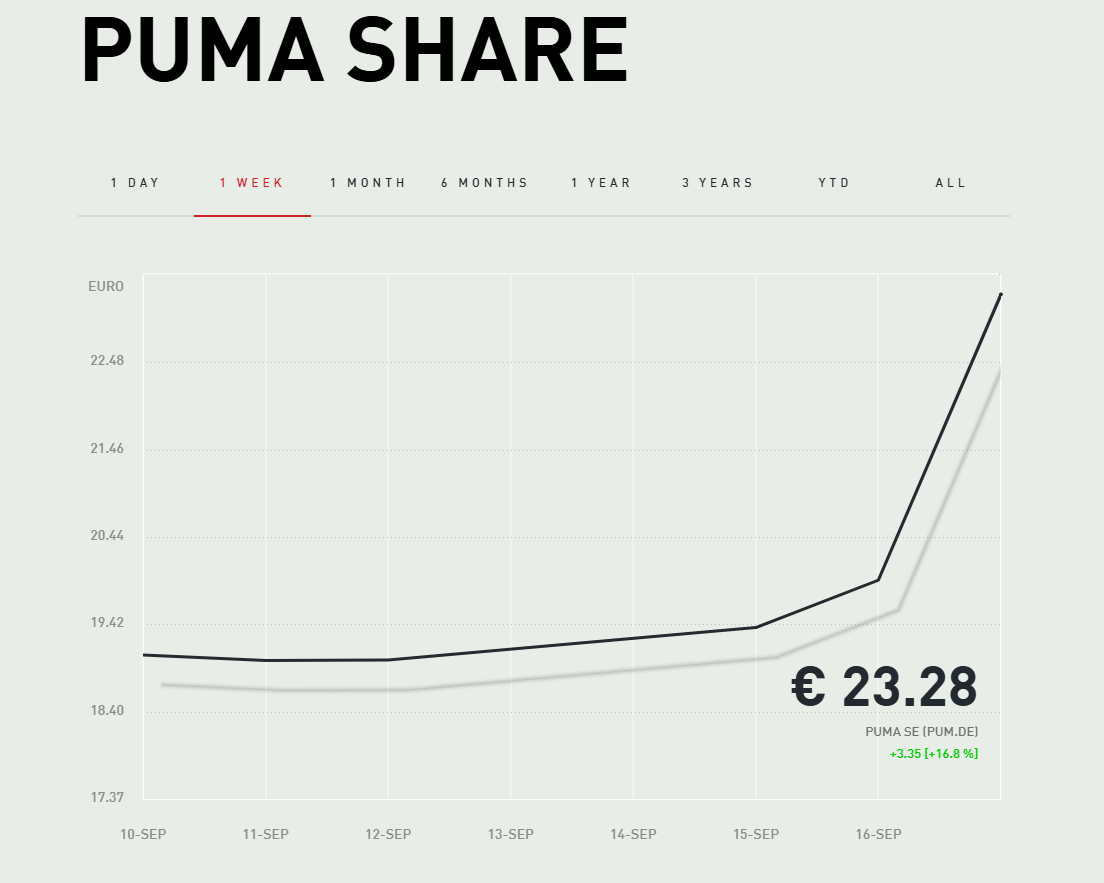
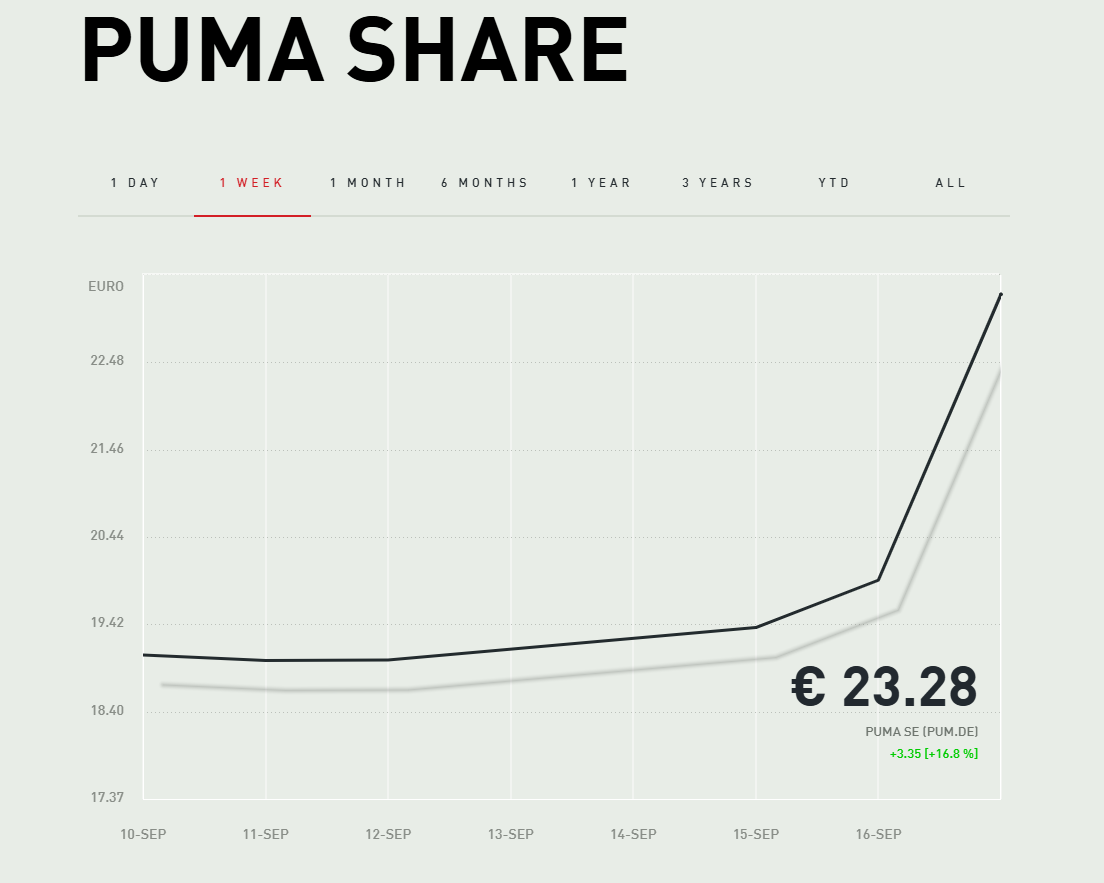
Core Viewpoint - The potential sale of Puma shares held by the Pinault family is generating significant interest in the capital market, with various buyers, including Adidas, Authentic Brands Group (ABG), and CVC Capital, expressing interest in acquiring the 29% stake [1][6][10] Group 1: Market Reactions and Stock Performance - Following speculation that Adidas might be a potential buyer, Puma's stock price rose by 2.9% on September 16 and surged by 16.8% on September 17, marking a total increase of over 19% in two days [1][9] - The stock price had previously experienced a decline of 23% earlier in the year due to macroeconomic challenges and a significant drop to a new low since 2016 [6][9] Group 2: Ownership Structure and Potential Buyers - The Pinault family, through their holding company Artémis, owns 29% of Puma, making them the largest single shareholder, while other institutional investors hold around 3% each [3][5] - If CVC acquires the 29% stake from Artémis, it would become the largest single shareholder in Puma [5] - ABG is known for acquiring and revitalizing struggling brands and has previously engaged in competitive bidding with CVC for other brands, indicating a strong interest in Puma [5][6] Group 3: Historical Context and Strategic Implications - The historical rivalry between Adidas and Puma dates back to their founding by the Dassler brothers in 1948, and a potential acquisition would symbolize a "family reunion" in the industry [8][9] - The combined revenue of Adidas and Puma could challenge Nike's market dominance, with projected revenues of approximately $514 billion for Nike, €236.8 billion for Adidas, and €88.17 billion for Puma [8][9] - The merger would allow for a dual-brand strategy, potentially covering a broader customer base from professional sports to fashion [8][9] Group 4: Challenges and Regulatory Concerns - The acquisition faces significant hurdles, including potential antitrust issues from the EU, particularly in overlapping markets like football sponsorship [9] - Maintaining brand identity and managing the competitive history between Adidas and Puma would also pose challenges [9]


彪马待价而沽,阿迪达斯、中资企业、国际私募或上演“三国杀”| 彪马出售案追踪
Mei Ri Jing Ji Xin Wen· 2025-09-18 11:22
Core Viewpoint - The potential sale of Puma shares held by the Pinault family is generating significant interest in the capital market, with various buyers, including Adidas, Authentic Brands Group (ABG), and CVC Capital, expressing interest in acquiring the 29% stake [1][4][9] Group 1: Market Reactions and Stock Performance - Following speculation about Adidas potentially acquiring Puma, Puma's stock price rose by 2.9% on September 16 and surged by 16.8% on September 17, marking a total increase of over 19% in two days [1][5][9] - The stock price had previously suffered a decline of 23% earlier in the year due to macroeconomic challenges and a global workforce reduction of 500 employees [5] Group 2: Stakeholder Interests - The Pinault family, through their holding company Artémis, owns 29% of Puma, making them the largest shareholder, while other institutional investors hold around 3% each [3][4] - ABG is known for acquiring and revitalizing struggling brands, having acquired over 50 global brands since its inception in 2010, including Reebok [4][5] Group 3: Historical Context and Strategic Implications - The historical rivalry between Adidas and Puma dates back to their founding by the Dassler brothers in 1948, and a potential acquisition would symbolize a "family reunion" in the industry [6][8] - If Adidas successfully acquires Puma, the combined revenue could approach Nike's, with projections of $51.4 billion for Nike, €23.68 billion for Adidas, and €8.817 billion for Puma [8] - The merger would allow for a dual-brand strategy, potentially enhancing competitiveness against Nike, but faces challenges such as EU antitrust regulations and maintaining brand identities [8][9]
体育外卖,究竟能火多久?
3 6 Ke· 2025-09-18 11:16
Core Insights - The core viewpoint of the articles is that sports brands are shifting their focus from merely selling equipment to becoming "sports lifestyle service providers" by entering the instant retail market, which is rapidly growing in China [1][9]. Group 1: Market Trends - Over 1,000 stores of 361 Degrees have launched a "30-minute delivery" service on Meituan, while Anta has over 1,200 stores on Meituan Flash Purchase, and Xtep has over 2,500 stores on JD Instant Delivery [1]. - Instant retail for sports categories has shown significant growth, with running shoes and sports T-shirts seeing over 200% year-on-year sales growth since June, and swimming and cycling gear sales increasing by over 100% [1][2]. - Decathlon's collaboration with Meituan resulted in a nearly 120% month-on-month sales increase [1]. Group 2: Sales Channel Innovations - Sports brands primarily rely on a combination of online and offline sales channels, with a significant number of physical stores, such as Anta with over 13,000 stores globally and Li Ning with 7,534 stores [2]. - The growth of offline stores has slowed, leading brands to explore innovative channel strategies, including instant retail, to tap into new sales growth points [2][3]. Group 3: Operational Efficiency - Instant retail can enhance the efficiency of sports brands' offline resources by converting stores into "front warehouses," reducing delivery times from 1-3 days to around 30 minutes [3]. - This model allows for the circulation of idle inventory, improving space utilization and overall operational efficiency [3]. Group 4: Marketing and Consumer Engagement - Marketing costs are significant for sports brands, with Xtep spending 12.6% of its revenue on marketing, 361 Degrees at 10.1%, Li Ning at 9%, and Anta at 6.6% [4]. - Instant retail platforms are intensifying competition, allowing brands to reach more consumers at lower costs, thus achieving dual benefits of sales and marketing [4]. Group 5: Consumer Behavior and Challenges - Price differences between instant retail and physical stores pose a challenge for sports brands, as consumers may be sensitive to pricing discrepancies [6]. - The potential for high return rates in instant retail, particularly for sports footwear, is a concern, as the lack of fitting opportunities may lead to dissatisfaction [7]. Group 6: Future Outlook - The integration of instant retail into sports brands' strategies is still in its early stages, with a focus on delivery speed and inventory management [9]. - As the relationship between sports brands and instant retail matures, the focus may shift from speed to creating a comprehensive service ecosystem, potentially offering value-added services alongside products [9].
中国运动品牌,正在全球 “扫货”
Hu Xiu· 2025-09-18 10:53
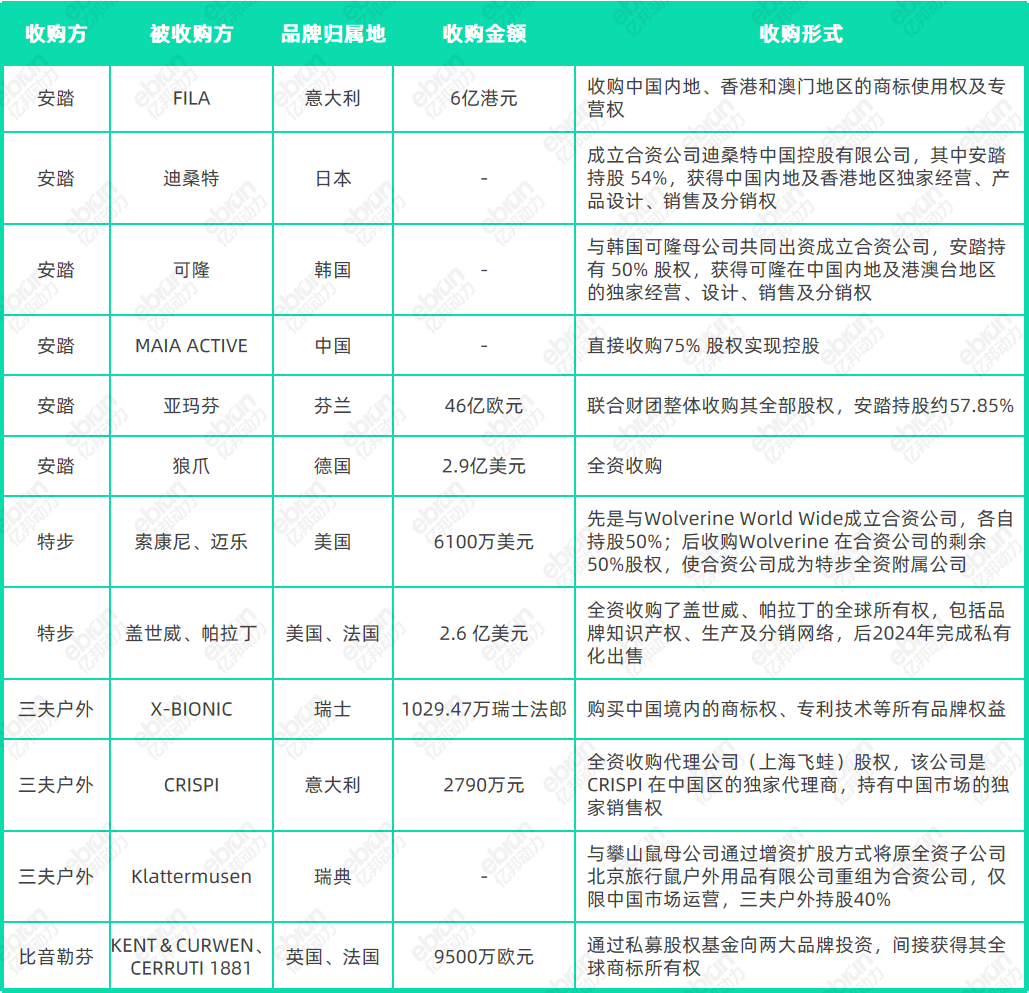
Core Viewpoint - The article discusses the rise of Chinese companies, particularly Anta, as key players in the global sports and outdoor market through strategic acquisitions of international brands, positioning them as a "third pole" in the industry, alongside Nike and Adidas [5][40]. Group 1: Market Dynamics - In recent years, international brands have been selling stakes to Chinese companies like Anta and Li Ning, indicating a trend of Chinese firms acquiring global sports brands [3][2]. - The global sports and outdoor market is undergoing significant changes, with Chinese companies leveraging efficient supply chains and marketing capabilities to integrate international brands [5][39]. - The Chinese sportswear market is projected to exceed 500 billion yuan in 2024, with segments like outdoor and professional sports growing over 30% [14]. Group 2: Acquisition Strategies - Anta has been a pioneer in acquiring various brands, leading to a projected revenue of over 100 billion yuan in 2024, making it the third-largest player in the global sportswear market [3][5]. - Other Chinese companies like Xtep and Li Ning are also pursuing integration strategies, with notable successes such as Xtep's acquisition of Saucony, which has seen revenue growth [4][39]. - The article outlines three main acquisition strategies employed by Chinese firms: full acquisition, regional trademark buyouts, and joint ventures [16][34]. Group 3: European Market Challenges - European sports brands are facing stagnation and declining sales, prompting many to seek partnerships with Chinese companies for financial support and market access [8][11]. - The article notes that approximately 60% of the brands acquired by Chinese companies originated in Europe, highlighting the region's challenges in growth [7][8]. - The COVID-19 pandemic has exacerbated the financial struggles of European brands, leading to a need for capital and strategic partnerships [9][10]. Group 4: Competitive Landscape - Nike and Adidas have maintained a dominant position in the market but have not engaged in the recent wave of brand acquisitions, focusing instead on core brand innovation [18][19]. - The strategic focus of Nike and Adidas contrasts with that of Chinese companies, which emphasize regional market adaptation and operational efficiency [22][23]. - The article suggests that the competitive landscape is evolving towards a "three-legged" structure, with Chinese companies solidifying their position as a significant force in the market [40].
匹克深陷降薪传闻,但许志华仍想坚持“长期主义”
Guan Cha Zhe Wang· 2025-09-18 09:57
Core Viewpoint - The recent salary cuts at Peak, a former leading Chinese sports brand, have drawn significant media attention, highlighting the company's struggles in a competitive market and the challenges it faces in the basketball category [1][2]. Company Performance - Peak's chairman acknowledged salary reductions of up to 50% for high-salary positions and loss-making departments, indicating financial pressure [1]. - The company has not publicly disclosed its operational status since going private in 2016, making it difficult to assess its current performance accurately [1]. - In 2015, Peak's revenue was 3.11 billion yuan, significantly lower than competitors like Anta, Li Ning, and Xtep, which reported revenues exceeding 5 billion yuan [2]. Market Challenges - The disappearance of channel profits has led to intense competition across both online and offline sales channels, with no clear advantages remaining [1][3]. - Peak's CEO admitted that the company is facing substantial pressure due to a downturn in the basketball segment and the overall competitive landscape [1][3]. Strategic Initiatives - Since 2018, Peak has attempted to embrace e-commerce, including live streaming on platforms like Douyin and Tmall [3]. - The company is focusing on enhancing its direct retail management and distribution systems to tap into the potential of first- and second-tier markets [3]. Product Development - Peak has introduced innovative technologies, such as the "Taiji" midsole, which has received positive market feedback and has become a significant product line, surpassing basketball shoes in sales [4][5]. - The company is expanding into various product categories, including outdoor gear, badminton rackets, and sports watches, with the latter achieving significant sales [6]. Long-term Vision - Peak aims to establish a strong foothold through competitive pricing while investing time in technological advancements [8]. - The company is exploring opportunities for international expansion, with overseas revenue consistently accounting for about 20% of total income [6]. Industry Context - The domestic sports brand market has seen substantial growth, with competitors like Anta and Xtep achieving significant revenue milestones [9]. - Despite setting a target of over 10 billion yuan in revenue, Peak has yet to publicly report progress towards this goal, indicating a lack of a clear growth strategy [9]. Philosophical Approach - The CEO emphasizes a "long-termism" and "deep cultivation" strategy, advocating for sustained investment in specific areas to build brand recognition over time [10].
白牌围攻、赛道跨界,中国服饰行业迎来最卷时代
3 6 Ke· 2025-09-18 04:37
Group 1 - The core point of the news is that the domestic clothing brand "Hailan Home" has officially announced its plan to list in Hong Kong, aiming to enhance its global strategy, accelerate overseas business development, and improve its international brand image [1] - Hailan Home's listing plan is supported by stable performance, with a revenue of 11.566 billion yuan in the first half of 2025, a year-on-year increase of 1.73%, and a net profit of 1.58 billion yuan, a year-on-year decrease of 3.42% [3][4] - The overall clothing industry is experiencing a contraction in market demand, with 31 out of 48 listed clothing companies reporting a decline in revenue and net profit in the first half of 2025 [3][5] Group 2 - The clothing industry is showing a significant "Matthew effect," where larger companies are performing better, with only three companies exceeding 10 billion yuan in revenue, namely Anta, Li Ning, and Hailan Home [5] - Anta leads the industry with a revenue of 38.54 billion yuan, followed by Li Ning at 14.82 billion yuan and Hailan Home at 11.566 billion yuan [5][6] - The competition in the clothing industry is intensifying, with many brands facing challenges in maintaining profitability and market share [8][14] Group 3 - The performance of men's clothing brands has been disappointing, with several companies, including Yagor and Baoxini, reporting declines in both revenue and net profit [7] - The children's clothing segment is becoming a core growth driver for companies like Semir, which reported a revenue of 10.268 billion yuan in 2024, with a 5.97% increase in the first half of 2025 [10] - Anta has also launched a children's series, achieving over 10 billion yuan in revenue in 2024, indicating a shift towards targeting younger consumers [12] Group 4 - The retail landscape is changing, with many clothing brands closing underperforming stores and focusing on e-commerce as a growth channel [19][20] - Anta's e-commerce revenue accounted for 34.8% of total revenue in the first half of 2025, reflecting the effectiveness of its digital transformation strategy [19] - The rise of white-label brands is creating additional competition, as consumers increasingly seek value for money [14]




运动市场调整:安踏反腐,匹克降薪丨消费参考
2 1 Shi Ji Jing Ji Bao Dao· 2025-09-18 03:53
Group 1: Market Adjustments - The sports market is entering a period of adjustment, with companies like Peak Group implementing salary cuts targeting high-salary positions and loss-making departments [1][3][7] - Peak Group's chairman announced a salary adjustment plan where salaries above 5,000 yuan will be reduced by 10% to 30%, while those earning below 3,000 yuan will be guaranteed a minimum salary of 3,000 yuan [1][3] Group 2: Company Performance - Li Ning reported a revenue increase of 3.3% to 14.82 billion yuan in the first half of the year, but its net profit decreased by 11.0% to 1.74 billion yuan [4] - Anta's revenue grew by 14.3% to 38.544 billion yuan, but its net profit fell by 8.9% to 7.031 billion yuan [4][5] - Nike's revenue in Greater China declined by 18.7% to approximately 23 billion yuan in the second half of the 2025 fiscal year [4] Group 3: Industry Challenges - The competitive landscape in the sports market is intensifying, leading to price wars and operational challenges for companies [3][7] - Anta's gross margin decreased by 0.7 percentage points to 63.4% amid industry price competition [5][6]
智通港股沽空统计|9月18日
智通财经网· 2025-09-18 00:22
Short Selling Ratios - Li Ning-R (82331) and Great Wall Motors-R (82333) have the highest short selling ratios at 100.00% [1][2] - AIA Group-R (81299) follows with a short selling ratio of 94.40% [1][2] Short Selling Amounts - Alibaba-SW (09988) leads in short selling amount with 4.735 billion [2] - Baidu Group-SW (09888) and Tencent Holdings (00700) follow with 2.629 billion and 2.498 billion respectively [2] Deviation Values - China Railway Signal & Communication (03969) has the highest deviation value at 44.84% [1][2] - Tianan (00028) and Li Ning-R (82331) have deviation values of 35.02% and 34.66% respectively [1][2]




安踏强势反腐,辞退74人,10家供应商永不合作
2 1 Shi Ji Jing Ji Bao Dao· 2025-09-17 15:57
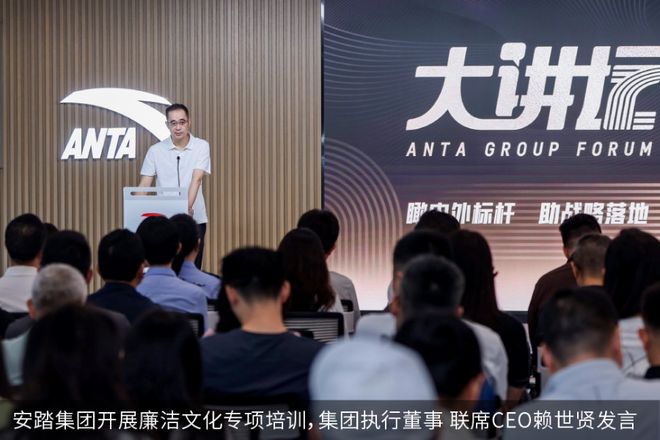
Core Viewpoint - Anta Group is intensifying its anti-corruption efforts, focusing on system construction and internal controls to combat corruption and fraud within the organization [1][4][9]. Group 1: Anti-Corruption Measures - As of August 2025, Anta has dismissed 74 employees for serious misconduct and transferred 46 individuals to judicial authorities for suspected criminal activities, including one at the president level and 14 at the director level [1]. - The company has established a "career tracing mechanism" to hold employees accountable for misconduct regardless of their employment status [1]. - Anta has published a list of 10 suppliers banned from cooperation due to violations, with a significant number being from the cultural media sector [5]. Group 2: Systematic Strengthening - Anta is enhancing its internal control measures by revising six core regulations, including the anti-corruption system and supplier compliance management [4]. - The company is implementing a "three-line defense" system covering 58 risk modules and 208 risk responsibilities to ensure accountability among management [4]. - Regular compliance training is being conducted for supply chain partners to promote industry integrity [4]. Group 3: Financial Performance - In the first half of the year, Anta's revenue increased by 14.3% to 38.544 billion yuan, while net profit decreased by 8.9% to 7.031 billion yuan [9]. - The gross margin for Anta has declined by 0.7 percentage points to 63.4%, with specific brands like Anta and FILA experiencing more significant drops [10][11]. - The online revenue proportion reached 36.2%, up from 34.6% in the previous year, indicating a shift in sales strategy [11]. Group 4: Market Context - The competitive landscape in the sports market is intensifying, with other major brands like Li Ning and Adidas also facing challenges in revenue growth [9]. - Anta's stock price has significantly decreased from its peak, reflecting market pressures and the need for improved profitability [11]. - The company is focusing on investing in existing businesses, particularly in innovation and digital transformation, while also seeking high-quality acquisition opportunities [11].
安踏强势反腐,辞退74人,10家供应商永不合作
21世纪经济报道· 2025-09-17 15:51
Core Viewpoint - Anta Group is intensifying its anti-corruption efforts, focusing on system construction and internal controls to combat corruption and fraud within the organization [2][5][9]. Group 1: Anti-Corruption Measures - As of August 2025, Anta has dismissed 74 employees for serious fraud, with 46 individuals, including one executive, referred to judicial authorities for criminal activities [2][3]. - The company has established a "career tracing mechanism" to hold employees accountable for misconduct regardless of their employment status [3]. - Anta has created a "Integrity and Ethics Committee" and revised six core regulations, including anti-corruption and supplier compliance management [5][6]. Group 2: Financial Performance - In the first half of the year, Anta's revenue increased by 14.3% to 38.544 billion yuan, while net profit decreased by 8.9% to 7.031 billion yuan [9][10]. - The gross margin for Anta has declined by 0.7 percentage points to 63.4%, with specific brands like Anta and FILA experiencing more significant drops [10][11]. - The online revenue share reached 36.2%, up from 34.6% in the previous year, indicating a shift in sales strategy [11]. Group 3: Market Context - The competitive landscape in the sportswear market is intensifying, with major brands like Li Ning and Adidas also facing challenges in revenue growth [9][10]. - Anta's proactive anti-corruption stance is seen as a necessary response to the current market pressures and the need for refined operational practices [12].