
东风股份

Search documents
固态电池量产竞速:东风、奇瑞突破千公里续航,成本仍是拦路虎
Mei Ri Jing Ji Xin Wen· 2025-10-24 11:05
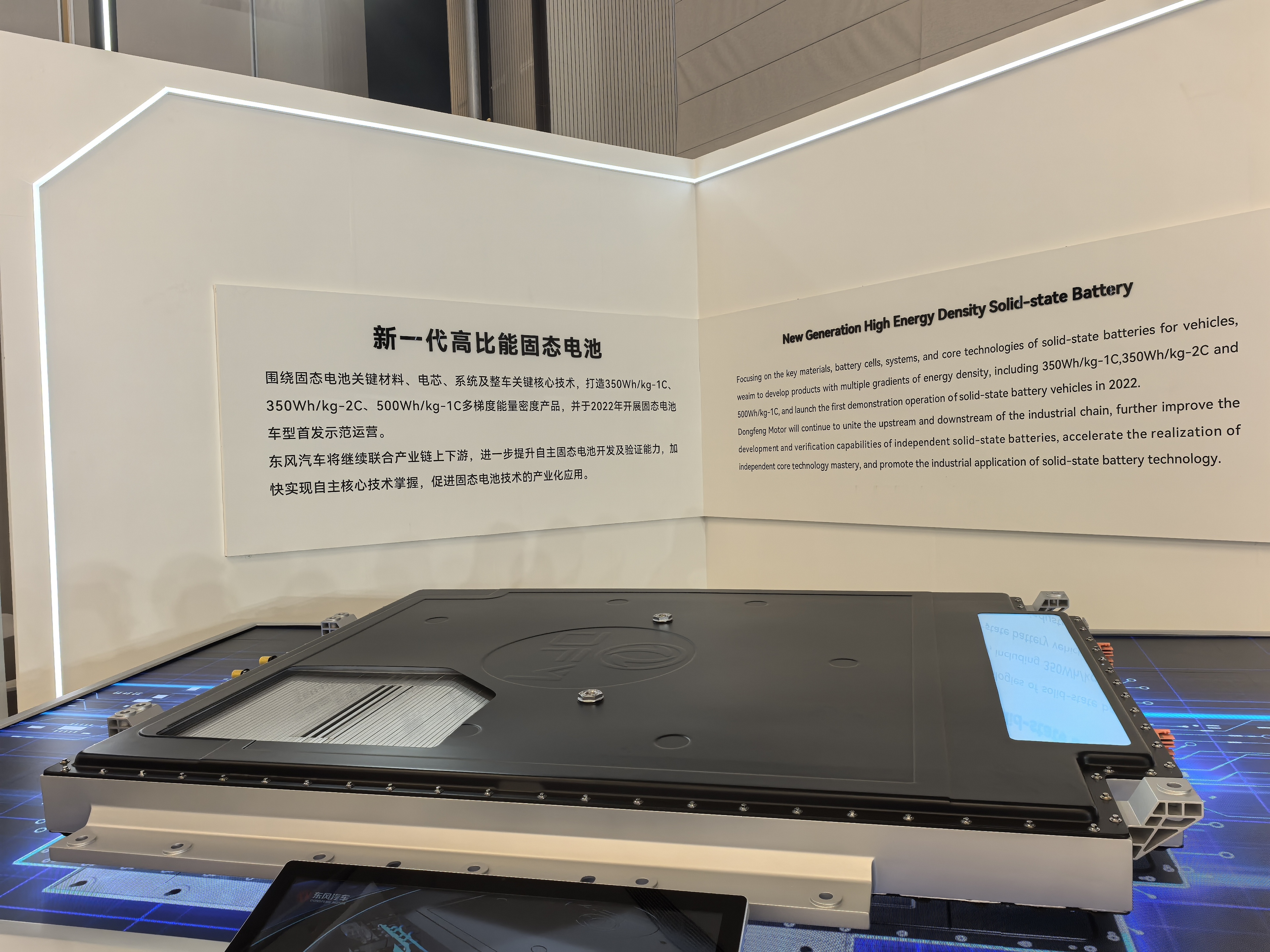
Core Insights - The solid-state battery sector is experiencing significant advancements, with breakthroughs in technology and supply chain development reported by various automotive companies [1][5][6] Company Developments - Dongfeng Motor has established a self-controlled solid-state battery supply chain, achieving core technology mastery in electrolytes, membranes, and in-situ curing, resulting in solid-state battery products with energy densities of 240Wh/kg and 350Wh/kg, and a maximum range exceeding 1000 kilometers [1][2] - Dongfeng's solid-state battery demonstration operation began in January 2022, with over 220 million kilometers driven across 10 cities in 6 provinces [1][2] - Chery Automobile announced a breakthrough in the entire solid-state battery industry chain, showcasing a solid-state battery module with an energy density of 600Wh/kg and a targeted range of 1200 to 1300 kilometers, with plans for vehicle validation starting in 2027 [5] Industry Standards and Policies - The China Society of Automotive Engineers released a new standard for solid-state batteries in May 2023, clarifying the definition and technical boundaries of "full solid-state batteries," which is expected to regulate the market and facilitate technology collaboration across the industry [5][6] - The Ministry of Industry and Information Technology has emphasized the importance of technological innovation and systematic layout for new battery materials, including solid-state batteries, to accelerate their commercialization [6] Market Outlook - Predictions indicate that full solid-state batteries will begin to be installed in vehicles by 2027, with mass production expected by 2030 [6][8] - Challenges remain for the mass production of solid-state batteries, including supply chain issues for raw materials and the need for specialized manufacturing equipment, which currently results in higher costs compared to traditional lithium batteries [9]


东风股份:回应市值管理疑问,强调为投资者创造价值
Xin Lang Cai Jing· 2025-10-24 09:01
Core Viewpoint - The company emphasizes its commitment to long-term healthy development and value creation for investors, addressing concerns about its market value management in relation to its holdings in Seres [1] Group 1: Company Overview - The company is a subsidiary of Dongfeng Motor Group Co., Ltd., primarily engaged in the research, production, and sales of a full range of light commercial vehicles and powertrains [1] - The product offerings include light trucks, vans, buses, and chassis [1] Group 2: Investor Relations - The company has consistently prioritized investor value return since its listing, maintaining a dividend policy and enhancing communication with investors [1] - Efforts are made to increase investor recognition of the company's value [1]

续航千里的固态电池,为何车企集体“用不起”?
Hu Xiu· 2025-10-24 04:52
Core Insights - The automotive industry is rapidly advancing towards solid-state batteries, which are seen as the next generation of energy storage technology, especially as traditional lithium-ion batteries approach their performance limits [1][4]. Industry Trends - By the end of 2024, solid-state batteries are expected to be a key trend in China's electric vehicle industry, with significant investments from automakers and battery manufacturers [2][4]. - Major companies like CATL, Guoxuan High-Tech, and others are actively developing solid-state battery technologies, with CATL focusing on sulfide routes and expanding its R&D team [2][9]. Technological Developments - Recent breakthroughs in solid-state battery technology have led to significant improvements in performance, such as the potential for over 1000 km range with lighter batteries [3][17]. - The industry anticipates that solid-state batteries will begin to be installed in vehicles by 2027, with mass production expected by 2030 [4][11]. Competitive Landscape - A variety of companies, including traditional automakers like Changan and Geely, are entering the solid-state battery space, each pursuing different technological routes [10][12]. - International players like Toyota and Samsung SDI are also making strides, with plans for mass production of solid-state batteries by 2027 [13]. Challenges and Barriers - Despite the promising outlook, solid-state batteries face challenges such as high production costs, which are currently 5 to 10 times higher than traditional lithium-ion batteries [20][21]. - Technical hurdles include the need for high-pressure environments for solid-state cells, which complicates their commercial viability [23][24]. Market Dynamics - The rapid increase in patent applications for solid-state batteries in China indicates a growing interest and investment in this technology, outpacing Japan by three times [14]. - The cost of solid-state batteries poses a significant barrier, with estimates suggesting that the cost of a solid-state battery pack could exceed 400,000 yuan compared to 40,000 to 44,000 yuan for traditional batteries [20][22].




荣耀董事长吴晖:已累计投入超100亿元用于AI研发;阿里巴巴将开启夸克AI眼镜预售丨智能制造日报
创业邦· 2025-10-24 03:34
Group 1 - Alibaba Group will start pre-sales of its Quark AI glasses at a price of 4,699 RMB, featuring hands-free calls, music streaming, real-time translation, and meeting transcription, with deliveries planned for December [2] - Honor's Chairman, Wu Hui, announced that the company has invested over 10 billion RMB in AI research and development, emphasizing the importance of AI in reshaping the terminal ecosystem [2] - Elon Musk stated that Samsung Electronics will play a larger role in the production of Tesla's AI5 chip, sharing manufacturing responsibilities with TSMC, indicating a significant collaboration in the semiconductor market [2] Group 2 - Dongfeng Motor has officially entered the debugging production phase of the world's largest tonnage integrated die-casting factory, which can produce larger and higher-quality components, marking a key leap for China in the high-value automotive manufacturing chain [2]



2025年1-8月中国基本型乘用车(轿车)产量为791.7万辆 累计增长10.2%
Chan Ye Xin Xi Wang· 2025-10-24 03:29
Core Viewpoint - The Chinese passenger car market is experiencing significant growth, with production figures showing a year-on-year increase in both monthly and cumulative production for 2025 [1] Group 1: Industry Overview - In August 2025, the production of basic passenger cars in China reached 1.08 million units, representing a year-on-year growth of 11.6% [1] - From January to August 2025, the cumulative production of basic passenger cars in China totaled 7.917 million units, reflecting a cumulative growth of 10.2% [1] Group 2: Companies Involved - Key listed companies in the Chinese automotive sector include BYD, SAIC Motor, Great Wall Motors, Changan Automobile, GAC Group, FAW Jiefang, Dongfeng Motor, and BAIC Blue Valley [1] Group 3: Research and Insights - The report titled "2025-2031 China Automotive Industry Market Operation Status and Investment Potential Research Report" by Zhiyan Consulting provides insights into the automotive industry's future trends and investment opportunities [1] - Zhiyan Consulting is recognized as a leading industry consulting firm in China, specializing in in-depth industry research and providing comprehensive consulting services for investment decisions [1]

超越单点智能!“人-车-路-云-星”联合创新体行业首发
Nan Fang Du Shi Bao· 2025-10-24 03:05
Core Insights - The 32nd China Society of Automotive Engineers Annual Conference and Automotive Innovation Technology Exhibition (SAECCE 2025) was held in Chongqing, where a joint innovation platform for "human-vehicle-road-cloud-satellite" was launched, marking the first of its kind in the automotive industry [1] - The "vehicle-road-cloud integration" aims to create a systematic solution for intelligent collaboration among vehicles, roadside infrastructure, and cloud computing, enhancing the safety and efficiency of autonomous driving [1][2] - The Ministry of Industry and Information Technology announced plans for the "14th Five-Year" intelligent connected new energy vehicle development plan, emphasizing the importance of "vehicle-road-cloud integration" applications and the establishment of a reliable data space [2] Group 1 - The joint innovation platform involves collaboration with major automotive companies and low-orbit satellite operators, focusing on real-time data sharing to improve autonomous driving capabilities [1] - The platform's architecture is defined as "vehicle as the endpoint, road as the extension, cloud as the hub, and satellite as the link," aiming to address complex operational challenges in intelligent vehicles [1] - The future transportation ecosystem is envisioned to be multi-dimensional, integrating various forms of vehicles and deeply connecting with society, infrastructure, and daily life [2] Group 2 - The "Energy-saving and New Energy Vehicle Technology Roadmap 3.0" was released, outlining a timeline for the maturity of the vehicle-road-cloud integration ecosystem, with L4 autonomous vehicles expected to be fully popularized by 2040 and L5 vehicles entering the market [2] - Despite rapid development, the commercialization of vehicle-road-cloud integration faces challenges, particularly in achieving efficient connectivity between different systems, requiring collaboration among various stakeholders [2]

集中力量办大事,全力打造国家科技创新中心
Chang Jiang Ri Bao· 2025-10-24 02:24
Core Insights - Wuhan is transforming into a significant innovation growth hub, with its global research city ranking rising from 13th to 9th place [3] - The city is focusing on deep integration of technological and industrial innovation during the 14th Five-Year Plan period, establishing numerous national and provincial innovation centers [5][6] Group 1: Innovation Achievements - Wuhan has established 41 national key laboratories, ranking among the top in the country, and has produced 24 notable achievements from 8 laboratories [2] - The city has seen a rapid increase in high-tech enterprises, with over 16,600 high-tech companies, which is 2.66 times that of 2020 [6][7] - Major autonomous innovation outcomes include the world's first 8-inch silicon optical thin-film lithium niobate wafer and the first medical remote sensing experimental satellite [2] Group 2: Collaborative Efforts - The establishment of 11 industrial innovation joint laboratories has integrated 97 units and gathered over 3,700 researchers, with nearly 9 billion yuan invested in research funding [4] - The Wuhan University-led laboratory has developed a vehicle environmental state intelligent sensor, which has been applied in Dongfeng Motor, enhancing smart driving capabilities [2] Group 3: Government Support and Policy - The Wuhan government is actively promoting technology innovation by establishing offices to convert government investment projects into application scenarios, enhancing the AI industry [6] - The city has created a conducive environment for R&D enterprises, with over 1,100 R&D-focused companies and centers established during the 14th Five-Year Plan [7]
岚图汽车赴港上市开始倒计时,高增长赛道再添优质标的
Sou Hu Cai Jing· 2025-10-24 02:10
Core Viewpoint - The Hong Kong stock market is experiencing a strong resurgence in 2025, marked by increased trading activity and a significant rise in IPOs, with 68 new stocks raising a total of HKD 182.45 billion, representing a 51% and 227% increase year-on-year, respectively [1] Group 1: Market Activity - The Hong Kong IPO market is recovering, with 98% of new stocks receiving oversubscription, and 86% of them having oversubscription multiples exceeding 20 times, doubling from the previous year [1] - The influx of both domestic and foreign capital has led to a notable increase in profitability, making newly listed companies highly attractive to investors [1] Group 2: Company Overview - Lantu Automotive - Lantu Automotive, a high-end smart electric vehicle brand under Dongfeng Motor, has submitted its listing application to the Hong Kong Stock Exchange, aiming to become the first listed central enterprise high-end electric vehicle brand [1] - Lantu's sales are projected to grow from 19,000 units in 2022 to over 80,000 units by 2024, achieving a compound annual growth rate (CAGR) of 103.2%, ranking among the top three in growth among Chinese high-end electric vehicle brands [2] Group 3: Product Performance - Lantu's product lineup includes the Lantu Dreamer, Lantu Pursuit L, and Lantu Taishan, covering MPV, sedan, and full-size SUV categories, with the Lantu FREE+ becoming the sales champion in the 200,000 to 300,000 yuan electric SUV segment in July 2025 [4] - The Lantu Dreamer has been the national sales champion for new energy MPVs for three consecutive months, with one in three high-end MPVs sold being a Lantu Dreamer [5] Group 4: Financial Metrics - Lantu's revenue is expected to grow from CNY 6.05 billion in 2022 to CNY 19.36 billion in 2024, with a CAGR of 78.9%, and a revenue of CNY 15.78 billion achieved in the first seven months of 2025, reflecting a year-on-year growth of 90.2% [7] - The company's gross margin has improved from 8.3% in 2022 to 21% in 2024, and further to 21.3% in the first seven months of 2025, ranking second in the industry [8] Group 5: Investment Appeal - Lantu Automotive is expected to attract significant investor interest post-listing due to its status as a high-quality asset with a strong growth trajectory and profitability, appealing to both local and international investors [10][11] - The current market environment, characterized by abundant liquidity and a scarcity of quality assets, is likely to drive funds towards Lantu Automotive, which is seen as a rare investment opportunity [13][14] Group 6: Strategic Positioning - Lantu Automotive represents a new paradigm for central enterprise electric vehicle brands, relying on product, technology, and profitability rather than solely on policy support or capital games, potentially reshaping the valuation logic for state-owned enterprises in the new energy sector [16]

广汽、一汽等均布局“车路云一体化”迎阶段性成果
Mei Ri Jing Ji Xin Wen· 2025-10-23 18:12
Core Insights - GAC Group collaborates with 14 domestic and international automotive and autonomous driving companies to participate in a demonstration event for "Vehicle-Road-Cloud Integration" organized by the National Intelligent Connected Vehicle Innovation Center [1] - The event showcased two key application scenarios: "Cloud-Supported Automatic Emergency Braking" and "Cloud-Supported Green Wave Speed Guidance" [1] - The "Vehicle-Road-Cloud Integration" initiative is expected to significantly support the commercialization of smart public transport and unmanned delivery systems, with a projected industry scale exceeding 300 billion yuan by 2030 [1] Industry Overview - "Vehicle-Road-Cloud Integration" utilizes advanced information and communication technologies to create a cyber-physical system that integrates people, vehicles, roads, and clouds, enhancing traffic safety, energy efficiency, comfort, and operational efficiency [2] - This system allows vehicles to interact with roadside devices and cloud servers, improving safety through real-time risk information sharing and decision-making support [2] - The initiative represents an upgrade from the previous "Vehicle-Road Collaboration" concept, focusing on a holistic design for better synergy between smart vehicles and traffic systems [2] Technological Development - Various regions are actively promoting "Vehicle-Road-Cloud Integration" technology, with significant investments such as Beijing's 9.9 billion yuan project for smart road upgrades [3] - There is ongoing debate in the industry regarding the merits of "Single Vehicle Intelligence" versus "Vehicle-Road-Cloud Integration," with some companies advocating for the former due to lower costs and shorter implementation times [3][4] - GAC Group emphasizes that "Vehicle-Road-Cloud Integration" is a new phase in smart vehicle development, enhancing existing single-vehicle systems with digital infrastructure to overcome perception limitations [3] Market Challenges - Despite policy support and expanding pilot cities, "Vehicle-Road-Cloud Integration" lags behind single-vehicle intelligence in terms of industry enthusiasm, market acceptance, and technological maturity [5] - High costs and long infrastructure development cycles pose significant challenges, leading some companies to pivot towards more popular AI technologies [5][6] - The reliance on government investment for infrastructure and the current inadequacy of roadside technology to meet autonomous driving needs are critical barriers to progress [5][6] Future Directions - Experts suggest a phased approach to promoting "Vehicle-Road-Cloud Integration," starting with closed environments to refine technology before broader implementation [6] - Vehicles must possess standalone intelligent driving capabilities to ensure effective integration with roadside systems, creating a commercial ecosystem that enhances traffic safety [6]

技术路线图3.0,中国汽车2040年这么干
Xin Lang Cai Jing· 2025-10-23 15:30
Core Insights - The article discusses the future of the Chinese automotive industry, projecting significant advancements in technology and market dynamics over the next 15 years, particularly focusing on the integration of electric and intelligent vehicles [2][4][5] Group 1: Market Projections - By 2040, approximately one-third of new passenger vehicles will still rely on internal combustion engines (ICE), while the penetration rate of new energy vehicles (NEVs) is expected to exceed 85%, with battery electric vehicles (BEVs) making up 80% of that [2][7] - The Chinese automotive market is projected to reach a production and sales volume of over 31 million units in 2024, with NEVs experiencing rapid growth from under 1.4 million units in 2020 to nearly 13 million units in 2024, increasing their market share from 5.4% to over 40% [11][13] Group 2: Technological Developments - The "Technology Roadmap 3.0" outlines three major breakthroughs: extending the timeline to include long-term goals for 2040, enhancing the structural framework to cover energy-saving, new energy, and intelligent connected vehicles, and aligning industry development with global changes [4][5][6] - The roadmap specifies that by 2030, the average fuel consumption of hybrid vehicles will decrease to 4.5L/100km, and further to 3.5L by 2040, indicating a strong focus on energy efficiency [9][10] Group 3: Intelligent Vehicles - By 2030, L2 level assisted driving will be widely adopted in passenger vehicles, with L3 and L4 levels expected to be implemented in urban and highway scenarios, respectively [19][21] - By 2040, nearly all new intelligent connected vehicles are anticipated to achieve L4 level autonomous driving, with L5 level vehicles beginning to enter the market, indicating a significant shift towards fully autonomous driving capabilities [21][22] Group 4: Industry Transformation - The automotive industry is transitioning towards becoming mobile intelligent entities, with a focus on four core technological areas: intelligent chassis, electronic and electrical information architecture, automotive chips, and vehicle operating systems [22][26] - The roadmap emphasizes the importance of smart manufacturing, aiming for 40% of companies to reach the highest level of intelligent manufacturing by 2040, integrating various aspects of production and supply [26]
