博时基金

Search documents
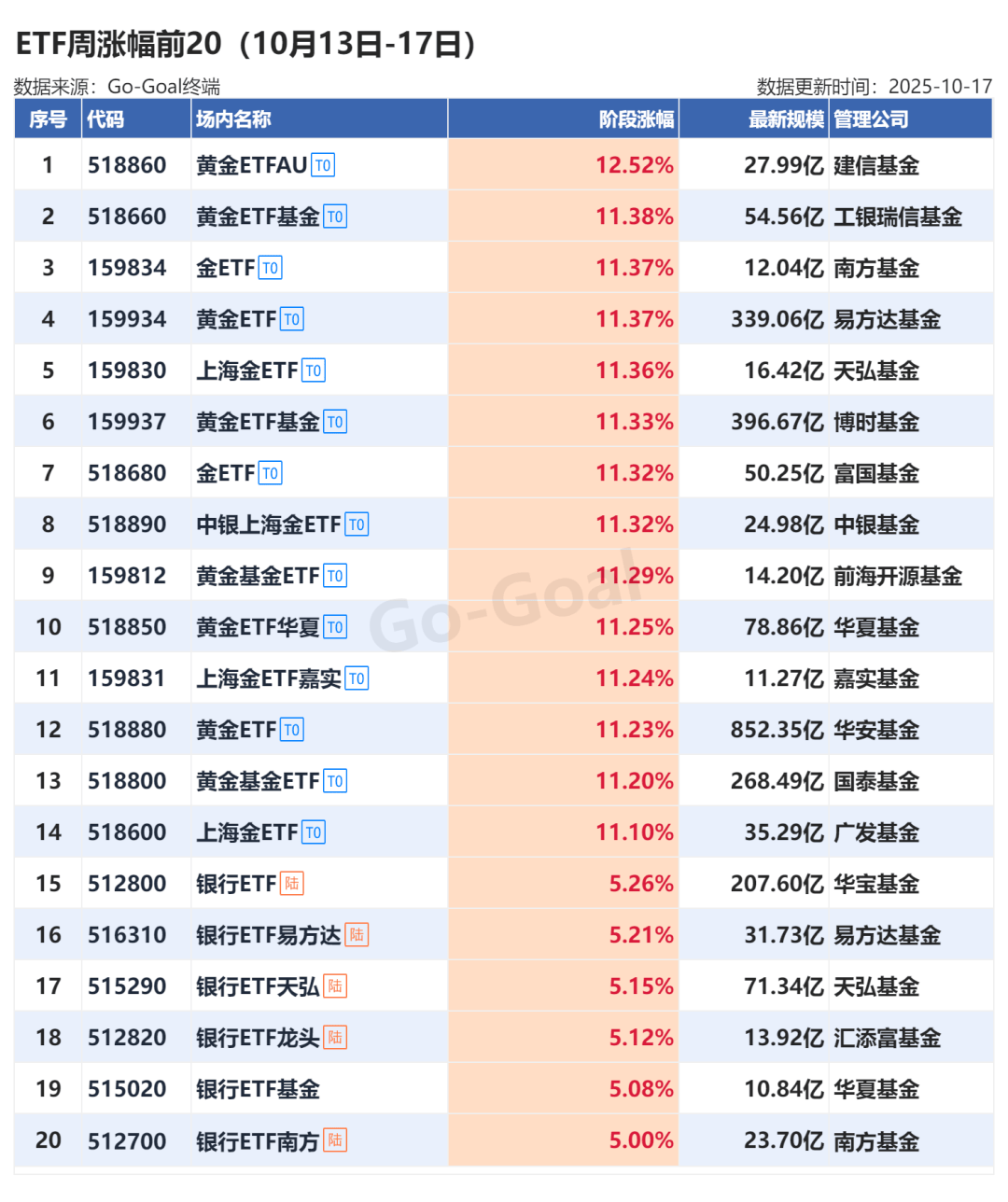
黄金ETF本周涨幅居前 ETF资金整体净流入605.85亿元
Sou Hu Cai Jing· 2025-10-19 11:13
Core Insights - The article highlights a significant increase in gold ETFs, with the Gold ETF AU rising by 12.52%, marking it as the top performer for the week [1][2] - Overall, the A-share market experienced a decline, with the Shanghai Composite Index down by 1.47%, Shenzhen Component down by 4.99%, and the ChiNext Index down by 5.71% [1] - There was a net inflow of 605.85 billion yuan into ETFs this week, indicating strong investor interest [2] ETF Performance - Gold ETFs showed remarkable performance, with several funds reporting substantial gains: - Gold ETF AU: +12.52% (27.99 billion yuan) [2] - Other notable gold ETFs include: - Gold ETF Fund TO: +11.38% (54.56 billion yuan) [2] - Gold ETF TO: +11.37% (12.04 billion yuan) [2] - Shanghai Gold ETF TO: +11.36% (16.42 billion yuan) [2] - Bank-related ETFs also saw positive performance, with increases around 5% [2] Sector Trends - The article notes a significant outflow in sectors related to robotics and smart driving, with declines exceeding 9% [1] - The overall ETF market saw a net inflow of 442.37 billion yuan into industry ETFs, while broad-based ETFs experienced a net outflow of 170.91 billion yuan [2] Upcoming ETFs - Seven new ETFs are set to be issued next week, focusing on popular sectors such as internet and artificial intelligence [3] - Upcoming ETFs include: - Hong Kong Stock Connect Internet ETF by Southern Fund [4] - ChiNext Artificial Intelligence ETF by China Merchants Fund [4] - ChiNext ETF by Huatai-PineBridge Fund [4] Upcoming Listings - Four ETFs are scheduled to be listed next week, including: - Private Enterprise 300 ETF by Qianhai Kaiyuan Fund [5] - Shanghai 580 ETF by E Fund [5] - Satellite ETF by GF Fund [5] - Hong Kong Stock Connect Consumer ETF by Huaan Fund [5]

博时基金“换帅”
Guo Ji Jin Rong Bao· 2025-10-18 10:57
Core Viewpoint - The recent leadership change at Bosera Fund, with Zhang Dong taking over as chairman from Jiang Xiangyang, reflects the company's commitment to stable management and growth in the public fund industry [1][2][7]. Group 1: Leadership Transition - Jiang Xiangyang has officially stepped down as chairman after a decade, during which he significantly increased the fund's management scale from 143.26 billion to 1.09 trillion [2]. - Zhang Dong, previously the general manager and a veteran in the financial industry, has taken over as chairman and will also serve as general manager [3][7]. Group 2: Company Performance - Under Jiang's leadership, Bosera Fund's bond fund scale exceeded 450 billion, ranking first in the market, while its non-cash ETF management surpassed 220 billion [2]. - In the first half of 2025, Bosera Fund reported revenues of 2.356 billion and net profits of 763 million [3]. Group 3: Market Environment and Strategy - The public fund industry is undergoing significant transformation, with a need to enhance equity fund offerings amidst increasing competition [7]. - Bosera Fund aims to balance its strengths in fixed income with a focus on growing its equity fund segment, which presents both opportunities and challenges for Zhang Dong [7][8]. Group 4: Industry Trends - The public fund industry has seen 318 executive changes across 129 companies this year, indicating a trend of leadership turnover driven by strategic adjustments and talent mobility [9].
年内45家公司“换帅” 公募跨界引才
Zhong Guo Jing Ying Bao· 2025-10-17 19:19
Core Viewpoint - The public fund industry is experiencing a significant leadership change, with nearly 30% of public funds undergoing management transitions this year, driven by stricter regulatory requirements, intensified competition, and the need for internal transformation [1][2][3]. Group 1: Leadership Changes - As of October 16, 2023, 45 public funds have changed their chairpersons, involving 81 individuals, while 36 funds have replaced their general managers, involving 66 individuals [1]. - The frequency of chairperson changes has notably increased compared to the same period last year, with 43 funds changing chairpersons in the first three quarters of 2023, up nearly 23% from 35 in the previous year [3]. - The trend of leadership changes is particularly pronounced among major public funds, with institutions like Bosera Fund, Huaxia Fund, and China Merchants Fund all announcing chairperson transitions in a short timeframe [2]. Group 2: Strategic Direction and Governance - The changes in leadership reflect a stronger strategic direction from shareholders, with a focus on appointing executives with shareholder backgrounds to enhance business collaboration and resource integration [4]. - Regulatory policies are pushing public funds to improve their governance structures, with an emphasis on optimizing board frameworks as part of the industry's high-quality development initiatives [2][4]. - The shift in leadership is also attributed to the retirement of veteran executives, leading to a concentrated wave of changes in the industry [2][3]. Group 3: Talent Acquisition and Internal Promotion - There is a noticeable trend of cross-industry talent acquisition, with public funds hiring executives from securities firms, insurance asset management, and technology sectors, particularly those with experience in equity research or digitalization [6][7]. - Internal promotions are also common, with core business personnel being elevated to senior management positions, which helps ensure strategic continuity and team stability [6][8]. - The competition in the public fund industry has shifted from scale to research capability and service experience, necessitating the integration of diverse resources through cross-industry talent [7][8].
黄金“吸金”!51只债券ETF飘红
Zhong Guo Zheng Quan Bao· 2025-10-17 13:24
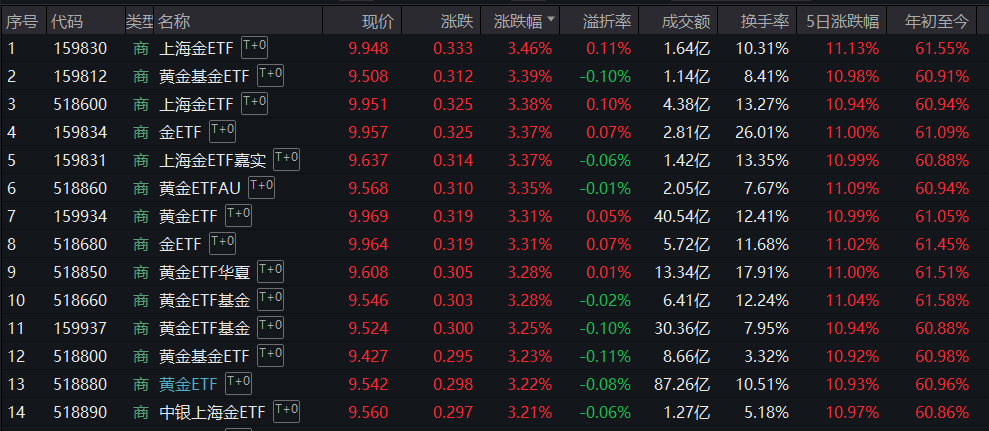
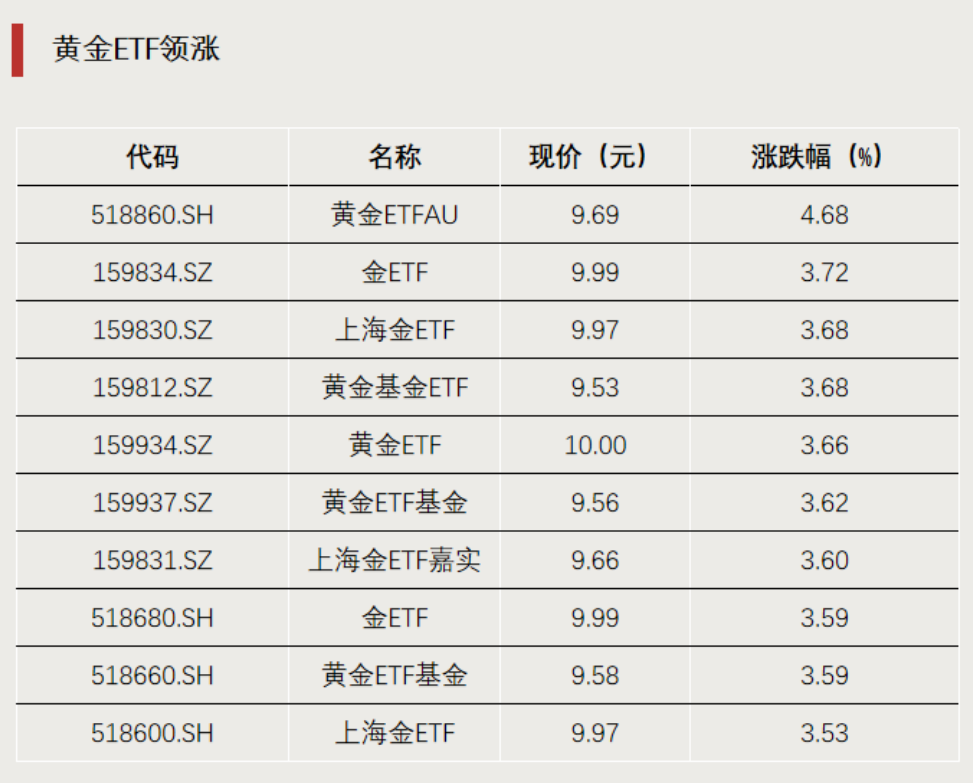
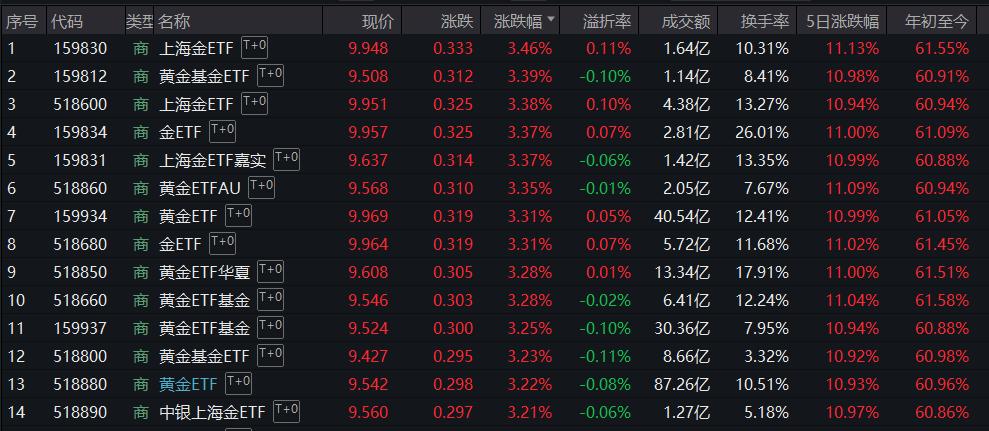
Group 1: Gold Sector Performance - The gold sector showed significant gains on October 17, with multiple gold-themed ETFs rising over 3% [1][4] - On October 16, the total net inflow for 14 commodity gold ETFs exceeded 5.1 billion yuan, with Huaan Gold ETF and Bosera Gold ETF each seeing net inflows over 1 billion yuan [3][8] - The highest single-day gain was recorded by Gold ETF AU (518860.SH) at 4.68%, while several other ETFs also saw gains exceeding 3.5% [4][9] Group 2: Factors Influencing Gold Prices - The current rally in gold prices began in late August, driven by the onset of the Federal Reserve's interest rate cut cycle and increased geopolitical uncertainties, leading to gold prices surpassing 4,000 USD per ounce in October [5] Group 3: New Energy Sector Performance - The new energy sector experienced notable adjustments, with several photovoltaic and energy storage battery-themed ETFs declining over 5% on October 17 [2][6] - Specific ETFs such as the Energy Storage Battery ETF and leading Photovoltaic ETF saw declines of 6.46% and 6.41%, respectively [7] Group 4: Insights on New Energy Market - According to Dongwu Fund, the construction of new projects and capacity in the new energy sector has significantly slowed since 2023, with capital expenditures expected to decline further in 2024 [6][8] - The capacity utilization rate across the industry has returned to over 60% since Q2 2023, with some sub-sectors reaching 80%, indicating a healthier state [6][8]
基金火线解读
中国基金报· 2025-10-17 12:19
Core Viewpoint - The article discusses the recent decline in the A-share market, attributing it to high valuations in certain sectors, profit-taking by investors, and external uncertainties such as trade policies and global market sentiment [1][3]. Market Adjustment Factors - The market adjustment is primarily driven by heightened trade tensions, leading to decreased risk appetite among investors. This has resulted in profit-taking from previously high-performing sectors, particularly technology [2][3]. - External factors, including the recent crisis in U.S. regional banks and uncertainties surrounding tariffs, have contributed to increased market volatility [3]. Short-term Market Outlook - Despite the current market pressures, fund companies believe that the downside potential is limited. The ongoing U.S.-China trade negotiations are expected to stabilize after a period of volatility [4][5]. - The market is currently in a risk release phase, but this is anticipated to be short-lived, with a focus on upcoming trade negotiation milestones in November [5][6]. Investment Strategy - Fund managers suggest that the market correction presents an opportunity for balanced portfolio allocation. They recommend focusing on sectors that may benefit from policy support and improving earnings expectations [7][8]. - Specific sectors highlighted for investment include AI, semiconductor self-sufficiency, solid-state batteries, and commercial aerospace, which are expected to show resilience during market adjustments [8][9]. Defensive Investment Considerations - Following two months of market adjustments, sectors like banking are regaining their dividend yield appeal, making dividend stocks a defensive option during periods of market volatility [9]. - The technology sector remains a focal point, although caution is advised due to the liquidity-driven nature of the recent market rally [9].

中证1000指数ETF今日合计成交额29.89亿元,环比增加35.34%
Zheng Quan Shi Bao Wang· 2025-10-17 10:09
Core Insights - The total trading volume of the CSI 1000 Index ETFs reached 2.989 billion yuan today, an increase of 781 million yuan from the previous trading day, representing a growth rate of 35.34% [1] Trading Volume Summary - The Southern CSI 1000 ETF (512100) had a trading volume of 1.593 billion yuan, up 402 million yuan from the previous day, with a growth rate of 33.72% [1] - The E Fund CSI 1000 ETF (159633) recorded a trading volume of 394 million yuan, an increase of 260 million yuan, with a remarkable growth rate of 193.67% [1] - The Huaxia CSI 1000 ETF (159845) saw a trading volume of 486 million yuan, up 122 million yuan, with a growth rate of 33.41% [1] - The top performers in terms of trading volume increase included the E Fund CSI 1000 ETF (159633) and the Bosera CSI 1000 Enhanced ETF (561780), with increases of 193.67% and 70.25% respectively [1] Market Performance Summary - As of market close, the CSI 1000 Index (000852) fell by 2.92%, while the average decline for related ETFs tracking the CSI 1000 Index was 2.65% [1] - The ETFs with the largest declines included the GF CSI 1000 ETF (560010) and the 1000 Enhanced ETF (561590), which dropped by 3.11% and 2.97% respectively [1]
中证A500一周年:ETF稳中有升,增强基金分化拉开
Sou Hu Cai Jing· 2025-10-17 09:55
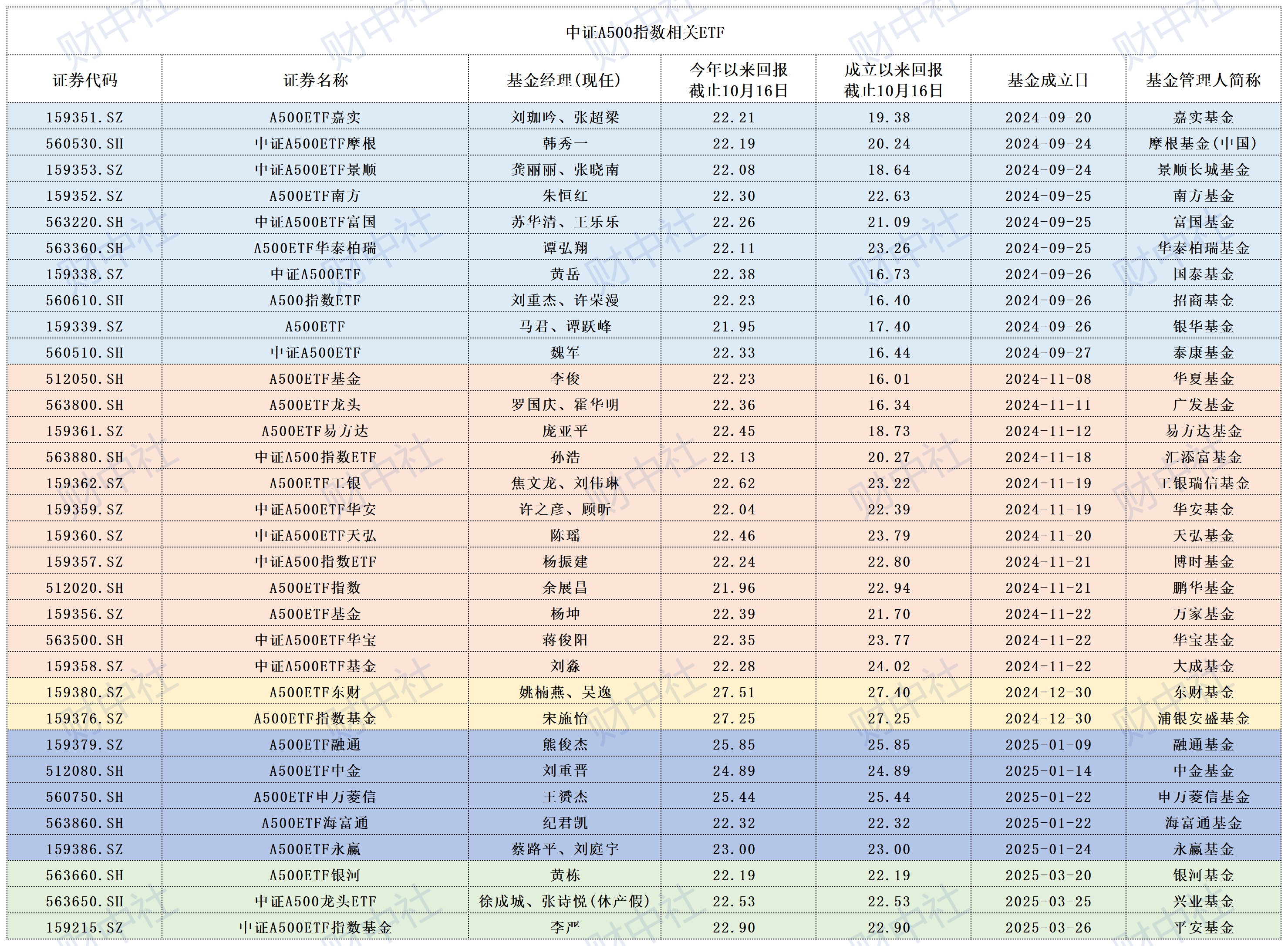
Core Insights - The CSI A500 Index has rapidly grown from 20 billion to 300 billion RMB, becoming the second-largest core broad-based index in the A-share market within a year, reflecting market expectations for mid-cap blue chips and structural transformation in the economy [1] - As of October 16, 2025, the A500 ETF has shown stable returns, with an average return of approximately 22.9% year-to-date, outperforming the CSI 300 Index [2][12] - The A500 index has become a key indicator of China's economic transformation, with over 35% of its constituent companies classified as "specialized, sophisticated, and innovative" [12] ETF Performance - The average return of 32 A500 ETFs year-to-date is about 22.9%, with the index itself rising by 23.05% over the past year, indicating strong resilience in the mid-cap blue-chip sector [2][12] - The performance differences among the three batches of ETFs are attributed to their respective launch timings, with the first batch averaging returns of 21.4% since inception [2][5] - The leading A500 ETFs by size include Huatai-PB A500 ETF and E Fund A500 ETF, with sizes of 24.9 billion and 22.6 billion RMB respectively [6] Index Enhancement Funds - The average return of over 50 A500 index enhancement funds is approximately 15.94%, with significant performance disparities exceeding 30 percentage points [7][8] - The best-performing fund, Huitianfu CSI A500 Index Enhancement A, achieved a return of 31.27% year-to-date, while some funds have underperformed significantly [7][8] - The performance of enhancement funds is influenced by model stability and market timing, with many newer funds missing out on key market movements [12] Market Structure and Future Outlook - The A500 index has become the second-largest core broad-based index in terms of investment scale, with a total fund size of 319.3 billion RMB as of October 17, 2025 [12] - The index reflects a shift in China's economic structure, with a lower allocation to traditional sectors like banking and a higher focus on technology and high-end manufacturing [12] - International interest in the A500 index is growing, with foreign asset managers looking to offer products tracking this index, indicating its potential as a channel for overseas investors [12][13]
“黄金赛道”,大举加仓
3 6 Ke· 2025-10-17 07:29
Market Overview - On October 16, A-shares showed mixed performance with a shift in market style, as funds flowed into dividend sectors, leading to a collective surge in the coal sector, while insurance and banking sectors also performed well. In contrast, the semiconductor and controlled nuclear fusion sectors experienced declines [1][4]. Fund Flows - The stock ETF market saw a net outflow of over 5 billion yuan, with broad-based indices like the CSI A500 experiencing significant outflows. The recent surge in "golden tracks" attracted substantial capital, with over 15 billion yuan flowing into the SGE Gold 9999 index in the past five days and over 10 billion yuan into the Hang Seng Technology index [2][3]. ETF Performance - As of October 16, the total scale of 1,228 stock ETFs reached 4.58 trillion yuan. The stock ETF market saw a reduction of 1.147 billion shares, translating to a net outflow of 5.042 billion yuan [2]. - Commodity ETFs and Hong Kong market ETFs led the inflows, with net inflows of 5.147 billion yuan and 3.374 billion yuan, respectively [3]. Sector Analysis - The banking, securities, and coal sectors were notably active, with the Bank ETF, Rare Earth ETF, and Securities ETF seeing the highest net inflows [6]. - Conversely, the CSI A500 index faced a net outflow of 2.36 billion yuan, indicating a shift away from broader market indices [8]. Gold ETFs - Gold-related ETFs continued to perform strongly, with year-to-date gains exceeding 60%. The gold ETF saw a net inflow of 800 million yuan on October 16 [5][7]. Investment Sentiment - The current market sentiment is cautious due to factors such as U.S.-China tensions, leading to a decline in risk appetite. The coal, banking, and food and beverage sectors are currently leading the market, while sectors like steel and construction materials are weakening [10]. Fund Management Insights - Major fund companies like E Fund and Huaxia Fund reported significant inflows into their ETFs, with E Fund's ETFs increasing by 2.5 billion yuan recently, reflecting strong investor interest in specific sectors [7]. Conclusion - The market is currently in a phase of "policy impetus + performance verification," with a focus on sectors with strong earnings certainty and clear policy catalysts expected to drive future performance [10].
“黄金赛道”,大举加仓!
中国基金报· 2025-10-17 06:07
Core Viewpoint - Recent market trends indicate a significant influx of capital into the "golden track," particularly in gold-related ETFs, with over 15 billion yuan flowing into the SGE Gold 9999 index in the past five days [2][6]. Market Trends - On October 16, A-shares showed mixed performance, with a shift in market style towards dividend sectors, coal stocks rising collectively, and insurance and banking sectors leading in gains [2]. - The stock ETF market experienced a net outflow of over 5 billion yuan, with broad-based indices like the CSI A500 seeing significant withdrawals [2][14]. ETF Performance - The total scale of the stock ETF market reached 4.58 trillion yuan, with a reduction of 11.47 million units in total shares on October 16, leading to a net outflow of 50.42 billion yuan [4][5]. - Gold ETFs continued to perform well, with year-to-date gains exceeding 60% for products like the Shanghai Gold ETF [7]. Capital Flow - In terms of capital flow, commodity ETFs and Hong Kong market ETFs saw the highest net inflows, amounting to 51.47 billion yuan and 33.74 billion yuan, respectively [6]. - The SGE Gold 9999 index led the inflow with 47.46 billion yuan on October 16, and over 153 billion yuan in the last five days [6]. Sector Analysis - The banking, brokerage, and coal sectors have shown increased activity, with significant net inflows into related ETFs [11]. - Conversely, technology stocks have faced challenges, with a notable shift of funds from emerging market tech stocks back to gold and other safer assets due to rising global risk aversion [9]. Future Outlook - Analysts suggest that the current market is at a critical juncture, with potential for policy-driven growth and performance verification in the upcoming earnings reports [18].

“黄金赛道”,大举加仓!
Zhong Guo Ji Jin Bao· 2025-10-17 06:07
Core Insights - Recent market trends indicate a significant influx of capital into the "golden track," with over 15 billion yuan flowing into the SGE Gold 9999 index in the past five days [1][4] - The A-share market showed mixed performance on October 16, with notable gains in the coal, insurance, and banking sectors, while technology and controlled nuclear fusion stocks faced declines [1][5] Fund Flow Analysis - The total scale of all stock ETFs in the market reached 4.58 trillion yuan as of October 16, with a net outflow of over 5 billion yuan from the stock ETF market on the same day [2][3] - Commodity ETFs and Hong Kong market ETFs saw the highest net inflows, amounting to 5.15 billion yuan and 3.37 billion yuan respectively [4] - The SGE Gold 9999 index led the inflows with 4.75 billion yuan on October 16, contributing to a total of over 15.3 billion yuan in the last five days [4][6] Sector Performance - Gold-related ETFs have shown strong performance, with year-to-date gains exceeding 60% [6] - In contrast, the broad-based ETFs experienced significant outflows, with the CSI A500 index seeing a net outflow of 2.36 billion yuan on October 16 [9][10] - Specific ETFs such as the bank ETF, rare earth ETF, and non-bank Hong Kong stock ETFs attracted substantial inflows, indicating a shift in investor sentiment towards these sectors [7][8] Market Sentiment - The current market sentiment is influenced by rising global risk aversion and ongoing U.S.-China tensions, leading to a shift from emerging market tech stocks to safer assets like gold [5][11] - Analysts suggest that the market is at a critical juncture, with upcoming policy initiatives and earnings reports expected to guide future investment directions [11]