康方生物

Search documents
康方生物20250827
2025-08-27 15:19
Summary of Key Points from the Conference Call of 康方生物 Company Overview - 康方生物 is advancing in the field of tumor immunotherapy, entering the 2.0 era with products like 卡度尼利 and 伊沃西, while actively exploring the ADC sector and various combination therapies [2][6][8]. Financial Performance - In the first half of 2025, 康方生物 achieved a total revenue of 14.1 billion RMB, with a commercial sales increase of 49% year-on-year [3][49]. - The gross profit from commercial sales was 11.1 billion RMB, a 20% increase from 8.89 billion RMB in the same period last year [50]. - R&D expenses rose by 23% to 7.3 billion RMB, while cash reserves stood at 71.38 billion RMB [50][13]. Clinical and Commercial Achievements - Significant clinical results were reported for AK112, which showed positive overall survival (OS) in EGFR TKI-resistant indications, marking it as the first IO drug to achieve such results globally [4][11]. - Multiple phase III clinical trials for 卡度尼利 have been initiated, covering various cancers including lung, gastric, liver, and cervical cancers [4][5]. - The final analysis of 伊沃西 (Harmony A) demonstrated statistically significant OS results, reinforcing its market position [2][4]. Product Pipeline and Development - 康方生物 has several products in the pipeline, with multiple autoimmune products expected to be approved between late 2024 and early 2025 [2][4]. - The company is focusing on ADC development, with two dual-target ADC products entering clinical stages [4][10]. - The company has independently conducted international multi-center clinical trials for 派安普利, showcasing its capabilities in global registration systems [2][10]. Strategic Direction - 康方生物 aims to enhance its product offerings in tumor immunotherapy and ADC, with plans to combine PD-1 with ADC to improve efficacy and reduce toxicity [6][8]. - The company is expanding its international presence, with clinical data showing consistency between Chinese and global data, indicating the potential for global patient treatment [7][8]. Market Position and Future Outlook - The company has established a strong commercial presence, with its dual antibody products included in the national medical insurance directory, covering over 2,000 hospitals [11][20]. - Future plans include expanding the market for non-tumor drugs and enhancing the commercialization of existing products like AK112 and AK104 [9][20]. - 康方生物 is committed to maintaining a balance between R&D investment and commercial operations, aiming to reduce R&D expenses as a percentage of sales over time [63][62]. Challenges and Considerations - The company reported a loss of 588 million RMB in the first half of 2025, attributed to increased R&D investments and equity investment losses [52][53]. - 毛利率 (gross margin) has decreased due to price adjustments following the inclusion of key products in medical insurance [61][62]. Conclusion - 康方生物 is positioned for significant growth in the biopharmaceutical sector, with a robust pipeline and strategic focus on innovative therapies, while navigating challenges related to financial performance and market dynamics [2][4][8].

康方生物的“最热双抗”交出大涨业绩
Xin Lang Cai Jing· 2025-08-27 14:39
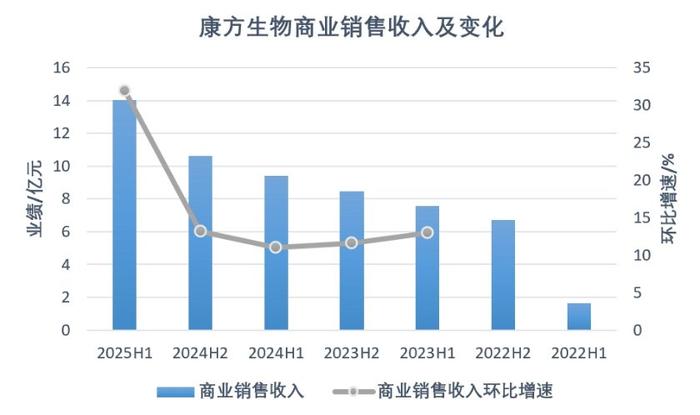
Core Viewpoint - Kangfang Biopharma reported a revenue of 1.412 billion yuan for the first half of 2025, marking a year-on-year increase of 37.75%, while the loss expanded to 588 million yuan from 249 million yuan in the same period last year [1][3] Financial Performance - Revenue for the period was 1.412 billion yuan, a 37.75% increase year-on-year [1] - Commercial sales revenue reached 1.402 billion yuan, up 49.20% year-on-year [1] - The company incurred a loss of 588 million yuan, which is an increase from the previous year's loss of 249 million yuan [1][3] Revenue Drivers - The growth in commercial sales revenue was primarily driven by the inclusion of AK104 and AK112 in the national medical insurance since January, leading to increased sales volume [1] - The increase in losses was attributed to a rise in equity investment losses from a partnership with Summit, which increased from 32.6 million yuan to 192 million yuan, as well as higher R&D expenses and stock incentive costs [3] Product Pipeline and Market Position - Kangfang Biopharma has received approval for seven products, including AK104 and AK112, which are key dual antibodies, and has expanded its commercial product range to include metabolic and autoimmune areas [4] - The sales team has grown from over 800 to 1,200 members, covering oncology and specialty drug sectors [4] - The company is focusing on AK112, which has shown promising results in clinical trials for non-small cell lung cancer [5][8] Clinical Development and Strategy - AK112 has achieved significant clinical endpoints in trials, including a statistically significant improvement in progression-free survival (PFS) [8][9] - The company is pursuing a strategy termed "IO2.0+ADC2.0," which aims to integrate dual antibodies with antibody-drug conjugates (ADCs) [12][13] - Kangfang Biopharma's pipeline includes ongoing clinical trials for various indications, with a focus on enhancing the efficacy of existing treatments [12][16]

医药生物周报(25年第33周):2025年WCLC摘要公布,推荐关注国产创新药公司-20250827
Guoxin Securities· 2025-08-27 11:32
Investment Rating - The report maintains an "Outperform" rating for the pharmaceutical and biotechnology sector [1][5]. Core Insights - The report highlights the upcoming World Lung Cancer Conference (WCLC) where Chinese pharmaceutical companies will present innovative research results, particularly focusing on domestic innovative drug companies [2][11]. - The pharmaceutical sector has shown weaker performance compared to the overall market, with a current price-to-earnings ratio (TTM) of 40.45x, which is at the 83.46th percentile of the historical valuation over the past five years [1][2]. Company-Specific Summaries - **Mindray Medical (300760.SZ)**: Rated "Outperform" with a projected net profit of 11.67 billion in 2024, increasing to 16.19 billion by 2027, and a PE ratio decreasing from 25.4 in 2024 to 18.3 in 2027 [4]. - **Aier Eye Hospital (300015.SZ)**: Rated "Outperform" with a projected net profit of 3.56 billion in 2024, increasing to 5.76 billion by 2027, and a PE ratio decreasing from 35.1 in 2024 to 21.7 in 2027 [4]. - **WuXi AppTec (603259.SH)**: Rated "Outperform" with a projected net profit of 9.35 billion in 2024, increasing to 14.51 billion by 2027, and a PE ratio decreasing from 29.7 in 2024 to 19.2 in 2027 [4]. - **Innovent Biologics (9926.HK)**: Rated "Outperform" with a projected net profit of -0.51 billion in 2024, turning positive to 1.79 billion by 2027, with a PE ratio from -281.7 in 2024 to 80.8 in 2027 [4]. - **Legend Biotech (688212.SH)**: Rated "Outperform" with a projected net profit of 0.2 million in 2024, increasing to 1.2 million by 2027, and a PE ratio decreasing from 321.8 in 2024 to 54.5 in 2027 [4]. Market Performance - The overall A-share market increased by 3.58%, with the Shanghai Composite Index rising by 4.18%, while the biotechnology sector only saw a 1.05% increase, indicating underperformance relative to the broader market [1][2].



资金动向 | 北水爆买港股近154亿港元,大幅加仓阿里、美团!
Ge Long Hui A P P· 2025-08-27 10:59
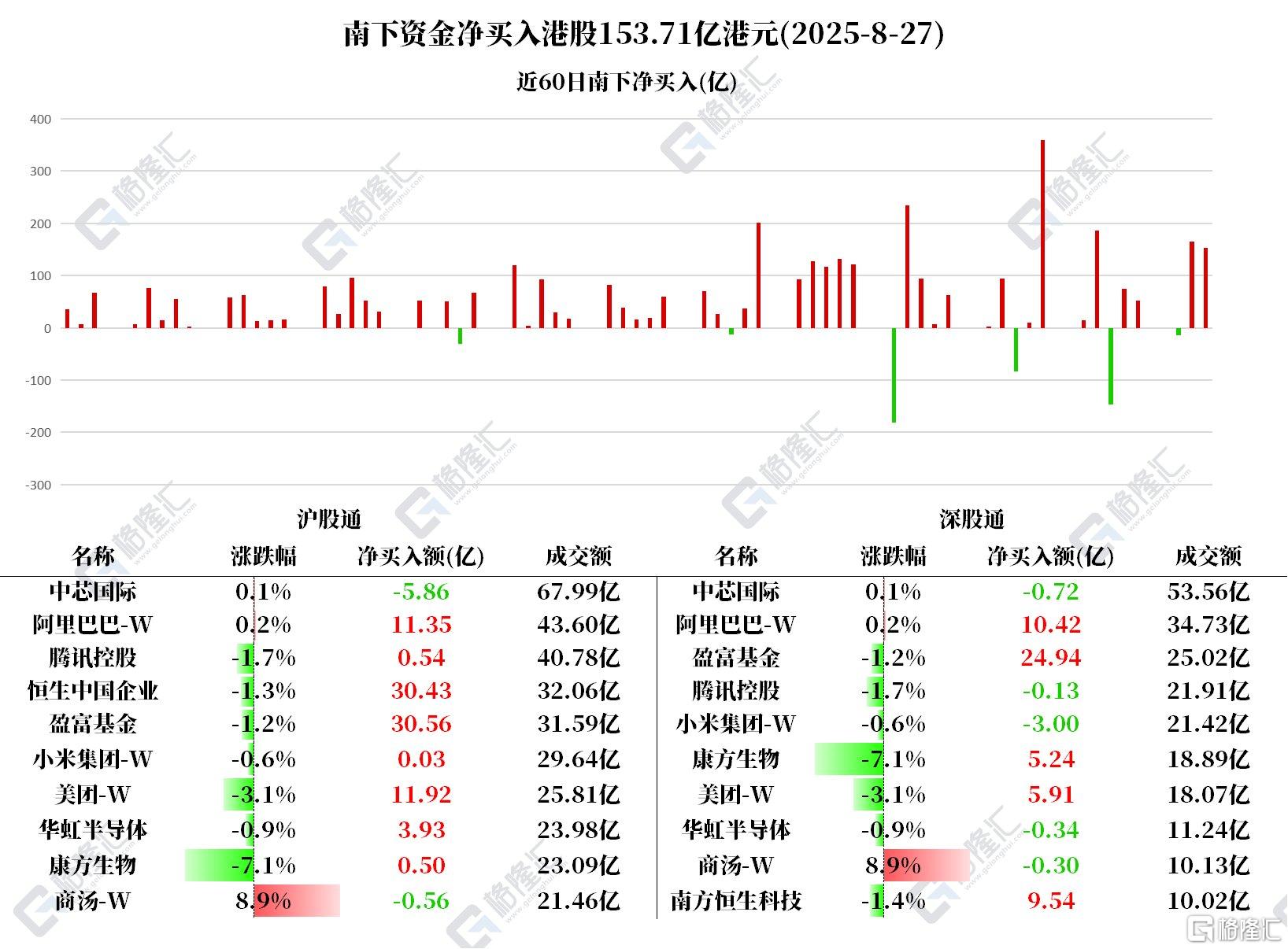
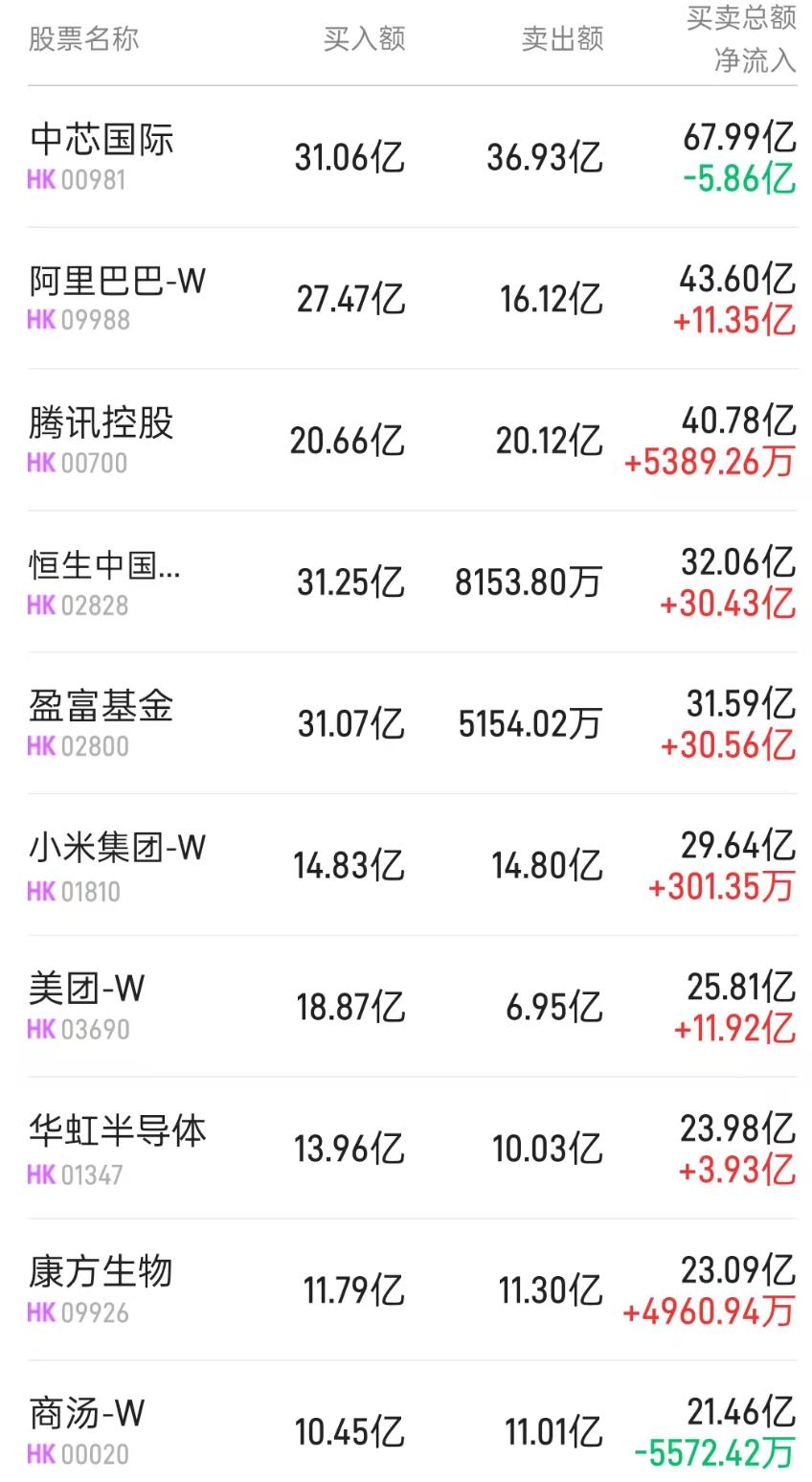
Group 1: Market Activity - Southbound funds net bought Hong Kong stocks worth 15.371 billion HKD on August 27, with significant purchases in the Tracker Fund (5.55 billion HKD), Hang Seng China Enterprises (3.043 billion HKD), Alibaba (2.178 billion HKD), and Meituan (1.783 billion HKD) [1] - Notable net sales included SMIC (0.658 billion HKD) and Xiaomi (0.297 billion HKD) [1] - Southbound funds have continuously net bought Tencent for 9 days, totaling 6.92464 billion HKD, and Meituan for 6 days, totaling 4.83983 billion HKD [4] Group 2: Company Performance - Alibaba's stock saw a net buy of 1.135 billion HKD, with a slight increase of 0.2% in share price [4] - Meituan reported Q2 revenue of 91.8 billion RMB, a year-on-year increase of 11.7%, with monthly active users surpassing 500 million [5] - Kangfang Biologics achieved total revenue of 1.412 billion RMB in the first half of the year, a 37.75% increase year-on-year, but reported a loss of 588 million RMB, which is a significant increase from the previous year's loss [6] Group 3: Industry Insights - The Chinese government released an opinion on implementing "Artificial Intelligence+" actions, which is expected to boost the AI industry chain, similar to the "Internet+" policy in 2015 [5] - The domestic chip market is anticipated to grow as new AI chips support FP8, with improvements in design technology and manufacturing processes [6] - SMIC is expected to benefit from government support for AI chip innovation and software ecosystem development [6]

南向资金追踪|净买入超153亿港元 扫货三大ETF加仓阿里和美团
Xin Lang Cai Jing· 2025-08-27 10:29
Group 1 - Southbound funds traded approximately HKD 191.17 billion today, an increase of nearly HKD 43 billion compared to the previous day, accounting for 51.48% of the total turnover of the Hang Seng Index [2] - Despite the decline in Hong Kong stocks, southbound funds significantly increased their positions, with a net purchase of approximately HKD 15.37 billion, including a net inflow of about HKD 9.00 billion from the Shanghai-Hong Kong Stock Connect and HKD 6.37 billion from the Shenzhen-Hong Kong Stock Connect [2] - Major ETFs such as the Tracker Fund of Hong Kong, Hang Seng China Enterprises Index ETF, and Southern Hang Seng Technology ETF saw substantial inflows of HKD 5.55 billion, HKD 3.04 billion, and HKD 0.95 billion respectively [2] Group 2 - Individual stocks with significant net purchases included Alibaba Group (HKD 2.18 billion), Meituan (HKD 1.78 billion), and CanSino Biologics (HKD 0.57 billion) [3] - Stocks with notable net outflows included SMIC (HKD 0.66 billion) and Xiaomi Group (HKD 0.30 billion) [3] Group 3 - Alibaba Group's stock rose by 0.16%, with short-term fund trends remaining unclear, having reduced holdings by 1.54 million shares over the past five days [4] - Meituan's stock fell by 3.08%, but short-term funds accelerated inflows, increasing holdings by 24.10 million shares over the past five days [4] - CanSino Biologics' stock dropped by 7.10%, with short-term fund trends remaining unclear, having reduced holdings by 90,000 shares over the past five days [4] - SMIC's stock rose by 0.09%, with short-term funds primarily flowing in, having increased holdings by 4.22 million shares over the past five days [4] - Xiaomi Group's stock fell by 0.56%, with short-term fund inflows slowing down, having increased holdings by 2.53 million shares over the past five days [4] Group 4 - In the past month, the top active stocks in the Shanghai-Hong Kong Stock Connect included SMIC, Alibaba Group, and Tencent Holdings, with net outflows of HKD 0.59 billion, HKD 1.14 billion, and HKD 0.54 billion respectively [6] - In the Shenzhen-Hong Kong Stock Connect, the top active stocks included SMIC, Alibaba Group, and the Tracker Fund of Hong Kong, with net outflows of HKD 0.72 billion, HKD 1.04 billion, and HKD 2.49 billion respectively [7]




图解丨南下资金净买入港股153.7亿港元,大幅加仓阿里、美团
Ge Long Hui A P P· 2025-08-27 10:09
Group 1 - Southbound funds net bought Hong Kong stocks worth 15.371 billion HKD today, with notable purchases including 5.55 billion in the Tracker Fund, 3.043 billion in Hang Seng China Enterprises, and 2.178 billion in Alibaba [1] - Southbound funds have continuously net bought Tencent for 9 days, totaling 6.92464 billion HKD, and Meituan for 6 days, totaling 4.83983 billion HKD [1] - Continuous net selling was observed in Xiaomi for 4 days, totaling 2.80031 billion HKD, and in SMIC for 3 days, totaling 2.45265 billion HKD [1] Group 2 - In the Shanghai Stock Connect, Alibaba saw a net purchase of 1.135 billion with a trading volume of 4.360 billion, while Tencent had a net purchase of 0.54 billion with a trading volume of 4.078 billion [3] - SMIC experienced a net selling of 5.86 billion with a trading volume of 6.799 billion, while Meituan had a net purchase of 1.192 billion with a trading volume of 2.581 billion [3] - The performance of various stocks showed fluctuations, with Alibaba and Tencent both experiencing slight declines of 0.2% and 1.7% respectively [3]
北水动向|北水成交净买入153.71亿 港股ETF及科网股再获加仓 芯片股继续分化
智通财经网· 2025-08-27 09:57
Core Insights - The Hong Kong stock market saw a net inflow of 15.371 billion HKD from northbound trading on August 27, with the Shanghai-Hong Kong Stock Connect contributing 9.005 billion HKD and the Shenzhen-Hong Kong Stock Connect contributing 6.366 billion HKD [1] Group 1: Stock Performance - The most bought stocks by northbound funds were the Tracker Fund of Hong Kong (02800), Hang Seng China Enterprises (02828), and Alibaba-W (09988) [1] - The most sold stocks included Semiconductor Manufacturing International Corporation (00981) and Xiaomi Group-W (01810) [1] - Semiconductor Manufacturing International Corporation had a net outflow of 5.86 billion HKD, while Alibaba-W saw a net inflow of 11.35 billion HKD [2] Group 2: Sector Trends - Northbound funds continued to favor Hong Kong ETFs, with significant net purchases in the Tracker Fund of Hong Kong (55.49 billion HKD), Hang Seng China Enterprises (30.43 billion HKD), and Southern Hang Seng Technology (9.53 billion HKD) [4] - The AI sector received attention following the Chinese government's announcement on implementing "AI+" initiatives, which is expected to boost demand across the AI industry [5] - The chip sector showed mixed results, with Huahong Semiconductor (01347) receiving a net inflow of 3.58 billion HKD, while Semiconductor Manufacturing International Corporation faced a net outflow of 6.58 billion HKD [6] Group 3: Company-Specific Developments - Kangfang Bio (09926) reported a revenue increase of 37.75% year-on-year, driven by new product approvals and inclusion in the national medical insurance directory [5] - Xiaomi Group-W faced a net outflow of 2.97 billion HKD, with concerns over demand momentum due to the anticipated cessation of subsidies in late 2025 [7]

恒生指数连跌两日 部分半导体股逆势走强
Xin Lang Cai Jing· 2025-08-27 08:55
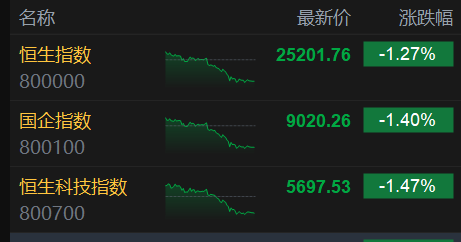
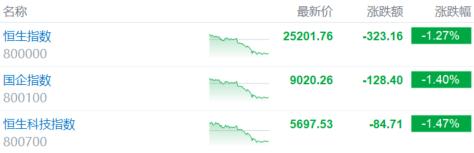
Market Performance - The Hong Kong stock market continues to show weakness, with the Hang Seng Index down 1.27% closing at 25,201.76 points, the Tech Index down 1.47% at 5,697.53 points, and the National Enterprises Index down 1.40% at 9,020.26 points [2][4]. Pharmaceutical Sector - Pharmaceutical stocks are under pressure due to U.S. President Trump's consideration of imposing tariffs up to 250% on imported drugs, which could create significant volatility in the global pharmaceutical industry. This presents both opportunities and challenges for Chinese biopharmaceutical companies [5]. - Notable declines in pharmaceutical stocks include Connoisseur-B (down 8.59%), King’s Ray Biotechnology (down 7.42%), and Kangfang Biologics (down 7.10%) [4]. Brokerage Sector - Brokerage stocks mostly declined, with notable drops in Shenwan Hongyuan (down 6.02%), Dongfang Securities (down 5.78%), and CICC (down 5.64%). However, there are indications of active trading and policy-driven valuation recovery, with increased market activity and record high margin trading balances [6]. Real Estate Sector - Real estate stocks continue to weaken, with China Jinmao down 8.23%, Vanke down 5.35%, and Sunac China down 5%. This follows the recent "Six Measures" policy adjustment in Shanghai, which has not positively impacted related stocks [7][8]. Beverage Sector - Beverage stocks faced declines despite positive earnings reports, with notable drops in Hu Shang Ayi (down 5.84%), Mixue Group (down 5.27%), and Gu Ming (down 3.75%) [9][10]. Technology Sector - Technology stocks also saw declines, with major companies like Beike-W down 6.82%, Kuaishou-W down 3.35%, and JD Health-W down 3.21%. Beike reported a net income of 49.339 billion RMB, a year-on-year increase of 24.13%, but a net profit decrease of 7.2% [11][12]. Semiconductor Sector - Semiconductor stocks performed well against the market trend, with Shanghai Fudan up 3.25%, Hard Egg Innovation up 0.41%, and SMIC up 0.09%. This is attributed to the recent government policy promoting the integration of artificial intelligence and economic sectors [13]. Individual Stock Movements - CSPC Pharmaceutical Group fell 6.36% due to second-quarter revenue and net profit missing expectations, despite management highlighting potential in their EGFR ADC product [14]. - Shuangdeng Co. saw a significant increase of 14.65% on its second day of trading, driven by strong demand during its IPO, with oversubscription rates of 3,876 times for public offerings and 18.75 times for international offerings [15][16].
港股收评:连跌两日!恒指收跌1.27%,科技、金融股继续下挫
Ge Long Hui· 2025-08-27 08:50
Market Overview - The Hong Kong stock market experienced a significant decline, with the Hang Seng Index dropping by 1.27%, closing at 25,201.76, down 323.16 points [1][2] - The Hang Seng Tech Index and the Hang Seng China Enterprises Index also fell by 1.47% and 1.4%, respectively, with the China Enterprises Index barely holding above the 9,000-point mark [1][2] Sector Performance - Major technology stocks saw a downturn, with companies like Kuaishou and Meituan falling over 3%, while JD.com dropped by 2.5% [5][6] - Financial sectors, including banks and insurance stocks, collectively underperformed, contributing to the overall market decline [2][5] - The biopharmaceutical sector faced significant losses, particularly after former President Trump announced plans to impose tariffs on drugs, leading to a broad sell-off in biotech stocks [2][5] Real Estate and Property Management - Property management stocks experienced sharp declines, with companies like Excellence Commercial Services dropping 16% and Country Garden Services falling over 11% [7] - Recent real estate policies in major cities like Beijing and Shanghai are expected to stabilize the market, with analysts optimistic about recovery in core cities [7] Brokerage Firms - Chinese brokerage stocks also fell, with Shenwan Hongyuan down over 6% and other major firms like Dongfang Securities and Huatai Securities declining more than 5% [8] - Despite the downturn, there is optimism regarding the brokerage sector's performance due to increased market activity and potential earnings growth [8] Biopharmaceutical Sector - The biopharmaceutical and innovative drug sectors saw significant declines, with stocks like CanSino Biologics and Innovent Biologics dropping over 7% [9] - Analysts suggest that recent changes in liquidity conditions may support a rebound in the Hong Kong stock market, narrowing the gap with the rapidly rising A-share market [9] Consumer Sector - New consumption concept stocks also faced declines, with companies like Nayuki's Tea and Bubble Mart dropping over 5% [10] - The Chinese Ministry of Commerce plans to introduce policies to boost service consumption, indicating a shift towards a balanced consumption model [10] Apple-Related Stocks - Apple-related stocks performed well, with Lens Technology rising nearly 8% ahead of the upcoming iPhone 17 launch event scheduled for September 9 [3][12] Capital Inflows - Southbound capital saw a net inflow of 15.371 billion HKD, indicating continued interest in Hong Kong stocks from mainland investors [12] Hedge Fund Activity - Recent reports indicate that global hedge funds have increased their bets on Chinese stocks, with significant inflows observed in consumer staples and industrial sectors [14]

港股收评:午后跳水恒指跌1.27%,科技股、金融股普遍弱势!蓝思科技涨8%,快手美团跌超3%,百度网易腾讯跌近2%
Ge Long Hui· 2025-08-27 08:40
Market Overview - The Hong Kong stock market experienced a significant decline in the afternoon, with the Hang Seng Index dropping by 1.27%, losing over 300 points. The Hang Seng China Enterprises Index and the Hang Seng Tech Index fell by 1.4% and 1.47% respectively, with the former barely holding above the 9000-point mark [2] - Major technology stocks, which serve as market indicators, continued to decline in the afternoon. Kuaishou and Meituan fell over 3%, while JD.com dropped by 2.5%. Baidu, NetEase, and Tencent saw declines close to 2%, and Xiaomi fell by 0.56%. Alibaba managed to stay slightly positive [3] Sector Performance - The financial sector, including banks, insurance companies, and Chinese brokerage firms, collectively underperformed, contributing to the overall market decline. The performance of individual stocks continued to be affected by ongoing earnings reports, with property management and real estate stocks experiencing significant drops [3] - Biopharmaceutical stocks faced a collective downturn, particularly in the innovative drug sector, following comments from Trump regarding the rapid imposition of tariffs on pharmaceuticals. This led to notable declines in various biopharma stocks [3] Specific Stock Movements - Several biopharmaceutical companies saw substantial declines, including Kanghao Ya-B (-8.59%), Qiansirui Biotechnology (-7.42%), and Kangfang Biotechnology (-7.10%). Other notable decliners included Xiansheng Pharmaceutical (-6.79%) and Shiyao Group (-6.36%) [3] - In contrast, the rare earth sector remained strong, benefiting from the implementation of supply reforms and multiple catalysts. Apple’s upcoming event on September 9, where the iPhone 17 series is expected to be launched, led to a rise in Apple-related stocks, with Lens Technology (300433) surging nearly 8% and reaching a new high since its listing [4]