
南方电网

Search documents
电网ETF(561380)近5日资金净流入超8亿元,国内电网投资大周期有望开启
Mei Ri Jing Ji Xin Wen· 2026-01-20 05:15
Group 1 - The core viewpoint is that the domestic power grid investment cycle is expected to begin, with significant capital inflow into the electric grid ETF (561380) exceeding 800 million yuan in the past five days [1] - During the "14th Five-Year Plan" period, the State Grid's fixed asset investment is projected to reach 4 trillion yuan, representing a 40% increase compared to the "13th Five-Year Plan" investment, aimed at promoting high-quality development of the new power system industry [1] - The State Grid is expected to add an average of 20 million kilowatts of wind and solar energy capacity annually in its service areas, accelerating the construction of ultra-high voltage direct current transmission channels, with cross-regional and cross-provincial transmission capacity expected to increase by over 30% by the end of the "14th Five-Year Plan" [1] Group 2 - The Southern Power Grid plans a year-on-year increase of 20% in fixed asset investment for the first quarter [1] - The electric grid ETF (561380) tracks the Hang Seng A-share Electric Grid Equipment Index (HSCAUPG), which reflects the overall performance of listed companies related to electric grid equipment in mainland China, covering areas such as transmission and transformation, distribution, and control equipment manufacturing [1] - The index has a high industry concentration and market representativeness, indicating the overall trend of electric grid construction and intelligent upgrades [1]
【财经分析】国企改革深化提升行动如期收官 新一轮改革将在何处发力?
Xin Hua Cai Jing· 2026-01-20 03:03
Group 1 - The core viewpoint of the articles emphasizes the ongoing reforms in state-owned enterprises (SOEs) in China, highlighting the completion of the main tasks of the current round of reform while indicating that further deepening of reforms is necessary to address structural issues and enhance innovation capabilities [1][2][6] - The State-owned Assets Supervision and Administration Commission (SASAC) has reported that the core functions and competitiveness of SOEs have steadily improved, with significant progress in strategic restructuring, technological innovation, and corporate governance [2][4] - Data indicates that during the "14th Five-Year Plan" period, central enterprises invested over 5 trillion yuan in research and development, with an annual growth rate of over 20% in emerging industries, and a nearly 50% increase in the number of technology talents [2][3] Group 2 - Local SOEs are optimizing their layouts based on regional endowments, with examples including the establishment of intelligent coal mines in Shanxi and the formation of a provincial low-altitude economy group in Hunan [3] - The focus on emerging industries is evident, with central enterprises actively engaging in sectors such as new energy, aerospace, and quantum technology, aiming to create new growth engines [3][5] - The next phase of SOE reform will prioritize the establishment of a modern enterprise system with Chinese characteristics, enhancing governance structures, and addressing deep-seated issues that hinder enterprise development [6][7] Group 3 - The reform process is described as ongoing, with a commitment to continue addressing challenges such as economic efficiency and high asset-liability ratios, while also tackling structural contradictions in emerging industries [6][7] - The SASAC plans to focus on cultivating leading technology enterprises and accelerating the application of research outcomes, alongside promoting strategic and professional restructuring [6][7] - The emphasis on high-quality development and the optimization of mechanisms and incentives is expected to drive innovation and enhance the overall effectiveness of SOEs [7][8]
广东省和海南省坚持相向而行 加强协同联动 在服务国家重大战略实施中拓展新空间实现新发展
Zhong Guo Fa Zhan Wang· 2026-01-20 01:44
Group 1 - The Guangdong and Hainan provincial governments are enhancing cooperation to implement the strategic directives from President Xi Jinping regarding the development of the Hainan Free Trade Port and the Guangdong-Hong Kong-Macao Greater Bay Area [2][3] - Guangdong's leadership expressed gratitude for Hainan's support in its reform and development, highlighting the importance of both regions' strategic alignment for national modernization and economic growth [2][3] - Hainan's government acknowledged Guangdong's comprehensive support for its economic and social development, emphasizing the need for ongoing collaboration in various sectors, including technology and public services [3] Group 2 - The two provinces are focusing on deepening industrial and technological cooperation, particularly in emerging fields such as commercial aerospace, low-altitude economy, and biomedicine [2][3] - There is a commitment to enhance infrastructure connectivity and facilitate joint projects, particularly in the Qiongzhou Strait area, to promote high-quality development [3] - The Hainan delegation visited several innovation and technology platforms in Guangdong, including the National Nanotechnology Innovation Research Institute, to learn from Guangdong's advancements in modern industrial systems [4]
A股盘前播报 | 事关经济!两场重要新闻发布会今日举行 存储芯片短缺或持续到2026年以后
智通财经网· 2026-01-20 00:38
Group 1: Macroeconomic Developments - Premier Li Qiang emphasized the goal of high-quality development and the implementation of more proactive fiscal policies and moderately loose monetary policies during a meeting with experts and entrepreneurs [1] - Two important press conferences will be held to discuss the implementation of the central economic work conference and the role of proactive fiscal policies in promoting high-quality economic development [4] Group 2: Industry Insights - Micron Technology warned of an unprecedented shortage of memory chips driven by the surge in demand for high-end semiconductors due to AI infrastructure, with supply tightness expected to last until after 2026 [2] - The shortage of memory chips has led to rising costs, prompting major smartphone manufacturers like Xiaomi and Oppo to lower their shipment targets for 2026 [2] Group 3: Market Reactions - The geopolitical tensions surrounding Greenland have led to a potential trade war, with Trump proposing a 10% tariff on eight European countries, which has resulted in a significant increase in gold and silver prices [3] - The offshore RMB rose over 100 points, reaching 6.95, amid the heightened risk aversion in the market [3] Group 4: Investment Opportunities - Southern Power Grid has confirmed a fixed asset investment of 180 billion yuan for 2026, marking a five-year high, indicating steady growth in grid investment during the 14th Five-Year Plan [10] - Tesla's transition into a robotics company could lead to a valuation of $25 trillion, with domestic humanoid robot manufacturers gaining orders and benefiting from commercial exploration [11]
南方电网今年固定资产投资安排1800亿元,连续五年创新高
2 1 Shi Ji Jing Ji Bao Dao· 2026-01-19 16:03
Core Insights - In 2026, the Southern Power Grid Company plans to invest 180 billion yuan in fixed assets, marking a record high for five consecutive years, with an average annual growth rate of 9.5% [2] Investment Focus - The investment will primarily target the construction of a new power system, development of strategic emerging industries, and enhancement of quality power supply services [2] - The company aims to support the addition of 40 million kilowatts of new energy capacity by 2026, focusing on large-scale development and high-level consumption of renewable energy [2] Key Projects - The offshore wind power flexible direct current transmission project in Yangjiang, Guangdong, is over halfway complete and is expected to be operational by the end of 2026, delivering approximately 6 billion kilowatt-hours of green electricity annually to the Guangdong-Hong Kong-Macao Greater Bay Area [2] - Other projects include the construction of flexible interconnection projects in Zangyue and Xiangqian, which will facilitate the introduction of clean electricity from outside the region [2] Strategic Emerging Industries - The company plans to accelerate the expansion and quality improvement of charging and swapping infrastructure, as well as advance the development of marine energy and intelligent technologies [2] - A major interactive vehicle-network demonstration station in the Guangdong-Hong Kong-Macao Greater Bay Area is set to be operational in Shenzhen in the first quarter of 2026 [2] Modernization of Infrastructure - Southern Power Grid will focus on strengthening modern power grid infrastructure, emphasizing flexible direct current interconnections and enhancing distribution network construction [3] - Specific projects include the Guangzhou Tianhe Tangxia flexible direct current project, which will provide reliable power supply solutions for densely populated urban areas by the end of 2026 [3] - The company plans to invest no less than 50.6 billion yuan in large-scale equipment updates in 2026, promoting the development of "power + computing" new infrastructure [3] Additional Projects - The 220 kV undersea interconnection project in Weizhou Island, Guangxi, is expected to be operational in the first quarter of 2026, along with the 500 kV offshore wind power transmission line in Hainan, which will commence construction within the year [3]
广东能源转型加速:清洁能源占比近48% 布局“零碳细胞”
2 1 Shi Ji Jing Ji Bao Dao· 2026-01-19 15:11
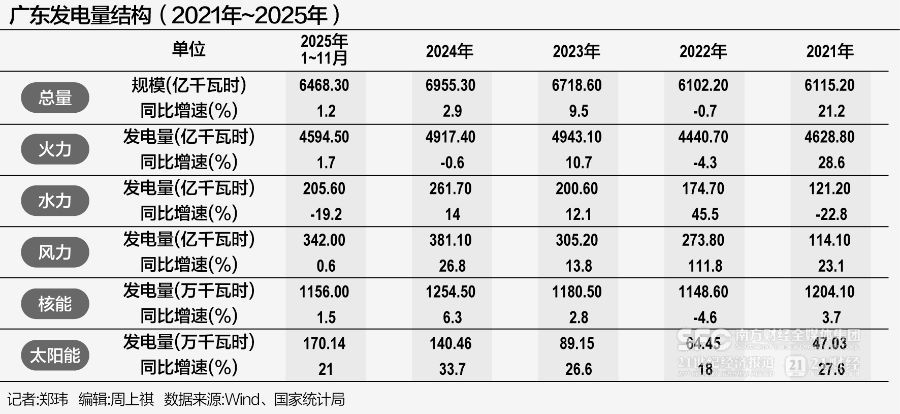
Core Insights - The National Energy Administration of China projects that by 2025, the total electricity consumption in China will reach 10.4 trillion kilowatt-hours, marking a 5% year-on-year increase, with Guangdong province leading at 958.973 billion kilowatt-hours, a 4.93% increase [1] - Guangdong's clean energy share in the power grid is expected to approach 48% by 2025, reflecting a significant shift in the energy structure towards renewable sources [1] - The province's energy transition is accelerating, with a notable decrease in coal-fired power generation from approximately 75.69% in late 2021 to 71.03% by late 2025, while the shares of hydropower, wind, and solar energy have increased significantly [1][4] Energy Structure Transformation - Guangdong's total power generation reached 646.83 billion kilowatt-hours from January to November 2025, with coal, hydropower, wind, nuclear, and solar power contributions being 459.45 billion, 20.56 billion, 34.2 billion, 115.6 billion, and 17.014 billion kilowatt-hours respectively [4] - Wind power generation has doubled from 11.41 billion kilowatt-hours in 2021 to 34.2 billion by late 2025, while solar power surged from 4.703 billion to 17.014 billion kilowatt-hours [4] - The share of non-fossil energy consumption in Guangdong is projected to reach 28.7% by 2024, with electricity accounting for 39% of total energy consumption, exceeding national averages by approximately 9 and 10 percentage points respectively [6] Clean Energy Projects - Guangdong has launched several clean energy projects, with wind and solar energy surpassing coal as the largest installed capacity source since April 2025 [5] - The National Energy Investment Corporation has commissioned three offshore wind projects in Guangdong, with a total installed capacity exceeding 900,000 kilowatts and a total investment of 18.8 billion yuan [5] - By June 2025, the total installed capacity of renewable energy in Guangdong exceeded 78.5 million kilowatts, accounting for nearly 33% of the province's total installed capacity [5] Zero Carbon Park Initiatives - Guangdong is initiating the "Zero Carbon Park Construction Plan," aiming to establish around 25 zero-carbon parks by 2027 to accelerate the green transition of energy consumption structures [1][8] - The first batch of national-level zero-carbon parks includes the Zhanjiang Lingang Economic Zone, which aims to leverage local renewable energy resources for sustainable development [2][9] - The plan encourages the development of renewable energy, energy storage, and the use of alternative fuels, with a focus on integrating various energy sources to enhance sustainability [8][10]
广东能源转型加速:清洁能源占比近48%,布局“零碳细胞”
2 1 Shi Ji Jing Ji Bao Dao· 2026-01-19 13:03
Core Viewpoint - Guangdong province is accelerating its green development narrative, with significant increases in clean energy generation and a commitment to building zero-carbon parks by 2027 [1][2]. Group 1: Energy Consumption and Generation - By 2025, China's total electricity consumption is projected to reach 10.4 trillion kilowatt-hours, with Guangdong accounting for approximately 958.973 billion kilowatt-hours, marking a 4.93% year-on-year increase [1]. - Guangdong's clean energy share in the electricity grid is expected to approach 48% by 2025, reflecting a shift in energy structure [1]. - From the end of 2021 to November 2025, the proportion of thermal power generation in Guangdong decreased from about 75.69% to 71.03%, while the shares of hydropower, wind, and solar energy increased significantly [1][4]. Group 2: Clean Energy Projects - As of June 2025, Guangdong's total installed capacity of renewable energy exceeded 78.5 million kilowatts, accounting for nearly 33% of the province's total installed capacity, with offshore wind power leading at over 12.51 million kilowatts [6]. - The National Energy Investment Corporation has launched three offshore wind power projects in Guangdong, with a total installed capacity exceeding 900,000 kilowatts and a total investment of 18.8 billion yuan [5]. - The Guangdong provincial government plans to construct around 25 zero-carbon parks by 2027, focusing on green energy transformation at the park level [8][9]. Group 3: Zero-Carbon Park Initiatives - The Guangdong Zero-Carbon Park Construction Plan aims to enhance renewable energy development and promote green electricity supply models [8]. - The first batch of national-level zero-carbon parks includes the Zhanjiang Lingang Economic Zone, which aims to leverage local renewable resources for green transformation [9]. - The park will focus on optimizing energy structure and attracting high-quality projects in oil and gas production, new materials, and renewable energy [10].

这个“10万亿”,意味着什么?
Ren Min Ri Bao· 2026-01-19 09:23
Group 1: Overall Electricity Consumption - In 2025, China's total electricity consumption is expected to exceed 10 trillion kilowatt-hours for the first time, which is more than double the annual electricity consumption of the United States and higher than the combined total of the EU, Russia, India, and Japan [1] - The electricity consumption in 2025 will be nearly double that of 2015, reflecting a unique growth rate among major global economies [1] Group 2: Industrial Electricity Consumption - By 2025, the secondary industry is projected to consume 66,366 billion kilowatt-hours, accounting for approximately 64% of total electricity consumption, maintaining its status as the primary sector [2] - The demand for electricity in high-value-added and technology-intensive industries is increasing, with significant growth in sectors like semiconductor manufacturing and artificial intelligence [2][3] - The electricity consumption in the computer, communication, and other electronic equipment manufacturing sectors is expected to surpass 50 billion kilowatt-hours for the first time, overtaking traditional industries like steel and chemicals [2] Group 3: Service Sector Electricity Consumption - The tertiary industry is anticipated to consume nearly 2 trillion kilowatt-hours in 2025, with a year-on-year growth of 8.2%, representing about 19.2% of total electricity consumption [3] - The rapid growth of the data industry, particularly in big data and cloud computing, is a significant driver of electricity consumption in regions like Guizhou [3] Group 4: Electrification and Energy Efficiency - The electrification rate of end-use energy is approximately 30%, which is higher than that of major developed economies, contributing to increased electricity consumption [4] - Investments in smart irrigation systems and rural electrification projects are enhancing energy efficiency and supporting agricultural electricity needs [5] Group 5: Power Supply and Infrastructure - China's power generation capacity accounts for one-third of the global total, with over 95% of coal-fired power plants achieving ultra-low emissions [6][7] - The construction of extensive ultra-high voltage transmission lines is facilitating the transfer of clean energy from western regions to eastern load centers, enhancing the reliability of electricity supply [7] - The national electricity market is evolving, with a significant increase in market transaction volumes, reflecting a more dynamic and integrated electricity supply system [8] Group 6: Future Outlook - The anticipated electricity consumption of 10 trillion kilowatt-hours signifies an upgrade in power supply capabilities and reflects the ongoing transformation of the Chinese economy towards higher quality and sustainability [9]
四万亿投资来袭!募密集加仓,你的基金触“电”了吗?
Xin Lang Cai Jing· 2026-01-19 08:59
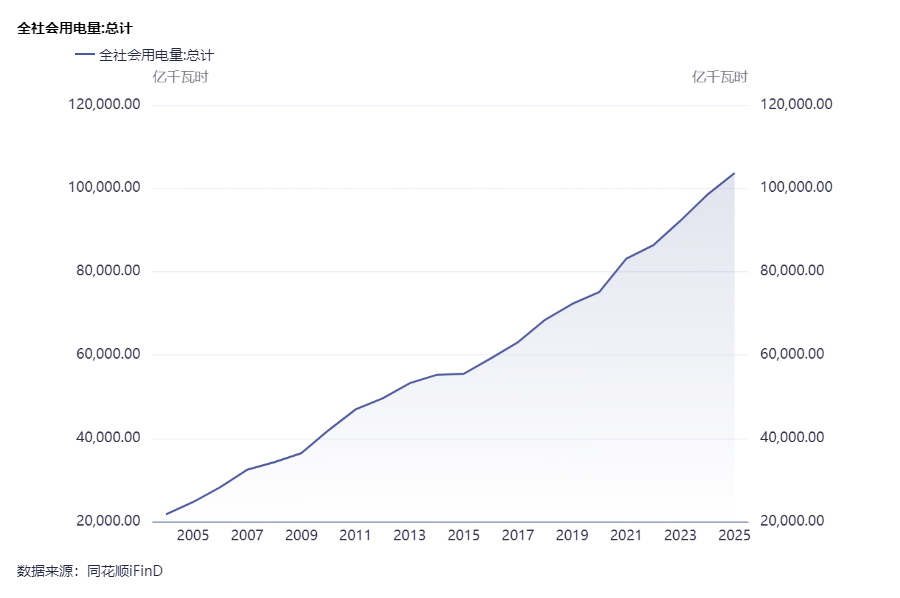
近期国家电网又有重磅消息披露:1月15日,国家电网宣布将在"十五五"期间投入4万亿元进行固定资产投资,这一数字较"十四五"期间增长40%。加上南方 电网的投资,全国年均电网投资或将突破1万亿元大关。 这笔史无前例的"4万亿大单"不仅像一颗投入资本市场的深水炸弹,激起了整个电力产业链的涟漪。更是把整条电网产业链按在聚光灯下:资本有了确定 性,订单有了确定性,估值模型直接切换至"能源基建2.0"赛道,电力系统重塑的阿尔法空间被一次性摊开在桌面上。 电力缺口的持续扩大或成为行业未来爆发点 从国内来看,全社会用电量正从"温和爬坡"切换为"陡峭拉升"。国家能源局最新月报显示,2025年1—11月全国累计用电8.94万亿千瓦时,同比+7.2%,增速 创2012年以来同期峰值;即便在高基数效应下,电网调度口径仍把2026—2028年复合增速锚定在6.3%—6.8%,远高于2016—2020年4.2%的平均值。 国内用电总量增速明显 数据来源:同花顺iFinD 数据区间:2005-2025 这其中AI对于电力的巨大需求成为主因,2025年底全国标准机架规模突破1200万架,对应用电量2600亿千瓦时;AI大模型训练负荷的利用 ...
电网设备ETF、电网ETF涨超5%,有机构认为2026年或为电网投资大年
Ge Long Hui A P P· 2026-01-19 04:56
Core Viewpoint - The A-share market for smart grid stocks has shown strong performance, with the Electric Grid Equipment ETF and Electric Grid ETF both rising over 5% [1] Group 1: Market Performance - The Electric Grid Equipment ETF increased by 5.27% and has a year-to-date growth of 19.97%, with a trading volume of 1.921 billion [2] - The Electric Grid ETF rose by 5.13% with a year-to-date increase of 18.20%, and a trading volume of 2.76 billion [2] - The Electric Grid Equipment ETF is the only product tracking the CSI Electric Grid Equipment Theme Index, with a high weight of 64% in ultra-high voltage stocks [2][5] Group 2: Investment Outlook - The State Grid Corporation of China plans to invest 4 trillion yuan during the 14th Five-Year Plan, a 40% increase compared to the previous plan, with an average annual investment of 800 billion yuan [3][5] - The investment will focus on building a new power system and enhancing cross-regional transmission capacity by over 30% compared to the end of the previous plan [3][4] - The demand for electric grid equipment is expected to grow significantly due to the aging infrastructure in North America and Europe, as well as the rising electricity needs from AI data centers [4][8] Group 3: Industry Trends - The 14th Five-Year Plan is expected to initiate a new cycle of investment in the electric grid, driven by the high annual increase in renewable energy installations [4][7] - The construction of new transmission channels and the reinforcement of weak grids in the western regions are anticipated to maintain a high growth rate in investment [4][7] - The export of transformers, high-voltage switches, and cables from China has shown strong growth, with increases of 35.3%, 29.4%, and 22.9% respectively from January to November 2025 [3][6]
