
大参林

Search documents
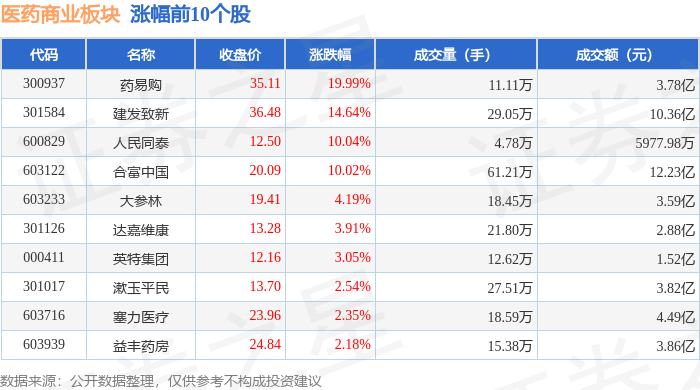
医药商业板块11月12日涨1.58%,药易购领涨,主力资金净流出574.92万元
Zheng Xing Xing Ye Ri Bao· 2025-11-12 08:44
Market Performance - The pharmaceutical commercial sector increased by 1.58% compared to the previous trading day, with Yao Yigou leading the gains [1] - The Shanghai Composite Index closed at 4000.14, down 0.07%, while the Shenzhen Component Index closed at 13240.62, down 0.36% [1] Top Gainers - Yao Yigou (300937) closed at 35.11, up 19.99% with a trading volume of 111,100 shares and a transaction value of 378 million [1] - Jianfa Zhixin (301584) closed at 36.48, up 14.64% with a trading volume of 290,500 shares and a transaction value of 1.036 billion [1] - Renmin Tongtai (600829) closed at 12.50, up 10.04% with a trading volume of 47,800 shares and a transaction value of 59.78 million [1] Other Notable Stocks - HeFu China (603122) closed at 20.09, up 10.02% with a trading volume of 612,100 shares and a transaction value of 1.223 billion [1] - Dacai Lin (603233) closed at 19.41, up 4.19% with a trading volume of 184,500 shares and a transaction value of 359 million [1] Market Capital Flow - The pharmaceutical commercial sector experienced a net outflow of 5.7492 million from institutional investors, while retail investors saw a net inflow of 8.24708 million [2] - The overall market showed a mixed trend with some stocks experiencing significant inflows while others faced outflows [2] Individual Stock Capital Flow - Yao Yigou had a net inflow of 94.9041 million from institutional investors, but a net outflow of 61.2622 million from speculative funds [3] - Jianfa Zhixin saw a net inflow of 68.0270 million from institutional investors, with a net outflow of 0.8755 million from speculative funds [3] - China Pharmaceutical (600056) had a net inflow of 26.6319 million from institutional investors, while retail investors experienced a net outflow of 31.1127 million [3]


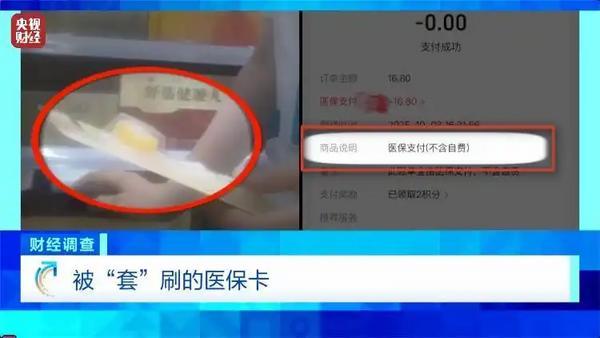
医保卡变“购物卡”?央视曝光大参林、海王星辰等“套”刷医保卡黑链条
Yang Shi Wang· 2025-11-12 07:52
Core Viewpoint - The article highlights the ongoing misuse of medical insurance cards in China, where non-medical products are being fraudulently classified as medical devices to allow consumers to purchase everyday items using their insurance funds [1][3][5]. Group 1: Misuse of Medical Insurance Cards - Various pharmacies are openly promoting the ability to use medical insurance cards for purchasing daily necessities, such as toothbrushes and skincare products, which violates regulations that restrict insurance funds to medical-related expenses [3][5]. - Investigations reveal that some products, like "dental brushes" and "medical dressings," are essentially ordinary items but are labeled as medical devices to facilitate insurance payments [7][10][14][17]. - A significant number of consumers are being encouraged to exploit these loopholes, with online platforms sharing strategies for using insurance cards to buy non-medical items [3][5]. Group 2: Pharmaceutical Companies' Role - Companies are producing everyday products under the guise of medical devices, claiming they are "cleaner and safer" to attract consumers and increase profits [24][26]. - A specific company reported a substantial contract worth 90 million yuan for supplying these products to nearly 20,000 pharmacies, indicating a lucrative market for such practices [26][28]. - The production of these items is described as legal and compliant, as they possess the necessary medical coding to qualify for insurance payments, despite their actual use being unrelated to medical care [30][28]. Group 3: Impact on the Market - In Gansu, a chain of pharmacies is prominently displaying "medical skincare products" that are registered as medical devices, allowing them to be purchased with insurance funds, despite being marketed as regular skincare items [32][34]. - The profitability of pharmacies is closely tied to the ability to process insurance claims, leading to aggressive promotion of these products [38][39]. - A specific company revealed that approximately 60% of its sales in Gansu are processed through insurance payments, amounting to an estimated 6 million yuan being drawn from consumers' insurance accounts [45].


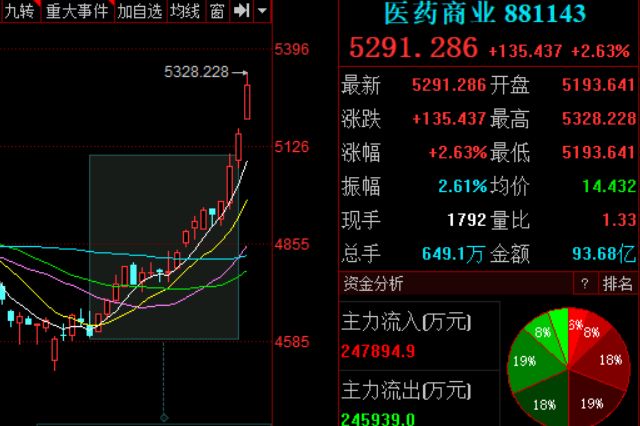
这一板块,今日大涨
Di Yi Cai Jing Zi Xun· 2025-11-12 07:03
Core Viewpoint - The pharmaceutical commercial sector experienced a significant surge, with the sector index reaching a new high for the year [1]. Group 1: Market Performance - Individual stocks such as YaoYigou saw a rapid increase, hitting a 20% limit up within approximately 4 minutes of opening [3]. - HeFu China achieved a limit up after a strong opening, marking 11 limit ups in the last 12 trading days [3]. - RenMin TongTai opened with a limit up, achieving three consecutive limit ups [3]. Group 2: Stock Details - YaoYigou: +19.99%, previous amount 3.75 billion, current market cap 33.59 billion, current price 35.14 [4]. - JianFa ZhiXin: +14.86%, previous amount 9.66 billion, current market cap 154.01 billion, current price 36.55 [4]. - RenMin JianTan: +10.04%, previous amount 59.297 million, current market cap 72.49 billion, current price 12.50 [4]. - HeLiang China: +10.02%, previous amount 12.16 billion, current market cap 79.97 billion, current price 20.09 [4]. - DaShenLin: +4.67%, previous amount 3.23 billion, current market cap 222.1 billion, current price 19.50 [4]. - YiFeng Pharmacy: +2.80%, previous amount 3.71 billion, current market cap 303.0 billion, current price 24.99 [4].


这一板块,今日大涨
第一财经· 2025-11-12 06:58
Core Viewpoint - The pharmaceutical commercial sector experienced a significant surge, with the sector index reaching a new high for the year [1]. Group 1: Market Performance - Individual stocks such as YaoYigou saw a rapid increase, hitting a 20% limit up within just 4 minutes of opening [3]. - HeFu China opened high and quickly reached a limit up, achieving 11 limit up days in the last 12 trading days [3]. - RenMin TongTai opened with a limit up and secured three consecutive limit up days [3]. Group 2: Stock Details - YaoYigou (300937) increased by 19.99%, with a total amount of 3.75 billion and a market cap of 33.59 billion, currently priced at 35.11 [4]. - JianFa ZhiXin (301584) rose by 14.86%, with a total amount of 9.66 billion and a market cap of 154 billion, currently priced at 36.55 [4]. - RenMin TongTai (600829) increased by 10.04%, with a total amount of 59.297 million and a market cap of 72.49 billion, currently priced at 12.50 [4]. - HeFu China (603122) rose by 10.02%, with a total amount of 12.16 billion and a market cap of 79.97 billion, currently priced at 20.09 [4]. - Other stocks like DaCanLin (603233) and YingTe Group (000411) also showed positive performance, with increases of 4.67% and 2.71% respectively [4].


A股“一哥”,3万亿元
Zhong Guo Zheng Quan Bao· 2025-11-12 04:34
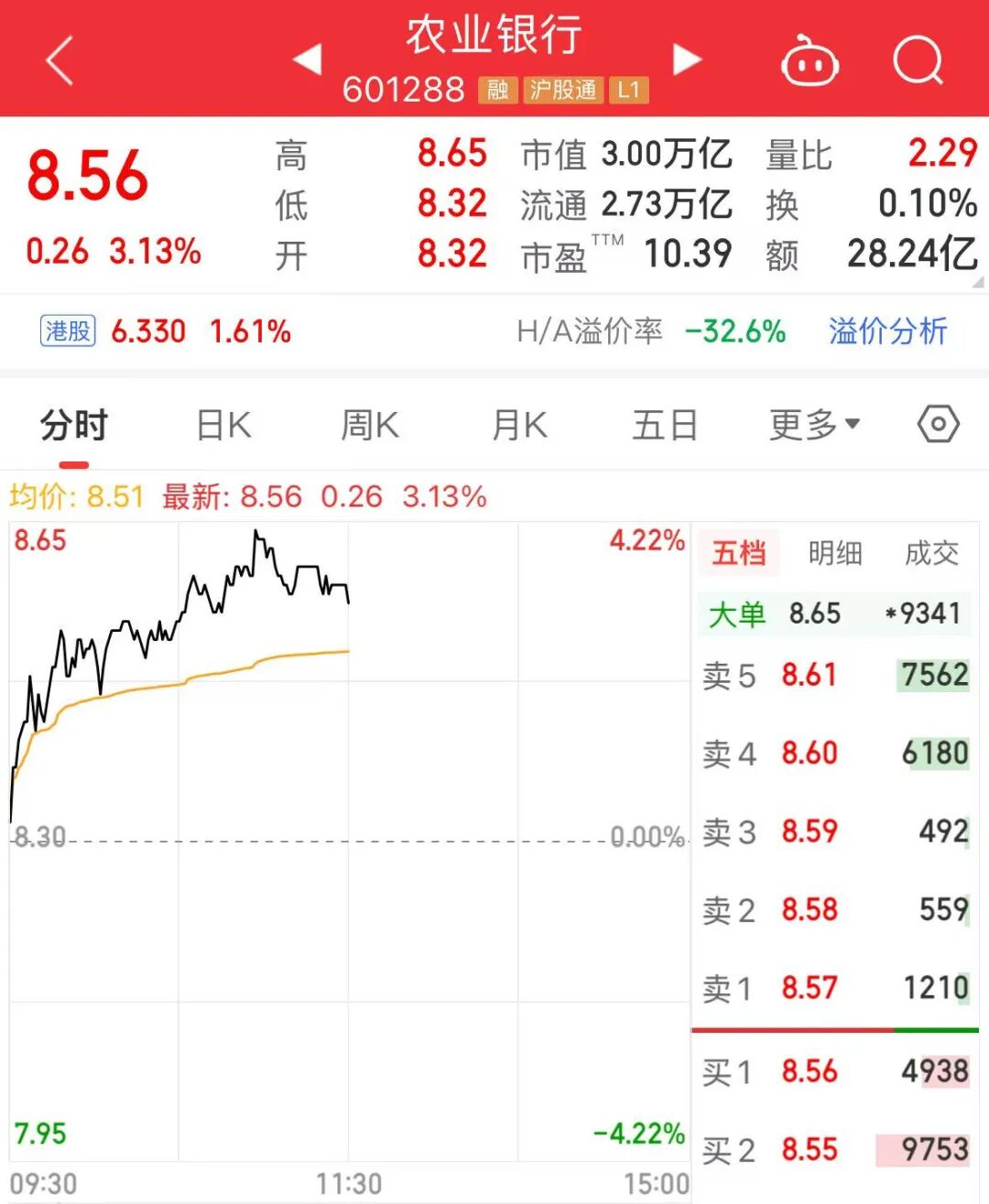
Group 1: Agricultural Bank Performance - Agricultural Bank experienced a 14-day consecutive rise in stock price from September 25 to October 22, with its price-to-book ratio (PB) recovering to above 1, breaking the long-standing trend of state-owned banks trading below book value [1] - On the morning of the report, Agricultural Bank's stock rose by 3.13%, reaching a market capitalization of 3 trillion yuan, making it the largest in A-shares and setting a new historical high [1] - The bank's PB is currently at 1.09, while other major banks like Industrial and Commercial Bank of China, China Construction Bank, and Bank of China have PBs of 0.773, 0.737, and 0.7 respectively [6] Group 2: Key Highlights of Agricultural Bank - The bank benefits from the potential release of county-level economic growth and has a larger credit growth space compared to peers due to its deep layout in these regions [6] - Agricultural Bank has the highest proportion of personal demand deposits among comparable peers, resulting in lower deposit costs and stronger interest margin resilience [6] - The bank maintains the lowest non-performing loan ratio among its peers while adhering to strict non-performing loan recognition standards [6][7] - High provisions strengthen the bank's risk compensation and profit reinvestment capabilities, leading the industry [7] Group 3: Market Trends - The banking sector saw an overall rise, with Agricultural Bank, Bank of China, and Chongqing Rural Commercial Bank among the top gainers [4] - The broader market, however, faced declines with the Shanghai Composite Index down by 0.24%, Shenzhen Component Index down by 1.07%, and ChiNext Index down by 1.58% [3] Group 4: Pharmaceutical Sector Performance - The pharmaceutical sector showed strong performance, with significant gains in pharmaceutical commerce, brain-computer interface, and ophthalmology sectors [8] - Notable stocks in the pharmaceutical commerce sector included Yaoyigou and Jianfa Zhixin, with the latter hitting the daily limit [11] Group 5: Brain-Computer Interface Industry - The brain-computer interface industry is expected to see significant growth, with a projected global market size of approximately $2.62 billion in 2024, reaching $2.94 billion in 2025, and potentially growing to $12.4 billion by 2034 [13] - Recent policy support and industry standards are anticipated to drive innovation and development in the brain-computer interface sector, creating new market opportunities [12][13]


A股“一哥”,3万亿元!
Zhong Guo Zheng Quan Bao· 2025-11-12 04:16
Group 1: Agricultural Bank Performance - Agricultural Bank experienced a 14-day consecutive rise in stock price from September 25 to October 22, breaking the long-standing price-to-book (PB) ratio below 1, now exceeding 1 [1][6] - The stock price increased by 3.13% today, reaching a market capitalization of 3 trillion yuan, making it the largest in A-shares [1][2] - The PB ratio of Agricultural Bank is currently at 1.09, while other major banks like Industrial and Commercial Bank of China (ICBC) and China Construction Bank have PB ratios of 0.773 and 0.737 respectively [6] Group 2: Key Highlights of Agricultural Bank - Agricultural Bank benefits from the potential release of county-level economic growth and has a larger credit growth space compared to peers due to its deep layout in these regions [6][7] - The bank has the highest proportion of personal demand deposits among comparable peers, leading to lower deposit costs and stronger interest margin resilience [6] - Agricultural Bank maintains the lowest non-performing loan ratio among its peers while having a strict recognition of non-performing loans [6][7] - The bank's high provisions strengthen its risk compensation and profit reinvestment capabilities, leading the industry [7] Group 3: Market Trends - The banking sector saw an overall rise today, with Agricultural Bank, Bank of China, and Chongqing Rural Commercial Bank among the top gainers [4][5] - The Shanghai Composite Index fell by 0.24%, while the Shenzhen Component Index and the ChiNext Index dropped by 1.07% and 1.58% respectively [3]
消费风起,布局医药消费正当时
2025-11-12 02:18
Summary of Conference Call Records Industry Overview - The pharmaceutical and healthcare sectors are currently experiencing a shift, with companies like沃伍生物, 方盛制药, and 佐力药业 showing strong stock performance and potential investment opportunities due to their solid revenue, profit, and cash flow [1][3] - The medical services industry is facing challenges due to DRG policies and a weak consumer environment, but improvements are expected by 2026 as supply-side constraints and potential mergers or new hospital openings may enhance performance metrics [1][4] Key Companies and Investment Opportunities - **Ophthalmology Sector**: Companies such as 爱尔, 华夏, and 普瑞 are recommended for investment, with expectations of performance release in refractive services by Q1 2026 and improvements in cataract screening next year [1][5] - **Dental Sector**: 通策医疗 is highlighted for its new hospital openings and expected revenue and profit growth in 2026, indicating a turning point for the company [1][6] - **Pharmaceutical Companies**: 流感-related companies like 国邦, 普洛药业, and 联邦制药 are experiencing high capacity utilization and are expected to see significant growth in Q4 and Q1 due to potential shortages and price increases [2][12] Market Trends and Predictions - The blood products industry is consolidating, with a focus on mergers and acquisitions, which may stabilize product prices and enhance demand in the context of flu outbreaks [8] - The vaccine industry is poised for growth with key players like 康华生物 and 康希诺 expected to release significant data and products in 2026, which could drive market interest [9][10] - The traditional Chinese medicine sector is forecasted to recover, with a focus on innovative drug companies and OTC brands that are well-positioned for growth [13] Retail Pharmacy Sector - The retail pharmacy sector is expected to benefit from consolidation as smaller chains face operational pressures, allowing leading companies like 益丰, 大森林, and 老百姓 to capitalize on improved consumer conditions and policy support [14] Conclusion - The overall sentiment in the pharmaceutical and healthcare sectors is cautiously optimistic, with several companies positioned for growth amid a backdrop of regulatory changes and market dynamics. Investors are encouraged to focus on companies with strong fundamentals and growth potential in the coming years [1][3][4][12][14]


每日报告精选-20251111
GUOTAI HAITONG SECURITIES· 2025-11-11 11:29
Market Overview - The average daily trading volume in the A-share market decreased to 2.0 trillion CNY, with the turnover rate declining, indicating reduced market activity[5] - The proportion of stocks rising increased to 54.77%, with the median weekly return for A-share stocks rising to 0.6%[5] Fund Flows - New issuance of equity funds decreased to 21.84 billion CNY, while foreign capital inflow accelerated, with a net inflow of 8.0 million USD as of November 5[6] - The net buying amount of financing decreased to 11.63 billion CNY, accounting for 10.8% of total trading volume[6] Sector Performance - Foreign capital primarily flowed into the electronics sector, with a net inflow of 63.2 million USD, while financing capital mainly flowed into the power equipment sector, with a net inflow of 68.3 billion CNY[7] - The healthcare equipment sector is expected to benefit from policy-driven market recovery, with significant growth in bidding volumes for new medical equipment[17][20] Economic Indicators - The average price of Brent crude oil was 68.17 USD per barrel in Q3 2025, reflecting a year-on-year decrease of 13.40%[44] - The construction sector showed signs of recovery, with new home transaction areas in major cities decreasing by 40.6% week-on-week, indicating ongoing challenges in the real estate market[33] Investment Recommendations - The company recommends an overweight position in A/H shares and industrial commodities, suggesting an equity allocation of 45% and a commodity allocation of 10%[9][10]




益丰药房(603939):头部连锁药房,稳健运营扩张维持增长动力
Guoxin Securities· 2025-11-11 03:27
Investment Rating - The report maintains an "Outperform" rating for the company [6]. Core Views - The company is a leading chain pharmacy in China, with a strong market presence in Central South, East China, and South China regions. It is expected to enhance its industry position through refined operations and the development of a new retail system, maintaining steady growth in revenue and profit [4][34]. - The company has shown slight revenue growth and strong profit growth in the first three quarters of 2025, with total revenue reaching 17.286 billion yuan, a year-on-year increase of 0.4%, and net profit attributable to shareholders of 1.225 billion yuan, up 10.3% year-on-year [1][9]. Summary by Sections Financial Performance - In Q3 2025, the company achieved revenue of 5.564 billion yuan, a 2.0% year-on-year increase, and net profit of 345 million yuan, up 10.1% year-on-year. The company is experiencing a marginal improvement trend in both revenue and profit due to the clearing of closed stores and initial alleviation of industry competition pressure [1][9]. - The company’s gross margin for the first three quarters of 2025 was 40.4%, with a net margin of 7.6%. The retail business achieved a gross margin of 42.0%, while the franchise and distribution business had a gross margin of 10.9% [2][15]. Operational Efficiency - The company maintains stable expense ratios, with a sales expense ratio of 25.0%, a management expense ratio of 4.7%, and a financial expense ratio of 0.7%. This stability is attributed to the company's strong operational capabilities [2][15]. - The company has been focusing on high-margin non-pharmaceutical products, which are expected to continue increasing their revenue share, thereby enhancing overall gross margin [2][15]. Market Position and Strategy - The company is transitioning from a focus on scale to quality and efficiency in response to increasing demand driven by aging populations and healthcare spending. The company has established a "fleet-type" store network to enhance operational efficiency and customer loyalty [3][34]. - The company has a total of 14,666 stores as of Q3 2025, with a slight decrease in total store count compared to the end of 2024. The company is adjusting its store expansion strategy in response to industry trends [29][87]. Future Projections - Revenue projections for 2025-2027 are 24.546 billion yuan, 27.292 billion yuan, and 30.444 billion yuan, with year-on-year growth rates of 2.0%, 11.2%, and 11.5% respectively. Net profit projections for the same period are 1.725 billion yuan, 2.007 billion yuan, and 2.316 billion yuan, with growth rates of 12.8%, 16.4%, and 15.4% respectively [4][5].

央视曝光:医保卡被薅羊毛
Jing Ji Guan Cha Wang· 2025-11-10 06:54
Core Viewpoint - Recent reports indicate that consumers are being encouraged to misuse their medical insurance cards for purchasing non-medical items, raising concerns about the integrity of the healthcare system and potential regulatory implications [1] Group 1: Consumer Behavior - Consumers are being taught through online platforms how to exploit their medical insurance cards to buy everyday items like dental floss, toothbrushes, facial towels, and skincare products, detaching these purchases from legitimate medical contexts [1] - The trend highlights a growing misuse of medical insurance benefits, as individuals treat their insurance funds as disposable income [1] Group 2: Industry Response - Major pharmacy chains such as Haiwangxingchen, Dacilin (603233), Zhang Zhongjing Pharmacy, and Foci Pharmacy are reportedly selling everyday products packaged as medical devices, promoting them with the ability to be purchased using medical insurance [1] - In specific instances, products not covered by insurance, such as cosmetic contact lenses, are also being sold under the guise of medical necessity, further complicating the issue [1]