
滨江集团

Search documents
策略联合行业-周期在扩散
2026-01-30 03:12
Summary of Key Points from Conference Call Records Industry Overview - **Upstream Cycle Products**: Benefiting from loose monetary conditions and a bottoming capacity cycle, supply-demand tight balance is driving price increases in sectors like chemicals, black chain, and real estate chain, presenting investment opportunities. Short-term market remains strong with long-term logic supporting this trend, but structural rotation and cost-effectiveness need to be monitored [1][2] Chemical Industry - **Current Situation**: The chemical industry is experiencing a hot market, with public fund holdings in large chemical sectors still underweight. Policies limiting new capacity and negative growth in capital expenditure are restricting supply, leading to an upward trend in industry prosperity [4] - **Investment Recommendations**: 1. **Oil and Petrochemicals**: Focus on companies with good resource endowments benefiting from high oil prices and potential value assessments [4] 2. **Basic Chemicals**: After a long bottoming process, current price differentials and valuations have safety margins. Key assets benefiting from unexpected demand and marginal changes in dual carbon policies should be monitored [4] 3. **Cyclical Leaders**: Attention should be given to tire companies with overseas expansion potential [4] Coal Sector - **Current Situation**: The coal sector has seen supply contraction and increased overseas demand, with inventory levels decreasing, indicating potential price increases. Many companies are undervalued from a price-to-book (PB) perspective, especially those with high spot market ratios [5][7] - **Investment Logic**: Companies with high spot ratios are expected to benefit significantly from rising coal prices. Recommended companies include Lu'an Huanneng, Jinkong Coal, and Shanmei International [6] Precious Metals - **Market Dynamics**: In the context of global turmoil, physical assets like gold are rising, with ongoing central bank purchases. Recommended stocks include Zijin Mining International and Shandong Gold [10] - **Industrial Metals**: Favorable outlook for aluminum and copper, with specific recommendations for China Aluminum and Zijin Mining [10][11] Logistics and Delivery - **SF Holding**: The company shows potential for absolute returns and valuation recovery, with a projected absolute return rate of 3.8% for 2025 and 2026. The company is at a ten-year low in valuation, with significant room for EPS upgrades and PE recovery [12] - **Third-party Delivery**: SF's leading position in the third-party delivery sector is expected to enhance performance through partnerships with major internet companies [12] Insurance Sector - **2026 Outlook**: The insurance sector is expected to perform strongly due to resonance in both asset and liability sides. The demand for dividend insurance is increasing, and the long-term interest rates are stabilizing, enhancing profit elasticity for insurance companies [23][24] Construction Materials - **Investment Opportunities**: Traditional undervalued construction materials like renovation materials, glass, and cement still hold investment value. Recommended companies include Beixin Building Materials and China Liansu [25] Real Estate Sector - **Recent Trends**: The real estate sector has rebounded due to bullish market sentiment and policy expectations. Anticipated easing measures in core cities may lead to a short-term market recovery [26][27] Engineering Machinery - **2026 Prospects**: The engineering machinery sector is expected to see synchronized domestic and international demand growth. Key recommendations include SANY Heavy Industry, XCMG, and Zoomlion [29][30] This summary encapsulates the critical insights and recommendations from the conference call records, providing a comprehensive overview of the current market dynamics and investment opportunities across various sectors.
地产-十五五-新启航-掘金地产-定位变革新纪元
2026-01-30 03:11
Summary of Conference Call on Real Estate Industry Industry Overview - The conference call focuses on the real estate industry in China, particularly the impact of policies and market dynamics on the sector's performance and future outlook [1][2][4]. Core Insights and Arguments - The issuance of real estate REITs by the China Securities Regulatory Commission (CSRC) is expected to significantly change the real estate industry by improving liquidity, reducing financing costs (expected at 3.6%), and re-evaluating land assets [1][5]. - The "14th Five-Year Plan" emphasizes high-quality development in real estate, requiring state-owned enterprises to avoid large-scale losses and high debt levels, with real estate investment growth expected to align with GDP growth (projected at least 4.5%) [1][6][7]. - The secondary market is anticipated to focus on fundamentals in March and April, with a potential stabilization in the second half of the year, particularly for leading companies and core cities [1][8]. - Despite a general pessimism in the real estate sector, the disclosure of risk performance has been thorough, leading to a valuation recovery and an upward trend in the overall market index [1][9]. Important but Overlooked Content - The real estate sector's stock performance has been in line with expectations, with stock prices typically leading transaction volumes, which in turn precede property prices [3]. - The property sector's dividend and special dividend rates remain strong, with an expected rise in CPI to around 1.5%, enhancing price stability and service trade elasticity for property companies [3][11]. - Companies benefiting from supply-side reforms and high-quality development, such as China Resources, Poly, and China Overseas, are highlighted as key investment opportunities [10]. - The potential for companies like Beike and Wo Ai Wo Jia to show resilience in the second quarter is noted, especially if policy expectations are realized [12]. - The focus on internal renovations rather than just external facade improvements is emphasized as a more certain path for enhancing living experiences and driving industry growth [14]. Conclusion - The real estate industry is at a pivotal moment, with policy changes and market dynamics creating both challenges and opportunities. Investors are encouraged to focus on companies that align with high-quality development goals and those that can leverage the benefits of REITs to improve their financial positions.


上证50指数大涨1.65% 白酒地产联袂走强激活蓝筹主线
Shang Hai Zheng Quan Bao· 2026-01-29 18:42
1月29日,A股市场呈现沪强深弱分化格局,资金向低估值蓝筹集中特征显著。截至收盘,上证指数报 4157.98点,微涨0.16%;深证成指报14300.08点,小幅回调0.30%;创业板指报3304.51点,下跌0.57%; 上证50指数逆势走强,上涨1.65%领跑宽基指数。沪深北三市成交额达3.26万亿元,较上一交易日放量 2671亿元,市场量能维持高位。白酒、地产板块联袂大涨成为当日盘面核心亮点,有效支撑市场情绪。 白酒板块掀涨停潮 白酒板块昨日全线爆发,板块内20只个股强势涨停,头部酒企集体冲高引领行情。贵州茅台单日大涨 8.61%,收盘价报1437.72元,成交额达263亿元,总市值重回1.8万亿元关口;五粮液、山西汾酒、泸州 老窖、洋河股份、古井贡酒等核心酒企悉数涨停,板块整体涨幅居全市场首位。 此次白酒板块走强,源于旺季动销预期与行业拐点预期形成共振。一方面,近期飞天茅台市场批发价格 逐步回暖。1月29日,第三方平台数据显示,53度、500ml飞天茅台酒批发价格继续上涨。其中,2025 年飞天茅台原箱较上一日上涨20元/瓶,至1620元/瓶。另一方面,因白酒行业处于深度调整期,已有多 家白酒企业预计 ...
房地产板块集体爆发,多只个股涨停
Xin Jing Bao· 2026-01-29 14:25
新京报贝壳财经讯(记者徐倩)1月29日,房地产板块集体爆发。港股内房股持续走强,截至今日收盘, 中国奥园上涨32.88%,融创中国上涨29.13%,富力地产上涨20.75%,佳兆业集团上涨20%,时代中国 控股上涨15.91%,越秀地产、万科企业也有较大幅度上涨。 A股房地产板块亦大幅拉升。截至收盘,新城控股(601155)、大悦城(000031)、珠江股份 (600684)、深深房A等涨停,滨江集团(002244)、华发股份(600325)、城投控股(600649)、万 科A等大涨。房地产ETF一度大涨近3%。 消息面上,据新京报贝壳财经昨日报道,多家房企相关人士表示,目前其所在公司已不被监管部门要求 每月上报"三条红线"指标。不过,部分出险房企被要求向总部所在城市专班组定期汇报企业动态。 ...
房地产行业深度报告:房地产行业:销售延续调整,“控增量、去库存”下投资承压
金融街证券· 2026-01-29 10:25
Investment Rating - The report maintains an "Outperform" rating for the real estate industry, indicating a positive outlook compared to the broader market [3]. Core Insights - The report highlights that the sales of new homes in China are expected to decline, but the rate of decline is slowing down. In 2025, the total sales of commercial housing are projected to be 8.39 trillion, a year-on-year decrease of 12.6%, while the sales area is expected to be 881 million square meters, down 8.7% year-on-year [4][9]. - The report emphasizes the ongoing inventory reduction efforts, with the area of existing home sales increasing to 316 million square meters, accounting for 35.91% of total sales area, which is a 5.07% increase from 2024 [15][19]. - The report notes that the second-hand housing market is experiencing an upward trend in transaction volume, which is partially diverting demand from new homes. The prices of second-hand homes are under pressure, which may impact new home sales [30][28]. Summary by Sections New Homes - The sales scale of new homes is expected to decline in 2025, but the decline rate is narrowing. The total sales amount is projected at 8.39 trillion, with a year-on-year decrease of 12.6%, and the sales area at 881 million square meters, down 8.7% year-on-year [4][9]. - The report indicates that the sales area decline is less severe than the sales amount decline, suggesting a trend of "price for volume" [9][10]. Second-Hand Homes - The report states that the transaction area of second-hand homes is on the rise, with a total sales area of 201 million square meters in 2025, showing a slight year-on-year decrease of 0.2% [28][26]. - The prices of second-hand homes are under pressure, with a year-on-year decline of 7% in first-tier cities, which may affect new home sales due to increased competition [30][31]. Land Market - The report notes a reduction in the total area of land sold in 300 cities, with a total planning area of 624 million square meters, down 13.27% year-on-year. However, the average land price has increased compared to 2024 [39][41]. - State-owned enterprises are leading in land acquisition, with major players like China Overseas Land, China Merchants Shekou, and Poly Developments being the top three in land acquisition amounts [41][42]. Investment Trends - The report highlights a continued decline in real estate development investment, with a cumulative year-on-year decrease of 13.9% in December. The report indicates that the market is still under pressure, with no clear signs of recovery [45][48]. - New construction and completion areas are also experiencing a decline, with new construction down 20.4% year-on-year, reflecting a cautious approach from developers in response to market conditions [48][50]. Hong Kong Real Estate Market - The report discusses the easing of housing policies in Hong Kong, which has reduced transaction costs and attracted new demand. The influx of talent has also increased rental demand, contributing to a gradual recovery in rental prices [52][56]. - The report notes that the mortgage rates in Hong Kong have decreased, falling below rental yields, which has improved the attractiveness of property investments [58][59]. Investment Recommendations - The report suggests focusing on developers with sufficient new value in core areas, such as Country Garden, Greentown China, and China Resources Land. It also recommends paying attention to real estate ETFs like Huabao CSI 800 Real Estate ETF and Southern CSI All-Share Real Estate ETF [60][62].
新城控股涨停,房地产ETF(512200)持续走强涨近4%,房地产行业迎来多重政策利好共振
Xin Lang Cai Jing· 2026-01-29 07:09
Core Viewpoint - The real estate sector is experiencing a significant recovery driven by regulatory optimization, policy benefits, and a shift towards high-quality development, leading to valuation restoration and structural reconfiguration opportunities. Group 1: Market Performance - As of January 29, 2026, the Real Estate ETF (512200) saw an intraday increase of nearly 4%, currently up by 3.09%, with a turnover rate of 16.92% and a transaction volume of 994 million yuan, indicating active market trading [1] - Key stocks in the index, such as Zhujiang Holdings, Tefa Services, and Dayuecheng, saw increases of 10.07%, 10.06%, and 10.03% respectively, reflecting strong performance in the sector [1] Group 2: Regulatory and Policy Environment - The cancellation of the monthly reporting requirements for the "three red lines" indicates a shift in regulatory focus from universal deleveraging to differentiated and refined control, allowing financially sound companies more operational freedom and improving the financing environment [1] - The extension of the financing "white list" for five years provides real estate companies with a buffer for cash flow, effectively alleviating liquidity pressures [2] - The initiation of commercial real estate REITs trials is expected to activate existing assets and reduce reliance on financing, contributing to a comprehensive support system for the industry [2] Group 3: Industry Outlook - Despite current pressures on sales and prices, the accelerated release of policy benefits is driving the industry away from high leverage and expansion towards a new phase of quality development focused on asset optimization and operational efficiency [2] - The Ministry of Finance and other departments have extended tax refund incentives for home purchases until the end of 2027, reducing transaction costs for improvement demand [2] - The central bank has lowered the down payment ratio for commercial properties from 50% to 30%, directly stimulating liquidity in the commercial market [2] - A "small spring" in the real estate market is emerging, with policy efforts and demand in core cities creating a positive feedback loop, leading to a rebound in the secondary housing market [2]
突然,集体爆发!股市“大变局”,三大信号!
券商中国· 2026-01-29 05:38
Core Viewpoint - The real estate sector has experienced a significant surge in both A-shares and Hong Kong stocks, indicating a potential shift in market dynamics and investor sentiment [1][5][9]. Group 1: Real Estate Sector Performance - A-shares real estate ETF rose nearly 3%, while Hong Kong's property stocks surged over 6%, with notable increases in companies like Sunac China and Hongyang Real Estate, both rising over 20% [1][5]. - Specific stock performances included China Aoyuan up 27.4%, Sunac China up 23.3%, and Hongyang Real Estate up 22.58% [5][6]. - The overall performance of the real estate sector suggests a clean clearing of chips, with low valuations attracting investor interest [9]. Group 2: Market Dynamics and Signals - The rise in real estate stocks coincides with a notable increase in the liquor sector, indicating structural volatility in the market as these sectors are seen as lagging behind in previous downturns [1][9]. - The recent surge in commodities, including gold and copper, reflects heightened inflation expectations, which could impact sectors like AI negatively [2][9]. - The performance of 30-year treasury futures has been unexpectedly strong, suggesting a complex market narrative that does not align with traditional economic theories regarding inflation and bond prices [3][9]. Group 3: Policy and Regulatory Environment - Reports indicate that several real estate companies are no longer required to report "three red lines" metrics monthly, suggesting a more lenient regulatory environment [7]. - Analysts believe that recent policy adjustments, such as the reduction of the value-added tax on second-hand homes and the lowering of commercial property loan down payments, may support a stabilization in the real estate market [7].



业绩预喜!002230 直线涨停
Shang Hai Zheng Quan Bao· 2026-01-29 04:57
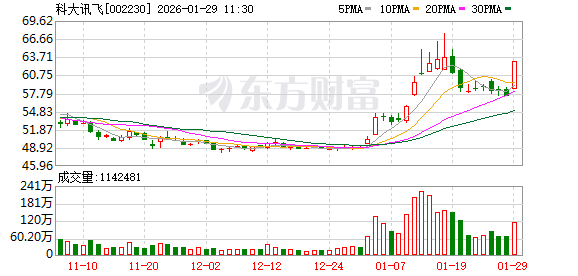
Market Overview - As of January 29, A-share major indices showed mixed performance, with the Shanghai Composite Index down 0.1% and the Shenzhen Component Index up 0.01% [2] - The total trading volume in the Shanghai and Shenzhen markets reached 20,349 billion yuan, an increase of 1,042 billion yuan compared to the previous day [2] - Over 2,400 stocks in the market experienced gains [2] Gold Market - International gold prices reached new highs, with spot gold surpassing $5,500 per ounce, peaking at $5,598.75 per ounce, marking a year-to-date increase of over 28% [10][11] - Gold stocks surged, with China Gold achieving five consecutive trading limits [9][12] - Despite the surge, China Gold warned investors about potential risks, stating that its main business remains unchanged and projecting a net profit decrease of 55% to 65% for 2025 [12] AI Application Sector - AI application stocks saw a significant rally, with Keda Xunfei (科大讯飞) hitting the daily limit up after a positive earnings forecast [5][6] - Keda Xunfei expects a net profit of 785 million to 950 million yuan for 2025, representing a growth of 40% to 70% year-on-year [8] - The company reported over a 20% increase in R&D investment, emphasizing its commitment to core technology autonomy [8] - Analysts from CITIC Securities expressed optimism about the AI application and computing power sectors, anticipating a surge in AI-native applications and the need for increased computing power [8] Real Estate Sector - The real estate sector experienced a rebound, with stocks like I Love My Home and Shenzhen Deep Housing hitting daily limits [14] - Shenzhen Deep Housing projected a net profit of 80.8 million to 121 million yuan for 2025, marking a turnaround from a loss of 177 million yuan the previous year [14] - Hong Kong-listed property stocks also saw significant gains, with notable increases in companies like Contemporary Land and China Aoyuan [14][16] - The restructuring of debts among leading real estate companies is progressing, with Vanke successfully extending three domestic bonds and other companies like Country Garden and Sunac China entering execution phases for debt restructuring [17] - Experts suggest that a new financing model for real estate is emerging, focusing on cash flow safety and operational efficiency [18]


房屋租赁概念震荡反弹,我爱我家涨停
Xin Lang Cai Jing· 2026-01-29 02:26
Core Viewpoint - The housing rental concept is experiencing a significant rebound, with notable stock price increases for several companies in the sector, including I Love My Home, which reached its daily limit, along with others like Binjiang Group, China Merchants Shekou, Jindi Group, Vanke A, 365 Network, and Weiye Shares [1] Group 1 - The stock price of I Love My Home has hit the daily limit, indicating strong market interest and confidence in the company [1] - Other companies in the housing rental sector, such as Binjiang Group, China Merchants Shekou, Jindi Group, Vanke A, 365 Network, and Weiye Shares, have also seen their stock prices rise in response to the market trend [1]





房地产板块震荡反弹,大悦城、三湘印象双双涨停
Feng Huang Wang· 2026-01-29 02:02
Core Viewpoint - The real estate sector experienced a volatile rebound on January 29, with several companies, including Dayue City and Sanxiang Impression, hitting the daily limit for stock price increases. Other companies such as New Town Holdings, Binjiang Group, Jingtou Development, and Huaxia Happiness also saw significant gains. [1] Group 1 - The regulatory requirement for companies to report the "three red lines" indicators on a monthly basis has been lifted for many firms, indicating a potential easing of regulatory pressure in the real estate sector. [1] - Some distressed real estate companies are still required to regularly report their asset-liability ratios and other financial indicators to specialized teams in their respective headquarters cities. [1]


