
ARM

Search documents
超级周期?刚刚,这一板块,全线爆发!
Zheng Quan Shi Bao· 2025-10-02 03:53
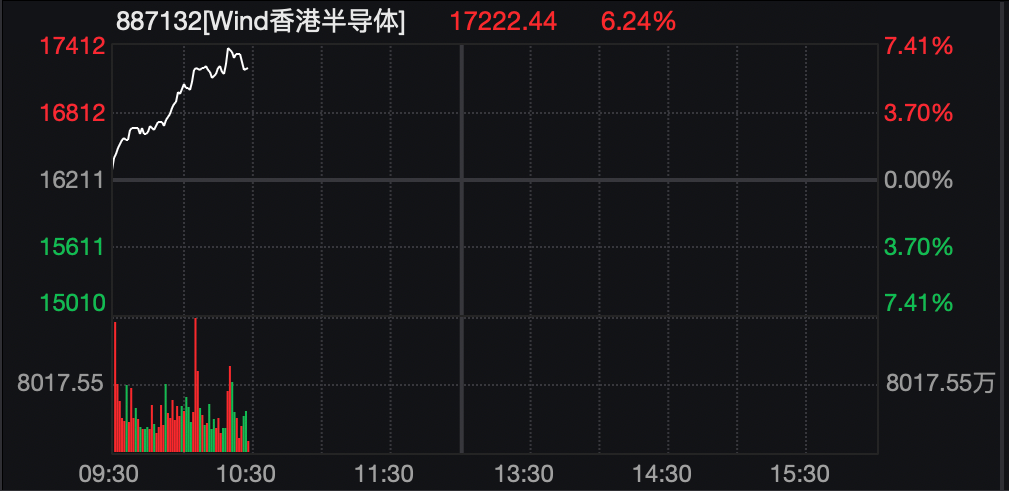
Core Viewpoint - The semiconductor sector is experiencing a significant surge, driven by a new wave of price increases in the global memory chip market due to supply-demand imbalances, technological advancements, and geopolitical factors. Institutions are optimistic about the industry's prospects over the next two years, with Morgan Stanley predicting a "super cycle" in the memory chip sector due to potential supply-demand imbalances in the coming year [1][11]. Group 1: Market Performance - On October 2, Asian markets saw a collective rise in semiconductor stocks, with the Hong Kong semiconductor index increasing over 6% and reaching a peak of over 7% during trading [2]. - Notable individual stock performances included SMIC rising over 8% and HUA Hong Semiconductor increasing over 4%, both reaching new highs [4]. - In South Korea, SK Hynix surged over 12%, while other semiconductor stocks like Hanmi Semiconductor and Samsung Electronics also saw significant gains [5][6]. Group 2: Price Trends and Projections - The memory chip market is entering a new cycle, with expectations of steady price increases over the next 2-3 years, particularly for High Bandwidth Memory (HBM) products, which are projected to see exponential demand growth [11]. - Morgan Stanley forecasts that the global HBM market size will grow from $3 billion in 2023 to $53 billion by 2027 [11]. - Recent announcements from major manufacturers indicate price increases for DRAM (15%-30%) and NAND (5%-10%) products, reflecting a broader trend of rising prices in the memory sector [11][12]. Group 3: AI and Infrastructure Investment - The surge in AI investments is driving explosive growth in demand for storage semiconductors, with OpenAI collaborating with Samsung and SK Hynix to support its "Stargate" project, which aims to invest $100 billion in AI computing servers over four years [8][10]. - The project emphasizes the need for expanded chip supply, with NVIDIA also committing to invest up to $100 billion to support OpenAI's data center chip requirements [9]. - The shift in production focus towards higher-margin products like DDR5 and HBM is evident, as manufacturers reduce DDR4 capacity and prioritize advanced memory solutions to meet the demands of the AI market [12][13].

半导体早参丨长川科技发布A股半导体首个三季度预喜季报,盛美上海已交付首台前道涂胶显影设备
Mei Ri Jing Ji Xin Wen· 2025-09-24 01:38
Market Overview - As of September 22, 2025, the Shanghai Composite Index fell by 0.18% to close at 3821.83 points, while the Shenzhen Component Index decreased by 0.29% to 13119.82 points. The ChiNext Index rose by 0.21% to 3114.55 points [1] - In the overnight U.S. market, the Dow Jones Industrial Average dropped by 0.19%, the Nasdaq Composite fell by 0.95%, and the S&P 500 decreased by 0.55%. The Philadelphia Semiconductor Index declined by 0.35% [1] Industry Insights - In August, there were 68 private equity investment events in the domestic semiconductor sector, a decrease of 5.56% from 72 events in the previous month. The disclosed total financing amount was approximately 2.49 billion yuan, an increase of 17.45% from 2.12 billion yuan in the previous month [2] - Shengmei Shanghai announced a significant upgrade to its UltraCwb wet cleaning equipment on July 28. This technology has substantial application prospects in 3D NAND, 3D DRAM, and 3D logic devices. The first system was delivered to a leading logic wafer manufacturer in China on September 8, 2025 [2] - Changchuan Technology released the first performance forecast in the semiconductor sector for the first three quarters of 2025, expecting a net profit attributable to shareholders of 827 million to 877 million yuan, representing a year-on-year growth of 131.39% to 145.38%, potentially setting a new quarterly performance record [2] Analyst Recommendations - Dongguan Securities maintains an overweight rating on the semiconductor sector, citing clear trends in AI penetration and domestic substitution. The semiconductor industry has gradually entered a recovery cycle since the second half of 2023, with revenue and net profit expected to continue growing into the first quarter of 2024 and 2025 [3] - The firm suggests focusing on semiconductor equipment and materials, AI computing power, AI terminal chips, analog chips, and semiconductor packaging and testing sectors that are expected to perform well in Q1 2025 [3] - Relevant ETFs include the Sci-Tech Semiconductor ETF (588170), which tracks the Sci-Tech Board Semiconductor Materials and Equipment Index, and the Semiconductor Materials ETF (562590), both of which focus on the semiconductor upstream sector [3]

印度豪掷180亿美元角逐全球芯片竞赛 半导体雄心面临多重考验
智通财经网· 2025-09-23 07:10
Core Insights - India aims to become a significant player in the global semiconductor industry but faces severe challenges, including intense competition and being a latecomer in advanced chip manufacturing [1] - The Indian government has approved 10 semiconductor projects with a total investment of 1.6 trillion rupees (approximately 18.2 billion USD) to establish a complete supply chain from design to manufacturing [1][2] - The government has introduced new policies to support the manufacturing of electronic components, addressing critical bottlenecks and creating a domestic buyer-supplier base for chip manufacturers [2] Investment and Development - The largest semiconductor project in India is a 910 billion rupee (approximately 11 billion USD) wafer manufacturing plant being built by Tata Electronics and Taiwan's Powerchip Semiconductor Manufacturing Corporation [3] - The Indian government is providing 50% cost coverage for all manufacturing plants, regardless of chip size, to stimulate growth in the semiconductor sector [2] - There is a growing interest from companies in Taiwan, the UK, the US, and South Korea to support India's semiconductor initiatives [2] Challenges and Opportunities - Experts highlight that India needs a vibrant and long-term ecosystem rather than just a few high-profile projects to support its semiconductor ambitions [1][3] - The establishment of operational silicon wafer manufacturing facilities and overcoming technical and infrastructure challenges are critical milestones for India's semiconductor goals [3][5] - The success of semiconductor testing and packaging (OSAT) presents significant opportunities for Indian mid-sized companies, but clear market access and demand channels are essential for sustained growth [5] Talent and Knowledge - India has a strong talent pool in chip design, which has been developing since the 1990s, but faces challenges in core design knowledge and intellectual property [6][7] - The government is encouraged to update intellectual property laws to protect new forms of digital content and software, which is crucial for competing with regions like the US and Taiwan that have robust IP laws [7]
半导体早参丨英伟达将逐步向OpenAI投资至多1000亿美元,DeepSeek-V3.1-Terminus更新上线!
Mei Ri Jing Ji Xin Wen· 2025-09-23 01:44
Market Performance - As of September 22, 2025, the Shanghai Composite Index rose by 0.22% to close at 3828.58 points, the Shenzhen Component Index increased by 0.67% to 13157.97 points, and the ChiNext Index gained 0.55% to 3107.89 points [1] - The overnight performance of U.S. markets showed the Dow Jones Industrial Average up by 0.14%, the Nasdaq Composite up by 0.70%, and the S&P 500 up by 0.44% [1] - The Philadelphia Semiconductor Index increased by 1.57%, with notable gains in semiconductor stocks such as NXP Semiconductors up by 2.08%, Micron Technology up by 1.16%, ARM up by 1.10%, Applied Materials up by 5.48%, and Microchip Technology up by 0.38% [1] Industry News - NVIDIA and OpenAI announced a partnership involving a significant data center project and an investment of up to $100 billion from NVIDIA. OpenAI will utilize NVIDIA systems to build and deploy at least 10 gigawatts of AI data centers, equivalent to the electricity consumption of 8 million U.S. households [2] - NVIDIA's CEO stated that 10 gigawatts corresponds to 4 to 5 million GPUs, which is about double the company's total shipments for the previous year [2] - Samsung has raised prices for its DRAM and NAND flash products due to supply constraints, with some DRAM products seeing price increases of up to 30% and NAND flash products increasing by 5% to 10% [2] - A report indicated that OpenAI has signed agreements with companies like Luxshare Precision to develop consumer-grade devices, although Luxshare has not confirmed this [3] - DeepSeek announced an update to its model, improving language consistency and optimizing the performance of its Code Agent and Search Agent [3] - The domestic semiconductor packaging and testing industry is facing a critical breakthrough window, with opportunities arising from the improvement of local manufacturers' production capacity and yield rates [3] Related ETFs - The Sci-Tech Semiconductor ETF (588170) tracks the Sci-Tech Board Semiconductor Materials and Equipment Index, focusing on semiconductor equipment (59%) and materials (25%) [4] - The semiconductor materials ETF (562590) also emphasizes semiconductor equipment (59%) and materials (24%), benefiting from the expansion of semiconductor demand driven by the AI revolution and technological advancements [4]

芯片新帝国崛起?
半导体行业观察· 2025-09-23 01:08
Core Viewpoint - India aims to become a global semiconductor powerhouse but faces significant challenges due to late entry into the advanced chip manufacturing race and intense competition [2] Group 1: India's Semiconductor Ambitions - India has approved 10 semiconductor projects with a total investment of ₹1.6 trillion (approximately $18.2 billion), including two semiconductor manufacturing plants and several testing and packaging facilities [2] - The Indian government has introduced a new plan to support electronic component manufacturing to address critical bottlenecks in the semiconductor supply chain [4][6] - The country is shifting from traditional silicon-based semiconductors to advanced silicon carbide-based semiconductors, with a roadmap to introduce advanced 3D glass packaging technology [6][9] Group 2: Investment and Infrastructure - Major investments include Tata Electronics' collaboration with Taiwan's Powerchip Semiconductor Manufacturing Corp to build a ₹910 billion ($11 billion) semiconductor manufacturing facility in Gujarat [9] - The Indian semiconductor industry is projected to create 1 million jobs by 2026, driven by government initiatives, infrastructure development, and increasing private investment [14] Group 3: Challenges and Ecosystem Development - Experts emphasize that India needs a vibrant and long-term ecosystem, not just a few manufacturing plants, to succeed in the semiconductor industry [3] - The country faces challenges in infrastructure, continuous power supply, and a talent gap in managing and scaling manufacturing facilities [13] - India's semiconductor design talent pool contributes 20% to the global market, but the core knowledge for advanced chip design often resides in countries with mature intellectual property systems [11][12] Group 4: Future Prospects - The success of India's semiconductor ambitions will depend on addressing operational challenges and ensuring sustainable funding and strategic partnerships [13] - With global giants entering the Indian market, the country is poised to reduce import dependency and accelerate its economic transformation [14]
英伟达重金入股英特尔:一笔不可思议的投资
2 1 Shi Ji Jing Ji Bao Dao· 2025-09-21 11:48
Core Viewpoint - The historic alliance between Nvidia and Intel marks a significant shift in the competitive landscape of the semiconductor industry, focusing on AI infrastructure and personal computing products through a $5 billion investment from Nvidia into Intel [2][6][10]. Group 1: Partnership Details - Nvidia and Intel will collaborate on three main areas: integrating Nvidia's NVLink technology for seamless CPU-GPU connectivity, customizing x86 architecture CPUs for Nvidia's AI platform, and launching a new x86 SoC with integrated Nvidia RTX GPU for the PC consumer market [6][10]. - Nvidia's investment of $5 billion at a price of $23.28 per share has led to a nearly 30% surge in Intel's stock price, raising its market capitalization to $129.5 billion with a year-to-date increase of 47.53% [6][8]. Group 2: Strategic Implications - The partnership provides Intel with a crucial entry point into the AI market, which it has been striving to penetrate, while also enhancing its cash flow amidst financial pressures [10][11]. - Nvidia's role as a core player in the AI server market positions Intel's CPUs as potential standard components in Nvidia's system solutions, thereby increasing Intel's relevance in the AI ecosystem [10][11]. Group 3: Competitive Landscape - The collaboration alters the competitive dynamics, putting pressure on rivals such as AMD and ARM, as the combined strengths of Nvidia's GPUs and Intel's CPUs create a formidable alliance [14][15]. - Nvidia's CEO emphasized that the partnership does not hinder its ongoing development of ARM-based products, indicating a continued commitment to multiple architectures while leveraging Intel's x86 ecosystem for broader market penetration [16][17].

芯原股份(688521):国产算力卖铲人,受益ASIC定制趋势(国产ASIC系列研究之2)
Shenwan Hongyuan Securities· 2025-09-21 08:39
Investment Rating - The report initiates coverage with a "Buy" rating for the company, Chip Origin Technology [7][6]. Core Views - Chip Origin Technology has over 20 years of experience in semiconductor IP and provides comprehensive chip customization services and semiconductor IP licensing. The company serves a diverse range of clients, including chip design firms, IDM manufacturers, system vendors, internet companies, and CSPs, across various sectors such as consumer electronics, IoT, data processing, automotive electronics, and industrial applications [6][17]. - The company is the largest domestic and eighth largest global design IP provider, with a robust product matrix that includes six categories of processor IP, smart pixel processing platforms, and over 1600 mixed-signal IPs [6][21]. - The SiPaaS model positions the company as a "shovel seller" in chip development, focusing on delivering IP products and design services without designing end products, which enhances the reusability of IP and meets the growing demand for outsourced chip design services [6][10]. - The company is expected to benefit from the increasing demand for ASIC customization driven by domestic internet giants and the growing trend of AI services, with projected revenues of 2.753 billion, 6.104 billion, and 8.525 billion yuan for 2025-2027 [6][7]. Financial Data and Profit Forecast - Total revenue (in million yuan) is projected to be 2,322 in 2024, 2,753 in 2025, 6,104 in 2026, and 8,525 in 2027, with year-on-year growth rates of -0.7%, 18.6%, 121.7%, and 39.7% respectively [2]. - The net profit attributable to the parent company is forecasted to be -601 million in 2024, -439 million in 2025, -158 million in 2026, and 347 million in 2027 [2]. - The earnings per share (EPS) is expected to improve from -1.20 yuan in 2024 to 0.66 yuan in 2027 [2]. Market Data - As of September 19, 2025, the closing price of the company's stock is 173.00 yuan, with a market capitalization of 86.648 billion yuan [3]. - The company has a price-to-book ratio of 25.2 and a projected price-to-sales ratio of 33 for 2025, which is below the average of comparable companies [3][7]. Key Assumptions - The company anticipates a significant increase in ASIC customization orders from domestic system vendors, with an order backlog of approximately 3 billion yuan as of Q2 2025, indicating a high demand environment [8][50]. - Revenue from chip design services is expected to grow at a rate of 20% annually from 2025 to 2027, reflecting the increasing complexity and demand for customized chips [9]. - The semiconductor IP licensing business is projected to generate substantial revenue growth, driven by the ongoing demand for high-quality IP assets [9][38]. Industry Context - The semiconductor industry is experiencing a trend towards increased specialization and outsourcing, with a growing need for customized solutions to meet diverse application requirements [10][23]. - The report highlights the significant market concentration among leading IP providers, with the top four companies holding a 75% market share, indicating a competitive landscape where Chip Origin Technology is well-positioned to capture growth opportunities [6][10].

印度首颗3nm芯片,要来了
半导体行业观察· 2025-09-21 02:59
Core Viewpoint - Renesas Electronics has completed the tape-out of 3nm automotive chips, marking a significant milestone in India's semiconductor design capabilities [2][4]. Group 1: Company Developments - Renesas Electronics is the first company in India to design 3nm automotive chips, with samples already provided to partners, although commercialization timelines remain uncertain [2]. - The company is collaborating with CG Power, a subsidiary of the Murugappa Group, to establish a semiconductor packaging and testing factory in Sanand [2]. Group 2: Government Initiatives - The Indian government is actively promoting the development of a complete semiconductor ecosystem, leveraging the fact that nearly 20% of global chip design engineers are based in India [4]. - Initiatives include new courses for VLSI design and IC manufacturing introduced by the All India Council for Technical Education (AICTE), aiming to train 85,000 skilled technicians in semiconductor design [4]. - A SMART laboratory is being established in NIELIT Calicut to train 100,000 engineers, with partnerships involving Lam Research, IBM, and Purdue University, having already trained over 44,000 engineers [5].

Analysts revamp Nvidia stock outlook on its investment in Intel
Yahoo Finance· 2025-09-20 17:07
Core Insights - Nvidia has been reliant on ARM for CPU cores in its superchips and has plans for new chips, including a laptop chip named N1 based on the GB10 superchip [1] - Nvidia reported a 59% year-over-year increase in net income for Q2 of fiscal 2026, amounting to $26.4 billion [2][6] - Nvidia's CEO emphasized the significance of NVLink rack-scale computing in enhancing AI model performance, positioning Blackwell as a central platform in the AI race [3] Financial Performance - Nvidia's revenue grew by 56% year-over-year to $46.7 billion, with a gross margin of 72.4%, down from 75.1% in Q2 FY 2025 [6] - The company expects Q3 revenue to be around $54.0 billion, with a gross margin forecast of 73.3% [6] Strategic Developments - Nvidia plans to invest $5 billion in Intel's common stock to develop custom data center and PC products [3] - The integration of custom Intel x86 server CPUs into Nvidia's architecture will enhance its capabilities, previously limited to custom ARM CPUs [4] - Intel will create x86 system-on-chips that incorporate Nvidia RTX GPU chiplets for the PC market, leveraging both companies' strengths [5] Market Outlook - Analysts anticipate improved access for Nvidia to enterprise AI deployments following its collaboration with Intel, although product timelines remain uncertain [7]
英伟达50亿美元“雪中送炭”,英特尔绝地求生?全球格局一夜生变,国产芯片如何突围
Hua Xia Shi Bao· 2025-09-20 14:43
Core Insights - Intel and Nvidia have formed a historic partnership, with Nvidia investing $5 billion in Intel to co-develop customized data center and personal computing products, aiming to enhance large-scale computing capabilities [1][2] - This collaboration signifies a shift in the semiconductor industry, potentially leading to market differentiation, where competitors like AMD and ARM may face increased pressure [1][11] Group 1: Partnership Details - Nvidia will utilize its NVLink technology to integrate its AI and accelerated computing strengths with Intel's advanced CPU technology, providing cutting-edge solutions for clients [2][4] - Intel will customize x86 processors for Nvidia's AI infrastructure and launch a new x86 system-on-chip (SoC) that integrates Nvidia's RTX GPU for various PC products [2][4] Group 2: Market Reactions - Following the announcement, Intel's stock surged nearly 30%, closing with a 22.77% increase at $30.57 per share, while Nvidia's stock rose 3.49% to $176.24 per share [6][9] - The partnership has raised concerns for competitors AMD and ARM, with AMD's stock dropping over 5% initially, reflecting market apprehension about the new alliance [9][10] Group 3: Strategic Implications - Nvidia's investment is seen as a strategic move to solidify its position in the CPU market while mitigating risks from competitors like Microsoft and Amazon, which are developing their own chips [4][10] - The collaboration may also challenge TSMC if Nvidia shifts some of its chip manufacturing to Intel, although TSMC's market outlook remains stable for now [8][10] Group 4: Impact on Chinese Semiconductor Industry - The partnership could further entrench the U.S. dominance in high-end computing and data center chips, complicating competition for Chinese firms [11][12] - Chinese semiconductor companies are expected to accelerate their independent innovation efforts, particularly in the development of "super nodes" to enhance their competitive edge [11][13]