万华化学

Search documents
化工板块深度回调!锂电领跌,化工ETF(516020)盘中跌超4%!板块估值仍处低位,布局良机或现?
Xin Lang Ji Jin· 2025-11-18 11:32
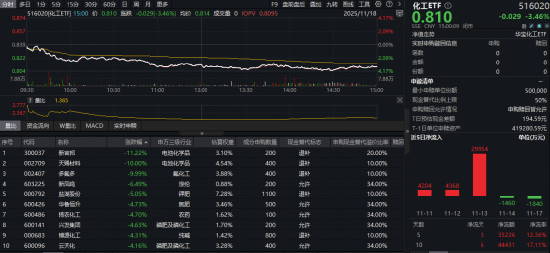
Group 1 - The chemical sector experienced a significant pullback on November 18, with the chemical ETF (516020) declining by 3.46% and intra-day prices dropping over 4% [1] - Key stocks in the sector, including Tianqi Lithium and New Chemical Materials, faced substantial losses, with Tianqi Materials hitting the limit down and New Chemical Materials dropping by 11.22% [1] - Analysts suggest that the recent price corrections are normal, as the lithium battery materials sector is expected to see improved profitability in the coming year, indicating a potential rebound in demand and supply dynamics [3] Group 2 - The chemical ETF (516020) has seen significant net inflows, with over 3.52 billion CNY in net subscriptions over the last five trading days, indicating strong investor interest [3] - The current valuation of the chemical sector is relatively low, with the ETF's underlying index price-to-book ratio at 2.46, positioning it in the 44.23 percentile over the past decade, suggesting a favorable investment opportunity [3] - Future investment strategies should focus on sectors benefiting from de-involution, such as pesticides, urea, and organic silicon, as well as new materials like semiconductor materials and OLED materials, which are crucial for China's chemical industry development [4][5]

远景发布绿电直连方案,旭阳率先打造负极材料标杆项目
起点锂电· 2025-11-18 10:24
Core Insights - The article discusses the launch of the world's largest AI-driven power system by Yuanjing at the 2025 Chifeng Zero Carbon Industry Conference, aimed at facilitating the green transformation of industries through integrated solutions for energy sources, networks, loads, storage, and direct green electricity connections [2] Group 1: Green Electricity Direct Connection - The green electricity direct connection is identified as a crucial pathway for the zero-carbon transformation in the chemical industry, enhancing the proportion of green energy and reducing energy costs while providing a "green passport" for export-oriented enterprises [5] - Yuanjing's AI power system offers more economical, stable, and greener electricity for various sectors, including chemicals, steel, and new materials, transforming renewable energy into a driving force for industrial development [4] Group 2: Project Implementation and Achievements - The integrated source-network-load-storage project developed in collaboration with Xiangfu Technology under the Xiyang Group has become a benchmark for green electricity direct connection, supplying 580,000 kW of green electricity for a production capacity of 200,000 tons of negative electrode materials, with over 60% of electricity sourced from green energy [4] - The Yuanjing Chifeng green hydrogen and ammonia project is noted as the world's largest, achieving 100% green electricity direct connection and utilizing a 2GW-level independent AI power system for dynamic coupling of the entire "wind-solar-storage-hydrogen-ammonia" chain [8][10] Group 3: Technological Innovations - The AI power system integrates the "Yuanjing Tianji" meteorological model and the "Yuanjing Tianshu" energy model, covering planning, forecasting, scheduling, and operation stages, with capabilities for global perception, real-time scheduling, and self-learning [10] - The system has demonstrated a 10% improvement in power prediction accuracy and a 20% reduction in electricity costs through high-precision power forecasting and intelligent scheduling, effectively addressing the challenges of renewable energy volatility [12]

中国油气化工行业:2026 年展望-油价企稳,化工周期是否反转-China Oil, Gas and Chemical Sector _ 2026 Outlook_ Oil price stabilising, is chemical cycle turning around_
2025-11-18 09:41
Summary of Key Points from the Conference Call Industry Overview - **Industry**: Oil, Gas, and Chemical Sector in China - **Outlook Period**: 2026-2028 Oil Market Insights - **Brent Crude Price Forecast**: UBS projects average prices of US$64, US$70, and US$75 per barrel for 2026, 2027, and 2028 respectively [7][10][12] - **OPEC+ Production Cuts**: The second tranche of OPEC+'s voluntary cuts of 1.65 million barrels per day (Mb/d) may conclude in December 2026, with effective production increases expected to be only 40% of the headline numbers [2][24] - **China's Oil Demand**: Anticipated declines in gasoline and diesel demand by 4.4% and 3.7% year-over-year (YoY) in 2025 and 2026 respectively, driven by the rise of electric vehicles (EVs) [2][53] Natural Gas Market Insights - **Asia LNG Price Forecast**: Expected prices of US$12.8 and US$11.5 per million British thermal units (MMBtu) for 2025 and 2026 respectively, with long-term prices approaching US$7-8/MMBtu [2][41][47] - **China's Natural Gas Demand Growth**: Projected compound annual growth rate (CAGR) of 3-4% from 2025 to 2030, despite a 1% YoY decline in H1 2025 due to various economic factors [48][52] Chemical Sector Insights - **Earnings Recovery**: The petrochemical industry is expected to rebound due to overseas capacity exits and China's anti-involution policies [3] - **Preferred Sectors**: Recommendations include PTA, silicone, and glyphosate sectors, focusing on industries with low profitability and potential for improved utilization rates [3] New Materials Insights - **Lithium Hexafluorophosphate (LiPF6)**: Prices expected to remain strong in 2026, with demand growth outpacing effective capacity growth [4] - **Memory Chip Cycle Recovery**: Anticipated support for earnings rebound for electronic gas and wet chemical producers [4] Stock Recommendations - **Oil Companies**: Favorable outlook for PetroChina A/H, CNOOC A/H, and Sinopec A/H due to expected recovery in oil prices and attractive dividend yields [5] - **Chemical Companies**: Recommendations include Wanhua Chemical, Baofeng Energy, and Hengli Petrochemical [5] - **New Materials**: Positive outlook for Capchem, Sinocera, and Jiemei as beneficiaries of the electrolyte and MLCC cycle recoveries [5] Risks and Considerations - **Oil Price Risks**: Potential upside risks include firmer global economic growth and geopolitical tensions, while downside risks involve a global economic slowdown and weaker compliance from OPEC+ [9][10] - **Natural Gas Market Volatility**: Expected tightness in the global LNG market until 2030, with potential disruptions leading to elevated prices [41][47] Additional Insights - **EV Penetration**: Domestic EV penetration in China has exceeded 50% since April, with expectations to reach 76% by 2030 [54][55] - **China's Crude Imports**: A 3% YoY increase in crude imports in 9M25, attributed to lower oil prices and inventory scaling [60]

继巴斯夫、万华后,中国石化也加入这个新材料赛道
Xin Lang Cai Jing· 2025-11-18 06:47
Core Viewpoint - Sinopec and LG Chem have signed an agreement to jointly develop key materials for sodium-ion batteries, targeting the energy storage systems and low-speed electric vehicle markets in China and globally, aiming to accelerate commercialization and expand into new energy and high-value materials sectors [1] Industry Overview - Sodium-ion batteries offer advantages over lithium-ion batteries in terms of resources, cost, safety, and charging speed, with better performance in low-temperature environments compared to lithium iron phosphate batteries [3] - The sodium-ion battery market in China is projected to grow from 10 GWh in 2025 to 292 GWh by 2034, with an average annual growth rate of approximately 45% [6] - Major companies involved in sodium-ion battery production include CATL, BYD, and others, with significant developments in battery technology and applications [4][6] Key Materials and Technologies - The main cathode materials for sodium-ion batteries include layered oxides, polyanionic compounds, and Prussian blue, each with distinct characteristics and commercialization speeds [3] - Hard carbon is the mainstream choice for anode materials due to its high sodium storage capacity and excellent cycling stability [3] - The electrolyte composition is similar to lithium-ion batteries, primarily using sodium hexafluorophosphate, with key players including Tianqi Materials and others [4] Market Developments - The first large-capacity sodium-ion battery energy storage station in China has commenced operations, showcasing the technology's application potential [6] - CATL's "Sodium New Battery" brand has achieved an energy density of 175 Wh/kg, comparable to lithium iron phosphate batteries, with a cycle life exceeding 10,000 cycles [6] - Wanhua Chemical has entered the sodium-ion battery sector, developing high-capacity cathode materials and establishing strategic partnerships for further advancements [5] Challenges and Future Outlook - The commercialization of sodium-ion batteries is at a critical juncture, with technological advancements, cost control, and policy support being key factors for success [7] - Despite the theoretical cost advantage of sodium-ion batteries being around 20% lower than lithium-ion batteries, current prices exceed 0.5 yuan/Wh, with expectations to drop to 0.3 yuan/Wh upon achieving scale [8]


万华化学跌2.02%,成交额11.24亿元,主力资金净流出8331.35万元
Xin Lang Cai Jing· 2025-11-18 05:50
Core Viewpoint - Wanhua Chemical's stock has experienced a decline of 7.90% year-to-date, with a recent drop of 2.02% on November 18, 2023, indicating potential challenges in the market [1] Financial Performance - For the period from January to September 2025, Wanhua Chemical reported a revenue of 144.23 billion yuan, a year-on-year decrease of 2.29%, and a net profit attributable to shareholders of 9.16 billion yuan, down 17.45% year-on-year [2] - Cumulative cash dividends since the company's A-share listing amount to 50.24 billion yuan, with 14.05 billion yuan distributed over the past three years [3] Shareholder Structure - As of September 30, 2025, the number of shareholders decreased by 9.49% to 243,600, while the average number of tradable shares per person increased by 10.16% to 12,850 shares [2] - The top ten circulating shareholders include Hong Kong Central Clearing Limited and China Securities Finance Corporation, with notable reductions in holdings for several ETFs [3]
高分子材料投资“风口”在哪里
Zhong Guo Hua Gong Bao· 2025-11-18 03:18
Core Insights - The polymer materials sector is gaining significant attention from investors due to national policy support, technological innovations, and expanding application demands [1][4]. Industry Trends - The petrochemical industry in China is transitioning from large-scale production to strength, with new materials being a key focus for development. The industry is experiencing a shift towards high-end products, with an emphasis on technological innovation and green transformation [2][9]. - The demand for high-performance materials such as high-end polyolefins, engineering plastics, and high-performance resins is increasing, particularly in emerging fields like humanoid robots and low-altitude aircraft [2][4]. Technological Advancements - Breakthroughs in technology are expanding the application potential of polymer materials across various sectors, including electronics, biomedicine, and high-end manufacturing. New materials are being developed to address challenges such as lightweighting and thermal management [4][8]. - The integration of artificial intelligence in material science is revolutionizing product development, significantly reducing research and development cycles while enhancing efficiency [3][8]. Investment Landscape - The rapid development of polymer materials has attracted significant interest from the financial investment community, with a notable increase in IPOs for new materials companies [9]. - The new materials sector is viewed as a long-term investment opportunity, driven by policy support and the transition of manufacturing towards high-end production [9][10]. Market Applications - High-performance materials like liquid crystal polymers (LCP) are seeing increased demand in the electronics sector, particularly in high-speed communication [5][8]. - Medical-grade polyurethane materials are being developed for various biomedical applications, highlighting the importance of biocompatibility and safety in healthcare [6]. Competitive Dynamics - Despite high investor enthusiasm, the industry faces challenges such as intense competition and the risk of oversupply, necessitating companies to develop unique products and explore new application scenarios [10].
万华化学扩产巩固龙头地位!化工ETF(516020)下挫3.1%!机构:看好纺服链、农化链等结构性机会
Xin Lang Ji Jin· 2025-11-18 03:12
Group 1 - The chemical ETF (516020) showed weak performance, with an intraday drop of 3.1% and a trading volume of 117 million yuan [1] - Among the constituent stocks, Xinzhou Bang, Duofluor, and Tianci Materials experienced the largest declines, with drops of 9.41%, 9.32%, and 9.27% respectively [1] - Conversely, Guangdong Hongda, Lanxiao Technology, and Tongcheng New Materials performed relatively well, with increases of 0.36%, 0.29%, and 0.08% respectively [1] Group 2 - Wanhua Chemical's MDI capacity expansion project in Fujian has recently completed, increasing its capacity to 1.5 million tons per year, reinforcing its global leadership in the polyurethane sector [1] - Juhua Group is advancing its "three zeros" project for digital transformation, enhancing safety, environmental protection, and energy efficiency metrics through a unified data platform [1] - Shenwan Hongyuan Securities indicates structural opportunities in the basic chemical and chemical products industry, with a 20% coordinated production cut in the caprolactam industry and price increases [1] Group 3 - The chemical ETF and its linked funds passively track a specialized chemical index, with the top ten weighted stocks including Wanhua Chemical, Yalku Co., Tianci Materials, Juhua Co., and others [2]
以数智化技术激发产业新增长———访施耐德电气(中国)有限公司副总裁唐蓉
Zhong Guo Hua Gong Bao· 2025-11-18 02:55
Core Insights - The petrochemical industry is transitioning from "scale competition" to "value competition" during the 14th Five-Year Plan, with digital intelligence technology playing a crucial role in driving new growth [1][2] - The industry faces challenges such as insufficient self-sufficiency in high-end materials and increasing pressure for green and low-carbon solutions, making the shift towards high-end, intelligent, and green transformation a core task [2][3] Digital Intelligence as a Key Driver - Digital intelligence technology is identified as a key lever for transformation, providing comprehensive solutions covering the entire lifecycle from design to operation and maintenance [2] - Schneider Electric's solutions have enabled companies like Wanhua Chemical to create process twin models for operator training and optimize operational processes using AI technology, resulting in significant economic benefits [2][3] Intelligent Production and Operations - AI technology can significantly shorten R&D cycles by quickly screening data and predicting molecular properties and catalytic activity, enhancing the success rate and efficiency of pilot tests [3] - In production, digital intelligence technologies improve safety, environmental protection, and energy efficiency, with Schneider Electric's systems ensuring maximum availability and reliability in operations [3][4] Smart Factory as a Core Strategy - Building smart factories is emphasized as a core strategy for the transformation and upgrading of petrochemical enterprises, with the potential for Chinese chemical companies to become future lighthouse factories [5] - Schneider Electric's sustainable lighthouse factory in Wuxi exemplifies the use of digital technologies across procurement, production, and delivery processes, achieving efficient resource utilization and reduced time-to-market [5]
反内卷重构千亿赛道,这个板块悄悄逆袭!
Ge Long Hui· 2025-11-17 10:50
Core Insights - The chemical industry is experiencing a significant transformation, moving away from its previous image of being low-profit and heavily polluting, now recognized as a foundational element of high-end manufacturing and a growth sector worth 4 trillion yuan [3][10]. Supply and Demand Dynamics - The chemical sector has shifted from chaotic overproduction to a more balanced supply-demand relationship, driven by policy changes, industry adjustments, and resource constraints [5][6]. - The Ministry of Industry and Information Technology's "14th Five-Year Plan" has curtailed blind capacity expansion, reducing industry capacity growth from double digits to below 7% [5]. - Key resources like phosphate rock and fluorite are in tight supply, with demand from emerging industries such as electric vehicles and energy storage expected to drive material demand growth by over 50% in 2024 [5][10]. Competitive Landscape - The competition in the chemical industry has evolved from merely increasing production capacity to focusing on technological advancements and high-value products [6][7]. - Leading companies are investing in high-margin sectors, with over 30% of Wanhua Chemical's 25.24 billion yuan investment directed towards fine chemicals and emerging materials [7]. - China's chemical products now account for over 60% of the global market share in basic and fine chemicals, with increasing international pricing power [8][10]. Investment Opportunities - The chemical sector is undergoing a strategic revaluation, with expectations of improved profitability and valuation recovery, particularly in segments like refrigerants and pesticides [8][9]. - Companies with strong supply-demand management, high technological barriers, and comprehensive global strategies are positioned to benefit from the ongoing market changes [9][12]. - The global chemical market is projected to exceed $5.2 trillion by 2030, with China's market reaching $1.9 trillion, indicating significant growth potential [11][12].

反内卷重构千亿赛道,这个板块悄悄逆袭!
格隆汇APP· 2025-11-17 10:35
Core Viewpoint - The chemical industry, previously labeled as "big and clumsy," is experiencing a resurgence, driven by supply-demand balance and technological advancements, positioning it as a high-growth sector worth 4 trillion yuan [5][10]. Supply-Demand Dynamics - Since September, the chemical sector index has surged over 60%, primarily due to price increases in battery chemicals [3]. - The industry has shifted from chaotic overcapacity to a more balanced supply-demand structure, aided by policy changes and strategic industry actions [6][9]. - The Ministry of Industry and Information Technology's "14th Five-Year Plan" has curtailed blind capacity expansion, reducing industry capacity growth from double digits to below 7% [9]. - Key resources like phosphate rock and fluorite are in tight supply, with demand from emerging industries like electric vehicles and energy storage expected to drive material demand growth over 50% by 2024 [9][10]. Competitive Landscape - The competition in the chemical sector has evolved from merely increasing production capacity to focusing on high-value-added products and technological advancements [11]. - Leading companies are investing significantly in fine chemicals and emerging materials, with over 30% of Wanhua Chemical's 25.24 billion yuan investment directed towards these areas [11]. - China's chemical industry has achieved over 60% global market share in basic and fine chemicals, enhancing its pricing power internationally [12]. Investment Opportunities - The chemical sector is undergoing a strategic revaluation, with expectations of improved profitability and valuation recovery, particularly as the global chemical export demand is projected to grow by 8%-10% by 2026 [13][10]. - Key investment themes include supply contraction, high-end product development, and green transformation, with a focus on companies that can manage supply-demand dynamics and possess strong technological barriers [14][15]. - The global chemical market is expected to exceed $5.2 trillion by 2030, with China's market reaching $1.9 trillion, indicating significant growth potential [17]. Conclusion - The chemical industry is transitioning from a low-end, overcapacity model to a global leader in high-value products, driven by technological innovation and strategic resource management [16][18].