三星电子

Search documents
去年中国GDP增长5%,多家手机厂商下调出货预期 | 财经日日评
吴晓波频道· 2026-01-20 00:30
Economic Overview - In 2025, China's GDP reached 1401879 billion yuan, growing by 5% year-on-year, with quarterly growth rates of 5.4%, 5.2%, 4.8%, and 4.5% respectively [2] - The industrial added value increased by 5.9%, while the service sector grew by 5.4%. Retail sales totaled 501202 billion yuan, up by 3.7% [2] - Fixed asset investment decreased by 3.8%, with a notable decline in real estate investment [3] Trade and Investment - Canada has reduced the import tax on Chinese electric vehicles to 6.1%, allowing an annual quota of 49,000 vehicles, which is a significant policy shift aimed at filling market gaps [4][5] - The adjustment in tariffs is expected to enhance the competitiveness of Chinese electric vehicles in the Canadian market, which has seen a decline in sales due to high costs and tariffs [5] Real Estate Market - In December 2025, new home prices in first-tier cities fell by 0.3%, with a notable increase in Shanghai, while overall new home sales area decreased by 8.7% year-on-year [6] - The real estate market is still in a bottoming phase, with a significant reduction in new supply and ongoing inventory pressure [7] Mobile Phone Industry - Several smartphone manufacturers, including Xiaomi and OPPO, have lowered their annual shipment forecasts due to rising storage costs, with reductions exceeding 20% for some brands [8] - The impact of rising storage prices is uneven across manufacturers, with larger firms like Apple and Samsung less affected [9] Solar Industry - Nine leading solar companies, including LONGi Green Energy and Tongwei Co., have announced expected losses for 2025, with Tongwei projecting a loss of 90 to 100 billion yuan [10] - The solar industry is facing significant challenges, including high inventory levels and price competition, leading to a prolonged period of losses [11] Wealth Disparity - The global wealth of billionaires reached a record 18.3 trillion USD in 2025, with a 16% increase in total wealth, highlighting a growing wealth gap amid stagnant poverty reduction efforts [12][13] - The AI sector's growth has significantly contributed to the increase in billionaire wealth, while ordinary residents face declining purchasing power due to inflation [13] Space Tourism - A startup has announced the opening of reservations for the world's first lunar hotel, aiming to begin operations by 2032, although the feasibility of such a project remains uncertain [14][15]





美光警告:AI引发的存储芯片短缺“前所未有”,将持续到2026年以后
Hua Er Jie Jian Wen· 2026-01-19 15:29
Group 1: Core Insights - Micron Technology highlights an unprecedented shortage of memory chips driven by surging demand for AI infrastructure, which is expected to persist beyond 2026 [1] - The high bandwidth memory (HBM) required for AI accelerators is consuming a significant portion of the industry's available capacity, leading to severe shortages in traditional sectors like smartphones and personal computers [1] - Major smartphone manufacturers, including Xiaomi and Oppo, have revised their 2026 shipment targets downward due to rising memory costs, with Oppo predicting a reduction of up to 20% [1] Group 2: Market Dynamics - The global memory chip giants, including Micron, SK Hynix, and Samsung Electronics, are experiencing substantial stock price increases due to the AI demand explosion, with Micron's stock rising over 231.6% in the past year [2] - SK Hynix has reported that its chip production capacity for 2026 is already sold out, while Micron's AI-focused high-end memory products have been fully booked for the year [2] Group 3: Strategic Moves - To prioritize supply for strategic clients like NVIDIA, Micron announced the termination of its popular consumer memory brand, Crucial, to focus on DRAM, which is essential for AI accelerator performance [4] - Micron is accelerating its capacity expansion in the U.S. and Asia, planning to invest $1.8 billion to acquire an existing factory site in Taiwan, which is crucial for its production capabilities [5] - The company is also advancing multiple large-scale factory projects, including a $100 billion investment in New York to build four DRAM wafer fabs, with the first wafers expected to be produced by 2030 [5]

美光警告内存大缺货、三星发放超额奖金 存储上市公司业绩爆棚
Zheng Quan Shi Bao Wang· 2026-01-19 13:44
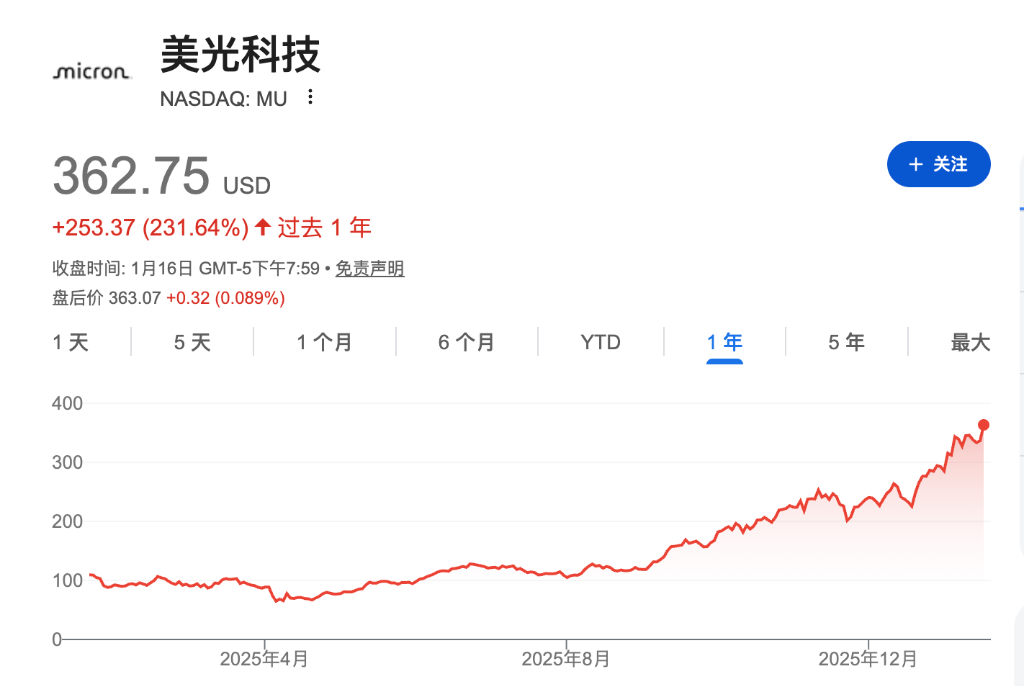
1月16日美光科技打造全球最先进的存储半导体制造中心,该项目将包含多达四个工厂,将有助于满足 人工智能系统日益增长的需求,项目总投资约1000亿美元,将成为美国纽约州投资当地历史上最大的私 人投资项目。 在AI算力强劲需求驱动下,全球存储缺货涨价愈演愈烈。 日前,美光科技高管称内存芯片短缺愈演愈烈,并重申供应紧张状况将持续到2026年之后;另一家存储 巨头三星电子将发放2025年度超额绩效奖,比例将首次接近半年的工资水平。1月19日,A股存储板块 指数上周冲高后回落,部分存储上市公司业绩预增。 内存大缺货 美光运营执行副总裁Manish Bhatia日前在纽约州一个生产基地奠基仪式后接受采访时表示,内存芯片短 缺在过去一个季度愈演愈烈,并重申供应紧张状况将持续到今年之后,原因是人工智能(AI)基础设施建 设对高端半导体的需求激增。 "我们当前看到的短缺程度的确前所未见。"Manish Bhatia指出,"制造AI加速器所需的高带宽内存"正在 占用整个行业如此之多的可用产能,以至于手机和个人电脑等传统领域面临严重短缺。" 行业机构Counterpoint Research在今年1月指出,存储市场已进入"超级牛市 ...
美光股价暴涨背后
Guo Ji Jin Rong Bao· 2026-01-19 11:23
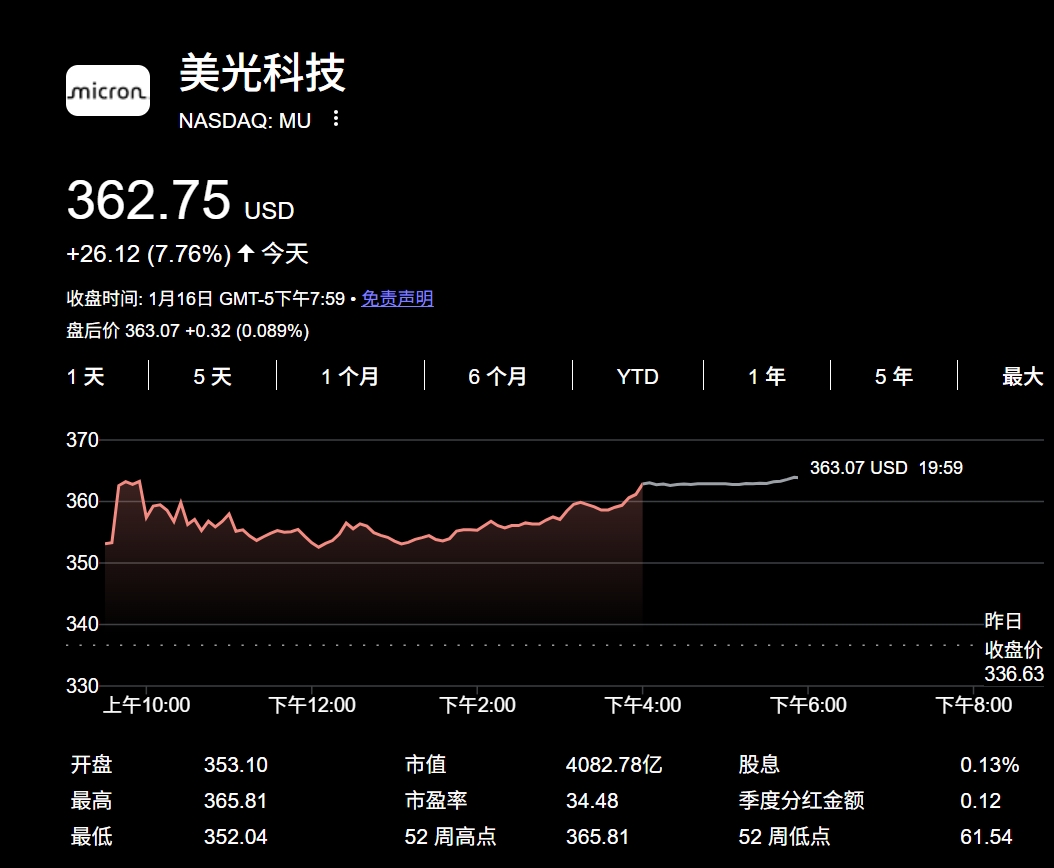
Core Viewpoint - Micron Technology's stock price surged over 7% to a record high of $362.75, with a market capitalization reaching $408 billion, driven by strong demand for AI-related memory products [1][4]. Group 1: Stock Performance - On January 16, Micron's stock closed at $362.75, marking a 7.76% increase from the previous day [2]. - The stock's after-hours price was $363.07, reflecting a slight increase of 0.089% [2]. - Over the past three months, Micron's stock price has risen by 86%, and it has increased by 245% over the past year [4]. Group 2: Financial Performance - For the fiscal year ending August 28, 2025, Micron reported revenues of $37.38 billion, up from $25.11 billion in the previous fiscal year [5]. - The non-GAAP earnings per share for the fiscal year 2025 were $8.29, a significant increase from $1.30 in the prior year [5]. - Micron is projected to achieve a 99% revenue growth rate in fiscal year 2026, ranking tenth among S&P 500 companies [5]. Group 3: Market Dynamics - The demand for high bandwidth memory (HBM) chips has surged due to the growth of AI applications, leading to a "memory shortage" across the industry [4]. - Micron's products are widely used in hardware that drives AI applications, enhancing its pricing power [4]. - The company has sold out its AI memory chips through 2026 and is expanding production capacity by building a new factory in New York and acquiring a wafer fab in Taiwan for $1.8 billion [4][5]. Group 4: Analyst Insights - Analysts from Mizuho and Morgan Stanley have highlighted the positive market sentiment towards Micron and memory stocks, citing limited memory capacity and strong demand for AI as key factors [6]. - Morgan Stanley has ranked Micron among the top ten global DRAM suppliers, emphasizing the long-term visibility of orders due to rising AI demand [6].
三星产能利用率,仅为60%?
半导体芯闻· 2026-01-19 10:17
Core Viewpoint - Samsung Electronics' foundry business is gradually recovering its operating rate, with expected losses decreasing compared to last year due to increased wafer input in advanced and core processes [1][2]. Group 1: Production Capacity and Utilization - The average capacity utilization rate of Samsung's wafer factories is expected to be around 60% in the first half of this year, an increase of approximately 10 percentage points from 50% in the second half of last year [1]. - The foundry department's operating losses were estimated at about 20 trillion KRW in the first and second quarters of last year, but losses narrowed to around 10 trillion KRW in the third and fourth quarters due to increased wafer input in existing core processes [1]. Group 2: Advanced Technology and Market Opportunities - Samsung has started mass production of the latest mobile application processor "Exynos 2600" based on 2nm technology, with a single wafer yield expected to be around 50% [1]. - The semiconductor industry insider noted that Samsung is increasing wafer input for its foundry, indicating a better market environment this year compared to last year, especially as TSMC faces supply shortages in advanced processes [2]. - Samsung's foundry department needs over 80% capacity utilization to break even, highlighting the importance of stable mass production of advanced processes to gain the trust of global tech giants [2].
DRAM,大厂警告
半导体芯闻· 2026-01-19 10:17
Core Viewpoint - The semiconductor industry, particularly in DRAM and high bandwidth memory (HBM), is experiencing significant supply shortages driven by strong demand from AI applications, smartphones, and PCs. Major manufacturers are prioritizing production for AI-related products, leading to a competitive landscape for securing supply beyond 2027 [1][4][8]. Group 1: Market Dynamics - Micron Technology has indicated that the demand for HBM is increasing, while traditional markets like smartphones and PCs are facing severe supply shortages [1]. - Counterpoint Research estimates a 2.1% decline in global smartphone shipments this year due to rising costs and memory shortages [2]. - South Asia Technology's management noted the presence of duplicate orders in the DRAM market, prompting a cautious approach to capacity allocation to avoid stockpiling by clients [4]. Group 2: Pricing Trends - The average selling price (ASP) of DRAM increased by 30% in Q4 last year, with expectations of a slight increase in Q1, although not as significant as the previous quarter [5][6]. - TrendForce reported a more than 10% increase in DRAM prices in the second week of January, with predictions of a 55-60% rise in contract prices for Q1 compared to the previous quarter [7][8]. - NAND flash prices are also expected to rise significantly, with a forecasted increase of 33-38% in Q1 [8]. Group 3: Company Performance Expectations - Samsung Electronics is projected to achieve a record operating profit of approximately 133 trillion KRW from its memory semiconductor business, driven by increased shipments of high-value memory and price hikes due to AI data center expansions [9]. - SK Hynix is also expected to report an operating profit of around 115 trillion KRW this year, reflecting the overall positive outlook for the memory semiconductor sector [9].
中国也加入了半导体玻璃基板竞赛
半导体芯闻· 2026-01-19 10:17
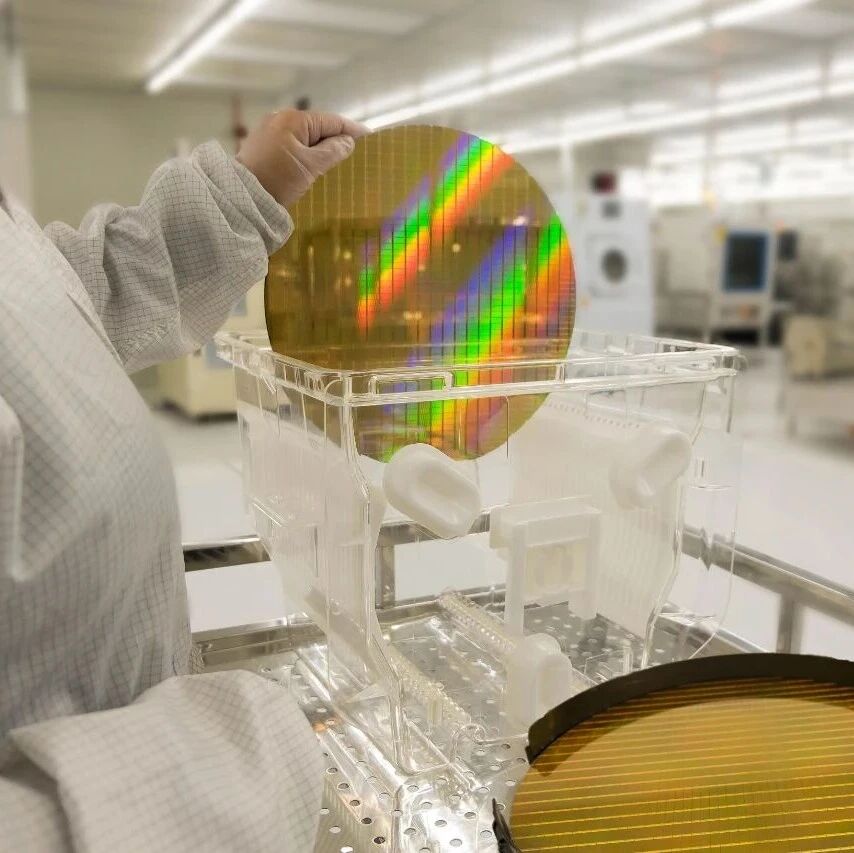
Core Viewpoint - China is entering the semiconductor glass substrate market, intensifying competition with established players from South Korea, Taiwan, Japan, and the United States [1][2] Group 1: Market Entry and Competition - Visionox, one of China's leading display companies, plans to invest in glass substrates this year, having built a supply chain since last year [1] - AKM Midville, a top 20 global PCB company, is preparing to supply glass substrates and has established a trial production line [1] - Uncheon Semiconductor is also developing its supply chain for semiconductor glass substrates, leveraging its technical expertise [1] Group 2: Technological Adoption and Growth Potential - Glass substrates are gaining attention as they replace traditional plastic materials, enhancing semiconductor packaging performance, particularly in AI semiconductor applications [2] - BOE, a leading Chinese display manufacturer, has launched a semiconductor glass substrate business to leverage its expertise in the display industry [2] - Industry insiders indicate that companies are viewing glass substrates as future growth engines, planning significant investments based on their knowledge in the glass sector [2] Group 3: Competitive Advantages - Chinese companies are expected to leverage their financial strength and rapid response capabilities to gain market advantages [3] - They are actively addressing technical challenges, such as micro-cracks in glass substrates, which may lead to cost advantages in future commercialization [3]


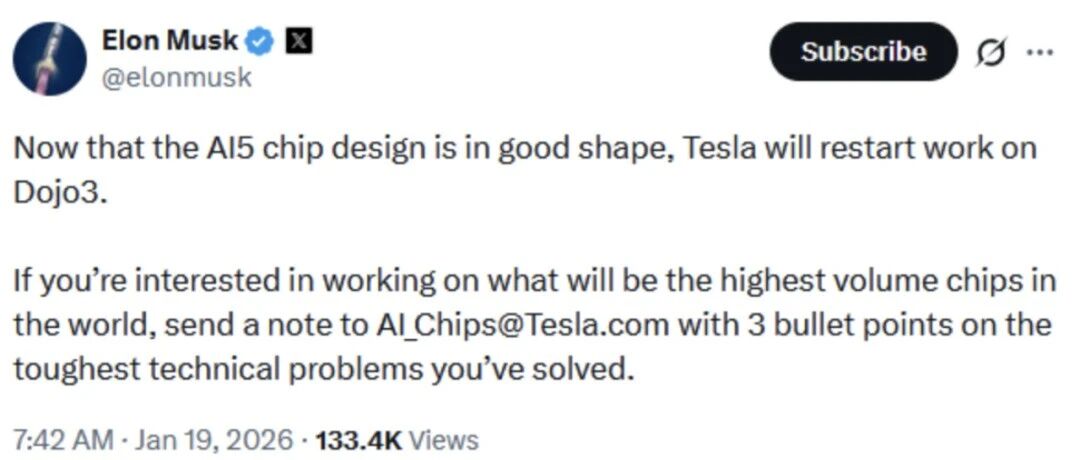
重启!刚刚,马斯克重大宣布!
天天基金网· 2026-01-19 08:29
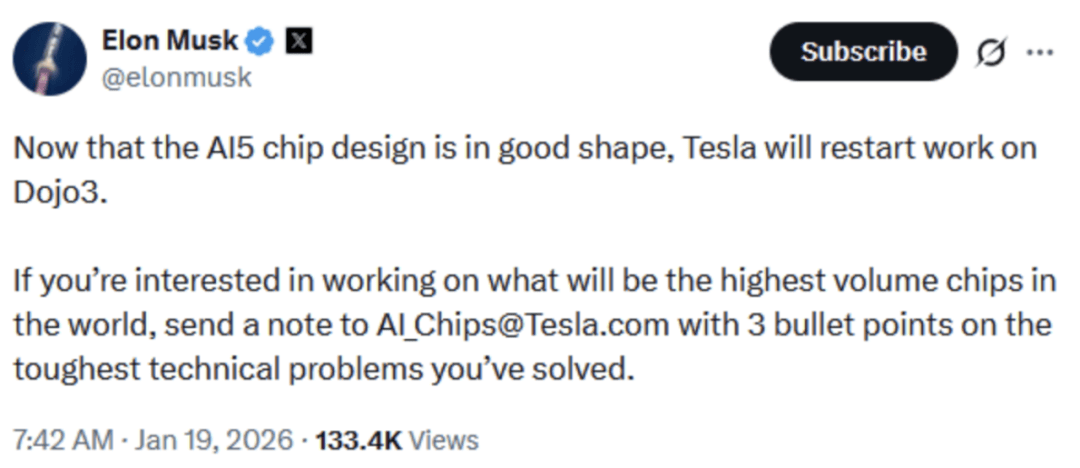
Core Viewpoint - Elon Musk announced the completion of the AI5 chip design, leading to the restart of the Dojo 3 supercomputer project, which aims to provide robust computing power for autonomous driving systems and AI models, reducing reliance on external suppliers [3][5][8]. Group 1: AI5 Chip Development - The AI5 chip is expected to support more complex Full Self-Driving (FSD) system algorithms, with a performance of 2000-2500 TOPS, approximately five times that of the current HW4 chip [11]. - The production timeline for the AI5 chip includes sample deployment in 2026 and mass production expected by 2027 [12]. - The AI6 chip is already in early development, likely to follow the same manufacturing partnerships as AI5, with plans for Samsung Electronics to be the exclusive manufacturer [12][13]. Group 2: Dojo Project Significance - The Dojo project, first mentioned in 2019, is seen as a cornerstone of Tesla's AI ambitions, aiming to enhance performance in processing autonomous driving video data and optimizing neural network models [8][9]. - Analysts estimate that full deployment of Dojo could potentially increase Tesla's valuation by billions [9]. Group 3: FSD Subscription Model - Starting February 14, Tesla will shift its FSD offering from a one-time purchase price of $8,000 in the U.S. to a monthly subscription model, marking a significant strategic shift towards a Software as a Service (SaaS) approach [14][16]. - This change aims to lower the usage threshold for FSD, increase penetration rates, and create a continuous revenue stream [17].


重启!刚刚,马斯克重大宣布
Sou Hu Cai Jing· 2026-01-19 08:11
Group 1 - Tesla CEO Elon Musk announced the completion of the AI5 chip design, leading to the restart of the Dojo 3 supercomputer project development [1][2] - The Dojo project aims to provide robust computing power for autonomous driving systems and AI models, reducing reliance on external suppliers [1][4] - Analysts believe the AI5 chip will support more complex Full Self-Driving (FSD) system algorithms, with its production timeline directly impacting the rollout of Tesla's FSD features [1][5] Group 2 - The AI5 chip is expected to achieve performance levels of 2000-2500 TOPS, approximately five times the current HW4 chip performance [5] - Production of AI5 chip samples and small-scale deployment is planned for 2026, with mass production expected in 2027 [5][6] - Tesla is transitioning its FSD offering from a one-time purchase model to a monthly subscription model starting February 14, aiming to lower usage barriers and increase penetration [7][8]
刚刚,马斯克重大宣布!
是说芯语· 2026-01-19 08:02
Core Viewpoint - Tesla is making significant advancements in its AI capabilities by restarting the Dojo supercomputer project, driven by the completion of its self-developed AI5 chip, which is crucial for its autonomous driving and robotics initiatives [2][3]. Group 1: Dojo Project and AI5 Chip - The Dojo project, initially proposed by Elon Musk in 2019, aims to create Tesla's own computing foundation to support its Full Self-Driving (FSD) system and AI models, reducing reliance on external chips [3]. - The AI5 chip boasts impressive performance, with a single SoC performance comparable to NVIDIA's Hopper level and a dual-chip configuration nearing Blackwell level, while being more cost-effective and energy-efficient [3][4]. - The AI5 chip's operational performance ranges between 2000 to 2500 TOPS, approximately five times that of the current HW4 chip, enabling more complex FSD algorithms and potentially serving as the "brain" for Tesla's robots [5]. Group 2: Production and Future Developments - Sample production and small-scale deployment of the AI5 chip are set to advance in 2026, with mass production expected to be completed by 2027, involving partnerships with Samsung and TSMC for manufacturing [5][6]. - Tesla has already initiated early development of the AI6 chip, which is planned for release in 2028, featuring a modular design that integrates deeply with the Dojo supercomputer [6]. Group 3: Software and Business Model Changes - Starting February 14, 2026, Tesla will transition its FSD from a one-time purchase model to a monthly subscription model, marking a significant shift in its software business strategy [7]. - This change aims to lower the usage barrier and increase adoption rates while establishing a stable revenue stream from software, supporting the rollout of new features like fully autonomous driving and Robotaxi testing [7]. - Analysts estimate that the full deployment of Dojo could enhance Tesla's valuation by up to $500 billion, highlighting the potential impact on its future business ventures, including robotics and shared mobility [7].