
洋河股份

Search documents
吃喝板块深跌近1%,资金疯狂加码!估值大底+旺季将至,板块反转或至?
Xin Lang Ji Jin· 2025-09-19 02:50
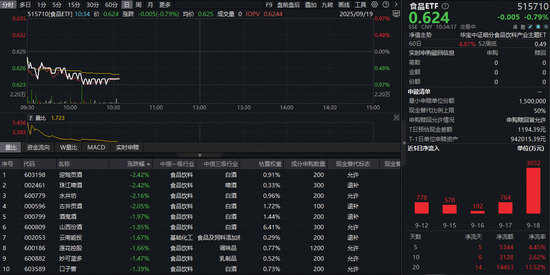
Group 1 - The food and beverage sector is experiencing a pullback, with the Food ETF (515710) showing a decline of 0.79% as of the latest report [1][3] - Key stocks in the sector, such as Wuliangye, Zhujiang Beer, and Shui Jing Fang, have seen declines exceeding 2%, while others like Jiu Gui Jiu and Shanxi Fen Jiu have dropped over 1% [1][3] - Recent data indicates that the Food ETF has attracted significant net purchases, totaling 53.44 million yuan over the last five trading days and 145 million yuan over the past 20 days [1][3] Group 2 - Pacific Securities notes that the liquor sector is currently in a "fundamental bottoming + low valuation" phase, with potential for weak recovery in demand due to upcoming consumption peaks during the Mid-Autumn Festival and National Day [3][4] - The current price-to-earnings ratio for the Food ETF's underlying index is 20.72, which is at a low point historically, suggesting a favorable time for investment [3][4] - Despite challenges, the liquor sector is expected to gradually improve as demand recovers and policies become more favorable, with a focus on the upcoming peak seasons for sales [4][5] Group 3 - The Food ETF (515710) is designed to track the CSI segmented food and beverage industry index, with approximately 60% of its holdings in leading high-end and mid-range liquor stocks, and nearly 40% in other beverage and food segments [5][6] - The ETF's top ten weighted stocks include major brands like Moutai, Wuliangye, and Yili, indicating a strong focus on established market leaders [5][6] - Investors can also consider connecting funds for the Food ETF to gain exposure to core assets in the food and beverage sector [5][6]

8月酒水销售好转动销反弹 能填第二季度的“坑”吗
Nan Fang Du Shi Bao· 2025-09-18 23:10
Core Viewpoint - The Chinese liquor industry is experiencing a recovery in sales after a prolonged downturn, driven by seasonal demand and price adjustments, although the overall market remains in a deep adjustment phase [2][9][11]. Group 1: Industry Performance - In the second quarter, the majority of liquor companies reported a decline in both revenue and net profit, with only a few exceptions like Guizhou Moutai and Tianyoude Liquor showing growth [4][6][11]. - The overall performance of the liquor industry reflects a return to normalcy after a period of rapid growth, with the second quarter traditionally being a slow season for sales [7][11]. - The industry is currently facing challenges such as high inventory levels and reduced demand from business receptions, which have significantly impacted sales figures [8][10]. Group 2: Sales Recovery - August saw a notable increase in sales and shipment volumes compared to July, attributed to the upcoming Mid-Autumn and National Day holidays, as well as further price reductions [2][9]. - The recovery in sales is primarily driven by increased consumption during traditional events like graduation and wedding banquets, alongside a rise in demand for mid-range and mass-market products [9][10]. - Despite the sales rebound, the industry is still expected to face challenges in matching last year's performance levels, with many analysts predicting continued declines in overall market demand [11][12]. Group 3: Market Trends and Investor Sentiment - The liquor sector has seen a rebound in stock prices over the past month, with the industry index rising by 12.32% from early August to mid-September [12]. - Analysts suggest that while there is optimism regarding a potential turning point for premium liquor prices, the overall industry sentiment remains cautious due to ongoing adjustments and competitive pressures [13]. - The current market environment is characterized by a focus on inventory clearance and price adjustments, with many companies adopting strategies to manage their sales and distribution channels effectively [10][11].

高盛白酒深度研究:控货去库存筑底,Q3迎最暗时刻,茅五目标价大调(附全名单评级)
Zhi Tong Cai Jing· 2025-09-18 12:56
Core Viewpoint - The Chinese liquor industry is approaching a critical seasonal test in Q3 2025, with cautious market sentiment prevailing. Goldman Sachs predicts that Q3 2025 may represent a low point in valuation for the industry, with some stocks already reflecting a "bottoming" expectation. Target prices for leading companies like Moutai and Wuliangye have been adjusted upwards [1][2]. Group 1: Market Conditions - The liquor industry is facing dual pressures from ongoing anti-extravagance policies and a reduction in the length of the Mid-Autumn Festival and National Day holidays, leading to weakened retail momentum [2]. - Companies are focusing on inventory normalization through measures such as waiving prepayments and controlling shipment volumes, which may pressure short-term performance but help return inventory levels to normal [2]. - Despite a significant decline in wholesale prices for Moutai and Wuliangye, some retailers have slightly increased end prices in anticipation of brand-controlled inventory to support profits [2][3]. Group 2: Valuation and Stock Performance - The stock prices of liquor companies have risen by 24% since Q3, with a 17% increase in price-to-earnings ratios, indicating that the market has already absorbed the impact of policy changes [2]. - The average target price for liquor stocks has been raised by 6%, with mid-to-high-end liquor valuation multiples adjusted upwards by 13% to 19% [2]. - The high dividend yields of leading companies like Moutai and Wuliangye provide a valuation safety net, with potential price increases of 20% to 30% based on normalized earnings projections for 2027 [4]. Group 3: Company-Specific Adjustments - Moutai's target price has been adjusted from 1742 yuan to 1724 yuan, reflecting a 3% to 4% decrease in earnings expectations due to policy impacts [5]. - Wuliangye's target price has been raised from 139 yuan to 145 yuan, despite a 5% to 8% reduction in earnings expectations, as its valuation multiple has been increased from 17 times to 18.5 times [5]. - Other companies like Luzhou Laojiao and Gujing Gongjiu have also seen adjustments in their target prices and earnings expectations, reflecting varying degrees of resilience and market conditions [5]. Group 4: Investment Strategy - The current "low point" in Q3 is viewed as a critical phase for the industry, with inventory control measures potentially laying the groundwork for recovery in 2026 as policies ease [6]. - Investment recommendations focus on leading companies with strong dividend yields and brand strength, as well as those with significant valuation adjustments and earnings resilience [7].







吃喝板块深度回调,“茅五泸汾洋”集体大跌!食品ETF(515710)盘中跌超2%,资金持续加码
Xin Lang Ji Jin· 2025-09-18 12:01
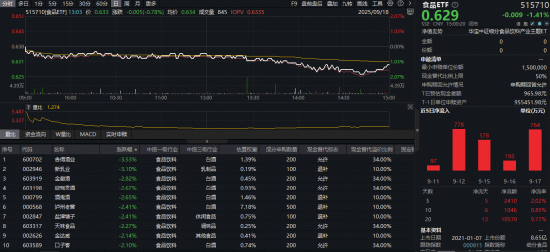
Group 1: Market Performance - The food and beverage sector experienced a significant pullback on September 18, with the Food ETF (515710) dropping over 2% during intraday trading before closing down 1.41% [1] - Major liquor stocks, including Shede Liquor, Yanghe Brewery, and Luzhou Laojiao, saw declines exceeding 2%, while leading brands like Kweichow Moutai and Wuliangye fell over 1% [1] Group 2: Investment Trends - Despite the recent pullback, there has been a notable influx of capital into the food and beverage sector, with the Food ETF (515710) recording a net subscription of 24.1 million CNY over the past five trading days [1] - The food and beverage sector is currently viewed as having a favorable valuation, with the Food ETF's underlying index PE ratio at 21.12, placing it at a low point historically [4] Group 3: Industry Outlook - Kweichow Moutai ranked third in the Kantar BrandZ Most Valuable Chinese Brands 2025 list, with a brand value of 80.023 billion USD, marking its sixth consecutive year in the top three [3] - Analysts suggest that as policy pressures ease, there is potential for a weak recovery in demand for liquor, particularly with the upcoming holiday season expected to improve sales [3][6] - The liquor industry is seen as being at a low valuation point, with expectations for gradual improvement in fundamentals as the market stabilizes [4][6]


今世缘半年报:营收净利双降背后的行业寒冬与战略突围
Sou Hu Cai Jing· 2025-09-18 10:19
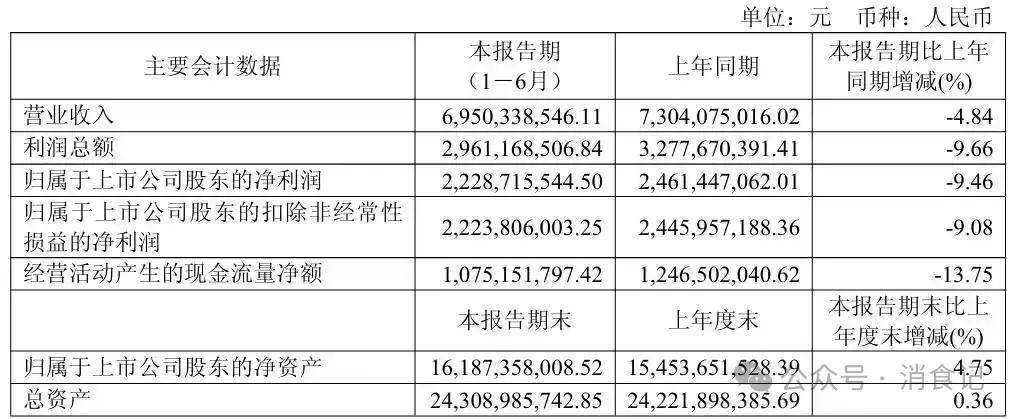
Core Insights - The core market for high-end products is experiencing structural shocks, leading to a significant decline in revenue for the company [1][10] - The company is facing challenges in both domestic and provincial markets, with a notable drop in sales and market share due to increased competition and changing consumer preferences [3][11] Revenue Performance - The revenue from core A+ products decreased by 7.37% year-on-year, totaling 4.311 billion yuan [1] - The company's provincial revenue fell to 6.254 billion yuan, marking a 6.07% decline, the first negative growth in a decade [3] Inventory and Supply Chain Issues - The company's total inventory reached 5.723 billion yuan, equivalent to 50% of annual revenue, with a significant portion being finished products [6] - Inventory turnover days have increased to 980 days, indicating a severe mismatch between market demand and production pace [6][16] Market Strategy and Competition - The company is implementing a "10+N" strategy focusing on key cities, but is reducing its budget for provincial expansion by 12% [11] - Increased competition from national brands and regional players is squeezing the company's market share, particularly in the lower price segments [11][12] Product and Pricing Strategy - The company is experiencing declines across all product categories, with A, B, and C/D class products seeing year-on-year drops of 10.04%, 6.34%, and 39.38% respectively [10] - There is a need to shift focus towards high-end products in the 400-500 yuan price range to capture upgrading consumer demand [12] Operational Adjustments - The company is advised to pause non-core capacity expansions and focus on smart brewing and quality improvements [16] - Digital transformation initiatives are necessary to enhance inventory visibility and consumer profiling, aiming to reduce channel costs and improve sales efficiency [14]

20只白酒股下跌 贵州茅台1467.96元/股收盘
Bei Jing Shang Bao· 2025-09-18 07:41
Core Viewpoint - The stock market experienced a collective decline on September 18, with the Shanghai Composite Index falling by 1.15% to 3831.66 points, and the liquor sector also faced a downturn, indicating potential challenges in the industry despite the upcoming consumption peak during the Mid-Autumn Festival and National Day [1]. Industry Summary - The liquor sector index closed at 2315.48 points, down 1.60%, with all 20 liquor stocks declining by over 1% [1]. - Major liquor companies saw significant stock price drops: Kweichow Moutai (600519) closed at 1467.96 CNY per share, down 1.68%; Wuliangye (000858) at 123.94 CNY, down 1.60%; Shanxi Fenjiu (600809) at 201.00 CNY, down 1.69%; Luzhou Laojiao (000568) at 133.70 CNY, down 2.41%; and Yanghe Brewery (002304) at 70.13 CNY, down 2.04% [1]. - According to Pacific Securities, while terminal sales are expected to recover on a month-on-month basis due to the approaching consumption peak, year-on-year sales pressure remains significant due to economic and policy factors. It is anticipated that products priced below 300 CNY will perform better than those above 500 CNY [1].
民生证券:25H1白酒行业报表释压 加速筑底
智通财经网· 2025-09-18 06:25
Core Viewpoint - The report from Minsheng Securities indicates that the Chinese liquor industry is experiencing a significant downturn, with major companies reporting negative revenue and profit growth for the first half of 2025, marking the first negative growth in revenue during this cycle [1][4]. Group 1: Financial Performance - In the first half of 2025, 17 major liquor companies reported revenues and net profits of 236.83 billion and 94.46 billion yuan respectively, showing a year-on-year decline of 0.4% and 0.9% [1][4]. - For Q2 2025, these companies achieved revenues and net profits of 86.72 billion and 31.34 billion yuan, reflecting a year-on-year decline of 4.7% and 7.3% [1][4]. - Excluding Moutai, the revenue and net profit for the first half of 2025 were 145.74 billion and 49.06 billion yuan, with declines of 5.5% and 8.6% year-on-year [4][5]. Group 2: Market Dynamics - The industry is transitioning from "passive clearing" to "active adjustment," indicating a phase of accelerated bottoming out due to ongoing pressures from inventory and cash flow [1][4]. - The report highlights a shift in market focus from short-term recovery signs to long-term trends, emphasizing the importance of brand strength and market share in determining pricing [2][3]. Group 3: Consumer Behavior and Demand - The demand for liquor is expected to recover during the Mid-Autumn Festival and National Day, driven by cultural events such as banquets and gatherings, which are seen as resilient demand scenarios [2][6]. - The report notes that the high-end liquor demand has been negatively impacted by government restrictions, leading to a trend of increasing volume but decreasing prices [5][6]. Group 4: Investment Recommendations - The report recommends strong brands such as Kweichow Moutai, Wuliangye, and Luzhou Laojiao, as well as regional leaders with growth potential like Gujing Gongjiu and Jinhui Liquor [7].
白酒板块午盘微跌 贵州茅台下跌0.51%
Bei Jing Shang Bao· 2025-09-18 04:02
Core Viewpoint - The white liquor sector is experiencing a shift in pricing logic, indicating that it may no longer be considered a cyclical growth stock, with future stock price gains expected to come from stable performance increments and appropriate dividends [1] Market Performance - On September 18, the Shanghai Composite Index opened at 3893.95 points, rising by 0.45% - The white liquor sector closed at 2344.99 points, down by 0.35%, with 17 stocks in the sector declining [1] Individual Stock Performance - Kweichow Moutai closed at 1485.40 CNY per share, down by 0.51% - Wuliangye closed at 125.15 CNY per share, down by 0.64% - Shanxi Fenjiu closed at 203.29 CNY per share, down by 0.57% - Luzhou Laojiao closed at 135.39 CNY per share, down by 1.18% - Yanghe Brewery closed at 70.89 CNY per share, down by 0.98% [1] Analyst Insights - Guotai Junan Securities suggests that the pricing logic in the white liquor industry will undergo a trend change, moving away from being a cyclical growth stock [1]
洋河股份9月17日获融资买入1990.39万元,融资余额14.97亿元
Xin Lang Cai Jing· 2025-09-18 01:24
Core Viewpoint - Yanghe Co., Ltd. has experienced a decline in both revenue and net profit for the first half of 2025, indicating potential challenges in the market [2]. Group 1: Stock Performance - On September 17, Yanghe's stock fell by 0.29%, with a trading volume of 292 million yuan [1]. - The financing buy-in amount for Yanghe on the same day was 19.90 million yuan, while the financing repayment was 27.54 million yuan, resulting in a net financing outflow of 7.63 million yuan [1]. - As of September 17, the total financing and securities lending balance for Yanghe was 1.51 billion yuan [1]. Group 2: Financial Performance - For the period from January to June 2025, Yanghe reported operating revenue of 14.80 billion yuan, a year-on-year decrease of 35.32% [2]. - The net profit attributable to shareholders for the same period was 4.34 billion yuan, reflecting a year-on-year decline of 45.34% [2]. Group 3: Shareholder and Dividend Information - Since its A-share listing, Yanghe has distributed a total of 56.34 billion yuan in dividends, with 19.66 billion yuan distributed over the past three years [3]. - As of June 30, 2025, the number of shareholders for Yanghe was 190,700, an increase of 1.68% from the previous period [2]. - The top ten circulating shareholders include notable entities such as the China Securities White Wine Index A and Hong Kong Central Clearing Limited, with changes in their holdings noted [3].
万联晨会-20250918
Wanlian Securities· 2025-09-18 01:14
Core Viewpoints - The A-share market saw collective gains on Wednesday, with the Shanghai Composite Index rising by 0.37%, the Shenzhen Component Index by 1.16%, and the ChiNext Index by 1.95%. The total trading volume in the Shanghai and Shenzhen markets reached 23,764.76 billion yuan. The leading sectors included power equipment, automobiles, and home appliances, while agriculture, retail, and social services lagged behind [2][8] - The U.S. Federal Reserve announced a 25 basis point cut in the federal funds rate, bringing it to a target range of 4.00% to 4.25%. This marks the first rate cut of 2025 and follows three cuts in 2024. The Fed noted a slowdown in economic activity and rising inflation, with high uncertainty in the economic outlook [3][9] - The Hong Kong government introduced measures to enhance the stock market, including support for tech companies to raise funds in Hong Kong and optimizing listing regulations. These initiatives aim to boost the market's vitality and competitiveness [4][10] Industry Insights Banking Sector - In August, the social financing stock growth rate was 8.8%, a decrease of 0.2% from July. New social financing totaled 2.57 trillion yuan, down by 0.47 trillion yuan year-on-year. The decline was attributed to a slowdown in government bond issuance and credit growth [11][12] - The M1 growth rate was 6%, with M2 growing by 8.8%. The anticipated smooth deployment of fiscal funds may continue to support economic growth, although the increase in monetary growth is expected to narrow [12][14] - The banking sector is expected to see gradual recovery in revenue and profit growth, supported by attractive dividend yields and regulatory encouragement for insurance funds to increase market participation [14] Media Sector - The media industry reported a revenue increase of 3.86% in H1 2025, totaling 254.86 billion yuan, with net profit rising by 28.85% to 21.78 billion yuan. The gross margin remained stable at 32.90% [15][16] - The gaming sector showed significant growth, with revenue reaching 54.45 billion yuan in H1 2025, a 22.17% increase, and net profit soaring by 74.95% to 8.05 billion yuan [15][16] - The film and television sector experienced a revenue increase of 15.24% in H1 2025, driven by successful releases, although Q2 saw a decline in revenue and an increase in losses [16][19] Food and Beverage Sector - The food and beverage industry saw a revenue increase of 2.41% in H1 2025, totaling 5,806.35 billion yuan, but net profit decreased by 0.56% to 1,275.08 billion yuan. The sector's growth rates ranked 14th and 20th among 31 sub-industries [22][23] - The beverage segment, particularly soft drinks and condiments, showed strong revenue growth, while the beer segment maintained positive growth in both revenue and profit [23][24] - The liquor industry faced challenges, with a slight decline in revenue and profit, particularly in the mid-range segment, while high-end brands remained resilient [25][26] Electronics Sector - The SW electronics industry reported a revenue increase of 19.10% in H1 2025, totaling 1,846.095 billion yuan, with net profit rising by 29.29% to 84.04 billion yuan [30][31] - The semiconductor sector performed well, driven by AI demand and domestic substitution, while consumer electronics benefited from government subsidies [31][32] - The optical and electronic sectors saw significant profit growth, particularly in the panel segment, which experienced a 193.31% increase in net profit [32]