江西铜业

Search documents
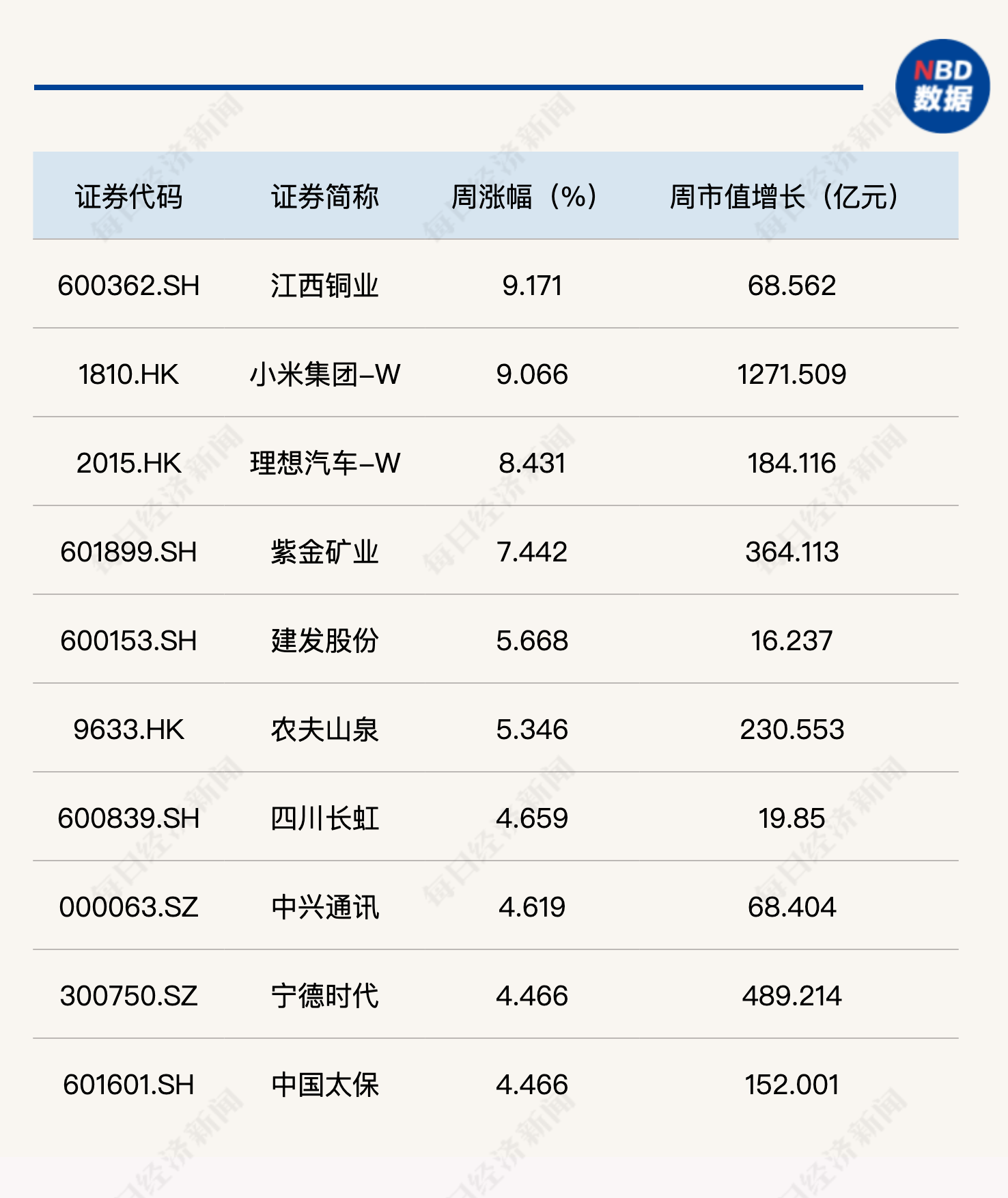
成分股普涨,每经品牌100指数周涨1.6%
Mei Ri Jing Ji Xin Wen· 2025-06-29 08:58
Market Overview - The A-share market has shown a significant recovery in risk appetite, with the Shanghai Composite Index rising by 1.91% this week, surpassing 3400 points [1] - The 每经品牌100 Index also saw a weekly increase of 1.6%, closing at 1076.21 points, continuing its upward trend towards the 1100-point mark [1] Performance of Stocks - Nearly 80% of the constituent stocks in the 每经品牌100 Index experienced gains, with 76 stocks rising, accounting for 76.77% of the index [2] - Notable performers included 江西铜业 (Jiangxi Copper), 小米集团 (Xiaomi Group), 理想汽车 (Li Auto), 紫金矿业 (Zijin Mining), and 建发股份 (Jianfa Co.), all of which had weekly gains exceeding 5% [2] Sector Analysis - The macroeconomic environment has remained stable, supported by policy measures, although challenges in exports and consumer demand are anticipated in the second half of the year [4] - The liquidity environment in the A-share market is gradually expanding, with policies aimed at stabilizing and activating the capital market [4] Focus on New Energy Vehicles - The performance of new energy vehicle leaders, 小米集团 and 理想汽车, has attracted market attention, particularly regarding their delivery expectations [5] - 理想汽车 has adjusted its delivery forecast for Q2 2025 to approximately 108,000 vehicles, down from a previous estimate of 123,000 to 128,000 vehicles [5] - 小米汽车 has also updated its delivery timelines based on order volume and current production capacity, indicating potential dynamic changes in actual delivery times [5] Insights on Non-Ferrous Metals - The non-ferrous metals sector has shown strong performance, with stocks like 江西铜业 and 紫金矿业 leading the gains [7] - The 中证申万有色金属指数, which tracks the performance of the non-ferrous metals sector, includes major companies such as 紫金矿业, indicating its investment significance [9]



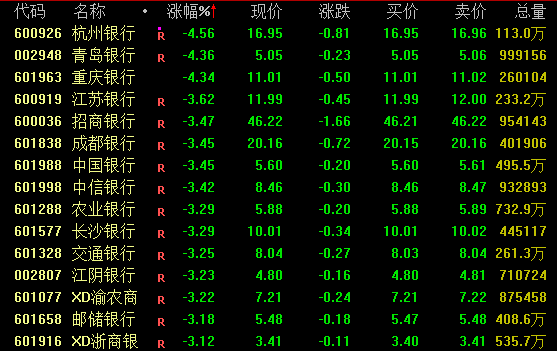
银行股突发跳水
Zheng Quan Shi Bao· 2025-06-27 10:06
Market Overview - A-shares showed mixed performance on June 27, with the Shanghai Composite Index declining by 0.7% to 3424.23 points, while the Shenzhen Component Index rose by 0.34% to 10378.55 points and the ChiNext Index increased by 0.47% to 2124.34 points [1] - The total trading volume in the Shanghai, Shenzhen, and Beijing markets was 157.59 billion yuan, a decrease of 47.6 billion yuan from the previous day [1] Sector Performance - The banking and insurance sectors dragged down the Shanghai Composite Index, with major banks like Qingdao Bank, Hangzhou Bank, and Chongqing Bank each falling over 4% [1][3] - The non-ferrous metals sector performed strongly, with stocks like Electric Alloy and Northern Copper reaching their daily limit [6] - The semiconductor sector saw gains, with Longxin Zhongke rising over 13% and Chip Original shares increasing by about 6% [1] - The CPO concept stocks were active, with companies like Lian Te Technology hitting the daily limit and Yuanjie Technology rising nearly 7% [1] Banking Sector Analysis - The banking sector experienced a significant decline, with several major banks reporting drops of over 3% to 4% [3][4] - Analysts suggest that the early dividend payout dates for banks this year may have prompted investors to sell after receiving dividends [3] Non-Ferrous Metals Sector Insights - The non-ferrous metals sector saw a strong performance, with significant gains in stocks like Electric Alloy and Jiangxi Copper, which rose by approximately 6% [6][7] - Analysts believe that the precious metals sector will continue to perform well due to factors such as the weakening of the US dollar credit system and rising geopolitical risks [8] AI Industry Chain Activity - AI-related stocks, particularly in the copper cable connection and CPO concepts, saw substantial increases, with companies like Chuangyitong and Xin Ya Electronics hitting their daily limits [9][10] - The demand for AI model training and inference remains strong, with advancements in system-level products expected to drive growth in the AI sector [11]
金属铜概念涨1.95%,主力资金净流入这些股
Zheng Quan Shi Bao Wang· 2025-06-27 09:56
Group 1 - The copper concept sector increased by 1.95%, ranking 6th among concept sectors, with 58 stocks rising, including Northern Copper, which hit the daily limit, and Jin Chengxin, Jiangxi Copper, and Jintian Co., which rose by 6.70%, 6.12%, and 6.05% respectively [1][2] - The main capital inflow into the copper concept sector was 281 million yuan, with 35 stocks receiving net inflows, and 5 stocks seeing inflows exceeding 50 million yuan, led by Northern Copper with a net inflow of 244 million yuan [2][3] - The net inflow ratios for Northern Copper, Xiyu Co., and ST Shengtun were 19.90%, 15.00%, and 11.19% respectively, indicating strong investor interest in these stocks [3] Group 2 - The top gainers in the copper concept sector included Northern Copper, which rose by 10.03%, and Xiyu Co., which increased by 5.95%, while the top losers included Huamao Co., which fell by 7.56% [3][6] - The trading volume and turnover rates for the leading stocks in the copper sector showed significant activity, with Northern Copper having a turnover rate of 6.86% and Xiyu Co. at 4.85% [3][4] - The overall performance of the copper concept sector reflects a positive sentiment among investors, as evidenced by the substantial net inflows and the number of stocks experiencing gains [2][5]


高盛预测铜价2025年破万美元,有色金属板块强势上涨
Jin Rong Jie· 2025-06-27 03:06
Group 1 - The non-ferrous metal sector showed strong performance, with electrical alloy hitting the 20% limit up, and stocks like Northern Copper, Zhongfu Industry, and Jinchengxin all rising over 5% [1] - Major companies such as Luoyang Molybdenum, Jiangxi Copper, and Shenhuo Co. also experienced significant stock price increases [1] - Goldman Sachs predicts that copper prices will peak at approximately $10,050 per ton by August 2025, driven by tightening supply outside the U.S. [2] Group 2 - The global copper market is facing a structural imbalance in supply and demand, with processing fees for copper concentrate declining and some smelters reducing output due to cost pressures [3] - The demand for copper is being supported by the transition to renewable energy and digitalization, with a surge in data center construction expected to significantly increase copper consumption [3] - Supply-side tensions are unlikely to ease in the short term, with traditional copper-producing countries like Chile and Peru facing rising production costs and slower-than-expected new capacity additions [3] Group 3 - There has been a noticeable shift in trade flows, with commodity traders rerouting copper originally destined for Asia to the U.S., leading to supply shortages in non-U.S. regions [3] - The London Metal Exchange's inventory has significantly decreased, with available stocks dropping to historical lows [3] - The recycled copper market is also under pressure, as price fluctuations affect the collection of scrap copper, leading to a temporary contraction in recycled copper supply [3] Group 4 - Companies like Luoyang Molybdenum and Jiangxi Copper are well-positioned to benefit from rising copper prices due to their advantages in capacity release and cost control [3] - Companies in niche sectors, such as electrical alloys, are also experiencing growth opportunities [3] - The technical outlook shows that Shanghai copper futures have stabilized above 80,000 yuan, reflecting market concerns over short-term supply tightness [3]




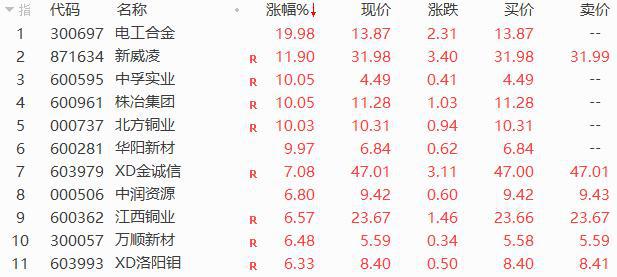
有色金属板块持续拉升,华阳新材涨停


news flash· 2025-06-27 01:50
Group 1 - The non-ferrous metal sector continues to rise, with Huayang New Materials (600281) hitting the daily limit up [1] - Beifang Copper Industry (000737) increased by over 7% [1] - Luoping Zinc & Electricity (002114), Pengxin Resources (600490), and Jiangxi Copper (600362) also experienced gains [1]
瑞达期货沪铜产业日报-20250626
Rui Da Qi Huo· 2025-06-26 08:45
沪铜产业日报 2025/6/26 | 项目类别 | 数据指标 环比 数据指标 最新 | 最新 | | | 环比 | | --- | --- | --- | --- | --- | --- | | 期货市场 | 期货主力合约收盘价:沪铜(日,元/吨) | 78,890.00 | +80.00↑ LME3个月铜(日,美元/吨) | 9,795.50 | +83.00↑ | | | 主力合约隔月价差(日,元/吨) | 160.00 | -20.00↓ 主力合约持仓量:沪铜(日,手) | 191,140.00 | +53503.00↑ | | | 期货前20名持仓:沪铜(日,手) | 6,571.00 | +1689.00↑ LME铜:库存(日,吨) | 93,475.00 | -1200.00↓ | | | 上期所库存:阴极铜(周,吨) | 100,814.00 | -1129.00↓ LME铜:注销仓单(日,吨) | 37,225.00 | -2925.00↓ | | | 上期所仓单:阴极铜(日,吨) | 23,696.00 | -2856.00↓ | | | | | SMM1#铜现货(日,元/吨) | 78,9 ...
研判2025!中国热熔胶机行业发展历程、销量、市场规模、重点企业及前景展望:下游产业蓬勃发展,热熔胶机市场潜力无限[图]
Chan Ye Xin Xi Wang· 2025-06-26 01:32
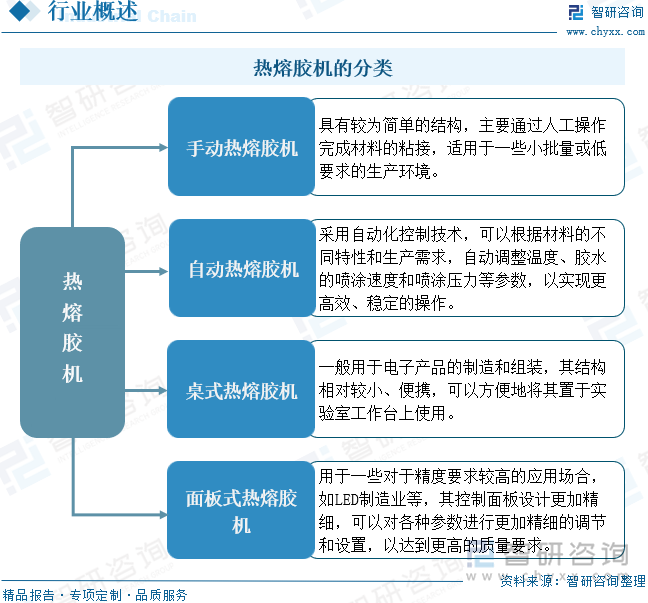
Core Insights - The hot melt adhesive machine is a key device in various industries such as packaging, construction, automotive, and electronics, significantly enhancing production efficiency, reducing costs, and improving product quality [1][15] - The market demand for hot melt adhesive machines is continuously growing, driven by the global trend towards intelligent, green, and service-oriented manufacturing, as well as increasing environmental awareness and regulations in China [1][15] - The market size of China's hot melt adhesive machine industry is projected to reach approximately 2.08 billion yuan in 2024, indicating substantial growth potential in the coming years [1][15] Industry Overview - Hot melt adhesive machines are electro-mechanical devices that melt solid hot melt adhesives and apply them to substrates through various methods, including spraying and rolling [3] - The industry has evolved since the mid-1980s, initially used in small sectors like cosmetics, and has expanded to packaging and high-end applications in automotive and electronics due to advancements in control technology [5] Industry Development History - The introduction of hot melt adhesive machines in China began in the mid-1980s, with local manufacturers emerging in the 1990s, leading to broader applications across various industries [5] - Modern hot melt adhesive machines now feature intelligent and multifunctional characteristics, with temperature control precision reaching ±1°C [5] Industry Supply Chain - The upstream of the hot melt adhesive machine industry includes raw materials such as steel, aluminum, and copper, as well as core components like heating elements and control systems [7] - The downstream applications encompass a wide range of sectors, including home goods, automotive, household appliances, and packaging [7] Steel Industry Insights - Steel is a fundamental raw material for hot melt adhesive machines, with production in China increasing from 1.05 billion tons in 2017 to an estimated 1.4 billion tons in 2024, reflecting a compound annual growth rate of 4.2% [9] - The demand for high-performance specialty steel is expected to support the development of high-end equipment manufacturing, including hot melt adhesive machines [9] Automotive Industry Applications - The automotive sector is a significant application area for hot melt adhesive machines, used in interior assembly and component bonding, with production and sales of vehicles in China projected to grow in 2024 [10] - The trend towards lightweight vehicles and the adoption of new materials will further expand the application of hot melt adhesive technology in automotive manufacturing [10] Market Trends - The hot melt adhesive machine industry is moving towards smart manufacturing, integrating advanced sensors and IoT technology for real-time monitoring and optimization [26] - Automation is a core trend, emphasizing full-process automation to reduce manual errors and enhance production efficiency [27][28] - Precision is increasingly important, with high-end manufacturing requiring micro-level adhesive application and improved temperature control for consistent bonding [29]
研判2025!中国电磁制动器行业发展历程、市场规模及进出口分析:行业市场规模持续扩大,技术进步推动产业升级[图]
Chan Ye Xin Xi Wang· 2025-06-26 01:32
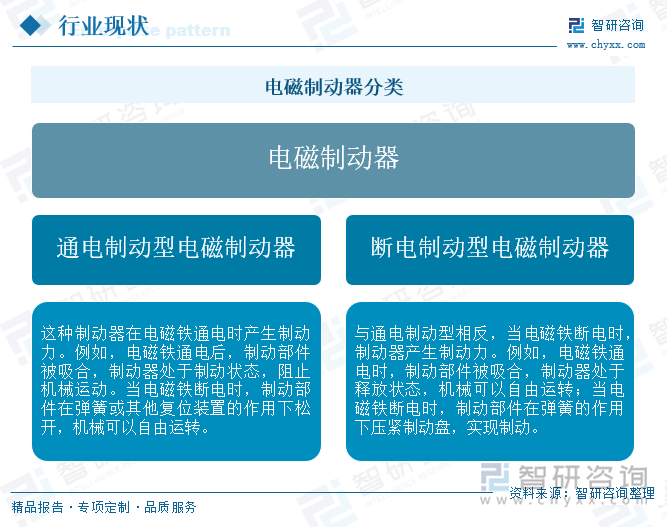
Core Viewpoint - The electromagnetic brake industry in China is experiencing significant growth driven by advancements in industrial automation, smart manufacturing, and the electric vehicle sector, with a projected market size of 21.695 billion yuan in 2024, reflecting a year-on-year increase of 9.08% [1][10]. Industry Overview - Electromagnetic brakes utilize electromagnetic force for stopping or holding motion, characterized by their compact structure, simple operation, and quick response time of 0.3 seconds [2][4]. - The industry has evolved through four main stages: initial development (1960s-1980s), scale-up (1990s-early 2000s), domestic replacement (early 2000s-2010), and the current phase of smart and green technology [4][5]. Market Size - The market for electromagnetic brakes is expanding due to the rapid development of industrial automation and electric vehicles, with a forecasted market size of 21.695 billion yuan in 2024, marking a 9.08% increase from the previous year [1][10]. Industry Development Trends 1. **Technological Innovation and Product Upgrading** - The industry is transitioning towards a technology-intensive model, with a focus on high precision, reliability, and smart features, driven by the demands of Industry 4.0 and smart manufacturing [19]. 2. **Diversification of Application Scenarios and Market Expansion** - The application of electromagnetic brakes is broadening, particularly in electric vehicles and rail transportation, which is driving market growth [20][21]. 3. **Industry Chain Integration and International Competition** - The industry is enhancing competitiveness through vertical integration of upstream materials and downstream applications, while also expanding internationally to capture emerging markets [22]. Key Companies - **Reidi Intelligent Drive**: A leading brand in the elevator sector, focusing on electromagnetic brakes and robotics, with plans for an IPO to fund expansion projects [15]. - **Asia Pacific Electromechanical Co., Ltd.**: A dominant player in the automotive brake system industry, achieving significant revenue growth [15]. - **Jiangxi Huawai Brake Co., Ltd.**: A key player in industrial braking systems, with a diverse product range and a strong export presence [17].


密云不雨,引而待发
Dong Zheng Qi Huo· 2025-06-25 04:13
1. Report Industry Investment Rating - The investment rating for copper is bullish [1] 2. Core Viewpoints of the Report - The shortage at the raw material end continues, with limited cold material supplements, leading to a significant downward adjustment of the marginal growth of global copper mine production in 2025 to 280,000 - 380,000 metric tons. The pressure at the raw material end will further reduce processing fees and impact downstream industries. - The processing profit of the smelting industry continues to deteriorate, with an initial risk of industry - wide losses. The scope of active production cuts overseas is expanding, and the market is focusing on domestic smelting trends. The marginal growth of global refined copper production in 2025 is expected to be 500,000 - 600,000 metric tons. - The marginal growth of traditional demand is weakening, the new - energy demand is slowing down, while the demand from emerging industries is growing strongly. The marginal growth of global copper demand in 2025 is adjusted down to 700,000 - 800,000 metric tons. - Macro factors center around the weakening of the US dollar, and policies from various countries are expected to stimulate the economy. The fundamentals are in a stalemate, with greater potential for supply constraints. In a low - inventory state, the regional balance needs time to recover. It is recommended to focus on structural market trends, with the low point of copper prices in the second half of the year unlikely to break through 74,000 yuan/ton, and the high point may exceed 83,000 yuan/ton [2][3][4][5] 3. Summary by Relevant Catalogs 3.1 Raw Material End 3.1.1 Copper Concentrate - In Chile, the copper supply is in a recovery cycle. From January to April, the cumulative copper production increased by 3.5% year - on - year to 1.752 million metric tons, with an absolute increase of 59,000 metric tons. The government expects a 3% increase in production in 2025 to 5.672 million metric tons, but there are uncertainties. Large - scale projects like Escondida have significant production increases, while some mines like Collahuasi and Anglo American Sur have lower - than - normal production [19][21] - In Peru, the copper mine is in a restorative growth period. From January to April, the cumulative copper production increased by 4.9% year - on - year to 887,000 metric tons, with an absolute increase of about 41,000 metric tons. The government expects the annual production to be around 2.8 million metric tons. Some projects have production differentiations, and the government's policies to stimulate production have limited effects for now [29][31] - In the Democratic Republic of the Congo, the copper production was in a high - growth period but has faced challenges this year. Geopolitical issues, infrastructure weaknesses, and resource nationalism have affected production. The output of the Kamoa - Kakula project has been significantly reduced, and the production forecast for 2025 has been greatly lowered [34][35][36] - In China, copper production has been in a recovery phase since 2022 but is constrained by factors such as ore grade decline and aging mines. The marginal growth of global copper mine production in 2025 is estimated to be 250,000 - 350,000 metric tons, with different trends in different regions [37][40] - From a company perspective, the production of major mining companies in 2024 increased by 3.3% to 17.05 million metric tons. In 2025, the growth is expected to be 2.1% to 17.41 million metric tons, mainly due to disruptions in African mines [42][43] - Regarding new projects, the marginal contribution of new global copper mines before 2028 is decreasing. Policy instability and external environment changes are the main risks for project delays or cancellations [46] 3.1.2 Recycled Materials - Overseas, due to the shortage of copper concentrate, smelters are relying more on cold materials. European smelters are competing for scrap copper, and India is increasing scrap copper imports. The US has new scrap - copper - based processing enterprises, and its scrap copper export ratio is expected to decline [50][52] - In China, smelters' demand for cold materials has increased, but supply has been restricted. From January to May, scrap copper imports decreased by nearly 2% year - on - year to 962,000 physical tons, mainly due to tariff policies and overseas demand. Domestic scrap copper supply is also constrained by fiscal and tax policies and profit margins. The supply of anode copper has also decreased [55][59] 3.1.3 Conclusions and Thoughts - The marginal growth of global copper mine production in 2024 was 530,000 - 550,000 metric tons, and it is adjusted down to 280,000 - 380,000 metric tons in 2025. The copper raw material gap in China is expected to widen in 2025, and copper prices can regulate cold material supply. Attention should be paid to domestic and overseas policies [62][63] 3.2 Smelting End 3.2.1 Domestic Market - The shortage of copper concentrate has led to a decline in processing fees. If the long - term processing fee is set at a low level, Chinese smelters may face industry - wide losses. Sulfuric acid price increases have provided some support, but there are uncertainties. The planned production increase of major listed smelters in 2025 is to 8.5 million tons, but raw material shortages may limit production. The marginal growth of China's refined copper production in 2025 is expected to be 600,000 - 700,000 metric tons [70][77][83] 3.2.2 Overseas Market - In Chile, the decline in refined copper production is significant, with an expected 10% decrease in 2025. Similar situations exist in Mexico. Overseas smelters are showing a trend of production cuts, mainly due to raw material constraints and processing fee decreases. The risk of a decline in overseas refined copper production in 2025 is increasing [86][91][92] 3.2.3 Conclusions and Thoughts - The marginal growth of global refined copper production in 2024 was 650,000 - 700,000 metric tons, and it is expected to be 500,000 - 600,000 metric tons in 2025. The transfer of the raw material shortage to smelters takes time. Attention should be paid to the impact of sulfuric acid prices and cold materials on smelters [94][95] 3.3 Demand End 3.3.1 Macro Level - From an economic cycle perspective, the global economy is in a transition from "recession" to "recovery," with different economic situations in different countries. The US economy shows signs of stagflation, and the Fed's monetary policy shift is uncertain. The US dollar's credit cycle is weakening, and copper's financial attributes are expected to increase [97] - From a manufacturing cycle perspective, the global manufacturing PMI is around 50, and the recovery will be more differentiated. Tariff policies are the core external factor affecting manufacturing [102] - In the long - term, the US fiscal deficit is expected to expand, and the US dollar will continue to depreciate. Copper will play a more important role in resource currency, and investment in copper will provide support [102] 3.3.2 Traditional Demand: China - In the power industry, grid investment is expected to grow steadily, with a focus on UHV projects and distribution network upgrades. Power source investment growth is slowing down, but there may be new drivers in 2026. Overseas exports of electrical equipment have been strong, but are affected by external policies [106][112][115] - In the home appliance industry, domestic air - conditioner sales and production increased in the first four months of 2025. Domestic sales may decline in the third quarter, while overseas sales are relatively strong but face risks from tariff policies. High inventory levels may limit production [117][119] - In the real estate industry, policies are being strengthened, but the industry is still in a bottom - building phase and will drag down copper demand this year, with a possible return to positive demand in 2026 - 2027 [120][121] - In the transportation industry, domestic automobile production is growing strongly, with new - energy vehicles as the main growth driver. However, it is affected by policy subsidies and consumer income expectations. China's automobile exports are facing bottlenecks [122][124] - The marginal growth of China's traditional copper demand in 2024 was 255,000 - 475,000 metric tons, and it is adjusted down to 132,000 - 392,000 metric tons in 2025, with risks in the second half of the year [132] 3.3.3 Traditional Demand: Overseas - In the US, policies have increased inflation expectations and economic uncertainties. The real estate and durable - goods consumption markets show a downward trend but not a significant decline. The US government's policies on power infrastructure and renewable energy will drive copper demand growth [133][136][137]
“中国绿色硅谷”崛起之路:乐山追光逐链 打造千亿级光伏创新集群
Huan Qiu Wang· 2025-06-24 10:06
Core Viewpoint - Leshan has established itself as a significant player in the global polysilicon photovoltaic industry, evolving from its inception in the 1960s to becoming a leader in production capacity and technological advancements [1][3][4]. Historical Development - The polysilicon industry in Leshan began in 1964 with the relocation of the Beijing Nonferrous Metals Research Institute, marking the start of a significant industrial journey [3]. - The first polysilicon ingot was produced in Leshan in 1965, weighing 0.9 kilograms, and by the end of that year, the production reached 69.27 kilograms of polysilicon and 10.05 kilograms of monocrystalline silicon [3][4]. - By 1972, the production capacity had increased to 4.49 tons of polysilicon and 2.51 tons of monocrystalline silicon annually, with products being exported to Europe and the United States [3]. Technological Advancements - In 2000, the Emei Semiconductor Materials Factory achieved a production capacity of 100 tons per year, marking a significant milestone in breaking foreign technology monopolies [4]. - The establishment of the first dry-ton polysilicon project in 2008, with a capacity of 1,000 tons, positioned Leshan as a leader in the industry [5]. Industry Challenges and Resilience - The global financial crisis in 2008 led to a significant downturn in the polysilicon market, with prices plummeting and many companies exiting the market [7]. - Despite these challenges, Leshan's companies focused on technological upgrades and cost reductions, successfully navigating through the industry downturn [7][8]. Current Market Position and Future Outlook - By 2016, the global photovoltaic market was projected to grow significantly, prompting renewed investment and development in Leshan's polysilicon industry [8]. - The local government has implemented supportive policies to enhance the development of the polysilicon industry, including investment in infrastructure and optimizing the business environment [9][10]. - Leshan aims to become a "Chinese Green Silicon Valley," focusing on building a competitive industrial cluster with a projected scale of hundreds of billions [12][13]. Innovation and Collaboration - Leshan is fostering innovation through the establishment of research and development platforms and collaborative projects with leading companies in the photovoltaic sector [10][12]. - The ongoing projects, such as the 10 GW HBC cell project, are expected to position Leshan as a global leader in advanced photovoltaic technology [12]. Investment and Economic Growth - A recent investment fund of approximately 600 billion yuan has been launched to support the transformation and upgrading of the polysilicon industry in Leshan [13]. - The focus on developing the entire supply chain, including battery cells and storage devices, reflects a strategic move towards a more integrated and sustainable industry [13].