
海富通基金

Search documents
年内连跨三个万亿台阶,国内ETF总规模突破6万亿元
Sou Hu Cai Jing· 2025-12-28 00:57
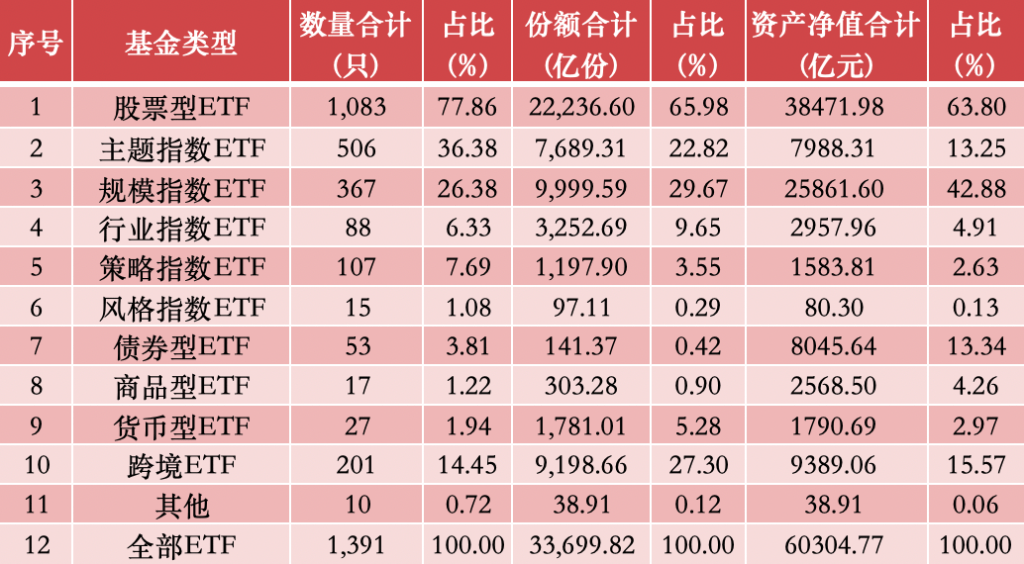
Core Viewpoint - The total scale of domestic ETFs in China has surpassed 6 trillion yuan, reaching 6.03 trillion yuan, with stock ETFs dominating the market [1] Group 1: ETF Market Overview - The total number of ETFs in the market is 1,391, with 125 exceeding 10 billion yuan and 7 surpassing 100 billion yuan [1] - The largest ETF is the Huatai-PB CSI 300 ETF, with a scale of 427.07 billion yuan, followed by E Fund and Huaxia ETFs [1] - The rapid expansion of the domestic ETF market is evident, with significant growth from 1 trillion yuan in October 2020 to over 6 trillion yuan by December 2023 [3] Group 2: ETF Types and Sizes - Stock ETFs account for 77.86% of the total number of ETFs and 63.80% of the total net asset value, amounting to 38.47 trillion yuan [3] - The largest cross-border ETF is the FTSE China Hong Kong Internet ETF, with a scale of 80.46 billion yuan [2] - The bond ETF market has 53 products, with a total scale of 804.56 billion yuan, while commodity ETFs total 256.85 billion yuan [3] Group 3: Fund Inflows - In the four months during which the ETF scale increased from 5 trillion to 6 trillion yuan, 22 ETFs saw net inflows exceeding 10 billion yuan [4] - The top inflow ETFs include the Southern CSI 500 ETF and various technology bond ETFs, each with inflows over 10 billion yuan [4][5] - Key sectors attracting investment include gold, securities, and Hong Kong internet stocks, with significant inflows into related ETFs [4] Group 4: Market Drivers - The rapid growth of ETF scale is attributed to policy support, an improved product system, and increased market allocation demand [6] - ETFs are recognized for their transparency and lower management fees, making them an attractive investment option compared to actively managed funds [6]

4只中证2000指数ETF成交额环比增超50%
Zheng Quan Shi Bao Wang· 2025-12-24 11:32
Core Viewpoint - The trading volume of the CSI 2000 Index ETFs increased significantly today, indicating heightened market activity and investor interest in this segment [1]. Trading Volume Summary - The total trading volume of the CSI 2000 Index ETFs reached 510 million yuan today, an increase of 138 million yuan from the previous trading day, representing a growth rate of 37.01% [1]. - Specifically, the CSI 2000 ETF (563300) had a trading volume of 287 million yuan, up 105 million yuan from the previous day, with a growth rate of 58.04% [1]. - The Southern CSI 2000 ETF (159531) recorded a trading volume of 125 million yuan, an increase of 44.26 million yuan, with a growth rate of 54.78% [1]. - The Huatai-PB CSI 2000 ETF (159536) had a trading volume of 8.06 million yuan, up 3.57 million yuan, with a growth rate of 79.62% [1]. - The top performers in terms of trading volume increase included the Huatai-PB CSI 2000 ETF (159536) and the Fortune CSI 2000 ETF (563200), both showing increases of 79.62% and 79.58% respectively [1]. Market Performance Summary - As of market close, the CSI 2000 Index (932000) rose by 1.55%, while the average increase for related ETFs was 1.71% [1]. - The Southern CSI 2000 ETF (159531) and the Fortune CSI 2000 ETF (563200) were among the top gainers, with increases of 2.07% and 2.04% respectively [1].
90余只货基七日年化收益率跌破1%
Zheng Quan Ri Bao· 2025-12-23 16:15
Core Viewpoint - The money market funds (MMFs), once considered a stable investment tool, are facing challenges due to declining returns, with many funds reporting annual returns below 1% [1][2] Group 1: Current Market Situation - As of December 23, 112 MMFs have annual returns below 1%, with some large-scale funds like Huatai-PB Cash Management Fund C and ICBC Ruyi Money Fund E reporting returns below 0.5% [1] - By December 22, 92 MMFs had a seven-day annualized yield below 1%, indicating a widespread decline in returns [1] - The largest MMF, Tianhong Yu'ebao, reported an annual return of 1.15% and a seven-day annualized yield of 1.032% as of December 22 [1] Group 2: Reasons for Declining Yields - The decline in MMF yields is attributed to three main factors: continued accommodative monetary policy, ample liquidity in the banking system leading to lower interbank deposit rates, and self-regulation of non-bank deposit rates [2] - The current 10-year government bond yield is at 1.83%, reflecting a dual decline in market interest rates and real economy rates, indicating effective market mechanisms [2] Group 3: Investment Strategy and Outlook - Investors are advised to reposition MMFs as tools for daily liquidity management rather than high-yield investment channels, focusing on reasonable fee structures and stable strategies [2] - Industry experts believe that as the market interest rate environment stabilizes, MMFs will continue to play a crucial role in cash management and will maintain their fundamental value in supporting inclusive finance and meeting daily liquidity needs [2]
2025公募基金十大关键事件纵览:高质量发展行动方案发布 “中国版平准基金”横空出世 销售费率新规明确
Xin Lang Cai Jing· 2025-12-23 10:36
Group 1 - The core viewpoint of the article highlights the significant developments in the public fund industry in 2025, with a focus on regulatory reforms, market stability, and the industry's growth trajectory towards a scale of nearly 37 trillion yuan [1][16]. - The China Securities Regulatory Commission (CSRC) issued the "Action Plan for Promoting High-Quality Development of Public Funds," which includes 25 measures aimed at addressing industry pain points and shifting the focus from scale to returns [1][18]. - The introduction of a "Chinese version of the stabilizing fund" by the central bank and financial regulators aims to maintain market stability, with the "national team" committing to support the capital market [3][20]. Group 2 - The new sales fee regulations will lead to a reduction in public fund sales costs by approximately 30 billion yuan annually, marking the final phase of a three-stage fee reform [4][21]. - The launch of floating fee rate funds has seen positive market reception, with 84.6% of the first batch of 26 funds achieving positive returns, indicating a successful trial of innovative fund structures [6][22]. - The public fund industry experienced significant personnel changes, with 450 executives from 161 companies undergoing changes, reflecting a broader trend of leadership transitions within major fund companies [7][23]. Group 3 - Regulatory enforcement has intensified, with several fund companies facing penalties for violations, underscoring the commitment to investor protection and stricter oversight [9][25]. - The CSRC is seeking opinions on a systematic standard for performance benchmarks in public funds, aiming to enhance internal controls and ensure stable investment styles [11][27]. - The investment education system has been upgraded, with various initiatives launched to enhance investor protection and awareness, including collaborations with multiple fund companies [12][29]. Group 4 - The public fund sales behavior norms are being revised to prohibit short-term performance promotions and encourage long-term rational investment strategies [13][30]. - The personal pension system has expanded significantly, with over 300 fund products and a total scale exceeding 15 billion yuan, marking a critical transition in the pension fund landscape [14][32]. - The public fund industry is moving towards a more regulated and transparent phase, emphasizing investor interests and the importance of reform and innovation for sustainable growth [15][33].
大部分基金公司都是陪跑
Xin Lang Cai Jing· 2025-12-23 01:44
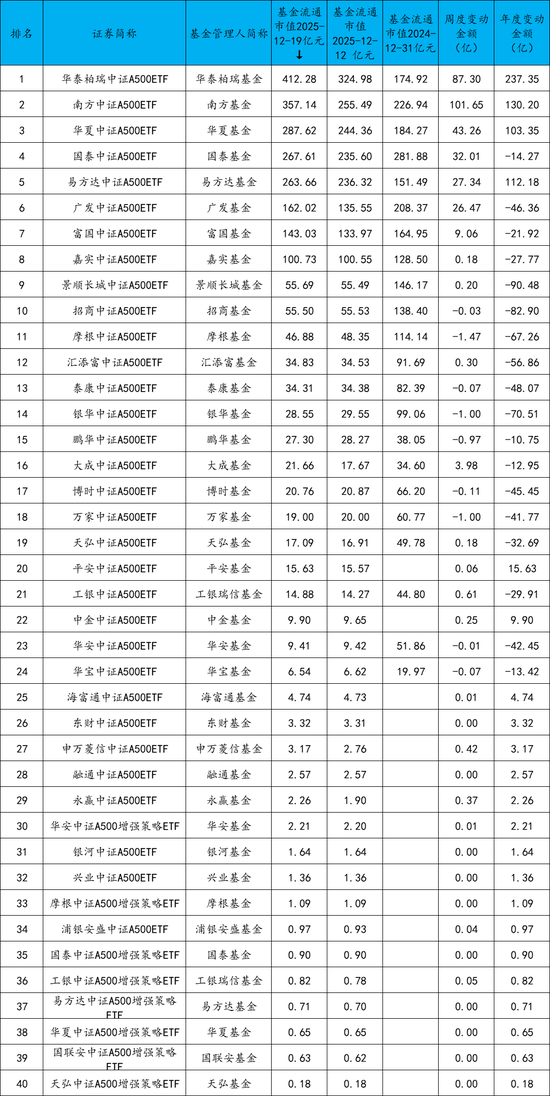
Core Viewpoint - The launch of the CSI A500 index has created a competitive landscape in the ETF market, where only a few major players dominate, while many smaller firms end up as "also-rans" [1][2][10]. Group 1: Market Dynamics - The CSI A500 index was launched in September 2024 and is considered a significant opportunity for public funds, leading to a rush of product submissions from various fund companies [2][17]. - By mid-December 2025, the total market size of A500 ETFs approached 250 billion yuan, indicating a rapid growth in this segment [2][17]. - The market has shown a clear "head effect," where a few leading funds capture the majority of the assets, leaving smaller firms struggling to compete [3][18]. Group 2: Fund Performance - The top five A500 ETFs, including Huatai-PB, Southern, and Huaxia, have assets ranging from 260 billion to 412 billion yuan, collectively dominating the market with nearly 1.6 trillion yuan [6][22]. - Recent inflows have been substantial, with Huatai-PB and Southern ETFs attracting 87.30 billion and 101.65 billion yuan, respectively, in just one week [7][22]. - The performance of smaller funds has been lackluster, with many experiencing significant redemptions and struggling to maintain their market presence [7][22]. Group 3: Challenges for Smaller Firms - Smaller public funds face significant challenges due to resource constraints, making it difficult to compete with larger firms that have established marketing and distribution channels [11][12]. - The cost of marketing and maintaining sales channels is high, with management fees for A500 ETFs around 0.15%, making it hard for smaller firms to achieve profitability without substantial scale [11][12]. - Some smaller firms have opted to withdraw from the competition, adopting a strategy of waiting rather than engaging in a costly race for market share [12][13]. Group 4: Future Outlook - The competitive landscape suggests that the development of index funds should be gradual, focusing on building differentiated competitive advantages rather than following trends blindly [13]. - Smaller firms may need to explore niche markets such as thematic, strategy-based, QDII, bond, or actively managed ETFs to find sustainable growth opportunities [13]. - The prevailing trend indicates that a few giants will continue to dominate the market, while many participants may remain on the sidelines [14].
两市ETF两融余额减少4.53亿元丨ETF融资融券日报
2 1 Shi Ji Jing Ji Bao Dao· 2025-12-22 06:49
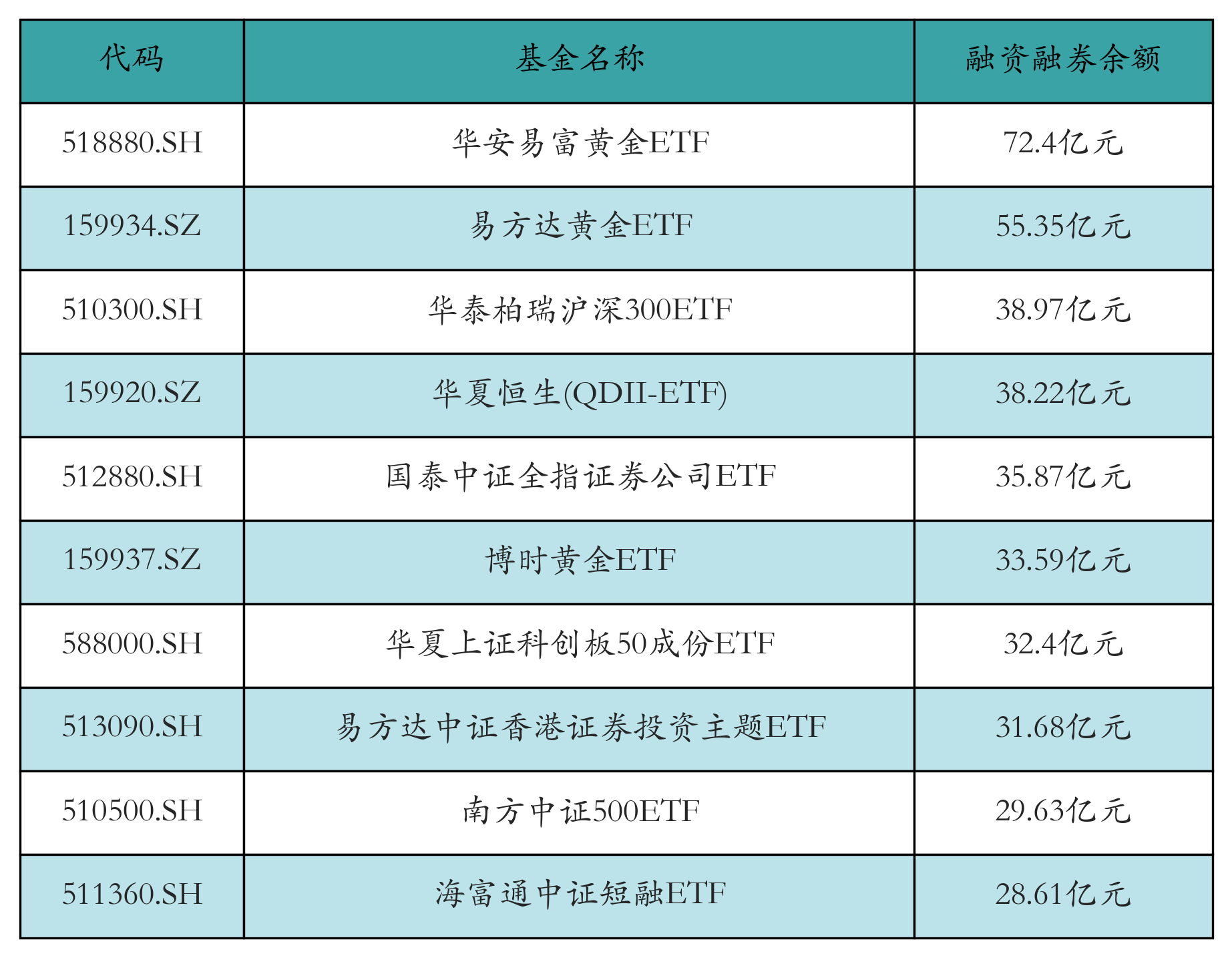
Market Overview - As of December 19, the total ETF margin balance in the two markets is 119.13 billion yuan, a decrease of 0.453 billion yuan from the previous trading day [1] - The financing balance is 111.87 billion yuan, down by 0.37 billion yuan, while the securities lending balance is 7.26 billion yuan, reduced by 83.13 million yuan [1] - In the Shanghai market, the ETF margin balance is 83.61 billion yuan, a decrease of 0.28 billion yuan, with a financing balance of 77.25 billion yuan, down by 0.213 billion yuan [1] - In the Shenzhen market, the ETF margin balance is 35.53 billion yuan, a decrease of 0.173 billion yuan, with a financing balance of 34.62 billion yuan, down by 0.157 billion yuan [1] ETF Margin Financing Balances - The top three ETFs by margin financing balance on December 19 are: - Huaan Yifu Gold ETF (7.24 billion yuan) - E Fund Gold ETF (5.535 billion yuan) - Huatai-PB CSI 300 ETF (3.897 billion yuan) [2] ETF Financing Buy Amounts - The top three ETFs by financing buy amounts on December 19 are: - Hai Futong CSI Short Bond ETF (1.465 billion yuan) - E Fund CSI Hong Kong Securities Investment Theme ETF (1.31 billion yuan) - Huatai-PB Southbound Hang Seng Technology Index (0.869 billion yuan) [4] ETF Financing Net Buy Amounts - The top three ETFs by financing net buy amounts on December 19 are: - Huabao CSI Bank ETF (178 million yuan) - Huaxia Shanghai Stock Exchange Sci-Tech Innovation Board 50 ETF (70.336 million yuan) - E Fund CSI Hong Kong Securities Investment Theme ETF (58.834 million yuan) [6] ETF Securities Lending Sell Amounts - The top three ETFs by securities lending sell amounts on December 19 are: - Southern CSI 500 ETF (18.5254 million yuan) - Huatai-PB CSI 300 ETF (16.5763 million yuan) - GF CSI 1000 ETF (9.4158 million yuan) [8]
不给基金持有人短期“惊喜”或“惊吓”
Zheng Quan Shi Bao· 2025-12-21 04:23
Core Viewpoint - The A-share market is potentially entering a slow bull phase driven by dual factors of valuation recovery and profit improvement [2][6]. Group 1: Market Conditions - Current bank stocks offer a dividend yield exceeding 4%, significantly higher than the yield on ten-year government bonds, indicating a favorable investment environment [2]. - There is an expectation of a rebound in profitability for cyclical industries, contributing to a positive market sentiment [2][6]. - The average price-to-book ratio for the banking sector is currently 0.7, suggesting that the valuation disparity is unsustainable [6]. Group 2: Investment Strategy - The company employs a strategy of "extreme diversification + safety margin" to navigate potential market volatility, utilizing quantitative models to identify undervalued and profit-stable assets [2][3]. - The investment philosophy adheres to the "absolute return" principle, focusing on dynamic asset allocation based on market conditions rather than a fixed stock-bond ratio [3]. - The company emphasizes a balanced and diversified portfolio, with individual stock holdings rarely exceeding 1% of total positions, aiming for a long-term positive experience for investors [4]. Group 3: Sector and Stock Selection - The investment approach includes a balanced distribution across industries and a diversified stock selection, with a focus on low valuation and stable profit growth [4][5]. - The company tracks potential stocks using quantitative models to efficiently identify promising sectors and stocks, while final investment decisions are based on safety and return assessments [5]. Group 4: Outlook on Equity and Bond Markets - The equity market is expected to experience a slow bull trend, with improved market sentiment and potential for significant capital inflows [6]. - In the bond market, the company maintains a cautious stance due to historically low interest rates and limited room for further declines, focusing on mid to short-duration bonds for their value [7].

直击2025证券时报分析师年会:洞见价值荣耀加冕 投研天团苏州论剑
Zheng Quan Shi Bao Wang· 2025-12-18 23:32
Group 1 - The 2025 Securities Times Analyst Annual Conference and Best Analyst Award Ceremony was held in Suzhou, featuring over 60 securities firms, nearly 100 listed companies, and around 2,000 guests [2][3] - The conference theme was "Going Far by Starting Small," focusing on enhancing financial service quality to support the real economy [2] - The event included a main forum and specialized forums, showcasing the strongest research teams and discussing investment hotspots [2][3] Group 2 - The 2025 Best Analyst Award winners were announced, with notable firms like Changjiang Securities, GF Securities, and others recognized for their research capabilities [3] - The award for "Visionary Investment Institutions" was given based on voting accuracy across 30 research areas, with several prominent funds receiving accolades [4] - Over 800 institutions participated in the voting process, managing assets exceeding 100 trillion yuan, marking a significant milestone [4] Group 3 - The conference included discussions on investment strategies for 2026, with insights from top analysts on macroeconomic trends and market directions [5] - Key themes included the rise of global narratives, economic differentiation, and the performance of precious metals and emerging market stocks [6] - Analysts expressed a cautious outlook for 2026, anticipating a narrowing of economic temperature differences and potential policy space in the real estate sector [6][7]



270只基金年内退场
第一财经· 2025-12-17 15:48
Core Viewpoint - The article discusses the ongoing trend of fund liquidations as the year-end approaches, highlighting that 270 funds have been liquidated this year, with over 80% due to insufficient scale or number of investors [3][6]. Group 1: Fund Liquidation Trends - As of December 18, 2025, the 17th fund of the month entered liquidation, with 47 additional funds issuing warnings about potential liquidation [5]. - The majority of liquidated funds are equity funds, with 171 out of 270 funds liquidated this year being equity funds, accounting for over 60% of the total [6][11]. - Many newly established funds, some less than a year old, are facing liquidation, indicating a challenging environment for new products [5][6]. Group 2: Causes of Liquidation - Poor performance and loss of investor trust are cited as primary reasons for the liquidation of equity funds, exacerbated by a volatile market [6][10]. - A significant number of funds are failing to meet the minimum asset threshold of 50 million yuan, leading to liquidation warnings [5][6]. - Among the liquidated funds, at least 57 were initiated without meeting the minimum fundraising requirement of 200 investors or 200 million yuan, indicating a systemic issue in fund management [7]. Group 3: Mini Fund Challenges - The article highlights the ongoing struggles of "mini funds," which are funds with low asset sizes that are increasingly at risk of liquidation [8][10]. - Some fund companies have adjusted their automatic termination clauses to extend the liquidation period from 50 to 60 days, providing more options for struggling funds [9]. - Despite efforts to maintain operations, many funds are facing challenges in gathering sufficient investor participation for decision-making meetings [10]. Group 4: Market Dynamics and Future Outlook - The current market conditions are leading to a concentration of resources towards more competitive and viable funds, as the industry shifts towards a focus on quality over quantity [3][6]. - Fund companies are weighing the strategic value of maintaining underperforming funds, with some opting to retain funds that may have future potential despite current challenges [10]. - The scarcity of fund shell resources has increased the difficulty of reissuing certain specialized products after liquidation, suggesting a tightening market for fund offerings [10].

270只基金年内退场,次新基金与债基均难幸免
Di Yi Cai Jing Zi Xun· 2025-12-17 14:21
Group 1 - The core viewpoint of the article highlights the ongoing trend of fund liquidations as the year-end approaches, with 270 funds having announced their exit this year, primarily due to insufficient scale or number of investors [1][3][4] - A total of 47 funds have issued liquidation warnings this month, indicating a significant number of products are at risk of being forced out of the market [2][3] - Equity funds are identified as the most affected category, with 171 out of the 270 liquidated funds being equity funds, representing over 60% of the total [3][4] Group 2 - The article notes that many newly established funds, including those less than a year old, are facing liquidation, reflecting a broader trend of underperformance and loss of investor confidence [1][2] - The bond market's continued adjustment in the fourth quarter has also led to several bond funds facing liquidation or warning signs, indicating a challenging environment for these products [3][4] - The industry is witnessing a shift towards a more selective approach, with resources likely concentrating on more competitive products as the number of funds exceeds ten thousand [1][5] Group 3 - Fund companies are modifying their automatic termination clauses to extend the liquidation period and provide more options for "mini funds," but the decision to liquidate or continue operations still requires investor input [5][6] - Instances of failed shareholder meetings to decide on fund continuance are becoming common, reflecting low investor engagement and interest in these products [6][7] - The article suggests that the decision to maintain or liquidate a fund often depends on the strategic positioning of the product within the company's portfolio, with some companies willing to retain funds that may have future potential [7][8]