Burberry

Search documents
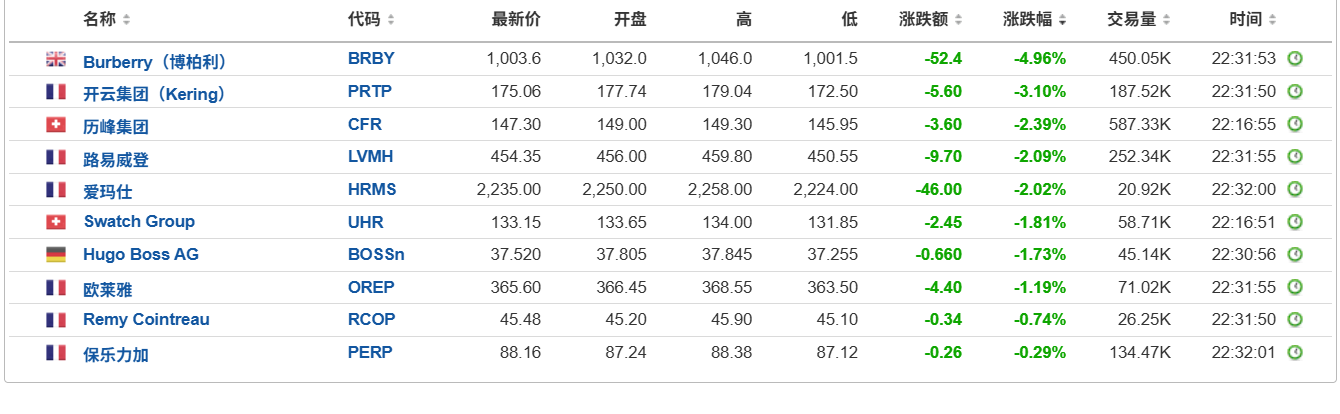
欧洲奢侈品概念股普遍下跌,博柏利跌超4.9%,开云集团、瑞士历峰集团、LVMH集团、爱马仕跌3.10%-2.02%,雨果博斯跌超1.7%,LVMH集团跌约1.2%。高盛欧洲奢侈品股票篮子指数下跌1.8%,创4月24日以来最低水平。
news flash· 2025-06-19 14:38
Group 1 - European luxury stocks experienced a widespread decline, with Burberry falling over 4.9%, Kering, Richemont, LVMH, and Hermès dropping between 3.10% and 2.02%, and Hugo Boss decreasing by over 1.7% [1] - The Goldman Sachs European luxury stock basket index fell by 1.8%, reaching its lowest level since April 24 [1] Group 2 - Burberry's latest price was 1,003.6, down by 52.4, or 4.96% [2] - Kering's latest price was 175.06, down by 5.60, or 3.10% [2] - Richemont's latest price was 147.30, down by 3.60, or 2.39% [2] - LVMH's latest price was 454.35, down by 9.70, or 2.09% [2] - Hermès' latest price was 2,235.00, down by 46.00, or 2.02% [2] - Hugo Boss' latest price was 37.520, down by 0.660, or 1.73% [2] - Other luxury brands like Swatch Group, L'Oréal, Rémy Cointreau, and Pernod Ricard also saw minor declines [2]



2025年第23周:服装行业周度市场观察
艾瑞咨询· 2025-06-19 07:08
Group 1: Second-Hand Luxury Market - The second-hand luxury goods market is expanding into county-level cities, reflecting an increase in consumer spending power in these areas. During the Spring Festival, order volume for second-hand luxury items in fifth-tier cities grew by 33%, while third and fourth-tier cities also saw double-digit growth [1] - Challenges for second-hand luxury stores in county areas include limited style variety, inventory backlog, and profit compression, necessitating stable sourcing and authentication capabilities [1] - The second-hand luxury industry is shifting from high profits to refined operations, with competition expected to concentrate among financially strong major players or local small shops [1] Group 2: New Consumption Trends - New consumption brands are rapidly emerging by targeting lower-tier markets and utilizing efficient channels, disrupting traditional consumer perceptions in first and second-tier cities [2] - Generation Z consumers prioritize emotional value, cost-effectiveness, and information transparency, driving a comprehensive restructuring of products, brands, and channels [2] - The lower-tier market shows strong consumption potential, becoming a new growth engine, reflecting profound changes in demand-side consumption [2] Group 3: Emotional Value in Luxury Consumption - A report indicates that happiness dominates luxury consumption trends in China, with brands needing to provide enjoyable and relaxed experiences while emphasizing equality and respect [4] - The value of luxury goods is shifting towards emotional, cultural, and personal expression, with consumers seeking resonance with ideal personas [4] - Changes in product roles are evident, with bags focusing on practicality and jewelry serving as emotional tokens, highlighting the need for brands to create high-level emotional connections [4] Group 4: Gold Consumption and IP Collaboration - The gold consumption market in China is experiencing turbulence, with rising gold prices but weak demand, leading to a decline in jewelry consumption and an increase in investment gold bars [5] - Brands are exploring the "Golden Valley" model, combining IP collaborations with the value retention of gold to shift consumer perception from "family assets" to "personal expression" [5] - Companies like Chow Tai Fook and Lao Feng Xiang are partnering with anime IPs to achieve product premiumization, while future strategies must balance value retention with emotional needs [5] Group 5: Fast Fashion Challenges - The fast fashion industry faces challenges due to the end of the U.S. tax exemption policy for small packages, significantly impacting the "small order quick response" model represented by Shein [10] - New tariffs increase costs and extend customs clearance times, undermining the rapid response advantage of these businesses [10] - While industry scale may decline in the short term, the "small order quick response" model remains a long-term development direction, requiring companies to innovate technologically and commercially [10] Group 6: Silver Economy in Luxury Brands - Luxury brands are targeting the "silver economy," with China's silver economy scale reaching 7 trillion yuan, indicating significant future potential [11] - Brands are developing practical products and age-appropriate experiences, such as lightweight handbags and cultural scene enhancements, to cater to this demographic [11] - Silver consumers are rational and loyal, focusing on self-expression and brand connotation, prompting brands to reinforce nostalgic emotions through classic revivals and workshops [11] Group 7: Brand Dynamics - The Chinese menswear brand Li Ning has opened its first overseas store in Malaysia, marking a key step in its internationalization strategy [12] - The opening aligns with Li Ning's multi-brand and international strategy, with projected revenue of 3.65 billion yuan in 2024 and a total of 2,773 stores [12] - Semir's children's clothing brand Balabala is facing challenges in a competitive market, with a decline in revenue and net profit, necessitating supply chain optimization and product enhancement [13]

中产消费觉醒,让奢侈品特卖会火了?
Sou Hu Cai Jing· 2025-06-16 14:14
Core Insights - The luxury goods industry in China is experiencing a downturn, with sales expected to decline by 18%-20% in 2024, reverting to levels seen during the pandemic in 2020 [1] - The decline in full-price luxury goods sales is attributed to a shift in consumer focus towards luxury outlet sales events, which are gaining popularity among middle-class consumers [1] Group 1: Market Trends - Luxury outlet sales events are becoming a popular method for brands to clear inventory and generate cash flow, appealing to consumers who prefer reasonable prices over high markups [1] - Discount stores in China reached a market size of 30.60 billion yuan in 2023, with a year-on-year growth rate of 17.92%, indicating a blue ocean market for the discount sector [3] Group 2: Consumer Behavior - Consumers are increasingly valuing "buying right" over "buying expensive," reflecting a shift towards rational consumerism [7] - The exclusivity of luxury outlet events, often limited to members who have previously shopped at physical stores, restricts access for younger consumers interested in luxury goods [3] Group 3: E-commerce Opportunities - E-commerce platforms like Vipshop are capitalizing on the trend by connecting directly with brands for overseas warehouse direct shipping, offering significant discounts during promotional events [5] - During recent sales events, luxury items were available at prices significantly lower than retail, attracting consumers looking for bargains [5]
「丑车」卖爆了,“审丑经济学”硬控年轻人,越土越好卖?
3 6 Ke· 2025-06-03 10:55
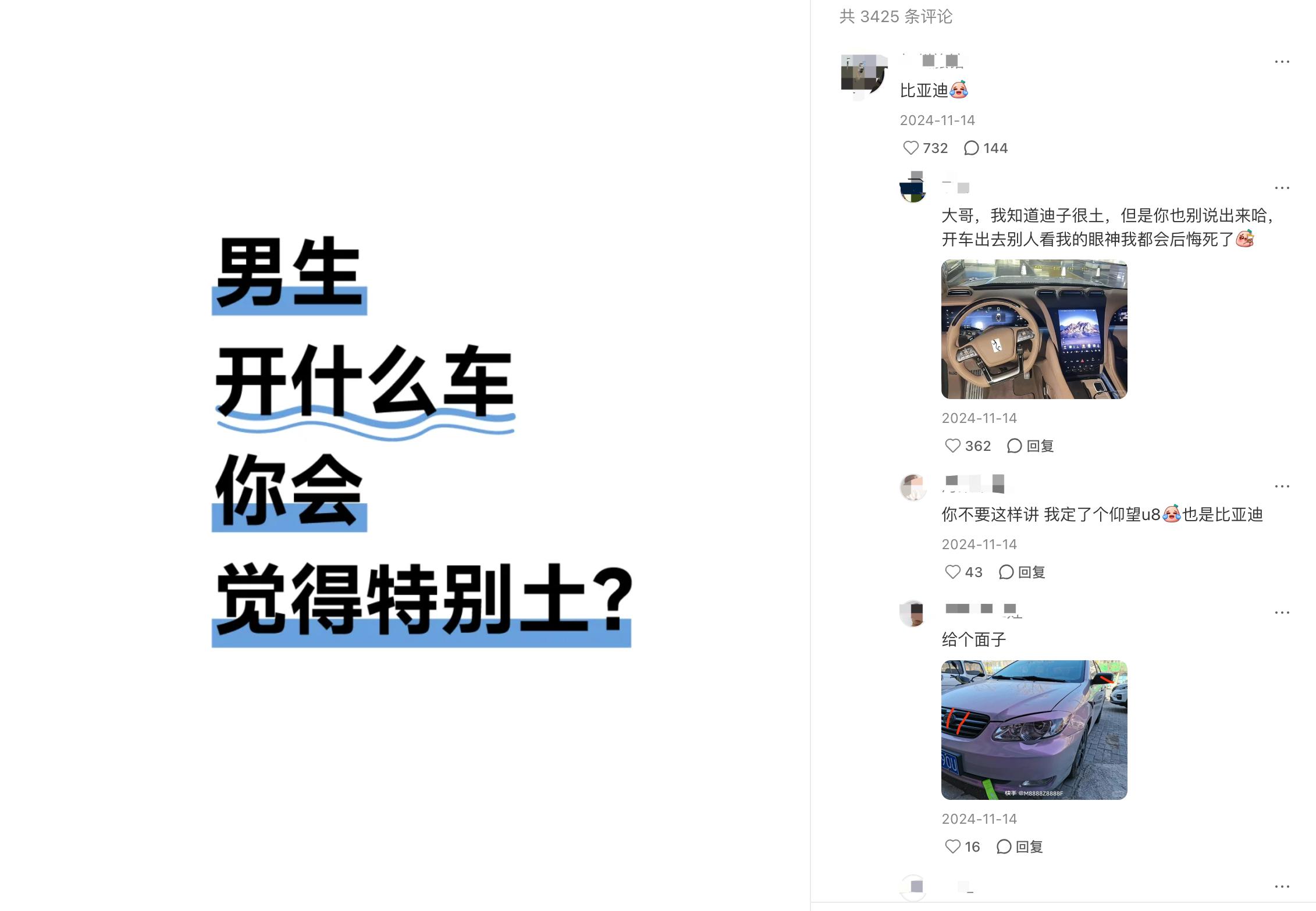
Core Viewpoint - The rise of "ugly design" in the automotive industry reflects a shift in consumer preferences, particularly among younger generations, who are increasingly embracing products that defy traditional aesthetic norms and challenge mainstream beauty standards [1][19][20]. Group 1: Trends in Automotive Design - Chinese car manufacturers are intentionally adopting "ugly designs" as a strategic response to market demands, prioritizing functionality over aesthetics [2][24]. - The K-Car model by BYD exemplifies this trend, as it is designed to cater to the Japanese microcar market, aiming for a 40% market share by next year [8][24]. - The "ugly" design of models like Li Auto's MEGA and NIO's Firefly has sparked debate, yet they have successfully attracted attention and sales, indicating a shift in consumer acceptance [9][15][18]. Group 2: Cultural and Economic Implications - The popularity of "ugly things" among young consumers signifies a broader cultural movement against "refined aesthetics," allowing for personal expression and identity through unconventional design [19][20]. - Brands are leveraging this trend to create buzz and engage consumers, as seen with high-profile collaborations and unique product offerings that challenge traditional beauty standards [21][22]. - The emergence of "ugly design" in the automotive sector highlights the need for differentiation in a rapidly evolving market, particularly as electric and smart technologies become standard [24][25]. Group 3: Future Directions - The challenge for Chinese automotive brands lies in translating the success of "ugly design" in domestic markets to international markets, where cultural perceptions of beauty differ [24][25]. - To achieve global recognition, these brands must develop a coherent aesthetic logic that resonates with youth culture worldwide, moving beyond mere product output to cultural influence [25][26]. - The ongoing experiment with "ugly design" presents an opportunity for the automotive industry to redefine its narrative and establish a new paradigm in global automotive aesthetics [25][26].

Burberry Banks On Schulman Turnaround As Bumper Pay Package Revealed
Forbes· 2025-06-02 12:50
Core Insights - Burberry is undergoing significant leadership changes and restructuring efforts to address its financial struggles and reposition itself in the luxury market [1][5][11] Executive Compensation - New CEO Joshua Schulman has received over $3.5 million in his first nine months, including relocation costs, and could earn up to $7.6 million this year if he meets bonus targets [2][3] - Schulman is also eligible for a potential $4.9 million bonus if he doubles Burberry's share price in three years [2] - Former CEO Jonathan Akeroyd received a $2 million payoff upon his exit, reflecting a year's notice including salary and benefits [4] Workforce Reduction - Burberry plans to cut approximately 1,700 jobs globally by 2027, which represents about 20% of its workforce, aiming for $81 million in additional cost savings [6][7] - The company has already reduced its workforce by over 870 employees, bringing the total to 8,459 [7] Financial Performance - Burberry reported an annual loss of just over $4 million for the year ending March 29, 2025, a significant decline from a profit of approximately $566 million the previous year [8] - The company is facing challenges due to a downturn in the global luxury goods market and issues with brand diversification [8] Strategic Initiatives - Schulman has initiated the "Burberry Forward" program to reset the brand's expression and focus on its heritage, particularly its outerwear [10] - The strategy aims to enhance brand sentiment and engagement, with a focus on authenticity in product offerings [11] Shareholder Sentiment - Despite the substantial executive payouts amid job cuts, Burberry's stakeholders have largely supported Schulman's recruitment and compensation structure [12][13] - The company has engaged with shareholders regarding the level of Schulman's pay and has taken feedback into account for bonus determinations [14]

年轻人买奢侈品必须要折扣,消费风向变了
Sou Hu Cai Jing· 2025-05-29 02:46
Core Insights - The luxury goods market is experiencing a significant downturn, with global sales projected to reach approximately €1.48 trillion in 2024, reflecting a growth rate of only -1% to 1%, marking the first overall decline since 2008-2009 [1] - The industry is facing a "price dependency syndrome," with iconic products like the Chanel 2.55 handbag seeing a price increase from ¥38,100 in 2019 to ¥84,000 in 2024, a rise of 120% [3] - Consumer sentiment is shifting, with younger generations increasingly valuing cost-effectiveness, leading to a decline in the willingness to pay high premiums for luxury items [3] Market Trends - Discount channels are becoming a significant avenue for luxury purchases, with outlets and platforms like Vipshop gaining popularity among consumers seeking better value [5] - The search volume for discounted luxury items surged during events like the 618 Mid-Year Shopping Festival, with brands such as COACH and Burberry seeing heightened interest [5] - Promotions on platforms can lead to substantial price reductions, exemplified by a Burberry bag originally priced at ¥16,200 being offered for ¥4,199, representing a 75% discount [5] Consumer Behavior - The luxury market is transitioning from "symbolic consumption" to "quality consumption," emphasizing the need for brands to balance price and value to thrive in the evolving consumer landscape [7] - The true essence of luxury is increasingly defined by the value of the consumer experience rather than just the price tag [7]

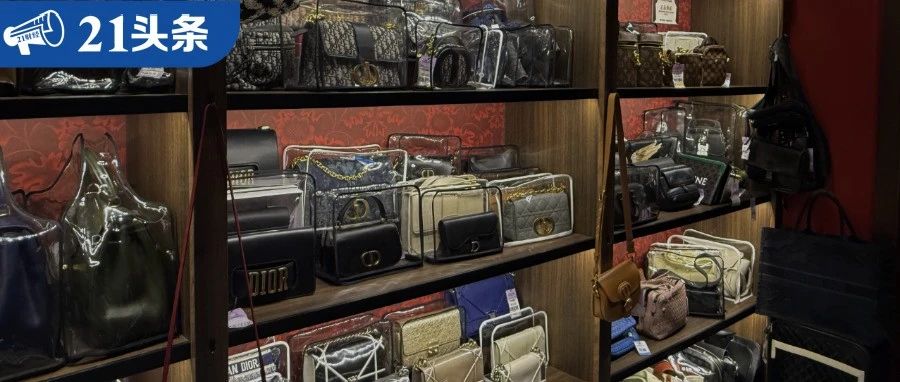
奢品包卖不动了?LV等巨头利润大跳水!“做二手奢品包的都在疯狂清库存”,买包理财神话终结
21世纪经济报道· 2025-05-28 11:12
Core Viewpoint - The luxury goods market is experiencing a significant downturn, with major brands like Chanel and LVMH reporting declines in sales and profits, indicating a shift in consumer behavior and a reevaluation of luxury items as investment assets [1][2][3]. Group 1: Industry Performance - Richemont reported a 4% increase in revenue to €21.4 billion for the fiscal year 2025, but a 1% decline in operating profit to €3.76 billion, with the Asia-Pacific market suffering a 13% revenue drop, particularly in China where it fell by 23% [3]. - LVMH's revenue decreased by 2% to €84.683 billion, with net profit down 17% to €12.25 billion, while Kering's revenue fell by 12% to €17.194 billion and net profit dropped by 62% [3]. - Chanel's sales for 2024 were $18.7 billion, a 4.3% decrease year-on-year, with operating profit down 30% [3]. Group 2: Market Trends - The luxury goods market in China is projected to decline by 18%-20% in 2024, returning to 2020 levels, with leather goods expected to drop by 20%-25% [4]. - High-end commercial properties are also affected, with Beijing SKP's sales plummeting 17% to ¥22 billion, and other malls experiencing a 6% revenue decline [4]. - The second-hand luxury market is seeing increased demand as consumers seek value, with significant price drops reported in the resale of luxury items [7][9]. Group 3: Consumer Behavior - Consumers are becoming more cautious, focusing on practicality and value rather than viewing luxury items as investment tools, with many preferring traditional investment options like ETFs and bank deposits [13][15]. - The perception of luxury goods as financial assets is shifting, with consumers recognizing the marketing illusion behind the idea of luxury items as reliable investments [15]. - The second-hand market is gaining traction, with consumers looking for high-value items at lower prices, and classic brands like Chanel and Hermes being viewed as more stable investments [10][14]. Group 4: Investment Shifts - The average annual price increase for Chanel's Classic Flap bag from 2015 to 2023 was 8.5%, while Hermes Birkin crocodile skin bags saw annual appreciation rates of 10%-15% [12][14]. - As traditional investment returns decline, gold is becoming a preferred investment choice among high-net-worth individuals, with 15.7% still considering it their top investment option [15].

江苏15条实招,撬动首发消费新高地
Sou Hu Cai Jing· 2025-05-27 23:15
今年以来,Burberry、DIOR等在宜兴窑湖小镇、运河外滩美术馆等地走起"中国风","扎堆式"首发首秀 品牌新品。如何推动首发经济更好撬动消费新浪潮?今年5月,省商务厅印发《江苏省加快推动首发经 济促进消费高质量发展的若干措施》,以"首店、首秀、首展、首发"为支点,聚焦丰富首发消费场景、 拓展首发多元供给、优化首发营商环境3个方面,提出15条务实举措,营造"可感知、可参与、可传 播"的消费热力圈。 满足"尝鲜需求" 打造特色消费场景 随着江苏省人均GDP超过2.7万美元,居民消费从"生存型"向"发展型""享受型"转变,个性化、品质化、 体验化需求日益凸显。《若干措施》提出,鼓励省级以上旅游休闲街区、夜间文化和旅游消费集聚区等 完善配套设施,吸引知名品牌入驻开设首店。 "骑行者的痛点,就是我们的创新起点。"站在紫金山南麓的"紫金·钟爱里"入口,项目负责人介绍,该 骑行友好街区占地近2万平方米,以紫金山脉轮廓为设计灵感,打造"无台阶、全坡道"的流畅动线。骑 行者可从地面直接滑行至负一层商铺,最大8度的缓坡设计既保障安全,又让"骑车到店"成为可能。5月 17日开街首日,超20家骑行主题商铺开门迎客,闪电自行车双 ...
年轻人没钱? Gucci要把上海比斯特奥莱店关掉!
Sou Hu Cai Jing· 2025-05-26 07:03
Core Insights - Gucci is experiencing significant challenges, including the closure of multiple stores in Shanghai and a decline in sales performance, indicating a shift from being a leading luxury brand to facing a downturn [2][11][21] Store Closures - Gucci will officially close its outlet store in Shanghai on June 2, following the earlier closure of two flagship stores in the city [2][11] - The brand has closed a total of six stores in China since July 2024, including locations in Fuzhou, Dalian, Taiyuan, and Shenyang, marking a significant reduction from its previous expansion strategy [9][11] - The rapid closure rate is notable, with Gucci having previously expanded aggressively, opening stores at a rate of 0.3 per day [9][21] Sales Performance - Kering Group, Gucci's parent company, reported a 14% decline in sales to €3.883 billion in Q1 2025, with Gucci's revenue dropping 25% to €1.57 billion [11] - Gucci's revenue for 2024 fell by 23% year-on-year to €7.65 billion, with a staggering 32% decline in the Asia-Pacific market, particularly in China [11][21] Consumer Sentiment - Younger consumers perceive Gucci as outdated, leading to a decline in impulse and status-driven purchases, which has affected overall sales [4][13] - The brand's reliance on outlet stores has created a perception of diminished value among regular customers, impacting their willingness to pay full price [6][18] Market Trends - The luxury market is facing a shift, with younger generations prioritizing experiences over luxury goods, leading to a decrease in spending on brands like Gucci [21][23] - The second-hand market for Gucci products has seen significant depreciation, with resale values ranging from 10% to 30% of original prices, further questioning the brand's value [16][18]

终于,连爱马仕也涨不动了
创业邦· 2025-05-22 10:06
Core Viewpoint - The luxury goods industry is facing significant challenges, including leadership changes in major companies, declining sales growth, and a shift in consumer behavior towards high-quality replicas and alternatives [3][4][30]. Group 1: Leadership Changes and Performance - Recent leadership changes in top luxury brands like LVMH and Kering reflect a response to market pressures and declining performance [3][4]. - Major luxury brands are experiencing disappointing sales, with Hermès' growth slowing by 10 percentage points compared to last year, and Kering's Gucci facing a double-digit decline in sales for five consecutive quarters [4][9]. - LVMH's revenue fell short of market expectations, particularly in its wine and spirits segment, leading to a nearly 13% drop in its stock price this year [7][9]. Group 2: Financial Performance - Burberry reported a staggering 94% drop in profit, prompting the company to cut approximately 20% of its global workforce to save £60 million by fiscal year 2027 [4][5]. - From 2019 to 2024, the luxury goods sector saw economic profits triple, primarily due to price increases, but signs of slowdown are evident as this strategy loses effectiveness [4][30]. - Prada stands out with a 13% revenue increase in Q1 2025, driven by strong performance from its Miu Miu brand, while Kering's overall sales dropped by 14% [9][11]. Group 3: Market Dynamics - The luxury market is experiencing a bifurcation, with core brands like Prada performing well while others like Gucci and YSL struggle [11][15]. - North America remains a stable market for luxury brands, with Hermès and Prada achieving growth of 11% and 9.9% respectively, while Japan shows a remarkable recovery with a 25% increase for Richemont [18][19]. - The luxury sector is witnessing a shift in consumer preferences, with a notable decline in the number of luxury consumers in North America by 12.5% from 2022 to 2024 [32]. Group 4: Product Performance - Leather goods continue to be a stronghold for luxury brands, with Hermès' leather and harness business growing by 10% [24][25]. - In contrast, the wine and spirits segment of LVMH saw an 8% decline, indicating a significant disparity in performance across different product categories [25][26]. - The demand for high-end watches and jewelry is declining, with Rolex's secondary market prices dropping over 30% from their peak two years ago [28][30]. Group 5: Strategic Challenges - The effectiveness of price increases as a strategy is waning, with brands like Prada and Balenciaga implementing price hikes in early 2025, citing inflation and rising costs [30][31]. - The rise of high-quality replicas is challenging traditional luxury brands, with a significant portion of consumers now openly purchasing and wearing these alternatives [33][35]. - The luxury industry faces a complex landscape of changing consumer demographics, economic uncertainties, and evolving retail channels, necessitating a reevaluation of strategies [35][37].