邮储银行

Search documents
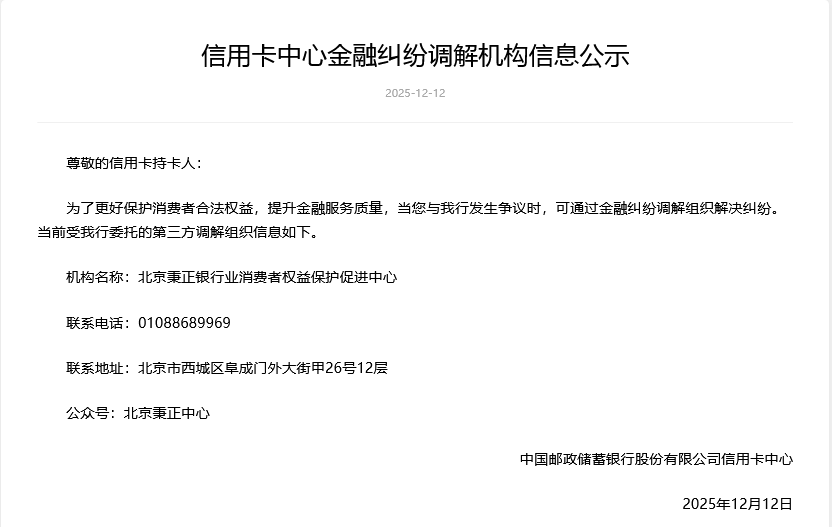
什么信号?国有大行首度公示第三方调解机构信息,各地正创新应对各类金融纠纷
Xin Lang Cai Jing· 2025-12-23 06:27
Core Viewpoint - Postal Savings Bank of China has publicly announced the information of third-party mediation organizations for financial disputes, marking the first instance among state-owned banks to disclose such information at the headquarters level [3][6]. Group 1: Announcement of Mediation Organizations - The bank has specified that the third-party mediation organization it has entrusted is the Beijing Bingzheng Banking Consumer Rights Protection Promotion Center [6]. - This move is unprecedented among major state-owned banks, as previous attempts were made at the branch level with local regulatory support [3][6]. Group 2: Regulatory Background - The external impetus for this action stems from a directive issued in April by the Financial Regulatory Bureau and the People's Bank of China, which emphasized the importance of addressing financial disputes and establishing relevant mechanisms [4]. - The internal reason includes the increasing number of disputes between banks and consumers due to changing economic conditions [5]. Group 3: Industry Response and Innovations - Various banks are actively innovating to address complaints and disputes, with some local regulators setting specific targets to reduce complaint volumes [5][10]. - Some regions have adopted practices from the insurance sector, such as providing risk warnings and mediation organization information during service transactions [5][11]. Group 4: Importance of Third-Party Mediation - The establishment of third-party mediation organizations is seen as a necessary solution, especially in cases where both banks and consumers believe they are not at fault [9]. - These organizations can facilitate communication between consumers and banks, helping to resolve issues like overdue fees more effectively [9]. Group 5: Local Regulatory Efforts - Local financial regulatory departments are placing significant emphasis on improving financial dispute mediation mechanisms and have set ambitious goals to reduce consumer complaints by approximately 30% in some regions [10]. - Many banks are enhancing their consumer rights protection departments, establishing independent offices to better safeguard consumer interests [10].


重磅!芦苇调任邮储集团副总经理,拟任邮储银行行长
Xin Lang Cai Jing· 2025-12-23 06:11
12月23日消息,金融一线获悉,中信银行行长芦苇调任邮储集团党组成员、副总经理,同时拟任邮储银 行行长一职。 据了解,邮政集团党组成员、副总经理兼邮储银行党委书记、行长刘建军现已满60岁。 "70后"芦苇是一名中信银行"老将",1997年加入该行后,曾在多家分支行担任要职,积累了丰富的金融 管理经验;2022年10月,芦苇离开中信银行,被中信信托任命为党委书记,后获批成为该公司总经理、 董事长;今年2月,芦苇回归中信银行担任党委副书记,4月获批出任行长一职,任职经历覆盖银行前中 后台以及信托业态。 在担任行长期间,芦苇曾指出,中信银行已经摒弃了规模情结,将更专注于效益和质量并重的增长,此 构成该行财务业绩背后的业务支撑。此外,他还深度推进"五篇大文章"和"五个领先"银行战略,提出将 财富管理打造成新的增长极。 芦苇将任邮储银行行长,曾在中信系统深耕超28年 公开资料显示,芦苇,男,1971年10月出生,持有中国、中国香港及澳大利亚注册会计师资格,获澳大 利亚迪肯大学会计学硕士学位。 2020年11月,中信银行发布董事会会议决议公告称,董事会同意聘任芦苇为该行副行长,2021年4月该 任职资格获批。 而后,芦苇 ...


恒生科技反转走强,银行、消费紧随其后,恒生医疗逆势回撤
Ge Long Hui· 2025-12-23 04:57
冲高回落,临近尾盘出现拉升,最终小涨0.43%。恒生科技涨幅居前,银行、大消费、互联网等紧随其 后,恒生医疗逆势回撤。 恒生医疗开盘后直线跳水,随后全天震荡下行,截至收盘下跌1.02%。其中药明生物下跌2.99%,药明生 物下跌2.6%,信达生物、康方生物、翰森制药、中国生物等股均小幅收跌;京东健康逆势大涨3.3%。 内容只是个人观点,仅供参考,不作为投资依据!欢迎关注交流,互相学习、共同探讨! 恒生科技高开低走后全天弱势,截至收盘上涨0.55%,中芯国际大涨5.92%,百度集团上涨1.26%,京东 集团、阿里巴巴、快手、美团等股均小幅收涨;小米集团逆势小跌1.83%,网易下跌0.09%。 银行股全天维持在中轴上方窄幅盘整,截至收盘上涨0.43%。其中汇丰控股上涨1.68%,中银香港上涨 1.67%,大新银行上涨1.13%;民生银行逆势小跌1.48%,邮储银行、郑州银行、交通银行等股均小幅收 跌。 ...

中国银行、建设银行、工商银行、农业银行、交通银行、邮储银行,集体调整中长期存款产品!
Mei Ri Jing Ji Xin Wen· 2025-12-23 03:53
Core Viewpoint - Major Chinese banks, including Bank of China, China Construction Bank, Industrial and Commercial Bank of China, Agricultural Bank of China, Bank of Communications, and Postal Savings Bank, have collectively adjusted their deposit products, particularly reducing the availability of medium to long-term deposit offerings as year-end savings demand increases [1][3]. Group 1: Changes in Deposit Products - Many customers, such as a resident in Beijing, have reported difficulties in finding suitable 5-year large-denomination certificates of deposit (CDs) as these products are no longer displayed by major banks [3]. - The interest rates for 3-year related products have dropped to between 1.5% and 1.75% across various banks [3]. - Smaller banks are also following suit, with institutions like Meizhou Commercial Bank and Yilian Bank removing 5-year fixed deposit products from their offerings [5]. Group 2: Reasons for Adjustments - The withdrawal of long-term deposit products is a response to the ongoing decline in banks' net interest margins, driven by falling loan rates that have significantly reduced asset yields [5]. - Analysts suggest that banks are compelled to eliminate high-interest long-term products to avoid severe interest margin losses or potential deficits, which could threaten their long-term stability and pose systemic risks [5]. Group 3: Implications for the Banking Sector - The adjustments in deposit products are expected to enhance the certainty of banks' profit forecasts, providing fundamental support for valuation recovery, particularly for large banks with low-cost liabilities and high dividend yields [6]. - The reduction in deposit rates may lead to a "deposit migration" effect, where funds seeking higher returns move from the banking system to capital markets, potentially benefiting direct financing markets [6].


中国银行、建设银行、工商银行、农业银行、交通银行、邮储银行,集体调整!
Mei Ri Jing Ji Xin Wen· 2025-12-23 03:45
Core Viewpoint - The recent decrease in medium to long-term deposit products in the market is attributed to banks' responses to the ongoing decline in net interest margins, leading to a reduction in the availability of five-year large certificates of deposit (CDs) and lower interest rates on three-year products [3][5][6]. Group 1: Market Trends - There is a noticeable reduction in the availability of five-year large CDs among major banks, with interest rates for three-year products dropping to between 1.5% and 1.75% [3]. - Smaller banks are also adjusting their deposit offerings, with some, like Meizhou Commercial Bank, announcing the removal of five-year fixed deposit products [5]. - The trend of withdrawing long-term deposit products is not limited to national banks but is also seen in local and private banks [5]. Group 2: Banking Sector Implications - The withdrawal of long-term deposit products is a necessary response to the challenges posed by declining bank net interest margins, as banks face significant risks of interest margin losses if they do not eliminate high-interest long-term products [5]. - Analysts suggest that this shift will enhance the certainty of banks' profit expectations, particularly benefiting large banks with low-cost liabilities and high dividend yields, making them more attractive to long-term investors [6]. - The reduction in deposit rates may lead to a "deposit migration" effect, where funds move from the banking system to capital markets, potentially increasing liquidity in stocks, bonds, and funds, which could positively impact direct financing markets [6].



加强协同 更大力度提振消费
Jin Rong Shi Bao· 2025-12-23 03:34
Group 1 - The central economic work conference emphasizes "domestic demand as the main driver" and the need to implement measures to boost consumption and increase residents' income [1][2] - Experts predict that consumption growth will be supported by enhanced policies and the accelerated release of service consumption potential by 2026 [1][2] - Financial institutions are innovating consumer credit products to meet the diverse needs of residents, aligning with government policies [2][3] Group 2 - Banks are actively responding to consumption promotion policies by increasing credit issuance and innovating service models, injecting vitality into the domestic consumption market [4][5] - The Industrial and Commercial Bank of China has issued nearly 100 billion yuan in personal consumption loans and signed up around 1.6 million clients for interest subsidy services [4] - Postal Savings Bank and other banks are launching exclusive discount activities to stimulate consumer spending, with significant participation from customers [6][7] Group 3 - There is a growing focus on service consumption, with a shift from basic needs to quality and personalized services, indicating a transformation in consumer behavior [7][8] - Financial institutions are encouraged to enhance their understanding of consumption promotion and innovate financial products and services to meet diverse consumer needs [8] - As of September 2025, the loan balance in key service consumption areas reached 2.8 trillion yuan, reflecting a 4.9% year-on-year growth [7]

坚持内需主导:加强协同 更大力度提振消费
Jin Rong Shi Bao· 2025-12-23 03:08
Group 1 - The central economic work conference emphasizes the importance of domestic demand and plans to implement actions to boost consumption and increase residents' income [1][2] - Financial institutions are innovating consumer credit products to meet the diverse needs of residents, with expectations for consumption growth driven by policy effectiveness and the release of service consumption potential by 2026 [1][2] - A coordinated effort involving top-level design and collaboration between local governments and financial institutions is underway to stimulate consumption through various policy measures [2][3] Group 2 - Major banks are aligning with government initiatives to support consumption, enhancing their product and service offerings to meet diverse financial needs [3][4] - Banks are actively participating in promotional activities to invigorate the consumption market, with significant loan disbursements and promotional campaigns reported [4][5] - Financial institutions are encouraged to innovate in financial services targeting service consumption, which is currently a weak area in China's consumption landscape [7][8] Group 3 - The demand for service consumption is rapidly increasing, driven by rising income levels and changing consumer preferences, with a notable shift from goods to services [7] - Financial institutions are advised to leverage digital finance to enhance online consumer finance accessibility and improve customer satisfaction [8]
半两财经|六大国有银行下架五年期大额存单 居民投资理财方式在变
Sou Hu Cai Jing· 2025-12-23 03:06
Core Viewpoint - The six major state-owned banks in China have collectively withdrawn high-interest five-year large-denomination certificates of deposit (CDs), marking a significant shift in the savings market as they adjust to ongoing pressure on net interest margins [2][3]. Group 1: Changes in Deposit Products - The five-year large-denomination CDs have been completely removed from sale, with searches on banking apps returning results indicating "no products available" or "sold out" [2]. - The minimum investment for three-year large-denomination CDs has increased significantly, with thresholds rising from the traditional 200,000 yuan to between 1 million and 5 million yuan, while the interest rate for a 1 million yuan three-year product is only 1.55%, narrowing the gap with regular savings accounts [3]. Group 2: Impact on Banking Sector - Data from the National Financial Regulatory Administration shows that the net interest margin for commercial banks was only 1.42% in Q3 2025, with predictions indicating a slight narrowing of the decline to around 4 basis points in 2026, marking the first time since 2022 that the annual decline will be in single digits [4]. - The continuous narrowing of net interest margins has been a significant factor affecting bank profitability, prompting banks to withdraw high-interest long-term deposit products to stabilize their margins [5]. Group 3: Shifts in Savings Behavior - The withdrawal of high-interest CDs has led to a migration of funds estimated to be in the hundreds of billions, as the market loses "risk-free high-yield" products [6]. - Despite 62.3% of residents still preferring to save more, this figure has been declining for two consecutive quarters, with a noticeable increase in the willingness to invest [6]. - Different types of savers are adjusting their strategies: conservative savers are sticking to deposit products, while moderate investors are moving towards bank wealth management and "fixed income plus" products, and aggressive investors are beginning to allocate funds to high-dividend stocks and gold ETFs [6].

在黑土地上书写新时代致富经
Qi Huo Ri Bao Wang· 2025-12-23 02:14
Core Viewpoint - The article highlights the journey of Li Fuqiang, a successful farmer and cooperative leader, who transformed his agricultural practices through technology, financial tools, and community support, ultimately aiming to expand his farming operations significantly. Group 1: Personal Journey and Challenges - Li Fuqiang, known as the "King of Soybeans," initially struggled with farming after returning home in 2001, facing significant losses due to inexperience [2][3] - After a series of setbacks, including a major loss of over 4.6 million yuan in 2013 due to adverse weather, he learned the importance of technical knowledge and risk management in agriculture [3][4] - The traditional belief of "five-year cycles" in farming, where farmers expect to earn for three years, lose in one, and break even in another, was challenged as Li's cooperative grew larger and faced increasing risks [5] Group 2: Adoption of Financial Tools - Li Fuqiang adopted the "insurance + futures" model after experiencing significant losses, which provided him with a safety net and allowed him to recover from disasters without depleting his savings [6][8] - In 2019, he received over 16 million yuan in compensation through this model, which helped him pay salaries and loans, demonstrating the effectiveness of financial instruments in agriculture [6][8] - By 2023, he participated in the "Yinqi Bao" project, which allowed him to secure better prices for his soybeans and reduce costs associated with intermediaries [7][8] Group 3: Community Impact and Future Plans - Li Fuqiang's cooperative has created over 500 jobs and increased local farmers' income by more than 16 million yuan, showcasing the cooperative's role in community development [9][10] - He has implemented innovative models to support local farmers, such as "capital entry into the cooperative" and "joint operation," which have helped improve the livelihoods of many in his community [9][10] - Looking ahead, Li plans to expand his farming operations to 500,000 acres, leveraging partnerships with large state-owned enterprises and modern agricultural practices [11]
六大国有银行,集体调整→
证券时报· 2025-12-22 23:50
Core Viewpoint - The article discusses the recent decline in the availability of medium to long-term deposit products in the banking sector, particularly five-year large certificates of deposit, amid increasing investment and savings demand from citizens as the year-end approaches [1][3]. Group 1: Market Trends - Citizens, like Ms. Wan from Beijing, are facing challenges in finding suitable five-year large certificates of deposit as many banks have reduced or removed these products from their offerings [1][3]. - Major state-owned banks, including Industrial, Agricultural, China, Construction, Communications, and Postal Savings Banks, have stopped displaying five-year large certificates of deposit, with three-year products' interest rates dropping to between 1.5% and 1.75% [3]. Group 2: Banking Sector Analysis - According to Zeng Gang, Director of the Shanghai Financial and Development Laboratory, the reduction of high-interest long-term deposit products is a necessary response to the ongoing decline in banks' net interest margins [5]. - The continuous decrease in loan interest rates has significantly reduced the yield on banks' asset sides, prompting banks to eliminate high-interest long-term products to avoid serious interest margin losses or even potential losses [5]. - The narrowing of net interest margins has been a critical factor affecting banks' profitability in recent years, and the recent removal of high-interest long-term deposit products is seen as a measure to stabilize these margins [5]. Group 3: Future Implications - Zeng Gang also noted that this trend indicates an enhancement in the certainty of banks' profit expectations, providing fundamental support for valuation recovery, particularly for large banks with low-cost liabilities and high dividend yield stocks, which may attract long-term capital [7].