亚马逊

Search documents
鲍威尔讲话打压降息预期,黄金跳水
Sou Hu Cai Jing· 2025-08-27 21:18
Core Insights - The Federal Reserve decided to maintain the federal funds rate target range at 4.25% to 4.50%, marking the fifth consecutive meeting without a change, aligning with market expectations [2][3] - There was notable dissent within the Federal Reserve, with two governors voting against the decision, advocating for a 25 basis point rate cut, reflecting a divided opinion on monetary policy [3] - Economic indicators suggest a slowdown in growth, with potential for future rate cuts if the trend continues, but uncertainties around inflation and employment remain high [3][6] Market Reactions - Gold prices fell over 1.5%, dropping below $3280 per ounce, with significant declines in U.S. gold stocks [7][10] - U.S. stock markets showed mixed results, with tech stocks like NVIDIA and Broadcom rising, while major companies like Apple experienced slight declines [10] - The Nasdaq China Golden Dragon Index fell by 1.82%, with significant drops in stocks like NIO and New Oriental [11] Commodity Market Impact - Following the Federal Reserve's meeting, former President Trump announced a 50% tariff on imported semi-finished copper, leading to an 18% drop in copper prices in New York [11]

暴涨43倍!超越茅台,新股王诞生
Ge Long Hui A P P· 2025-08-27 09:21
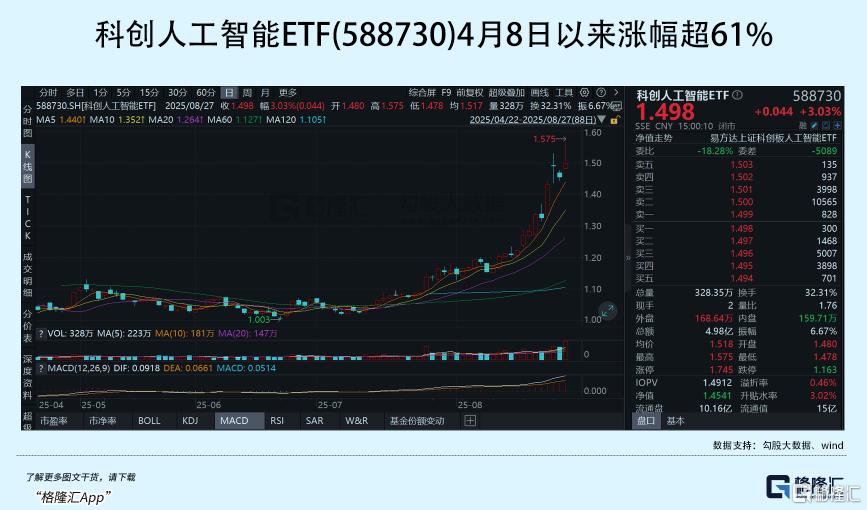
Core Viewpoint - The AI sector is experiencing significant growth, driven by strong policy support, impressive earnings reports from key companies, and increasing investment through ETFs [7][8][11]. Group 1: Market Performance - The AI sector, including chips, optical modules, communication devices, and internet segments, has collectively surged, with Cambricon's stock price soaring nearly 10% at one point, surpassing Kweichow Moutai to become the new stock king of A-shares [2]. - Cambricon's stock has seen a maximum increase of over 100% this month and a cumulative increase of over 2500% in 2023, with its market capitalization exceeding 600 billion yuan [2]. - The performance of Cambricon has positively influenced the Sci-Tech Innovation AI ETF (588730), which rose by 3.03% today and has increased over 61% since April 8 [2]. Group 2: Policy Support - The State Council's official release of the "Artificial Intelligence +" action plan aims for deep integration of AI with six key sectors by 2027, with a target of over 70% application penetration of new intelligent terminals and agents [7]. - By 2030, the penetration rate is expected to exceed 90%, establishing AI as a crucial growth driver for China's economy [7]. Group 3: Earnings Reports - Cambricon reported a staggering revenue of 2.881 billion yuan for the first half of 2025, a year-on-year increase of 4347.82%, and a net profit of 1.038 billion yuan, marking a turnaround from a loss of 530 million yuan in the same period last year [7][8]. - Zhongji Xuchuang also reported strong earnings, with a revenue of 14.789 billion yuan, up 36.95%, and a net profit of 3.995 billion yuan, an increase of 69.40% year-on-year [7]. Group 4: Investment Trends - The trend of investing in AI through ETFs is gaining momentum, with significant net inflows into the Sci-Tech Innovation AI ETF (588730) and another AI ETF (159819), indicating strong demand for AI-related investments [14]. - The total scale of ETFs has rapidly climbed to 5 trillion yuan, with the latest surge occurring in just five months [13]. Group 5: Industry Growth - The rapid growth of companies like Cambricon and Zhongji Xuchuang reflects the increasing demand for AI infrastructure, driven by the global AI arms race and the need for data centers and AI servers [17]. - The performance of these companies is supported by their established relationships with major tech firms, ensuring a steady flow of orders and revenue [16]. Group 6: Future Outlook - The AI sector is positioned for continued growth, with hardware providers like Cambricon and Zhongji Xuchuang benefiting from high demand for their products [27]. - The ongoing AI revolution is expected to create substantial commercial value, with various applications nearing commercialization and clear business models emerging [27].
大动作!美银拆解全球资金流向,机构配置逻辑已清晰
贝塔投资智库· 2025-08-27 04:00
Group 1 - The core logic of the report revolves around "fund holding behavior + active exposure + triple momentum," revealing global institutional capital's allocation preferences under the long-term theme of AI [3] - The semiconductor sector has seen significant increases in investment due to the recovery of the AI long-term investment theme, with a net purchase of $27.2 billion, making it the largest industry for net buying [4] - The industrial and healthcare sectors faced significant sell-offs, with net outflows of $42.3 billion and $27.1 billion respectively, driven by a decline in global manufacturing PMI and rising uncertainty in healthcare policies [4][7] Group 2 - From a regional perspective, the Asia-Pacific region (excluding Japan) has become a major beneficiary, attracting a net inflow of $21 billion, primarily due to valuation recovery in technology sectors like semiconductors and the growth expectations in Southeast Asia's manufacturing [8] - In contrast, the US market experienced a net outflow of $6.5 billion, reflecting institutional concerns over the high interest rate environment and slowing economic growth [12] - Other regions, including Europe and Japan, also saw slight outflows, but the Asia-Pacific region remains one of the top areas for capital inflow in 2025 [13] Group 3 - On an individual stock level, Nvidia and TSMC emerged as the top beneficiaries, with Nvidia receiving a net purchase of $16.9 billion, while TSMC gained $5.9 billion due to its advanced process technology [17][21] - Conversely, Apple faced a net reduction of $11.2 billion due to weak consumer electronics demand, while Honda was also reduced by $1.1 billion due to slow progress in electric vehicle transformation [17][21] Group 4 - The report identifies four major stock screening criteria: crowded positives, crowded negatives, under-owned positives, and under-owned negatives, which help in identifying potential investment opportunities and risks [22] - Crowded positives include stocks with high ownership and positive momentum, such as Meta, Broadcom, and Netflix, which benefit from long-term themes [23] - Crowded negatives are stocks with high ownership but low active exposure and negative momentum, such as Meituan and LVMH, indicating potential reversal risks [25] Group 5 - The backtesting results from 2015 to 2025 show that crowded positive stocks have an annualized return of 9.4%, significantly outperforming the global composite index, while crowded negative stocks have an annualized return of only 0.0% [31] - The report concludes that AI and the Asia-Pacific region will be the core themes for the second half of 2025, with semiconductor stocks and internet leaders being key areas of focus for investors [34]

多只中概股,大涨
Zheng Quan Shi Bao· 2025-08-27 00:15
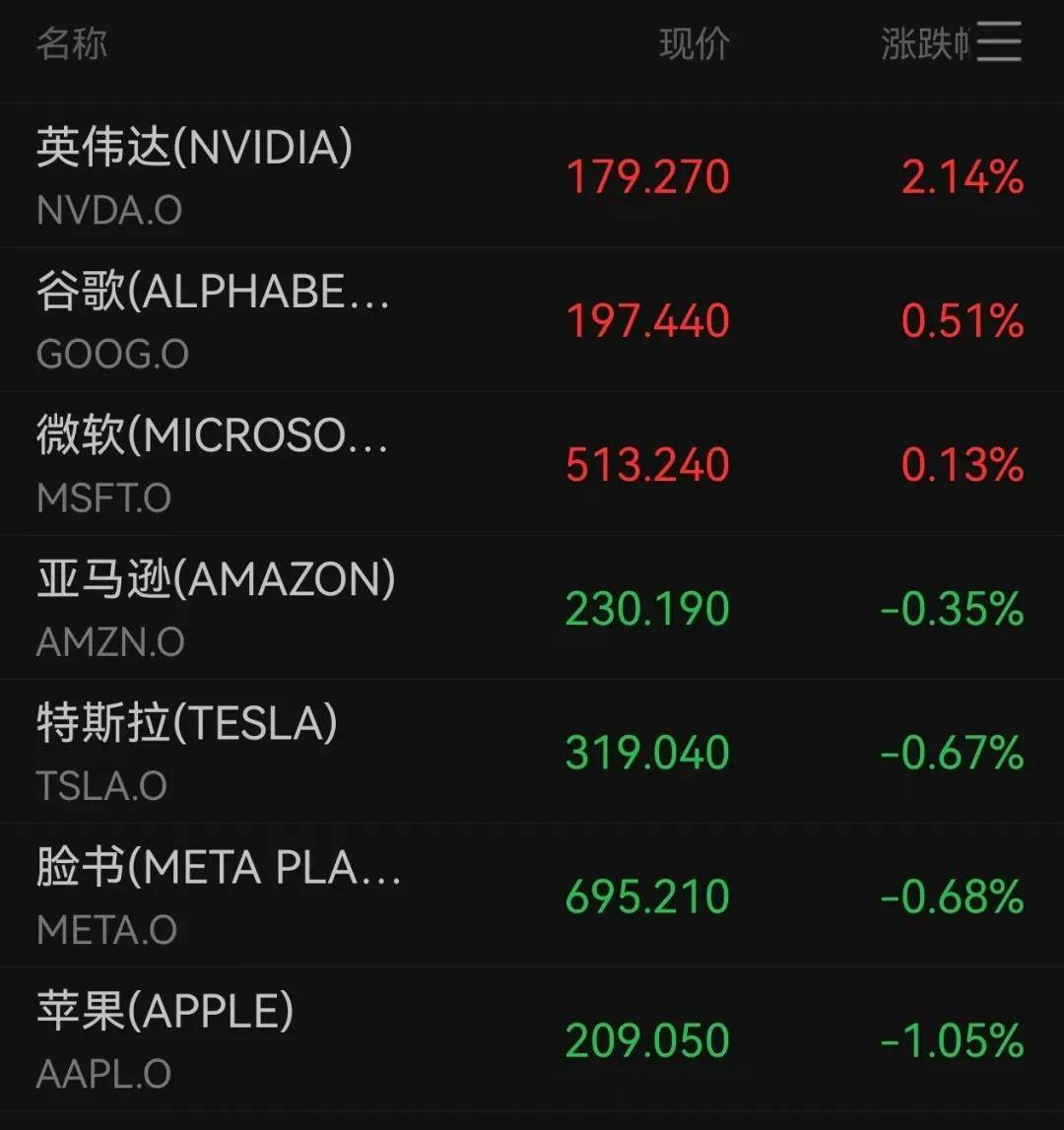
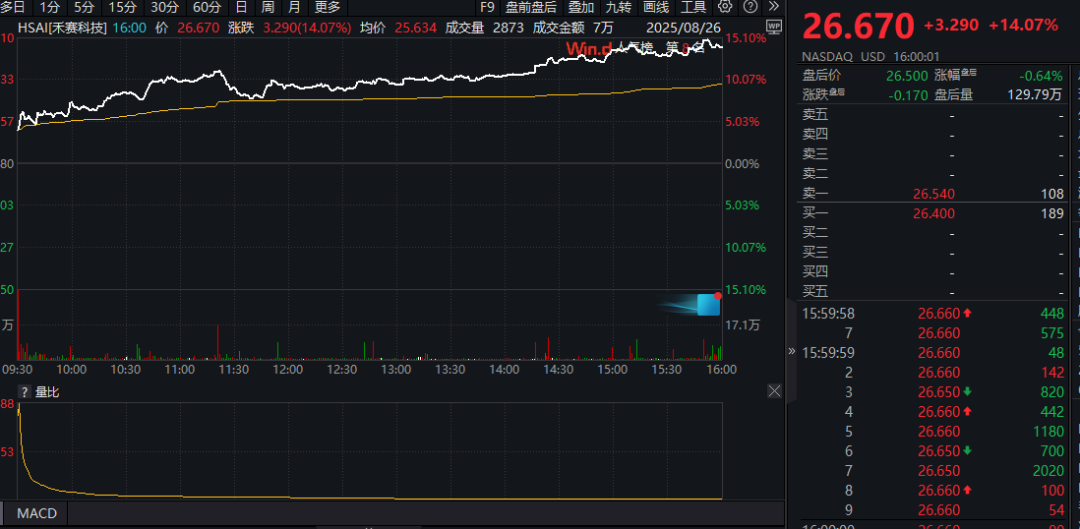
Market Performance - The US stock market indices collectively rose, with the Dow Jones Industrial Average up 0.3%, the S&P 500 up 0.41%, and the Nasdaq Composite up 0.44% [2][4] - Major technology stocks mostly increased, with Tesla and Nvidia both rising over 1%, while Microsoft and Google saw slight declines [5] - Bank stocks experienced a collective rise, with JPMorgan, Goldman Sachs, Bank of America, and Wells Fargo all increasing by over 1% [6] Chinese Concept Stocks - Chinese concept stocks showed strong performance, with the Nasdaq China Golden Dragon Index rising by 0.73% [2][9] - Notable individual stock performances included Hesai Technology surging over 14%, NIO rising over 10%, and Xpeng Motors increasing by over 5% [10][13] - Conversely, some Chinese concept stocks faced declines, with Douyu dropping over 8% and Pinduoduo falling by more than 3% [13] Oil Market - International oil prices saw a significant decline, with both NYMEX WTI and ICE Brent crude dropping over 2% [3][14] - Domestic oil prices in China are set to decrease, with gasoline and diesel prices lowered by 180 yuan and 175 yuan per ton, respectively, effective from August 26, 2025 [14] Company Specific News - The China Securities Regulatory Commission disclosed that Hesai Technology plans to issue up to 51,236,200 shares for overseas listing on the Hong Kong Stock Exchange [12] - The company must report any significant events during the overseas issuance process and update its filing materials if the listing is not completed within 12 months [12][13]
英伟达发布机器人“新大脑”Jetson Thor,开发套件售价3499美元
Sou Hu Cai Jing· 2025-08-26 12:19
Core Insights - Nvidia has launched its latest robotics chip, Jetson AGX Thor, which is marketed as the "new brain" for robots, featuring a 7.5 times speed increase and equipped with 128GB of memory to run large language and vision models [2][5] - The initial development kits are priced at $3,499 and will begin shipping next month, with bulk purchases of over 1,000 units available at $2,999 each [4] Group 1 - The CEO of Nvidia, Jensen Huang, stated that robotics represents the company's largest growth opportunity outside of artificial intelligence, which has already tripled overall sales in the past two years [5] - Nvidia's Vice President, Deepu Talla, emphasized that the company does not manufacture robots or cars but empowers the entire industry through infrastructure computing and related software [5] - The Jetson Thor chip is based on the Blackwell graphics processor, which is currently used for AI and gaming chips [5] Group 2 - The Jetson Thor chip's capabilities include running generative AI models, which are crucial for humanoid robots, and it supports large AI models due to its 128GB memory [5] - Companies such as Agility Robotics, Amazon, Meta, and Boston Dynamics are already utilizing Nvidia's Jetson chips, and Nvidia has also invested in robotics companies like Field AI [5] - Despite the rapid growth of the robotics business, it still accounts for only about 1% of Nvidia's overall revenue [5] Group 3 - Nvidia has recently merged its automotive and robotics businesses into the same segment, reporting quarterly sales of $567 million in May, a 72% year-over-year increase [6] - The Jetson Thor chip can also be applied to autonomous vehicles, particularly models from Chinese brands, while Nvidia's automotive chips, known as Drive AGX, run on a specialized operating system optimized for automotive use [6]

TrendForce:预计人形机器人芯片市场规模有望于2028年突破4800万美元
Zhi Tong Cai Jing· 2025-08-26 07:49
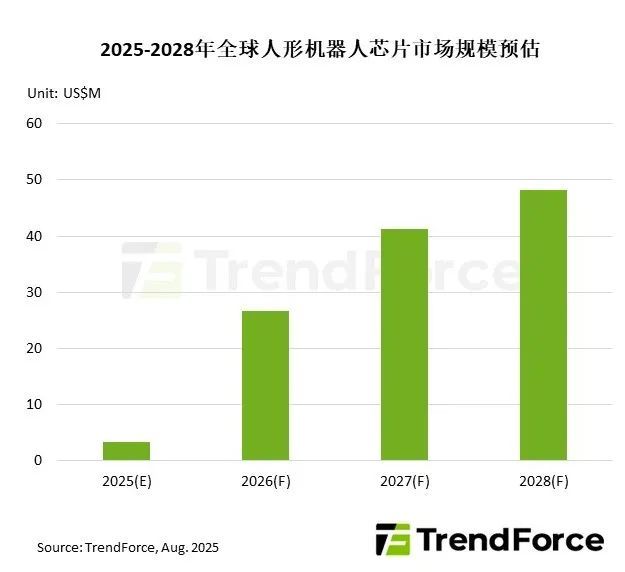
Group 1 - TrendForce's latest research indicates that NVIDIA's newly launched Jetson Thor is expected to enhance computational power for robots, potentially expanding the chip market [1] - The humanoid robot chip market is projected to exceed $48 million by 2028, driven by the adoption of Jetson Thor by companies like Agility Robotics, Boston Dynamics, and Amazon [1] - Jetson Thor features a Blackwell GPU and 128 GB memory, achieving 2070 FP4 TFLOPS AI computing power, which is 7.5 times that of the previous Jetson Orin [1] Group 2 - The International Federation of Robotics (IFR) suggests that humanoid robot development varies by country, with short-term focus on pilot projects, mid-term scaling in manufacturing and services, and long-term integration into daily household scenarios [4] - TrendForce notes that despite the powerful performance of the NVIDIA Jetson Thor series, its development kit is priced at $3,499, significantly higher than the previous Jetson Orin's $1,499 [4] - The industry trend aims to lower humanoid robot prices for broader adoption, indicating that companies planning simpler tasks may opt for more affordable chips [4]

鲍威尔放鸽未必救市,华尔街盯紧英伟达财报!
Jin Shi Shu Ju· 2025-08-26 05:20
AI播客:换个方式听新闻 下载mp3 音频由扣子空间生成 她表示:"这将对美股整体进一步上涨,尤其是大盘成长股和科技股交易,构成挑战。" 在此背景下,英伟达定于周三美股盘后公布的第二财季业绩,格外引人关注。这家人工智能芯片龙头企 业处于科技巨头行情的核心,其营收约40%来自微软(MSFT.O)、亚马逊(AMZN.O)、Meta Platforms(META.O)和谷歌(GOOGL.O)母公司Alphabet。 英伟达在AI芯片市场占有率高达80%,公司市值约4.3万亿美元,占标普500指数总市值的约8%。根据 Synovus分析师丹·摩根(Dan Morgan)的测算,这些科技巨头的资本开支中大约60%将流向AI,英伟达 的销售前景将直接验证或挑战市场最重要的叙事。 目前美股市值最大的六家科技公司合计占标普500总市值的约34%,这意味着英伟达的表现可能比降息 预期更具影响力。尽管美联储在9月中旬会议前还会迎来就业与通胀数据,但英伟达的展望可能更具决 定性。 对于维持美股的反弹走势来说,将于周三美股盘后公布的英伟达(NVDA.O)第二季度财报,重要性可能 甚至超过了上周美联储主席鲍威尔转向降息的信号。 上周五 ...
突发利空,美医药股大跌
Zheng Quan Shi Bao· 2025-08-26 00:13
Group 1 - The U.S. stock market experienced a decline on August 25, with the Dow Jones falling by 0.77%, the S&P 500 by 0.43%, and the Nasdaq by 0.22% [1] - Chinese concept stocks showed mixed performance, with the Nasdaq Golden Dragon China Index up by 0.11%, while companies like Douyu and Sohu rose over 3% [1] - President Trump announced plans to significantly reduce drug prices, aiming to cut them to 1/1400 to 1/1500 of current levels, which led to a broad decline in pharmaceutical stocks [1][3] Group 2 - Intel's stock fell by 1.01% after the company warned that the U.S. government's 10% stake could pose risks to its international sales and future subsidy eligibility [2] - The U.S. government is set to become Intel's largest shareholder by purchasing 9.9% of its stock at a price lower than the market value, which may dilute existing shareholders' equity [2] - In the last fiscal year, 76% of Intel's revenue came from international markets, highlighting the potential impact of government ownership on its global business [2] Group 3 - Major pharmaceutical companies like DexCom, Moderna, Pfizer, and Merck saw significant stock declines following Trump's announcement on drug price reductions [3] - DexCom's stock dropped over 7.6%, while Moderna fell by 6.53%, Pfizer by 2.86%, and Merck by 2.36% in response to the news [3]
周三,美股真正的“命运判官”要来了
Feng Huang Wang Cai Jing· 2025-08-25 23:35
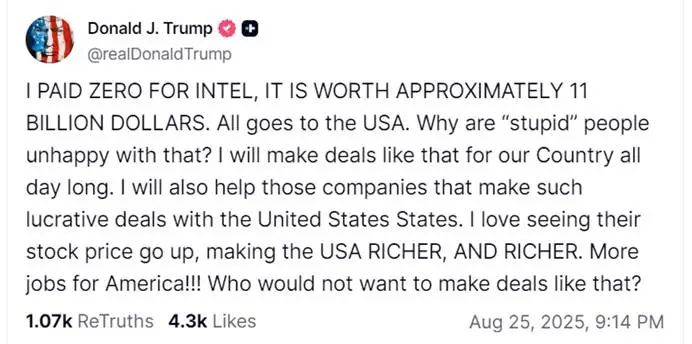
Group 1 - The core focus of the market is on Nvidia's upcoming earnings report, which is expected to significantly influence market trends due to its substantial weight in the S&P 500 index, close to 8% [1][2] - Nvidia's market capitalization has surpassed $4 trillion, with its stock price increasing nearly 34% year-to-date, outperforming the S&P 500's 9.5% gain [2] - Analysts are monitoring key technical levels for Nvidia, including a 50-day moving average around $167 and a short-term resistance level at $184 [3] Group 2 - Intel's recent government stake, valued at approximately $11 billion, poses risks to its business, particularly if specific manufacturing thresholds are not met, potentially increasing government ownership to 15% [4][5] - The intervention by the Trump administration in Intel's operations has raised concerns about the impact on the company's agility and the broader business environment, drawing comparisons to unprecedented government actions during the 2008 financial crisis [5]
周三,美股真正的“命运判官”要来了
凤凰网财经· 2025-08-25 23:13
Core Viewpoint - The upcoming Nvidia earnings report is seen as a critical test for the market, especially after the recent comments from Federal Reserve Chairman Jerome Powell regarding potential interest rate cuts [1][2][4]. Group 1: Nvidia's Impact - Nvidia's market capitalization has surpassed $4 trillion, with its stock price increasing nearly 34% year-to-date, significantly outperforming the S&P 500's 9.5% gain [2]. - Nvidia holds a weight of nearly 8% in the S&P 500 index, making its performance crucial for the overall market sentiment [2][4]. - Analysts are closely monitoring key technical levels for Nvidia, including a 50-day moving average around $167 and a short-term resistance level at $184 [3]. Group 2: Market Concentration Risks - Nvidia is the last among the "Big Seven" tech companies to report quarterly earnings, raising concerns about market concentration risks as these companies collectively account for nearly one-third of the S&P 500 index [4]. - Despite a strong earnings season where 80% of the 474 S&P 500 companies that reported exceeded expectations, the market's focus remains on Nvidia as the true test of market resilience [4]. Group 3: Intel's Government Involvement - Former President Trump announced a government stake in Intel valued at approximately $11 billion, claiming it would generate more funds and jobs for the U.S. [5]. - Intel warned that the government's 10% stake could pose risks to its business, potentially increasing to 15% if certain manufacturing thresholds are not met, which could lead to a decline in sales [5]. - Critics argue that this government intervention is unprecedented and threatens the agility of the business environment, drawing parallels to the financial crisis of 2008 [6].