牧原股份

Search documents
养殖业板块11月20日跌0.69%,益客食品领跌,主力资金净流出4759.27万元
Zheng Xing Xing Ye Ri Bao· 2025-11-20 09:09
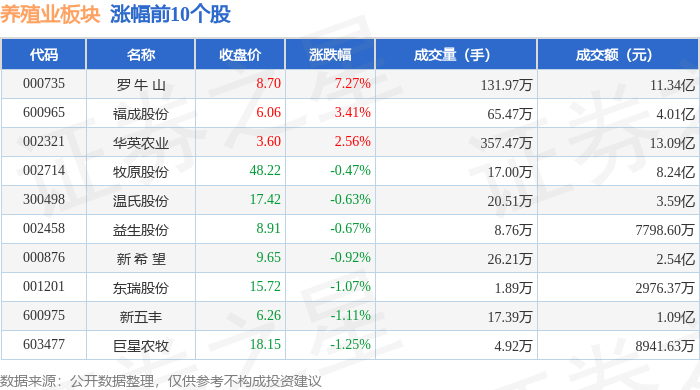
Market Overview - The aquaculture sector declined by 0.69% on November 20, with Yike Food leading the drop [1] - The Shanghai Composite Index closed at 3931.05, down 0.4%, while the Shenzhen Component Index closed at 12980.82, down 0.76% [1] Stock Performance - Notable gainers in the aquaculture sector included: - Luoniushan (000735) with a closing price of 8.70, up 7.27% on a trading volume of 1.32 million shares and a turnover of 1.134 billion [1] - Fucheng Co. (600965) closed at 6.06, up 3.41% with a trading volume of 654,700 shares and a turnover of 401 million [1] - Huaying Agriculture (002321) closed at 3.60, up 2.56% with a trading volume of 3.57 million shares and a turnover of 1.309 billion [1] - Major decliners included: - Yike Food (301116) closed at 13.29, down 5.41% with a trading volume of 420,100 shares and a turnover of 549 million [2] - ST Tianshan (300313) closed at 9.40, down 5.24% with a trading volume of 68,000 shares and a turnover of 67 million [2] - Xiangjia Co. (002982) closed at 14.91, down 3.12% with a trading volume of 54,400 shares and a turnover of 81.7 million [2] Capital Flow - The aquaculture sector experienced a net outflow of 47.59 million from institutional investors, while retail investors saw a net outflow of 60.96 million [2] - Conversely, speculative funds recorded a net inflow of 109 million [2] Individual Stock Capital Flow - Luoniushan (000735) had a net inflow of 16.6 million from institutional investors, while retail investors saw a net outflow of 1.48 million [3] - Fucheng Co. (600965) experienced a net inflow of 57.81 million from institutional investors, with a significant outflow of 54.22 million from retail investors [3] - Yike Food (301116) had a net outflow of 17.90 million from institutional investors [3]



农林牧渔行业周报(20251110-20251114):猪价持续弱势,去化逻辑或逐步加强-20251120
Hua Yuan Zheng Quan· 2025-11-20 09:02
Investment Rating - The industry investment rating is "Positive" (maintained) [1] Core Viewpoints - The report indicates that the pig price remains weak, and the logic of destocking may gradually strengthen. The price of pigs is currently at 11.85 yuan/kg, with the industry facing losses [3][18] - The agricultural policy is undergoing a profound transformation, focusing on protecting farmers' rights and activating enterprise innovation. The report anticipates that under the influence of capacity control policies, pig prices may stop falling and rebound earlier than expected [4][19] - The report highlights the importance of high-quality development in the industry, with a clear direction for capacity control policies. Companies that lead in cost and connect with farmers are expected to enjoy excess profits and valuation premiums [4][19] Summary by Sections 1. Swine Industry - The swine sector is experiencing fluctuations, with DeKang Agriculture leading the gains at +9% week-on-week. The number of breeding sows has decreased significantly, and futures prices are rising, but the stock market has not reacted [3][18] - The report emphasizes the need for solution-oriented enterprises as the industry policy shifts towards protecting farmers' rights and promoting innovation [4][19] 2. Poultry Industry - The poultry sector continues to face a "high capacity, weak consumption" contradiction, with the price of broiler chickens at 3.50 yuan/kg and chick prices at 3.60 yuan each. The report suggests that integrated enterprises may increase their market share due to losses forcing breeding farms to reduce capacity [5][19] 3. Feed Industry - The report recommends Haida Group due to the recovery of the domestic industry, improved management effects, and increased capacity utilization. The company is expected to achieve growth beyond expectations [6][20] 4. Pet Industry - The pet industry shows a strong concentration of leading brands, with the top five brands remaining stable. The report notes that the competition among leading brands is intensifying, leading to potential pressure on profit margins, but sales growth remains high [9][21] - The report predicts that the market concentration will increase, with the CR5 expected to reach nearly 40% in the next five years [11][23] 5. Agricultural Products - The USDA's November supply and demand report did not exceed expectations, leading to a significant drop in soybean prices. The report indicates that domestic soybean inventories are high, and the supply remains sufficient [13][25] 6. Market and Price Situation - The report notes that the agricultural index increased by 2.70% week-on-week, with agricultural product processing performing the best at +6.40% [26]



美农生物(301156) - 上海美农生物科技股份有限公司投资者关系活动记录表20251120
2025-11-20 08:04
Group 1: Company Overview and Growth Strategy - The company has achieved double-digit growth in revenue and profit for the first three quarters, driven by a focus on product innovation and market expansion [2][3] - The company implements a "product-leading, value service, partner growth" strategy, emphasizing product development and market penetration [3][4] - The company has established a comprehensive marketing network across China and is expanding internationally, particularly in countries along the "Belt and Road" initiative [3][4] Group 2: International Market Strategy - The company has developed a mature internationalization strategy over 20 years, focusing on selecting quality distributors and providing comprehensive services to partners [4][5] - The company has established sales networks in over 40 countries and regions, enhancing its brand image and market share [4][5] - Future plans include expanding direct sales models and becoming a global resource integration platform for the livestock industry [5] Group 3: Customer Structure and Value Proposition - The main customers include feed production companies, breeding enterprises, and distributors, with notable clients such as Haida Group and New Hope [5][6] - The company has built a robust marketing management system and a customer-centric value service system to enhance customer loyalty [5][6] Group 4: Pricing and Product Line Management - Pricing strategies are based on market conditions, competition, and customer negotiations, ensuring flexibility and responsiveness [6][7] - The company focuses on a diverse product line supported by core technologies, emphasizing research and development to meet various customer needs [6][7] Group 5: Operational Efficiency and Digitalization - The company has implemented automated production lines and digital management systems to enhance operational efficiency [7][8] - Investments in smart manufacturing and customer relationship management systems aim to improve responsiveness to customer needs [7][8] Group 6: Future Development Plans - The company aims to become a global leader in animal nutrition technology, focusing on both domestic and international market expansion [9] - Plans include continuous product innovation and addressing industry challenges to improve animal production performance and food safety [9] - The company emphasizes talent development through internal training and external recruitment to build a strong workforce [9]
农业ETF天弘(512620)明日上市!农业农村部部署工作,事关种业科技自立自强
2 1 Shi Ji Jing Ji Bao Dao· 2025-11-20 02:36
Group 1 - The three major indices collectively rose, with the agriculture sector showing significant gains, as evidenced by the 0.73% increase in the China Securities Agriculture Index [1] - A new agriculture-focused ETF, Tianhong (512620), is set to launch on November 21, tracking the China Securities Agriculture Index and covering sectors such as breeding and agrochemicals, featuring leading companies like Muyuan Foods and Wens Foodstuff Group [1] - The Ministry of Agriculture and Rural Affairs held a meeting on November 13 to promote the revitalization of the seed industry, emphasizing the need for high-quality development and self-sufficiency in seed technology [1] Group 2 - Guosheng Securities highlights that the revitalization of the seed industry is crucial for advancing new agricultural productivity, with significant breakthroughs in biotechnology expected to reshape the industry landscape [2] - Guoxin Securities anticipates that by 2026, leading companies in the pig and poultry breeding chains will strengthen, shifting investment focus from capital expenditure to cash flow generation [2] - The official capacity regulation is expected to enhance cash flow for leading enterprises in the pig industry, while the poultry sector is projected to see limited supply fluctuations, benefiting from demand recovery [2]

重庆女博士在广东养鸡养猪,天农集去年净赚8.9亿元!儿子、侄子、学生也是公司高管,将赴香港IPO
Mei Ri Jing Ji Xin Wen· 2025-11-20 01:59
Core Viewpoint - The company, Tian Nong Group, is preparing for an IPO in Hong Kong, leveraging its dominance in the Qingyuan chicken market, while facing challenges due to its significant reliance on the pig farming business and family governance issues [1][2][10]. Group 1: Company Overview - Tian Nong Group specializes in raising Qingyuan chicken, holding over 59% market share in this niche [1][7]. - The company was founded by Zhang Zhengfen and her husband in 2003, focusing on the industrialization of Qingyuan chicken after reviving its breeding stock [3][4]. - The company has developed a comprehensive supply chain involving over 4,000 poultry farmers, transitioning traditional farming into a modern industrial model [7][10]. Group 2: Financial Performance - Tian Nong Group's revenue reached 4.8 billion yuan in 2024, with over 60% derived from pig farming, indicating a dual reliance on both chicken and pig cycles [10][11]. - The company's net profit fluctuated significantly over the past three years, from a peak of 890 million yuan to a loss of 670 million yuan [2][12]. - The average selling price of Qingyuan chicken has decreased by over 20% from 2022 to 2025, impacting profit margins [8][12]. Group 3: Market Position and Challenges - The market for Qingyuan chicken is expected to grow from 1.363 billion yuan in 2020 to 1.788 billion yuan in 2024, with projections to exceed 3.1 billion yuan by 2029 [7]. - The company faces challenges from price volatility in both chicken and pig markets, which directly affects profitability [12][17]. - Tian Nong Group's governance structure is heavily family-oriented, with significant control held by the founding couple and their relatives [13][14]. Group 4: Debt and Capital Structure - The company has a high debt ratio, with liabilities reaching approximately 1.334 billion yuan, of which 83.13% is due within one year [17][18]. - Recent capital maneuvers include share buybacks and restructuring efforts aimed at optimizing the capital structure ahead of the IPO [16][18].

上市猪企10月销量同比下降19% 傲农生物、正邦科技销量同比增速靠前
Xin Hua Cai Jing· 2025-11-20 00:47
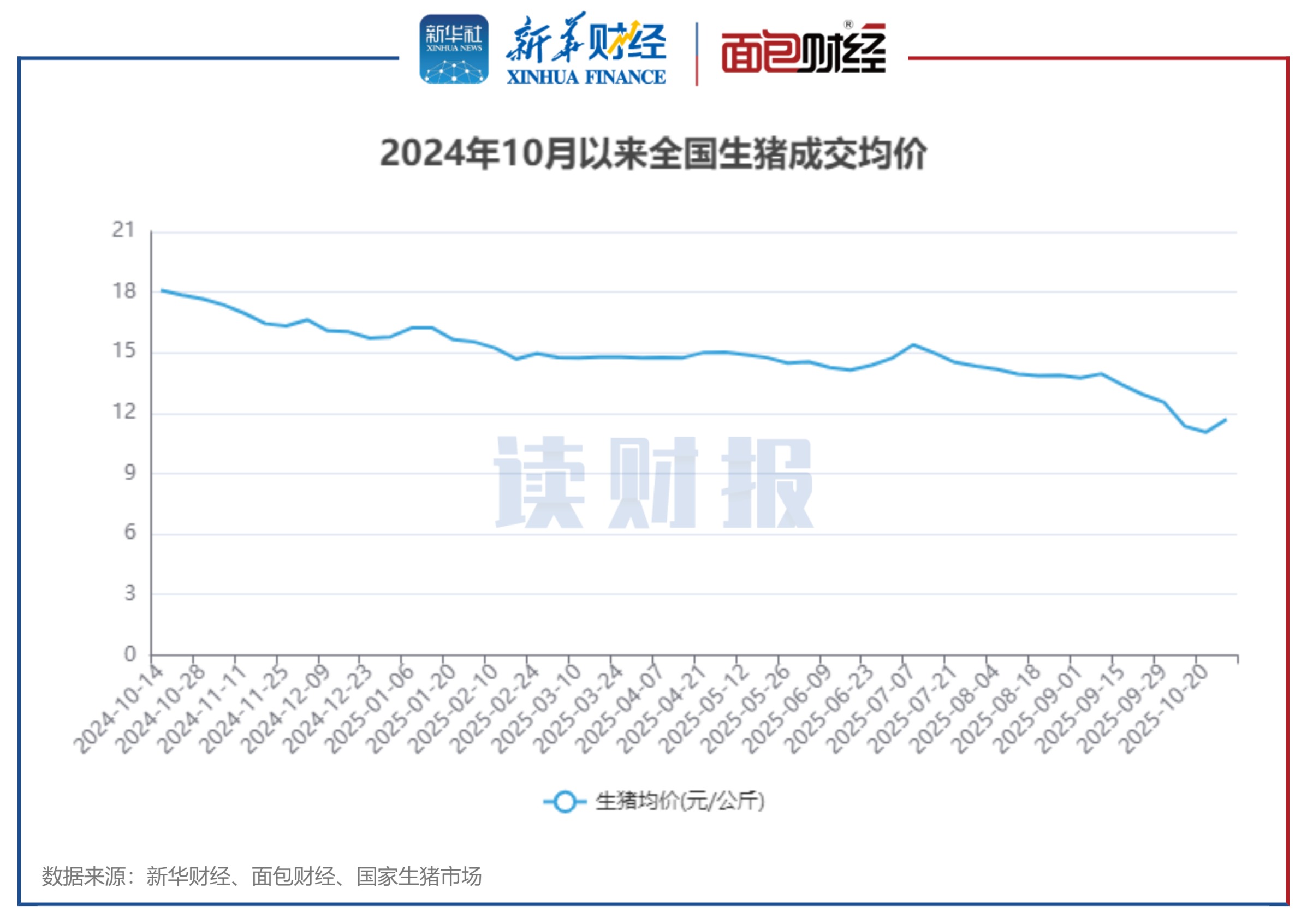
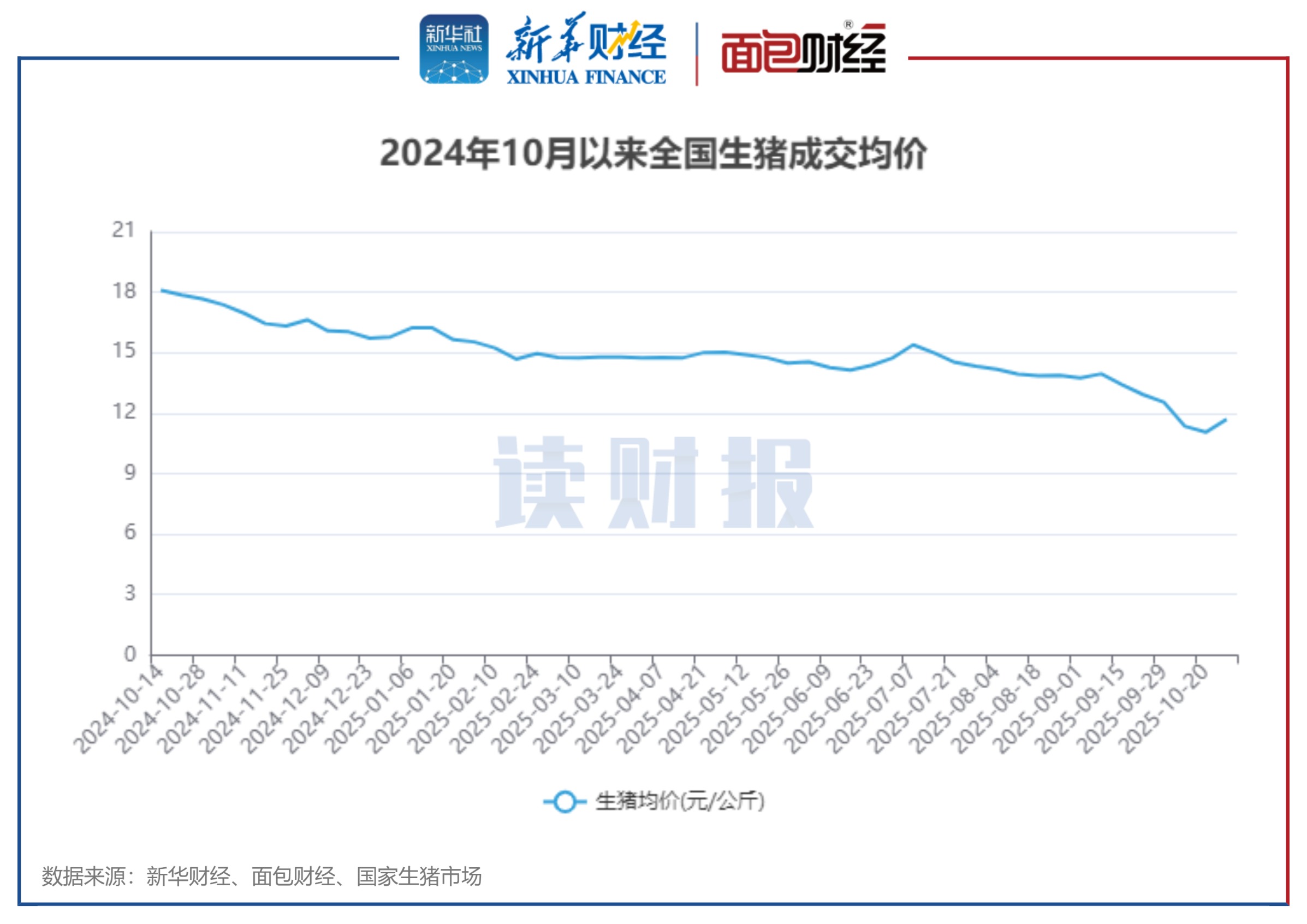
Core Insights - In October 2025, the total sales volume of live pigs from major listed breeding companies reached 17.1992 million heads, marking a year-on-year increase of 24.03% and a month-on-month increase of 22.42% [1][6][9] - The total revenue for these companies in October was 22.188 billion yuan, reflecting a year-on-year decline of 19.04% but a month-on-month increase of 8.92% [1][6][13] Sales Volume Summary - Leading the sales volume, Muyuan Foods sold 7.076 million heads, followed by Wens Foodstuffs and New Hope with sales of 3.8928 million heads and 1.6851 million heads, respectively [1][9][10] - Several companies, including Aonong Bio, Zhengbang Technology, Jinxinnong, and Shennong Group, reported sales growth exceeding 60% year-on-year [1][9] Revenue Summary - The top three companies by revenue in October were Muyuan Foods, Wens Foodstuffs, and New Hope, with revenues of 10.331 billion yuan, 5.048 billion yuan, and 1.918 billion yuan, respectively [13][15] - Notably, Muyuan Foods and Zhenghong Technology experienced revenue declines exceeding 20% year-on-year [13][16] Price Trends - The national average transaction price of live pigs has been declining since September 2025, with the lowest price recorded at 11.1 yuan per kilogram in October 2025 [2][6]



【读财报】上市猪企10月销量同比下降19% 傲农生物、正邦科技销量同比增速靠前
Xin Hua Cai Jing· 2025-11-19 23:22
Core Insights - The sales data for October 2025 from major listed pig farming companies shows a significant increase in sales volume but a decline in revenue compared to the previous year [1][5][12]. Sales Volume - In October 2025, the total sales volume of 17 listed pig farming companies reached 17.1992 million heads, representing a year-on-year increase of 24.03% and a month-on-month increase of 22.42% [1][5][8]. - Leading the sales volume, Muyuan Foods sold 7.076 million heads, while Wens Foodstuff and New Hope sold over 1.6 million heads each [1][8][17]. - Several companies, including Aonong Bio, Zhengbang Technology, Jinxinnong, and Shennong Group, reported sales growth exceeding 60% year-on-year [1][8]. Revenue Performance - The total revenue for these companies in October 2025 was 22.188 billion yuan, which is a year-on-year decrease of 19.04% but a month-on-month increase of 8.92% [1][5][12]. - Most companies experienced negative revenue growth year-on-year, with Zhenghong Technology and Muyuan Foods seeing declines exceeding 20% [1][13][16]. - Aonong Bio's sales volume increased by 73.31% year-on-year, while Zhenghong Technology reported a significant decline in both sales volume and revenue [12][16]. Price Trends - The national average transaction price for pigs has been declining since September 2025, with the lowest price recorded at 11.1 yuan per kilogram in October 2025, contributing to the revenue decline for pig farming companies [2][5].
重庆女博士在广东养鸡养猪,一年净赚8.9亿元
Mei Ri Jing Ji Xin Wen· 2025-11-19 14:12
Core Viewpoint - Tian Nong Group, a poultry and pig farming company, is preparing for an IPO in Hong Kong, highlighting its success in revitalizing the Qingyuan chicken breed while facing significant challenges related to its dual reliance on both chicken and pig farming [1][11]. Company Overview - Founded by Zhang Zhengfen and her husband, the company focuses on the industrialization of Qingyuan chicken, achieving a market share of over 59% in this niche [1][8]. - The company has developed a complete breeding system for Qingyuan chicken, emphasizing high-quality, natural farming practices [5][8]. Financial Performance - Tian Nong Group's revenue structure shows over 60% dependence on pig farming, with pig product revenue increasing from 25.87 billion to 32.03 billion from 2022 to 2024 [11][12]. - The company's net profit has fluctuated significantly, from a peak of 8.9 billion in 2022 to a loss of 6.7 billion in 2023, before rebounding in 2024 [12][13]. - Average selling prices for Qingyuan chicken have decreased by over 20% from 2022 to 2025, impacting gross margins which have shown significant volatility [9][12]. Market Position - The market for Qingyuan chicken is expected to grow from 1.363 billion in 2020 to 1.788 billion by 2024, with projections to exceed 3.1 billion by 2029 [8]. - The company has established a comprehensive supply chain involving over 4,000 poultry farmers, enhancing its market position [8][11]. Governance and Management - The company exhibits a strong family governance structure, with the founding couple controlling approximately 52.28% of voting rights [14][17]. - The management team includes several family members, indicating a close-knit operational approach [14]. Capital Market Journey - Tian Nong Group has faced challenges in its previous attempts to list on the A-share market, which adds pressure to its current IPO efforts in Hong Kong [16][17]. - The company has engaged in various capital operations, including share buybacks and restructuring, to optimize its financial position ahead of the IPO [16][17]. Debt and Financial Health - The company has a high debt ratio, with liabilities reaching approximately 1.334 billion, of which 83.13% is due within one year [17]. - The financial strategy includes addressing short-term debt pressures while aiming to improve cash flow stability [17].

重庆女博士在广东养鸡养猪,去年净赚8.9亿元!儿子、侄子、学生也是公司高管,将赴香港IPO
Mei Ri Jing Ji Xin Wen· 2025-11-19 12:41
Core Viewpoint - Guangdong Tiannong Group Co., Ltd. has officially submitted its IPO application to the Hong Kong Stock Exchange, focusing on the production of Qingyuan chicken, which holds over 59% market share in its segment [1][8]. Group 1: Company Overview - Tiannong Group is primarily engaged in the breeding and production of Qingyuan chicken, a premium chicken variety, and has expanded its operations to include pig farming, with over 60% of its revenue derived from this sector [2][10]. - The company was founded by Dr. Zhang Zhengfen and her husband, who revitalized the Qingyuan chicken breed from a state of genetic decline, achieving an annual output of over 32 million chickens [3][5]. Group 2: Financial Performance - The company's net profit has fluctuated significantly over the past three years, ranging from a peak profit of 890 million yuan to a loss of 670 million yuan, indicating vulnerability to both the pig and chicken market cycles [2][12]. - In 2024, Tiannong Group's revenue is projected to reach 4.8 billion yuan, with pig farming revenue increasing from 2.587 billion yuan in 2022 to 3.203 billion yuan in 2024, while poultry revenue accounts for only about 20% of total revenue [10][11]. Group 3: Market Position and Pricing - Tiannong Group's Qingyuan chicken commands a premium price, with average selling prices dropping from 37.7 yuan per chicken in 2022 to 30.7 yuan in the first half of 2025, reflecting a decline of over 20% [9]. - The average price of Qingyuan chicken remains significantly higher than that of other chicken varieties, with a stable price range of 17.6 to 22.3 yuan per kilogram compared to 7.2 to 15.6 yuan for white feathered chickens [8]. Group 4: Governance and Capital Structure - The company exhibits a strong family governance structure, with the founders controlling approximately 52.28% of voting rights and a significant portion of the executive team being family members [13][16]. - Tiannong Group has faced challenges in its capital journey, having previously attempted to list on the A-share market before shifting focus to the Hong Kong market, indicating a strategic pivot in response to market conditions [15][16]. Group 5: Debt and Financial Strategy - The company is under considerable debt pressure, with a debt-to-asset ratio consistently above 65% and approximately 83.13% of its 1.334 billion yuan in outstanding loans due within one year [16]. - Despite high debt levels, Tiannong Group has engaged in significant share buybacks and capital restructuring, aiming to optimize its equity structure ahead of its IPO [16].

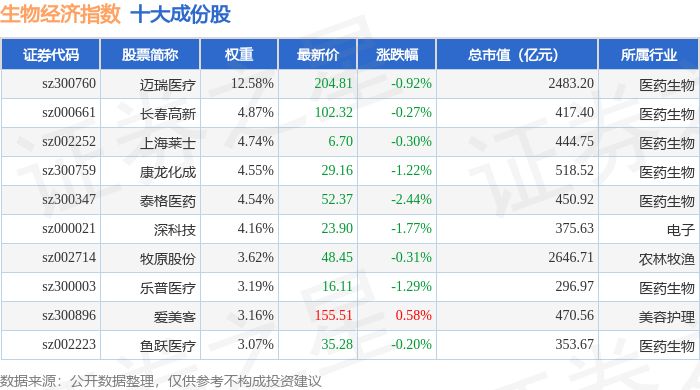
11月19日生物经济(970038)指数跌0.94%,成份股华兰疫苗(301207)领跌
Sou Hu Cai Jing· 2025-11-19 10:23
Core Insights - The Biotech Index (970038) closed at 2182.31 points, down 0.94%, with a trading volume of 13.462 billion yuan and a turnover rate of 1.08% [1] - Among the index constituents, 7 stocks rose while 42 stocks fell, with Xinlitai leading the gainers at 0.83% and Hualan Biological leading the decliners at 5.98% [1] Index Constituents Summary - The top ten constituents of the Biotech Index include: - Mindray Medical (sz300760) with a weight of 12.58%, latest price at 204.81, and a decline of 0.92% [1] - Changchun High-tech (sz000661) with a weight of 4.87%, latest price at 102.32, and a decline of 0.27% [1] - Shimeiao (sz002252) with a weight of 4.74%, latest price at 6.70, and a decline of 0.30% [1] - Kanglong Chemical (sz300759) with a weight of 4.55%, latest price at 29.16, and a decline of 1.22% [1] - Tigermed (sz300347) with a weight of 4.54%, latest price at 52.37, and a decline of 2.44% [1] - Shenzhen Technology (sz000021) with a weight of 4.16%, latest price at 23.90, and a decline of 1.77% [1] - Muyuan Foods (sz002714) with a weight of 3.62%, latest price at 48.45, and a decline of 0.31% [1] - Lepu Medical (sz300003) with a weight of 3.19%, latest price at 16.11, and a decline of 1.29% [1] - Aimeike (sz300896) with a weight of 3.16%, latest price at 155.51, and an increase of 0.58% [1] - Yuyue Medical (sz002223) with a weight of 3.07%, latest price at 35.28, and a decline of 0.20% [1] Capital Flow Analysis - The Biotech Index constituents experienced a net outflow of 1.382 billion yuan from major funds, while retail investors saw a net inflow of 1.358 billion yuan [1] - Notable capital flows include: - Aimeike (sz300896) had a net inflow of 26.5772 million yuan from major funds, but a net outflow from retail investors of 20.4422 million yuan [2] - Changchun High-tech (sz000661) saw a net inflow of 8.8418 million yuan from major funds, with a slight net inflow from retail investors of 186.25 thousand yuan [2] - Other stocks like Furuisi (sz300049) and Yuyue Medical (sz002223) also showed mixed capital flows with significant net outflows from retail investors [2]