
广发证券

Search documents
降准降息仍是政策工具选项,央行明年工作准备这么干
Di Yi Cai Jing· 2025-12-12 15:04
Group 1: Monetary Policy Direction - The People's Bank of China (PBOC) emphasizes the continuation of a moderately loose monetary policy to support key areas such as domestic demand, technological innovation, and small and micro enterprises [1][4] - The central bank outlines five main directions for its work in the coming year, including improving the central bank system and preventing financial risks in key areas [1][6] Group 2: Monetary Policy Framework - The PBOC aims to construct a scientific and robust monetary policy system, focusing on dynamic assessment and enhancement of the monetary policy framework [2][3] - Experts suggest that the monetary policy should balance short-term and long-term goals, as well as internal and external factors, to ensure effective financial support for high-quality development [2][3] Group 3: Tools and Implementation - The central bank plans to utilize various monetary policy tools, including reserve requirement ratio (RRR) cuts and interest rate reductions, to maintain liquidity and support the real economy [4][5] - There is an emphasis on flexible and efficient policy implementation, with a focus on balancing multiple objectives to improve the quality and long-term effects of monetary policy [4][5] Group 4: Financial Risk Management - The PBOC identifies the prevention and resolution of financial risks in key areas, such as real estate and small financial institutions, as a critical task moving forward [6] - The central bank is committed to market-oriented and legal principles in addressing risks associated with financing platforms and small financial institutions [6]
降准降息仍是政策工具选项,央行明年工作准备这么干!
Di Yi Cai Jing· 2025-12-12 14:37
Core Viewpoint - The People's Bank of China (PBOC) emphasizes a flexible and efficient monetary policy, focusing on balancing multiple objectives while implementing appropriate measures in response to economic conditions [1]. Group 1: Monetary Policy Framework - The PBOC aims to build a scientific and robust monetary policy system, enhancing the evaluation and improvement of the monetary policy framework and expanding the toolbox for monetary policy [2][3]. - Key aspects include optimizing the base currency issuance mechanism, reducing focus on quantitative targets, and maintaining reasonable growth in financial totals [3]. - The PBOC will also work on establishing a market-oriented interest rate formation and transmission mechanism, transitioning towards a price-based regulatory system [3]. Group 2: Policy Tools and Implementation - The central economic work conference confirmed the continuation of a moderately loose monetary policy in the coming year, with flexible use of tools such as reserve requirement ratio (RRR) cuts and interest rate reductions [4]. - The PBOC will maintain ample liquidity and support the real economy while ensuring the effective implementation of monetary policies [4]. - Analysts suggest that the PBOC may narrow the interest rate corridor and stabilize the yield curve of government bonds to enhance the transmission effect of monetary policy [5]. Group 3: Financial Risk Management - A significant focus for the PBOC will be on preventing and mitigating financial risks in key areas, particularly in real estate, financing platform debt, and risks associated with small and medium-sized financial institutions [6]. - The PBOC is committed to supporting the resolution of financing platform debt risks and managing real estate finance with a macro-prudential approach [6]. - The ongoing risk management efforts will likely lead to a shift towards the resolution of operational debts of financing platforms, with an emphasis on the reform and sustainable development of small financial institutions [6].
明年如何实现“稳楼市”?金融监管总局释放信号
Di Yi Cai Jing· 2025-12-12 14:31
Core Viewpoint - The focus remains on stabilizing the real estate market, with a clear policy direction to prevent and mitigate financial risks in key areas, particularly in local financial institutions and real estate companies [2][3]. Group 1: Policy Direction - The Financial Regulatory Authority emphasizes the need to prevent and resolve risks associated with local small financial institutions, real estate companies, and local government financing platform debts, while strictly controlling new risks and managing existing ones [2]. - The central economic work meeting has set the tone for stabilizing the real estate market, aligning with the Financial Regulatory Authority's commitment to risk prevention and control [2][3]. - By 2026, real estate regulation will focus on "controlling new risks, reducing inventory, and optimizing supply," with policies encouraging the acquisition of existing properties for affordable housing [2][3]. Group 2: Economic Impact - Real estate is expected to play a significant role in expanding domestic demand in 2026, with policies likely to include optimizing restrictive measures in major cities and supporting urban renewal through innovative financial and land policies [3]. - The stability of the real estate market is crucial for preventing liquidity risks for real estate companies and reducing financial risks for homebuyers, thereby lowering the non-performing loan rates for banks [3]. Group 3: Regulatory Enhancements - The regulatory framework will be further strengthened, with an emphasis on improving the regulatory system for key areas and enhancing compliance and risk awareness among financial institutions [3]. - The Financial Regulatory Authority aims to enhance the effectiveness of strict regulations, improve financial legal systems, and ensure efficient law enforcement to protect the public's financial interests [3].
欧克科技(001223) - 001223欧克科技投资者关系管理信息20251212
2025-12-12 13:52
Group 1: Strategic Layout and Business Model - The company adheres to a dual-core strategy of equipment and materials, establishing independent departments for each project to enhance professional capabilities [2] - Focus on profit enhancement and scale expansion in the materials sector, continuously adding new equipment categories and material strategies to create a virtuous cycle of sales profit [2][3] - The company aims to achieve a synergistic effect of 1+N>N+1 through distinctive management incentive mechanisms and technology advantages [3] Group 2: Core Competitiveness and Innovation - Core competitiveness is centered on technological innovation and comprehensive manufacturing capabilities, with a complete industrial chain from core technology R&D to product delivery [3] - The company promotes an "ecological win-win" barrier by empowering management and core teams, fostering internal creativity, and collaborating deeply with industry partners for shared growth [3] Group 3: Financial Strategies and Future Plans - A 1.5 billion yuan industrial fund has been established in collaboration with the government, focusing on the company's industrial chain layout needs while adhering to investment regulations [4] - The company maintains a robust cash flow to support strategic acquisitions, ensuring alignment with its core equipment and materials strategy [5] - Future investment and acquisition plans will continue to revolve around the core of "equipment + materials," targeting suitable candidates in the direction of smart manufacturing [5]
证券行业 2026 年度投资策略:聚焦格局更优的细分领域
Changjiang Securities· 2025-12-12 13:04
Core Insights - The report indicates that the securities industry experienced high growth in 2025, with a shift from self-operated brokerage as the main contributor to a more diversified support structure across various business lines [3][6] - Looking ahead to 2026, the industry is expected to enter a phase of high-quality development, with sustained slow bull market conditions and opportunities for investment in improved segments [3][8] Review of 2025 - In the first three quarters of 2025, the securities firms underperformed the market, with a cumulative increase of 1.2% compared to a 13.8 percentage point underperformance against the CSI 300 index [6][18] - The total operating revenue and net profit attributable to shareholders for listed securities firms reached CNY 4,196.08 billion and CNY 1,684.50 billion, respectively, representing year-on-year increases of 16.9% and 62.8% [6][26] - The average return on equity (ROE) for the industry was 5.6%, up by 2.02 percentage points year-on-year [6][30] Outlook for 2026 - The self-operated and brokerage businesses are likely to continue supporting performance, although brokerage income may be less elastic due to declining commission rates [8][9] - Investment banking and asset management businesses are showing signs of cyclical recovery, with the investment banking sector adapting to regulatory changes and the asset management sector experiencing its first year-on-year growth since 2024 [8][9] - International business contributions are increasing, with leading firms enhancing their overseas operations and capital support [8][9] Investment Recommendations - The report suggests focusing on individual stocks in improved segments, particularly: 1. High-quality leaders in investment banking, such as China International Capital Corporation (CICC) [9] 2. Leaders in asset management, like Orient Securities [9] 3. Industry leaders with strong international business layouts, including CITIC Securities, Huatai Securities, and China Galaxy Securities [9]
广发郭磊:2026年经济均衡提升,A股价值重估步入关键年
2 1 Shi Ji Jing Ji Bao Dao· 2025-12-12 09:29
Group 1 - The core viewpoint is that the economic balance in China is expected to improve significantly in 2026, driven by the release of fixed asset investment potential in major economic provinces and an emphasis on increasing consumption rates as outlined in the 14th Five-Year Plan [1][3] - The GDP growth for 2025 is projected at 5%, with a notable structural divergence in the economy, where exports and "two new" sectors perform strongly while other sectors remain relatively weak [1][2] - The A-share market is entering a "second phase" supported by reasonable pricing and profitability, with current valuations in a rational range and industrial profits expected to rebound to 6%-7% if PPI remains stable [2] Group 2 - Concerns regarding the AI bubble in the US market are highlighted, with a focus on the fragility of the narrative chain and the current stage of AI technology, which is still in the infrastructure and narrow application phase [2] - The risk of a reversal in yen carry trade is emphasized, as rising interest rate expectations for the yen could increase carry costs and potentially lead to cross-market volatility affecting commodities and high-valuation stocks [2] - 2026 is identified as a pivotal year for transitioning from a fragmented to a balanced economy and for the A-share market to shift from valuation expansion to profit-driven growth [3]

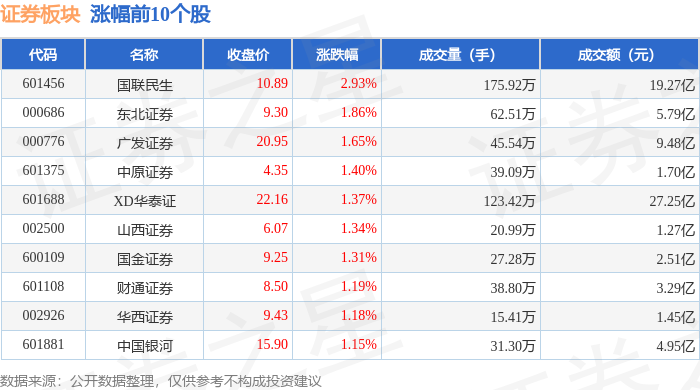
证券板块12月12日涨0.61%,国联民生领涨,主力资金净流入13.26亿元
Zheng Xing Xing Ye Ri Bao· 2025-12-12 09:12
Core Insights - The securities sector experienced an increase of 0.61% on December 12, with Guolian Minsheng leading the gains [1] - The Shanghai Composite Index closed at 3889.35, up 0.41%, while the Shenzhen Component Index closed at 13258.33, up 0.84% [1] Securities Sector Performance - Guolian Minsheng (601456) closed at 10.89, with a rise of 2.93% and a trading volume of 1.7592 million shares [1] - Northeast Securities (000686) rose by 1.86% to 9.30, with a trading volume of 625,100 shares [1] - GF Securities (000776) increased by 1.65% to 20.95, with a trading volume of 455,400 shares [1] - Zhongyuan Securities (601375) saw a 1.40% increase to 4.35, with a trading volume of 390,900 shares [1] - Huatai Securities (601688) rose by 1.37% to 22.16, with a trading volume of 1.2342 million shares [1] - Shanxi Securities (002500) increased by 1.34% to 6.07, with a trading volume of 209,900 shares [1] - Guojin Securities (600109) rose by 1.31% to 9.25, with a trading volume of 272,800 shares [1] - Caitong Securities (601108) increased by 1.19% to 8.50, with a trading volume of 388,000 shares [1] - Huaxi Securities (002926) rose by 1.18% to 9.43, with a trading volume of 154,100 shares [1] - China Galaxy (601881) increased by 1.15% to 15.90, with a trading volume of 313,000 shares [1] Capital Flow Analysis - The securities sector saw a net inflow of 1.326 billion yuan from institutional investors, while retail investors experienced a net outflow of 580 million yuan [3] - Speculative funds recorded a net outflow of 746 million yuan [3]





港股收评:恒生指数涨1.75%,恒生科技指数涨1.87%
Xin Lang Cai Jing· 2025-12-12 08:12
港股收盘,恒生指数涨1.75%,恒生科技指数涨1.87%。港股科技ETF(159751)涨1.42%,恒生港股通 ETF(159318)涨1.67%。板块方面,电气设备、生命科学工具板块涨幅靠前;居家用品、航空货运与 物流板块跌幅靠前。个股方面,中国银河涨9.45%,广发证券涨7.33%,康方生物涨7.33%,农夫山泉涨 7.23%,网易-S涨6.87%,交通银行涨6.57%,中信证券涨6.42%,国泰海通涨5.99%,中国财险涨 5.91%,新鸿基地产涨5.79%,百济神州涨5.64%,华泰证券涨5.63%,科伦博泰生物-B涨5.6%,中国太 保涨5.13%,长实集团涨5.05%,中国人寿涨5.0%,长江基建集团涨4.64%,中国铝业涨4.58%,五矿资 源涨4.55%,中兴通讯涨4.51%,中通快递-W涨4.05%;药明合联跌8.36%,曹操出行跌11.11%;昭衍新 药涨19.41%,狮腾控股涨14.55%。 ...
券商解读中央经济工作会议:八项经济工作任务各有亮点
Sou Hu Cai Jing· 2025-12-12 07:06
Core Viewpoint - The Central Economic Work Conference held on December 10-11 emphasizes five essential approaches for economic work under new circumstances, including fully tapping economic potential and combining policy support with reform innovation [2] Group 1: Domestic Market and Consumption - The conference highlights the need to build a strong domestic market, focusing on boosting consumer spending and income to enhance residents' consumption capacity [3] - Specific measures include implementing actions to stimulate consumption, improving supply quality, and stabilizing employment and income expectations [3] - The emphasis is on optimizing policies for service consumption and removing unreasonable restrictions in the consumption sector [3] Group 2: Innovation and New Momentum - The conference stresses the importance of innovation-driven development and aims to establish international technology innovation centers in key regions [4] - It calls for a new round of high-quality development actions for key industrial chains, particularly in electric vehicles, photovoltaics, and energy storage [4][5] - Policies will focus on enhancing the innovation ecosystem and protecting intellectual property rights in emerging fields [4] Group 3: Reform and Market Vitality - The conference outlines reforms to enhance market vitality, including the establishment of a unified national market and addressing "involution" in competition [6][7] - It emphasizes the need for tax system reforms to improve local financial capabilities and support consumer-driven competition [7] - Measures will also target the revitalization of state-owned and private enterprises, addressing issues like overdue payments to private firms [7] Group 4: External Cooperation and Trade - The conference reiterates the importance of steady external openness, particularly in the service sector, and encourages the development of digital and green trade [8] - It aims to accelerate the signing of regional and bilateral trade agreements to enhance international cooperation [8] Group 5: Regional Development and Urban-Rural Integration - The conference promotes urban-rural integration and regional collaboration, focusing on the development of county towns and revitalizing rural areas [9][10] - It emphasizes the need for coordinated development among major city clusters and enhancing cross-regional cooperation [9] Group 6: Green Transition and Carbon Neutrality - The conference prioritizes green transformation, emphasizing the development of a new energy system and the promotion of energy efficiency in key industries [11][12] - It aims to expand the application of green electricity and strengthen the national carbon trading market [12] Group 7: Social Welfare and Public Services - The conference addresses key social welfare issues, including employment, social security, education, and healthcare, with a focus on stabilizing the birth rate [13] - It proposes comprehensive solutions to reduce burdens on residents in these areas, aiming to enhance overall living standards [13] Group 8: Risk Management and Real Estate - The conference outlines strategies for risk management, particularly in the real estate sector, shifting focus from stabilizing prices to controlling supply and inventory [14][15] - It emphasizes the need for reforms in housing provident funds and improving the financial health of local governments [14]


八大券商首席最新发声
Zhong Guo Ji Jin Bao· 2025-12-12 07:03
Core Viewpoint - The Central Economic Work Conference held on December 10-11, 2025, outlines key tasks for 2026, emphasizing the need for policy coordination to stimulate economic potential and stabilize domestic demand [1][2]. Group 1: Economic Growth and Policy Direction - The conference aims for a GDP growth target of around 5% for 2026, focusing on "qualitative effective improvement and reasonable quantitative growth" [2][7]. - The emphasis on "domestic supply strong, demand weak" indicates a shift towards addressing supply-side issues while promoting domestic demand [5][6]. - The five new "musts" introduced in the conference highlight the need for policy support and reform innovation, aiming for a more pronounced "cross-cycle" policy characteristic in 2026 [3][4]. Group 2: Fiscal Policy - The conference advocates for a more proactive fiscal policy, maintaining a fiscal deficit rate of around 4% and increasing the scale of new debt to support economic stability [8][9]. - There is a focus on optimizing fiscal expenditure structure and addressing local fiscal difficulties to ensure basic public services [8][9]. - The need for fiscal expansion is underscored to counterbalance the impacts of declining real estate revenues and other economic pressures [9]. Group 3: Monetary Policy - The conference calls for a continuation of moderately loose monetary policy, with an emphasis on using various policy tools to support economic growth and stabilize prices [10][11]. - The approach includes maintaining liquidity and guiding financial institutions to support key areas such as domestic demand and technological innovation [10][11]. Group 4: Domestic Demand and Market Development - The conference prioritizes domestic demand, aiming to build a strong domestic market through initiatives like a rural resident income increase plan [12][13]. - The strategy to enhance domestic demand is seen as crucial for maintaining economic resilience amid complex international conditions [12]. Group 5: Real Estate Market Stability - The conference emphasizes stabilizing the real estate market through targeted policies, including inventory reduction and supply optimization [14]. - There is an expectation for continued supportive measures for the real estate sector, particularly in major cities, while addressing the need for a new development model [14].