药明生物

Search documents
“沸腾”!刚刚,涨停潮来了!
中国基金报· 2025-07-17 03:08
Core Viewpoint - The pharmaceutical sector is experiencing a significant surge, with multiple stocks hitting the daily limit up, indicating strong market interest and potential investment opportunities [8][9][11]. Market Performance - On July 17, the A-share market opened slightly lower but then rallied, with all three major indices showing positive performance. The Shanghai Composite Index rose by 0.07%, the Shenzhen Component Index increased by 0.81%, and the ChiNext Index gained 0.99% [2][3][4]. Sector Highlights - The pharmaceutical sector, particularly CRO (Contract Research Organization) stocks, saw substantial gains, with companies like Weikang Pharmaceutical and Chengdu Xian Dao hitting the daily limit up of 20% [9][10]. - Other notable stocks in the pharmaceutical sector included Fudan Zhangjiang and Kangfang Biotech, which also showed significant price increases in the Hong Kong market [11][12]. Policy Impact - The National Healthcare Security Administration recently announced the initiation of the 11th batch of centralized drug procurement, focusing on mature "old drugs" while excluding innovative drugs from this round of procurement. This policy is expected to impact the market dynamics for pharmaceutical companies [13]. Robotics Sector Activity - The humanoid robotics sector is also active, with companies like Nanjing Julong and Dongshan Precision hitting the daily limit up, reflecting strong investor interest in this emerging technology [14][15][17]. - A notable mention is the stock of Aowei New Materials, which achieved a seven-day consecutive limit up, driven by news related to the acquisition by Zhiyuan Robotics [17].



第十一批国家组织药品集采工作启动,创新药ETF天弘(517380)涨超2%,生物医药ETF(159859)实时成交额同标的第一
Sou Hu Cai Jing· 2025-07-17 02:15
Group 1: Market Overview - A-shares and Hong Kong stocks opened mixed on July 17, with the pharmaceutical and biotechnology sector showing upward movement [1] - The Tianhong Innovation Drug ETF (517380) rose by 2.09% during the session, with a current premium/discount rate of 0.08% [1] - The Biopharmaceutical ETF (159859) increased by 0.51%, with a real-time transaction volume exceeding 14.8 million yuan, leading among similar products [2] Group 2: ETF Details - The Tianhong Innovation Drug ETF (517380) is the largest in the market, covering both A-shares and Hong Kong stocks, and tracks the Hang Seng-Hushen-Hong Kong Innovation Drug Selected 50 Index [1] - The top ten constituent stocks of the Hang Seng-Hushen-Hong Kong Innovation Drug 50 Index account for nearly 60% of the total weight, including high-quality A-share companies like Innovent Biologics and BeiGene [1] - The Biopharmaceutical ETF (159859) closely tracks the Guozheng Biopharmaceutical Index and currently holds the largest product scale among similar ETFs [2] Group 3: Industry Developments - The National Healthcare Security Administration has initiated the 11th batch of centralized drug procurement, with 55 varieties included in the reporting range [2] - The procurement rules will adhere to principles of maintaining clinical stability, ensuring quality, preventing collusion, and avoiding internal competition [2] - The second Brain-Computer Interface Technology Developers Conference will be held from August 16 to August 17 [2] Group 4: Analyst Insights - According to Jiao Yin International, the core driver of the current Hong Kong innovation drug market is value reassessment, with attractive valuations remaining [3] - Domestic innovation drug enthusiasm has surged this year, with significant BD transactions and increased R&D investment, indicating a potential systematic recovery in the sector [3] - East China Securities suggests focusing on investment opportunities in CXO, innovative drugs, medical devices, traditional Chinese medicine, chain pharmacies, and medical services [3]
近一年累计上涨超100%!港股创新药ETF(513120)连续6日上涨,近22日累计“吸金”超10亿元
Sou Hu Cai Jing· 2025-07-16 06:42
Group 1 - The core viewpoint of the news is the significant performance and growth of the Hong Kong Innovative Drug ETF, which has seen a cumulative increase of over 100% in the past year, reflecting strong investor interest in the innovative drug sector [1][2] - As of July 15, 2025, the Hong Kong Innovative Drug ETF has a net asset value increase of 108.39% over the past year, ranking 1st out of 122 QDII equity funds, indicating its strong performance relative to peers [2] - The Hong Kong Innovative Drug ETF closely tracks the CSI Hong Kong Innovative Drug Index, which includes up to 50 listed companies primarily engaged in innovative drug research and development, providing a comprehensive view of the sector's performance [2] Group 2 - Recent measures introduced by the National Healthcare Security Administration and the National Health Commission aim to support the high-quality development of innovative drugs, including increased R&D support and inclusion in insurance directories [3] - The current market rally in Hong Kong's innovative drug sector is driven by a revaluation of value, with expectations for a new commercial insurance directory for innovative drugs to be launched in 2025, potentially creating a more favorable pricing environment [3] - The Hong Kong Innovative Drug ETF supports T+0 trading, enhancing liquidity and allowing investors to conduct multiple transactions within a trading day, thereby improving capital efficiency [3]


中美谈判超预期与医药板块投资观点更新 (1)
2025-07-16 06:13
Summary of Conference Call Notes Industry or Company Involved - The discussion primarily revolves around the pharmaceutical industry, particularly focusing on the implications of U.S. drug pricing policies and U.S.-China trade negotiations on Chinese pharmaceutical companies and their market opportunities. Core Points and Arguments 1. **Positive Impact of U.S.-China Negotiations on Pharmaceuticals** The recent U.S.-China negotiations are viewed as a significant positive for the pharmaceutical sector, alleviating previous concerns regarding trade impacts on drug pricing and exports of innovative drugs and raw materials [1] 2. **U.S. Drug Pricing Policy Changes** Trump's announcement of an executive order to reduce prescription drug prices by 30% to 80% is highlighted. The U.S. drug pricing system, characterized by high list prices, is under scrutiny, with the potential for significant price reductions impacting the market [2][3] 3. **Global Drug Pricing Context** U.S. drug prices are noted to be among the highest globally, particularly for innovative drugs, which are approximately 300% higher than prices in countries like Japan and Germany. This pricing structure encourages innovation but also raises concerns about affordability [3] 4. **Encouragement of Competition** The U.S. policy aims to accelerate competition among high-priced drugs, encouraging the entry of biosimilars and generic drugs, which could benefit Chinese pharmaceutical companies that can offer lower-cost alternatives [4][6] 5. **Opportunities for Chinese Pharmaceutical Companies** The reduction in U.S. drug prices is expected to create opportunities for Chinese companies, particularly in the fast-follow and biosimilar segments, as they can provide high-quality, cost-effective alternatives [6][8] 6. **Long-term Trends Favoring Chinese Innovation** The inefficiencies in innovation among multinational pharmaceutical companies may lead to increased reliance on Chinese innovation and manufacturing capabilities, especially if U.S. companies face cost pressures [7][8] 7. **Market Dynamics and Export Opportunities** The easing of trade tensions is anticipated to enhance the macroeconomic environment in China, leading to improved domestic demand and potential export opportunities for medical devices and raw materials [10][9] 8. **Impact of Drug Price Reductions on Market Dynamics** The anticipated drug price reductions in the U.S. are not expected to significantly diminish the addressable market for Chinese companies, as their market share in the U.S. remains relatively small [11][12] 9. **Long-term Supply Chain Considerations** U.S. concerns regarding supply chain security may lead to a push for domestic manufacturing, which could have long-term implications for Chinese companies seeking to penetrate the U.S. market [14][15] 10. **Investment Recommendations** The call suggests focusing on three categories of companies: innovative leaders, those with strong business development (BD) expectations, and upstream suppliers with global advantages, as the market enters a new growth cycle [16][18] Other Important but Possibly Overlooked Content 1. **Sector-Specific Insights** The discussion includes insights into specific companies and their competitive advantages, such as the potential for certain drugs to achieve significant market penetration despite pricing pressures [31][33] 2. **Emerging Trends in Medical Devices** The call also touches on the medical device sector, emphasizing the importance of high-end equipment and the potential for growth in home healthcare products, which may offer higher profit margins compared to domestic markets [25][26] 3. **Long-term Growth Projections** There is an optimistic outlook for the pharmaceutical sector, with expectations of a gradual recovery in demand and performance improvements in the coming years, driven by policy support and market dynamics [29][40] 4. **Focus on Innovation and R&D** The emphasis on innovation and the need for companies to adapt to changing market conditions is reiterated, highlighting the importance of R&D in maintaining competitive advantages [19][20] 5. **Market Sentiment and Future Outlook** The overall sentiment is cautiously optimistic, with a belief that the current market conditions present opportunities for growth and investment in the pharmaceutical and medical device sectors [46][47]



香港医药ETF(513700)冲击4连阳,首个商保参与制定的创新药目录有望推出
Sou Hu Cai Jing· 2025-07-16 05:41
Core Insights - The Hong Kong pharmaceutical sector is experiencing a strong rally, with the China Securities Hong Kong Stock Connect Pharmaceutical and Health Comprehensive Index (930965) rising by 1.50% as of July 16, 2025, driven by significant gains in individual stocks such as Lijun Pharmaceutical (01513) up 11.16% and Green Leaf Pharmaceutical (02186) up 8.55% [1][2] - The introduction of a commercial health insurance innovative drug directory by the National Healthcare Security Administration on July 11, 2025, marks a significant development, allowing for the inclusion of high-innovation drugs that exceed basic insurance coverage [1][2] - The first innovative drug directory involving commercial insurance is expected to be launched within 2025, potentially creating a more favorable pricing environment compared to traditional medical insurance negotiations [2] Industry Summary - The Hong Kong Medical ETF (513700) has seen a 1.72% increase, marking its fourth consecutive rise, with the latest price reported at 0.65 yuan [1] - The index reflects the performance of 50 liquid and large-cap healthcare companies within the Hong Kong Stock Connect, with the top ten weighted stocks accounting for 59.44% of the index [2] - The commercial health insurance sector is anticipated to experience significant growth, with potential for premium and innovative drug payment scales to increase by several multiples in the long term [2]


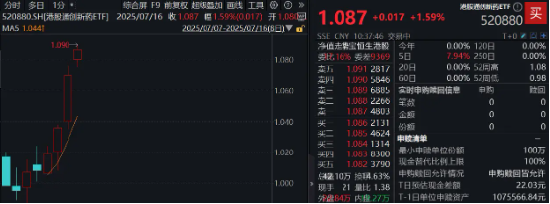
创新药继续上攻,港股通创新药ETF(520880)续涨1.5%日线4连阳,丽珠医药涨超11%,康方生物再刷新高
Xin Lang Ji Jin· 2025-07-16 02:48
Core Viewpoint - The Hong Kong stock market for innovative drugs continues to be active, with the Hong Kong Stock Connect Innovative Drug ETF (520880) experiencing a price increase of 1.59%, marking a four-day consecutive rise [1]. Group 1: Market Performance - The innovative drug sector in Hong Kong has shown strong performance since the beginning of the year, with the Hang Seng Hong Kong Stock Connect Innovative Drug Select Index rising by 58.95% as of the end of June, outperforming other indices by 38.95 and 40.27 percentage points respectively [4]. - Key stocks in the sector have seen significant gains, with Lijun Pharmaceutical leading with a 17.01% increase, followed by Kangfang Bio with a 6.71% rise, and Green Leaf Pharmaceutical with a 5.13% increase [2][3]. Group 2: Industry Developments - The National Healthcare Security Administration is promoting reforms in medical insurance payment methods, which is expected to create a broader space for commercial insurance development, particularly in supporting high-priced innovative drugs and medical devices [2]. - The first innovative drug catalog involving commercial insurance is expected to be launched by 2025, which aims to include products beyond the basic medical insurance coverage, potentially creating a more flexible pricing environment [3]. Group 3: Investment Outlook - The current valuation of the innovative drug sector remains attractive, with expectations for continued recovery in the sector [3]. - The Hang Seng Hong Kong Stock Connect Innovative Drug Select Index has a price-to-earnings ratio (TTM) of 26.97, indicating a relatively low valuation compared to historical levels, suggesting a strong margin of safety for investors [5].
港股市场策略周报2024.1.22-2024.1.28-20250716
Zhe Shang Guo Ji Jin Rong Kong Gu· 2025-07-15 23:50
1 港股市场策略周报 - 投资要点 l 港股市场表现回顾: 港股市场策略周报 2025.7.7-2025.7.13 | 分析师: | 沈凡超 | | --- | --- | | 中央编号: | BTT231 | | 联系电话: | 852-4623 5564 | | 邮箱: | hector@cnzsqh.hk | n 中美关系缓和、官方反内卷叠加南向资金流入改善,上周港股市场引来反弹。本周恒生综指/恒生指数/恒生科技分别 +1.09%/+0.93%/+0.62%。本周市场一级行业板块多数收涨,仅必选消费、公用事业和原材料业收跌。 n 截至本周末,恒生综指的5年PE(TTM)估值分位点为77%,估值水平超5年均值。 2 l 港股市场宏观环境: n 基本面:6月通胀表现仍然偏弱,后续利好因素有望支撑下半年PPI改善,关注官方"反内卷"治理企业低价无序竞争。 n 资金面:中美关系近期有所缓和;美国降息预期分歧较大,降息节点与力度不确定性仍较大;本周南向资金面逆势加码。 l 港股市场展望: n 基本面:国内经济数据显示经济活动表现仍然承压;政策面:政策组合加力应对内需走弱,近期官方重点"反内卷"; 资金面:南向资金 ...
多元主体发力科创融资 探路“无人区”培育独角兽
Zhong Guo Jing Ying Bao· 2025-07-15 14:05
Group 1 - The establishment of the first quantum chip production line in Hefei and the 2 billion yuan "Science and Technology Innovation Loan" supporting GuoDun Quantum highlights the critical role of financial engines in driving technological innovation and economic growth [1] - The launch of the bond market technology board aims to provide financial support for technology enterprises, with a focus on issuing technology innovation bonds by financial institutions and private equity investment firms [1][2] - China's investment in research and development (R&D) is projected to reach 36,130 billion yuan in 2024, reflecting an 8.3% increase from the previous year, positioning the country as the second-largest R&D investor globally [2] Group 2 - The efficiency of organizing R&D funds can be improved, as exemplified by Huawei's 2024 revenue of 862.1 billion yuan and R&D expenditure of 179.7 billion yuan, which constitutes 20.8% of its total revenue [3] - The Beijing-Tianjin-Hebei National Technology Innovation Center aims to enhance the growth engine of technological innovation by fostering a collaborative innovation system that integrates research, industry cultivation, and talent development [4] - The bond market technology board has broken down financing barriers, allowing for a more flexible and tailored approach to financing for technology enterprises, which often lack collateral and profitability [5][6] Group 3 - Since the launch of the bond market technology board on May 7, 2024, 506 technology innovation bonds have been issued, with a total issuance scale of 702.378 billion yuan by July 15 [5] - Approximately 90% of the issuers of technology innovation bonds in 2024 are state-owned enterprises, but the proportion of private and public enterprises has approached 20% since the board's establishment [6] - The bond market technology board not only signals strong governmental support for hard technology but also aims to stimulate innovation among private enterprises and promote the deep integration of technology and capital [6]
7300亿南下资金重构港股生态:2025上半年高股息与硬科技双主线深度解析
智通财经网· 2025-07-15 13:18
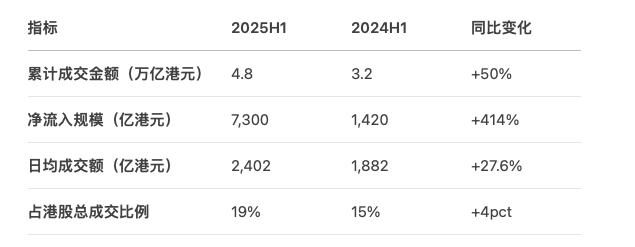
Core Insights - The Hong Kong stock market experienced a significant rebound in the first half of 2025, with the Hang Seng Index rising by 20%, leading among major global indices [1] - The primary driver of this rebound was the substantial inflow of mainland funds through the "Hong Kong Stock Connect" channel, coupled with a global reassessment of the value of "cheap Chinese assets" [1] - The net inflow of southbound funds reached over 730 billion HKD, marking a 414% increase year-on-year and setting a historical record for the same period [3][5] Market Dynamics - The total trading volume through the Hong Kong Stock Connect reached 4.8 trillion HKD, a 50% increase compared to the previous year, accounting for 19% of the total trading volume in the Hong Kong market [2][3] - Southbound funds have significantly reshaped the investor structure in the Hong Kong market, with their proportion of total trading volume rising from less than 10% in 2020 to nearly 20% [4] - The inflow of southbound funds has enhanced the correlation between the Hong Kong and A-share markets, while also increasing the independence of the Hong Kong market from global trends [4] Sector Preferences - The southbound funds showed a clear preference for high-dividend and innovative pharmaceutical sectors, with energy, telecommunications, and banking being the top three sectors for net buying [6][7] - The energy sector attracted a net buying of 620 million HKD, while telecommunications and banking received 410 million HKD and 380 million HKD, respectively [6][7] - The innovative pharmaceutical index saw significant gains, with some stocks experiencing over 60% increases, reflecting a strong recovery after a prolonged downturn [6][8] Investment Trends - The current market environment is characterized by a "barbell strategy," where investors are seeking both stable cash flow from high-dividend assets and growth potential from innovative sectors [10][16] - The anticipated interest rate cuts by the Federal Reserve are expected to further highlight the defensive value of high-dividend sectors, while the commercialization capabilities of innovative pharmaceutical companies will be crucial for growth stocks [16] - The semiconductor, innovative pharmaceuticals, and energy security sectors are expected to benefit from policy support and sustained inflows from mainland funds [17] Notable Stocks - The top-performing stocks in the Hong Kong Stock Connect included Lao Pu Gold, which saw a staggering increase of 330.18%, followed by Sangfor Technologies and Rongchang Biopharmaceuticals with increases of 288.98% and 278.12%, respectively [11][12] - The presence of diverse sectors among the top gainers indicates a broad market interest, with biotechnology leading the way [11][12] - Stocks like Rongchang Biopharmaceuticals have gained significant institutional recognition, with over 50% of holdings through the Hong Kong Stock Connect [13]
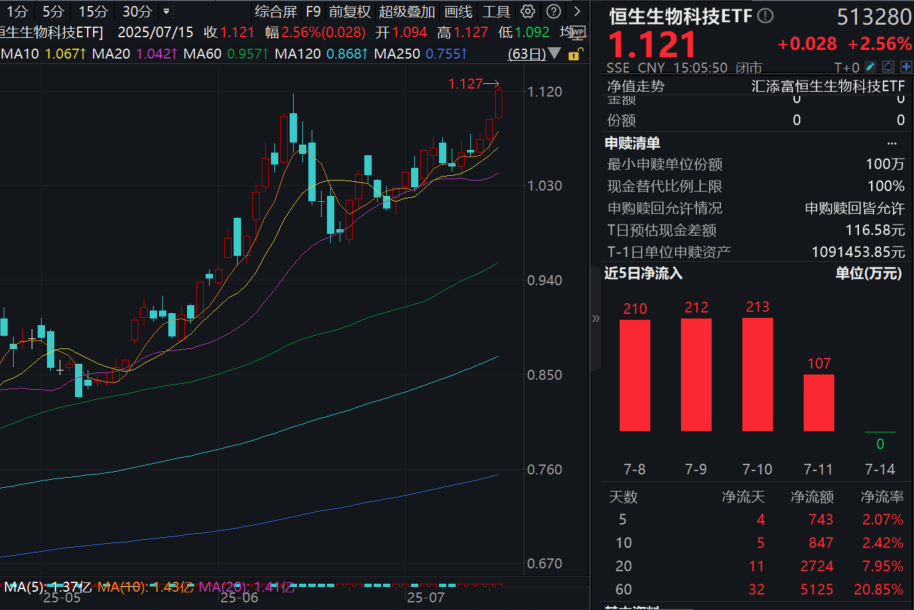
港药午后大涨,石药集团涨超7%!可T+0交易的恒生生物科技ETF(513280)大涨超2%强势三连阳,最新规模创上市以来新高!
Sou Hu Cai Jing· 2025-07-15 07:59
Group 1 - The core viewpoint of the news highlights the significant performance of the Hang Seng Biotechnology ETF (513280), which has seen a strong upward trend with a more than 2% increase and has recorded net inflows for 4 out of the last 5 days, marking it as the only ETF in its category to achieve net inflows this year [1][6] - The latest scale of the Hang Seng Biotechnology ETF has reached a new high since its listing, indicating strong investor interest and confidence in the biotechnology sector [1][6] - The majority of the index constituent stocks of the Hang Seng Biotechnology ETF have shown positive performance, with notable increases from companies such as CSPC Pharmaceutical Group (up over 7%) and BeiGene (up over 6%) [3][4] Group 2 - According to Zhongyou Securities, China's share of global innovative drug BD transactions has increased significantly from 3% in 2019 to 13% in 2024, with the monetary share rising from 1% to 28% [4] - The total amount of innovative drug License-out transactions in China for the first half of 2025 is approaching $66 billion, surpassing the total BD transaction amount for 2024, indicating a growing interest from multinational corporations in Chinese innovative drug assets [4][5] - The report suggests that there will be continued activity in the ADC and dual-antibody sectors in the short term, with several related BD transactions expected to materialize in the second half of 2025 [5]