华峰化学

Search documents
东方证券:行业产能加速出清 氨纶需求保持高速增长
智通财经网· 2026-01-19 06:33
Core Viewpoint - The report from Dongfang Securities indicates that the spandex industry is currently at a historical low in terms of price and demand, but with industry restructuring, there is potential for price recovery and demand growth in the future [1] Supply Side - The spandex industry is in the late stage of capacity expansion, with domestic production capacity increasing from 593,900 tons in 2015 to an expected 1,420,000 tons by January 2026, led by Huafeng Chemical with 475,000 tons [2] - Currently, only the first phase of the Xinxiang Chemical Fiber's 100,000-ton project, which is 50,000 tons, is under construction and is expected to be operational by 2027 [2] - Since 2019, over 200,000 tons of capacity from small enterprises have been shut down, leading to a reduction in the share of capacity below 50,000 tons from 47% in 2015 to 16% in 2025, indicating a trend towards concentration of supply among leading companies [2] - The industry has faced negative gross margins since May 2023, making it difficult for unprofitable companies to sustain operations, which may lead to further exits from the market [2] Demand Side - Spandex is primarily used in clothing to provide elasticity, with applications in casual wear, jeans, underwear, fitness apparel, swimwear, and socks [3] - The demand for spandex is expected to continue growing due to trends in sports and tight-fitting clothing, with apparent consumption increasing from 510,000 tons in 2017 to an estimated 1,027,000 tons by 2024, reflecting a CAGR of 10.51% [3] - The combination of high elasticity and durability of spandex enhances the core performance of garments, contributing to its increasing penetration in downstream markets [3] Related Companies - Key companies in the spandex industry include Huafeng Chemical (002064.SZ), Taihe New Materials (002254.SZ), and Xinxiang Chemical Fiber (000949.SZ) [4]



氟化工龙头涨停,化工板块午后继续猛攻!机构:供需双底确立,2026年或迎“戴维斯双击”
Xin Lang Cai Jing· 2026-01-19 06:24
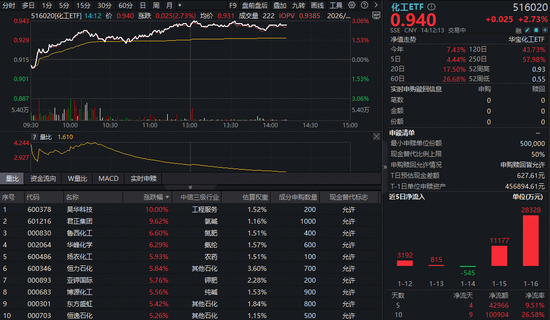
Group 1 - The chemical sector continues to show strength, with the Chemical ETF (516020) experiencing a price increase of 2.73% as of the latest update [1][8] - Key stocks in the sector include Haohua Technology, which reached the daily limit, and Junzheng Group, which surged over 9%, along with other notable gains from companies like Luxi Chemical and Huafeng Chemical [1][8] - Since 2025, the Chemical ETF has shown a cumulative increase of 47.53%, significantly outperforming major indices such as the Shanghai Composite Index (22.38%) and the CSI 300 Index (20.25%) [10][11] Group 2 - The chemical industry has faced negative growth in capital expenditure since 2024, but the "anti-involution" trend and the accelerated elimination of outdated overseas capacity are expected to lead to a contraction in supply [12] - The "14th Five-Year Plan" emphasizes expanding domestic demand, which is anticipated to drive growth in chemical product demand, especially with the onset of a U.S. interest rate cut cycle [12] - The chemical industry may experience a cyclical turning point in 2026, transitioning from valuation recovery to earnings growth, referred to as the "Davis Double Play" [12] Group 3 - The Chemical ETF (516020) tracks the CSI Sub-Industry Chemical Theme Index, with nearly 50% of its holdings concentrated in large-cap leading stocks, including Wanhua Chemical and Salt Lake Co., allowing investors to capitalize on strong investment opportunities [13] - The ETF also diversifies its holdings across key sectors such as phosphate and nitrogen fertilizers, fluorine chemicals, and other leading stocks in the chemical sector [13] - Investors can also access the Chemical ETF through linked funds, which have specific subscription and redemption fee structures [5][14]


氨纶行业深度:产能出清加速,氨纶行业景气有望改善
Orient Securities· 2026-01-19 05:43
Investment Rating - The report maintains a "Positive" investment rating for the basic chemical industry, specifically for the spandex sector [5]. Core Insights - The spandex industry is expected to improve as supply and demand dynamics optimize due to accelerated capacity clearance. The report highlights the potential for recovery in spandex prices and profitability for leading companies with significant domestic capacity and cost advantages [3][43]. Supply Side Summary - The spandex industry is at the end of its expansion phase, with domestic capacity increasing from 593,900 tons in 2015 to 1,420,000 tons by January 2026, with major players like Huafeng Chemical leading the market [8][20]. - Since 2019, over 200,000 tons of capacity from small and medium enterprises have been shut down, leading to a concentration of supply among leading companies [26]. - The industry has faced prolonged negative gross margins since May 2023, indicating financial difficulties for many companies, which may lead to further exits from the market [29][41]. Demand Side Summary - Spandex demand is projected to grow significantly, driven by trends in activewear and tight-fitting clothing. The apparent consumption of spandex is expected to rise from 510,000 tons in 2017 to 1,027,000 tons by 2024, with a CAGR of 10.51% [33][35]. - The demand for spandex is primarily concentrated in the apparel sector, which accounts for 76% of total usage, with applications in leisurewear, jeans, underwear, and swimwear [33][34]. Supply-Demand Balance Summary - The supply-demand balance for the domestic spandex industry is improving, with limited new capacity expected and ongoing pressure on existing capacity. The anticipated demand growth from the activewear trend is expected to support this balance [40][41]. Investment Recommendations - The report recommends investing in leading companies with price and volume elasticity, specifically Huafeng Chemical (002064, Buy), Taihe New Materials (002254, Buy), and Xinxiang Chemical Fiber (000949, Not Rated). The potential profit increases from spandex price rises are highlighted, with significant earnings boosts projected for these companies [3][43][44].
涨超2.0%,石化ETF(159731)连续8天净流入
Sou Hu Cai Jing· 2026-01-19 02:41
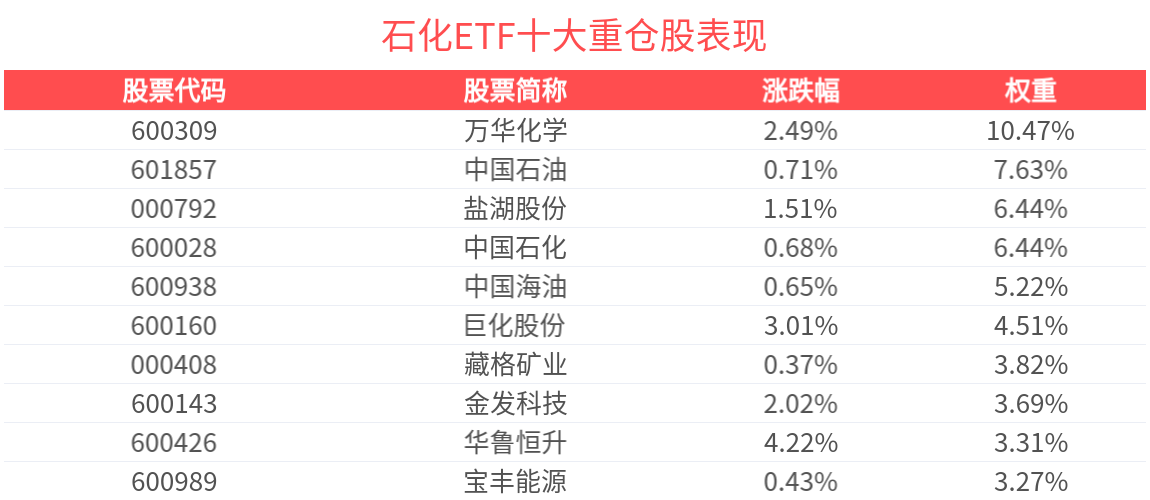
Core Insights - The petrochemical industry index has shown a strong increase of 1.88%, with significant gains in constituent stocks such as Yara International (up 4.93%) and Haohua Technology (up 4.58%) [1] - The Petrochemical ETF (159731) has experienced continuous net inflows over the past 8 days, totaling 269 million yuan, reaching a record high in both shares and scale [2] - The Petrochemical ETF has achieved a net value increase of 53.13% over the past two years, with a maximum single-month return of 15.86% since its inception [2] Fund Performance - The Petrochemical ETF's latest share count is 549 million, with a total scale of 522 million yuan [2] - The ETF has recorded an average monthly return of 5.25% during its rising months, with the longest consecutive rising streak lasting 8 months and a total increase of 41.60% [2] - The top ten weighted stocks in the index account for 56.73% of the total, including major companies like Wanhua Chemical and China Petroleum [2] Stock Performance - Notable stock performances include Wanhua Chemical (up 2.49%, weight 10.47%), China Petroleum (up 0.71%, weight 7.63%), and Salt Lake Potash (up 1.51%, weight 6.44%) [4] - Other significant stocks include China Petrochemical (up 0.68%, weight 6.44%) and Haohua Technology (up 4.22%, weight 3.31%) [4]
东吴证券:氨纶产能陆续出清 行业景气度有望改善
智通财经网· 2026-01-19 01:52
Core Viewpoint - The expansion phase of the spandex industry is nearing its end, and the elimination of backward production capacity is expected to drive an upward trend in industry prosperity [1][2]. Supply Side - As of the end of 2025, China's spandex production capacity is projected to be 1.44 million tons per year, with an industry operating rate of 85%. The supply-demand situation from 2022 to 2025 is expected to remain loose, with an average annual operating rate between 70% and 80%, leading to many companies operating at a loss [2]. - The concentration of the spandex industry is high, with a CR5 of 84% as of the end of 2025. The leading companies by production capacity are Huafeng Chemical (400,000 tons/year), Xiaoxing Spandex (246,000 tons/year), Zhujing Huahai (225,000 tons/year), Xinxiang Chemical Fiber (220,000 tons/year), and Taihe New Materials (100,000 tons/year) [2]. - New production capacity additions by 2025 include Huafeng Chongqing (75,000 tons/year), Xiaoxing Ningxia (36,000 tons/year), and Lycra Yinchuan (10,000 tons/year). Huafeng Chongqing is expected to continue expanding in 2026, while Xinxiang Chemical Fiber plans to add 100,000 tons/year, with the first phase of 50,000 tons/year expected to start construction in Q1 2026 [2]. - A total of 58,000 tons/year of spandex production capacity is expected to be eliminated by 2025, including 30,000 tons/year from Lianyungang Du Zhong Spandex and 28,000 tons/year from Taiguang Chemical Fiber [2]. Demand Side - The performance of spandex is excellent, with a projected CAGR of 11% for apparent consumption in China from 2017 to 2024. Spandex is often referred to as the "MSG of textiles," significantly enhancing the performance and quality of fabrics even at low addition ratios [3]. - Spandex is primarily used in blends with other fabrics, commonly found in tight-fitting clothing, sportswear, swimwear, and hygiene products such as medical bandages and diapers. The demand for spandex is expected to grow rapidly as its application range and addition ratios expand [3]. Related Companies - Huafeng Chemical: By the end of 2025, spandex production capacity will be 400,000 tons/year, with an additional 75,000 tons/year expected to be gradually put into production by the end of 2026 [4]. - Xinxiang Chemical Fiber: By the end of 2025, spandex production capacity will be 220,000 tons/year, with a planned additional capacity of 100,000 tons/year, including a first phase of 50,000 tons/year expected to start construction in Q1 2026 [4]. - Taihe New Materials: By the end of 2025, spandex production capacity will be 100,000 tons/year [4].

聚氨酯TPU结构件,防护减震理想选择,人形机器人量产落地的“安全垫”
Zhong Guo Neng Yuan Wang· 2026-01-19 00:54
Core Insights - The TPU (Thermoplastic Polyurethane) market is expected to grow significantly, driven by its applications in humanoid robots, with consumption in China projected to rise from 447,000 tons in 2019 to 720,000 tons by 2024, reflecting a CAGR of 10% [1][4] - The introduction of Tesla's Optimus robot, which features soft covering materials, highlights the increasing importance of TPU in robotics, particularly for safety and interaction [2][4] Group 1: TPU Applications in Robotics - TPU materials are ideal for safety and shock absorption in humanoid robots, providing protection for internal components and suitable for high-contact scenarios [3] - The versatility of TPU allows for the production of non-load-bearing structural components, enhancing the manufacturing process through techniques like 3D printing [3] - TPU's properties make it suitable for protective and sealing applications in high-motion areas, such as joints and cables [3] Group 2: Market Growth and Investment Opportunities - The mass production of humanoid robots is anticipated to expand the TPU market significantly, with a potential market space exceeding 3 billion yuan when producing one million robots [4] - Companies with existing expertise in TPU manufacturing and partnerships with downstream robot manufacturers are positioned to benefit first from this growth [5] - Specific companies identified as beneficiaries include Kaizhong Co., Moulded Technology, and others involved in flexible covering materials and TPU production [5]


东吴证券晨会纪要2026-01-19-20260119
Soochow Securities· 2026-01-18 23:37
Macro Strategy - The report indicates that structural "targeted interest rate cuts" have been implemented, and there is still room for "reserve requirement ratio (RRR) cuts and interest rate cuts" in 2026, especially if the RMB exchange rate and bank net interest margins remain stable [1][2][9] - It is expected that monetary policy in 2026 will be adjusted based on economic and financial conditions, with specific timing to be determined through comprehensive assessment [2][9] Fixed Income and Industry Analysis Industry Overview: Spandex - As of January 15, 2026, the price of spandex in China is 23,000 yuan/ton, with a price difference of 10,864 yuan/ton, indicating a high price percentile since 2018 [3][5] - The spandex industry is nearing the end of capacity expansion, and the elimination of outdated capacity is expected to improve industry conditions [3] - By the end of 2025, China's spandex capacity is projected to be 1.44 million tons/year, with an industry operating rate of 85% [3] - The industry concentration is high, with the top five companies holding 84% of the market share, indicating a significant head effect [3] - Demand for spandex is expected to grow rapidly, with a CAGR of 11% from 2017 to 2024, driven by its applications in textiles and hygiene products [5] Company Analysis: Huafeng Chemical - Huafeng Chemical is expected to maintain a spandex capacity of 400,000 tons/year by the end of 2025, with an additional 75,000 tons/year capacity expected to be gradually put into production by the end of 2026 [5] - The company is positioned to benefit from the anticipated improvement in industry conditions due to capacity elimination and increasing demand [5] Company Analysis: Xinxing Chemical Fiber - Xinxing Chemical Fiber is projected to have a spandex capacity of 220,000 tons/year by the end of 2025, with plans for an additional 100,000 tons/year capacity, with the first phase expected to start construction in Q1 2026 [5] - The company is also expected to benefit from the industry's recovery as outdated capacities are phased out [5] Company Analysis: Taihe New Materials - Taihe New Materials is expected to have a spandex capacity of 100,000 tons/year by the end of 2025, contributing to the overall industry capacity and benefiting from the anticipated demand growth [5]
行业周报:聚氨酯TPU结构件:防护减震理想选择,人形机器人量产落地的“安全垫”-20260118
KAIYUAN SECURITIES· 2026-01-18 10:41
Investment Rating - Investment rating: Positive (maintained) [1] Core Viewpoints - The report emphasizes the potential of thermoplastic polyurethane (TPU) materials in humanoid robots, highlighting their excellent performance in safety protection and shock absorption, making them an ideal choice for the latest developments in robotics [5][19][30] - The application of TPU in humanoid robots is expected to drive significant market growth, with a projected increase in TPU consumption from 447,000 tons in 2019 to 720,000 tons in 2024, reflecting a CAGR of 10% [7][41] - The report identifies key companies that are likely to benefit from the growth in humanoid robots, particularly those involved in the manufacturing of TPU structural components [8][45] Summary by Sections TPU Material Advantages - TPU combines high elasticity and mechanical strength, making it suitable for various applications in humanoid robots, including safety protection, structural components, and sensor packaging [6][24] - The material's properties, such as high wear resistance, tear resistance, and fatigue resistance, make it ideal for high-contact and high-friction scenarios [30][31] Market Expansion Potential - The humanoid robot market is expected to create a new growth space for TPU, with an optimistic scenario projecting a market space exceeding 3 billion yuan when production reaches one million units [7][40] - The report suggests that the TPU market will expand significantly as it replaces and penetrates traditional applications in footwear, films, and automotive sectors [41] Beneficiary Companies - Midstream TPU structural component manufacturers are expected to benefit first from the volume production of humanoid robots, with companies like Kaizhong Co. and Mould Technology identified as key players [8][45] - Other beneficiaries include companies involved in flexible protective materials and electronic skin production, such as Riyi Electronics and Henghui Security [8][52] Investment Logic - The report outlines that the production of humanoid robots will lead to an increase in TPU market size and push industry valuation upwards, with a projected single-unit TPU usage of 6-10 kg per robot [40][41] - The existing experience and production lines in the automotive sector can be leveraged for the production of TPU components for humanoid robots, facilitating a quicker adaptation to market demands [45][46]


化工复盘:前两轮周期牛市,阿尔法龙头表现几何?
Changjiang Securities· 2026-01-18 09:45
Investment Rating - The industry investment rating is "Positive" and maintained [8] Core Insights - In the previous two cyclical bull markets, alpha leading stocks significantly outperformed the basic chemical sector. These leaders possess both supply-demand improvements and cost advantages, leading to price elasticity and sustainable low-cost expansion. In cyclical bull markets, they exhibit performance drivers of volume and price increases, providing excess returns for investors [2][6][38]. - The report emphasizes the importance of investing in high-quality leading companies such as Wanhua Chemical, Hualu Hengsheng, Longbai Group, Yangnong Chemical, Huafeng Chemical, and Boyuan Chemical [2][6][38]. Summary by Sections Introduction: Why Focus on Leading Stocks in Cyclical Bull Markets? - The PPI (Producer Price Index) has shown a continuous narrowing of decline and is expected to turn positive by October 2025. This indicates a potential recovery in industrial product pricing and an improvement in market demand and supply conditions. The chemical industry, as a key industrial raw material, is likely to reflect these changes first, suggesting a transition from demand stagnation to a new round of inventory replenishment or capacity adjustment [4][14]. Performance of Alpha Leaders in Previous Cyclical Bull Markets - The report analyzes the stock selection and performance of alpha leaders during the last two cyclical bull markets (2016-2018 and 2020-2021). The selected stocks include Wanhua Chemical, Hualu Hengsheng, Longbai Group, and Yangnong Chemical, with the addition of Huafeng Chemical and Boyuan Chemical in the second round. The performance data shows that these leaders significantly outperformed the basic chemical index [5][18]. - In the first cycle (2016-2018), the highest stock price increases for these leaders were 488.9% for Wanhua Chemical, 281.4% for Hualu Hengsheng, 147.7% for Longbai Group, and 247.5% for Yangnong Chemical, with an average increase of 291.4%. The basic chemical index saw a maximum increase of around 39% during the same period [18][19]. - In the second cycle (2020-2021), the highest increases were 311.0% for Wanhua Chemical, 276.5% for Hualu Hengsheng, 314.2% for Longbai Group, 188.0% for Yangnong Chemical, 290.1% for Huafeng Chemical, and 728.7% for Boyuan Chemical, with an average increase of 351.4% compared to a maximum of 136% for the basic chemical index [18][19]. Investment Recommendations - The report suggests focusing on high-quality leading companies for investment opportunities, as they are expected to benefit from supply-demand improvements and cost advantages. The overall chemical sector is currently at a low point, but with anticipated global economic growth, demand for chemical products is expected to increase. The report also highlights the potential for a recovery in PPI and chemical prices in 2026 [6][38][39].



挖掘超额收益新路径!ETF申报与发行成基金布局新风向标?
券商中国· 2026-01-17 04:58
Core Viewpoint - The boundary between passive investment ETFs and actively managed funds is increasingly blurring, with ETFs becoming a key indicator for active equity funds in identifying industry trends and market turning points [1][2]. Group 1: ETF and Active Equity Fund Interaction - The direction of ETF applications is becoming a "barometer" for many active equity funds, reflecting market demand and profitability [2]. - Active equity funds are increasingly adopting ETF-like characteristics, with top-performing products in 2025 showing high concentration in specific sectors, often exceeding 90% in positions [2]. - The issuance of ETFs is often seen as a precursor to industry booms, as evidenced by the rapid rise of the robotics sector following the launch of several ETFs [2]. Group 2: Sector-Specific Trends - The commercial aerospace sector has gained attention from active equity funds following the launch of the first satellite ETF, indicating a shift in investment focus [3]. - A decrease in ETF applications for consumer sectors has led to a corresponding reduction in active equity fund allocations to these areas, demonstrating a synchronized response to market trends [3]. Group 3: ETF as a Research Tool - The logic behind ETF applications has evolved from merely capturing flows to predicting industry turning points, thereby enhancing the research capabilities of active equity funds [4]. - The recent surge in chemical ETFs reflects a strategic shift in product development, aligning with active fund managers' anticipations of market reversals [5]. Group 4: Confidence in Market Recovery - ETF applications serve as confidence anchors during industry downturns, with recent ETF launches in the solar and battery sectors signaling potential market recoveries [6]. - The issuance of ETFs during low points in the market suggests a strategic approach to capitalize on upcoming industry recoveries, supported by favorable policy changes [6]. Group 5: Collaborative Advantages - The synergy between ETF product development and research departments is becoming a significant advantage for public funds, enhancing their ability to identify and capitalize on niche opportunities [7]. - The evolving role of ETFs as precursors to active fund investments provides liquidity for sectors that are undervalued and poised for recovery, creating a closed loop of investment strategy [7].