比亚迪

Search documents
汽车行业2026年投资策略:汽车出海迈入深水区,智能化&机器人大展宏图
Southwest Securities· 2026-01-23 12:34
Investment Rating - The report provides a positive investment outlook for the automotive industry, particularly focusing on smart vehicles, new energy vehicles, commercial vehicles, and humanoid robots, indicating significant growth potential in these sectors [1][2]. Core Insights - The automotive industry is entering a transformative phase driven by policies that support the development of smart vehicles and the expansion of new energy vehicles. The report highlights the acceleration of intelligent driving technology and the increasing market penetration of new energy vehicles [3][4]. Summary by Relevant Sections Smart Vehicles - The report emphasizes that the intelligent vehicle sector is experiencing rapid advancements due to policy support, with L3 vehicle standards expected to be implemented by 2026. The adoption of advanced driving assistance systems (ADAS) is increasing, with new vehicle models showing significant growth in features like highway and urban NOA (Navigation on Autopilot) [4][68]. - The financing landscape for autonomous driving is booming, with 35 companies in the sector raising over 582 billion yuan in 2025, nearly three times the amount raised in 2023 [4][80]. New Energy Vehicles - The continuation of vehicle replacement policies is expected to bolster sales, with wholesale volumes of new energy passenger vehicles projected to reach 18.16 million units in 2026, a year-on-year increase of 18% [4][34]. - Exports of new energy vehicles have shown remarkable growth, with a 102.5% year-on-year increase in 2025, indicating strong demand in international markets [4][34]. Commercial Vehicles - The heavy truck sector is supported by ongoing vehicle replacement policies, with sales expected to reach 1.196 million units in 2026, reflecting a year-on-year growth of 4.6% [4][34]. - The report notes that the heavy truck market is benefiting from both domestic and international demand, with significant growth anticipated due to the continued penetration of new energy heavy trucks [4][34]. Humanoid Robots - The humanoid robot sector is poised for rapid growth, with applications in automotive manufacturing expected to enhance production efficiency. The report forecasts a compound annual growth rate of approximately 85% in humanoid robot shipments from 2024 to 2035 [4][34]. - The cost of humanoid robots is expected to decrease significantly, with projections indicating that the price of a standard humanoid robot could drop from $80,000-$90,000 to $15,000-$20,000 by 2030 [4][34]. Policy Environment - The report highlights a favorable policy environment that is increasingly supportive of the automotive industry's transition towards smart and electric vehicles. Key policies include the approval of L3 autonomous vehicle models and the establishment of unified standards for vehicle replacement subsidies [4][53]. Market Trends - The automotive market is witnessing a shift towards intelligent and electric vehicles, with consumer preferences evolving towards higher levels of automation and connectivity in vehicles. The report indicates that the penetration rate of intelligent driving features is expected to increase significantly in the coming years [4][68]. Capital Market Activity - The report notes a surge in investment activity within the autonomous driving sector, indicating a strong belief in the future growth of this industry. The capital market's enthusiasm is reflected in the substantial funding raised by various companies, signaling a robust outlook for the sector [4][80].



车载SoC报告:智能驾驶算力跃迁加速兑现,国产化生态驱动车规芯片结构性放量
East Money Securities· 2026-01-23 11:10
Investment Rating - The report maintains an investment rating of "Outperform" for the automotive SoC industry, indicating a positive outlook for growth in this sector [2]. Core Insights - The automotive SoC market is experiencing a significant transformation driven by the acceleration of smart driving capabilities and the push for domestic production in the chip ecosystem [1][6]. - The global smart device SoC market is projected to grow from $41.9 billion in 2020 to $65.7 billion by 2024, with a compound annual growth rate (CAGR) of 11.9% [6][48]. - The demand for automotive SoCs is entering a high-certainty growth phase, supported by the increasing integration of AI and smart automotive technologies [6][7]. Summary by Sections 1. Industry Upgrade and Demand Expansion - The evolution of E/E architecture is shifting from distributed systems to centralized computing platforms, enhancing the role of SoCs as core computational units [15][16]. - The global smart automotive sales are expected to rise from 41.2 million units in 2020 to 65.7 million units by 2024, reflecting a CAGR of 12.4% [48]. - The integration of multi-domain functionalities in automotive SoCs is becoming mainstream, with significant advancements in performance and efficiency [62][63]. 2. Technological Advancements and Collaboration - The report highlights the importance of heterogeneous computing in advancing automotive SoC capabilities, with a focus on integrating CPU, GPU, NPU, and DSP [6][25]. - Companies like Horizon Robotics and Black Sesame Intelligence are making strides in the domestic SoC market, enhancing their competitive edge in high-level smart driving applications [7][38]. 3. Domestic Production and Market Dynamics - The domestic production of automotive SoCs is gaining momentum, with local companies like Horizon Robotics and Allwinner Technology showing promising growth trajectories [7][54]. - The report emphasizes the increasing market share of domestic SoC manufacturers, which is projected to exceed 10% by 2024 [54]. 4. Investment Recommendations - The report suggests focusing on investment opportunities within the domestic automotive SoC supply chain, particularly in companies like Black Sesame Intelligence, Horizon Robotics, and Allwinner Technology [7].
科马材料打造国产摩擦材料核心竞争力
Zheng Quan Ri Bao Wang· 2026-01-23 10:48
Core Viewpoint - Zhejiang Kema Material Co., Ltd. has officially listed on the Beijing Stock Exchange, leveraging its leading T2 core technology and strong performance in the automotive parts sector, positioning itself as a high-quality investment target in the capital market [1] Group 1: Technology and Production - The T2 dry extrusion process is a key competitive advantage for Kema Materials, showcasing significant technological leadership globally [1] - The T2 process offers comprehensive breakthroughs in environmental protection, production efficiency, and product performance compared to the traditional T1 wet process, including reduced organic solvent usage and lower natural gas consumption [1] - Kema Materials is the first company in China to achieve large-scale industrial application of the T2 production process, establishing a strong industry barrier through its technical scarcity [1] Group 2: Market Demand and Growth - The market demand for dry friction plates is optimizing under the automotive industry upgrade, providing Kema Materials with substantial growth opportunities [2] - In the commercial vehicle sector, manual transmission vehicles dominate the domestic market, while AMT automatic transmissions are widely used in Europe and the U.S., supporting stable global demand for dry friction plates [2] - The rapid rise of new energy hybrid vehicles in the passenger car sector has become a new growth engine, with the proportion of vehicles requiring dry friction plates in the domestic market reaching 27.94% by 2024 [2] Group 3: Strategic Initiatives and Funding - Kema Materials is proactively entering the wet paper-based friction plate market to seize domestic opportunities, with a focus on increasing the localization rate [3] - The company plans to invest 73.32% of the 206 million yuan raised from its IPO into upgrading the T2 dry extrusion process, which will add an annual production capacity of 10 million plates [3] - Kema Materials holds 80 authorized patents and has participated in drafting 13 national and industry standards, establishing a closed-loop innovation mechanism through collaboration with academic institutions [3]
汽车行业2026年投资策略:汽车出海迈入深水区,智能化、机器人大展宏图
Southwest Securities· 2026-01-23 10:36
Core Insights - The automotive industry is entering a critical phase of globalization, with significant advancements in smart technology and robotics expected to drive growth [1][4] - The report highlights the acceleration of smart vehicle development due to favorable policies, technological convergence, and increased consumer demand for intelligent features [4][68] Smart Vehicles - Policy support is enhancing the development of smart driving technologies, with L3 vehicle standards expected to be implemented by 2026, facilitating the growth of the autonomous driving industry [4][53] - The adoption of advanced driver-assistance systems (ADAS) is increasing, with new vehicle models showing a significant rise in the installation rates of highway NOA and urban NOA, reaching 30.20% and 34.82% respectively in early 2025 [4][79] - The capital market is witnessing explosive growth in autonomous driving financing, with 35 companies raising over 582 billion yuan in 2025, nearly three times the amount raised in 2023 [4][80] New Energy Vehicles - The continuation of vehicle replacement policies is expected to support sales, with wholesale volumes of new energy passenger vehicles projected to reach 18.16 million units in 2026, a year-on-year increase of 18% [4] - Exports of new energy vehicles showed robust growth, with 2.238 million units exported from January to November 2025, marking a 102.5% increase year-on-year [4] Commercial Vehicles - Heavy truck sales are supported by ongoing replacement policies and expected to reach 1.196 million units in 2026, reflecting a year-on-year growth of 4.6% [4] Humanoid Robots - The humanoid robot industry is poised for rapid growth, with applications in automotive manufacturing expected to enhance production efficiency [4] - The cost of humanoid robots is projected to decrease significantly, from approximately $80,000-$90,000 to $15,000-$20,000 by 2030, driven by advancements in AI and production scale [4] Policy Environment - The policy landscape is becoming increasingly favorable for the automotive industry, with initiatives aimed at promoting smart and connected vehicles, including the approval of L3 autonomous driving models [4][53] Supply Side Dynamics - Automakers are accelerating the rollout of intelligent driving features, transitioning from high-end options to standard offerings across various price segments, thereby meeting consumer preferences for smart technology [4][68][73]
从“海派”到“闯派”!深圳如何作答APEC?专家探讨“双向奔赴”背后……
Nan Fang Du Shi Bao· 2026-01-23 10:29
Core Viewpoint - The upcoming APEC meeting in Shenzhen in 2026 is seen as an opportunity for the city to showcase its unique characteristics as a major innovation hub and to explore mutual benefits with APEC member economies [2][25]. Group 1: Shenzhen's Unique Characteristics - Shenzhen is characterized as a "pioneering" city, representing the spirit of reform and opening up, contrasting with the "Beijing" and "Shanghai" cultural representations [5][6]. - The city maintains a high-density ecological environment while achieving economic growth and social inclusivity, serving as a model for urban development, especially for developing countries [7]. - The diverse business ecosystem in Shenzhen, with large enterprises and numerous small businesses, reflects the city's resilience and vitality [7]. Group 2: Technological and Ecological Contributions - Shenzhen aims to leverage its technological strengths at the APEC stage, with proposals for initiatives like the "APTC Technology Personnel Card" to facilitate cross-border movement of tech talent [9][28]. - The city is positioned as a leader in ecological governance, with suggestions to establish high-level dialogues on ecological cooperation within APEC, focusing on carbon trading and data networks for mangrove monitoring [16][17]. Group 3: Cultural and Economic Development - A proposal to create an "APEC Cultural Corridor" to immerse visitors in Shenzhen's transformation from a small town to a modern city, highlighting its rich cultural heritage [19]. - The meeting is seen as a chance for Shenzhen to enhance its international profile, optimize its business environment, and address social needs, thereby benefiting from APEC's presence [20][22]. Group 4: Health and Medical Initiatives - Shenzhen's ongoing "Hong Kong-Macau Medical Device Access" initiative is suggested to be upgraded to an "APEC Medical Device Access" framework, aiming to connect with high-quality industrial resources from APEC economies [23][33].

数据复盘丨钙钛矿电池、商业航天等概念走强 191股获主力资金净流入超1亿元



Zheng Quan Shi Bao Wang· 2026-01-23 09:56
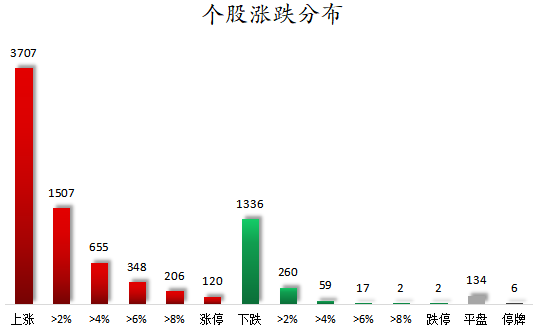
Market Overview - The Shanghai Composite Index closed at 4136.16 points, up 0.33%, with a trading volume of 1.3369 trillion yuan. The Shenzhen Component Index rose 0.79% to 14439.66 points, with a trading volume of 1.7484 trillion yuan. The ChiNext Index increased by 0.63% to 3349.50 points, with a trading volume of 822.63 billion yuan. The STAR Market 50 Index closed at 1553.71 points, up 0.78%, with a trading volume of 110.8 billion yuan. The total trading volume of both markets was 3.0853 trillion yuan, an increase of 393.5 billion yuan compared to the previous trading day [1]. Sector Performance - The market saw more sectors gaining than losing, with notable increases in power equipment, non-ferrous metals, precious metals, defense and military, steel, media, computer, environmental protection, and textile and apparel sectors. Concepts such as perovskite batteries, commercial aerospace, satellite internet, sapphire, lithium mining, cultivated diamonds, small metals, gold, and interactive short dramas were particularly active. In contrast, sectors like communication, insurance, banking, coal, and home appliances experienced declines [1]. Individual Stock Performance - A total of 3707 stocks rose, while 1336 stocks fell, with 134 stocks remaining flat and 6 stocks suspended. Excluding newly listed stocks, there were 120 stocks hitting the daily limit up and 2 stocks hitting the limit down [2]. - Among the stocks that hit the daily limit up, 23 stocks had consecutive limit-up days of 2 or more, with Fenglong Co., Ltd. leading with 18 consecutive limit-ups [3]. Capital Flow - The net capital outflow from the two markets was 4.167 billion yuan, with the ChiNext seeing a net inflow of 1.515 billion yuan. The CSI 300 index experienced a net outflow of 1.005 billion yuan, while the STAR Market saw a net outflow of 3.171 billion yuan. Out of 31 sectors, 13 sectors had net capital inflows, with the power equipment sector leading with a net inflow of 8.977 billion yuan [4][6]. - The top sectors with net inflows included non-ferrous metals (4.552 billion yuan), media (2.173 billion yuan), and defense and military (2.157 billion yuan). Conversely, the communication sector had the highest net outflow of 7.992 billion yuan, followed by electronics (6.350 billion yuan) and machinery (5.077 billion yuan) [4][6]. Notable Stocks - 191 stocks had net capital inflows exceeding 1 billion yuan, with Jin Feng Technology receiving the highest net inflow of 1.861 billion yuan. Other notable stocks included Lens Technology (1.594 billion yuan), Qian Zhao Optoelectronics (1.267 billion yuan), and Xian Dao Intelligent (1.217 billion yuan) [7][8]. - Conversely, 116 stocks experienced net capital outflows exceeding 1 billion yuan, with Xin Yi Sheng leading with a net outflow of 3.471 billion yuan, followed by Zhong Ji Xu Chuang (3.103 billion yuan) and Li Ou Shares (2.604 billion yuan) [10][11]. Institutional Activity - Institutional investors had a net selling of approximately 1.02 billion yuan, with 22 stocks seeing net purchases and 14 stocks net sales. Jin Feng Technology was the most purchased stock by institutions, with a net purchase amount of approximately 266 million yuan [13][14].
比亚迪:投资者提三大发展建议,公司将吸纳建言促发展
Xin Lang Cai Jing· 2026-01-23 09:53
Group 1 - The core viewpoint emphasizes that without acknowledging the distinction between "manufacturing advantage" and "value definition," the company risks being categorized as a "mature manufacturing enterprise" [1] - It highlights the importance of differentiating between "technological leadership" and "technology premium," warning that failing to do so may lead to the company incurring R&D costs while losing emotional value and capital premium [1] - The response indicates that if the company opts for low pricing to quickly gain market share in overseas markets instead of prioritizing high-end positioning, it risks being labeled as "cheap and reliable," which could be nearly irreversible [1] Group 2 - The company expresses gratitude for investor feedback and emphasizes its commitment to listening to market voices and incorporating valuable suggestions to enhance core capabilities and achieve high-quality development [2]
汽车行业双周报(2026、1、9-2026、1、22):中欧电动汽车反补贴案达成积极成果-20260123
Dongguan Securities· 2026-01-23 09:41
Investment Rating - The report maintains an "Overweight" rating for the automotive industry, indicating an expectation that the industry index will outperform the market index by more than 10% in the next six months [42]. Core Insights - The report highlights positive developments in the China-Europe electric vehicle anti-subsidy negotiations, which are expected to boost market confidence and create a stable business environment for Chinese automakers in Europe. This is anticipated to lead to a release of previously suppressed export demand in the short term [38]. - The automotive sector has shown resilience, with the Shenyin Wanguo automotive index rising 2.84% over the past two weeks, outperforming the CSI 300 index by 3.13 percentage points [9][11]. - The report suggests monitoring the export data of various automakers for marginal improvements following the recent policy developments [38]. Industry Data Tracking - In December 2025, China's automotive production was 3.296 million units, a year-on-year decrease of 2.1%, while sales were 3.272 million units, down 6.2% year-on-year. However, exports reached 753,000 units, marking a 49.4% increase year-on-year [15][16]. - The dealer inventory warning index for November was reported at 57.70%, reflecting a year-on-year increase of 7.50 percentage points [15]. Industry News - Guangdong province is promoting the orderly opening of autonomous driving testing applications, expanding the areas for high-level autonomous driving [23]. - The total number of electric vehicle charging facilities in China has surpassed 20 million, with a year-on-year growth of 49.7% [26]. - The Ministry of Finance has introduced a loan interest subsidy policy for small and micro enterprises, focusing on key industries including new energy and automotive [27]. Corporate News - Hongqi has successfully launched its first solid-state battery prototype, marking a significant step in battery technology [31]. - Geely has introduced the Galaxy V900, a luxury MPV with a starting price of 269,800 yuan, featuring advanced AI capabilities [32]. - Chery has invested in a self-driving chip design company, enhancing its technological capabilities in autonomous driving [34]. Investment Recommendations - The report recommends focusing on companies that are actively expanding into overseas markets, such as BYD and Seres, as well as those in the intelligent driving supply chain like Fuyao Glass and Joyson Electronics [38][39].
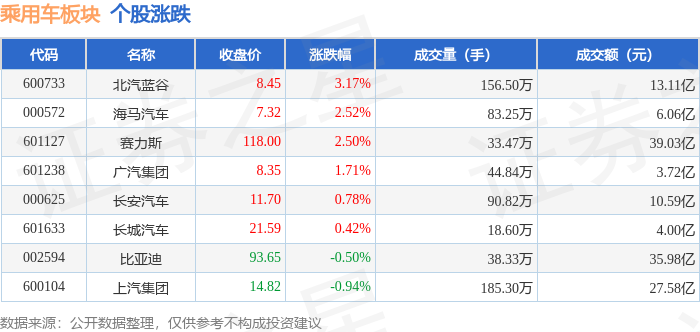
乘用车板块1月23日涨0.49%,北汽蓝谷领涨,主力资金净流出11.47亿元
Zheng Xing Xing Ye Ri Bao· 2026-01-23 09:04
Core Viewpoint - The passenger car sector experienced a slight increase of 0.49% on January 23, with Beijing Blue Valley leading the gains. The Shanghai Composite Index closed at 4136.16, up 0.33%, while the Shenzhen Component Index closed at 14439.66, up 0.79% [1]. Group 1: Market Performance - Beijing Blue Valley (600733) closed at 8.45, up 3.17% with a trading volume of 1.565 million shares and a transaction value of 1.311 billion yuan [1]. - Haima Automobile (000572) closed at 7.32, up 2.52% with a trading volume of 832,500 shares and a transaction value of 606 million yuan [1]. - Seres (601127) closed at 118.00, up 2.50% with a trading volume of 334,700 shares and a transaction value of 3.903 billion yuan [1]. - GAC Group (601238) closed at 8.35, up 1.71% with a trading volume of 448,400 shares and a transaction value of 372 million yuan [1]. - Changan Automobile (000625) closed at 11.70, up 0.78% with a trading volume of 908,200 shares and a transaction value of 1.059 billion yuan [1]. - Great Wall Motors (601633) closed at 21.59, up 0.42% with a trading volume of 186,000 shares and a transaction value of 400 million yuan [1]. - BYD (002594) closed at 93.65, down 0.50% with a trading volume of 383,300 shares and a transaction value of 3.598 billion yuan [1]. - SAIC Motor (600104) closed at 14.82, down 0.94% with a trading volume of 1.853 million shares and a transaction value of 2.758 billion yuan [1]. Group 2: Fund Flow Analysis - The passenger car sector saw a net outflow of 1.147 billion yuan from institutional investors, while retail investors contributed a net inflow of 718 million yuan [1]. - The main fund inflow for Seres (601127) was 118 million yuan, accounting for 3.02% of the total, while retail investors had a net outflow of 11.6 million yuan [2]. - Beijing Blue Valley (600733) had a main fund inflow of 108 million yuan, representing 8.26% of the total, with retail investors contributing a net inflow of 35.217 million yuan [2]. - Changan Automobile (000625) experienced a main fund inflow of 43.554 million yuan, accounting for 4.11%, while retail investors had a net inflow of 19.761 million yuan [2]. - Haima Automobile (000572) saw a main fund inflow of 26.734 million yuan, representing 4.41%, with a retail net outflow of 9.9696 million yuan [2]. - GAC Group (601238) had a main fund inflow of 18.375 million yuan, accounting for 4.94%, while retail investors experienced a net outflow of 26.513 million yuan [2]. - Great Wall Motors (601633) had a main fund inflow of 12.320 million yuan, representing 3.08%, with a retail net outflow of 35.988 million yuan [2]. - BYD (002594) experienced a significant net outflow of 686 million yuan from institutional investors, while retail investors had a net inflow of 51 million yuan [2]. - SAIC Motor (600104) faced a substantial net outflow of 788 million yuan from institutional investors, while retail investors had a net inflow of 34.2 million yuan [2].






为硬科技注入温度:汇志传媒如何助力湾区品牌“走出去”
Zhong Guo Jing Ying Bao· 2026-01-23 08:57
Core Insights - The Greater Bay Area is undergoing a significant transformation, evolving from a "manufacturing-driven" to an "innovation-enabled" economy, positioning itself as a core source of brand innovation [1] - Companies in the region are shifting from OEM (Original Equipment Manufacturer) models to developing their own brands for international markets [1] Group 1: Company Overview - Huizhi Media, established in 2006, has grown into a key partner in the Greater Bay Area, leveraging 20 years of experience and over 1,000 quality clients to evolve alongside the industry [1] - The company specializes in translating complex technological language into relatable stories for hard-tech enterprises, addressing the challenge of "technologically advanced but difficult to narrate" products [2] Group 2: Strategic Partnerships - Huizhi Media has collaborated with BYD for eight years, supporting its transition from a newcomer in the automotive industry to a leader in the new energy vehicle sector, evolving its communication strategy from local to global narratives [2] - The company played a pivotal role in facilitating a strategic meeting between BYD's founder and the chairman of Jomoo Group, enhancing collaboration in technology and brand vision [4] Group 3: Ecosystem Development - The company is expanding its traditional business boundaries by fostering strategic dialogues and collaborations across different industries, which has become a core competitive advantage for communication service providers in the Greater Bay Area [4] - Huizhi Media's establishment of the Zhimei Huizhi Industrial Park, the first 5G digital industrial park in Shenzhen, has served nearly 200 digital creative and live e-commerce companies, creating a comprehensive ecosystem that empowers the industry [5] Group 4: Cultural Integration - The Greater Bay Area's appeal lies in its diverse economic and cultural environment, which brands must leverage to create innovative narratives that resonate globally [7] - Huizhi Media's work in revitalizing the "Charming Yau Ma Tei" brand in Hong Kong exemplifies its approach of blending traditional craftsmanship with modern trends, successfully attracting cross-regional traffic [7][9] Group 5: Brand and Ecosystem Competition - The competition among brands is ultimately a competition of ecosystems, and Huizhi Media is contributing to the Greater Bay Area's fertile ground for nurturing globally recognized brands [9]