花旗集团

Search documents
暴涨!2天涨超450%!人造肉第一股又火了
证券时报· 2025-10-22 00:09
人造肉第一股又火了。 受到国际金价大跌影响,美股市场黄金股集体重挫,其中,盎格鲁黄金跌逾11%,金罗斯黄金跌逾11%,巴里克黄金跌逾9%。 值得一提的是,人造肉第一股Beyond Meat在周一(10月20日)大涨127%后,周二再度大涨,截至收盘,该股上涨146.26%,近两个交易日股价累计涨幅 超过450%。盘后该股涨超20%。 有消息称,Beyond Meat与沃尔玛将在超2000家门店增加部分产品的供应,公司有望借此摆脱经营困境。公司2025年二季度财报显示,该季度公司营收仅 7500万美元,同比下降近两成,远低于预期,净亏损3320万美元,运营亏损3490万美元;同时公司总债务高达12亿美元。 当地时间周二(10月21日),美国股市三大股指收盘涨跌不一。其中,道琼斯工业指数盘中一度创出历史新高。 中概股多数下跌,纳斯达克中国金龙指数跌0.97%。热门中概股方面,好未来涨超6%,哔哩哔哩涨超5%,新东方涨超4%;逸仙电商跌逾6%,宝尊电商、叮 咚买菜、大全新能源跌逾4%,阿里巴巴、蔚来跌逾3%,百度、京东跌逾2%。 国际金价重挫 美股黄金股集体暴跌 当地时间周二,国际金价出现大跌行情,当天伦敦金现价格 ...


跳水!国际金价一度暴跌6% 创2013年以来最大单日跌幅
Di Yi Cai Jing· 2025-10-21 23:12
当地时间10月21日,国际黄金市场在此前连创纪录高位后急剧下挫。现货黄金一度暴跌超6%,创下自 2013年4月以来最大单日跌幅,纽约商品交易所12月交割的黄金期货收跌5.7%,报每盎司4109.10美元。 此前一个交易日,金价刚创下4381美元的历史新高。 除黄金外,白银亦大幅下挫。现货白银收跌7.6%,报每盎司48.49美元,创2021年以来最大单日跌幅。 矿业股同步承压,纽蒙特(Newmont)下跌逾9%,哈莫尼黄金(Harmony Gold)与金罗斯黄金 (Kinross Gold)跌幅均超过10%。黄金ETF(GLD)全天下跌逾6%,创2013年4月以来最大单日跌幅。 市场普遍认为,这轮剧烈调整反映了前期涨势过快后的自然回调。随着金价在高位交投、市场多头仓位 集中,情绪变化被迅速放大。部分分析人士认为,这一轮下跌更多是技术性调整,而非趋势性逆转。 汇丰贵金属策略师詹姆斯·斯蒂尔(James Steel)对第一财经记者表示,近期金价涨势"近乎抛物线式", 高杠杆与集中持仓使市场对外部情绪的敏感度上升。在他看来,黄金中期上升趋势仍在延续。 美元反弹与风险偏好回升 本轮黄金上涨始于年初,在地缘政治风险、降息 ...
韩国央行货币政策前瞻:出口暴跌、韩元承压 降息时点再度推迟
Xin Hua Cai Jing· 2025-10-21 04:28
Group 1 - The Bank of Korea is expected to maintain the benchmark interest rate at 2.50% during the upcoming monetary policy meeting, with analysts predicting no rate cuts in October and potential cuts delayed to November or later [1][2] - The Bank of Korea has kept the benchmark interest rate unchanged since it was lowered to 2.50% in May, with the governor emphasizing a cautious policy stance [2] - The introduction of a "conditional forward guidance" mechanism aims to enhance monetary policy transparency and market communication, particularly in a low-interest-rate environment [2] Group 2 - South Korea's exports to the U.S. saw a significant decline of over 40% in the first ten days of October, influenced by U.S. tariff policies, leading to a shift in South Korea's export market ranking [3] - The domestic real estate market is a critical factor influencing monetary policy, with the Bank of Korea's governor stating efforts to avoid unnecessary liquidity injections amid rising property prices [3] - The consumer price index (CPI) in South Korea rose by 2.1% year-on-year in September, slightly exceeding market expectations, driven by a significant increase in communication costs [3] Group 3 - The Korean won depreciated against the U.S. dollar, prompting the Ministry of Economy and Finance and the Bank of Korea to implement verbal interventions to stabilize the currency [4] - External factors such as the U.S. government shutdown and ongoing trade tensions have contributed to increased market volatility and capital outflow pressures [4] - The Bank of Korea's governor stated that the current exchange rate is not at crisis levels and clarified that discussions with the Federal Reserve regarding currency swap arrangements have not occurred [4] Group 4 - Citigroup's economists believe that the current interest rate cut cycle in South Korea may be ending, adjusting their predictions for future rate cuts based on various economic factors [5] - The new forecast suggests that the Bank of Korea may only cut rates in November 2026 and May 2027, with a terminal rate of 2% [5] - Capital Economics predicts that the South Korean economy will slow down due to export pressures and a decline in fiscal stimulus, potentially leading to three more rate cuts by the end of the year [6]
美国地区银行信贷警报再次拉响 个别现象还是行业问题?
2 1 Shi Ji Jing Ji Bao Dao· 2025-10-20 23:24
Core Viewpoint - Recent failures of regional banks Zions Bank and West Alliance highlight vulnerabilities in the U.S. banking sector, exacerbated by credit fraud and defaults, raising concerns about the stability of both small and large banks [1][2][3] Group 1: Bank Failures and Legal Issues - Zions Bank is involved in legal disputes related to two real estate mortgage loans totaling $60 million, which were allegedly manipulated by fund managers, leading to significant losses for the bank [2][3] - The bank has reported a $60 million loss provision due to "obvious false statements and defaults" related to these loans, indicating a serious breach of trust [2][3] - West Alliance has also filed a fraud lawsuit against a borrower for failing to provide collateral, seeking to recover approximately $100 million [3] Group 2: Financial Performance and Market Reaction - The KBW Regional Banking Index dropped over 4% on October 16, marking its lowest level since August, with Zions Bank's stock falling by over 13% and West Alliance by nearly 8% [1] - The VIX index, a measure of market volatility, surged above 22, reflecting heightened investor anxiety, although it later retreated to 20.78 [1] Group 3: Broader Industry Concerns - The S&P Regional Banking Index has underperformed compared to the S&P 500, with a cumulative decline of 2.16% this year, while the S&P 500 has risen by 13.3% [4] - The regional banking sector, which serves local communities and small businesses, is facing significant risks due to concentrated exposure in real estate loans [6] - The overall banking industry shows stability, but underlying risks remain, particularly with floating losses in securities investments nearing $400 billion [6][7] Group 4: Economic Context and Future Outlook - Rising inflation and increased debt pressures on households and businesses could lead to higher default rates, posing further challenges for banks [7] - The U.S. federal government's total debt has reached $37.92 trillion, complicating the financial landscape for banks and increasing borrowing costs [7] - Economic uncertainty is heightened due to the government shutdown, which hampers the collection of economic data, leaving investors in the dark about the true state of the economy [8]
美国再现地区银行信贷危机,个别现象还是行业问题?
2 1 Shi Ji Jing Ji Bao Dao· 2025-10-20 11:24
Core Viewpoint - Recent failures of regional banks in the U.S., specifically Zions Bank and West Alliance Bank, have raised concerns about the stability of the banking sector, particularly regarding loan practices and potential fraud [1][2][3] Summary by Sections Bank Failures and Market Reaction - Zions Bank and West Alliance Bank faced significant issues due to alleged fraud by borrowers, leading to a sharp decline in the KBW Regional Banking Index by over 4%, marking its lowest level since August [1][2] - The VIX index, often referred to as the "Wall Street Fear Index," surged over 22% on October 16, indicating heightened market anxiety [1] Specific Cases of Fraud - Zions Bank's legal troubles stem from two real estate mortgage loans totaling $60 million issued to related special purpose investment entities, where fund managers allegedly manipulated loan structures and breached trust [2][3] - The bank has reported a $60 million loss provision due to "obvious false statements and default behaviors" related to these loans [3] Financial Stability of Zions Bank - Despite recent issues, Zions Bank's overall business remains stable, with total assets around $87 billion and a loan and lease portfolio of approximately $60 billion [3] - The bank's securities investment stands at $19 billion, with expectations that losses may decrease if the Federal Reserve lowers interest rates [3] Broader Banking Sector Concerns - The rising operational costs in the banking sector are a significant risk signal, with the S&P Regional Bank Index down 2.16% year-to-date, contrasting with a 13.3% increase in the S&P 500 [4] - Regional banks, which are crucial for community financing, face risks due to concentrated business in real estate loans, making them vulnerable to market downturns [4][6] Market Capitalization and Size of Regional Banks - The total market capitalization of U.S. regional banks is approximately $971.19 billion, with a significant number of institutions varying greatly in size [5][6] - Zions Bank, with a market value of $7.9 billion, exemplifies the challenges faced by smaller banks in the current economic climate [6] Economic and Regulatory Environment - The banking sector is under pressure from high floating losses in securities investments, estimated at nearly $400 billion, which could lead to capital management challenges if interest rates do not decrease [7] - Inflationary pressures and rising debt burdens on households and businesses may lead to increased loan defaults, posing further risks to banks [7][8] Economic Outlook - The current economic situation in the U.S. is uncertain, with potential impacts from government shutdowns and trade policies complicating the economic landscape [8] - Upcoming economic data releases, such as the Consumer Price Index, will be critical in assessing inflationary trends and their effects on the banking sector [8]
选择放弃有时是对的,放弃选择肯定是错的
Ge Long Hui· 2025-10-20 01:24
Market Overview - The market has shown volatility, with significant declines in major indices and stocks over the past two weeks, including a drop of over 13% in the Ample Hang Seng Technology Index and over 14% in the Hang Seng Biotechnology Index [1] - Notable declines in individual stocks include Tencent, which fell nearly 80 yuan, and SMIC, which dropped over 26% [1] - Despite a rise in gold prices by over $150, gold stocks like Zijin Mining and Shandong Gold experienced weekly declines [1] Financial Data Insights - As of the end of September, M2 growth was at 8.4% and M1 growth at 7.2%, indicating enhanced liquidity and economic activity [2] - PMI has been below 50 for six consecutive months, suggesting weak production expansion intentions among enterprises [2] - A significant increase in household deposits by 760 billion yuan in September indicates a shift towards saving rather than investing in the stock market [2] Corporate Developments - In the U.S. market, AI-related developments dominated headlines, with OpenAI partnering with Broadcom for AI chips and Apple launching the M5 chip [5] - Oracle Cloud plans to deploy 50,000 AMD chips, and Nvidia announced a $40 billion acquisition of Aligned, marking significant corporate activity in the AI sector [5] - Major investment banks reported substantial increases in fee income, with Goldman Sachs seeing a 42% rise, driven by a surge in merger and acquisition activity [5] IPO and New Listings - Recent IPOs in Hong Kong showed strong initial performance, with companies like Zhida Technology and Xuanzhu Biotechnology seeing significant gains in their dark pool trading [6] - However, some listings faced challenges, such as delays and underperformance, indicating a mixed sentiment in the IPO market [6] Historical Context and Investment Strategy - Historical analysis of the Persian Wars highlights the importance of strategic decision-making in both warfare and investment, emphasizing the need for calculated risks and emotional balance [9][10] - The current market environment suggests that maintaining a balanced investment approach, with a reserve of cash for opportunities, is prudent [11][12]

银行、科技双双企稳,黄金高台跳水
Ge Long Hui· 2025-10-19 04:59
银行股企稳反转,其中齐昂银行大涨5.84%,阿莱恩斯西部银行上涨3.07%,联合银行上涨2.68%,美国 银行上涨1.67%,花旗集团上涨0.84%;高盛、摩根大通、摩根士丹利等股逆势小跌。 科技股止跌企稳,其中特斯拉大涨2.46%,苹果上涨1.96%,奈飞上涨1.33%英特尔、英伟达、谷歌、微 软、META等股均小幅收涨;高通、超威公司、亚马逊等股逆势小跌。 低开高走后全天震荡上行,截至收盘三大指数集体收涨,其中道指上涨0.52%,纳指上涨0.52%,标指 上涨0.53%。盘面上,银行、科技分化反转,中概股相对弱势,黄金高开低走。 中概股低开高走但维持弱势,截至收盘中国金龙下跌0.14%,其中蔚来、爱奇艺、腾讯音乐等股跌幅均 在1%上方,理想汽车、小鹏汽车、百度、哔哩哔哩等股均小幅收跌;阿里巴巴、京东、拼多多、腾讯 控股等逆势收涨。 COMEX黄金高开低走,截至收盘下跌0.85%报4267.9美元/盎司,盘中最低报4196美元/盎司,最高报 4392美元/盎司。对于黄金,目前是矛盾的,一方面是对高价的恐惧,一方面是趋势。 理财就是一场修行,有人修有人度,结果就是看谁踩准了点,把握住了机会。 ...

欧洲股市集体跳水,国际金价再创新高
Zheng Quan Shi Bao· 2025-10-17 08:58
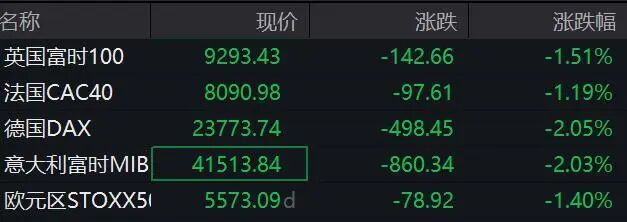
Market Overview - Global stock markets experienced a collective decline, with major European indices opening sharply lower. The Euro Stoxx 50 index fell by 1.4%, the UK FTSE 100 index dropped over 1.5%, and both the German DAX and Italian FTSE MIB indices saw declines of around 2% [1] - The UK FTSE 100 index was reported at 9293.43, down by 142.66 points or 1.51%. The French CAC 40 index decreased by 97.61 points or 1.19%, while the German DAX fell by 498.45 points or 2.05%. The Italian FTSE MIB dropped by 860.34 points or 2.03% [2] Sector Performance - Financial stocks were notably affected, with Citigroup's Frankfurt shares declining over 5% due to market concerns regarding regional banks in the US [2] - In the US pre-market, major tech stocks also faced declines, with Microsoft down 0.9%, Meta, Amazon, Apple, and Google A each falling by 1%, and Tesla and Nvidia dropping by 2%. Oracle's shares fell by over 3% [2] Cryptocurrency Market - Bitcoin fell below $101,000, experiencing a nearly 5% drop in the past 24 hours, while Ethereum declined by over 2% [3] Gold Market - International gold prices continued to reach new highs, with spot gold trading above $4,350 per ounce [5] - Gold has become the first global asset to surpass a total market capitalization of $30 trillion, reflecting its long-term appeal as a safe-haven asset amid current inflation and geopolitical risks. The total amount of mined gold is approximately 216,265 tons, equating to about 6.9 billion ounces [7]
突然跳水,超20万人爆仓
Zheng Quan Shi Bao· 2025-10-17 07:54
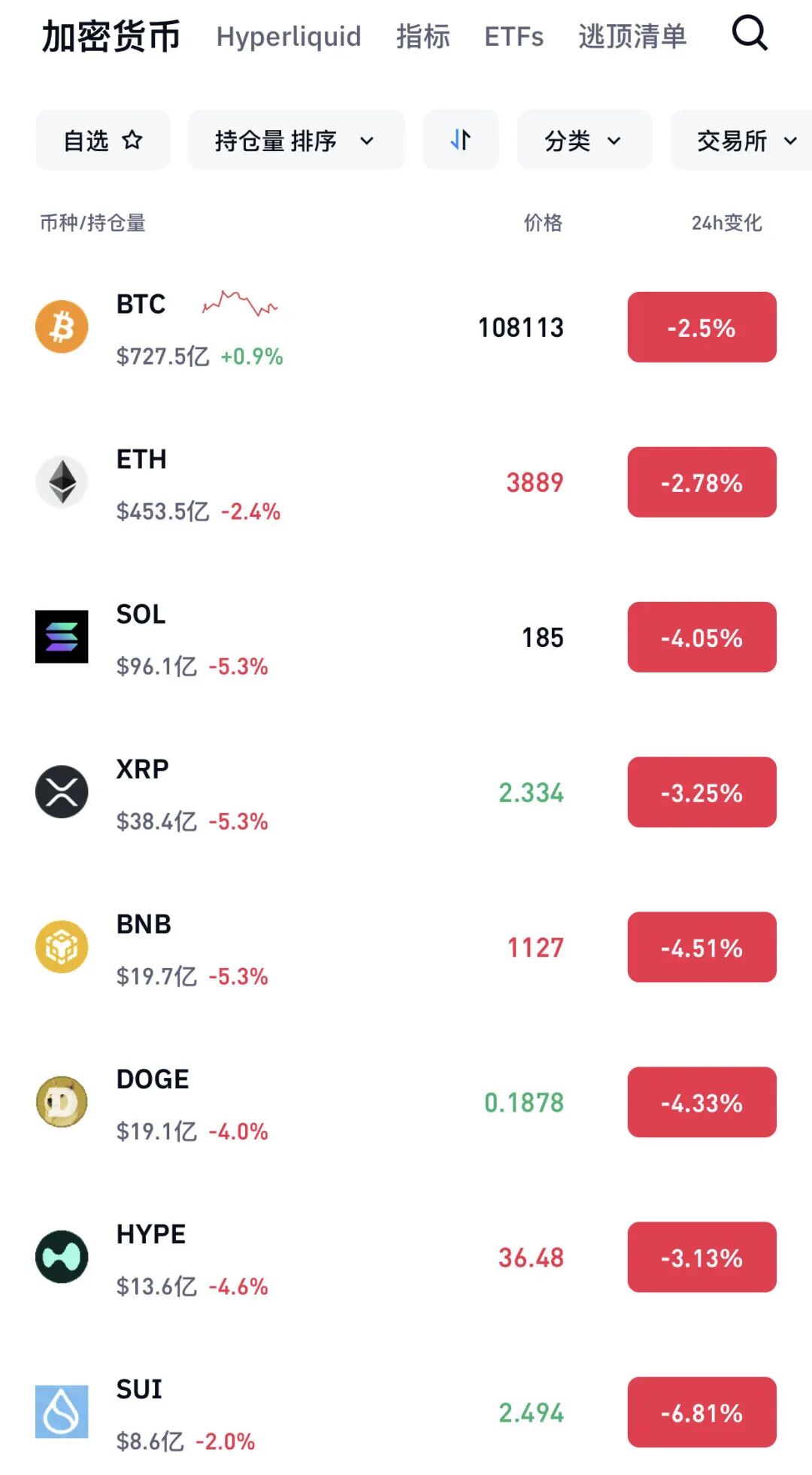
Market Overview - The cryptocurrency market experienced a significant downturn on October 17, with Bitcoin dropping 2.5% to $108,113 after previously surpassing $126,000 [1] - Ethereum fell by 2.78% to $3,889, while other cryptocurrencies like Solana, XRP, and Dogecoin saw declines of 4.05%, 3.25%, and 4.33% respectively [2][4] Liquidation Events - Over the past 24 hours, more than 200,000 traders faced liquidation, with a total liquidation amount of $718 million [4] - The largest single liquidation occurred on Hyperliquid-ETH, valued at $20.43 million [4] Banking Sector Impact - Concerns over credit fraud incidents involving regional banks in the U.S. have heightened investor anxiety, leading to a sell-off of risk assets, including cryptocurrencies [6] - The regional bank index in the U.S. fell by 6.2%, with notable declines in individual bank stocks such as Zions Bancorp (down 13.14%) and Western Alliance (down 10.8%) [6] Federal Reserve Insights - The Federal Reserve is expected to hold its next meeting on October 28-29, with market expectations indicating a 100% probability of a rate cut in October [7] - Analysts predict a 96.3% chance of a 25 basis point cut, while a 50 basis point cut has a 3.7% probability [7] - Recent comments from Federal Reserve officials suggest a cautious approach to rate cuts, emphasizing the need to observe market reactions before making further adjustments [7] Economic Conditions - The Federal Reserve's Beige Book report indicates that economic activity has remained relatively stable, with some regions reporting slight growth while others noted stagnation or a slowdown [8] - Challenges such as rising tariffs and weak overall demand have been highlighted, contributing to a cautious economic outlook [8]
突然跳水!超20万人爆仓!
Zheng Quan Shi Bao· 2025-10-17 07:15
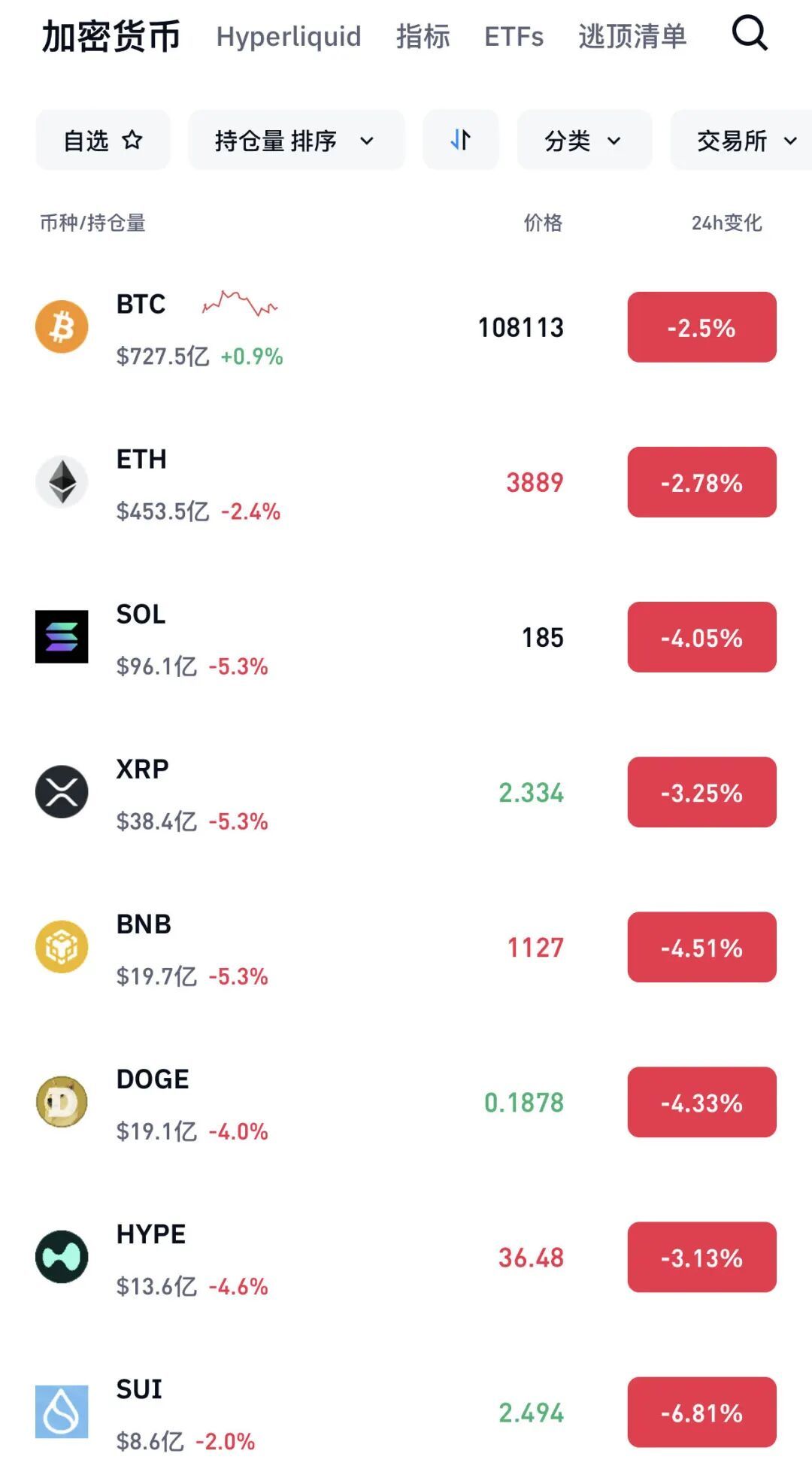
Market Overview - On October 17, the cryptocurrency market experienced a significant drop, with Bitcoin falling by 2.5% to $108,113 after previously surpassing $126,000 [1][2] - Ethereum declined by 2.78%, Ripple by 3.25%, and Dogecoin by 4.33%, among others [4] Liquidation Events - Over the past 24 hours, more than 200,000 traders faced liquidation, totaling approximately $718 million, with the largest single liquidation occurring on Hyperliquid-ETH valued at $20.43 million [4] Banking Sector Impact - Concerns over credit fraud incidents involving regional banks in the U.S. have heightened investor anxiety regarding the credit market, leading to a sell-off of risk assets like cryptocurrencies [6] - The regional bank index in the U.S. fell by 6.2%, with notable declines in individual bank stocks, such as Zions Bancorp down 13.14% and Western Alliance down 10.8% [6] Federal Reserve Insights - The Federal Reserve is expected to hold its next meeting on October 28-29, with a 100% probability of a rate cut in October, primarily by 25 basis points [7] - Recent comments from Fed officials suggest a cautious approach to rate cuts, with a focus on observing market reactions before making further adjustments [7] Economic Conditions - The Federal Reserve's Beige Book indicated that economic activity has remained relatively stable, with mixed reports on growth across different regions [8] - Challenges such as rising tariffs and weak overall demand have been highlighted, contributing to a cautious economic outlook [8]