ASML

Search documents
再创历史!英伟达市值一夜突破5万亿美元!
具身智能之心· 2025-10-31 00:04
Core Viewpoint - Nvidia has become the first company in history to surpass a market valuation of $5 trillion, marking a significant milestone in the tech industry [2][4][11]. Group 1: Market Performance - On October 29, Nvidia's stock price rose by 5.44%, reaching an intraday high of $212.19 per share, and closing at $207.04 per share, resulting in a market capitalization of $5.03 trillion [3][11]. - Since the beginning of 2025, Nvidia's stock has surged by 56%, showcasing its rapid growth compared to other major tech companies [6][40]. - Nvidia's market value now exceeds the combined market capitalizations of major competitors such as AMD, Intel, and Qualcomm, as well as entire sectors within the S&P 500 [6][7]. Group 2: Growth Trajectory - Nvidia's market value has skyrocketed from $1 trillion to $5 trillion in just two and a half years, a feat unmatched by other tech giants [10][24]. - The company achieved its first $1 trillion valuation in May 2023, followed by reaching $3 trillion in June 2024, and then $4 trillion in just over a year [23][24]. - In contrast, Microsoft took nearly six years to grow from $1 trillion to $4 trillion, while Apple took over seven years for the same growth [17][20]. Group 3: Strategic Developments - The recent surge in Nvidia's market value is attributed to announcements made during the GTC developer conference, where CEO Jensen Huang unveiled several technological advancements and partnerships [26][40]. - Key highlights from the conference included plans to collaborate with the U.S. Department of Energy to build new supercomputers and the introduction of the Blackwell chip series, which is expected to significantly increase production [27][28]. - Nvidia's new open system architecture, Nvidia NVQLink, aims to accelerate the development of quantum supercomputers, further positioning the company at the forefront of technological innovation [29][32]. Group 4: Future Outlook - Nvidia anticipates that the cumulative revenue from its upcoming products, including the Blackwell and Rubin chip platforms, could reach $500 billion by the end of next year [32][34]. - The company is also set to invest up to $100 billion in building AI data centers in collaboration with OpenAI, indicating a strong commitment to expanding its AI infrastructure [40][41]. - Nvidia's growth is closely tied to the increasing demand for computational power driven by AI advancements, with its GPUs being integral to the infrastructure of leading AI companies [40].

5 Top Artificial Intelligence Stocks to Buy Right Now
Yahoo Finance· 2025-10-30 13:15
Core Insights - The rise of artificial intelligence (AI) represents a significant investment opportunity, comparable to the industrial revolution [1] AI Adoption - A report by McKinsey & Company indicates that 78% of surveyed companies are utilizing AI in at least one business function, with expectations for this number to increase as companies seek to automate processes and enhance supply chain management [2] Key Companies in AI Sector - **Nvidia**: Holds over 90% market share in the data center GPU market, with a market capitalization around $4.6 trillion. In the most recent quarter, data center sales contributed $41.1 billion to total revenue of $46.7 billion. Concerns exist regarding revenue loss from the Chinese market, which accounted for 17% of fiscal 2025 revenue [4][5] - **Advanced Micro Devices (AMD)**: Competes with Nvidia, focusing on CPUs for desktop computers and data centers. AMD has announced a partnership with OpenAI to sell up to 6 gigawatts of GPU compute capacity and is providing warrants for OpenAI to acquire a 10% stake in AMD [6][7] Supporting Technologies - ASML provides machines that assist foundries in chip production, while Symbotic offers robotic solutions for inventory management and process automation. Amazon's data centers are also highlighted as a key player in the AI landscape [8]

英伟达的“10倍股历程”:3年前ChatGPT首发时市值4000亿美元,如今,首家“五万亿美元公司”!
美股IPO· 2025-10-30 07:22
Core Insights - Nvidia's market capitalization has officially surpassed $5 trillion, making it the first company to reach this milestone globally, reflecting unprecedented growth and market influence [3][4][6] - The company's stock price has increased approximately 90% over the past six months, driven by strong demand for its AI chips and optimistic sales expectations in the Chinese market [6][11] Market Position - Nvidia's market value exceeds the combined market capitalization of competitors such as AMD, Arm, ASML, Broadcom, Intel, Lam Research, Qualcomm, and TSMC, as well as entire sectors like utilities, industrials, and consumer staples within the S&P 500 [6][10] - The company's valuation trajectory has outpaced that of major tech giants like Apple and Microsoft, which recently crossed the $4 trillion mark [10] Growth Drivers - The surge in Nvidia's market value is primarily attributed to the skyrocketing demand for GPUs, particularly following the launch of generative AI tools like ChatGPT, which significantly increased the need for training and running large language models [8][11] - Nvidia's CEO, Jensen Huang, has projected substantial sales growth, estimating that total sales could reach $500 billion over the next five quarters, with chip sales expected to exceed $300 billion in the 2026 calendar year [12][13] Demand and Orders - Strong demand is reflected in Nvidia's order data, with 6 million units of the Blackwell chip shipped and an additional 14 million units on order [11] - Major tech companies are investing heavily in data center infrastructure to support AI model operations, driving demand for Nvidia's products [13] Valuation Concerns - Despite the impressive growth, there are concerns about potential market bubbles, with some analysts comparing the current AI stock surge to the early 2000s internet bubble [14] - Nvidia's stock is currently valued at approximately 33 times its expected earnings for the next year, compared to an average P/E ratio of 24 for the S&P 500, raising questions about sustainability [14]
英伟达成全球首家市值突破5万亿美元上市公司,AI狂潮再掀资本神话
Sou Hu Cai Jing· 2025-10-30 06:30
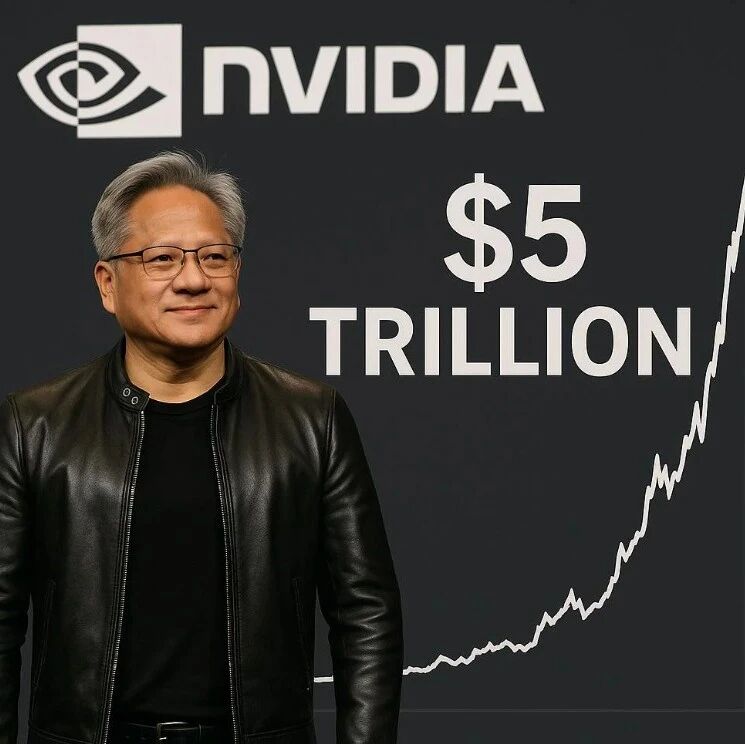
Core Insights - NVIDIA has achieved a market capitalization of over $5 trillion, becoming the first publicly traded company to reach this milestone, with a stock price increase of over 56% year-to-date and a market value increment of $2.9 trillion in 2023 [1][3] Group 1: Market Performance - NVIDIA's stock price surged to $207.04 per share, with an intraday increase exceeding 5%, contributing significantly to the S&P 500 index's annual growth of 17% [1] - The company's market value growth from $4 trillion to $5 trillion occurred in just over three months, a record pace compared to Microsoft and Apple [1] Group 2: AI Demand and Product Development - The explosive growth in AI computing demand is driving NVIDIA's success, with CEO Jensen Huang announcing that the flagship Blackwell chip has entered full-scale production, projecting over $500 billion in revenue over the next five quarters [2] - NVIDIA's next-generation Rubin chip is set for early production in October 2026, with a rolling innovation model in place for future architectures [2] Group 3: Strategic Partnerships and Ecosystem - NVIDIA has formed strategic partnerships, including a $100 billion investment in OpenAI for a 10 GW AI data center and collaboration with Uber to expand a global fleet of autonomous vehicles [2] - The company has also invested $1 billion in Nokia to explore the integration of 5G and AI technologies [2] Group 4: Market Position and Competition - NVIDIA's market capitalization surpasses the combined total of major semiconductor companies and is comparable to the total market value of several major economies [3] - Despite strong analyst support, there are concerns regarding the sustainability of NVIDIA's valuation amid competition from AMD and Broadcom [3][4] Group 5: Geopolitical Risks - NVIDIA's market share in China has dropped from 95% to 0%, raising concerns about geopolitical risks affecting its global supply chain [4] - CEO Huang emphasized that the strength of AI models will continue to drive customer willingness to pay, highlighting the synergy of software, hardware, and ecosystem as NVIDIA's competitive advantage [4] Group 6: Future Technologies - NVIDIA is developing the NVQLink quantum interconnect system to integrate GPU computing with quantum processors, aiming to create a global quantum supercomputer network [5] - The AI-native 6G technology stack, NVIDIA Arc, is designed to provide ultra-low latency for future communication infrastructure [5] Group 7: Market Sentiment - Analysts express high expectations for the transformative impact of AI, with NVIDIA redefining the technology industry's potential at an unprecedented pace [6]
X @Bloomberg
Bloomberg· 2025-10-28 13:24
RT Bloomberg TV (@BloombergTV)A secretive American startup says it has chipmaking technology to rival ASML and take on TSMC.Bloomberg’s @EdLudlow breaks the story on Substrate's particle accelerator-powered lithography machine and plans for an American foundry https://t.co/IP6vL4DLDF https://t.co/aiglKFnaRX ...
DRAM,走向9纳米
半导体行业观察· 2025-10-26 03:16
Core Insights - The storage industry is experiencing a significant upturn due to strong demand from AI data centers and a shortage of HBM, marking a new phase after years of challenges [2][23] - The industry is at a critical technological inflection point, with increasing demand for high-bandwidth, low-power memory across various applications [2][23] - Major DRAM manufacturers are accelerating the development and production of nodes below 10nm, with the competition intensifying as they aim to dominate the market [2][23] Development of 10nm-class Technology - The 10nm-class technology is not a precise measurement but refers to a range of 10-19nm, representing a key step in DRAM manufacturing [3] - The evolution of 10nm-class technology has seen the emergence of three mature production nodes: 1xnm (17-19nm), 1ynm (14-16nm), and 1znm (11-13nm) [3] - Future nodes like 1anm, 1bnm, and 1cnm will continue to optimize within the 10nm-class framework, focusing on density and power reduction [3][5] Challenges in Advancing to 9nm - The 9nm node aims to reduce DRAM feature sizes below 10nm, which could significantly enhance DRAM capacity and lower costs [5][6] - However, challenges include maintaining charge storage stability and managing leakage rates as capacitor sizes shrink [6] - The existing silicon materials and lithography techniques are nearing physical limits, complicating the transition to 9nm [6] Samsung's Strategy - Samsung is aggressively pursuing the 9nm node, incorporating a new 4F² cell structure to overcome limitations faced by the traditional 6F² structure [8][9] - The company plans to develop both 0a (9nm) and 0b (9.8nm) DRAM products, with a target to begin sample delivery by 2027 [11] - Samsung's competitive pressure has led to a more urgent approach in its technology roadmap to regain its leading position in the DRAM market [11] SK Hynix's Approach - SK Hynix is adopting a more conservative strategy, focusing on EUV technology for its next-generation DRAM, with plans to increase EUV layer counts [12][13] - The company is also preparing for the introduction of high numerical aperture (High-NA) EUV technology, which is expected to enhance resolution and manufacturing efficiency [13][20] - SK Hynix's advancements in HBM technology may allow it to debut its 9nm products in the next generation of HBM [14] Micron's Unique Path - Micron is taking a leapfrogging approach, potentially skipping the 8th generation 10nm process and moving directly to the 9nm generation [14][15] - The company is exploring innovative architectures to avoid the costs and time associated with intermediate generations [15][18] - Micron's strategy emphasizes integrated and system-level optimizations, aligning with its goal of transitioning to 3D or stacked solutions [18] High-NA EUV Technology - The surge in orders for ASML's High-NA EUV systems indicates a shift in the semiconductor equipment market, with storage chips gaining a larger share of orders [19][20] - High-NA EUV technology is expected to significantly reduce manufacturing complexity and costs, which is crucial for advancing DRAM processes [19][22] - The transition to High-NA EUV will require comprehensive upgrades across the semiconductor supply chain, presenting both opportunities and challenges [22] Conclusion - The global DRAM industry is at a pivotal moment, with the 9nm node representing a shift from size reduction to architectural upgrades [23] - The competition among major players is not just about technology but also involves strategic investments, customer relationships, and patent positioning [23] - The current market dynamics, driven by AI and data center demands, are fostering a rare dual-driven investment cycle in the storage industry [23][24]


Mistral Launches Platform for Improved Enterprise AI
Bloomberg Technology· 2025-10-24 19:30
This is a path to production, right. For and the enterprise category between you and Tropic Open. It's a fierce battle.I think let's just start by you explaining why you feel this is such a significant milestone for Mr. .. So hello and happy to be here.For us to say we're a global company really focused on creating value for the enterprises. And we have had three years now of experience in doing that. And so to do is basically the one stop shop platform where you can build your application as a business.And ...

Dissecting China's Chip Hype | Bloomberg Tech Asia 10/24/2025
Bloomberg Technology· 2025-10-24 04:42
>> "BLOOMBERG TECH: ASIA "BLOOMBERG TECH: ASIA IS LIVE WITH SHERY AHN IN TOKYO AND ANNABELLE DROULERS IN HONG KONG. "ANNABELLE: WELCOME TO "BLOOMBERG TECH: ASIA ." WELCOME TO THIS EPISODE WHERE WU BOWLBY -- WHERE WE WILL BE TALKING ABOUT ONE OF THE MOST TALKED ABOUT TOPICS IN ASIA TECH AND THAT IS CHINA'S SEMICONDUCTOR ECOSYSTEM BECAUSE IT HAS CAPTURED THE ATTENTION OF TRADERS. MONEY IS POURING INTO NAMES LIKE A CHIP DESIGNER AND FOUNDRY PLACE. FROM ON THE GROUND IN CHINA WE HAVE A COMMITMENT OR REAFFIRMATI ...

股价大涨4.45%!AI芯片制造设备需求强劲 泛林集团预测季度营收高于预期
美股IPO· 2025-10-24 03:39
Core Viewpoint - Lam Research (泛林集团) predicts second-quarter revenue will exceed Wall Street expectations due to increased orders from chip manufacturers for semiconductor equipment used in artificial intelligence applications [1][3] Group 1: Financial Performance - The company's stock rose 2.2% in after-hours trading and has doubled in value this year, driven by strong demand for AI semiconductors [3] - Lam Research expects revenue for the quarter ending December 28 to be $5.2 billion, with a fluctuation of $300 million, compared to analyst estimates of $4.81 billion [3] - The company reported revenue of $5.32 billion for the three months ending September 28, surpassing market expectations of $5.23 billion, with an adjusted earnings per share of $1.26, exceeding the expected $1.22 [3] Group 2: Market Demand and Competition - The surge in demand for AI chips has boosted the need for wafer fabrication equipment (WFE), benefiting companies like Lam Research [3] - Lam Research develops equipment necessary for semiconductor manufacturing, primarily used for wafer processing and wiring of various semiconductor devices [3] - The company faces intense competition from semiconductor equipment manufacturers such as Applied Materials and ASML [3]
Tesla profits fall, oil prices surge as US imposes sanctions on Russian oil
Youtube· 2025-10-23 13:58
Group 1: Tesla's Financial Performance - Tesla's profits fell by more than 25% despite record car sales, leading to a pre-market share drop of over 3% [4][5] - Revenue exceeded $28 billion, beating street estimates, but the operating margin dropped to 5.8%, nearly half of the previous year's margin [4][5] - Record deliveries in Q3 were largely driven by a rush to purchase vehicles before the expiration of federal tax credits, with sales declining in other markets, including China [6][7] Group 2: US Sanctions and Global Oil Market - The US imposed sanctions on Russia's two largest oil companies, Rosneft and Lukoil, causing a surge in oil prices [2] - Approximately 20% of China's crude imports come from Russia, raising concerns about secondary penalties for companies dealing with sanctioned entities [3] Group 3: Semiconductor Industry Insights - The semiconductor sector is under scrutiny, with companies like Intel and ST Micro Electronics facing investor concerns over profitability trends and conservative guidance [26] - The semiconductor ecosystem involves various players, including Nvidia, AMD, and Taiwan Semiconductor, each playing distinct roles in chip design and fabrication [29][34] Group 4: Quantum Computing Stocks - Quantum computing stocks, including Rigetti and D-Wave Computing, saw significant pre-market gains of 20-30% following reports of US government interest in equity stakes in quantum firms [36][37] - Google's recent advancements in quantum technology, claiming their chips are 13,000 times faster than current supercomputers, have reignited discussions on the scalability of quantum technology [37] Group 5: Aerospace Developments - Airbus and other European satellite companies are merging their satellite businesses to create a competitive entity against SpaceX, with an expected annual turnover of about $7.5 billion [38][39] Group 6: Earnings Reports and Market Reactions - American Airlines reported a smaller-than-expected loss, driven by a rebound in travel, and anticipates profitability in Q4 [50] - T-Mobile added 1 million new subscribers but saw a decline in shares, indicating mixed market reactions despite positive service revenue growth [52] - Hasbro's Q3 earnings beat expectations, leading to initial share gains, although they later slipped back [54]