
MSC

Search documents
集运指数(欧线)观点:关税战升级,或暂时延续弱势-20251012
Guo Tai Jun An Qi Huo· 2025-10-12 08:46
Report Industry Investment Rating No relevant content provided. Core View of the Report The escalation of the tariff war may cause the Container Shipping Index (European Line) to continue its weak performance temporarily. The supply and demand situation of the European line is complex, with potential fluctuations in freight rates and market sentiment affected by trade friction and other factors. [1][4] Summary by Relevant Catalogs Overview - The weekly average capacity in October was revised down from 265,000 TEU/week before the holiday to 257,000 TEU/week, mainly due to many postponed sailings on the FE4 route. The spot market will mainly take cargo for Weeks 43 and 44 next week, corresponding to capacity supplies of 290,000 and 335,000 TEU respectively, with relatively sufficient cabin space. [4] - The weekly average capacity in November was 310,000 TEU/week before the holiday, with little overall change in the past two weeks. Currently, it is 307,000 TEU/week (excluding pending voyages), a month-on-month increase of 19% and a year-on-year increase of 8.9%. [4] - December includes 6 pending and 3 empty sailings, with a weekly average capacity of 295,000 TEU/week (excluding pending voyages). Due to many pending voyages, there is room for significant revision in the future. [4] - In the short term, considering comprehensive loading and suspension information, the reduction of empty sailings by the PA Alliance in mid - to late October reduced the pressure on shipowners to take cargo after the holiday. However, there was no significant improvement in demand in late October, so the freight rate increase in late October lacked a solid cargo volume foundation. Observe the freight rate adjustment actions next week. [4] - The trade volume between Asia and Europe (Northwest Europe + Mediterranean) in August reached 1.85 million TEU, a year-on-year increase of 11.8% and a month-on-month increase of 5.2%. The cumulative trade volume from January to August was 13.18 million TEU, a cumulative year-on-year increase of 9.7%. [4] Price - It is expected that the SCFIS European Line Index for Week 41 (October 13) will slightly decline from the previous period (1046.50 points); there is also a certain probability of oscillation. Considering that the ships of the PA Alliance with significant pre - holiday price cuts will not be reflected in this period's index but in the index on October 20. [5] - For the 2510 contract, it will fluctuate narrowly around 1100 points. [5] - For the 2512 contract, the seasonal characteristics of the European line cannot be ignored. The escalation of the trade friction will inevitably lead to market adjustments. It is recommended to treat the 2512 contract with a wide - range oscillation mindset (1400 - 1800 points), and pay attention to the unilateral low - buying opportunities brought by the tariff event next week. [5] - For the 2602 contract, due to the later Spring Festival in 2026 compared to 2025, the valuation of the 2602 contract depends more on the freight rate level in January. It is recommended to intervene in the 02 - 04 positive spread with a light position. [6] - The counter - measures taken by China against the US USTR port surcharges will have a limited impact on the European line market. [6] Demand Side - From the perspective of China's exports (valued in amount, updated to August), in August 2025, the year - on - year growth rate of China's exports in US dollars dropped from 7.2% in July to 4.4%, lower than the Bloomberg consensus forecast of 5.5%. Exports to the US continued to decline, while exports to the EU continued high - growth, and exports to ASEAN increased significantly. [26] - From the perspective of Asia's exports to Europe (updated to August), the container trade volume between Asia and Europe (Northwest Europe + Mediterranean) in August reached 1.85 million TEU, a year - on - year increase of 11.8% and a month - on - month increase of 5.2%. [4] - From the perspective of Asia's exports to North America, the container trade volume between Asia and North America in August 2025 was 2.0148 million TEU, a month - on - month decrease of 5.3% and a year - on - year decrease of 12.3%. [33] Supply Side - **Ship Schedule**: The weekly average capacity in October was revised down. The weekly average capacity in November was 307,000 TEU/week (excluding pending voyages), and December had 6 pending and 3 empty sailings, with a weekly average capacity of 295,000 TEU/week (excluding pending voyages). [38][39] - **Dynamic Capacity**: In the past week, the speeds of 8,000 - 11,999 TEU, 12,000 - 16,999 TEU, and 17,000+ TEU container fleets were maintained at around 15, 15.2, and 15.2 knots respectively. As of October 10, the number of idle ships in the 8 - 11,999 TEU, 12 - 16,999 TEU, and 17,000+ TEU container fleets was 12, 7, and 2 respectively. [50] - **Turnover Efficiency**: Analyzed the congestion situations of container ships at ports in different regions such as China, the UK/Europe, the Mediterranean/Black Sea, Southeast Asia, North America, and Asia. [52] - **Static Capacity**: From August to October, multiple new container ships of the top ten liner companies were launched and deployed on different routes. From October to December, the top ten liner companies will receive 15 new 12,000 - 16,999 TEU container ships (228,000 TEU) and 3 new 17,000+ TEU container ships. [72][74]
航运衍生品数据日报-20251010
Guo Mao Qi Huo· 2025-10-10 07:15
Report Summary 1. Report Industry Investment Rating No relevant content provided. 2. Core View of the Report - The shipping market shows a pattern of strong near - term and weak long - term. The end - of - year peak season may not materialize as expected due to the double decline in supply and demand in October. The market will continue the trend of "falling freight rates and rising bargaining power of shippers" before the new long - term agreement cycle in 2026. The resumption of the Suez route will likely be phased, with the second quarter of next year being the first key observation point. The negotiation between Israel and Hamas has created theoretical possibilities for the resumption of Red Sea shipping, but the shipping industry still faces multiple challenges [8][9]. 3. Summary by Relevant Content Shipping Derivatives Data - **Freight Rate Index**: The Shanghai Export Container Freight Composite Index (SCFI) is at 1115, down 6.97% from the previous value; the China Export Container Freight Index (CCFI) is at 1087, down 2.93%. Rates for various routes such as SCFI - US West, SCFI - US East, and SCFI - Northwest Europe all decreased, with declines ranging from 4.89% to 10.76% [5]. - **EC Contracts**: Prices of most EC contracts decreased, with EC2506 down 13.05% and EC2608 down 10.57%. However, EC2510 increased by 0.84%. The positions of some contracts changed, with EC2606 and EC2608 positions increasing, while EC2410 positions decreased [5]. - **Month - to - Month Spread**: The 10 - 12 month - to - month spread is - 568.1, up 53.2 from the previous value; the 12 - 2 spread is 282.0, up 192.9; the 12 - 4 spread is 568.1, up 90.4 [5]. Market News - On October 5, 2025, OPEC + announced that eight oil - producing countries will increase production by 137,000 barrels per day in November. The next meeting on December policies will be held on November 2 [5]. - On October 4, Trump said that Israel agreed to a preliminary withdrawal route in Gaza, and a cease - fire would take effect after Hamas' confirmation. A prisoner exchange will also be initiated [6]. - On October 1, the US federal government "shut down" for the first time in nearly 7 years due to the Senate's rejection of the appropriation bill [6]. - On October 4, the Kriskii refinery in Russia's Leningrad Oblast was attacked by drones and caught fire. The fire has been extinguished, and seven drones were destroyed [7]. - On October 1, US media reported that the Trump administration agreed to provide intelligence to Ukraine to support long - range attacks on Russian energy facilities [7]. - The Nikkei 225 index rose 4.8% to 47,944.76 points, and the Topix index rose 3.1%. The yen weakened significantly against the US dollar, breaking through the key level of 150 [7]. EC Market Analysis - **Spot Price**: In early October, GEMINI prices dropped to 1500, QA to 1500, RA to 1400, and MSC to 1600. The overall quoted price range in late October is between 2000 - 2200, and there are rumors of continued price support [8]. - **Logic**: In late September, shipping companies cut prices to grab cargo, and freight rates dropped to $1300/FEU. In October, supply and demand both decreased, and the market is likely to return to the off - season. Shipping companies' price increase announcements may not be implemented, and key factors to monitor include price increase implementation, peak - season cargo volume, and shipping companies' attitude towards price support [9]. - **Strategy**: A long - short spread strategy between the 10 - month and 12 - month contracts is recommended [10].
美国即将对中国船舶征收港口费 对航运市场影响几何?
Qi Huo Ri Bao· 2025-10-09 00:54
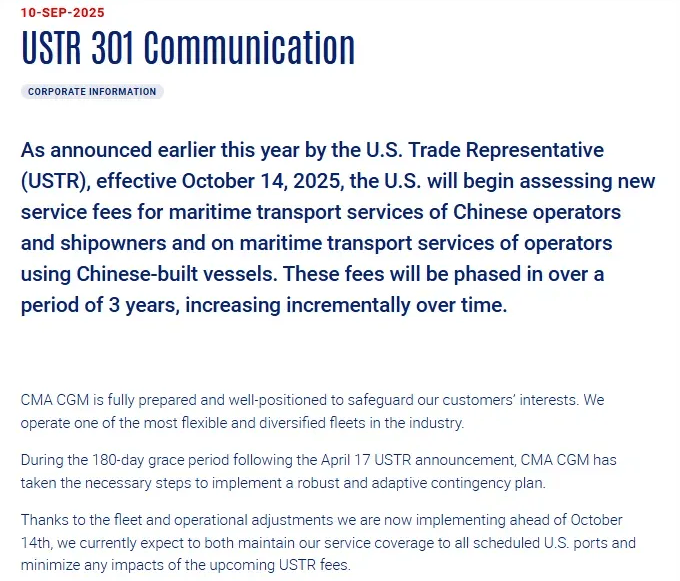
Core Viewpoint - The U.S. is implementing additional port fees for Chinese vessels starting October 14, 2025, which will significantly increase operational costs for Chinese shipowners and shipbuilders [1][3]. Group 1: U.S. Port Fee Implementation - The U.S. Trade Representative's Office (USTR) announced a fee structure for Chinese-owned, operated, and built vessels, with charges starting at $50 per net ton, increasing annually until reaching $140 by 2028 [1]. - The fees must be paid three working days before arrival at the first U.S. port, with non-compliance risking unloading delays or customs clearance suspension [1]. - The fee structure aims to boost U.S. shipbuilding and tax revenue while targeting Chinese maritime operations [3]. Group 2: Chinese Response and Operational Adjustments - In response, China amended its international shipping regulations to impose special fees on vessels from countries that implement discriminatory measures against Chinese shipping [2]. - Major shipping alliances have begun adjusting their operations, with some routes to the U.S. being suspended to reduce costs associated with the new port fees [4]. Group 3: Impact on Shipping Costs and Market Dynamics - The new port fees are expected to increase operational costs for Chinese shipowners significantly, with estimates of an additional $304 per TEU for container ships calling at U.S. ports [3]. - Shipping companies are prioritizing market share over profitability, leading to a rapid cancellation of sailings due to tariff disruptions and weak U.S. demand [5][6]. - The overall impact on the European shipping market is expected to be limited, but the situation will require ongoing observation as shipping lines may adjust their strategies in response to the new fees [7][8].

注意,美国即将对中国船舶征收港口费!对航运市场影响几何?
Qi Huo Ri Bao· 2025-10-08 23:42
Core Viewpoint - The U.S. has introduced a new port fee structure targeting Chinese-owned and operated vessels, effective from October 14, 2025, which is expected to significantly increase operational costs for Chinese shipping companies [1][3]. Group 1: U.S. Port Fee Structure - The U.S. Customs and Border Protection (CBP) has detailed the port fee structure, charging $50 per net ton for Chinese-owned or operated vessels, with increases planned for subsequent years [1]. - Fees for Chinese-built vessels will be $18 per net ton or $120 per container, whichever is higher, with future increases set for 2028 [1]. - Non-U.S. built car carriers will incur a fee of $14 per net ton [1]. - Payment must be completed three working days before arrival at the first U.S. port, with penalties for non-compliance [1]. Group 2: Impact on Chinese Shipping Companies - The new fees will substantially raise operational costs for Chinese shipping companies, with an estimated increase of $304 per TEU for shipowners and $120 per TEU for vessels [3]. - The port fee structure is designed to discourage the use of Chinese vessels in U.S. ports and aims to bolster the U.S. shipbuilding industry [3]. Group 3: Adjustments by Shipping Alliances - Major shipping alliances have begun to adjust their operations in response to the new fees, with some routes being suspended and vessel deployments being altered to reduce reliance on Chinese ships [4]. - Companies like CMA and MSC have stated they will not impose additional fees related to the port charges [4]. Group 4: Market Reactions and Trends - The shipping industry is experiencing a significant number of canceled voyages due to tariff disruptions and weak U.S. demand, with 67 sailings from China to the U.S. canceled recently [5]. - Analysts suggest that the impact of the new port fees on the European shipping market will be limited, but ongoing adjustments in shipping strategies are expected [6]. - The overall shipping costs are anticipated to continue rising, with potential price increases in freight rates as shipping companies negotiate with European clients [7].
集装箱产业风险管理日报-20250930
Nan Hua Qi Huo· 2025-09-30 10:18
Report Overview - Report Title: Container Industry Risk Management Daily Report - Date: September 30, 2025 - Author: Yu Junchen [1] Investment Rating - No investment rating provided in the report Core Viewpoints - Today, the futures price of the Container Shipping Index (European Line) (EC) opened lower, fluctuated upwards, and then significantly declined near the close. As of the close, the prices of EC contracts showed mixed trends. Near the National Day holiday, some investors gradually closed their positions. The futures price is influenced by both long and short factors, and in the short term, it is likely to continue to fluctuate. For the 12 - contract, low - long opportunities can be continuously monitored, and overall, it is advisable to mainly adopt a wait - and - see approach or conduct intraday short - term operations [3] Summary by Section EC Risk Management Strategy Recommendations - For position management, if the position has been acquired but the shipping capacity is full or the booked cargo volume is poor, and there are concerns about falling freight rates (long spot exposure), to prevent losses, short the container shipping index futures according to the company's position to lock in profits. Recommend selling the EC2510 contract at an entry range of 1200 - 1300 [2] - For cost management, if the shipping companies increase the frequency of blank sailings or the market peak season is approaching, and one hopes to book cabins according to the order situation (short spot exposure), to prevent the increase in transportation costs due to rising freight rates, buy the container shipping index futures at present to determine the cabin - booking cost in advance. Recommend buying the EC2510 contract at an entry range of 950 - 1050 [2] Core Contradictions - The EC2510 contract saw a reduction of 2161 long positions to 14922, a reduction of 2106 short positions to 15712, and a decrease in trading volume of 2414 to 17476 (bilateral) [3] - Bullish factor: MSC announced a price increase notice from the Far East to the Nordic route from October 15th to 31st, which has a certain positive impact on the market [3] - Bearish factors: The actual implementation of price increase notices this year has been infrequent, market expectations are relatively weak, MSC lowered the European Line quotes for mid - to - late October, and the new SCFIS European Line is lower than market expectations, pulling down the futures price valuation [3] Bullish Interpretations - MSC announced a price increase notice for mid - to - late October, with sea freight rates of $1320/TEU and $2200/FEU from the Far East to the Nordic region [4] - The Israeli military continues to attack the Gaza Strip, causing dozens of deaths in one day, and Hamas said it has not received any proposals from Trump or mediators [4] Bearish Interpretations - US President Trump and Israeli Prime Minister Netanyahu are scheduled to meet at the White House on the 29th. Trump said on the 28th that he hopes the two sides can finalize a Gaza peace plan, and Netanyahu said that the US and Israel are jointly formulating a new cease - fire plan, with details still under discussion [5] - MSC's European Line quotes declined in early to mid - October [5] EC Basis Daily Changes - On September 30, 2025, the basis of EC2510 was 9.89 points, with a daily increase of 4.40 points and a weekly decrease of 145.03 points [6] - The basis of EC2512 was - 611.41 points, with a daily increase of 24.40 points and a weekly decrease of 242.93 points [6] - The basis of EC2602 was - 522.31 points, with a daily increase of 24.20 points and a weekly decrease of 241.63 points [6] EC Price and Spread - On September 30, 2025, the closing price of EC2510 was 1110.6 points, with a daily decline of 0.39% and a weekly increase of 0.96% [7] - The closing price of EC2512 was 1731.9 points, with a daily decline of 1.39% and a weekly increase of 6.68% [7] - The closing price of EC2602 was 1642.8 points, with a daily decline of 1.45% and a weekly increase of 6.98% [7] Container Shipping Spot Cabin Quotes - For Maersk's sailings from Shanghai to Rotterdam on October 15th, the total quote for 20GP was $1144, a recovery of $5 compared to the previous period, and the total quote for 40GP was $1911, a recovery of $11 [9] - For Maersk's sailings on October 16th, the total quote for 20GP was $1090, a recovery of $5, and the total quote for 40GP was $1820, a recovery of $10 [9] - For MSC's sailings in the past two weeks, the total quote for 20GP was $855, a decrease of $60, and the total quote for 40GP was $1415, a decrease of $100. For mid - to - late October, the total quote for 20GP was $1245, a recovery of $330, and the total quote for 40GP was $2065, a recovery of $550 [9] - For Evergreen's sailings in mid - to - late October, the total quote for 20GP was $1355, a recovery of $300, and the total quote for 40GP was $2060, a recovery of $450 [9] Global Freight Rate Index - The latest value of SCFIS for the European route was 1120.49 points, a decrease of 134.43 points (- 10.71%) from the previous value [10] - The latest value of SCFIS for the US West route was 921.25 points, a decrease of 272.39 points (- 22.82%) from the previous value [10] - The latest value of SCFI for the European route was $971/TEU, a decrease of $81 (- 7.70%) from the previous value [10] Global Major Port Waiting Times - On September 29, 2025, the waiting time at Hong Kong Port was 2.020 days, an increase of 0.450 days from the previous day, and 0.362 days in the same period last year [17] - The waiting time at Shanghai Port was 1.135 days, an increase of 0.252 days from the previous day, and 2.284 days in the same period last year [17] - The waiting time at Yantian Port was 3.218 days, an increase of 0.955 days from the previous day, and 0.447 days in the same period last year [17] Ship Speed and Number of Container Ships Waiting at Suez Canal Port Anchorage - On September 29, 2025, the average speed of 8000 + container ships was 15.547 knots, an increase of 0.008 knots from the previous day, and 15.544 knots in the same period last year [25] - The average speed of 3000 + container ships was 14.741 knots, a decrease of 0.088 knots from the previous day, and 14.924 knots in the same period last year [25] - The average speed of 1000 + container ships was 13.291 knots, an increase of 0.068 knots from the previous day, and 13.437 knots in the same period last year [25] - The number of ships waiting at the Suez Canal port anchorage was 20, an increase of 1 from the previous day, and 7 in the same period last year [25]

瑞达期货集运指数(欧线)期货日报-20250930
Rui Da Qi Huo· 2025-09-30 09:07
Group 1: Report Industry Investment Rating - No information provided Group 2: Core Viewpoints of the Report - On Tuesday, the freight index (European line) futures prices showed mixed trends. The main contract EC2510 closed down 1.02%, and the far - month contracts declined between -1% and -11%. The latest SCFIS European line settlement freight rate index dropped 134.43 points from last week, a 10.7% week - on - week decline. Spot indicators continued to fall, and the futures prices lacked support. [1] - Maersk's spot cabin quotes for European lines stopped falling and rebounded in mid - October, and MSC's quotes followed with a small increase later, leading to a recovery in futures price valuation. Geopolitical conflicts supported the futures prices, but before the National Day holiday, shipping companies lowered freight rates to increase cargo volume, and the supply - demand pattern remained unchanged, with significant freight rate pressure. [1] - The recent economic data in the Eurozone fluctuated, with business sentiment indices weaker than expected. The ECB indicated a slower pace of interest rate cuts due to improved economic expectations and easing inflation. Overall, there is uncertainty in the trade war, the demand for the freight index (European line) is weak, and the futures prices fluctuate greatly. Investors are advised to be cautious, pay attention to operation rhythm and risk control, and track geopolitical, shipping capacity, and cargo volume data. [1] Group 3: Summary by Relevant Catalogs 1. Futures Market Data - EC main contract closing price: 1110.600, down 11.4; EC second - main contract closing price: 1731.9, down 3.10. [1] - EC2510 - EC2512 spread: -621.30, up 20.00; EC2510 - EC2602 spread: -532.20, up 19.80. [1] - EC contract basis: 9.89, up 4.40. [1] - EC main contract position: 24782 hands, down 4532. [1] 2. Spot Market Data - SCFIS (European line) (weekly): 1120.49, down 134.43; SCFIS (US West Coast line) (weekly): 921.25, down 272.39. [1] - SCFI (composite index) (weekly): 1114.52, down 83.69; spot price: 1087.41, down 69.06. [1] - CCFI (composite index) (weekly): down 32.82; CCFI (European line) (weekly): down 39.00. [1] - Baltic Dry Index (daily): 2259.00, down 400.00; Panama Freight Index (daily): 1832.00, down 14.00. [1] - Average charter price (Panamax): 14769.00, unchanged; average charter price (Capesize): 30090.00. [1] 3. Industry News - The US Department of Commerce issued export control penetration rules, and China's Ministry of Commerce responded firmly against it. [1] - US President Trump and Israeli Prime Minister Netanyahu held a bilateral meeting, and a Gaza peace plan was proposed. [1] - The National Development and Reform Commission announced that the new policy - based financial instruments totaling 500 billion yuan will be used to supplement project capital, and efforts are being made to allocate the funds to specific projects. [1] 4. Key Data to Watch - September manufacturing PMI final values in France, Germany, the Eurozone, and the UK on October 1st. [1] - Eurozone September CPI annual rate preliminary value on October 1st. [1] - US September ADP employment figures (in ten thousands) on October 1st. [1] - US September ISM manufacturing PMI on October 1st. [1]
美国“靠港费”新政来袭,新规引发全球航运巨头表态
Sou Hu Cai Jing· 2025-09-29 09:52
Core Viewpoint - The upcoming U.S. port fee policy targeting Chinese vessels, referred to as the "shipping tax," is set to significantly impact Chinese shipping companies, with steep fee increases scheduled from 2025 to 2028 [1][5]. Group 1: New Port Fee Policy - The new port fee policy will charge Chinese shipowners/operators $50 per net ton in 2025, escalating to $140 per net ton by 2028, with a maximum of five charges per ship per year [1]. - Non-Chinese operators using Chinese-built vessels will face initial fees of $18 per net ton or $120 per TEU, rising to $33 per net ton and $250 per TEU in three years [1]. Group 2: Financial Impact on Companies - China COSCO Shipping Holdings may incur up to $1.5 billion in annual port fees by 2026, representing 5.3% of its projected annual revenue and consuming 74% of its expected EBIT [5]. - Orient Overseas International may face port fees of $654 million in 2026, accounting for 65% of its expected EBIT [5]. Group 3: Exemptions and Compliance - Certain exemptions exist for domestic shipping vessels, empty bulk carriers, and some roll-on/roll-off ships, but most container ships used in cross-border e-commerce are subject to the fees [4]. - Ships that fail to pay the fees on time will face severe penalties, including operational bans or detention [3]. Group 4: Industry Response - Major shipping companies are adjusting strategies, such as replacing vessels with those built in non-Chinese shipyards to avoid fees [9]. - The Premier Alliance plans to split existing routes to prevent Chinese-built ships from docking at U.S. ports [10]. - Companies are exploring transshipment routes through Canada, Mexico, or Caribbean ports to mitigate the impact of the new fees [11]. Group 5: Statements from Shipping Companies - Maersk has stated it will not pass additional costs onto customers and will adjust vessel deployment to avoid U.S. routes [13]. - CMA CGM has indicated it will not impose extra fees for shipments to the U.S. despite the challenges posed by the new service fees [13]. - MSC has announced a proactive restructuring of its global fleet network to manage the new costs, with a significant portion of its fleet built outside China [13]. Group 6: Market Outlook and Recommendations - The current market reflects a combination of short-term price advantages and long-term structural adjustments, necessitating flexibility and proactive planning [15]. - Companies are advised to seize opportunities in the current low freight rates for non-urgent shipments while preparing for potential long-term cost increases due to the new port fees [15][16]. - Supply chain resilience is emphasized as a critical factor for companies navigating the dual challenges of rising shipping costs and fluctuating freight rates [16].

瑞达期货集运指数(欧线)期货日报-20250929
Rui Da Qi Huo· 2025-09-29 08:39
1. Report Industry Investment Rating - Not mentioned in the provided content 2. Core Viewpoints of the Report - Trade war uncertainties persist, demand for the Container Shipping Index (European Line) futures is weakly expected, and the futures price fluctuates significantly. Investors are advised to be cautious, pay attention to the operation rhythm and risk control, and track geopolitical, shipping capacity, and cargo volume data in a timely manner [1] 3. Summary according to Relevant Catalogs Market Data - EC main contract closing price is 1115.000, down 35.8; EC second - main contract closing price is 1756.3, down 24.30. The spread between EC2510 - EC2512 is - 641.30, down 3.30; the spread between EC2510 - EC2602 is - 552.00, down 6.00. The EC contract basis is 5.49, and the main contract position is 29314, down 3117 [1] - SCFIS (European Line) (weekly) is 1120.49, down 134.43; SCFIS (US West Line) (weekly) is 921.25, down 272.39. SCFI (composite index) (weekly) is 1114.52, down 83.69. Container ship capacity is 1227.97 (ten thousand TEUs), up 0.04 [1] - CCFI (composite index) (weekly) is 1087.41, down 32.82; CCFI (European Line) (weekly) is 1401.91, down 69.06. The Baltic Dry Index (daily) is 2259.00, up 7.00; the Panamax Freight Index (daily) is 1832.00, up 3.00 [1] - The average charter price of Panamax ships is 14769.00, unchanged; the average charter price of Capesize ships is 30090.00, down 400.00 [1] Industry News - US President Trump announced that from October 1st, a new round of high - tariffs will be imposed on multiple imported products, but for trade partners such as the EU and Japan with which the US has reached trade agreements, the 15% tariff cap in the agreements will be adhered to [1] - Five major German economic research institutions predict that the German economy will only grow slightly by 0.2% in 2025. Due to structural weaknesses and the impact of US tariff hikes, its foreign trade growth momentum is gradually disappearing, and the growth prospects of the German economy will continue to deteriorate [1] - Goldman Sachs analysts said that the risk of the US economy re - accelerating is rising, which will have an important impact on the Fed's monetary policy path, especially under the background of the Fed selecting a new chairman [1] Market Trends - On Monday, the prices of the Container Shipping Index (European Line) futures fell collectively. The main contract EC2510 rose 3.11%, and the far - month contracts fell between 1 - 2%. The latest SCFIS European Line settlement freight rate index is 1254.92, down 134.43 points from last week, a 10.7% decline. Spot indicators continue to decline, and the futures price lacks support [1] - Maersk's spot cabin quotes for the European Line in mid - October stopped falling and rebounded significantly, followed by a small rebound in MSC's quotes in the next two weeks, leading to an increase in the futures price valuation. Geopolitical conflicts support the futures price, but before the National Day holiday, liner companies lowered freight rates to increase cargo collection, and the supply - demand pattern remains unchanged, with significant freight rate pressure [1] - Eurozone economic data has fluctuated recently. The September manufacturing PMI was slightly worse than last month, but the service PMI exceeded expectations. The ECB stated that it will slow down the pace of interest rate cuts [1] Key Data to Watch - China's official manufacturing PMI for September, UK's Q2 GDP annual rate final value, France's September CPI monthly rate preliminary value, Germany's September seasonally adjusted unemployment rate, Germany's September CPI monthly rate preliminary value, US July S&P/CS20 - city unadjusted house price index annual rate, and US September Chicago PMI on September 30th [1]
欧美航线运价大跌!航运市场今年“旺季不旺” 什么原因?
Zheng Quan Shi Bao· 2025-09-29 08:28
(原标题:欧美航线运价大跌!航运市场今年"旺季不旺" 什么原因?) 受中美关税影响,美线航运市场在经历一轮狂热之后迎来了迅速回落,本应是航运市场传统旺季的9 月,相比往年却显得尤为冷清:一方面,美线航运价大幅跳水,另一方面,出货量也不及预期。 "这波运价跌幅确实有点大,欧美线的航运价格甚至跌破了部分船公司的成本价了。"众包物流总经理甘 建军对记者表示。为航运电商提供运价服务的Geek Rate官网显示,根据9月29日最新报价,10月7日从 上海至美国洛杉矶15日航程的航线报价为1220美元/40尺货柜,这较两周前的价格跌幅超30%。欧洲线 方面,上海至鹿特丹航线最低报价为1400美元/FEU,也较9月中旬有所下滑。 宁波航运交易所9月27日NCFI指数亦显示,美西航线运价指数报868.22 点,环比下滑 8.11%;美东航线 报834.04 点,环比下滑4.99%。此外,欧洲线也呈现较大跌幅,环比下滑 8.83%。此外,上海集装箱运 价指数在9 月15日—19 日创下2016年以来最大的单周跌幅,大跌14%。 欧美航线运价下跌幅度之大,甚至跌破部分船公司的成本价。"9月份欧线价格都已经跌到三位数了,正 常情况 ...
欧美航线运价大跌!航运市场今年“旺季不旺”,什么原因?
Zheng Quan Shi Bao· 2025-09-29 07:54
宁波航运交易所9月27日NCFI指数亦显示,美西航线运价指数报868.22点,环比下滑8.11%;美东航线 报834.04点,环比下滑4.99%。此外,欧洲线也呈现较大跌幅,环比下滑8.83%。此外,上海集装箱运价 指数在9月15日—19日创下2016年以来最大的单周跌幅,大跌14%。 "这波运价跌幅确实有点大,欧美线的航运价格甚至跌破了部分船公司的成本价了。"众包物流总经理甘 建军对记者表示。为航运电商提供运价服务的Geek Rate官网显示,根据9月29日最新报价,10月7日从 上海至美国洛杉矶15日航程的航线报价为1220美元/40尺货柜,这较两周前的价格跌幅超30%。欧洲线 方面,上海至鹿特丹航线最低报价为1400美元/FEU,也较9月中旬有所下滑。 欧美航线运价下跌幅度之大,甚至跌破部分船公司的成本价。"9月份欧线价格都已经跌到三位数了,正 常情况下绕行好望角的成本要比走苏伊士运河高30%,现在加起来反而比以前还便宜很多,船公司都在 亏钱。"甘建军直言,这是过去五年除2023年年初之外的最低水平。 受中美关税影响,美线航运市场在经历一轮狂热之后迎来了迅速回落,本应是航运市场传统旺季的9 月,相比往年 ...