
博时基金

Search documents
29只基金,本周开售!
Zhong Guo Ji Jin Bao· 2026-02-02 05:25
Core Insights - The public fund market will see the launch of 29 new funds in the first week of February 2026, with equity products remaining the dominant category [1] Fund Distribution - Among the 29 new funds, there are 11 equity funds, 7 mixed funds, 6 FOFs (Fund of Funds), and 5 bond funds, with an average subscription period of 12 days [3] - Active equity products include 8 funds with an average subscription period of approximately 13 days, including 2 pharmaceutical-themed products: Shangyin Medical Selection and Guangfa Medical Innovation Selection, the latter having a fundraising cap of 8 billion units and a subscription period of 3 days [4] - Passive index products feature themes such as biotechnology, non-ferrous metals, and batteries, with an average subscription period of 10 days. Three products have a fundraising cap of 8 billion units: E Fund CSI Battery Theme ETF, Bosera CSI Industrial Non-Ferrous Metals Theme ETF, and E Fund CSI All-Share Dividend Quality ETF [4] - The 6 FOFs have an average subscription period of about 11 days, all with a 3-month holding period, and three have a fundraising cap of 8 billion units: Guangfa Yuefeng Multi-Asset Stable Three-Month Holding, Guotou Ruijin Multi-Asset Stable Three-Month Holding, and Tianhong Yingxiang Multi-Asset Leading Three-Month Holding [4] - The 5 bond funds have an average subscription period of approximately 18 days, with Luobomai Tianhang and Nongyin Ruiheng setting a fundraising cap of 6 billion units [4]


量化资产配置月报202602:低波因子表现回归、形成共振-20260202
Shenwan Hongyuan Securities· 2026-02-02 04:11
Group 1 - The report indicates a return of the low volatility factor, forming a resonance with macroeconomic indicators showing a weakening economy, slightly loose liquidity, and a contraction in credit [2][5][8] - The report emphasizes the selection of factors that are insensitive to economic conditions, sensitive to liquidity, and insensitive to credit, with a focus on low volatility factors in the CSI 300 and small-cap stocks in the CSI 500 [5][9] - The overall asset allocation viewpoint suggests a slight allocation to US stocks, with a neutral stance on A-shares and a positive outlook on gold despite recent declines [29][30] Group 2 - Economic leading indicators maintain a downward judgment, with the PMI and new orders showing declines, indicating the economy is in an early stage of a downward cycle since December 2025 [12][18] - Liquidity is assessed as slightly loose, with short-term interest rates declining and monetary supply showing a neutral signal, while excess reserves continue to decrease [21][26] - Credit indicators show a widening credit spread and weakening credit price indicators, with a general decline in comprehensive credit indicators [27] Group 3 - The market focus remains on PPI, which has gained attention as inflation expectations rise, particularly after September 2024, indicating a heightened concern for future demand recovery [31] - The industry selection continues to favor TMT (Technology, Media, and Telecommunications) and consumer sectors, based on macroeconomic indicators [32]
500亿以上ETF梯队新洗牌,非货ETF单月缩水超5000亿,谁被洗出,谁成新贵?
Xin Lang Cai Jing· 2026-02-02 03:33
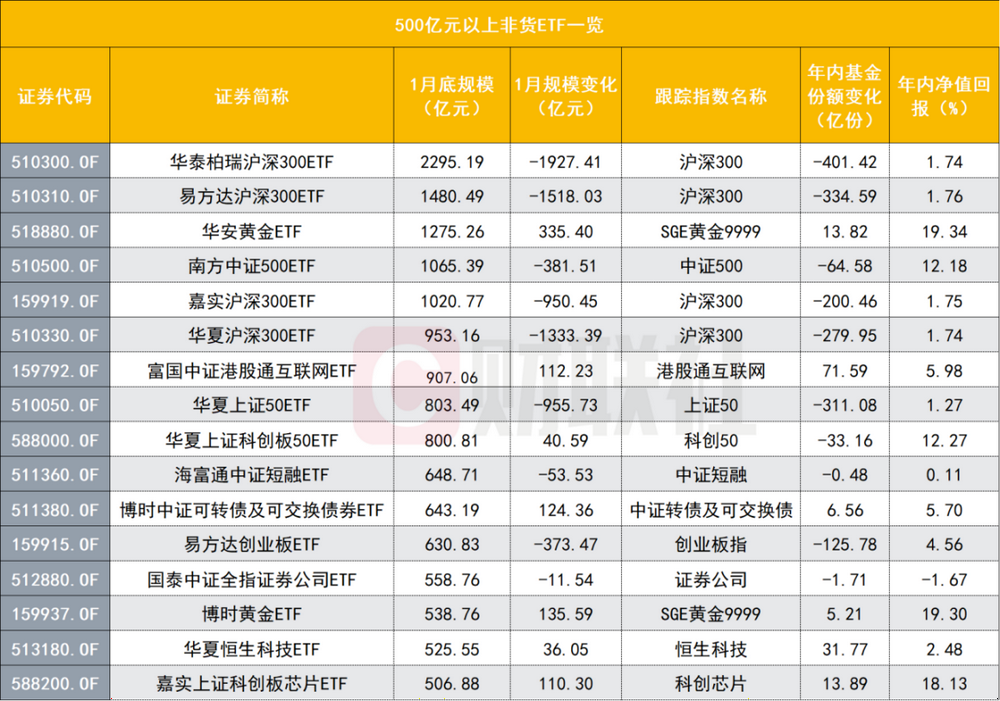
Core Insights - The non-cash ETF market experienced a significant contraction, with a reduction of over 500 billion yuan in January 2026, primarily driven by a decline in equity ETFs [1][6][7] - Despite the overall shrinkage, thematic ETFs, particularly those focused on gold and technology sectors, saw substantial inflows, with several new products entering the 500 billion yuan tier [2][4][5] ETF Market Overview - The total scale of non-cash ETFs as of the end of January was 5.31 trillion yuan, reflecting a decrease of 536.76 billion yuan from the previous month [7] - Broad-based ETFs saw a reduction of 909.96 billion yuan, bringing their total scale below 1.66 trillion yuan [7] - The three ETFs linked to the CSI 300, CSI 1000, and SSE 50 indices experienced the largest declines, with the CSI 300 ETF alone shrinking by 574.30 billion yuan [7][8] Thematic ETF Performance - The gold-themed ETFs collectively grew by 820.73 billion yuan in January, reaching a total scale of 3.01 trillion yuan [9][10] - Notable new entrants to the 500 billion yuan category included the Bosera Gold ETF, Huaxia Hang Seng Technology ETF, and Harvest SSE Sci-Tech Chip ETF, all of which showed strong performance in terms of net value returns [2][4][5] - The Bosera Gold ETF reported a net value return of nearly 20% in January, contributing to its growth of 135.59 billion yuan [3][4] Fund Management Insights - As of the end of January, Huaxia Fund led the market with four non-cash ETFs exceeding 500 billion yuan, while Bosera and Harvest Funds each had two [5] - The number of ETFs in the 1 billion yuan category decreased from seven to five, indicating a consolidation in the market [4][5] Redemption Trends - Significant redemptions were observed in the EasyOne SSE Sci-Tech 50 ETF and Southern CSI 1000 ETF, which saw net redemptions of 226.92 billion and 149.40 billion units, respectively, marking the largest monthly redemptions since their inception [4][8]
两市ETF两融余额减少28.96亿元丨ETF融资融券日报
2 1 Shi Ji Jing Ji Bao Dao· 2026-02-02 02:49
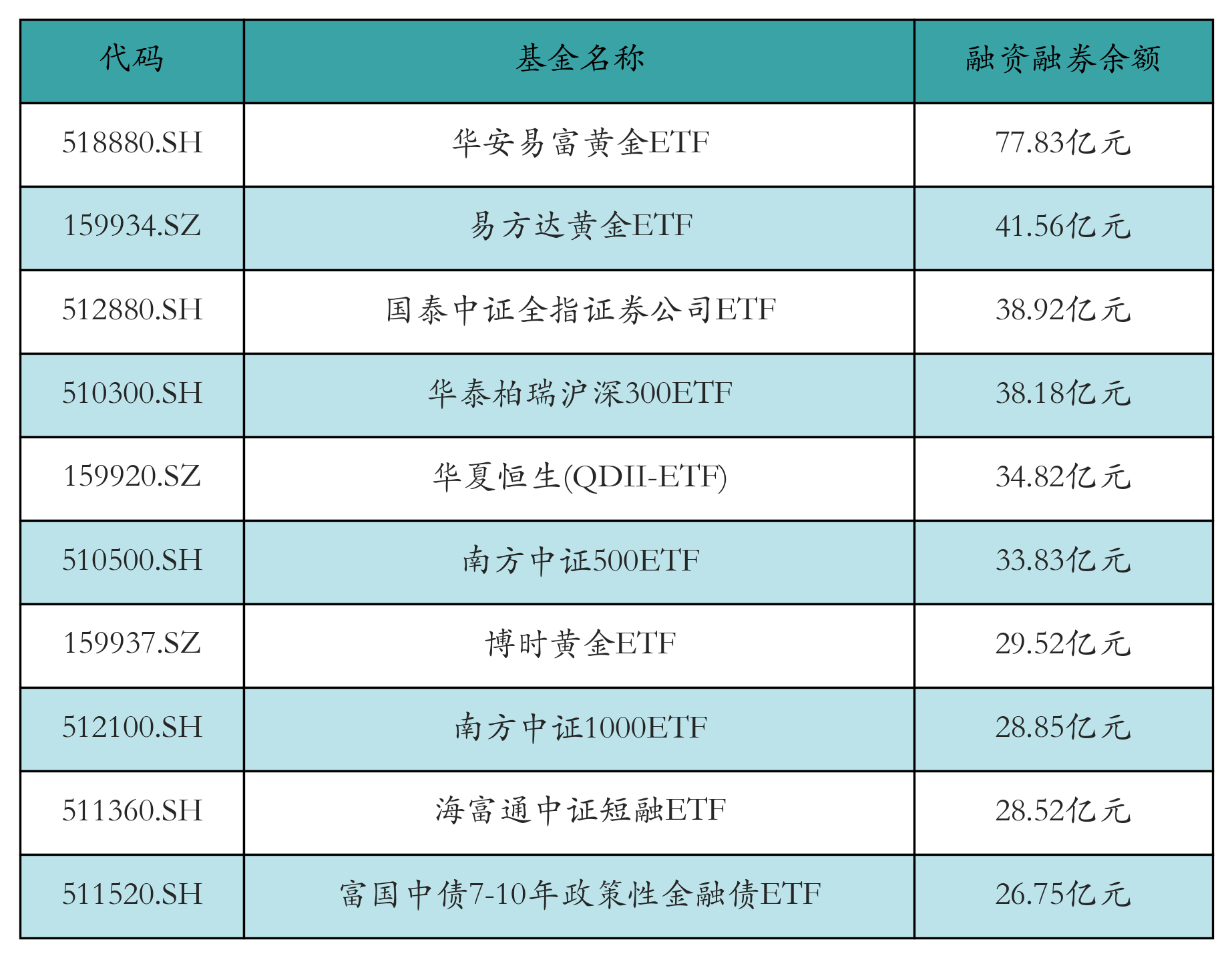
Market Overview - As of January 30, the total ETF margin balance in the two markets is 120.251 billion yuan, a decrease of 2.896 billion yuan from the previous trading day [1] - The financing balance is 112.88 billion yuan, down by 2.768 billion yuan, while the securities lending balance is 7.371 billion yuan, a decrease of 129 million yuan [1] - In the Shanghai market, the ETF margin balance is 84.19 billion yuan, a reduction of 1.917 billion yuan, with a financing balance of 77.757 billion yuan, down by 1.8 billion yuan [1] - The Shenzhen market's ETF margin balance is 36.061 billion yuan, decreasing by 979 million yuan, with a financing balance of 35.122 billion yuan, down by 967 million yuan [1] ETF Margin Financing Balances - The top three ETFs by margin balance on January 30 are: 1. Huaan Yifu Gold ETF (7.783 billion yuan) 2. E Fund Gold ETF (4.156 billion yuan) 3. Guotai CSI All-Share Securities Company ETF (3.892 billion yuan) [2] ETF Financing Buy Amounts - The top three ETFs by financing buy amounts on January 30 are: 1. Hai Futong CSI Short Bond ETF (4.538 billion yuan) 2. Bosera CSI Convertible Bonds and Exchangeable Bonds ETF (2.375 billion yuan) 3. Huaan Yifu Gold ETF (1.598 billion yuan) [4] ETF Financing Net Buy Amounts - The top three ETFs by financing net buy amounts on January 30 are: 1. E Fund CSI Hong Kong Securities Investment Theme ETF (84.1736 million yuan) 2. Huaxia Hang Seng Internet Technology Industry (QDII-ETF) (48.62 million yuan) 3. Fuguo Shanghai Composite Index ETF (42.3782 million yuan) [5] ETF Securities Lending Sell Amounts - The top three ETFs by securities lending sell amounts on January 30 are: 1. Southern CSI 1000 ETF (74.7985 million yuan) 2. Huatai-PB Shanghai and Shenzhen 300 ETF (18.0902 million yuan) 3. Southern CSI 500 ETF (11.3948 million yuan) [6]
闻泰科技跌停,博时基金旗下1只基金重仓,持有5.75万股浮亏损失22.65万元
Xin Lang Cai Jing· 2026-02-02 01:50
2月2日,闻泰科技跌停,截至发稿,报35.46元/股,成交1.61亿元,换手率0.36%,总市值441.35亿元。 博时湖北新旧动能转换ETF(159743)基金经理为尹浩。 资料显示,闻泰科技股份有限公司位于广东省深圳市罗湖区黄贝街道新秀社区罗沙路5097号银丰大厦B 座一层,成立日期1993年1月11日,上市日期1996年8月28日,公司主营业务涉及房地产开发与经营;以 智能手机为主的移动互联网设备产品的研发与制造;上游半导体。主营业务收入构成为:智能终端 69.00%,半导体产品30.88%,其他0.12%。 截至发稿,尹浩累计任职时间6年117天,现任基金资产总规模96.69亿元,任职期间最佳基金回报 158.37%, 任职期间最差基金回报-32.87%。 从基金十大重仓股角度 声明:市场有风险,投资需谨慎。 本文基于第三方数据库自动发布,不代表新浪财经观点,任何在本 文出现的信息均只作为参考,不构成个人投资建议。如有出入请以实际公告为准。如有疑问,请联系 biz@staff.sina.com.cn。 数据显示,博时基金旗下1只基金重仓闻泰科技。博时湖北新旧动能转换ETF(159743)四季度减持60 ...

巨量主力资金,最新动向来了!
Ge Long Hui· 2026-02-02 01:02
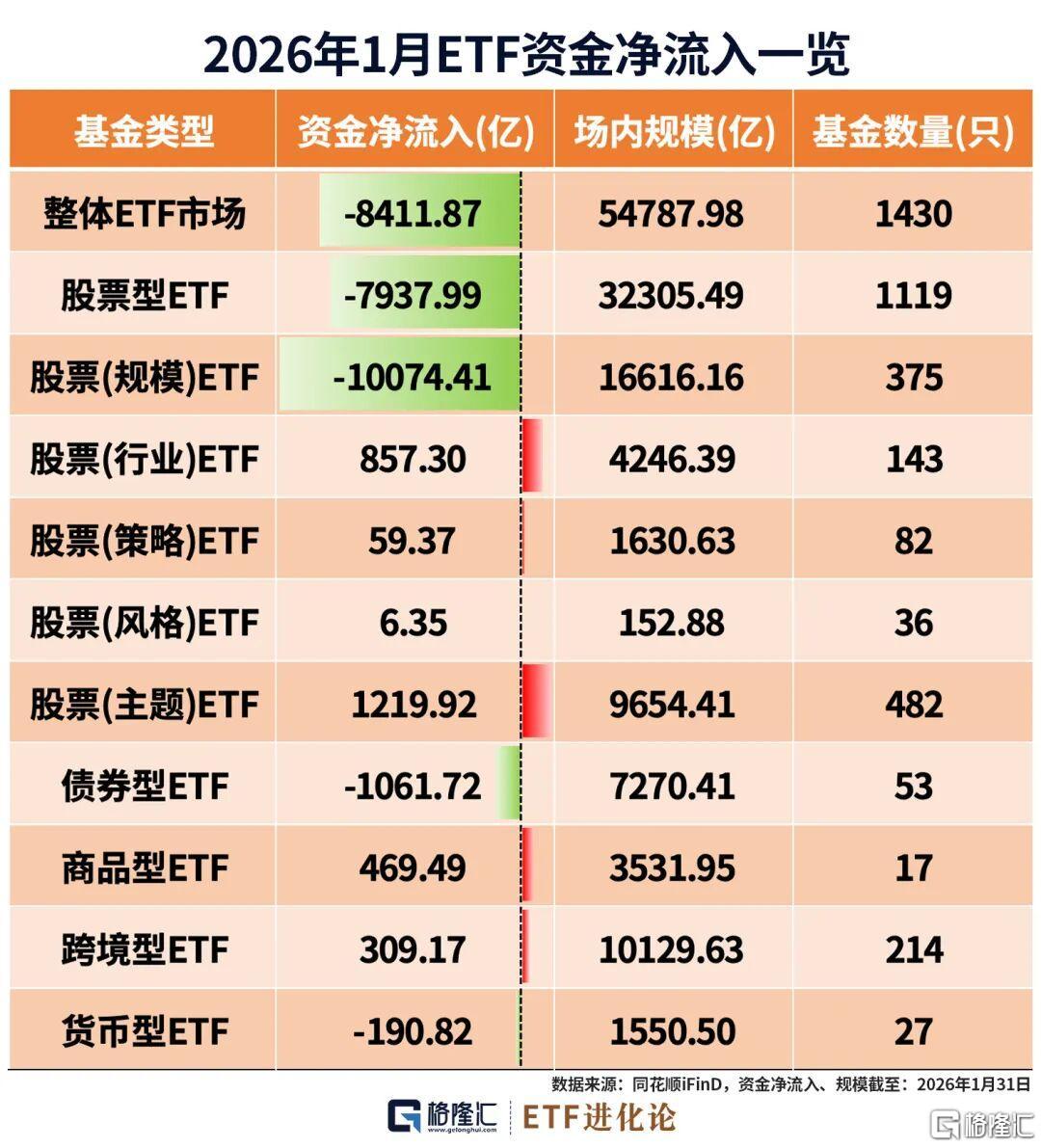
Core Viewpoint - In January 2026, the A-share ETF market exhibited a clear divergence, with over 200 billion yuan flowing into thematic ETFs in sectors like non-ferrous metals, gold, chemicals, and technology, while core broad-based ETFs like CSI 300 and CSI 1000 experienced a net outflow exceeding 1 trillion yuan [1][10]. Group 1: ETF Market Overview - The overall ETF market size reached approximately 54,787.98 billion yuan, with a net outflow of 841.87 billion yuan in January [3]. - Stock-type ETFs saw a net outflow of 793.80 billion yuan, while thematic stock ETFs recorded a net inflow of 1,219.92 billion yuan [3]. - The CSI 300 ETF from Huatai-PineBridge had a net outflow of 1,908.43 billion yuan, marking the largest outflow among broad-based ETFs [11]. Group 2: Performance of Thematic ETFs - The non-ferrous metals ETF and gold ETFs attracted significant inflows, with the non-ferrous metals ETF receiving 182.57 billion yuan and the gold ETF 147.71 billion yuan [13]. - The semiconductor ETFs, including the China-Korea Semiconductor ETF, saw substantial gains, with the former increasing by 45.09% in January [6]. - Other notable performers included the chemical ETF and the electric grid equipment ETF, which also received over 100 billion yuan in inflows [13]. Group 3: Sector Performance - In January, the non-ferrous metals and technology sectors alternated as the leading gainers, with the semiconductor and gold stock ETFs rising over 40% [4]. - The AI application concept surged, leading to a 20% increase in the media ETF, while oil and gas stocks also saw gains of over 20% [4]. - Conversely, the banking ETF and automotive ETF experienced declines, with the banking ETF dropping over 6% [7][8].
ETF龙虎榜 | 这些方向 资金大幅流入
Zhong Guo Zheng Quan Bao· 2026-02-01 23:20
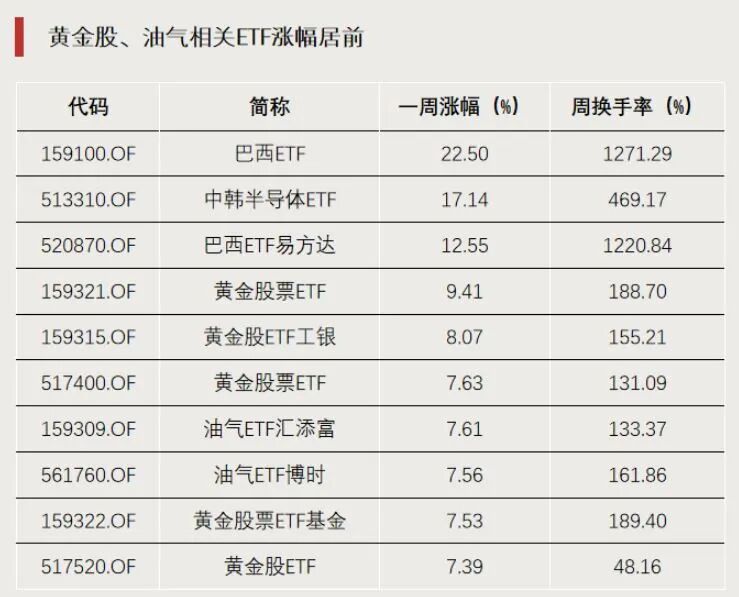
Core Viewpoint - The recent performance of ETFs indicates a strong interest in gold and energy-related sectors, with significant inflows into these areas despite an overall market outflow in ETF funds [1][9]. Fund Flows - Overall, the ETF market experienced a net outflow of 2984.22 billion yuan from January 26 to January 30 [1][8]. - Gold and non-ferrous related ETFs were the main beneficiaries, with gold ETFs linked to Shanghai Gold Exchange Au99.99 contracts receiving over 200 billion yuan in net inflows [9]. - ETFs tracking the SSH gold stock index saw a total net inflow of 75.25 billion yuan, while those tracking various non-ferrous metal indices had a combined net inflow of 170.49 billion yuan [9][10]. ETF Performance - A total of 541 ETFs recorded positive returns, accounting for over 35% of the market [3]. - Gold and energy-related ETFs led the gains, with several gold stock ETFs increasing by over 7% [3][6]. - The Brazilian ETF (159100) had the highest weekly gain at 22.5%, while the A500 ETF (159361) saw a trading volume exceeding 2200 billion yuan [2][4]. Trading Activity - The trading activity for ETFs tracking major indices such as the CSI 300 and SGE Gold 9999 remained robust, with significant weekly trading volumes [11][12]. - The CSI 300 ETF saw the largest net outflow, with over 700 billion yuan withdrawn from the Huatai-PineBridge CSI 300 ETF [13]. Sector Insights - The commercial aerospace sector faced adjustments, with satellite and general aviation-related ETFs experiencing declines of over 10% [3]. - The semiconductor sector also saw notable performance, with the Korea-China Semiconductor ETF (513310) showing a year-to-date decline of 45.09% [8][7]. Market Outlook - Analysts suggest focusing on cyclical resources supported by global demand and the AI industry, while also being cautious of potential short-term cooling risks in the market [14].
黄金股主题ETF领涨 有色相关ETF成“吸金”主力
Zhong Guo Zheng Quan Bao· 2026-02-01 21:25
Group 1 - The A-share market experienced high volatility from January 26 to January 30, with gold and oil-related ETFs showing significant gains, exceeding 7% [1][2] - A total of 541 ETFs achieved positive returns during the same period, with over 35% of the ETFs in the A-share market reporting positive performance [2] - The Brazilian ETF (159100) led the market with a weekly increase of 22.5%, while several other ETFs, including those tracking the semiconductor sector, also saw gains exceeding 10% [2][3] Group 2 - Overall, the ETF market faced a net outflow of approximately 2984.22 billion yuan during the week, indicating a general trend of capital withdrawal [4] - Gold and non-ferrous metal ETFs emerged as the main beneficiaries of capital inflow, with the gold ETF (518880) attracting the highest net inflow of 8.503 billion yuan [4] - The ETFs tracking the CSI 300 and other major indices saw significant trading volumes, with the CSI 300 ETF surpassing 3000 billion yuan in weekly trading volume [4][5] Group 3 - The broad-based ETFs continued to experience substantial net outflows, particularly the CSI 300 ETFs, which saw net outflows exceeding 700 billion yuan for some funds [5] - The market sentiment is cautious, with analysts suggesting a need to balance aggressive and defensive investment strategies, focusing on high-growth sectors while also considering undervalued dividend assets [6][7] - The geopolitical landscape is influencing investment strategies, particularly in rare metals, which are gaining importance for national strategic security amid rising regional conflicts [7]
金价历史性巨震 长期配置逻辑仍受部分机构认可
Zhong Guo Zheng Quan Bao· 2026-02-01 21:02
Core Viewpoint - On January 30, gold prices experienced a significant reversal, marking the largest single-day decline in nearly 40 years after reaching a historical high the previous trading day [1] Investor Sentiment - Investor sentiment has become polarized following the sharp decline in gold prices, with some early investors remaining calm due to unrealized gains, while others who did not enter the market feel relieved [2] - Discussions on investment platforms reflect anxiety, with topics such as whether to hold or sell amid the price drop gaining traction [2] - Some investors are taking a contrarian approach by gradually increasing their positions, indicating a complex emotional landscape among market participants [2] Factors Behind Price Decline - The sharp drop in gold prices is attributed to multiple factors, including profit-taking after a rapid increase of approximately 30% since the beginning of 2026 [3] - Increased margin requirements for gold futures trading have exacerbated the volatility, with exchanges raising margin ratios, leading to a chain reaction of selling [3] - The expectation of changes in monetary policy, particularly with the nomination of Kevin Walsh as the next Federal Reserve Chair, has added pressure on gold prices, as a stronger dollar negatively impacts gold [4] Institutional Perspectives - Various gold-themed ETFs have seen significant declines, with an average drop of over 7% on January 30, and some gold stock ETFs hitting their daily limit down [5] - Despite the recent volatility, there was a notable inflow of funds into related ETFs prior to the drop, indicating lingering optimism in the market [5] - Some institutions maintain a long-term bullish outlook on gold, citing factors such as ongoing de-dollarization, central bank purchases, geopolitical tensions, and inflation expectations as supportive for gold prices [6] - UBS has raised its gold price targets for March, June, and September 2026 from $5,000 to $6,200 per ounce, driven by stronger-than-expected demand [6]
黄金股主题ETF领涨有色相关ETF成“吸金”主力
Zhong Guo Zheng Quan Bao· 2026-02-01 20:53
Core Viewpoint - The A-share market experienced fluctuations at high levels, with gold and oil-related ETFs showing significant gains, while overall ETF funds saw a net outflow of nearly 300 billion yuan during the week of January 26 to January 30 [1][2]. ETF Performance - During the week, 541 ETFs achieved positive returns, with over 35% of the total ETFs showing gains. Gold and oil-related ETFs led the performance, with several gold stock ETFs and oil ETFs rising over 7% [1][2]. - The Brazilian ETF (159100) had the highest weekly gain at 22.5%, while the South Korean semiconductor ETF and other Brazilian ETFs also saw gains exceeding 10% [1]. Fund Flows - The overall ETF market experienced a net outflow of approximately 298.42 billion yuan from January 26 to January 30. However, gold and non-ferrous metal ETFs emerged as the main beneficiaries of fund inflows, with the gold ETF (518880) attracting the highest net inflow of 8.503 billion yuan [2][3]. - Other notable inflows included over 5 billion yuan for both the non-ferrous metal ETFs (516650 and 512400) and over 4 billion yuan for the Guotai gold ETF [2]. Trading Volume - ETFs tracking major indices such as the CSI 300 and CSI 500 saw significant trading volumes, with the CSI 300 ETF exceeding 300 billion yuan and the CSI A500 ETF surpassing 220 billion yuan in weekly trading volume [3]. Market Sentiment and Strategy - Analysts suggest that the current market requires caution due to potential short-term cooling risks, emphasizing the need for a balance between growth and defensive strategies. High-technology manufacturing and information technology sectors are highlighted for their solid growth logic despite high valuations [3][4]. - Investment strategies should focus on sectors benefiting from global demand and the AI industry, while also considering the defensive value of dividend assets in response to potential market volatility [4].