银邦股份

Search documents
中小盘周报:重视火箭核心环节的投资机会-20251221
KAIYUAN SECURITIES· 2025-12-21 14:42
Group 1: Investment Opportunities in Rocket Core Components - The manufacturing cost of rockets is concentrated in engines, storage tanks, and fairings, with liquid engines accounting for approximately 50% of the total cost[3] - The storage tanks, which hold liquid hydrogen and liquid oxygen, represent about 15-25% of the rocket's cost and make up 60% of the rocket's mass[3][26] - Fairings, located at the top of the rocket, account for about 10% of the total cost and protect payloads during launch[17] Group 2: Cost Breakdown of Falcon 9 Launch - The total manufacturing cost of a Falcon 9 rocket is estimated to be between $50 million and $60 million, with the booster alone costing $30 million to $40 million[50] - The recovery and refurbishment cost of the rocket after launch ranges from $250,000 to $2 million, depending on the extent of repairs needed[50] - The average launch cost, when reusing the Falcon 9, can drop to approximately $2.89 million, significantly reducing the overall expenses[51] Group 3: Market Performance and Trends - This week, the A-share market experienced a general decline, with the Shanghai Composite Index closing at 3,890.45 points, up by only 0.03%[53] - The total trading volume in the A-share market reached 5.74 billion shares, with a total transaction value of 880.24 billion yuan, reflecting a 9.86% decrease in liquidity compared to the previous week[53][54] - The micro-cap stocks outperformed major indices, indicating a shift in market dynamics favoring smaller companies[3]
计算机行业跟踪周报:商业航天还有哪些事件值得期待?-20251221
Soochow Securities· 2025-12-21 12:02
Investment Rating - The report maintains an "Overweight" rating for the industry, indicating a positive outlook for the sector over the next six months [1]. Core Insights - The commercial rocket sector is in a critical growth phase, with significant potential for investment opportunities as it transitions from initial development to operational capabilities [2]. - The upcoming launch of the Long March 12A rocket on December 23, 2025, is expected to mark a significant milestone, potentially making China the second country to master medium-sized reusable rocket technology, which could drastically reduce launch costs and support low Earth orbit satellite constellation development [5][10]. - A series of new commercial rockets are anticipated to have their maiden flights in 2026, which could lead to a transformative shift in the industry as China enters the era of reusable rockets [11]. - The SpaceX Starship and Starlink V3 launches are set to occur in 2026, with the new Starlink satellites expected to significantly enhance network capacity [12][16]. - SpaceX is preparing for an IPO in mid-2026, aiming to raise over $30 billion, which will help accelerate developments in the commercial space sector [17]. - The U.S. government has introduced a "America First" space policy, which is expected to bolster domestic industry growth through regulatory improvements and increased funding for commercial space initiatives [18][22]. - A new wave of satellite deployment is expected in 2026, driven by major companies initiating large-scale satellite tenders, which will stimulate growth across the entire aerospace supply chain [23]. Summary by Sections 1. Upcoming Events in Commercial Aerospace - The Long March 12A rocket is set for its first flight on December 23, 2025, with a focus on vertical recovery technology [10]. - 2026 is projected to be a pivotal year for reusable rocket launches, with multiple new models expected to undergo testing [11]. - SpaceX plans to launch its third-generation Starlink satellites in 2026, significantly increasing network capacity [12][16]. - The U.S. has outlined a comprehensive space policy aimed at maintaining leadership in space exploration and commercial activities [18][20]. 2. Investment Recommendations and Related Companies - Rocket Sector: Companies such as Chaojie Co., Srey New Materials, and others are highlighted for their roles in the commercial rocket supply chain [2][25]. - Satellite Sector: Companies like Shanghai Hanyun and Xinke Mobile are noted for their contributions to satellite payloads and technology [26]. - Space Computing: Companies such as Shunhao Co. and Dongfang Risheng are recognized for their investments in space computing and energy systems [27].
资金风向标 | 两融余额较上一日减少19.89亿元 电子行业获融资净买入额居首
Shang Hai Zheng Quan Bao· 2025-12-18 14:40
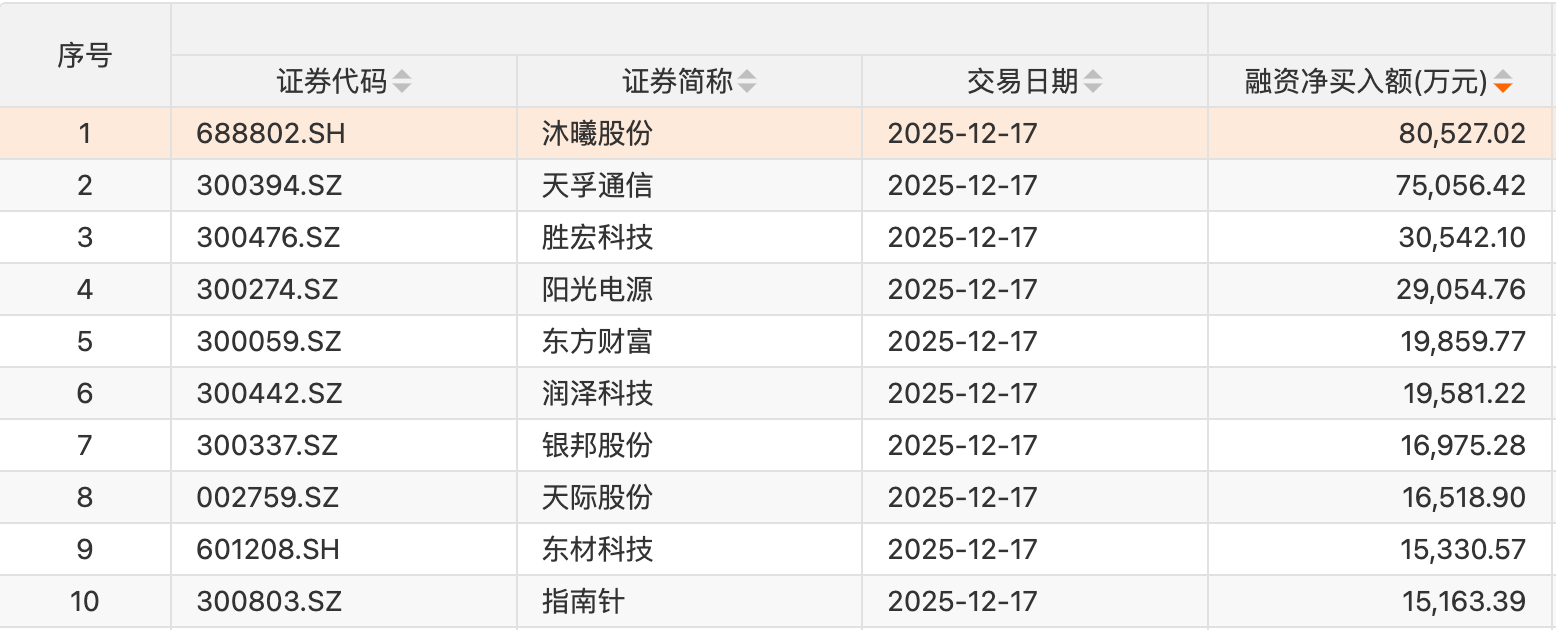
来源:上海证券报·中国证券网 上证报中国证券网讯(刘禹希 记者 徐蔚)截至12月17日,A股两融余额为25028.46亿元,较上一交易日减少19.89亿元,占A股流通市值比例为2.61%。当日 两融交易额为1852.92亿元,较上一交易日增加63.63亿元,占A股成交额的10.09%。 资金流向方面,申万31个一级行业中有9个行业获融资净买入,其中,电子行业获融资净买入额居首,当日净买入10.64亿元;获融资净买入居前的行业还有 通信、非银金融、建筑材料、钢铁等。 个股方面,21只个股获融资净买入额超1亿元。沐曦股份获融资净买入额居首,净买入8.05亿元;融资净买入金额居前的还有天孚通信、胜宏科技、阳光电 源、东方财富、润泽科技、银邦股份、天际股份、东材科技、指南针等。 | 序号 | | | | | --- | --- | --- | --- | | | 证券代码 ◆ | 证券简称 ◆ | 交易日期 ◀ | | 1 | 688802.SH | 沐曦股份 | 2025-12-17 | | 2 | 300394.SZ | 天孚通信 | 2025-12-17 | | ന | 300476.SZ | 胜宏科技 | 2 ...

银邦股份:公司已成为法国法雷奥集团、德国马勒集团等世界知名汽车系统零部件企业的供应商
Mei Ri Jing Ji Xin Wen· 2025-12-18 03:49
(记者 王晓波) 银邦股份(300337.SZ)12月18日在投资者互动平台表示,公司产品最大的应用领域在汽车行业,经过 近几年的努力,公司已成为法国Valeo thermal systems(法雷奥集团)、日本DENSO电装株式会社(电 装集团)、德国MAHLE Group(马勒集团)、美国Modine Manufacturing Company(摩丁集团)、韩国 ONEGENE、韩国Hanon Systems Corp.(翰昂集团)等世界知名汽车系统零部件企业的供应商。 每经AI快讯,有投资者在投资者互动平台提问:银邦与国际知名的热交换器制造商建立合作共同服务 于特斯拉、GE、BMW、Spacex等品牌? ...

工业金属板块短线拉升
Mei Ri Jing Ji Xin Wen· 2025-12-18 02:17
Core Viewpoint - The industrial metal sector has experienced a short-term surge, with notable increases in stock prices for several companies, particularly zinc-related firms [1] Group 1: Company Performance - Zinc Industry Co. has reached its daily limit increase in stock price [1] - New Weiling, Luoping Zinc Electric, Chihong Zn & Ge, Yiqiu Resources, and Yinbang Co. have also seen significant stock price increases [1]


创业板两融余额增加8.41亿元
Zheng Quan Shi Bao Wang· 2025-12-18 02:07
Core Insights - The latest financing balance of the ChiNext market is 535.116 billion yuan, with a week-on-week increase of 0.806 billion yuan, and 15 stocks have seen financing balances increase by over 10% [1] - On December 17, the ChiNext index rose by 3.39%, with a total margin balance of 536.993 billion yuan, an increase of 0.841 billion yuan from the previous trading day [1] - Among the stocks with increased financing balances, 410 stocks saw growth, with the largest increase being 49.19% for Yidong Electronics, which also experienced a price increase of 20.01% on the same day [1] Financing Balance Increase - The stocks with the highest financing balance increases include: - Yidong Electronics: 30.651 million yuan, up 49.19%, closing at 52.78 yuan, up 20.01% [3] - Xice Testing: 33.124 million yuan, up 34.95%, closing at 104.58 yuan, up 8.37% [3] - Yinbang Co.: 78.747 million yuan, up 27.48%, closing at 13.81 yuan, up 8.91% [3] - The average increase for stocks with over 10% financing balance growth was 6.81%, with 13 stocks rising, including Kaiwang Technology and Tongfei Co. with increases of 15.65% and 14.46% respectively [1][3] Financing Balance Decrease - A total of 537 stocks saw a decrease in financing balance, with 44 stocks experiencing a decline of over 5% [4] - The stock with the largest decrease was Baolijia, with a financing balance of 15.6505 million yuan, down 15.30% [4] - Other notable declines include: - Huanlejia: 99.9185 million yuan, down 14.68% [4] - Aike Co.: 185.2164 million yuan, down 14.02% [4] Capital Flow - On December 17, among the stocks with increased financing balances, 14 stocks saw net inflows of main funds, with Tianfu Communication and Yidong Electronics leading with net inflows of 0.846 billion yuan and 0.204 billion yuan respectively [2]

21股获融资净买入额超1亿元
Zheng Quan Shi Bao Wang· 2025-12-18 02:00
个股方面,12月17日,有1626只个股获融资净买入,净买入金额在3000万元以上的有109股。其中,21 股获融资净买入额超1亿元。C沐曦-U获融资净买入额居首,净买入8.05亿元;融资净买入金额居前的还 有天孚通信、胜宏科技、阳光电源、东方财富、润泽科技、银邦股份、天际股份、东材科技等股。 Wind统计显示,12月17日,申万31个一级行业中有9个行业获融资净买入,其中,电子行业获融资净买 入额居首,当日净买入10.64亿元;获融资净买入居前的行业还有通信、非银金融、建筑材料等。 ...
再创历史新高,年内大涨超120%!白银为何成贵金属“黑马”
Sou Hu Cai Jing· 2025-12-17 13:29
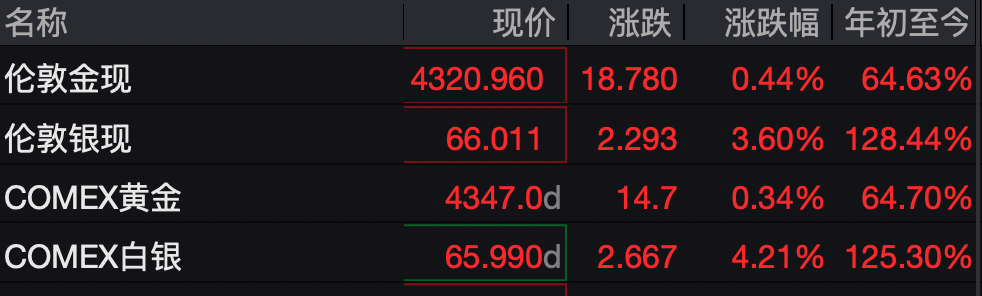
Core Viewpoint - The silver market has reached a historic milestone with spot silver prices surpassing $66 per ounce, marking a significant increase driven by supply-demand imbalances, the onset of a Federal Reserve easing cycle, and a surge in global capital inflows [1][2][5]. Price Movements - As of December 17, spot silver prices hit $66.01 per ounce, up 3.6%, while COMEX silver futures rose over 5% to a peak of $66.5 per ounce [1][2]. - Year-to-date, silver has shown an impressive increase of approximately 128.44%, significantly outperforming gold, which has risen about 64% [2]. Market Dynamics - The surge in silver prices is attributed to three main factors: supply-demand imbalance, expectations of continued monetary easing by the Federal Reserve, and concentrated inflows of global capital [2][5]. - The low supply elasticity and inventory levels of silver, combined with strong industrial demand and ongoing ETF investment, have contributed to the bullish market sentiment [4][5]. Economic Indicators - Recent U.S. economic data, including the November non-farm payroll report and retail sales figures, have reinforced expectations of a slowing economy, supporting the Fed's easing policy [4]. - The uncertainty surrounding Japan's monetary policy and its potential impact on global liquidity has also played a role in boosting precious metal prices [4]. Future Outlook - Analysts suggest that while the current bullish trend in silver may continue, caution is advised due to accumulating risk factors, including high implied volatility and potential profit-taking as the market adjusts [6][7]. - The global silver inventory is projected to cover only 1-2 months of consumption by 2025, indicating a significant supply constraint [6]. - Some analysts predict that silver prices could reach between $75 and $80 per ounce in a final surge, representing a peak emotional market response [8].
机器人+商业航天双buff,又一个科技赛道悄悄起风了
3 6 Ke· 2025-12-17 09:53
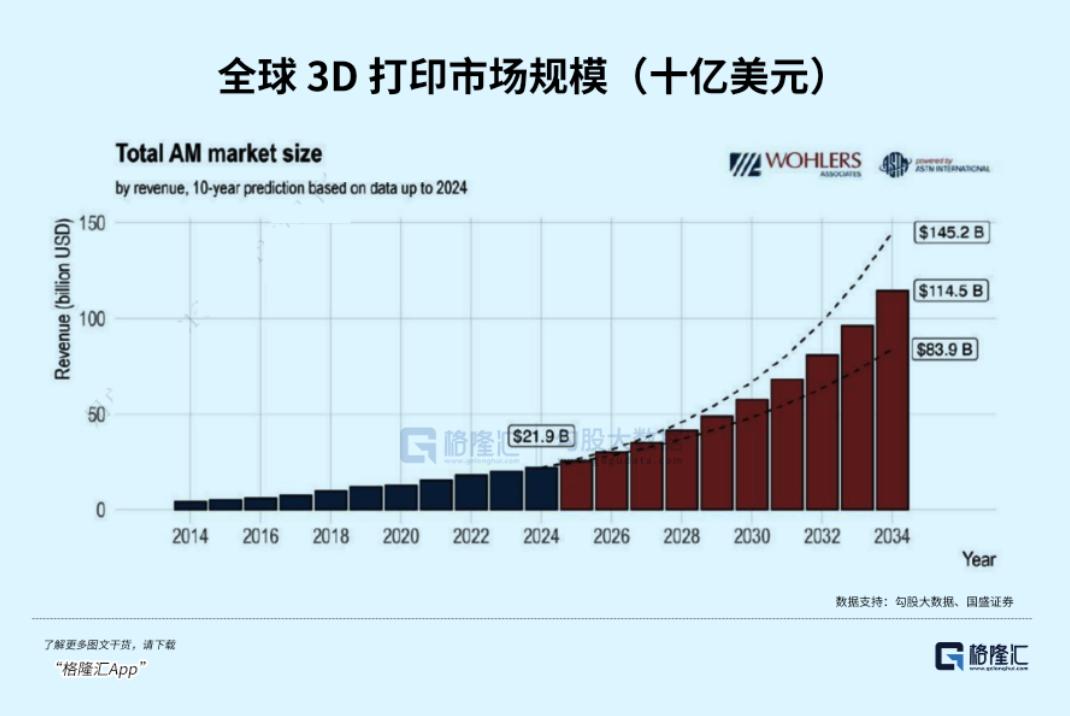
Core Insights - The 3D printing technology has transitioned from experimental stages to becoming a core productivity driver in high-end manufacturing, evidenced by successful applications in aerospace and robotics [1] - The global 3D printing market is projected to reach $21.9 billion in 2024 and is expected to grow to $114.5 billion by 2034, indicating a significant expansion phase [2] - Chinese manufacturers dominate the entry-level equipment market with over 90% market share, supported by rapid technological advancements and cost advantages [4] Market Growth - The 3D printing industry has entered a phase of large-scale expansion, with a notable increase in domestic exports, reaching 3.77 million units valued at 8.9 billion yuan in 2024 [4] - The export volume is expected to exceed 5 million units in 2025, with a potential for export value to surpass 10 billion yuan for the first time [4] Technological Advancements - Significant improvements in SLM metal printing precision and carbon fiber 3D printing have enhanced capabilities for aerospace and automotive applications [5] - AI modeling technology and advancements in consumer-grade 3D printing have made the technology more accessible, reducing operational complexity and costs [5] Application Expansion - The demand for 3D printing in humanoid robotics and commercial aerospace is rapidly increasing, with 3D printing reducing the number of parts in rocket engines by 80% and costs by 90% [6] - The consumer market is also experiencing a surge, with sales of 3D printed toys and custom home goods tripling during major shopping events [8] Investment Opportunities - The industry is poised for growth in 2025, driven by increased orders and capital investment, with three main investment lines identified: core equipment, core materials, and emerging applications [9] - Key players in industrial-grade 3D printing, such as Platinum and Huazhu, are well-positioned to benefit from the growing demand [9] - The domestic production of core materials, such as titanium alloy powders, is becoming increasingly competitive, with significant cost advantages over imports [10] Conclusion - The evolution of 3D printing technology from concept to reality has established it as a core production force, with Chinese companies leading in both consumer and industrial markets [12] - The structural opportunities in the industry, driven by exports and domestic production, warrant close attention from investors [12]


机器人+商业航天双buff,又一个科技赛道悄悄起风了!
Ge Long Hui· 2025-12-17 09:51
Core Insights - The 3D printing technology has transitioned from experimental stages to becoming a core productivity driver in high-end manufacturing, evidenced by successful applications in aerospace and robotics [2] - The global 3D printing market is projected to reach $21.9 billion in 2024 and is expected to grow to $114.5 billion by 2034, indicating a significant expansion phase [2] Market Growth and Domestic Manufacturers - The global 3D printing industry has moved beyond small-scale growth and is now in a phase of large-scale expansion, with Chinese manufacturers capturing over 90% of the entry-level equipment market due to high cost-performance ratios [4] - In 2024, China exported 3.7777 million 3D printing devices worth 8.9 billion yuan, with projections indicating that exports could exceed 5 million units and 10 billion yuan in 2025 [4] Domestic Production and Technological Advancements - The domestic production rate for metal 3D printing equipment has increased from less than 30% five years ago to 60%, while the local supply chain coverage for non-metal materials exceeds 85% [5] - Companies like Plater and Huazhu High-Tech are producing competitive metal 3D printers at prices 30% lower than their Western counterparts, successfully entering supply chains in aerospace and new energy vehicles [6] Technological Improvements and Application Expansion - Significant technological advancements have been made in industrial-grade 3D printing, with SLM metal printing achieving precision of 0.01 mm, suitable for aerospace engine components [7] - The efficiency of 3D printing has improved fivefold over the past three years, with entry-level device prices dropping by 60%, making the technology accessible to consumers and small businesses [7] Application Scenarios and Market Drivers - The demand for 3D printing in humanoid robotics and commercial aerospace is rapidly increasing, with 3D printing reducing the number of parts in rocket engines by 80% and cutting costs by 90% [8] - During the 618 shopping festival, sales of 3D printed toys and customized home goods surged over threefold, indicating a strong awakening of consumer demand [10] Investment Opportunities - The year 2025 is anticipated to be pivotal for 3D printing, with three main investment lines identified: core equipment, core materials, and emerging applications [10] - In the core equipment sector, companies like Plater and Huazhu High-Tech are positioned to benefit from industrial and consumer demand growth [11] - The core materials sector is expected to see further domestic production increases, with companies like Zhonghang Mite and Yuyuan Powder Materials offering competitive products [12] - Emerging applications in humanoid robotics and commercial aerospace are likely to experience significant growth, with companies like LZ Group and Yinbang Co. poised to capitalize on these trends [13]