禾赛科技

Search documents
无人驾驶双雄港股对决:小马智行股价曾较美股IPO发行价跌68% 港股发行比例或高达22%引股权稀释
Xin Lang Zheng Quan· 2025-10-21 10:51
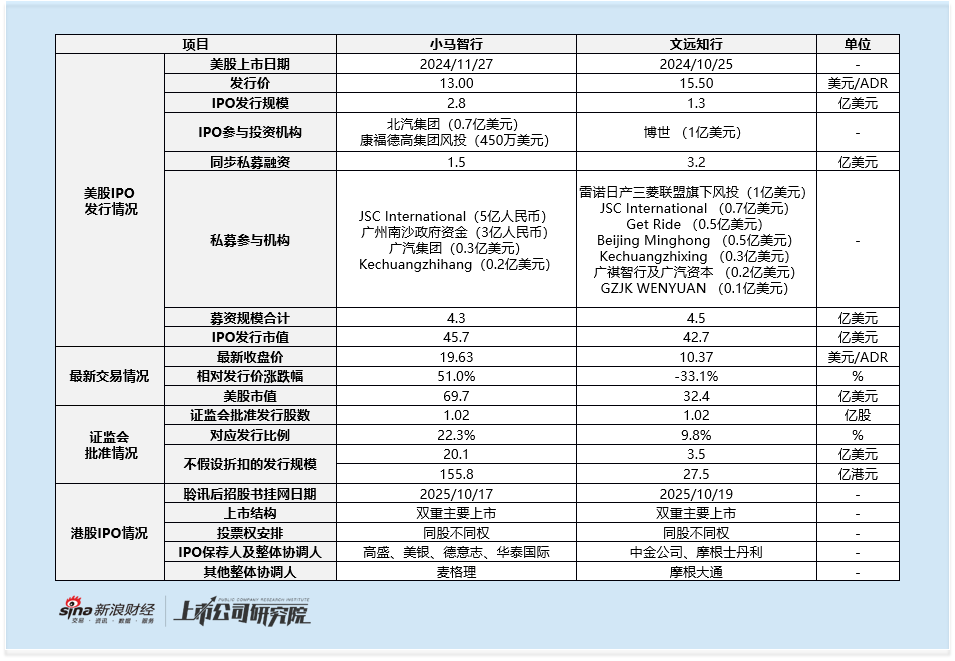
Core Viewpoint - The Chinese autonomous driving sector is witnessing a significant shift as two leading companies, Pony AI Inc. and We Ride Inc., prepare for their IPOs in Hong Kong, following the successful listing of Hesai Technology. This move reflects a competitive landscape in the capital markets, with contrasting post-IPO performances highlighting market sentiment and valuation disparities between the two firms [1][3]. Summary by Sections IPO Details - Pony AI plans to issue up to 102,146,500 shares, while We Ride aims to issue 102,428,200 shares [1]. - The IPO sizes are approximately $2.8 billion for Pony AI and $1.3 billion for We Ride [2]. - Both companies have engaged significant institutional investors, with notable participation from Baoneng Group and Bosch [2][3]. Post-IPO Performance - Pony AI's stock price has shown a strong recovery, rising 51% from its IPO price to $19.63 per ADR, with a market capitalization of $69.7 billion [4]. - In contrast, We Ride's stock has declined 33.1% from its IPO price, closing at $10.37 per ADR, resulting in a market cap of $32.4 billion [6][4]. - The valuation gap between the two companies has widened significantly, with a difference of $37.3 billion in market capitalization as of October 20 [6]. Institutional Investment Trends - Institutional interest in Pony AI has surged, with top investors increasing their holdings by $3.9 billion, indicating strong confidence in its long-term potential [8][9]. - Conversely, We Ride's institutional support has been weaker, with only $1 billion in increased holdings, and the quality of its investors is less favorable [9][10]. Regulatory and Market Considerations - The Chinese Securities Regulatory Commission's approval of share issuance suggests a favorable regulatory stance towards Pony AI, which has a higher issuance ratio compared to We Ride [11]. - Both companies have adopted dual-class share structures, which may limit their access to southbound capital for at least seven months post-listing, potentially affecting liquidity [12].

自动驾驶再现融资热,24起融资超350亿元,但行业尚未进入盈利期
Mei Ri Jing Ji Xin Wen· 2025-10-20 11:30
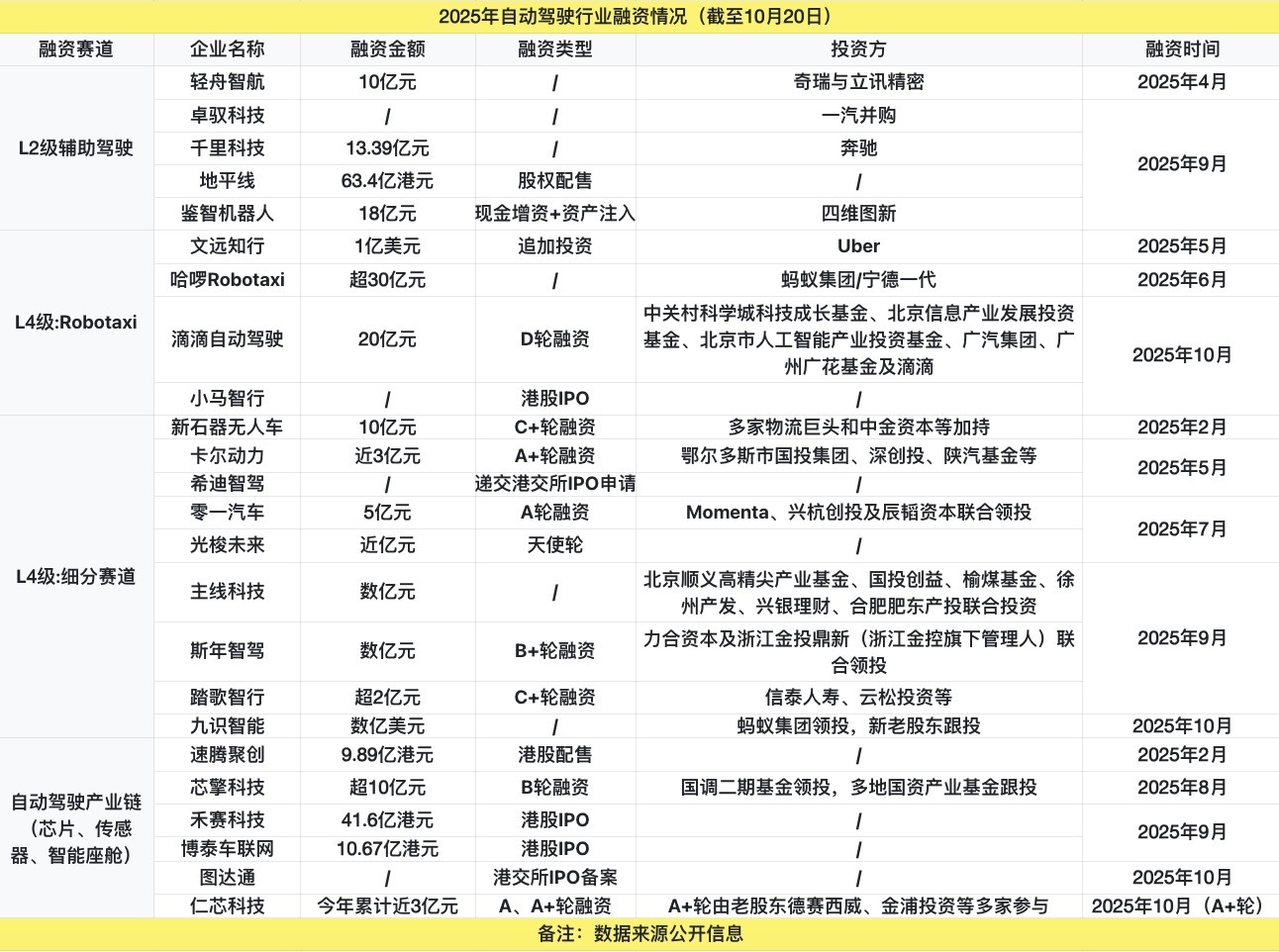
Core Insights - The autonomous driving industry is experiencing a significant resurgence in investment, with over 100 billion RMB raised in 11 financing events in the past month alone, totaling 350 billion RMB for the year as of October 20, 2025, indicating a strong recovery from the previous three years of capital winter [1][2][6] - The financing landscape is characterized by a preference for companies with clear application scenarios, with state-owned and industrial capital increasingly replacing traditional financial investors as key drivers of industry development [6][7] Financing Overview - As of October 20, 2025, there have been 24 financing events in the autonomous driving sector, with a total amount exceeding 350 billion RMB, including 10 events with disclosed amounts of 10 million RMB or more, accounting for 50% of the total financing [2][3] - The L2 level assisted driving segment has seen five financing events, with the largest being Horizon Robotics raising approximately 58.12 billion RMB through a share placement [2][3] - The Robotaxi segment has attracted significant investment, with notable financing events including Didi's 20 billion RMB Series D round and Hello's over 30 billion RMB funding [3][4] Market Dynamics - The L4 level autonomous driving sector is entering a phase of accelerated commercialization, particularly in specific scenarios such as mining and logistics, with nine companies raising over 30 billion RMB [4][6] - The supply chain for autonomous driving, particularly in chips and lidar technology, has also seen substantial financing, with companies like Hesai Technology raising approximately 38 billion RMB through an IPO [4][6] Policy and Technological Support - The autonomous driving industry is supported by a surge in relevant policies, with over 71 policies released in the first half of 2025, including national-level approvals for L3 vehicle production [7][8] - Technological advancements and increased market acceptance are crucial for commercial viability, with L2 level assisted driving penetration exceeding 50% in China, the highest globally [7][8] Financial Performance and Challenges - Despite the financing boom, many companies in the autonomous driving sector remain unprofitable, with significant losses reported alongside revenue growth, indicating ongoing challenges in achieving stable profitability [8][10] - Companies like Horizon Robotics reported a revenue of 1.567 billion RMB in the first half of 2025, a 67.6% increase, but also faced a loss of 5.233 billion RMB, highlighting the financial strain in the industry [8][10] Future Outlook - The market for intelligent connected vehicles in China is projected to grow from 161.1 billion RMB in 2023 to 222.3 billion RMB by 2025, with expectations that China will become the largest autonomous driving market globally by 2030 [10][11] - The emphasis on safety and the gradual expansion of application scenarios for autonomous driving technologies are critical for the industry's future development [11]
激光雷达还有蛋糕分给图达通吗?
3 6 Ke· 2025-10-18 02:05
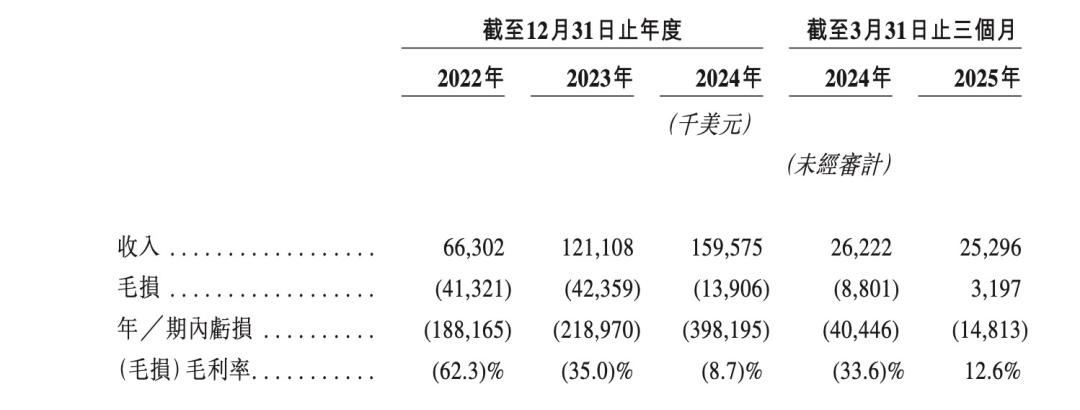
Core Viewpoint - The company TuDatong is attempting to go public through a SPAC merger after facing challenges in its previous IPO attempts, aiming for a valuation of HKD 11.7 billion in a highly competitive lidar market [1][9]. Financial Performance - TuDatong's gross margin turned positive for the first time in Q4 2022 at 5%, further increasing to 12.6% in Q1 2023, with a gross profit of USD 319.7 million [2][3]. - The company reported revenues of USD 66.3 million in 2022, projected to grow to USD 121.1 million in 2023 and USD 159.6 million in 2024, but it continues to incur significant losses, with total losses expected to reach USD 398.2 million in 2024 [3][4]. Market Position and Competition - TuDatong's market share in the global passenger car lidar market has declined to 12.8%, significantly lower than competitors like Hesai (20.3%), Huawei (19.1%), and RoboSense (16.7%) [9][12]. - The company relies heavily on a single major client, NIO, which accounted for 88.7% to 91.6% of its revenue from 2022 to 2024, leading to reduced bargaining power [4][6]. Technology and Cost Structure - TuDatong's 1550nm lidar technology is more expensive to produce, costing 2-3 times more than the 905nm technology used by competitors, which poses challenges in a price-sensitive market [4][12]. - The average selling price of TuDatong's products has been declining, with the Falcon series dropping from USD 879 per unit in 2022 to USD 704 in 2024 [5][6]. Cash Flow and Financial Health - As of March 2025, TuDatong had cash and equivalents of USD 24.27 million against current liabilities of USD 97.75 million, indicating a tight cash flow situation [7]. - The company's total assets decreased from USD 218.43 million in 2022 to USD 152.75 million by March 2025, reflecting financial strain [7]. Industry Outlook - The global lidar market is expected to grow significantly, with projections indicating a rise from USD 3 billion in 2023 to USD 10 billion by 2025, driven by increasing adoption in smart vehicles [13]. - Despite the growth potential, the industry faces intense price competition, with lidar prices expected to drop from 20,000-30,000 RMB in 2022 to around 1,000 RMB by 2025 [13][15]. Strategic Initiatives - To reduce dependency on NIO, TuDatong is expanding its customer base and has secured partnerships with companies like Hongjing Zhijia and Zhitong Technology, although revenue contributions from these new clients have not been disclosed [6][9]. - The company is also exploring opportunities in the robotics sector, which is experiencing rapid growth, but its current output in this area remains significantly lower than competitors [15].
第三次冲刺,图达通赴港上市获备案,激光雷达三巨头有望在港会师?
3 6 Ke· 2025-10-17 11:56
Core Insights - TudaTong's plan for a Hong Kong listing has progressed following the successful second listing of Hesai, indicating a new phase of commercialization in the lidar industry with multiple companies meeting listing conditions [1][2] - TudaTong ranks second globally in cumulative sales revenue for ADAS lidar solutions as of Q1 2023, trailing only Hesai [1][6] - The company has historically relied heavily on NIO for revenue, with nearly 90% of its income coming from NIO orders in recent years [2][3] Company Development - TudaTong was founded in 2016 by former Baidu employees and focuses on designing, developing, and producing automotive-grade lidar solutions for ADAS and ADS applications [2] - The company has achieved significant milestones, including being the first to mass-produce automotive-grade high-performance lidar and leading in global passenger car lidar shipments in 2023 [2][4] Financial Performance - TudaTong's revenue grew from $0.66 billion in 2022 to $1.60 billion in 2024, with a gross margin of 12.6% in Q1 2025, indicating improved profitability [6] - The company has delivered over 493,000 automotive-grade lidar solutions, with nearly half of these delivered in 2024 alone, showcasing a rapid commercialization process [6] Market Dynamics - The lidar market is experiencing price declines and increased competition, with TudaTong's negotiation power being affected by NIO's market pressures [3][7] - The global penetration rate of new energy vehicles is expected to exceed 45% by 2025, shifting the focus of competition towards "intelligentization" and making lidar a standard safety feature in new vehicles [3] Technological Advancements - TudaTong employs a dual-technology strategy with its Falcon series (1550nm) and Sparrow series (905nm/940nm), catering to both high-end and mass-market vehicles [4][5] - The introduction of the new solid-state lidar, Hummingbird D1, enhances TudaTong's technological edge, with a product matrix covering various distance and solid-state solutions [5] Client Diversification - To reduce reliance on NIO, TudaTong is actively expanding its client base, securing exclusive supply agreements with major automotive groups and multiple orders from state-owned and joint venture manufacturers [5][6] - The company is also penetrating new markets such as commercial vehicles and robotics, establishing partnerships with leading firms in these sectors [8][9]
2025年9月银行理财市场月报:银行理财大事记:政策重塑流动性管理,指数化布局与科技金融成创新焦点-20251017
HWABAO SECURITIES· 2025-10-17 09:39
Investment Rating - The report does not explicitly state an investment rating for the banking wealth management industry Core Insights - The banking wealth management market is experiencing growth, with a focus on innovative product offerings and strategic partnerships to enhance revenue structures and market reach [4][15][19] - Regulatory changes, such as the new public offering sales fee regulations, are reshaping liquidity management and may drive investors towards banking wealth management products [13][15] - The trend towards index-based investment products is gaining momentum, with banks actively developing proprietary indices to diversify risk and enhance returns [5][19] Summary by Sections Regulatory and Industry Dynamics - In September, new regulations on public offering sales fees were introduced, impacting both the asset and liability sides of banking wealth management [13] - The rise in gold prices has led to an increase in the issuance of gold-linked wealth management products by banks [13][15] - Several banks in Sichuan are collaborating to apply for wealth management licenses, which could serve as a model for other small and medium-sized banks [13][15] Market Performance - The total market size of wealth management products in September was 30.80 trillion yuan, showing a slight decrease of 0.48% month-on-month but a year-on-year increase of 6.30% [6][11] - The annualized yield for cash management products was recorded at 1.30%, a decrease of 1.86 basis points from the previous month [6][11] - The issuance of new wealth management products increased in September, aligning with seasonal trends, with a focus on fixed income and closed-end products [6][11] Product Development and Innovation - Wealth management companies are increasingly focusing on index-based products, with significant activity in the development of proprietary indices [5][19] - The report highlights the launch of various innovative products, including those linked to technology and gold, as banks seek to capture market opportunities [5][19] - The trend of wealth management companies participating in the issuance of science and technology bonds is noted, reflecting a strategic alignment with national innovation policies [19][22] Performance Metrics - The closed-end product compliance rate reached 86.09% in September, while the open-end product compliance rate was 54.35% [6][11] - The report indicates that the majority of new wealth management products have seen a downward adjustment in performance benchmarks, reflecting a consensus on the long-term low interest rate environment [6][11]
【银行理财】银行理财大事记:政策重塑流动性管理,指数化布局与科技金融成创新焦点——2025年9月银行理财市场月报
华宝财富魔方· 2025-10-17 09:08
Core Viewpoint - The article discusses the recent developments in the banking wealth management sector in September, highlighting regulatory changes, market trends, and innovative product offerings by various banks and wealth management companies [3][4][5]. Regulatory and Industry Dynamics - In September, significant regulatory changes were introduced, including new public fund sales fee regulations, which are expected to impact both the asset and liability sides of bank wealth management [3][8]. - The issuance of gold-linked wealth management products surged due to rising gold prices, with several banks actively launching these products to meet investor demand [4][9]. - Several banks in Sichuan province are collaborating to apply for wealth management company licenses, which could serve as a model for small and medium-sized banks [9][10]. Performance and Market Trends - The total market size of wealth management products in September was 30.80 trillion yuan, reflecting a slight decrease of 0.48% month-on-month but a year-on-year increase of 6.30% [5][12]. - The annualized yield for cash management products decreased to 1.30%, while pure fixed-income products saw a yield of 1.27%, down by 0.50 percentage points [5][12]. - The market's net value decline rate rose to 5.32%, indicating a continued upward trend in this metric [5][12]. Product Innovations - Wealth management companies are increasingly focusing on index-based products and actively participating in the investment of science and technology bonds ETFs, employing a dual strategy of expanding product offerings and enhancing research capabilities [3][4][10]. - Notable innovations include the launch of self-developed asset allocation indices by various banks, such as the "Bay Area Global Asset Selection Index" by 招银理财 and the "Technology Five Forces Model" by 浦银理财 [4][10][11]. - The trend of wealth management companies engaging in IPO investments has gained momentum, with 中邮理财 participating in significant IPOs like "禾赛科技" and "奇瑞汽车" [9][10]. Market Structure and Product Characteristics - The new wealth management products launched in September predominantly featured fixed-income and closed-end products, maintaining a consistent structure with a focus on solid returns [5][12]. - The performance benchmarks for many newly issued products have been adjusted downward, reflecting a consensus among wealth management companies regarding the long-term low interest rate environment [5][12]. - The closed-end product compliance rate reached 86.09%, while the open-ended product compliance rate was 54.35%, indicating varying levels of performance across product types [6][12].

拓邦股份:公司激光雷达电机累计量产上车数量已超100万台,目前产能持续扩建中
Mei Ri Jing Ji Xin Wen· 2025-10-16 09:02
Group 1 - The company has established varying degrees of cooperation with leading lidar brands such as Hesai Technology, Suteng Juchuang, and Tudatong, although specific details cannot be disclosed due to confidentiality agreements with clients [2] - The company's cumulative production of lidar motors has exceeded 1 million units, and production capacity is continuously being expanded [2]


第三次冲刺!图达通赴港上市获备案,激光雷达三巨头有望在港会师?
Sou Hu Cai Jing· 2025-10-16 08:27
Core Viewpoint - Tuda Technology Holdings Limited has received approval from the China Securities Regulatory Commission for its overseas listing plan, indicating a new phase of commercialization in the LiDAR industry as multiple leading companies prepare to list [2] Group 1: Company Overview - Tuda Technology was founded in 2016 by former Baidu employees and focuses on the design, development, and production of automotive-grade LiDAR solutions for advanced driver-assistance systems (ADAS) and autonomous driving [3] - The company has achieved significant milestones, including being the first to mass-produce high-performance automotive-grade LiDAR and leading in global passenger vehicle LiDAR shipments in 2023 [3][4] Group 2: Revenue Dependency - Tuda Technology's revenue has heavily relied on NIO, with nearly 90% of its income coming from NIO orders in recent years, highlighting a potential risk due to over-dependence on a single client [4][5] - Revenue from NIO accounted for 88.7%, 90.6%, 91.6%, and 85.6% of total revenue in 2022, 2023, 2024, and the first three months of 2025, respectively [4] Group 3: Market Dynamics - The LiDAR market is experiencing a decline in product pricing due to increased supply, which is compressing profit margins, but demand is expected to grow significantly, with global electric vehicle penetration projected to exceed 45% by 2025 [5][6] - Tuda Technology is adapting to market changes by diversifying its client base and expanding into new applications beyond passenger vehicles, including commercial vehicles and robotics [7][11] Group 4: Financial Performance - Tuda Technology's revenue grew from $0.66 billion in 2022 to $1.60 billion in 2024, with a gross margin of 12.6% in Q1 2025, indicating improved profitability and operational efficiency [8] - The company has delivered over 493,000 automotive-grade LiDAR solutions, with nearly half of these deliveries occurring in 2024, showcasing its accelerating commercialization process [8] Group 5: Future Prospects - Despite positive business developments, Tuda Technology's potential market valuation post-listing may be challenged by the overall market sentiment in the LiDAR sector, which remains subdued [9][10] - The company is also exploring opportunities in the robotics sector, which is seen as a significant growth area, with established partnerships and orders from leading firms in various applications [11][12][13]

刚刚!美联储重磅发布,全线大涨!
天天基金网· 2025-10-16 01:32
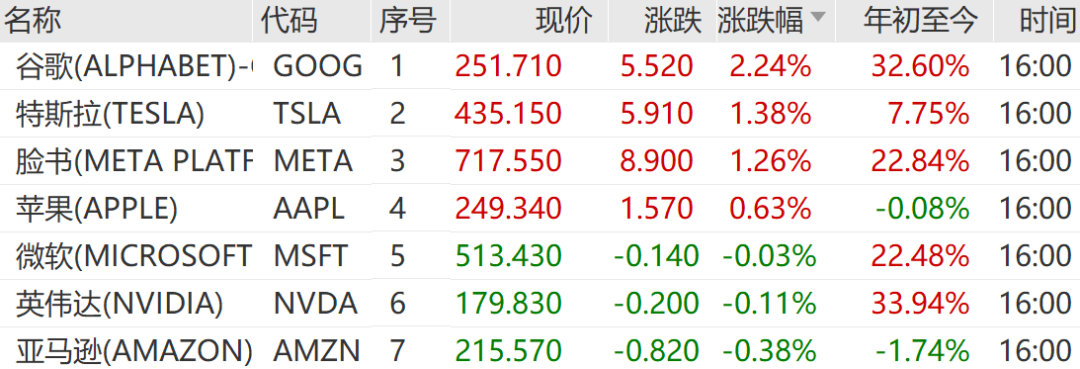
Market Overview - The three major U.S. stock indices closed mixed, with the Dow Jones Industrial Average down 0.04% at 46,253.31 points, the S&P 500 up 0.4% at 6,671.06 points, and the Nasdaq up 0.66% at 22,670.08 points [4][6][10] - The Nasdaq China Golden Dragon Index rose 1.70%, and the Wind China Concept Technology Leaders Index increased by 0.71% [14][15] Federal Reserve Insights - The Federal Reserve's Beige Book indicated that labor demand is generally weak, and prices are continuing to rise, suggesting a likelihood of further interest rate cuts [17][18] - The probability of a rate cut in October is as high as 97.3%, with a 2.7% chance of maintaining the current rate [26] - The report highlighted that economic activity has not changed significantly, with some districts reporting slight growth while others noted a decline [22][23] Government Shutdown Impact - The temporary funding bill failed to advance in the Senate, contributing to a government shutdown that affects Federal Reserve decision-making [27][28] - The shutdown has delayed the release of key economic data, including the Consumer Price Index (CPI) and employment statistics [29][30] Company Performance - Major technology stocks showed gains, with Google up 2.24%, Tesla up 1.38%, and Facebook up 1.26% [12][13] - Chinese companies like BYD, Alibaba, and NetEase saw increases of 2.30%, 1.87%, and 1.66% respectively, leading the gains in the China concept stocks [15][16]

美联储,重磅发布!中概股,大涨!
Zhong Guo Ji Jin Bao· 2025-10-15 23:57
Group 1: Federal Reserve Insights - The Federal Reserve's Beige Book indicates weak labor demand and further price increases, suggesting a likelihood of interest rate cuts [2][7][14] - Economic activity has shown little change overall, with mixed reports across different districts regarding growth and consumer spending [11][12] - Labor market conditions are characterized by layoffs and reduced hiring, with employers increasingly opting for temporary and part-time workers [12][13] Group 2: Market Performance - Major U.S. stock indices closed mixed, with the Dow Jones down 0.04%, while the S&P 500 and Nasdaq rose by 0.4% and 0.66%, respectively [3] - Chinese concept stocks outperformed the broader market, with the Nasdaq Golden Dragon China Index up 1.70% [5] - Notable gains in Chinese tech stocks included BYD up 2.30%, Alibaba up 1.87%, and NetEase up 1.66% [5][6] Group 3: Government Shutdown Impact - The U.S. government shutdown has delayed the release of key economic data, including the Consumer Price Index (CPI) and employment statistics [15][16] - The inability to pass a temporary funding bill has created uncertainty for the Federal Reserve's decision-making process [15][16]