
天弘基金

Search documents
ETF融资融券日报:两市ETF两融余额较前一交易日减少8.4亿元,华安易富黄金ETF融资净买入达4403.89万元
2 1 Shi Ji Jing Ji Bao Dao· 2025-05-26 03:06
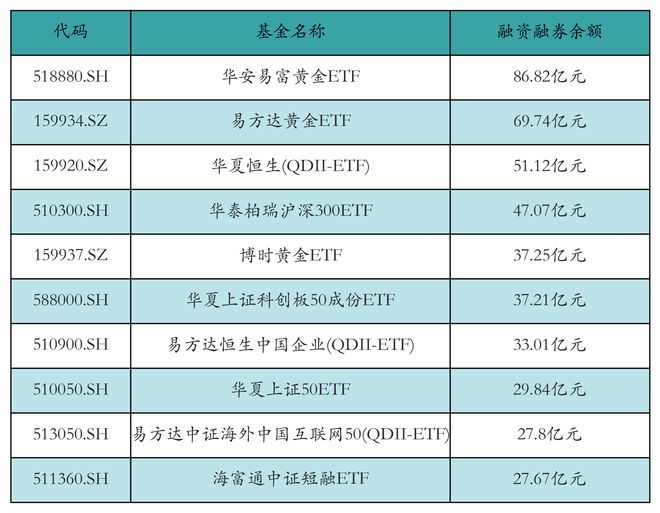
Market Overview - As of May 23, the total ETF margin balance in the two markets is 98.802 billion yuan, a decrease of 0.84 billion yuan from the previous trading day [1] - The financing balance is 93.599 billion yuan, down by 0.773 billion yuan, while the securities lending balance is 5.203 billion yuan, a decrease of 66.936 million yuan [1] - In the Shanghai market, the ETF margin balance is 65.107 billion yuan, down by 0.727 billion yuan, with a financing balance of 60.594 billion yuan, decreasing by 0.676 billion yuan [1] - In the Shenzhen market, the ETF margin balance is 33.695 billion yuan, a decrease of 0.112 billion yuan, with a financing balance of 33.005 billion yuan, down by 96.778 million yuan [1] ETF Margin Financing Balances - The top three ETF margin financing balances on May 23 are: 1. Huaan Yifu Gold ETF (8.682 billion yuan) 2. E Fund Gold ETF (6.974 billion yuan) 3. Huaxia Hang Seng (QDII-ETF) (5.112 billion yuan) [2] - The top ten ETFs by margin financing balance include notable funds such as Huatai-PB CSI 300 ETF and Bosera Gold ETF [2] ETF Financing Buy Amounts - The top three ETFs by financing buy amounts on May 23 are: 1. Huatai-PB Southern East England Hang Seng Technology Index (QDII-ETF) (880 million yuan) 2. Huaxia Hang Seng Technology (QDII-ETF) (542 million yuan) 3. Huaxia Shanghai Stock Exchange Sci-Tech Innovation Board 50 ETF (495 million yuan) [3][4] ETF Financing Net Buy Amounts - The top three ETFs by financing net buy amounts on May 23 are: 1. Huaan Yifu Gold ETF (44.0389 million yuan) 2. Southern CSI 1000 ETF (42.9707 million yuan) 3. Huaxia Nasdaq 100 (QDII-ETF) (29.4153 million yuan) [5][6] ETF Securities Lending Sell Amounts - The top three ETFs by securities lending sell amounts on May 23 are: 1. Huatai-PB CSI 300 ETF (17.8846 million yuan) 2. Southern CSI 500 ETF (14.9284 million yuan) 3. Southern CSI 1000 ETF (10.171 million yuan) [7][8]

ETF产品持续上新 行业分布多元化
Zhong Guo Zheng Quan Bao· 2025-05-25 21:09
Group 1 - The core viewpoint of the news highlights a significant increase in the establishment of ETFs, with 13 new ETFs launched from May 19 to May 25, totaling over 5 billion yuan in issuance [1][2] - The majority of newly launched ETFs are stock-type funds, primarily focusing on high-volatility markets such as Hong Kong stocks, STAR Market, and ChiNext, with a strong emphasis on the digital economy sector [1][3] - The number of ETFs scheduled for launch in May has nearly doubled compared to the same period last year, with a total of 29 ETFs set to debut [3][4] Group 2 - On May 21, a peak in ETF establishment occurred, with eight ETFs launched on the same day, including the Industrial Bank's Digital Economy ETF, which raised 9.82 billion yuan [2][3] - The newly launched ETFs cover a diverse range of industries, including digital economy, aerospace, and automotive sectors, indicating a broad market interest [3][4] - The newly listed ETFs have shown active trading, with the Industrial Bank's ETF recording a turnover rate exceeding 30% in the first three trading days [5]
首批创新浮动费率基金本周开抢 众多产品细节曝光
Zheng Quan Shi Bao· 2025-05-25 18:19
Core Viewpoint - The first batch of innovative floating rate funds has been approved and is set to launch on May 27, marking a significant shift in the fund management fee structure aimed at better aligning with investor interests [1][2]. Fund Structure and Fee Details - The innovative floating rate funds will operate on an open-ended basis, with management fees determined by the holding period and annualized return during that period [2]. - For holdings of less than one year, a management fee of 1.20% will be charged. For holdings of one year or more, fees will vary based on performance: 1.50% for annualized excess returns over 6%, 0.60% for returns at or below -3%, and 1.20% for other scenarios [2][3]. Emphasis on Investor Protection - The fee structure is designed asymmetrically, with a maximum increase of 25% in management fees during good performance and a potential decrease of 50% during poor performance, emphasizing investor protection over manager incentives [3]. - Companies like交银施罗德基金 and 易方达基金 highlight that this floating fee model encourages long-term holding and aligns the interests of fund managers with those of investors [3][4]. Fund Manager Selection - Leading fund companies have appointed experienced managers for these products, including both seasoned veterans and promising newcomers, to ensure strong performance [4][5]. - Notable managers include 王明旭 from 广发基金 and 孙彬 from 富国基金, among others, indicating a strategic focus on performance-driven leadership [4][5]. Fundraising Goals and Strategies - Fundraising targets vary, with some companies setting caps as high as 80 billion and others as low as 20 billion, but many aim for a more conservative target of around 10 billion [6]. - Companies are focusing on long-term growth rather than immediate fundraising success, with strategies like initiating funds with significant internal investments to align interests with investors [6][7]. Industry Response and Future Outlook - The launch of floating rate funds is seen as a proactive response to regulatory changes aimed at enhancing the quality of public funds, with expectations for more products to be introduced in the future [6][7]. - Fund companies are committed to improving their investment capabilities and enhancing investor returns, fostering a sustainable ecosystem that benefits both managers and investors [7].
“三年前存100万,利息能买一辆车,现在只够加三年油”…利率跌破“1”时代,储户转战新三金
第一财经· 2025-05-25 09:18
Core Viewpoint - The article highlights the significant decline in deposit interest rates in China, leading to a shift in consumer behavior towards alternative investment options, particularly among younger individuals seeking better returns on their savings [3][10]. Group 1: Interest Rate Decline - Major state-owned banks collectively lowered deposit rates, with one-year fixed deposit rates dropping below 1% for the first time, now at 0.95%, and savings account rates at 0.05% [5][6]. - Several national joint-stock commercial banks followed suit, with one-year fixed deposit rates now averaging around 1.15% and two-year rates at 1.2% [5][6]. - Smaller banks have also adjusted their rates, with many now offering one-year fixed deposit rates between 1.1% and 1.2% [5][6]. Group 2: Disappearance of High-Yield Products - The once-popular large-denomination certificates of deposit (CDs) have seen a decline in demand, with average rates for one-year CDs at 1.719% as of March 2025, down from over 3% last year [8][9]. - Many banks have removed two-year and longer-term CDs from their offerings, with current rates for shorter-term CDs not exceeding 1.4% [8][9]. - The attractiveness of large-denomination CDs has diminished compared to other investment products, such as money market funds, which currently offer competitive yields [9]. Group 3: Shift to Alternative Investments - In response to declining deposit rates, younger consumers are increasingly turning to alternative investment strategies, coining the term "new three golds," which includes money market funds, bond funds, and gold funds [10][12]. - Investors are prioritizing low-risk, inflation-beating, and higher-yielding products, with many reallocating significant portions of their savings into bond funds and gold ETFs [12][14]. - Data shows a growing trend of younger investors diversifying their portfolios, with millions now investing in a combination of money market funds, bond funds, and gold funds [15].
存款利率跌破“1”时代,储户转战“新三金”配置
Di Yi Cai Jing· 2025-05-25 08:44
Core Insights - The trend of deposit replacement is emerging as interest rates decline significantly, leading to a shift in investment strategies among savers [1][6][9] Group 1: Interest Rate Changes - Major state-owned banks collectively lowered deposit rates, with one-year fixed deposit rates dropping below 1% for the first time, now at 0.95%, and savings account rates at 0.05% [2][3] - Several national joint-stock commercial banks followed suit, with one-year fixed deposit rates now averaging around 1.15% and two-year rates at 1.2% [2][3] - Smaller banks have also adjusted their rates, with many now offering one-year fixed deposit rates between 1.1% and 1.2% [2][3] Group 2: Decline of High-Interest Products - The once-popular large-denomination certificates of deposit (CDs) have seen a decline in demand, with rates dropping significantly; for example, the average one-year rate was 1.719% in March 2025 [4][5] - Many banks have removed two-year and longer-term CDs from sale, with current rates for shorter terms not exceeding 1.4% [4][5] - The attractiveness of large-denomination CDs has diminished compared to other investment products, leading to a decrease in discussions and interest among savers [5] Group 3: Shift to New Investment Strategies - With declining deposit rates and the fading popularity of large-denomination CDs, savers are increasingly seeking alternative investment options [6][9] - Young investors are gravitating towards a new investment strategy termed "new three golds," which includes money market funds, bond funds, and gold funds, as they seek to achieve higher returns and mitigate risks [8][9] - Data shows a significant number of younger investors are diversifying their portfolios, with many allocating a substantial portion of their income to bond funds, indicating a shift in financial behavior [9][10] Group 4: Impact on Banking Sector - The trend of deposit migration is becoming evident, with a reported decrease of 1.39 trillion yuan in household deposits in April, while non-bank deposits increased significantly [10] - Analysts suggest that this shift could impact the stability of bank liabilities and increase liquidity risk, as the absolute interest levels for one-year fixed deposits are now lower than cash management product yields [10]
下周二开售!16只浮动费率基金披露招募书,新机制下管理费这么收
Sou Hu Cai Jing· 2025-05-25 06:01
Core Viewpoint - The approval of 26 floating fee rate funds marks a significant innovation in the public fund industry, breaking away from traditional fixed management fee structures and introducing a performance-based fee mechanism [2][15]. Group 1: Floating Fee Rate Structure - The floating fee rate structure includes three tiers: 1.2% (base), 1.5% (upward adjustment), and 0.6% (downward adjustment), with performance benchmarks set at annual returns exceeding 6% or falling below -3% [16][18]. - For holdings of less than one year, the management fee is charged at 1.2% per annum [16][18]. - After one year, the management fee is determined based on the annualized excess return compared to the performance benchmark [18][22]. Group 2: Fund Characteristics and Offerings - Sixteen funds are set to launch on May 27, with varying end dates for fundraising, the longest being August 26 for the FuGuo Balanced Allocation Fund [9][22]. - Most of the funds are equity-oriented mixed funds, with stock allocations ranging from 60% to 95% of the net asset value [9][22]. - The performance benchmarks for these funds include indices such as the CSI 800 Growth Index and the CSI 500 Index, reflecting a focus on growth-oriented investments [22][24]. Group 3: Management and Operational Requirements - The floating fee rate funds require enhanced operational management capabilities and robust data processing systems to track each fund share's holding period and performance accurately [25][26]. - Fund companies are preparing by establishing comprehensive management guidelines and risk control measures to ensure efficient operation during the product issuance and management phases [25][26]. - The new fee structure aims to align the interests of fund managers and investors, promoting a shared responsibility for investment returns [23][26].

大曝光!原来这样“浮”?
Zhong Guo Ji Jin Bao· 2025-05-24 09:58
Core Viewpoint - The article discusses the introduction of floating management fee rate funds in China, highlighting the new fee structure and the competitive lineup of fund managers involved in this innovative product launch [1][10]. Summary by Sections Floating Management Fee Structure - The new floating management fee structure is based on three main factors: the holding period of the investor, the fund's performance relative to a benchmark, and whether the fund has generated profits [1]. - For short-term holdings (less than one year), the management fee remains at a fixed rate of 1.2% [2]. - For long-term holdings (over one year), there are three scenarios for fee calculation: 1. If the fund outperforms the benchmark (CSI 300 Index) by more than 6%, the management fee can increase to 1.5% [3]. 2. If the fund underperforms the benchmark by 3% or more, the management fee is reduced to a maximum of 0.6% [3]. 3. If the fund performs moderately, the fee remains at 1.2% [4]. - The fee structure aims to simplify understanding for investors and sales channels, with consistent rules across the first batch of floating fee funds [5]. Fund Manager Lineup - The initial batch of floating management fee funds features a strong lineup of fund managers, including experienced veterans and promising newcomers [6][7]. - Notable fund managers include senior executives from various fund companies, such as Wang Mingxu from GF Fund and Luan Chao from Huaan Fund, who are leading the management of these funds [7][8]. - The article highlights the presence of "champion" fund managers, such as Wang Xiaochuan from Yinhua Fund, who has recently gained recognition in the market [8]. Launch Timeline - The first batch of 26 floating management fee funds was approved by the China Securities Regulatory Commission (CSRC) in a remarkably short time frame of six working days [10]. - The initial offering of 16 funds is set to launch on May 27, with varying fundraising periods ranging from June 17 to August 26 [10].
传奇基金经理出手了!
Ge Long Hui· 2025-05-24 07:12
Group 1 - The core viewpoint of the article highlights the impact of Trump's threats to impose tariffs on the EU and Apple, which has led to a significant decline in the U.S. stock market, particularly affecting major tech stocks like Apple [1][2] - The S&P 500 index has experienced a four-day decline, with Apple leading the drop among the tech giants, marking an eight-day losing streak [1] - Bill Ackman, a prominent hedge fund manager, has taken advantage of the market dip by buying Amazon shares after a significant price drop due to tariff concerns, indicating a potential undervaluation of the company [1][2] Group 2 - Ackman's investment strategy is supported by two main reasons: the resilience of Amazon Web Services (AWS) as the core profit driver and the limited impact of tariffs on Amazon's retail business, as less than 15% of its self-operated products are imported [2] - Ackman is recognized for his legendary investment acumen, having predicted the subprime mortgage crisis in 2007 and profiting significantly during the COVID-19 pandemic [2] - The article notes Ackman's strategic timing in selling Nike shares before the tariff announcement, raising questions about his investment decisions and market timing [2][4] Group 3 - Yang Dong, another notable fund manager, has made significant adjustments to his investment portfolio in April, reducing exposure to convertible bonds while increasing investments in sectors like real estate, power, and chemicals [5] - Yang's focus on domestic demand growth and the stabilization of the real estate market is seen as a key strategy for future investments [5] - He emphasizes that stocks remain a favorable investment choice compared to fixed-income assets, citing the potential for structural opportunities in consumption, healthcare, and new infrastructure [5] Group 4 - The first batch of new floating-rate funds has been rapidly approved, reflecting regulatory attention to enhancing the public fund industry [6][10] - These funds will feature a performance-based fee structure, linking management fees to investment performance, which is expected to improve active management capabilities and align interests between fund managers and investors [10][14] - The floating-rate funds are designed to encourage long-term investment by requiring a minimum holding period of one year to benefit from fee adjustments, thereby reducing short-term speculation [14]

挑固收+基金的核心到底是什么?
雪球· 2025-05-24 05:01
Core Viewpoint - The article discusses the growth of fixed income plus (固收+) products, particularly from Tianhong Fund, and emphasizes the importance of controlling drawdowns in investment strategies during market fluctuations [2][3][6]. Group 1: Growth of Fixed Income Plus Products - The equity market's strength often correlates with the significant development of fixed income plus products, as evidenced by Tianhong's nearly doubled product offerings in 2022 compared to 2021, which was a peak in the previous bull market [3]. - Tianhong's fixed income plus funds have shown varying annual returns over the past decade, with a notable average return of 14.88% in 2015 and a decline to -3.59% in 2022, highlighting the volatility in performance [4][8]. Group 2: Importance of Drawdown Control - The ability to control drawdowns in fixed income plus products becomes increasingly critical during market transitions, as demonstrated by Tianhong's only negative annual return occurring in 2022, when the average return for the entire market was -3.15% [6]. - The article stresses that for investors, the primary goal is capital preservation and achieving better returns than traditional savings, making drawdown control a priority over potential returns [6][11]. Group 3: Assessment and Evaluation Framework - The assessment of fixed income plus products should focus on the overall performance rather than solely on the investment methodology or the fund manager's capabilities [9][10]. - Tianhong's evaluation framework includes key indicators such as risk-adjusted returns (e.g., Sharpe Ratio), maximum drawdown control, and the time taken to recover from drawdowns, which are essential for maintaining a robust investment strategy [12][13][14].

多只电力主题基金月内净值增长率超3% 绿色电力投资价值受关注
Zheng Quan Ri Bao· 2025-05-23 16:13
Group 1 - The A-share market has shown a fluctuating upward trend recently, with accelerated sector rotation, making it a focal point for investors to identify investment opportunities [1] - The electricity sector has performed well since May, with several electricity-themed ETFs experiencing a net asset value growth rate exceeding 3% within the month [2] - Analysts believe that the advancement of electricity market reform and other factors support the investment value of the electricity sector, particularly in green electricity [1][3] Group 2 - In May, the electricity sector rebounded significantly after a lackluster first quarter, with indices such as the National Green Electricity Index and the China Securities All Share Electric Utility Index rising by 2.57% and 2.04% respectively [2] - The demand for electricity is supported by the development of new high-energy-consuming industries and the promotion of electricity substitution, while supply remains tight due to limited new power generation capacity expected by Q1 2025 [2] - May is considered a favorable time for allocating investments in the electricity sector, with historical data showing an average return of 4.18% for the China Securities All Share Electric Utility Index in May over the past five years [2] Group 3 - The ongoing electricity market reform is expected to enhance the long-term investment value of the green electricity sector, which includes renewable energy sources such as hydropower, nuclear, wind, and solar power [3] - The transition towards clean energy generation is anticipated to create significant market opportunities, with the overall electricity consumption expanding and the share of wind and solar power increasing [3] - The shift in business models towards renewable energy generation and the deepening of domestic electricity market reforms are likely to enhance the long-term investment and allocation value of the green electricity sector [3]