浪潮信息

Search documents
AI主题基金大调仓!基金经理如何看待估值“泡沫”?
天天基金网· 2026-01-20 01:01
Core Viewpoint - The article discusses the performance and strategic adjustments of several funds heavily invested in the artificial intelligence (AI) sector as they release their Q4 2025 reports, highlighting both consensus and divergence among fund managers regarding future investment opportunities and risks in this sector [2][3][4]. Consensus and Divergence - Fund managers show a mix of agreement and disagreement on the future of AI investments, with some maintaining significant positions in high-performing stocks while slightly reducing their holdings [3][4]. - For instance, the China Europe Digital Economy Fund achieved a 143.07% increase in 2025, with notable increases in holdings of stocks like Shengyi Technology and Inspur Information during Q4 [4]. - Conversely, leading stocks in optical modules, such as Zhongji Xuchuang and Xinyisheng, faced reductions in holdings, indicating a shift in focus among fund managers [4]. Investment Focus Areas - By the end of Q4 2025, funds are increasingly concentrating on sectors like optical communication and liquid cooling, with companies like Yingweike and Fojing Technology leading in these areas [5]. - The AI sector is projected to create significant investment opportunities in hardware devices closely linked to computing power, with expectations for increased capital expenditure on optical and storage technologies [6]. Emerging Investment Opportunities - The rapid growth of AI is expected to drive demand for electricity, with fund managers noting a potential energy crisis due to the pace of AI data center construction outstripping traditional grid expansion [7]. - There is optimism about the potential for North American power infrastructure companies to benefit from increased investments in power facilities to support large-scale computing clusters [7]. Bubble Discussion - The article addresses the ongoing debate about the valuation of AI stocks, with some fund managers arguing that while the tech growth sector has seen a recovery in valuations, many leading companies do not exhibit bubble-like characteristics [8]. - Concerns about high valuations leading to increased volatility are noted, with fund managers emphasizing the need to monitor technological advancements and business model validations closely [9][10].


AI主题基金调仓曝光 基金经理如何看待估值“泡沫”?
Zheng Quan Shi Bao· 2026-01-19 23:47
Core Insights - The performance of several funds heavily invested in the AI sector has been notable, with some achieving significant gains in 2025, but there are differing opinions among fund managers regarding future prospects [1][2]. Group 1: Fund Performance and Adjustments - The fund "China Europe Digital Economy" achieved a 143.07% increase in 2025, ranking high among active equity funds, with notable increases in holdings of companies like Shengyi Technology and Inspur Information in Q4 [2]. - The "Qianhai Kaiyuan Hong Kong-Shenzhen Enjoy Life" fund also saw significant growth, adjusting its top holdings to focus more on optical communication and liquid cooling sectors [3]. Group 2: Investment Opportunities and Risks - Fund managers are optimistic about hardware investment opportunities linked to computing power, with expectations that the share of "light" and "storage" in capital expenditures will increase by 2026 [4]. - There is a potential energy crisis due to the rapid construction of AI data centers outpacing traditional grid expansion, leading to investment opportunities in power infrastructure companies [5]. Group 3: Perspectives on Valuation and Market Sentiment - There is a debate among fund managers regarding the valuation of AI stocks, with some arguing that while valuations have recovered, they do not necessarily indicate a bubble [6]. - The concept of "bubble" is viewed as neutral, with the focus on whether technological advancements can sustain new applications and whether commercialization can convert capital into real income [7].
公募2025年四季报揭示调仓两大主线
Zheng Quan Ri Bao Zhi Sheng· 2026-01-19 16:13
Core Insights - The recent public fund reports for Q4 2025 indicate a trend of high positions and focused investments in high-growth sectors, particularly in AI and robotics, suggesting intensified competition among public funds in 2026 [1][2] Group 1: Fund Performance and Positioning - Many top-performing equity funds maintain high stock positions, with examples like Changcheng Jiuxiang Mixed A at 94.24%, Huafu New Energy Stock A at 93.31%, and Nuoan Selected Return Mixed at 92.07%, all achieving over 50% net value growth in 2025 [2] - The average stock position for 16 equity funds reached 94.35%, while 67 mixed funds averaged 86.40% [2] Group 2: Strategic Adjustments and Focus Areas - Fund managers are optimistic about structural opportunities in the market, with a clear shift towards reducing holdings in purely theme-based stocks and increasing investments in leading companies with established competitive advantages in AI hardware and applications [3] - For instance, the fund Zhongou Digital Economy Mixed A has added companies like Shenzhen South Circuit and Sunshine Power to its top holdings, reflecting this strategic shift [3] Group 3: Sector-Specific Insights - The focus on AI computing power is highlighted, with fund managers emphasizing its foundational role in AI development and its growing demand due to increasing model capabilities and user engagement [4] - Some funds are also proactively investing in sectors expected to experience a recovery, such as agriculture, with Zhongou Agricultural Industry Mixed A increasing its stock position from 88.84% to 93.44% [4] Group 4: Future Outlook - The fund Changcheng Emerging Industries Mixed A plans to continue focusing on investment opportunities driven by AI, particularly in humanoid robotics, which is seen as a promising long-term investment area [5]
计算机行业周报:阿里千问新升级,AI应用加速赋能产业
CHINA DRAGON SECURITIES· 2026-01-19 12:24
Investment Rating - The report maintains a "Recommended" investment rating for the computer industry [2][6]. Core Insights - The AI medical sector is experiencing rapid development, with significant commercial opportunities emerging. Major players like NVIDIA and Eli Lilly are investing heavily in AI drug development, while domestic companies like Ant Group are promoting AI health management products [5][13][14]. - Alibaba's Qianwen app has transitioned into the "AI service era," integrating over 400 AI service functions and achieving over 100 million monthly active users, indicating strong user engagement and ecosystem integration [15][17]. - The report highlights the importance of AI infrastructure development in China, emphasizing the need for a self-sufficient and efficient computing foundation to support the growing demand for AI applications [16]. Summary by Sections AI Empowerment in Healthcare - The report notes that AI is reaching a commercialization inflection point in healthcare, with significant investments and partnerships forming to accelerate AI drug development and health management solutions [5][13][14]. - Key areas of growth include AI drug development, AI-assisted medical imaging, and personal health management, which are expected to see increased investment and demand [14]. Development of AI Ecosystem - Domestic tech giants are leveraging their vast user bases and data resources to build comprehensive AI ecosystems, enhancing user experience and operational efficiency [15][16]. - The integration of AI services within existing platforms is seen as a critical factor for rapid deployment and market penetration [15]. Investment Recommendations - The report suggests focusing on AI computing companies such as Cambricon (688256.SH), Haiguang Information (688041.SH), Inspur Information (000977.SZ), and Zhongke Shuguang (603019.SH) [6][17]. - It also recommends monitoring vertical AI application companies like Kingsoft Office (688111.SH), Dingjie Zhizhi (300378.SZ), and Han's Information (300170.SZ) for potential investment opportunities [6][17].
计算机行业周报:阿里千问新升级,AI应用加速赋能产业-20260119
CHINA DRAGON SECURITIES· 2026-01-19 10:35
Investment Rating - The report maintains a "Recommended" investment rating for the computer industry [2][6]. Core Insights - The AI medical sector is experiencing rapid development, with significant commercial opportunities emerging. Major players like NVIDIA and Eli Lilly are investing heavily in AI drug development, while domestic companies like Ant Group are promoting AI health management products [5][13][14]. - Alibaba's Qianwen app has transitioned into the "AI service era," integrating over 400 AI service functions and achieving over 100 million monthly active users, showcasing the potential for AI applications in enhancing user experience and operational efficiency [15][17]. - The report emphasizes the importance of building a self-sufficient and efficient computing infrastructure in response to increasing global competition and the exponential growth of AI application demands [16]. Summary by Sections AI Empowerment in Healthcare - The AI healthcare sector is at a commercial inflection point, with significant investments from both domestic and international companies. Key areas of growth include AI drug development, medical imaging analysis, and personal health management, which are expected to see increased investment value as clinical validation and regulatory frameworks improve [5][14]. Development of AI Ecosystem - Domestic tech giants are rapidly advancing their AI ecosystems, leveraging their large user bases and data resources. This integration is expected to enhance service delivery and operational efficiency across various sectors [15][16]. Market Performance - The computer sector index rose by 3.82% from January 12 to January 16, 2026, indicating positive market sentiment [8]. Key Companies and Investment Recommendations - The report highlights several companies for investment consideration, including: - AI Computing: Cambrian (688256.SH), Haiguang Information (688041.SH), Inspur Information (000977.SZ), and Zhongke Shuguang (603019.SH) [6][17]. - Vertical AI Applications: Kingsoft Office (688111.SH), Dingjie Zhizhi (300378.SZ), Hand Information (300170.SZ), and others [6][17].


计算机行业今日跌1.55% 主力资金净流出107.50亿元
Zheng Quan Shi Bao Wang· 2026-01-19 09:34
Market Overview - The Shanghai Composite Index rose by 0.29% on January 19, with 23 out of the 28 sectors experiencing gains, led by the basic chemical and petroleum sectors, which increased by 2.70% and 2.08% respectively [1] - The computer and communication sectors faced the largest declines, with decreases of 1.55% and 0.96% respectively, with the computer sector being the worst performer of the day [1] Capital Flow Analysis - The main capital flow showed a net outflow of 35.714 billion yuan across the two markets, with 13 sectors seeing net inflows [1] - The power equipment sector had the highest net inflow, totaling 7.597 billion yuan, followed by the basic chemical sector with a net inflow of 1.331 billion yuan [1] Computer Sector Performance - The computer sector experienced a decline of 1.55%, with a total net outflow of 10.750 billion yuan [2] - Out of 336 stocks in the computer sector, 96 stocks rose while 231 stocks fell, including one stock that hit the daily limit down [2] - Notably, the top three stocks with the highest net inflow were Unisplendour (5.23 billion yuan), Zhongke Shuguang (2.78 billion yuan), and Langxin Technology (1.17 billion yuan) [2] Top Gainers in Computer Sector - The top gainers in the computer sector included: - Unisplendour: +2.77% with a turnover rate of 5.33% and a net inflow of 522.89 million yuan - Zhongke Shuguang: +0.81% with a turnover rate of 3.60% and a net inflow of 278.39 million yuan - Langxin Technology: +7.36% with a turnover rate of 7.91% and a net inflow of 117.38 million yuan [2] Top Losers in Computer Sector - The top losers in the computer sector included: - Yanshan Technology: -9.93% with a turnover rate of 29.87% and a net outflow of 1.002 billion yuan - Keda Xunfei: -4.16% with a turnover rate of 6.81% and a net outflow of 715.66 million yuan - Inspur Information: -3.36% with a turnover rate of 4.64% and a net outflow of 584.89 million yuan [3]


中欧数字经济A四季度加码AI硬件,冯炉丹谈AI泡沫论:并非泡沫末期,“让子弹再飞一会儿”
Xin Lang Cai Jing· 2026-01-19 09:13
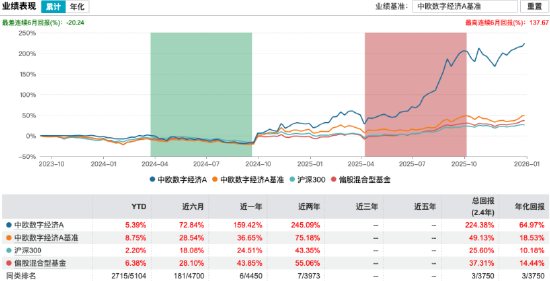
专题:2025基金四季报前瞻:AI应用、商业航天、核聚变,谁领2026投资主线? 公募基金2025年四季报披露工作已启动,市场迎来新一轮的持仓观察窗口。在目前已披露季报的70余只 主动权益类基金中,中欧数字经济混合成为少数率先亮相的百亿基金,该产品由冯炉丹担任基金经理。 从业绩表现看,该基金2025年第四季度回报率为0.92%,年内回报为5.39%,而2025年全年回报达到 143.07%。截至2026年1月16日,基金单位净值为3.2438元,近一年回报率为159.42%,近六个月回报率 为72.84%。从阶段表现来看,该基金在近一年、近六个月等中长期维度上表现较为突出,但在今年以 来及去年四季度表现相对平缓。 数据来源:Wind 截止 至20260116 在四季报中,冯炉丹重点回应了市场对人工智能产业"泡沫化"的担忧。她认为,"泡沫"是一个中性概 念,是几乎所有颠覆性技术在高速发展阶段不可避免的现象。关键问题并不在于是否存在泡沫,而在于 技术进步的速度是否足以持续打开新的应用边界,以及商业化进展是否能够逐步吸纳新增资本并转化为 真实收入与利润。 从四季度投资操作与持仓调整来看,该基金持续聚焦五大核心投资方 ...
智能工厂发展报告
中国信通院· 2026-01-19 08:26
Investment Rating - The report does not explicitly provide an investment rating for the industry Core Insights - The report highlights the significant progress in the development of smart factories in China, with over 15 leading smart factories, more than 500 excellent smart factories, and over 35,000 basic smart factories established, indicating a robust growth trend in the sector [9][10] - The evolution of smart factories is characterized by five core directions: expansion of factory construction, innovation in R&D design paradigms, upgrading of production capabilities, optimization of production management, and advancement in operational management [10][41] - The report emphasizes the need for the manufacturing industry to transition from quantity-driven growth to quality-driven improvements, addressing the challenges posed by global economic slowdowns and changing market demands [17][18] Summary by Sections Overall Trends - The report identifies four main drivers for the transformation of smart factories: industrial upgrades, changing market demands, technological advancements, and international cooperation [17][19] - It outlines a future vision for smart factories that includes the integration of AI across all manufacturing processes, leading to autonomous decision-making and enhanced collaboration within the manufacturing ecosystem [20][41] Industry Practices - The report describes a four-tiered system for cultivating smart factories, which includes basic, advanced, excellent, and leading levels, aimed at promoting digital transformation in manufacturing [41][42] - It notes that over 90% of manufacturing sectors are now covered by smart factory initiatives, with a focus on enhancing traditional industries and empowering consumer-driven sectors [50][49] Regional Development - The report discusses the regional disparities in smart factory development, with eastern regions leading and central regions making breakthroughs, highlighting the importance of localized strategies [12][49] Technology and Industry - The report emphasizes the need for a deep integration of technology and manufacturing systems, advocating for a shift towards a more resilient and intelligent industrial foundation [12][53] Future Outlook - The report envisions a next-generation smart manufacturing landscape characterized by autonomous manufacturing, ecological collaboration, and a focus on sustainability [12][41]
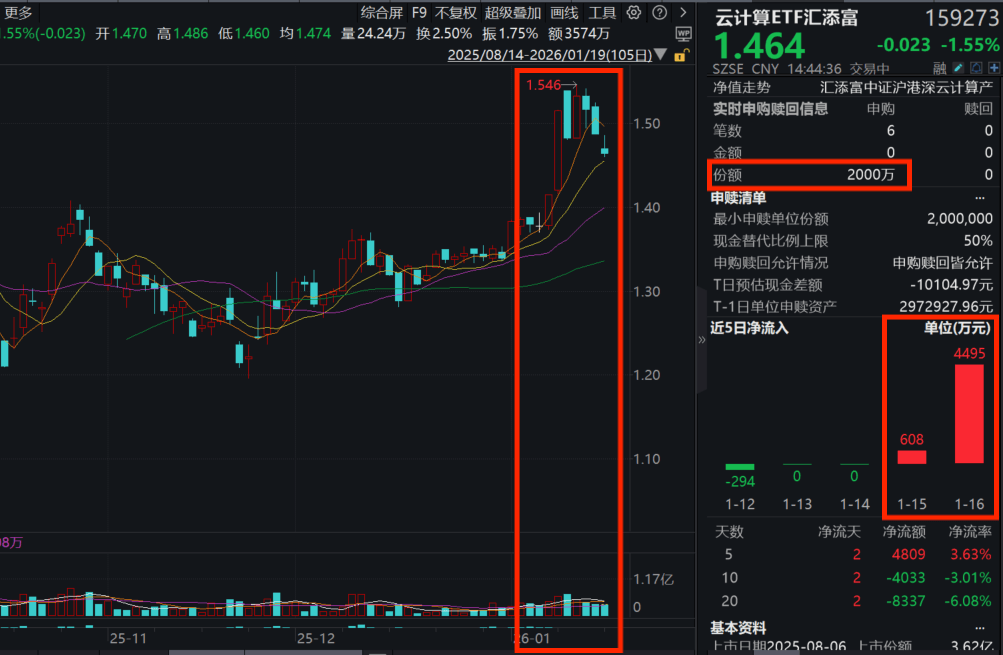
千问接入阿里生态业务,台积电超预期!云计算ETF汇添富(159273)跌超1.5%连续第三天回调,资金逢跌踊跃布局,2日净流入超7400万元!
Sou Hu Cai Jing· 2026-01-19 06:56
Core Viewpoint - The AI computing sector is experiencing a third consecutive day of adjustment, with significant capital inflow into the cloud computing ETF Huatai-PineBridge (159273), indicating ongoing investor interest despite recent declines in key stocks [1][3]. Group 1: Market Performance - The cloud computing ETF Huatai-PineBridge (159273) fell over 1.5%, with a trading volume exceeding 360 million yuan, and net inflow of nearly 30 million yuan during the day [1]. - Major stocks within the ETF, including Alibaba, Inspur Information, and Tencent, saw declines of over 3%, while NewEase and Zhongke Shuguang experienced slight increases [3][4]. Group 2: Company Developments - Alibaba's Qianwen App has fully integrated with its ecosystem, enabling AI shopping functionalities for various services, marking a significant advancement in AI applications [3][5]. - TSMC reported earnings that exceeded market expectations, achieving double-digit growth for the seventh consecutive quarter, which is seen as a positive indicator for the computing power industry [5]. Group 3: Industry Trends - The demand for AI computing power is shifting from a training-driven model to a dual-driven model of training and inference, unlocking significant potential for growth [9]. - The competition among major tech companies for AI applications and models is intensifying, with expectations of increased capital investment in AI capabilities by 2026 [12][14]. - The domestic intelligent computing capacity is projected to maintain a compound annual growth rate of 57% from 2020 to 2028, driven by advancements in domestic GPU technology and increased adaptation by cloud service providers [14][15].
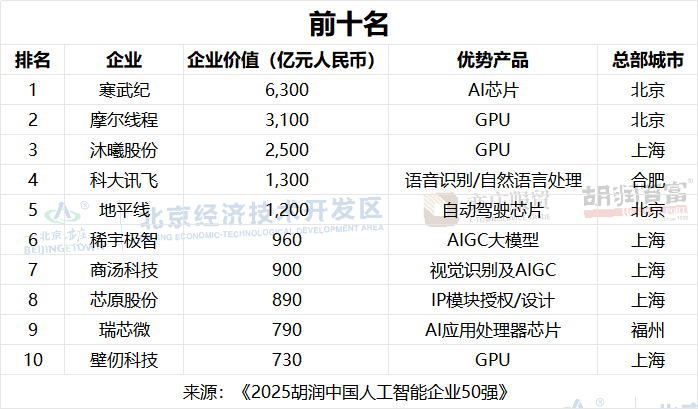
《2025胡润中国人工智能企业50强》重磅发布 寒武纪以6300亿价值位居榜首
Zhi Tong Cai Jing· 2026-01-19 04:51
Core Insights - The 2025 Hurun China AI Companies Top 50 list highlights the growth and valuation of AI-focused companies in China, with a significant increase in the number of AI chip companies due to tightening U.S. export controls on high-end AI chips [1][2] Company Rankings - Cambricon leads the list with a valuation of 630 billion RMB, marking a 165% increase from the previous year [1][2] - Moore Threads ranks second with a valuation of 310 billion RMB, achieving a 182% year-on-year revenue growth [3] - Muxi ranks third with a valuation of 250 billion RMB, recognized as one of the first high-end GPU companies to achieve full domestic production [3] - iFlytek, a leader in intelligent voice technology, ranks fourth with a valuation of 130 billion RMB [4] - Horizon Robotics ranks fifth with a valuation of 120 billion RMB, focusing on automotive AI chips [4] Market Trends - The list shows a total of 21 non-listed companies, with the entry threshold raised to 9.5 billion RMB, an increase of 3.5 billion RMB from last year [1] - The average valuation of listed companies is 54 billion RMB, which is 2.4 times higher than the previous year [1] - The number of AI chip companies on the list has increased to 14, up from 5 last year, indicating a shift towards domestic AI chip production [1] Geographic Distribution - Beijing leads with 19 companies on the list, followed by Shanghai with 14, and Shenzhen with 6, indicating a concentration of AI talent and resources in first-tier cities [1] Sector Breakdown - The majority of companies on the list are focused on AI chip hardware, with 14 companies in this category, reflecting the growing importance of AI infrastructure [5] - Other sectors include data analysis and decision-making with 11 companies, and content generation with 8 companies [5]