
海富通基金

Search documents
ETF周评|近五百亿资金趁大跌抄底,哪些ETF成了香饽饽
Sou Hu Cai Jing· 2025-11-24 10:44
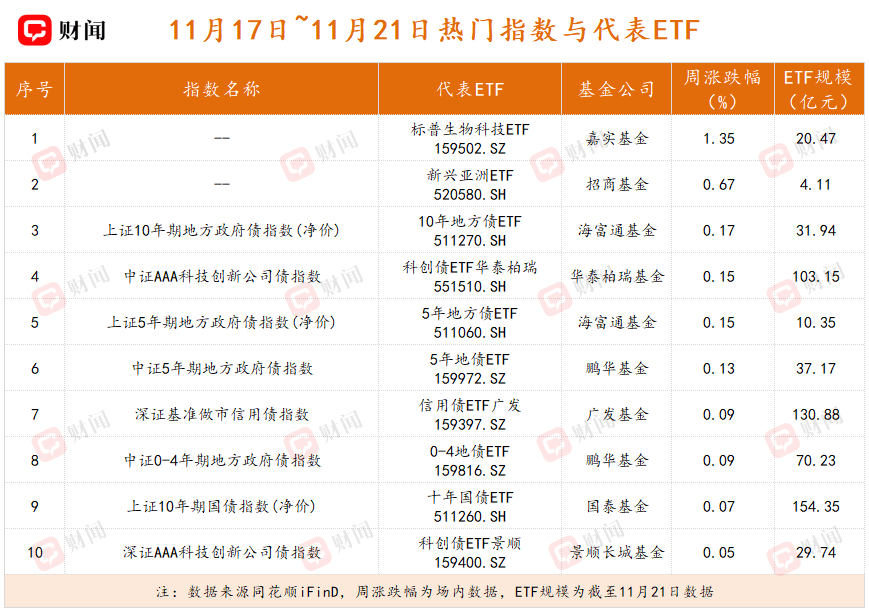
Market Overview - The A-share market experienced significant adjustments from November 17 to November 21, with the Shanghai Composite Index falling below 4000 points and a cumulative decline of 3.9% [1] - The Shenzhen market showed even weaker performance, with the Shenzhen Component Index down 5.13% and the ChiNext Index down 6.15% [2] - The Hong Kong market also faced pressure, with the Hang Seng Index dropping over 5% during the same period [2] ETF Performance - All stock-type ETFs in the market saw declines, particularly those related to new energy sectors like photovoltaic and lithium batteries, with 23 ETFs dropping over 10% [3] - The leading ETFs in decline were the Sci-Tech Innovation New Energy ETF (588960.SH) and the Sci-Tech New Energy ETF (588830.SH), with weekly declines of 13.44% and 13.17%, respectively [3] - Only 52 ETFs managed to rise, with the S&P Biotechnology ETF (159502.SZ) being the sole ETF to increase by more than 1%, up 1.35% [4] Fund Flows - The overall market saw a net inflow of 981.24 billion yuan into ETFs, with stock-type ETFs attracting the most significant inflow of 494.70 billion yuan [6] - On November 21, despite the market downturn, stock-type ETFs received a substantial net inflow of 357.95 billion yuan, with total trading volume reaching 1558.48 billion yuan, a 40.89% increase from the previous week [6] - Major contributors to the inflow included the CSI 300 ETF (510300.SH) and the CSI 500 ETF (510500.SH), each with net inflows exceeding 30 billion yuan [6] Sector-Specific Trends - Industry and thematic ETFs experienced notable outflows, with the Bank ETF (512800.SH) seeing a net outflow of 13.56 billion yuan, the only ETF with outflows exceeding 10 billion yuan [7] - Other cyclical ETFs, such as the Chemical ETF (159870.SH) and Coal ETF (515220.SH), also faced significant outflows of 9.64 billion yuan and 9.26 billion yuan, respectively [7] ETF Size Changes - Despite the inflow into broad-based index ETFs, the market volatility led to a reduction in the sizes of major ETFs, with the CSI 300 ETF and the CSI 500 ETF both shrinking by over 100 billion yuan [11] - As of November 21, the sizes of the two ETFs were reported at 2901.18 billion yuan and 4117.08 billion yuan, respectively [11] Top Performing ETFs - The top 10 ETFs by net inflow included the CSI 500 ETF (510500.SH) with an inflow of 57.78 billion yuan, followed by the Hua Bao Tian Yi ETF (511990.SH) with 51.79 billion yuan [9] - Other notable ETFs in the top inflow list included the ChiNext ETF (159915.SZ) and the CSI 300 ETF (510300.SH), with inflows of 46.78 billion yuan and 44.62 billion yuan, respectively [9] Bottom Performing ETFs - The Bank ETF (512800.SH) led the outflows with a decrease of 13.56 billion yuan, followed by the Chemical ETF (159870.SH) and Coal ETF (515220.SH) with outflows of 9.64 billion yuan and 9.26 billion yuan [10] - Other ETFs experiencing significant outflows included the 5G Communication ETF (515050.SH) and Financial Technology ETF (159851.SZ) [10]

银行开启冲刺2026年“开门红”,权益类和“固收+”或唱主角
Zhong Guo Ji Jin Bao· 2025-11-23 10:14
Core Viewpoint - Banks are gearing up for the "opening red" campaign for 2026, focusing on equity and "fixed income +" products as key offerings due to a low-risk appetite among clients [1][2][3] Group 1: Market Preparation - Major banks have begun preparations for the "opening red" campaign, with some starting as early as November [2] - The issuance of new funds has surpassed 1 trillion units this year, with equity funds seeing a 93.80% increase compared to the same period last year, totaling 527.285 billion units [2] - The "opening red" period is crucial for banks, as performance during this time significantly impacts annual business outcomes [2][3] Group 2: Product Focus - The focus for the 2026 "opening red" campaign is on "fixed income +", index tools, quantitative strategies, and balanced equity funds [4] - Banks are increasingly favoring products with stable returns, such as low-volatility "fixed income +" and high-dividend equity strategies [4][5] - There is a noticeable shift in client demand towards products that offer higher returns, moving away from traditional low-yield bond funds [5][6] Group 3: Risk Appetite and Strategy - There has been a significant increase in clients' risk appetite, with banks now offering a wider range of products, including higher-risk "fixed income +" options [6][7] - Different banks are adopting varied strategies for the "opening red" campaign, with larger banks focusing on high-performance fund managers and products, while smaller banks prefer stable income products [7][9] - The overall sentiment towards the "opening red" sales performance is cautiously optimistic, despite some concerns about geopolitical risks affecting client confidence [8][9] Group 4: Challenges and Innovations - The main challenges in bank-fund collaborations include shifting investor trust from brand reliance to sensitivity towards returns, and competition from younger investors favoring e-commerce platforms [9] - Fund companies are adapting by offering a diverse range of products to meet varying client risk preferences during the "opening red" period [8][9]
银行开启冲刺2026年“开门红”,权益类和“固收+”或唱主角
中国基金报· 2025-11-23 10:07
Core Viewpoint - The banking sector is gearing up for the "opening red" campaign for 2026, with a focus on equity and "fixed income+" products as key offerings [2][5][8]. Group 1: Preparation for "Opening Red" - Major banks have begun preparations for the "opening red" campaign, with some starting as early as November [5][6]. - The intensity of the "opening red" efforts varies among banks, with some maintaining traditional approaches while others are shifting focus to continuous marketing [2][5]. - The success of the "opening red" campaign is crucial, as it significantly impacts the overall business performance for the year [5][6]. Group 2: Market Trends and Fund Issuance - The A-share market has shown signs of recovery, leading to a surge in fund issuance, with over 1 trillion units of new funds issued this year, including 527.285 billion units of equity funds, a 93.80% increase year-on-year [4]. - The recovery in the market has boosted the morale of banks as they prepare for the "opening red" campaign [5][6]. Group 3: Product Focus and Risk Preferences - Banks are increasingly focusing on "fixed income+", index tools, quantitative strategies, and balanced equity funds for their product offerings [8][9]. - There is a noticeable shift in customer risk preferences, with a growing demand for products that offer higher returns, such as "fixed income+" and equity funds, reflecting a more mature investment mindset [9][10]. - The preference for stable, low-volatility products remains strong, but there is also a trend towards higher-risk "fixed income+" products to meet the demands of clients seeking better returns [9][10]. Group 4: Differentiation Among Banks - There is a clear differentiation in the "opening red" strategies among banks, with larger banks having stronger sales capabilities and higher expectations for fund managers and product strategies [12][14]. - Smaller banks are more cautious, focusing on stable income products due to past challenges with public fund sales [12][14]. Group 5: Challenges and Innovations in Bank-Fund Cooperation - The core challenges in bank-fund cooperation include shifting investor trust from brand reliance to performance sensitivity, and competition from younger investors favoring e-commerce platforms [14]. - Fund companies are adapting by offering a diverse range of products tailored to different risk preferences and exploring innovative sales models [13][14].

股票型ETF单周缩水超1100亿元 这两类产品却成避风港 | ETF规模周报
Mei Ri Jing Ji Xin Wen· 2025-11-23 05:35
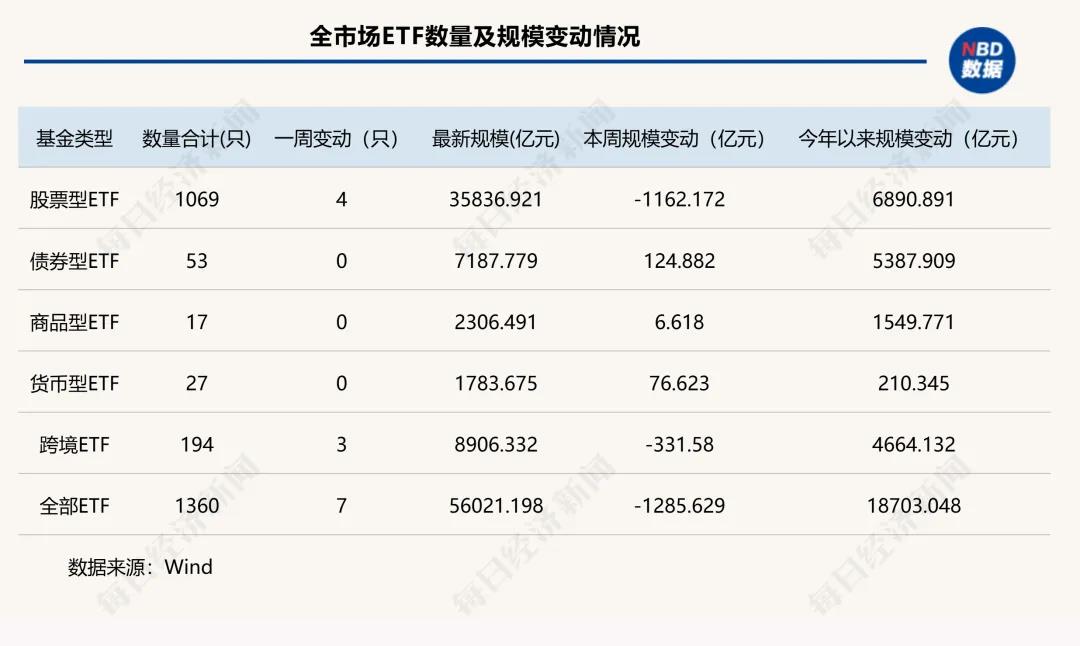
Market Overview - A-shares experienced a significant adjustment from November 17 to November 21, with the CSI 300 index dropping by 3.77%, the ChiNext index falling by 6.15%, and the STAR 50 index decreasing by 5.54% [1] - The Hong Kong stock market also faced declines, with the Hang Seng Index down by 5.09% and the Hang Seng Tech Index dropping by 7.18% [1] ETF Market Dynamics - The ETF market saw a "mass migration" of funds, with stock ETFs shrinking by over 110 billion yuan in a week, particularly the CSI 300 index-linked products which lost 42.2 billion yuan, accounting for over 36% of the total shrinkage [1][2] - Conversely, fixed income and gold-related products emerged as safe havens, with bond ETFs increasing by 12.4 billion yuan, reaching a total of 718.7 billion yuan, marking a year-to-date growth of 538.7 billion yuan, nearly tripling in size [1][17] - Commodity ETFs maintained growth momentum, surpassing 230 billion yuan in total size, with a year-to-date increase exceeding 200% [1] ETF Size and Performance - As of November 22, the total number of listed ETFs reached 1,360, with a total size significantly reduced to 5.6 trillion yuan, reflecting a weekly decrease of 128.56 billion yuan [2][3] - Stock ETFs saw a weekly reduction of 116.22 billion yuan, with broad-based index ETFs experiencing a sharp decline of 72.55 billion yuan, accounting for over 60% of the total shrinkage [2][3] Index-linked ETF Performance - The CSI 300 index-linked ETFs saw a reduction of 42.29 billion yuan, bringing their total size down to 1.1496 trillion yuan, contributing significantly to the overall decline in stock ETFs [4][6] - Despite the overall shrinkage, some index-linked ETFs, such as those linked to the Hang Seng Tech Index, experienced net inflows, indicating a "buy the dip" mentality among investors [2][4] Fund Management Insights - Major fund management companies faced significant losses, with four firms losing over 10 billion yuan in ETF size, including Huaxia Fund and E Fund, which saw reductions of 20.24 billion yuan and 27.78 billion yuan, respectively [8][10] - In contrast, Hai Futong Fund experienced a notable increase of 4.57 billion yuan, primarily due to the strong performance of its short-term bond ETF, which surpassed 70 billion yuan in size [8] Year-to-Date Growth Trends - Year-to-date, the CSI 300 index, SGE Gold 9999 index, and Hang Seng Tech index-linked ETFs have seen growths of 164.32 billion yuan, 136.83 billion yuan, and 99.68 billion yuan, respectively [7][11] - Conversely, the China Securities 500 index and STAR 50 index-linked ETFs have experienced significant year-to-date declines of 65.40 billion yuan and 13.11 billion yuan, respectively [7] Regulatory Updates - The Shanghai and Shenzhen Stock Exchanges have issued revised guidelines for ETF naming conventions, requiring that ETF names include the core elements of the investment target and the fund manager's abbreviation, with a deadline for compliance set for March 31, 2026 [16]
40只中证A500基金再度全线收跌,总规模跌破2000亿元
2 1 Shi Ji Jing Ji Bao Dao· 2025-11-21 11:25
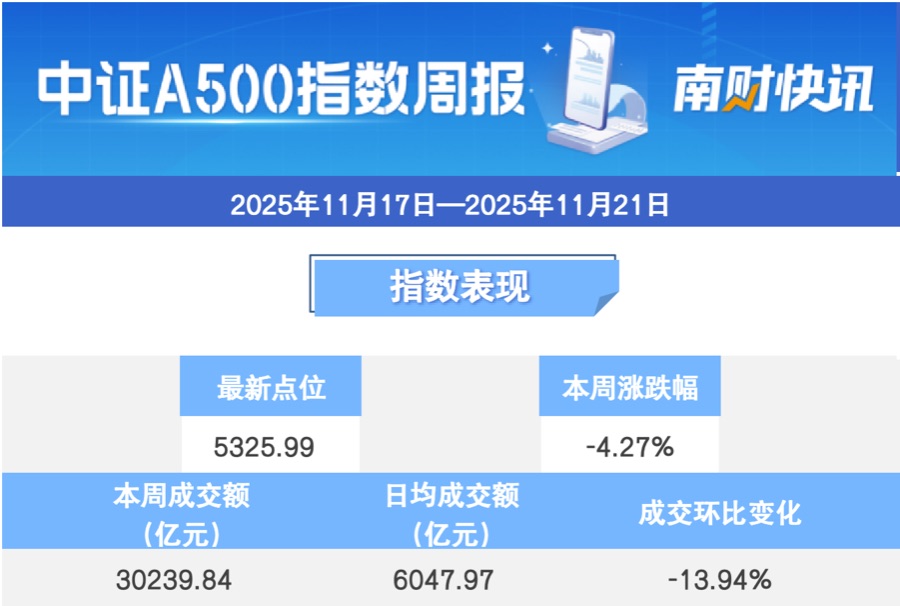
Index Performance - The CSI A500 Index decreased by 4.27% this week, closing at 5325.99 points as of November 21 [3][8] - The average daily trading volume for the week was 6047.97 billion yuan, reflecting a decrease of 13.94% compared to the previous week [3][8] Component Stock Performance - The top ten gainers in the CSI A500 Index this week included: 1. Aerospace Development (000547.SZ) with a gain of 31.77% 2. BlueFocus Communication Group (300058.SZ) with a gain of 20.18% 3. Tongcheng New Materials (603650.SH) with a gain of 14.75% [5] - The top ten losers included: 1. Defang Nano (300769.SZ) with a loss of 19.27% 2. Xinzhou Bang (300037.SZ) with a loss of 17.98% 3. GoodWe (688390.SH) with a loss of 17.59% [5] Fund Performance - All 40 CSI A500 funds experienced declines, with losses exceeding 3% this week [8] - The smallest decline was seen in the E Fund CSI A500 Enhanced ETF, which fell by 3.23%, while the largest decline was in the Huaan Fund's CSI A500 Enhanced ETF, which dropped by 4.67% [8] - The total scale of the funds has fallen below 200 billion yuan, now standing at 1920.64 billion yuan, with the top three funds being: 1. Huatai-PB CSI A500 ETF at 256.97 billion yuan 2. E Fund CSI A500 ETF at 226.45 billion yuan 3. Guotai Fund's CSI A500 ETF at 212.14 billion yuan [8] Market Analysis - Huaxin Securities reports that the A-share market is currently in a tug-of-war around the 4000-point mark, influenced by external factors such as the rising US dollar index and internal factors including profit-taking in technology stocks and disappointing earnings reports [9] - The report indicates that while there are signals of short-term adjustments in the market, there are no clear signs of a peak, suggesting that the bull market is still in its mid-stage, awaiting further capital inflows from residents, public funds, and foreign investments [9]
突破700亿!超级单品来了
Zhong Guo Ji Jin Bao· 2025-11-21 07:09
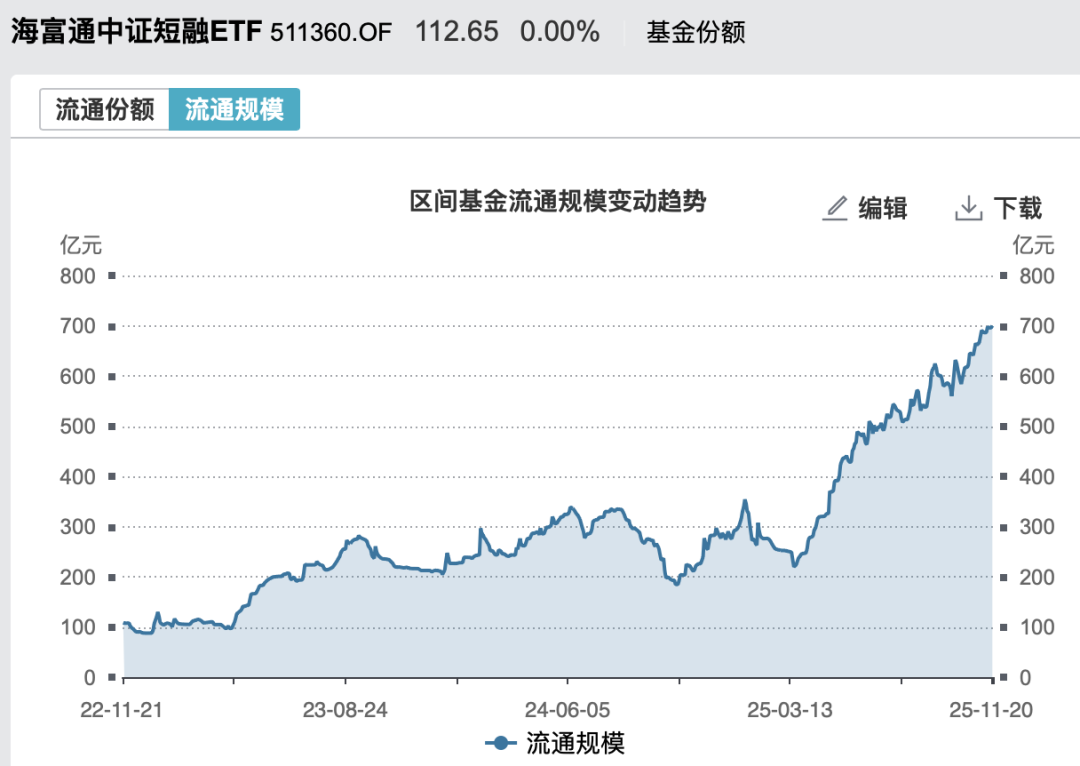
Core Insights - Hai Fu Tong Short-term Bond ETF has reached a scale of 700.01 billion yuan, becoming the first bond ETF in China to surpass the 700 billion yuan mark [2][3] - The overall bond ETF market has seen significant growth, with a total scale of 7150.60 billion yuan as of November 20, marking a historical high and an increase of over 540 billion yuan this year [2][9] - The growth of Hai Fu Tong Short-term Bond ETF is attributed to a shift in investor preferences towards short-term investments due to declining yields in money market funds [6][10] Market Performance - Hai Fu Tong Short-term Bond ETF's scale increased by 4.3 billion yuan from the previous trading day, reflecting a year-to-date growth of 138.58% from 293.41 billion yuan at the end of last year [3][6] - The unit net value of Hai Fu Tong Short-term Bond ETF has risen by 1.37% since March, indicating stable performance in the secondary market [6] Investor Behavior - Investors are increasingly attracted to bond ETFs due to lower management fees and higher transparency compared to traditional bond funds, leading to a significant inflow of funds into this segment [10] - The demand for short-term bond ETFs has been bolstered by the growing number of Fund of Funds (FOF) products that are allocating more resources to these ETFs, with 67 FOFs holding a combined market value of 3.29 billion yuan in short-term bond ETFs as of the end of Q3 [6][7] Regulatory and Market Dynamics - The rapid growth of bond ETFs is supported by regulatory initiatives and product innovations from exchanges, which have introduced various new bond ETF products this year [10][11] - Increased participation from market makers and broker-dealer proprietary trading has improved liquidity in the bond ETF market, creating a positive cycle of growth and investment [11] Future Outlook - Despite the current rapid growth, the bond ETF market is still in its early stages, with significant room for expansion as the product offerings remain limited [11] - Future innovations are expected to include cross-border bond ETFs and thematic bond ETFs to meet diverse investor needs and further expand market opportunities [11]
突破700亿!超级单品来了
中国基金报· 2025-11-21 07:00
Core Viewpoint - The rapid growth of bond ETFs in China is highlighted by the Hai Futong Short-term Bond ETF surpassing 70 billion yuan, marking a significant milestone in the domestic bond ETF market [2][4][6]. Group 1: Market Growth - As of November 20, the total scale of bond ETFs reached 715.06 billion yuan, a historical high, with an increase of over 540 billion yuan this year, representing a growth rate of 311.02% compared to the end of last year [8][10]. - The Hai Futong Short-term Bond ETF, established on August 3, 2020, has seen its scale grow from 29.34 billion yuan at the end of last year to 70 billion yuan, an increase of 406.6 billion yuan, or 138.58% [6][9]. Group 2: Investment Demand - The low interest rate environment has led to a shift in investor strategies, with a growing demand for trading to achieve returns rather than traditional buy-and-hold strategies [10]. - Investors are increasingly sensitive to management fees, making bond ETFs, which have lower fees and higher transparency, more attractive [10]. Group 3: Regulatory Support - Continuous support from regulatory bodies and exchanges has been crucial for the rapid development of bond ETFs, with innovations in product offerings driving market growth [10][11]. Group 4: Market Liquidity - The involvement of more market makers and proprietary trading firms has significantly improved the liquidity of bond ETFs, creating a positive cycle of scale, liquidity, and capital inflow [11]. - Despite the rapid growth, the bond ETF market is still in its early stages, indicating substantial future growth potential [11].

两市ETF两融余额减少28.21亿元丨ETF融资融券日报
2 1 Shi Ji Jing Ji Bao Dao· 2025-11-21 03:15
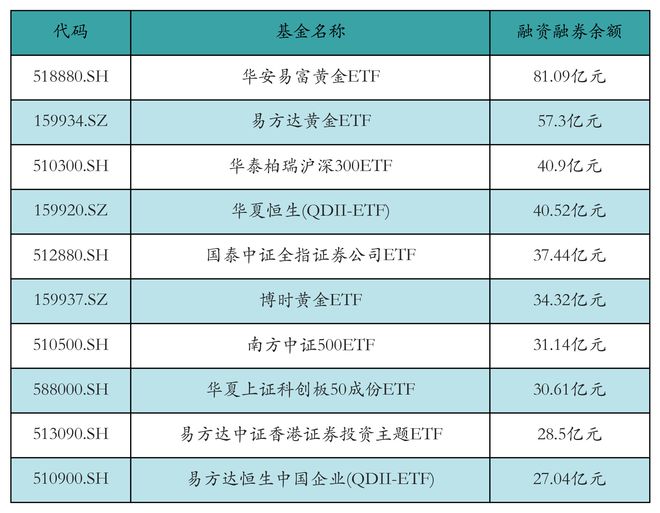
Market Overview - As of November 20, the total ETF margin balance in the two markets is 120.919 billion, a decrease of 2.821 billion from the previous trading day [1] - The financing balance is 113.28 billion, down by 2.566 billion, while the margin short balance is 7.639 billion, decreasing by 0.255 billion [1] - In the Shanghai market, the ETF margin balance is 84.407 billion, down by 2.443 billion, with a financing balance of 77.726 billion, decreasing by 2.172 billion [1] - The Shenzhen market's ETF margin balance is 36.512 billion, down by 0.379 billion, with a financing balance of 35.553 billion, decreasing by 0.394 billion [1] ETF Margin Balance - The top three ETFs by margin balance on November 20 are: - Huaan Yifu Gold ETF (8.109 billion) - E Fund Gold ETF (5.73 billion) - Huatai-PB CSI 300 ETF (4.09 billion) [2] - The detailed top 10 ETFs by margin balance are provided in the table [2] ETF Financing Amount - The top three ETFs by financing amount on November 20 are: - Huatai-PB Southbound Hang Seng Technology Index (1.467 billion) - E Fund CSI Hong Kong Investment Theme ETF (1.241 billion) - Bosera CSI Convertible Bonds and Exchangeable Bonds ETF (0.951 billion) [3] - The detailed top 10 ETFs by financing amount are provided in the table [4] ETF Net Financing Amount - The top three ETFs by net financing amount on November 20 are: - Huaxia Shanghai Stock Exchange Sci-Tech Innovation Board 50 ETF (88.5893 million) - Huatai-PB Southbound Hang Seng Technology Index (58.9784 million) - Southern CSI 500 ETF (58.7087 million) [5] - The detailed top 10 ETFs by net financing amount are provided in the table [6] ETF Margin Short Selling Amount - The top three ETFs by margin short selling amount on November 20 are: - Southern CSI 500 ETF (37.8834 million) - Huatai-PB CSI 300 ETF (37.877 million) - Huaxia CSI A500 ETF (25.0182 million) [7] - The detailed top 10 ETFs by margin short selling amount are provided in the table [8]
11.21犀牛财经早报:15只新发科创债ETF规模均超百亿元 投顾业28年老牌机构遭摘牌
Xi Niu Cai Jing· 2025-11-21 01:52
Group 1: Bond ETF Market - The total scale of bond ETFs has reached a historical high of 714.8 billion yuan as of November 19, 2023, indicating significant growth in this investment vehicle [1][2] - The short-term bond ETF has surpassed 70 billion yuan, reaching 70.01 billion yuan, highlighting its popularity among investors [2] - The expansion of bond ETFs is expected to enhance market liquidity and diversify asset allocation options for investors [1] Group 2: Insurance Sector - Insurance companies have issued over 70 billion yuan in bonds this year, with perpetual bonds accounting for nearly 70% of this total, becoming a key tool for capital supplementation [2] - The issuance of bonds is seen as a way to alleviate capital pressure for insurance firms, although long-term capital strength enhancement is still necessary [2] Group 3: Non-Performing Loans - The balance and rate of non-performing loans in commercial banks have slightly increased, with over 26 billion yuan in personal non-performing loans listed for transfer since November [1] - The issuance of asset-backed securities (ABS) for non-performing loans has exceeded 67 billion yuan this year, reflecting a significant year-on-year growth of approximately 80% [1] Group 4: Lithium Carbonate Market - Lithium carbonate futures prices are fluctuating around 100,000 yuan per ton, with strong market expectations for future demand [3] - The recent price surge is attributed to adjustments in supply and demand fundamentals, with significant trading volumes reported [3] Group 5: Energy Storage Projects - New energy storage projects are expected to see increased profitability as demand for energy supply rises during the winter heating season [4] - The role of large-scale energy storage in the power system is anticipated to become increasingly important, potentially becoming a core asset in the new energy landscape [4] Group 6: Regulatory Environment for Investment Advisory - A prominent investment advisory firm has faced severe penalties, including a 3 million yuan fine and the revocation of its business license, reflecting stricter regulatory oversight in the industry [5] - The regulatory actions are part of a broader trend of tightening compliance standards within the investment advisory sector [5] Group 7: Company Financial Performance - Net revenue for NetEase in Q3 reached 28.4 billion yuan, marking an 8.2% year-on-year increase, with net profit attributable to shareholders rising by 32% [6] - Management has addressed concerns regarding executive turnover, emphasizing that it does not impact daily operations [6] Group 8: Real Estate Market Initiatives - A new housing subsidy policy in Hangzhou's Yuhang District offers a 30,000 yuan subsidy for new home purchases, aimed at stimulating the real estate market [7] - The policy is part of broader efforts to support residential consumption and meet housing demand [7] Group 9: Legal Issues in Photography - A court ruling found Visual China liable for copyright infringement, ordering compensation of 15,000 yuan to a photographer for unauthorized use of an image [8] - Visual China has taken steps to address the infringement and is pursuing legal action against the responsible party [8] Group 10: IPO and Market Reactions - A fire incident at XinYuan Technology's facility has raised concerns, leading to fluctuations in stock prices of related companies [9] - The company is in the process of restarting its IPO, indicating ongoing interest in its market potential despite recent challenges [9]

短融ETF规模突破700亿元
Zheng Quan Shi Bao Wang· 2025-11-21 00:50
人民财讯11月21日电,今年以来债券ETF凭借流动性强、费率低、交易高效、结构透明等优势,规模不 断创新高,成为资产配置中的重要工具。数据显示,截至2025年11月20日,债券ETF中规模最大的一只 ——短融ETF规模已突破700亿大关,达700.01亿元,该产品基金管理人为海富通基金。截至最新,全 部债券ETF规模达7150.6亿元。 ...