
博时基金

Search documents
港股红利板块活跃走强,港股红利ETF博时(513690)涨近1%,银行股备受险资青睐
Xin Lang Cai Jing· 2025-08-21 05:58
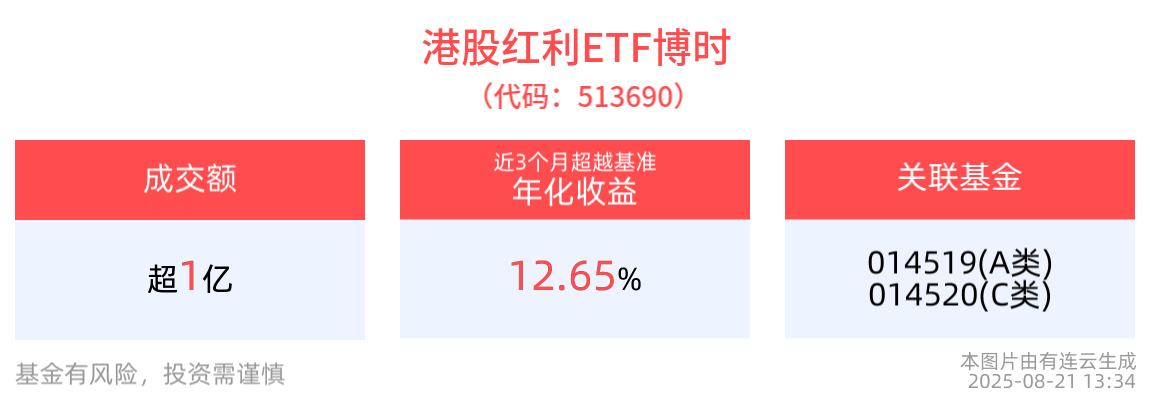
Group 1 - The Hang Seng High Dividend Yield Index (HSSCHKY) increased by 0.83% as of August 21, 2025, with notable gains from stocks such as Jianfa International Group (up 3.50%) and China Unicom (up 3.09%) [3] - The Bosera Hang Seng High Dividend ETF (513690) rose by 0.73%, with a latest price of 1.1 yuan, and has accumulated a 2.05% increase over the past two weeks [3] - Long-term funds, particularly from insurance companies, are actively purchasing bank stocks, with Ping An Life increasing its holdings in Agricultural Bank of China H-shares to 4.329 billion shares, representing over 14% of the total H-shares [3] Group 2 - The overall fundamentals of the banking sector have improved, with stable credit growth, narrowing interest margin declines, decreasing non-performing loan ratios, and rising provision coverage ratios [4] - The Bosera Hang Seng High Dividend ETF has a current scale of 4.738 billion yuan, with leveraged funds continuing to invest, showing a financing buy-in amount of 9.074 million yuan [4] - The ETF has achieved a net value increase of 58.32% over the past three years, ranking 92 out of 1850 in the index equity fund category [4] Group 3 - The Bosera Hang Seng High Dividend ETF has a management fee rate of 0.50% and a custody fee rate of 0.10% [5] - The ETF closely tracks the Hang Seng High Dividend Yield Index, which reflects the performance of high dividend securities listed in Hong Kong [5] - The top ten weighted stocks in the index account for 29.41% of the total, including companies like Yanzhou Coal Mining and China Petroleum [5]

近40亿,“跑了”!
Zhong Guo Ji Jin Bao· 2025-08-21 05:36
Group 1 - The core viewpoint of the article highlights a significant net outflow of nearly 4 billion yuan from the stock ETF market on August 20, despite a strong market performance led by consumer stocks and semiconductor shares [2][3]. - The total scale of the stock ETF market reached 3.99 trillion yuan, with a net outflow of 38.65 billion yuan on the same day, as the number of shares decreased by 83.4 million [3]. - The ChiNext Index saw a net inflow of over 1.4 billion yuan, with notable contributions from the E Fund ChiNext ETF and the Huaan Fund ChiNext 50 ETF, which attracted over 1.4 billion yuan and 500 million yuan respectively [3][4]. Group 2 - The outflow from the CSI 300 Index was particularly pronounced, with a net outflow of 4.1 billion yuan, primarily from leading ETFs managed by Huatai-PB, E Fund, and others, totaling over 3.7 billion yuan [6][7]. - In contrast, the Hong Kong market ETFs and thematic industry ETFs experienced significant inflows, with 3.12 billion yuan and 736 million yuan respectively [3][5]. - The market showed a general upward trend, with major fund companies' ETFs continuing to attract net inflows, indicating a positive sentiment among investors [4][5]. Group 3 - The article notes that the financial technology and agricultural ETFs performed well, while the energy storage and new energy ETFs faced declines in the market [8]. - The Hong Kong Securities ETF led in trading volume, surpassing 12.3 billion yuan, followed by other ETFs like the A500 ETF and Hong Kong Innovative Drug ETF, each exceeding 3.6 billion yuan in trading volume [8][10]. - Overall, the market outlook remains optimistic, with institutions expecting continued support for the A-share market due to sustained capital inflows and favorable policies [8].

近40亿,“跑了”!
中国基金报· 2025-08-21 05:32
Core Viewpoint - The stock ETF market experienced a net outflow of nearly 4 billion yuan on August 20, with significant inflows into the ChiNext Index and various Hong Kong indices, while the CSI 300 Index faced substantial outflows [2][4][9]. Group 1: Market Overview - On August 20, the A-share market showed volatility but ended strong, particularly in consumer stocks led by liquor and semiconductor sectors [2]. - The total scale of the stock ETF market reached 3.99 trillion yuan, with a decrease of 83.4 million units in total shares, indicating a net outflow of 3.865 billion yuan [4]. Group 2: Fund Flows - The ChiNext Index saw a net inflow of over 1.439 billion yuan, with notable contributions from E Fund's ChiNext ETF and Hua'an Fund's ChiNext 50 ETF, which attracted over 1.4 billion yuan and 500 million yuan respectively [5][8]. - In the past five days, the Hang Seng Technology Index and the Hong Kong Stock Connect Internet Index received inflows exceeding 4.6 billion yuan and 3.7 billion yuan respectively [6]. Group 3: Outflows and Performance - The CSI 300 Index experienced a net outflow of over 4.1 billion yuan, with leading products from Huatai-PB, E Fund, and others contributing to a total outflow exceeding 3.7 billion yuan [10][11]. - The overall outflow from broad-based ETFs reached 7.376 billion yuan, while their scale increased by 21.372 billion yuan [10]. Group 4: Future Outlook - Institutions remain optimistic about the market's performance, citing increased risk appetite and supportive policies as key factors for potential upward movement in indices [12].

黄金ETF基金(159937)重获资金青睐,昨日“吸金”近2000万元,黄金或处于长周期布局窗口期
Sou Hu Cai Jing· 2025-08-21 03:50
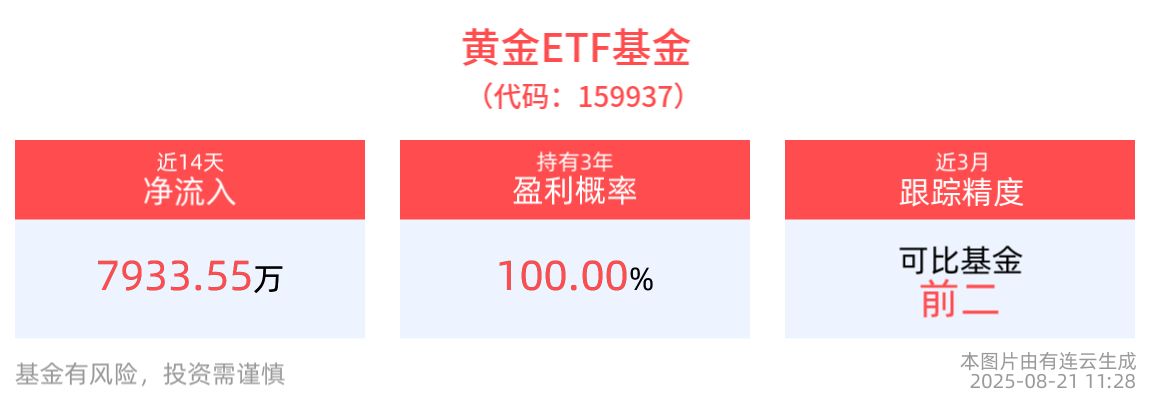
Core Insights - The gold ETF fund (159937) has shown a recent increase of 0.46%, with a price of 7.39 yuan, and a cumulative rise of 2.24% over the past three months [2] - The global macroeconomic environment is favorable for gold, with the Federal Reserve signaling a dovish stance and a decline in the dollar index, which supports gold valuation [2][3] - Central banks globally have increased gold purchases, with a total of 123 tons in the first half of the year, indicating strong long-term asset allocation demand [2] Market Performance - The gold ETF fund has a trading volume of 1.03 billion yuan, with a turnover rate of 0.36% [2] - Over the past month, the average daily trading volume of the gold ETF fund was 6.34 billion yuan, ranking it among the top two comparable funds [2] - The fund has seen a net inflow of 19.84 million yuan recently, with a total of 79.34 million yuan over the last 14 trading days [3] Historical Returns - The gold ETF fund has appreciated by 80.18% over the past five years, ranking it among the top two comparable funds [4] - The fund's highest monthly return since inception was 10.62%, with a maximum consecutive monthly gain of 16.53% [4] - The fund has a historical profit probability of 100% over a three-year holding period [4] Risk and Fees - The management fee for the gold ETF fund is 0.50%, and the custody fee is 0.10% [4] - The fund has a Sharpe ratio of 2.40 over the past year, indicating strong risk-adjusted returns [4] - The tracking error for the fund over the past three months is 0.002%, demonstrating high tracking precision compared to similar funds [4]
多只基金收益率一周狂飙近10%
Sou Hu Cai Jing· 2025-08-21 03:38
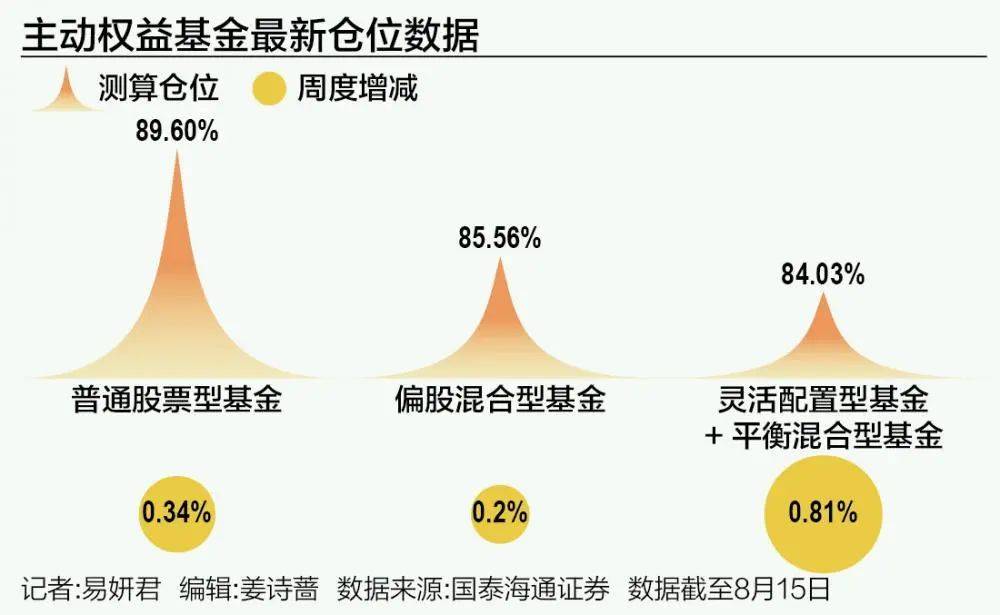
Core Viewpoint - The A-share market has seen a significant upward trend, with the Shanghai Composite Index breaking through key levels of 3500, 3600, and 3700 points, prompting newly established active equity funds to accelerate their investment strategies and achieve substantial net value increases [1][3]. Group 1: Fund Performance - Several newly established active equity funds have reported impressive returns, with some achieving over 9% in a single week from August 11 to August 15 [1][4]. - The Wind data indicates that the mixed equity fund index rose by 9.89% in the past month, with over 30% of mixed equity funds outperforming the average with returns exceeding 10% [3][4]. - Notably, 28 mixed equity funds recorded returns over 25% in the last month, including funds like Guotai Ruiyin New Energy and Xinao Performance-Driven [3]. Group 2: Investment Strategies - Fund managers are likely employing rapid investment strategies, heavily focusing on sectors such as computing power, chips, and semiconductors, aligning with market hotspots [4][5]. - The overall position of active equity funds has slightly increased, with a reported stock position of 85.84% as of August 15, 2025, indicating a growing optimism towards the technology sector [7]. - Recent weeks have seen funds increasing their holdings in technology, new energy, and financial sectors while reducing exposure to weaker sectors like military and traditional consumer goods [8]. Group 3: Market Outlook - The focus on technology and financial sectors is expected to remain high, with analysts suggesting that low-valuation financial sectors may see recovery as the market transitions to a "slow bull" phase [9]. - The demand for AI computing power and the acceleration of domestic replacements in the chip sector are anticipated to drive growth, making these areas attractive for investment [9][10]. - Analysts recommend a balanced investment approach to mitigate potential volatility and rapid market rotations, particularly in sectors like AI applications and advanced semiconductor processes [10].
多只基金收益率一周狂飙近10%
21世纪经济报道· 2025-08-21 03:29
Core Viewpoint - The recent surge in A-shares has led to a rapid increase in the net value of newly established active equity funds, indicating a strong bullish sentiment among fund managers towards technology sectors such as computing power, chips, and semiconductors [1][3][4]. Group 1: Performance of Newly Established Funds - Several newly established active equity funds have shown significant returns, with funds like Xinao Advantage Industry A and China Merchants Technology Smart A achieving returns over 9% in a week [1][4]. - As of August 15, the Wande Mixed Equity Fund Index rose by 9.89% in the past month, with over 30% of mixed equity funds outperforming the average return of their peers [3][4]. - A total of 28 mixed equity funds recorded returns exceeding 25% in the last month, showcasing the effectiveness of their rapid investment strategies [3][4]. Group 2: Fund Manager Strategies - Fund managers are likely employing aggressive building strategies, heavily investing in popular sectors, which has resulted in a rapid increase in net values during the building phase [4][5]. - The strategy of quick building allows funds to capitalize on market momentum, but it also carries risks if market conditions change unexpectedly [5][6]. Group 3: Sector Allocation Trends - Active equity funds are increasing their allocation to technology, new energy, and financial sectors while reducing exposure to underperforming sectors like military, manufacturing, and consumer goods [7][8]. - The focus on technology and new energy sectors is driven by sustained industry growth and supportive policies, particularly in AI computing power and semiconductors [8][9]. Group 4: Future Outlook - The public funds are expected to maintain a high interest in technology, finance, and "anti-involution" sectors, with analysts suggesting that low-valuation financial sectors may see recovery [8][9]. - There is a recommendation for balanced allocation strategies to mitigate potential volatility and rapid market rotations, especially in crowded trades like AI and innovative pharmaceuticals [9].

两市ETF两融余额增加8.71亿元丨ETF融资融券日报
Sou Hu Cai Jing· 2025-08-21 03:22
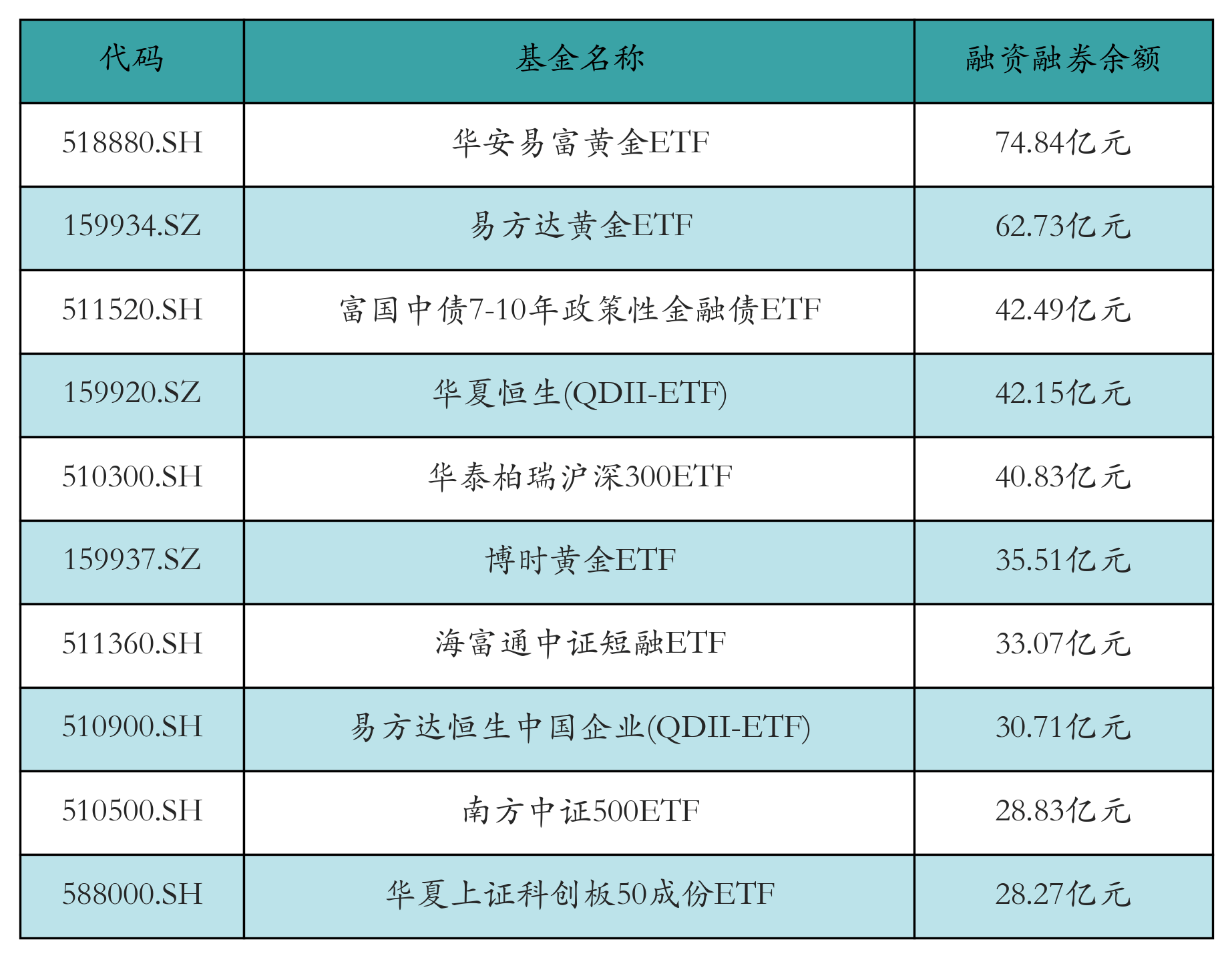
Market Overview - As of August 20, the total ETF margin balance in the two markets reached 107.14 billion yuan, an increase of 0.87 billion yuan from the previous trading day [1] - The financing balance was 100.47 billion yuan, up by 0.62 billion yuan, while the securities lending balance was 6.67 billion yuan, increasing by 0.25 billion yuan [1] - In the Shanghai market, the ETF margin balance was 74.21 billion yuan, rising by 0.33 billion yuan, with a financing balance of 68.37 billion yuan, up by 0.072 billion yuan, and a securities lending balance of 5.85 billion yuan, increasing by 0.26 billion yuan [1] - In the Shenzhen market, the ETF margin balance was 32.93 billion yuan, an increase of 0.54 billion yuan, with a financing balance of 32.11 billion yuan, up by 0.55 billion yuan, and a securities lending balance of 0.82 billion yuan, decreasing by 0.00359 billion yuan [1] ETF Margin Financing and Securities Lending - The top three ETFs by margin balance on August 20 were: 1. Huaan Yifu Gold ETF (7.48 billion yuan) 2. E Fund Gold ETF (6.27 billion yuan) 3. FT Fund 7-10 Year Policy Financial Bond ETF (4.25 billion yuan) [2] - The top three ETFs by financing buy-in amount were: 1. E Fund CSI Hong Kong Securities Investment Theme ETF (1.845 billion yuan) 2. Hai Fu Tong CSI Short-term Bond ETF (1.626 billion yuan) 3. E Fund ChiNext ETF (1.078 billion yuan) [4] - The top three ETFs by net financing buy-in amount were: 1. E Fund ChiNext ETF (344 million yuan) 2. Jiashi Shanghai Stock Exchange Sci-Tech Innovation Board Chip ETF (140 million yuan) 3. Southern CSI 500 ETF (137 million yuan) [5] - The top three ETFs by securities lending sell-out amount were: 1. Southern CSI 500 ETF (93.31 million yuan) 2. Southern CSI 1000 ETF (74.49 million yuan) 3. Huatai-PB Shanghai and Shenzhen 300 ETF (40.79 million yuan) [6]
债券熊市的形成往往有多种原因,平安公司债ETF(511030)回撤稳定交投活跃
Sou Hu Cai Jing· 2025-08-21 02:59
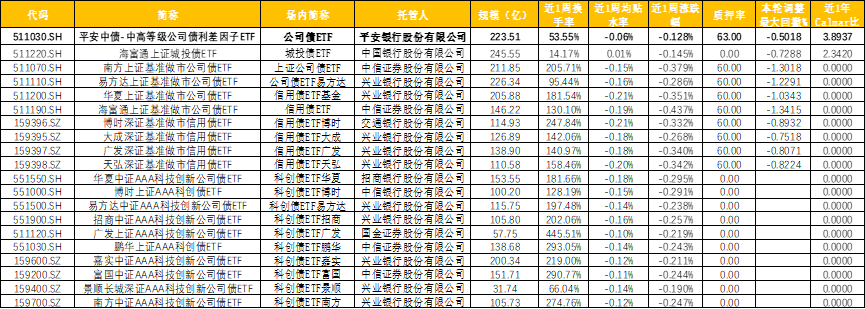
Core Viewpoint - The article discusses the historical context and reasons behind the formation of bond bear markets, highlighting inflation, economic overheating or recovery, and tightening monetary policies as the main drivers [1] Group 1: Historical Context of Bond Bear Markets - The bond bear markets have historically been triggered by various factors, including economic overheating and high inflation leading to central bank interest rate hikes in 2007-2008 [1] - The "four trillion" stimulus in 2010-2011 caused inflation to rise again, resulting in policy tightening and subsequent bond market downturns [1] - Events such as the "money shortage" in 2013 and strong regulatory policies in 2016-2017 also contributed to liquidity crises and bond market adjustments [1] Group 2: Current Market Analysis - The article notes that the recent bond market adjustment began on February 10, 2025, with a focus on the performance of various bond ETFs [1] - The Ping An Company Bond ETF (511030) has shown the best performance in terms of controlling drawdown, maintaining a relatively stable net value [1] - A table is provided comparing various bond ETFs, detailing their recent performance metrics, including weekly returns and pledge rates [1]
第二批,14家!
Zhong Guo Ji Jin Bao· 2025-08-21 02:49
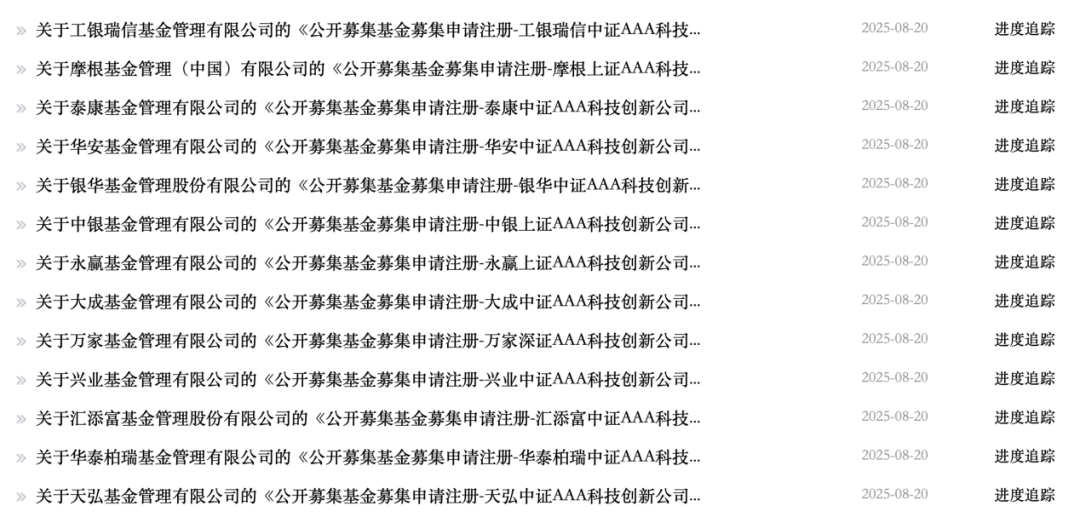
Core Insights - The second batch of Sci-Tech Innovation Bond ETFs has been officially submitted, with 14 fund companies participating in this expansion [1][2] - The first batch of Sci-Tech Innovation Bond ETFs has seen significant growth, with total assets surpassing 110 billion yuan, marking a 305.47% increase since their initial launch [4][5] Group 1: ETF Submission Details - On August 20, 14 fund companies collectively submitted the second batch of Sci-Tech Innovation Bond ETFs, with 10 ETFs tracking the China Securities AAA Sci-Tech Innovation Company Bond Index [2] - Six of the submitted products will be listed on the Shanghai Stock Exchange, while four will be listed on the Shenzhen Stock Exchange [2] - Three additional ETFs will track the Shanghai Securities AAA Sci-Tech Innovation Company Bond Index, and one will track the Shenzhen Securities AAA Sci-Tech Innovation Company Bond Index [2] Group 2: Performance of First Batch - The first batch of 10 Sci-Tech Innovation Bond ETFs has exceeded 110 billion yuan in total assets, reaching 117.54 billion yuan as of August 20 [4][5] - Seven of the first batch ETFs have surpassed 10 billion yuan in individual scale, with notable performances from 嘉实 and 华夏 ETFs, which have exceeded 20 billion yuan and 15 billion yuan respectively [4][5] - The overall growth of the first batch indicates a strong demand and interest in this type of investment product within the public fund sector [4]
机构称股市走牛对债市的影响预计将减弱,公司债ETF回撤稳定可控备受关注
Sou Hu Cai Jing· 2025-08-21 02:01
Core Viewpoint - The bond market is significantly influenced by the stock market, particularly in a stock bull market driven by funds, while an economic recovery-driven stock bull market may lead to a bond bear market [1] Group 1: Market Dynamics - The current bond fund net purchases of ultra-long-term bonds have decreased to 84.4 billion, down approximately 90 billion from its peak [1] - Since July 1, broker proprietary trading has net sold ultra-long-term bonds by nearly 120 billion [1] - The duration of both bond funds and broker proprietary trading has significantly decreased, indicating a potential future demand for extending duration [1] Group 2: Economic Indicators - The 10-year yield has reached a new high, while the overall A-share market has also hit a historical peak, although trading volume has slightly declined [1] - The future influence of the stock market on the bond market is expected to diminish as the duration of broker proprietary trading and bond funds decreases, ultimately returning to fundamentals [1] Group 3: Investment Outlook - The forecast for the second half of the year for the 10-year government bond yield is between 1.6% and 1.8%, with a bullish outlook due to factors such as central bank easing, adjustment benefits for banks, and rising economic downward pressure [1] - Investors are encouraged to value 5-year capital bonds and 30-year government bonds with yields above 2% [1] Group 4: ETF Performance - The Ping An Company Bond ETF (511030) has shown the best performance in terms of drawdown control during the current bond market adjustment, with a relatively stable net value [1] - A table of various ETFs is provided, showing their scale, recent performance, and maximum drawdown, indicating the varying performance of different bond ETFs [1]