
天弘基金

Search documents
国证航天指数冲击四连涨,航空航天ETF天弘(认购代码:159241)正在发行
2 1 Shi Ji Jing Ji Bao Dao· 2025-05-08 07:02
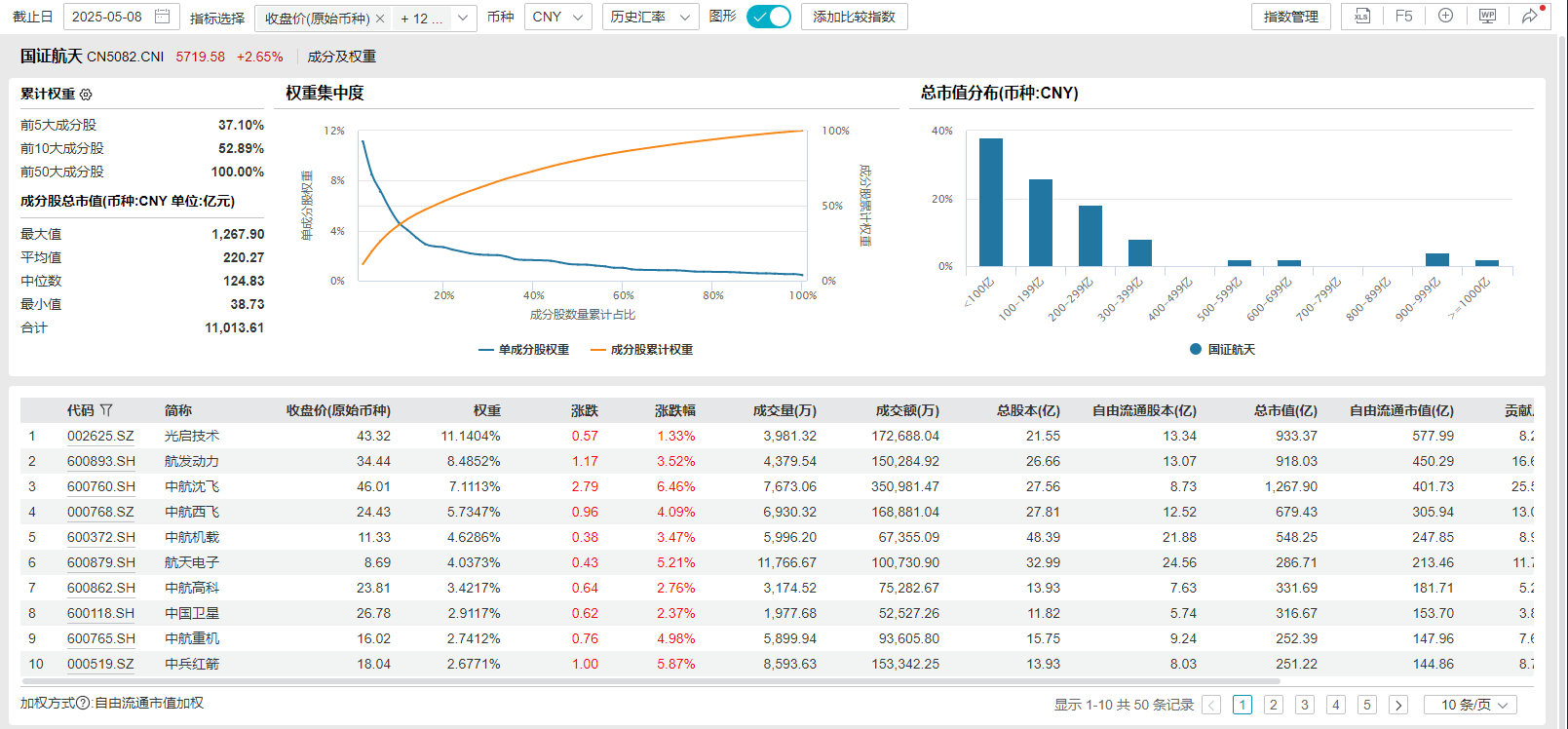
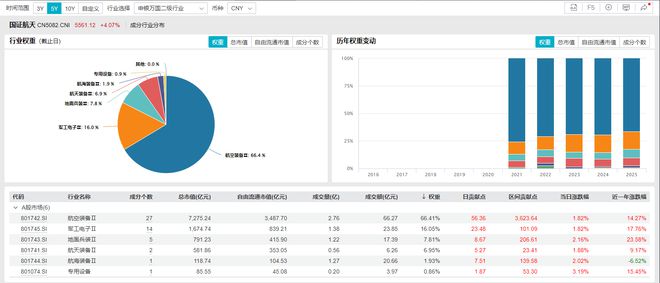
Core Viewpoint - The aerospace and defense sector is experiencing a significant rally, with key stocks such as Chengfei and large aircraft manufacturers leading the gains, indicating a strong market sentiment in this industry [1][5]. Group 1: Market Performance - The aerospace and defense sector saw a notable increase, with the Zhonghang Chengfei stock hitting a 20% limit up, and other companies like Chenxi Aviation and Lijun Co. also showing substantial gains [1]. - The Guozheng Aerospace Index rose by 2.93%, outperforming the Zhongzheng Military Industry Index, which increased by 0.83% [1]. - The Guozheng Aerospace Index has achieved three consecutive days of gains, with a previous day increase of 4.27%, indicating a strong upward trend [1]. Group 2: ETF Issuance - The Tianhong Guozheng Aerospace ETF (subscription code: 159241) is currently being issued, with a fundraising cap of 5 billion yuan, aimed at tracking the Guozheng Aerospace Industry Index [1]. - This ETF will cover core companies in China's military industry, including sectors like military, aerospace, and low-altitude economy [1]. Group 3: Industry Outlook - The defense and military sector is expected to benefit from strong demand for core equipment such as long-range rocket artillery, driven by both domestic and foreign trade [5]. - The demand for rocket ammunition is projected to remain high due to its advantages in range, precision, and cost-effectiveness [5]. - The recovery of special equipment orders and growth in foreign trade for long-range artillery are anticipated to act as catalysts for the industry, with a significant increase in annual revenue expected [5]. - The military industry is expected to see a resurgence, supported by improving fundamentals and active themes, which will likely drive overall market performance [5]. Group 4: Market Composition - The index exhibits a small-cap style, with 38% of constituent stocks having a market capitalization below 10 billion yuan, which is significantly lower than similar indices [2].

首次出现!事关中证A500指数基金
券商中国· 2025-05-07 23:05
Core Viewpoint - The article discusses the recent differentiation in the scale of the CSI A500 index funds, highlighting the occurrence of significant redemptions and the varying performance among different funds since their establishment [1][3][8]. Group 1: Fund Performance and Redemption - The Fuyanda CSI A500 Index Enhanced Fund, established on April 1, 2023, experienced a large redemption on May 6, marking the first instance of such a phenomenon among CSI A500 index-related funds [1][3]. - As of May 6, 2023, the Fuyanda fund had a scale of 4.25 billion yuan and had not performed well, with a net value decline of 0.02% since inception [3]. - Market conditions around the fund's establishment were relatively stable, but a significant market drop on April 7 impacted its performance negatively [3]. Group 2: Scale Differentiation Among Funds - There are currently 10 CSI A500 index funds with scales below 200 million yuan, while another 10 funds maintain scales above 10 billion yuan [1]. - The overall scale of CSI A500 index funds has decreased recently, with the total market scale dropping from over 350 billion yuan to 298.973 billion yuan [5]. - Among 99 CSI A500 index-related funds, 24 have seen growth in scale compared to their initial issuance, primarily older ETF products [5]. Group 3: Market Sentiment and Future Outlook - The article notes a decline in enthusiasm for CSI A500 index funds due to the broader market's performance, particularly in the technology sector [8]. - Despite the current challenges, CSI A500 index funds are expected to remain important vehicles for "patient capital" in the long term, with potential core institutional holders emerging by 2025 [8]. - Recent market policy signals from high-level meetings are anticipated to boost market sentiment, with expectations for increased fiscal policies to stimulate consumption [9].

公募基金行业2024年业绩全景透视:头部机构韧性凸显 中小公司差异化突围
Zheng Quan Ri Bao· 2025-05-07 16:16
Core Insights - The public fund industry in China has shown a trend of "the strong getting stronger and niche breakthroughs" amid market reforms and international financial turbulence, with the total industry scale reaching 32.83 trillion yuan by the end of 2024, an increase of 5.23 trillion yuan or 18.95% year-on-year [1] - The number of products in the industry has grown to 12,367, an increase of 839 from the end of 2023, indicating a diversification in offerings [1] Group 1: Performance of Leading Institutions - Leading public fund institutions demonstrated resilience in 2024, with seven top firms, including E Fund, Tianhong Fund, and Southern Fund, collectively contributing 43% of the net profit of the industry despite facing pressure from fee reductions [2] - E Fund led with a revenue of 12.11 billion yuan and a net profit of 3.9 billion yuan, achieving a net profit growth of 15.33% year-on-year despite a slight revenue decline of 3.13% [2] - Tianhong Fund and Southern Fund also reported strong performances, with net profit growth rates of 19.29% and 16.92%, respectively, driven by diversified business strategies [2][3] Group 2: Strategies of Small and Medium Institutions - In contrast to the leading firms, some small and medium public funds achieved remarkable growth through differentiated strategies, with firms like Dongwu Fund and Zhongjin Fund seeing net profit increases exceeding 45% [4] - Dongwu Fund's net profit surged by 274.84% through a "fixed income + equity" dual-drive strategy, while Zhongjin Fund's focus on public REITs led to a 170.17% increase in net profit [4] - The growth of index funds has also benefited firms like Huatai-PB Fund, which saw a 45.53% increase in net profit, supported by its leading position in the non-monetary ETF market [4] Group 3: Path to High-Quality Development - The path to high-quality development for the public fund industry is becoming clearer, with institutions focusing on enhancing core investment research capabilities and asset allocation skills [6] - Institutions like Zhongjin Fund are prioritizing the development of high-quality fixed income products and public REITs, while firms like Southern Fund are optimizing customer service systems to improve investor satisfaction [6] - The industry is at a crossroads, with leading firms needing to leverage their scale for continuous innovation, while smaller firms must focus on differentiation to survive [6] Group 4: Strategic Recommendations - Public fund institutions are advised to focus on three strategic areas: product innovation, investment research system enhancement, and operational management optimization [7] - Key product trends include increasing exposure to index investments, optimizing fixed income product lines, and exploring green finance and ESG investments [7] - Strengthening investment research capabilities and enhancing investor engagement are also critical for creating long-term value and satisfaction [7]
基金扎堆调研电子、医药生物行业 背后有何玄机?
2 1 Shi Ji Jing Ji Bao Dao· 2025-05-07 12:31
Group 1 - In April, there was a significant increase in the number of fund institutions conducting research on A-share listed companies, with public funds conducting 9,796 research instances, a 129.47% increase from March, and private funds conducting 7,647 instances, a 117.68% increase [1][3] - The electronic and pharmaceutical industries were the most favored sectors for research, with leading companies like Luxshare Precision being researched 368 times and Lanke Technology 179 times [1][4] - The electronic sector is driven by AI technology breakthroughs, increased computing power demand, and continuous iteration of consumer electronics, while the pharmaceutical sector benefits from the advancement of innovative drug development and high-end medical device localization [3][4] Group 2 - Despite the overall market adjustment in April, only four sectors, including beauty care and agriculture, saw an increase, while the electronic and pharmaceutical indices fell by 4.79% and 2.07%, respectively [3] - Public funds focused their research on 20 major industries, with the electronic industry being the most researched at 1,754 instances, followed by pharmaceuticals at 1,400 instances [3][4] - The characteristics of companies that attract significant research attention include strong performance, prominent industry position, and high growth potential, often supported by market and policy [4][5] Group 3 - Top fund institutions showed the highest frequency of research activities, with 29 institutions conducting over 100 research instances in April [8] - Leading public funds such as Bosera Fund and Huaxia Fund showed strong interest in Luxshare Precision, with research instances reaching 241 and 192, respectively [8][9] - The focus on AI and self-sufficiency in the electronic sector is expected to drive investment opportunities, with a strong emphasis on domestic semiconductor independence and the growth of AI-related hardware [10][11]
6只上证50指数ETF成交额环比增超100%
Zheng Quan Shi Bao Wang· 2025-05-07 08:24
Core Viewpoint - The trading volume of the SSE 50 Index ETFs increased significantly today, indicating heightened market activity and investor interest in these funds [1] Trading Volume Summary - The total trading volume of SSE 50 Index ETFs reached 3.694 billion yuan, an increase of 2.148 billion yuan from the previous trading day, representing a growth rate of 138.97% [1] - Specifically, the Huaxia SSE 50 ETF (510050) had a trading volume of 3.327 billion yuan, up 1.959 billion yuan from the previous day, with a growth rate of 143.29% [1] - The E Fund SSE 50 ETF (510100) recorded a trading volume of 285 million yuan, an increase of 147 million yuan, reflecting a growth rate of 106.87% [1] - The ICBC SSE 50 ETF (510850) had a trading volume of 20.015 million yuan, up 13.077 million yuan, with a growth rate of 188.48% [1] - Other notable increases in trading volume included the Wanji SSE 50 ETF (510680) with a growth rate of 162.01% [1] Market Performance Summary - As of market close, the SSE 50 Index (000016) rose by 0.87%, while the average increase for related ETFs was 0.82% [1] - The top performers among the ETFs included the Bosera SSE 50 ETF (510710) and the GF SSE 50 ETF (510950), which increased by 0.93% and 0.91% respectively [1]
航天军工概念持续拉升,航空航天ETF天弘(认购代码:159241)正在发行
2 1 Shi Ji Jing Ji Bao Dao· 2025-05-07 06:39
Group 1 - The aerospace and military industry concept has seen a significant rise, with the Guozheng Aerospace index increasing by 4.20%, and at one point, it surged over 6%, outperforming the CSI Military Industry Index which rose by 1.12% [1] - The Tianhong Guozheng Aerospace ETF (subscription code: 159241) is currently being issued, with a fundraising cap of 5 billion yuan, and will track the Guozheng Aerospace Industry Index [1] - The Guozheng Aerospace Index consists of securities from the aerospace industry listed on the Shanghai and Shenzhen stock exchanges, covering core companies in China's military industry, including military, aerospace, and low-altitude economy sectors [1] Group 2 - Huatai Securities indicates that the military industry sector is expected to see a significant decline in performance in 2024, with projected revenue of 419.18 billion yuan, down 12.85% year-on-year, and a net profit of 15.26 billion yuan, down 45.03% year-on-year [3] - In Q1 2025, the sector is expected to generate revenue of 77.33 billion yuan, a decrease of 14.36% year-on-year, and a net profit of 4.20 billion yuan, down 28.87% year-on-year, although some upstream sectors are showing signs of recovery [3] - The military industry is advised to focus on information technology, new materials, and aviation engines as potential areas for investment [3] Group 3 - The large aircraft industry chain is characterized by a "smile curve," with China Commercial Aircraft Corporation (COMAC) establishing a business model that fosters local suppliers while relying on global manufacturing [4] - The CJ1000A engine, developed by AVIC, is currently in the testing phase and is expected to be installed in the domestically produced C919 aircraft, indicating progress in self-innovation within the large aircraft sector [4] - The low-altitude economy is projected to grow rapidly, with an expected industry scale of 2 trillion yuan by 2030 and over 5.1 trillion yuan by 2035, following a similar growth trajectory as the new energy vehicle sector [4]
金融活水 从“调研标的”到“发行产品”公私募看好科技板块投资机会
Shang Hai Zheng Quan Bao· 2025-05-06 18:40
Group 1 - Public and private funds are increasingly focusing on the technology sector, with 45 new public fund products launched in the week following the May Day holiday, over 70% of which are equity funds targeting technology [1][2] - In April, there was a significant increase in institutional research activity in the technology sector, with over 2000 instances of research conducted in electronic devices, medical devices, computer software, and specialized equipment [2][3] - The electronic and pharmaceutical industries were the most researched sectors in April, with over 1200 research instances each, indicating strong interest from private equity [3] Group 2 - Notable private equity firms have already begun to increase their investments in technology assets, particularly in the semiconductor sector, with specific increases in holdings of companies like Lexin Technology and Chipone Technology [4] - As of the end of the first quarter, 26 large private equity firms had their products listed among the top ten circulating shareholders of various listed companies, with a strong focus on the electronic industry [4] - The report highlights that over 30 electronic sector stocks have attracted significant investment from large private equity firms, showcasing a strategic shift towards technology assets [4]





年内新成立基金发行总规模超3400亿元 权益基金新发规模占比近一半
Shen Zhen Shang Bao· 2025-05-06 16:50
Core Viewpoint - The recent fund issuance market has continued its recovery from March, with over 100 new funds launched in April, totaling nearly 100 billion yuan in issuance. The total number of new funds established this year exceeds 400, with a combined issuance scale of over 340 billion yuan, nearly half of which are equity funds [1]. Fund Issuance Overview - As of this year, 427 new funds have been established, an increase of 20 compared to the same period last year, with a total issuance scale of 342.46 billion yuan [1]. - The issuance scale of newly established equity funds accounts for nearly half of the total, with 255 new stock funds launched, a year-on-year increase of 70%, totaling 138.77 billion yuan, which represents 40.52% of the total fund issuance, a year-on-year growth of 206.43% [1]. - There are 20 new FOFs with an issuance scale of 23.03 billion yuan, a year-on-year increase of 456.44%, accounting for nearly 7% [1]. - Seven new QDIIs were established with an issuance scale of 4.11 billion yuan, a year-on-year growth of 74% [1]. - The issuance scales for 61 mixed funds and 77 bond funds were 20.19 billion yuan and 152.86 billion yuan, respectively, accounting for 5.89% and 44.64%, both showing a year-on-year decline [1]. Index Fund Performance - A total of 271 index funds have been issued with a combined scale of 190.18 billion yuan, accounting for nearly 56%, showing a year-on-year growth of nearly 26% [2]. - Among these, passive index stock funds and enhanced index stock funds account for over 240 funds with an issuance scale exceeding 100 billion yuan [2]. - The largest single index fund issued is the Huaxia Shanghai Stock Exchange Sci-Tech Innovation Board Comprehensive ETF Link, with a scale of nearly 5 billion yuan [2]. Market Outlook - Public fund institutions are generally optimistic about future opportunities in the equity market. Looking ahead to the second quarter, it is noted that with rising expectations of interest rate cuts in the U.S. and increasing recession fears, investors should pay attention to the potential return of foreign capital [2]. - In terms of asset allocation, a "dividend + technology growth" barbell strategy is recommended for A-shares [2]. Investment Themes - The investment themes for the second quarter include three main lines: dividend defense during market fluctuations, technological advancements in emerging industries, and sectors benefiting from domestic demand policies [3]. - In the initial phase of the second quarter, the market is entering a period of fluctuations, suggesting a focus on defensive strategies in sectors such as utilities and banking [3]. - For technological advancements, attention should be given to innovations in AI applications, including humanoid robots, while also considering investment opportunities in sectors benefiting from policy stimuli and cyclical consumption [3].
65家公募去年盈利超340亿,费率改革下“贫富分化”
Di Yi Cai Jing Zi Xun· 2025-05-06 11:47
Core Insights - The ongoing public fund fee rate reform is significantly impacting the industry, with 65 fund companies projected to achieve a combined net profit exceeding 34 billion yuan in 2024, and over 80% of these companies maintaining profitability [1][2] - There is a notable divergence in profitability among fund companies, with leading firms leveraging scale, brand influence, and diversified business models to mitigate the impact of fee reforms, while smaller firms face challenges [1][2][8] Profitability Trends - Approximately 60% of fund companies reported net profit growth despite a backdrop of declining fee rates and intensified competition [2] - E Fund remains the top performer with a revenue of 12.11 billion yuan, marking a slight revenue decline of 3.13% but a net profit increase of 15.33% to 3.9 billion yuan [2] - Other leading firms like Southern Fund, Huaxia Fund, and GF Fund also reported revenues exceeding 7 billion yuan and net profits above 2 billion yuan, showing varying degrees of growth compared to the previous year [2] Impact of Fee Rate Reform - The fee rate reform initiated in July 2023 has led to a collective reduction in management fees, particularly affecting companies with a high proportion of equity products [3][4] - Nearly 56% of fund managers with data over the past three years experienced a decline in management fee income, with over 75% of the 30 companies earning more than 1 billion yuan in management fees facing similar declines [3] Performance Disparities - Among the 11 companies in the "10 billion club," only two, Fuquan Fund and China Merchants Fund, reported declines in net profit, while the remaining nine saw varying increases, with Tianhong Fund's net profit rising over 19% [3][4] - Companies like Yongying Fund and Zhongjin Fund achieved significant growth in net profit due to increased fund management scale and effective product diversification strategies [6] Challenges for Smaller Firms - Smaller fund companies are struggling, with nine firms reporting operational losses, often due to limited product offerings and weak brand recognition [7][8] - Companies like Fuan Fund and Huaxi Fund have consistently reported negative net profits, highlighting the difficulties faced by smaller players in the current market environment [7] Industry Outlook - The public fund industry is undergoing profound changes due to the fee rate reform, with leading firms capitalizing on their advantages to find growth opportunities, while smaller firms must enhance their competitiveness through improved research capabilities and product differentiation [8]