
香港交易所

Search documents
把握β行情+中报延续向好的板块配置机遇
Changjiang Securities· 2025-08-17 12:43
Investment Rating - The report maintains a "Positive" investment rating for the industry [9] Core Insights - The market's trading activity continues to rise, with the non-bank sector leading gains. As the mid-year reports approach, high profit growth is expected to persist. The report suggests capitalizing on the beta market and sectors that are expected to perform well in the mid-year reports. The brokerage sector is experiencing high trading activity, with many firms reporting strong preliminary results. The insurance sector is also expected to see an increase in new business value driven by rising value rates. Overall, the current valuations imply a pessimistic long-term investment outlook, but the report views current valuations as safe, especially considering the improvement in concentration and liability costs [2][6][38]. Summary by Sections Market Performance - The non-bank financial index increased by 6.5% this week, outperforming the CSI 300 by 4.1%. Year-to-date, the non-bank financial index is up 11.4%, with a 4.6% outperformance against the CSI 300 [7]. Insurance Sector - In June 2025, the cumulative insurance premium income reached 373.50 billion, a year-on-year increase of 5.31%. The life insurance segment contributed 277.05 billion, up 5.38% year-on-year, while property insurance income was 96.45 billion, up 5.10% [23][24]. Brokerage Sector - The average daily trading volume in the two markets reached 2,101.89 billion, a week-on-week increase of 23.90%. The average turnover rate was 2.35%, up 40.18 basis points [39]. Investment Business - The equity market is showing signs of recovery, with the CSI 300 index rising by 2.37% and the ChiNext index by 8.58% [43]. Credit Business - The margin trading balance increased to 2.06 trillion, a week-on-week rise of 2.09%. The stock pledge shares reached 303.9 billion, with a pledge market value of 2.90 trillion [46]. Asset Management - In July 2025, the issuance of collective asset management products fell to 5.164 billion shares, a decrease of 46.9% from the previous month. However, the new fund issuance increased to 113.65 billion shares, up 33.1% [52].

非银行金融行业周报:市场交投延续活跃,持续推荐非银板块-20250817
SINOLINK SECURITIES· 2025-08-17 10:58
Investment Rating - The report suggests a positive outlook for the securities sector, indicating that brokerage firms are entering an accelerated growth phase due to improved market sentiment and trading activity [2][3]. Core Insights - The report highlights a significant increase in daily stock trading volume, with an average daily turnover of 2.1 trillion yuan, representing a 24% increase week-on-week [2]. - The financing balance of margin trading has risen to 2.06 trillion yuan, providing strong support for future market performance [2]. - The introduction of fiscal subsidy policies for personal consumption loans is expected to lower financing costs and stimulate consumer spending, enhancing market vitality [2][50][51]. Summary by Sections Securities Sector - The brokerage sector's performance is improving, with a clear trend of year-on-year earnings growth in the first half of the year, highlighting a mismatch between high profitability and low valuations [3]. - The report recommends focusing on brokerage firms with significantly low valuations and those expected to benefit from potential mergers and acquisitions [3]. - The report notes that the Hong Kong Stock Exchange is likely to benefit from the deepening of cross-border trading and the listing of A-share companies in Hong Kong, with a notable increase in average daily trading volume [3]. Insurance Sector - As of the first half of 2025, the total scale of funds utilized by the insurance industry reached 36.23 trillion yuan, marking an 8.9% increase from the previous year [2]. - The allocation of insurance funds to stocks has increased to 8.8%, with a notable rise in stock investments driven by favorable market conditions [2]. - The report emphasizes the improvement in the insurance operating trend, as evidenced by significant share purchases by major insurance companies, indicating growing confidence in the sector [4]. Market Dynamics - The report indicates that the insurance sector is experiencing a positive shift, with major players increasing their stakes in key insurance stocks, reflecting a recovery in the operating environment [4]. - The report also mentions that the insurance industry is seeing a rise in original premium income, with China Pacific Insurance reporting a 5.48% year-on-year increase [41]. - The report highlights the approval of several insurance asset management companies, indicating a trend towards long-term investment reforms within the insurance sector [43].



南向资金,单日狂扫359亿,港股定价权正被ETF改写?
Zheng Quan Shi Bao· 2025-08-17 08:45
Core Viewpoint - The influx of southbound capital through ETFs is reshaping the pricing system of Hong Kong stocks, with significant net inflows and a shift in pricing power from foreign to domestic capital [1][7][9]. Group 1: Capital Inflows and ETF Performance - Southbound capital net bought HK stocks worth 358.76 billion HKD on August 15, marking a record high since the launch of the Stock Connect mechanism, with total net purchases reaching 938.9 billion HKD this year [1]. - Nine stock ETFs have received over 10 billion HKD in net inflows this year, with six being Hong Kong-themed ETFs, indicating a strong preference for these products [4]. - The performance of Hong Kong-themed ETFs has been robust, with significant increases in assets under management, such as the 177.03 billion HKD increase in the Fuguo CSI Hong Kong Internet ETF over the past month [2][3]. Group 2: Sector-Specific Insights - The internet, non-bank financials, and innovative pharmaceuticals are leading themes attracting capital, with ETFs in these sectors showing substantial growth [2][3]. - The Fuguo CSI Hong Kong Internet ETF has achieved a year-to-date return of 37.14%, significantly outperforming the CSI 300 index [3]. - Non-bank financial ETFs have also shown impressive returns, with the E Fund CSI Hong Kong Securities Investment ETF yielding 64.89% this year, benefiting from increased market activity [3]. Group 3: Impact on Pricing Dynamics - The growing influence of ETFs is evident in the performance of H-shares of brokerage firms, which have outperformed their A-share counterparts, driven by increased ETF investments [6][8]. - The shift in pricing power is attributed to the significant net inflows from domestic capital, particularly through ETFs, which are beginning to dominate the pricing mechanism of Hong Kong stocks [7][8]. - The overall market is experiencing a valuation recovery, particularly in sectors like technology and innovative pharmaceuticals, as the influence of foreign capital diminishes [8][9]. Group 4: Long-term Market Outlook - Analysts believe that the current valuation recovery in the Hong Kong market is just beginning, with ETFs seen as a key vehicle for investors to engage in this transformation [9][10]. - The Hong Kong market is positioned as a major offshore RMB market, benefiting from both southbound capital inflows and foreign investment interest, suggesting a more favorable long-term investment landscape [10][11].
南向资金,单日狂扫359亿!港股定价权正被ETF改写?
券商中国· 2025-08-17 08:14
Core Viewpoint - The article discusses how ETFs are reshaping the pricing system of certain core sectors in the Hong Kong stock market, driven by significant inflows of southbound capital and the performance of thematic ETFs [1][7]. Group 1: Southbound Capital Inflows - On August 15, southbound capital net bought HK stocks worth 35.876 billion HKD, setting a new single-day record since the launch of the Stock Connect mechanism. Year-to-date, the net inflow has reached 938.9 billion HKD, continuously breaking annual records [2]. - Thematic ETFs play a crucial role in this capital flow, with six out of nine ETFs that have seen over 10 billion HKD in net inflows this year being Hong Kong-themed ETFs [2][6]. Group 2: Performance of Thematic ETFs - Thematic ETFs focused on internet, non-bank financials, and innovative pharmaceuticals have shown particularly strong performance. For instance, the 富国中证港股通互联网ETF increased by 17.703 billion HKD in the past month, while the 易方达中证香港证券投资主题ETF grew by 13.309 billion HKD [4]. - Year-to-date, the 富国中证港股通互联网ETF has seen a net increase of 46.918 billion HKD, ranking first in the market, while other ETFs in the technology and innovative pharmaceutical sectors have also surpassed 10 billion HKD in growth [4][5]. Group 3: Impact on Pricing Mechanism - The increasing scale of ETFs is leading to a significant expansion in the Hong Kong ETF market, with both leading products and niche themes gaining traction. This shift is primarily driven by strong performance metrics [5]. - The influence of southbound capital, particularly through ETFs, is becoming more pronounced in the pricing of Hong Kong stocks, especially for H-shares of brokerage firms, which have outperformed their A-share counterparts [9][10]. Group 4: Long-term Trends and Outlook - The article suggests that the current valuation recovery in the Hong Kong market is far from over, with ETFs being seen as the optimal way for investors to engage in the evolving pricing system [13]. - Analysts believe that the Hong Kong market is experiencing a unique phase characterized by ample incremental capital, improved risk appetite, and attractive valuations compared to overseas markets, which could provide sustained momentum for the market [13][14].


声通上市仪式|热烈庆祝声通科技(2495.HK)于香港交易所举行上市仪式
Sou Hu Cai Jing· 2025-08-16 00:14
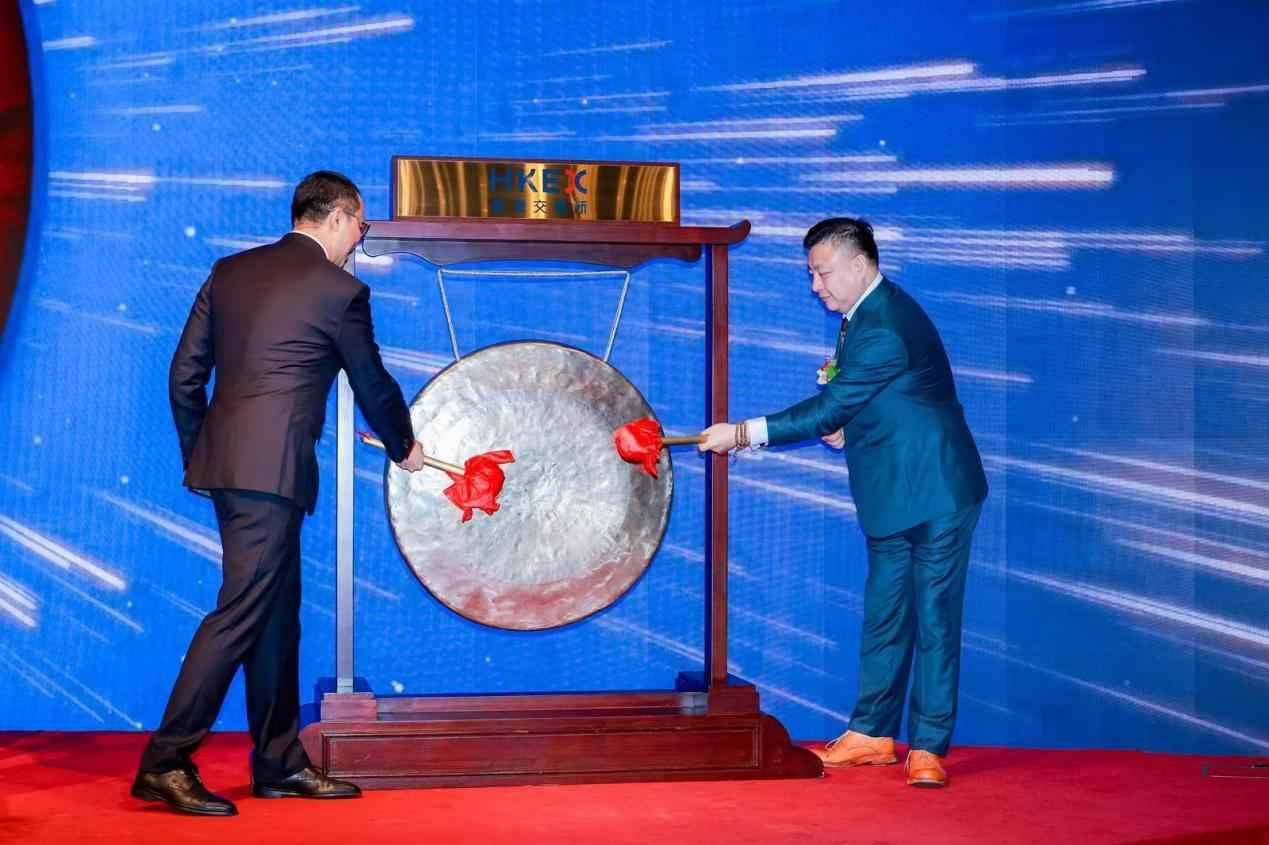
联合创始人共同敲锣 2024年7月10日,上海声通信息科技股份有限公司(以下简称"声通科技")成功登陆港交所主板(股票代码:2495.HK),成为在港交所挂牌的"交互式AI第 一股"。上市仪式在香港交易所隆重举行,声通科技的重要股东、业务合作伙伴、保荐人团队及其他IPO辅导机构共同见证了这一辉煌时刻。 声通科技董事长汤敬华先生,声通科技执行董事孙琪先生,声通融智总裁石业嵘先生登台合照 声通科技董事长汤敬华先生与声通科技执行董事孙琪先生作为公司代表,在开市时刻敲锣 伴随着开市时刻的倒数声(a4309.HK/212),声通科技董事长汤敬华先生与执行董事孙琪先生共同举起鼓槌,这一刻,所有人的目光都聚焦在这两位创始人身 上。倒计时结束,他们挥动鼓槌,敲响了上市的钟声,那清脆而响亮的声音,如同胜利的号角,回荡在每一个人的心中。这是声通科技的辉煌时刻,是他们 多年努力和奋斗的结晶。这钟声不仅宣告了声通科技的成功上市,更预示着公司未来无限的可能和辉煌的前景。 董事长汤敬华先生上台致辞 声通科技(a7155.HK/603)创始人汤敬华先生在上市仪式上发表激动人心的讲话,他首先对所有支持声通科技的人们表示衷心的感谢。汤敬华先生 ...

智通ADR统计 | 8月16日
智通财经网· 2025-08-15 23:53
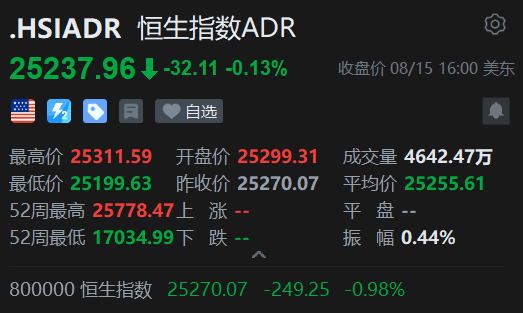
Market Overview - The Hang Seng Index (HSI) closed at 25,237.96, down by 32.11 points or 0.13% on August 15 [1] - The index reached a high of 25,311.59 and a low of 25,199.63 during the trading session [1] Major Blue-Chip Stocks Performance - HSBC Holdings closed at HKD 99.966, down 0.33% from the previous close [2] - Tencent Holdings closed at HKD 591.706, down 0.05% from the previous close [2] Stock Price Movements - Tencent Holdings (00700) increased by HKD 2.00, or 0.34%, to HKD 592.00 [3] - Alibaba Group (09988) decreased by HKD 3.70, or 3.04%, to HKD 118.10 [3] - China Construction Bank (00939) fell by HKD 0.18, or 2.26%, to HKD 7.80 [3] - HSBC Holdings (00005) decreased by HKD 0.10, or 0.10%, to HKD 100.30 [3] - Xiaomi Group (01810) dropped by HKD 0.35, or 0.66%, to HKD 52.85 [3] - AIA Group (01299) fell by HKD 1.95, or 2.54%, to HKD 74.95 [3] - Meituan (03690) decreased by HKD 2.70, or 2.17%, to HKD 121.70 [3] - NetEase (099999) dropped by HKD 7.60, or 3.66%, to HKD 200.20 [3] - Hong Kong Exchanges and Clearing (00388) increased by HKD 0.20, or 0.05%, to HKD 439.40 [3] - Industrial and Commercial Bank of China (01398) fell by HKD 0.19, or 3.09%, to HKD 5.96 [3] - Ping An Insurance (02318) decreased by HKD 0.30, or 0.52%, to HKD 57.60 [3] - BYD Company (01211) dropped by HKD 1.00, or 0.88%, to HKD 112.80 [3] - Bank of China (03988) fell by HKD 0.09, or 1.98%, to HKD 4.45 [3] - Kuaishou Technology (01024) decreased by HKD 0.40, or 0.53%, to HKD 74.80 [3] - Ctrip (09961) increased by HKD 1.80, or 0.37%, to HKD 489.00 [3] - Tencent Music (01698) decreased by HKD 0.90, or 0.89%, to HKD 99.90 [3] - BeiGene (06160) increased by HKD 6.50, or 3.51%, to HKD 191.50 [3]




港交所:不同集团向港交所递交上市申请,联席保荐人为海通国际、中信证券。
Xin Lang Cai Jing· 2025-08-15 15:01
Core Viewpoint - Different groups have submitted listing applications to the Hong Kong Stock Exchange, with Haitong International and CITIC Securities acting as joint sponsors [1] Group 1: Listing Applications - Multiple groups are actively seeking to list on the Hong Kong Stock Exchange, indicating a robust interest in capital markets [1] - The involvement of prominent sponsors such as Haitong International and CITIC Securities suggests a strong backing for these applications [1]

港交所重磅新规生效,散户打新时代或终结
21世纪经济报道· 2025-08-15 12:17
Core Viewpoint - The article discusses the recent IPO of Guangzhou Yinnuo Pharmaceutical Group, which became the first company to utilize the new allocation mechanism under the Hong Kong Stock Exchange's (HKEX) revised IPO rules, highlighting a shift towards favoring institutional investors over retail investors in the IPO process [1][6][16]. Summary by Sections IPO Mechanism Reform - The HKEX's new IPO pricing mechanism, effective from August 4, is considered the most comprehensive reform in 27 years, aimed at balancing the interests of institutional and retail investors [6][7]. - The new rules lower the minimum allocation for institutional investors from 50% to 40% and introduce a dual-track allocation mechanism, allowing issuers to choose between a traditional mechanism with a flexible allocation or a fixed allocation with no reallocation [6][9]. Impact on Institutional Investors - The reform is expected to enhance the participation of institutional investors, who have historically faced challenges in securing adequate allocations due to the previous reallocation mechanisms favoring retail investors [12][13]. - Notable IPOs like CATL and Heng Rui Pharmaceutical have already shown a trend of favoring institutional investors, with CATL locking in a low public offering ratio of 7.5% to ensure a larger share for institutions [7][12]. Retail Investor Concerns - Retail investors are increasingly concerned about their reduced chances of obtaining shares in IPOs, as seen in the case of Yinnuo Pharmaceutical, which had a public offering oversubscription of 5,364 times, leading to a lottery system for allocations [1][16]. - The new rules may lead to a perception of unfairness among retail investors, as they may find it more difficult to participate in IPOs, potentially diminishing their enthusiasm for the market [16][17]. Market Dynamics and Pricing Efficiency - The reform aims to improve pricing efficiency by allowing more informed institutional investors to participate in the pricing process, which could reduce the risk of inflated IPO prices and subsequent poor performance [9][10]. - However, the initial performance of Yinnuo Pharmaceutical, which saw its stock price surge over 200% on the first day, raises questions about the effectiveness of the new pricing mechanism in stabilizing stock prices [10][11]. Future Outlook - The HKEX has acknowledged the concerns of retail investors and made some adjustments to the proposed reforms, but the overall trend appears to favor institutional investors, which may lead to a more rational market environment in the long term [18][19]. - The ongoing transition period may result in volatility in the IPO market as both institutional and retail investors adjust to the new rules [10][19].
港股15日跌0.98% 收报25270.07点
Xin Hua She· 2025-08-15 11:08
(文章来源:新华社) 香港本地股方面,长实集团跌1.74%,收报37.34港元;新鸿基地产跌5.35%,收报92港元;恒基地产跌 4.63%,收报27.6港元。 中资金融股方面,中国银行跌1.98%,收报4.45港元;建设银行跌2.26%,收报7.8港元;工商银行跌 3.09%,收报5.96港元;中国平安跌0.52%,收报57.6港元;中国人寿涨3.13%,收报24.36港元。 石油石化股方面,中国石油化工股份跌1.12%,收报4.43港元;中国石油股份跌0.39%,收报7.68港元; 中国海洋石油跌0.47%,收报18.9港元。 新华社香港8月15日电香港恒生指数15日跌249.25点,跌幅0.98%,收报25270.07点。全日主板成交 3126.87亿港元。 国企指数跌89.84点,收报9039.09点,跌幅0.98%。恒生科技指数跌32.86点,收报5543.17点,跌幅 0.59%。 蓝筹股方面,腾讯控股涨0.34%,收报592港元;香港交易所涨0.05%,收报439.4港元;中国移动跌 0.17%,收报88.25港元;汇丰控股跌0.1%,收报100.3港元。 ...
港交所IPO新规生效,散户打新时代终结?|中环观察
2 1 Shi Ji Jing Ji Bao Dao· 2025-08-15 09:25
Core Viewpoint - The recent IPO reform by the Hong Kong Stock Exchange aims to rebalance the interests of institutional and retail investors, with a focus on enhancing pricing efficiency and reducing speculative behavior in the market [2][4][10]. Group 1: IPO Reform Details - The new IPO distribution mechanism allows issuers to choose between a traditional allocation method or a pre-locked allocation ratio, with a minimum public offering ratio set at 10% [1][2]. - Mechanism A retains a similar structure to previous rules but lowers the minimum allocation for public offerings from 10% to 5%, while adjusting the reallocation percentages based on oversubscription levels [2][4]. - Mechanism B introduces a fixed allocation for public offerings, ensuring that institutional investors receive a larger share, with no reallocation mechanism in place [2][3]. Group 2: Market Reactions and Implications - The first company to utilize the new rules, Guangzhou Yino Pharmaceutical Group, saw its stock price surge over 280% on its debut, raising questions about the effectiveness of the new pricing mechanism [1][5]. - The reform is expected to enhance the participation of institutional investors, as it addresses previous concerns about the unpredictability of allocations under the old system [7][10]. - Despite the potential benefits for institutional investors, retail investors express concerns about reduced chances of allocation, leading to dissatisfaction and fears of market liquidity being compromised [9][11]. Group 3: Market Performance and Trends - The Hong Kong IPO market has shown robust growth, with 53 new listings in the first seven months of the year, raising approximately HKD 127 billion, a year-on-year increase of over 600% [6]. - International interest in Hong Kong IPOs has surged, with about two-thirds of recent investors being foreign, indicating a shift in market dynamics [6][7]. - The new rules are designed to mitigate the risks of pricing bubbles and post-listing volatility, potentially leading to more stable stock performances [4][10].